2026 Nuffield NZ Farming Scholarship. Apply by 17 August 2025. Read More...

Apply for 2026 Nuffield NZ Farming Scholarship by 17 August 2025. More details...

The new Value Chain Innovation Programme

Innovating for our fast-changing
value chains.

A recent addition to The New Zealand Rural Leadership Trust’s cache of programmes is the VIP. The Value Chain Innovation Programme delivers a truly immersive experience, created to meet a growing need for strategically capable leaders in our food and fibre systems.

It is for those who are passionate about developing their leadership style, growing their networks, and contributing to their business and community.

Driving innovation in food and fibre.

The Value Chain Innovation Programme delivers two weeks of immersive learning, focused on strategic value chain analysis and design. The programme is a facilitated journey along ten or more established, disruptive, and novel value chains, delivering a sector and pan-sector view.

It connects participants to New Zealand’s key value chain influencers and accelerates their ability to adapt to a fast-changing environment.

  • It expands their entrepreneurial capability.

  • It builds advanced competencies.

  • And it develops a new mindset on food and fibre innovation in domestic and international markets.

Applications are open until 28 November 2021.

The programme spans two weeks for the industries immersion. Participants then return home and have three weeks to produce a value chain innovation report.
The course structure is as follows:

Phase 1: Virtual masterclass.

As a build-up to the journey, participants attend a virtual masterclass via zoom, of 1 -2 hours. This covers the current landscape within New Zealand’s value chains and what is likely to emerge in the future.

Participants then submit a short PowerPoint overview on their own value chain, or one they wish to explore.

Phase 2: Value chain immersion 16-28 January 2022.

Participants assemble in Auckland on the 16th. They then undertake two weeks of facilitated field trips through the North and South Islands.

The tour culminates in Christchurch on the 28th.

Phase 3: Extramural value chain innovation report.

Work on an individual value chain innovation report. This may be submitted as a PowerPoint.

Ready to take the next step?

For any queries contact Lisa Rogers +64 21 139 6881 or email lisarogers@ruralleaders.co.nz

Nuffield five for five.

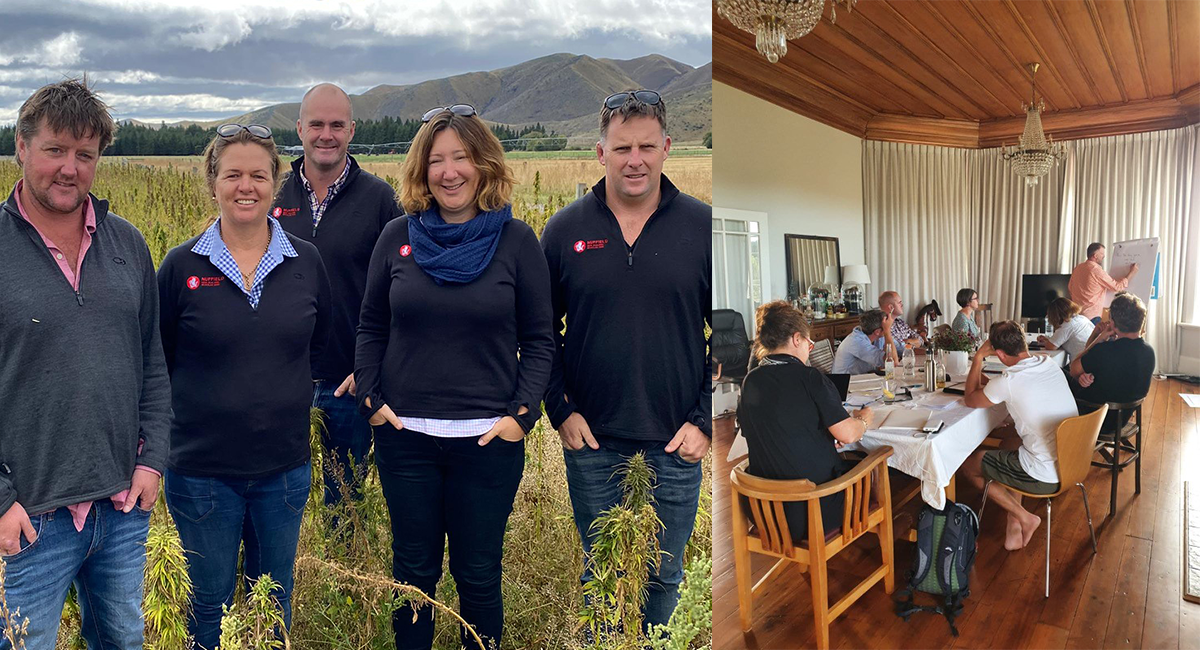
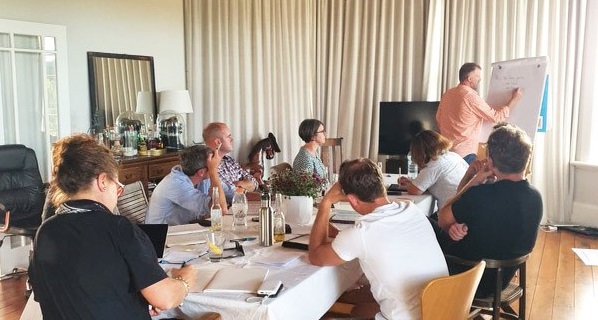
Image:Nuffield Scholars in study [supplied]

With five days to go until applications for the 2022 Nuffield Scholarship close, we thought we’d give five reasons as to why receiving a scholarship now, may represent a quantum gain in benefits over previous years. So calling all potential Nuffield Scholars, here’s some more food for thought.

  1. There have never been so many of New Zealand’s best business leaders and innovators in the country at the same time.
    There are a few silver linings to the global pandemic. One might be the number of influential people affiliated to innovation and the food and fibre sector, who have returned home. While their move may not be permanent, now is the time to meet and connect with them. Nuffield can help with that.

  2. With a programme that has adapted to the global pandemic, scholars currently have more flexibility, closer to home.
    We face many challenges right now. So, being away from family, farm and work could be tough on some. As a result of the global pandemic restrictions, the programme has adapted successfully by adding a deeper local layer, along with virtual and global input.

  3. No matter what happens with regard to global travel, Scholarship recipients still receive $40,000 to conduct research.
    Whether the borders open up or not in the short to medium term, the Scholarship funds are not adjusted. In a situation where the borders do open, your global travel component will continue, safely.

  4. Nuffield Scholars’ experiences and enhanced skillsets are increasingly in demand.
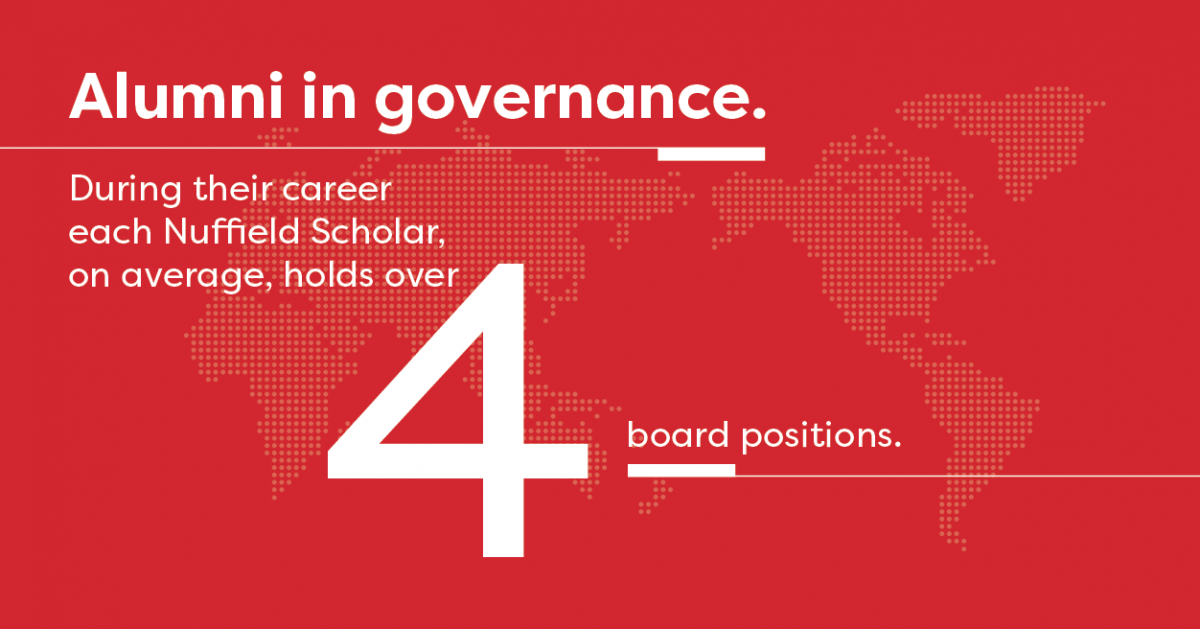
    As the rate of change in food and fibre and beyond increases exponentially, Nuffield Scholars’ exposure to research, innovation and leadership development, means their knowledge is always needed in governance and industry.

  5. Scholars will be part of the new Value Chain Innovation Programme (VIP).
    Two weeks’ immersion into more than ten of New Zealand’s established, novel and disruptive value chains.

    The Value Chain Innovation Programme introduces Scholars to value chains beyond their own. It represents an opportunity to meet, draw ideas from and connect with people across many industries.

    Thinking of launching a product, or adding another to a range? This is just one way the VIP can help.

Want to be part of this? Apply now.

Back to the August 2021 issue of The Rural Leader.

Tracy Brown on Country Life on Radio New Zealand

Tracy Brown

On 4 June, our Tracy Brown, one of our 2020 Nuffiled Scholars, was a guest in the Radio New Zealand’s Country Life programme.

In this interview, Tracy talks about her recent experience as a Nuffield Scholar on the National Focus Programme.

Interested in the process of change in Dairy Farming, Tracy is focused on getting dairy farmers onboard with doing the right thing – through improved actions for the environment and better connections with community. A big part of this is improving dairy farming’s social licence to operate, or right to farm – that is, helping the public understand why dairy farmers do what they do.


Listen to the full interview here.

Tracy Brown is 2020 Nuffiled New Zealand Farming Scholar, Chair of the DairyNZ Dairy Environment Leaders Programme, Chair of the Ballance Farm Environment Awards Alumni, and is a farmer representative on the Dairy Environment Leadership Group.

2021 Food and Fibre Sector Insights Report

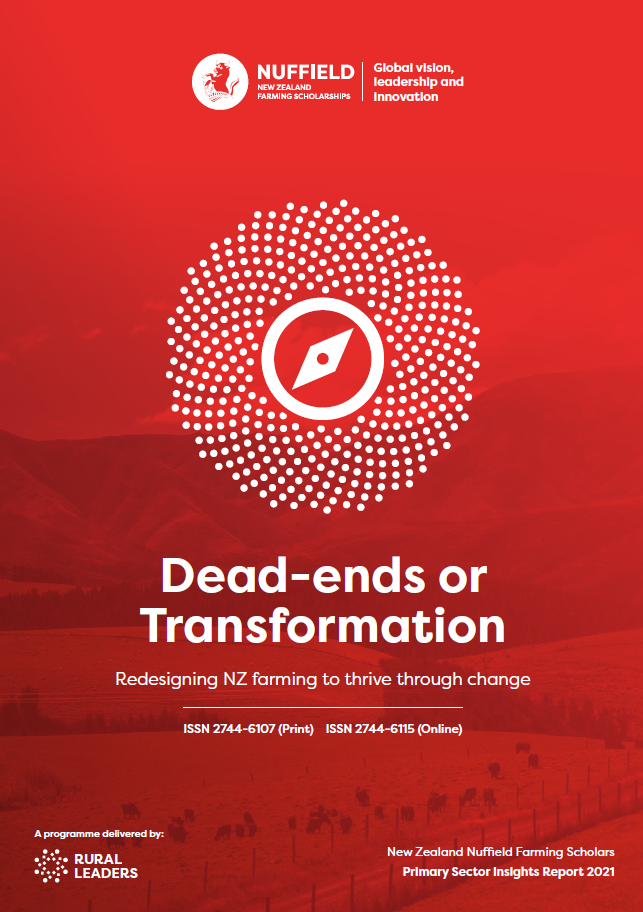
2021 Nuffiled New Zealand Farming Scholars Insights Report

Dead-ends or transformation - Redesigning NZ farming to thrive through change.

The environmental, social and economic contexts in which we farm and grow are changing rapidly. The pressure many primary sector New Zealanders feel is the collision of ‘business as usual’ with accelerating forces of change. Under these new conditions, protecting long-held structures and models becomes untenable. To thrive in a challenging new world, we must choose to self-disrupt and transform fundamental parts of our sector: however difficult that process may be.

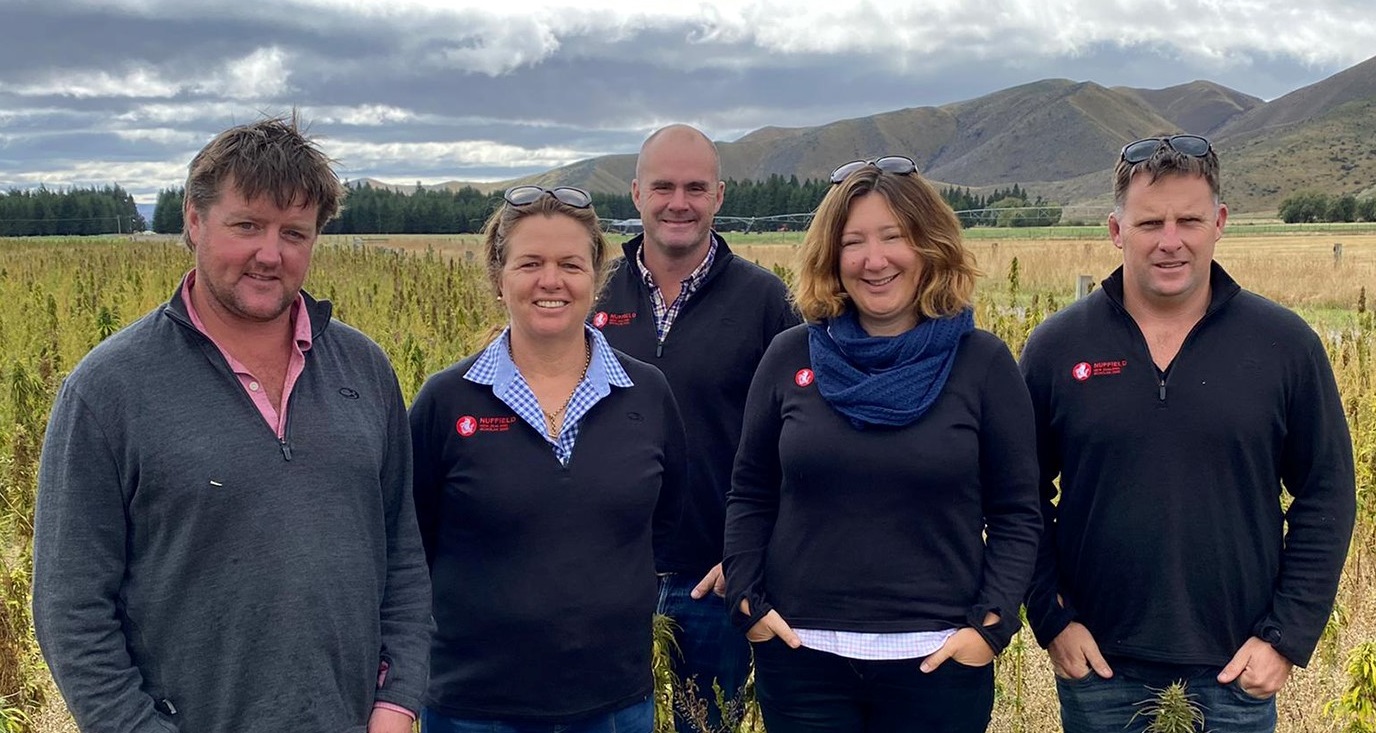
This is the core insight of the Nuffield 2021 ‘World Tour of New Zealand’ – a redesigned Nuffield Farming Scholarship experience that saw 10 emerging primary sector leaders travel the length of the country to gather insights into the challenges and opportunities ahead.

This report is a culmination of those insights, as viewed through five pillars fundamental to a thriving NZ food and fibre sector:

Incentives – How the end of the ’farming for capital gain’ model is forcing us to redefine value, and restructure our organisations to capture it.

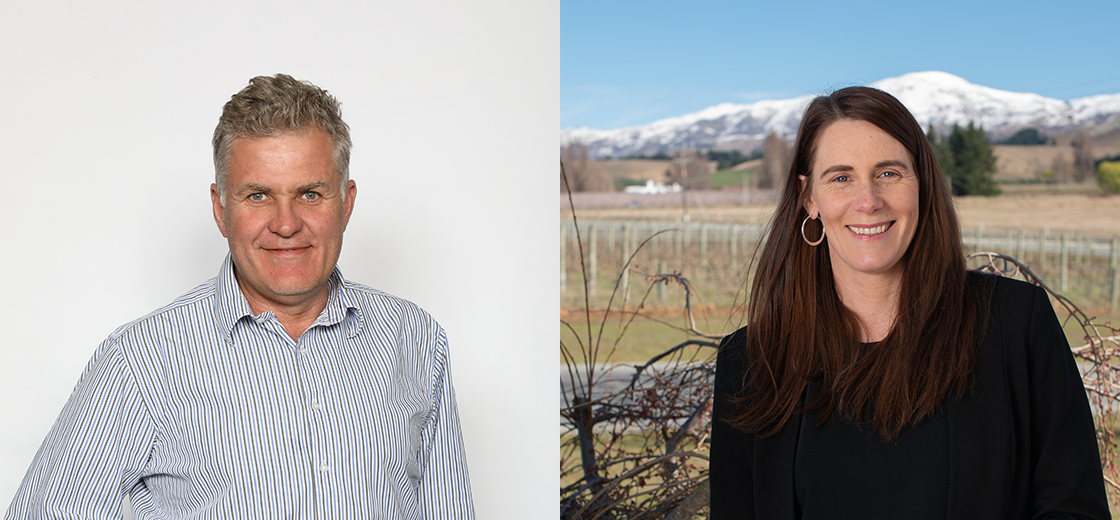
David Eade and Ben Anderson

Innovation – Mapping innovation potential across the sector to find what separates the status quo from the game-changers.

Shannon Harnett and Ben Mclauchlan

People – How leading organisations put people at the centre of what they do.

Lynsey Stratford and Edward Pinckney

Silos – How systemic silos across leadership, research and data management are restricting the potential of the sector.

Philip Weir and John Foley

Leadership – Why transformation must be led by values and purpose-driven leaders.

Tracy Brown and Daniel Eb

This report builds on the 2020 Nuffield Scholars Insights and represents the start of our individual study in chosen areas. We encourage those who wish to support our research to get in touch – our contact details are included throughout.

Finally, our sincere thanks to the many hundreds of primary sector New Zealanders who shared time and insights with us along the way. While there is a need for great transformation ahead, your pride, passion and talent are a reminder that we can and will get there.

Ngā mihi nui

The 2020 and 2021 New Zealand Nuffield Farming Scholars

Download your copy here


Sophie Stanley on agri-tech, AI and art classes

Sophie has been busy. Passionate about creating meaningful changes to the way we eat, and how that connects back to our planet – each step on her career path seems well placed to help make that happen.

Sophie’s Nuffield research paper, ‘Harnessing Social Media in Agriculture’, was followed by joining agri-tech start-up Figured, moving to Nebraska to launch it in the United States.

She returned to New Zealand in 2019 to join Autogrow and later WayBeyond, providers of artificial intelligence solutions for controlled environment farms. Sophie joined the board of the Dairy Women’s Network not long after.

Now standing at the intersection of agriculture, digital technology and innovation, we asked how the Nuffield Scholarship has helped expand her thinking.

“Before I received a Nuffield Scholarship, I was focused on the pastoral farming sector. But then [on the Global Focus Programme] you’re thrown into everything from row cropping to aquaculture. You get to see so many things. I met lots of interesting people in the agri-tech space too, from all over the world. I was exposed to a lot of diverse thinking, ways to solve problems, and to technology being used in different contexts. So yeah, the interest in agri-tech was sparked.”

On the potential of technology.

“When I came back to New Zealand, I noticed huge gaps, particularly with growers. Some hadn’t innovated for twenty years. And so, they were struggling to satisfactorily address challenges like consumer dietary preferences, traceability demands and sustainability evidence. New technology is the perfect solution to help address those things.

We can have a thriving, efficient agriculture sector using technology and at the same time achieve the sustainability and climate change goals we might have as a nation.

This is where social media is beneficial. There are always trends or signals that appear, often first on social media – signposts of the future. We need to start proactively picking up on those signals. One of my personal beliefs is to have a bias towards action – just make decisions and course correct later.

In the tech industry we have this concept of MVP, or Minimum Viable Product. It’s the quickest time you can get something of value out to a customer, so that they can try it, then you improve it.

We’re seeing the same thing across agriculture. People are asking, why don’t we just try something and see how it goes? And it doesn’t have to be solving climate change. Because that’s a big problem. It’s a very complex problem.”

We should instead ask, what is the smallest piece that we can carve off and solve? We need lots of players solving little pieces of that bigger problem. And eventually, we’ll all solve it.

On thinking differently.

“I started going to art classes recently – learning to look at problems in new and creative ways. It’s interesting to see people’s differing approaches to the same task – like painting a chair in the middle of a room. We all saw it from different perspectives – but from those perspectives you build a new picture. I like thinking about how we can apply that to the way we look at things in our industry – even just allowing me to approach my job differently.

I attended BOMA, E Tipu recently. One common thread running through many of the speakers was this idea of reframing challenges so that we tackle them from the opportunity rather than the problem.

What really stood out for me was hearing from Geoff Ross. He studied agriculture, but then he focused on creating great consumer brands like 42 Below Vodka.

He presented an aspirational and inspirational idea, something that could galvanise the primary sector. This idea was, could New Zealand be the world’s first climate positive farm? That’s an idea worth exploring. With that idea we know consumers would want to buy from us.

This ties back to my Nuffield social media research as well. Three years ago, you probably wouldn’t have heard about regenerative agriculture for example. Now, because of stories shared on social media, consumers have started to ask – is this produce from a regenerative agriculture ecosystem? Supermarkets like Whole Foods in the United States recognise this too, awarding New Zealand lamb company Atkins Ranch with their Supplier Award for Regenerative Agriculture Commitment.”

I’m interested in how we might catch the tailwind of these signals and ideas to get ahead of the curve too. I think telling better work stories can make that happen.

On Artificial Intelligence in agriculture.

“AI, the version without the gloves, is well and truly here – even still, people get scared of those two letters, AI. That it’s going to take everyone’s jobs and make us all irrelevant. For a different viewpoint, I went to TEDx Auckland recently.

There, Will Hewitt spoke about how medicine is using AI. He quoted Eric Topol who said, “AI won’t replace doctors, but doctors that use it will replace doctors that don’t”. And I think in turn you can replace ‘doctors’ with growers or farmers.

…AI won't replace doctors, but doctors that use it will replace doctors that don't. And I think in turn you can replace that word with growers or farmers.

At WayBeyond we find AI is most useful to growers for modelling six weeks ahead, to predict how many tomatoes they’ll have to meet their commitments to supermarkets. They’ve got thousands of data points, from temperature, from plant growth measurements, from colour change, so many things. That’s a lot of complex data for a human to process. They might get to 80% accuracy in a model.

Now, if you can use AI, you can continuously look at these data points and at the correlations between them. You go from 80% to 90% pretty quickly. The impact of that could be millions of dollars to the bottom line for large scale growers – and hugely reduced food waste.

There’s plenty happening within an operation that a computer just isn’t going to see though. You still need to walk the greenhouse. There are tweaks the grower needs to backfill with their experience.”

So, AI is a support tool for people to make better decisions, not the end of all our jobs.

On the next big leaps in agri-tech.

“They’ll be around solutions that are focused on sustainability. Because it’s something that consumers are driving and it’s important in terms of our shared planetary goals.

We’re going to see more around planetary accounting and carbon, things like that. Consumers want produce they can feel good about, produce that contributes to their morals and ethics.

We’re starting to think about how we can be more sustainable in aquaculture and commercial fisheries. We heard a bit about that at BOMA as well.

We’re in the very early stages of where we could be with artificial intelligence and neural networks. There’s likely to be many more technology applications here.”

…creating a digital twin of a plant or even a cow, would mean we can model and predict so many possible outcomes.

“Things like creating digital twins* of biological systems, and plants too. Digital twins have already been used with aircraft engines and other complex machines. Bringing it into a biological space and creating a digital twin of a plant or even a cow, would mean we can model and predict so many possible outcomes
– like the impact of disease. It’s something we’re looking at within controlled environment growing.”

On making good things happen.

“We’re really focused on return on investment for our grower customers – being able to show the benefits of an innovative change. The innovation must provide value back to them. So, whenever we’re doing a proposal, we’re always showing what the return on investment will be – to the bottom line and to the environment too.

Real industry-wide change will only happen if we hear those stories. Stories about the leaders breaking new ground for the rest of us to follow. And again, social media is key here.

At the end of the day, our customer is that person on the other end of the tweet, or the Instagram post. They’re buying our products, especially when we’re using all the technology at our disposal to do things better, not just by the environment but by future generations too.

I want to help make meaningful change in the way we eat, and the way that connects back to the planet. I’d like to be part of telling the stories that help connect and create solutions for change.”

I think by tackling little parts of big problems, using technology and sharing the stories that inspire others to act, we’ll get there together.

*A Digital Twin is a virtual representation of a physical object or process. It enables the testing of scenarios under varying conditions.

Associate Member for Owl Farm Management Committee

Owl Farm is located near Cambridge, Waikato; it is a 144ha (effective) demonstration dairy farm set up through a joint venture between St Peter’s School and Lincoln University.

A primary goal of the farm is to develop and share world-class resources, information, and on-farm practices with the dairy industry, particularly in the Waikato. We are doing this by applying proven research and extensive monitoring so that Owl Farm becomes an exemplar in production, financial, environmental and people performance while remaining focussed on building and maintaining high people and animal welfare standards.

The on-farm team is supported and guided by the Farm Management Committee, an experienced group of advisors with a broad range of skill sets representing our industry partners: DairyNZ, Fonterra FarmSource, Ballance Agri-Nutrients, PGG Wrightson Seeds and Westpac, together with farmers, St Peter’s and Lincoln University.

The Farm Management Committee also seeks to provide opportunities to grow and develop governance skills in young farming leaders, through an Associate Member position.  This position is for a period of 18 months, and the successful applicant will be supported as they learn the principles of governance.

Applications are currently being sought from farmers in the Waikato/Bay of Plenty area.  They should be already demonstrating leadership capabilities, and looking for an opening into governance, whilst also helping Owl Farm achieve its goals.

The application form FMC Associate Member Application 2021 gives more information.  If you are interested in this position, please complete and return the form via email to jo.sheridan@owlfarm.nz before Friday 30th April.

Two Kelloggers are finalists for the Fonterra Woman of the Year Award

Belinda Price

Rebecca Miller

We’re very excited for two of our 2018 Kelloggers Belinda Price and Rebecca Miller (along with one other finalist) who were named this month as this year’s finalists for the Fonterra Dairy Woman of the Year award.  Belinda who is a sharemilker based in Whanganui and Rebecca who is a Dairy Farmer from Ashburton are both in the running for the respected industry award managed by the Dairy Women’s Network.

Well done Belinda and Rebecca, and we wish you both well at the Award’s Ceremony on 8th April, when the recipient of the Award will be announced.

Read the full story here:

Fonterra Dairy Woman of the Year finalists focus on supporting other dairy farmers

Time to celebrate the role our primary industries play

Nuffield Scholar Rebecca Hyde

Article is sourced from NZ Farmlife’s ‘CountryWide’ February 2021 magazine

Written by: Annabelle Latz
Photo by: Andrew Kyburz

Time to celebrate the role our primary industries play, New Zealand

Let’s sing the praises of the skills and value of our primary industries, as we do for our New Zealand sports teams.

This is the vision of farm environment consultant Rebecca Hyde, who operates under her own brand TFD Consulting Ltd, which is short for ‘The Farmer’s Daughter.’

Based in Oxford, North Canterbury, she launched her business in 2020. Much of her work week involves talking with farmers about the ever-evolving raft of regulations, a somewhat new and often complex business tier within our traditional ‘Number 8 Wire’ agricultural sector.

Over the past few years health and safety, employment and water regulations, to name a few, have become permanent features on a farmer’s business plan, directed from central government.

“A lot of farmers don’t understand all of it. It’s all come at once,” says Rebecca, the former nutrient management advisor at Ballance Agri-Nutrients and Ravensdown.

Rebecca is not shy to remind farmers that these changes are here to stay.

“The regulations will never stop, and collaboration to grapple these changes, while remembering the ‘people’ element of farming, is a must.”

Rebecca says while there is regulation involved with her business, there is also a large element of best practice.

While some farmers need more critical conversations than others, Rebecca says some don’t get why things have changed, or don’t want things to change.

“My advice is, either make the changes and I can help you, or the next person might not be so nice.”

Born and raised on a sheep and beef farm in Scargill, North Canterbury, farming has always run strong through Rebecca’s veins, and she has never imagined working in any other sector.

“One thing I will always be is a farmer’s daughter. And I really feel privileged to sit down at a farmer’s table and help them now.”

Within her advisory roles, Rebecca has appreciated how in tune she has always been with farmers.

“You just get that mum and dad are trying to get the shearing done, need to get to kids’ sport, will be drafting sheep in the dust, picking up calves in the rain… You just get stuff, and farmers appreciate this.”

What appealed to Rebecca about starting her own business was embracing the challenges, and having that natural instinct of what is happening on the land.

In 2017 Rebecca was awarded a Nuffield Scholarship, which she utilised to investigate globally how collaboration works well between groups in the agricultural sector, and how well New Zealand was doing comparatively.

Her travels took her to 13 different countries including Brazil, India, America, Canada, Denmark and China.

“One of the things that came across really clearly was that most groups saw the bigger picture of working together.”

Rebecca believes New Zealand at the time was not as strong on collaboration, as there was still plenty of segregation between farming industries: dairy, arable, non-irrigation, irrigation, sheep and beef, etc.

But this has changed, and collaborative groups such as the Primary Sector Council and the development of the Red Meat Sector story with Taste Pure Nature are great initiatives that encourage conversation, ideas, and solutions for the primary sector as a whole.

Rebecca cannot emphasise enough the importance of continued collaboration and communication, and the complexity of farming that must be acknowledged.

She talks about the three layers of farming: The ground layer is the physical farm, the middle layer is the farm management system, and the third layer is the people layer.

“And that is what makes a farm unique, the combination of all of them. And farmers must work out where that sweet spot is.”

Time and time again, Rebecca has sat in front of industry ‘experts’ with her fellow farming community.

“Farmers are expected to show up and contribute, but they’re not considered experts. I think that is something that’s really been missed – that people element.

‘One thing I will always be is a farmer’s daughter. And I really feel privileged to sit down at a farmer’s table and help them now.”

Farmers have the data and the systems – they are the people living that land and system. Farmers know their capabilities, their limitations.”

Rebecca admits there is no argument that the pressures on the environment are increasing, which is human-driven. Modern day regulations have put restrictions on farmers being able to make changes on their own farm, at their own discretion. Nowadays a farm environment plan, a nutrient budget, and in some instances, a land use consent, are required.

Rebecca certainly isn’t anti regulations, which she sees as tools for raising the floor, but agrees with farmers they can be confusing.

“Farmers know the practical, and they might not need the practical changes (such as fencing off waterways), but they might just need to know the new regulations.”

Should collaboration and the ‘people’ side of farming continue to flourish, the future of the New Zealand agricultural sector is a bright one.

“Agriculture is a big business in New Zealand, and it creates business minds.”

Rebecca believes good farmers are open to different types of experts; for example dry land farmers farming for moisture and using soil moisture monitors.

She says Covid-19 has really changed how people are looking at their own health, and sees farmers as being a big part of this as food producers.

“I would like to see a future where New Zealanders are proud of what farmers do. Where someone in central Auckland is singing the praises of their New Zealand- grown food, because they are proud of what we can produce, like we are proud of our sports people.”

The Knowledge Hub

Over the past 12 months GroundHQ have been working on pulling together a podcast series called The Knowledge Hub focused on connecting farmers and growers with information and knowledge on the topical issues facing agriculture.

The Knowledge Hub is about creating a platform for informed conversation, and ultimately helping to create a path for environmental excellence for New Zealand’s farmers and growers.

Check out the first episode on regenerative farming (in a series of 8 podcasts that will be released every fortnight between December and March) featuring  our very own 2016 Nuffield Scholar Sam Lang.

His research was on the same topic and you can access the report here.

Click here to access the full podcast series.

Feel free to share this content across your own platforms, encourage conversation, and keep supporting  the New Zealand Food & Fibre Sector.

The Knowledge Hub is brought to you by Ground HQ, powered by Landpro.

Open Farms is back and looking for hosts

Strong connections between farmers and urban Kiwis are essential for a thriving agri-sector. The work of farmers should be valued and our customers need to understand what it takes to grow food.

We know that most people are disconnected from their food – so let’s do something about it.

That’s why Rural Leaders is a channel partner of Open Farms – a platform to reconnect urban Kiwis with our food, land and farmers via a nationwide open farm day on Sunday February 21, 2021.

Click through to their Visit a farm page.

We’re supporting Open Farms to find open day hosts, by connecting them with farming leaders like yourself. If you are farming close to urban areas around Auckland, Wellington, Christchurch, Tauranga and Dunedin and your keen to be an Open Farms host – You can register to host or request a call back on the Open Farms website.

Open Farms is a nationwide initiative to reconnect urban Kiwis with our food, land and farmers.

Few reasons why you should host an Open Farms Day


  • In March 2020, 3,500 Kiwis visited 45 farms across New Zealand for the inaugural Open Farms.

  • Your Open Farms event can be as small or as large as you like – farmer hosts choose the size, format and focus of their event.

  • The Open Farms Host Handbook answers all of your questions, including health & safety, activity ideas and tips for using your event to promote a product or diversification. Leave all the marketing and registrations to Open Farms – you just focus on running an event and sharing your farming story.

  • Post event research shows that just getting urban folks on farm, changes the way they think and feel about agriculture, and their own actions in the food system.