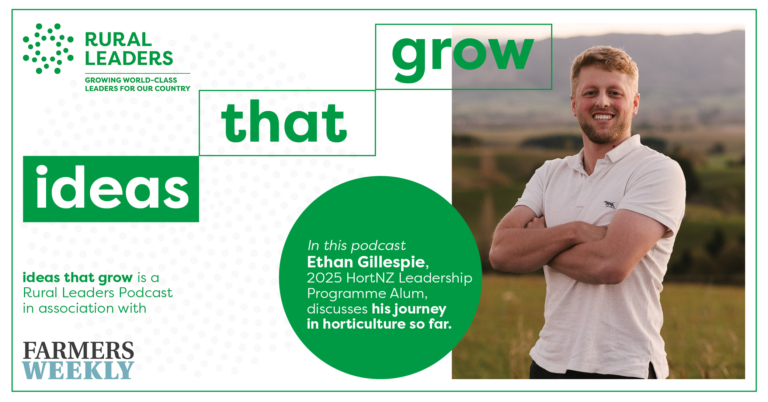
Listen to this episode of Ideas that Grow, or click on one of the platform icons below to listen on your favourite player:
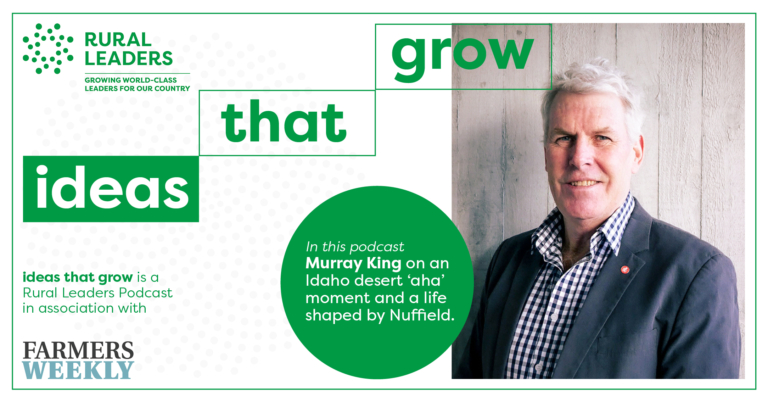
In this Ideas that Grow Podcast, Murray King, 2003 Nuffield Scholar and Rural Leaders Board Board member, talks to Bryan Gibson Managing Editor at Farmers Weekly, and shares his journey from horticulture and the 1980s agricultural downturn, through farm management consultancy in South Canterbury, to running the family farm in Nelson and chairing organisations including LIC.
Now on the selection side of the table two decades after his own scholarship, Murray reflects on what 75 years of Nuffield has meant for New Zealand agribusiness, why stepping away from your business is the point rather than the cost, and the advice he offers anyone weighing it up: the busiest people are the ones who can least afford not to apply.
Episode Transcript
Bryan Gibson, Managing Editor Farmers Weekly, 2025 Kellogg Scholar.
You’ve joined the Ideas That Grow podcast, brought to you by Rural Leaders. In this series, we’ll be drawing on insights from innovative rural leaders to help plant ideas that grow so our regions can flourish.
Ideas That Grow is presented in association with Farmers Weekly. Welcome to Ideas That Grow, the Rural Leaders podcast. I’m your host, Bryan Gibson, Managing Editor of the Farmers Weekly. This week we’re focusing on the Nuffield programme, which is open for applications very soon.
Our guest this week is Murray King, a Nuffield Scholar and a current member of the Rural Leaders board. G’day Murray, how are you?
Murray King, Nuffield Scholar (2003), Rural Leaders Board Member.
Good morning, Bryan. I’m well, thank you. When you say former Nuffield Scholar, I’d just correct that — once you’re a Nuffield Scholar, you’re a scholar for life.
BG: It is true. Yeah, such a great group of alumni involved in the programme. That’s kind of part of its appeal, isn’t it?
MK: It really is a prestigious award and one which I’m greatly honoured to have received. And certainly it might sound a bit trite, but it is a life-changing experience.
BG: A lot of our listeners involved in New Zealand’s food and fibre sector will probably know a little bit about you because you’ve been at the top of a number of different organisations, co-ops and companies. Can we just touch a little bit on your career and how you got to where you are now? Have you always been in the farming world?
From horticulture through the 1980s downturn.
MK: No, I haven’t always been in the farming world, although I grew up on a dairy farm and have migrated back here after many, many years. I did a number of other things over the years. Started out in horticulture actually, and then went through the dark days of the 1980s and ’90s when agriculture was seen as the sunset industry. I was at Lincoln College at the time, now Lincoln University. It was a pretty trying time. Basically halfway through, there were no jobs for graduates. So it was a slow process after that. And I guess of my cohort at the time, there’s only really a couple of us that are actually farming today. Most of that generation that went through at that time left the industry for various reasons.
BG: So how did you manage to make your way through?
MK: I was fortunate enough to be employed as a private farm management consultant in a small firm in South Canterbury in the late ’80s. That was at the tail end of Rural Bank discounting and what have you, when farmers were facing significant interest costs. And our job was to either help them get out of business or help them stay in business. So it was quite a demanding and difficult time, especially for a relatively young graduate. After a couple of years of doing that, I realised this was a pretty tough gig and decided I’d take off overseas and see the world.
Why apply for Nuffield?
BG: You applied for, and were accepted into, the Nuffield Scholarship programme for the 2003 year. What made you want to pursue it?
MK: I’m a reasonably curious and nosy person and easily bored. I’d been overseas for a number of years, came back to Nelson to the home farm, and the manager that we had at the time, after a number of years, decided he wanted to do something else. So I said I would look after the farm for the family until they found somebody else. I ended up running the family business for a number of years and just really wanted to do more, wanted to learn more.
I’d read the book, Jim Collins’ Good to Great, which is a fantastic business book. One of the key learnings in there is a thing called sharpen the saw. And I firmly believe that you’ve got to keep investing in your own personal development and looking for new things. I’d been fortunate enough to have done the Kellogg programme 3 or 4 years prior, so had a little bit of a taste, and had always been aware of Nuffield. Never thought that I would be suitable for it, but as usually happens in these situations, someone gives you a nudge — and that’s what happened. Someone said, “you should put your hand up and I’ll support you.” And that was the catalyst that was required. So the rest is history.
The history of Nuffield Scholarships.
BG: And of course, the Nuffield programme sees you head off around the world to see how the farming world works in other places. How was that for you?
MK: Really good. Not easy, I might add. And maybe it’d be useful just to give a little bit of insight into the history of Nuffield. We’ve just celebrated our 75th anniversary here in New Zealand. So 75 years of scholars, and we will this year likely award our 200th scholarship.
It goes back to the 1950s when a chap called William Morris, who later was awarded a lordship and became Lord Nuffield. William Morris was a bicycle repairman who turned into a very successful industrialist, and he was the founder of the Morris Motor Vehicle Company and Nuffield Tractors and such like. He early on learnt that by travelling the world and looking at what was happening in other parts of the world, you could learn a lot. This is post-war, and obviously food security was a big thing. So he established two things. One was the Nuffield Nursing Awards and Scholarships, where they set up nursing homes for convalescence of returned servicemen and the like. The other part was the farming component, which was the Nuffield Farming Scholarships originally in the UK. New Zealand’s had Nuffield Scholars since 1950, and as I say, 197 to date.
When you look through some of the names, you soon see people who have been very influential in New Zealand agribusiness over the years at all levels and in their own communities. So I guess it was just an opportunity to travel the world and see what’s actually happening over there and bring those ideas back, for the benefit of New Zealand agribusiness.
Staffing solutions for primary industries.
BG: And your research project focused on how to manage teams and deal with the constant rate of change and still stay successful.
MK: That’s right. I was looking at staffing solutions for New Zealand’s primary industries. We were faced at the time with really low unemployment and struggled to attract the right sort of talent onto farms and into agribusinesses, and thought, well, this would be a worthy topic. As usually happens, once you get outside and start looking back, you start finding all sorts of other interesting things to study as well. So that’s exactly what happened. And I might add, there’s no real easy solutions out there — it’s a common problem around the world. That’s the other thing that you really do learn and appreciate: whilst farming systems might be different all around the world, farmers all share very similar or the same problems, whether it be access to markets, labour, environmental challenges, regulation, and the like.
BG: And of course, the recruitment and retention of good people into the sector is still a problem in farming today. It’s sort of ongoing.
MK: Yeah, sure. And that people management component is really critical. When you see significant businesses and wonder how they do it, and you see people who you think are exceptional at people management, they’re the first to admit that actually they don’t always get it right either.
Understanding what motivates people.
BG: In terms of that management of teams, often people seem to look at the pay, the hours, and that sort of thing, and kind of think that you’ve got those bare bones in place, you’ve done your job. But of course, it’s about relationships, it’s about ongoing training and giving someone a sense of place to a certain extent.
MK: Absolutely. One of the critical things I see is that the first thing you need to understand is your own leadership style. But secondly, and more importantly, is understanding what it is that pushes people’s buttons, what motivates them, what are the things that they really want? Because often it’s not about pay. It could be any of a number of different things. It could be about more training, it could be about more flexible working conditions, it could be good working conditions, it could be about advancement within the organisation. So until you actually understand what people are looking for, it’s very hard to address what they really need.
BG: Because at the end of the day, while in frank business terms a person is a resource in some sense, they’re more than that. They’re not just something to use and discard — you’re setting them up for the rest of their lives as well, and that carries something, doesn’t it?
MK: It sure does. It’s really important to grow those people as you grow your own business as well. You can’t do it by yourself. One of the things you learn and see in the Nuffield experience is the exposure to agribusiness at scale, particularly in places like Brazil, the US, Australia. By comparison, we are relatively small, and the bigger those businesses get, the more people you need.
Confidence, connections, and leadership roles.
BG: You’ve gone on to hold some pretty big positions yourself in the New Zealand food and fibre sector. You’re chair of LIC, and you were director and chair of Waimea Irrigators Limited, among various other roles. The Nuffield experience would have given you the tools to navigate those?
MK: Yes, it sure does. One of the things that Nuffield does is it gives you confidence — confidence and connections. And I think they’re both really useful, especially when you need to have perspective as to what’s happening in the greater landscape, particularly internationally.
So with the likes of LIC, it was really useful to understand what’s happening in genetics globally. With respect to the likes of Waimea Irrigators, that was really interesting. One of the key insights I had from Nuffield was the exposure to the influence of water and water storage and what it does to transform agriculture. And it is really a lost opportunity in New Zealand if we don’t exploit it more.
We are one of the most water-abundant nations in the world — I think we’re second, actually. So that was a key highlight from my studies and my travels: just seeing the influence and the power of water.
An “aha” moment in the Idaho desert.
BG: While harnessing that resource better is obviously vital to the food and fibre sector, it’s still sometimes a fraught conversation we have nationally about water storage and that sort of thing. So you need a fair bit of experience and conviction to navigate all of that.
MK: Yes, you do. One of the learnings for me — and there was a key aha moment, I guess, in my travels — was on a Sunday afternoon driving along through the high desert in Idaho. If you can picture it, it’s just like the Wild West with tumbleweeds and things blowing across the road. And then all of a sudden we came across a centre pivot irrigator in a field of potatoes — probably, I don’t know, a couple of hundred hectares of potatoes. I just looked at it and thought, this is amazing. This is the middle of the desert and they’re growing this crop of healthy potatoes. And all it was about was sunshine and water. And I thought, man, that just shows you the power of those two resources. If you put them together carefully, just shows you what you can do.
That really was a key learning for me and one which I still remember. Our whole farming business has actually been built around that insight, and that is about managing to control the controllables. Farming is so diametrically opposed to making money in many ways. There are so many forces which you have no control over, whether it be the markets, the exchange rate, interest rates, regulation, weather. But one part of weather you can control is the application of water. So that’s what our business has since been founded on.
Why Nuffield still matters.
BG: You still are involved with the Rural Leaders organisation on the board of trustees. Nuffield is still the hero programme for Rural Leaders, and it still seems to attract the best and brightest and still be really relevant in today’s farming world.
MK: Yes, Nuffield certainly is the flagship for Rural Leaders — not taking away from the other programmes, but it is the ultimate challenge for people and the one that carries the most prestige. We give it that prestige as well by the size of the scholarship and the limited number of scholars which we select every year.
Compared to some of the other countries, we only usually award somewhere between 2 and 5 scholarships a year, whereas Australia and the UK, for example, are in excess of 20. We like to think of it as quality over quantity, so we are reasonably selective. But it’s one of the highlights of my year actually going through those 2 days of interviews because you get exposed to some really good people, and it gives you real hope for the future. These are people who are keen to learn, keen to contribute, and I’m sure they’ll keep popping up over the years.
Doors, networks, and credibility.
BG: Having the benefit of hindsight — you went through the programme earlier this century, you’ve gone on to some amazing leadership roles — having the Nuffield Scholarship in the back pocket is part of the reason for your success?
MK: It’s hard to know, but certainly it should not be understated that it does open doors. Nuffield gets you into places you would never get otherwise, particularly overseas. If you can show your credentials as a Nuffield Scholar, particularly in Europe and the UK, people understand what it is. Places like the States, you just have to say that you’ve been awarded a scholarship and they say, “wow, well done. What can I do for you?” So it does certainly open doors and expose you to some really interesting people who are only too pleased to share their experiences and how they run their businesses. They’re often the best and brightest around, really resourceful and successful people, which is great.
That network grows over time. Nuffield has the largest independent network of farmers globally, so you develop friendships with people all over the place from different backgrounds and doing some really amazing things. What’s been quite cool is, in our case, our kids have even ended up working for some of those people in foreign countries, which has been great. Back at home, of course, it’s well recognised and certainly helps with your CV. I think it adds some credibility when it comes to dealing with banks and such like. It certainly helped us to grow our business.
“You probably can’t afford not to do it.”
BG: And just lastly — you mentioned earlier that when you were thinking about Nuffield, you wondered whether you were the right sort of person for it. I guess a lot of people might think that. What would your advice to anyone having those same thoughts be?
MK: The first thing that people say is, “I’m not up to it,” or “I’m too busy.” And most people who are successful are too busy and say, “look, I can’t afford the time. I can’t afford to be away.” I would turn around and say, “you probably can’t afford not to do it.”
To put it into perspective, I travelled in 2003. It was at the time of the Iraq War, as it happened. I left Sarah, my wife, at home with a 2-year-old and pregnant and shot away for 24 weeks continuous. You talk to people about that now and they think, “Really? How did you get away with that?” Gratefully Sarah was supportive. But in earlier years, it was nothing for the original scholars to go on a boat to the UK and be away for a significant amount of time. I think that’s one of the things which Lord Nuffield really encouraged — the fact that you got away from your business. You couldn’t be hands-on, you couldn’t interfere, and you had to learn that it could survive without you. So that was one of the key things that Nuffield does: it makes you get out of your comfort zone, get out of your daily grind.
I would highly encourage anybody, no matter how busy you are. The doors that it opens, the opportunities, and just the learnings that you gain by looking back at New Zealand from the other side is really insightful.
BG: Excellent. Thanks, Murray.
Thanks for listening to Ideas That Grow, a Rural Leaders’ podcast presented in association with Farmers Weekly. For more information on Rural Leaders, the Nuffield New Zealand Farming Scholarship, the Kellogg Rural Leadership Programme, and the Value Chain Innovation Programme, please visit ruralleaders.co.nz