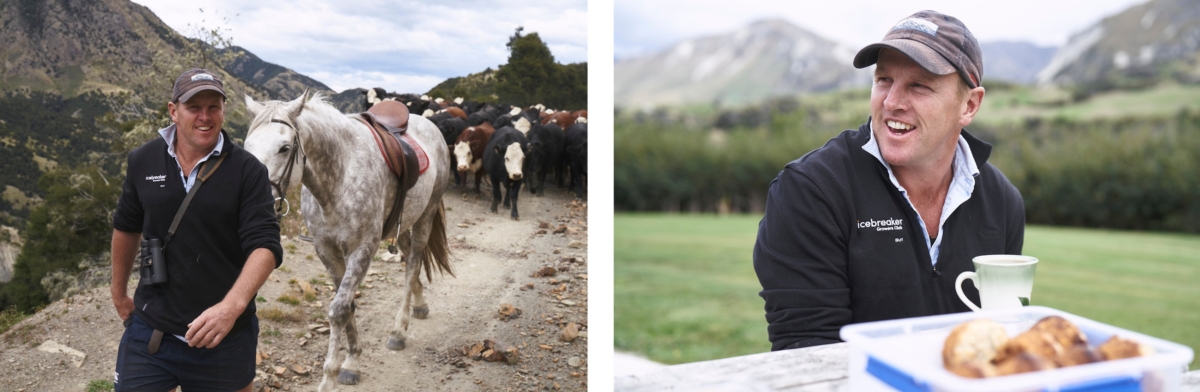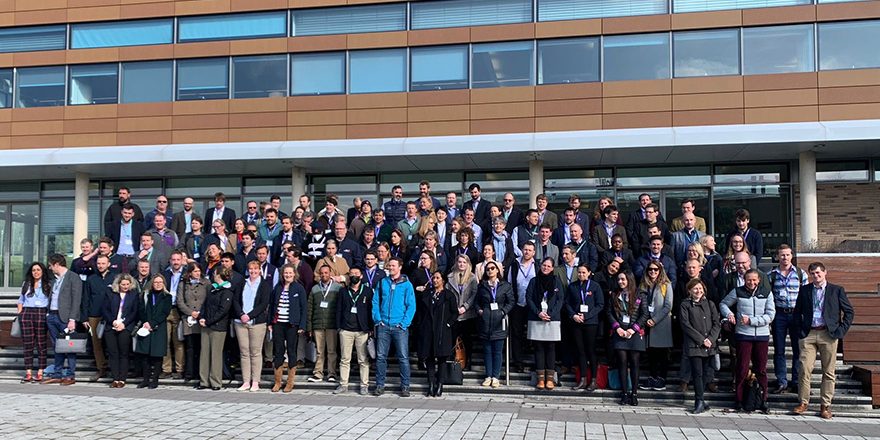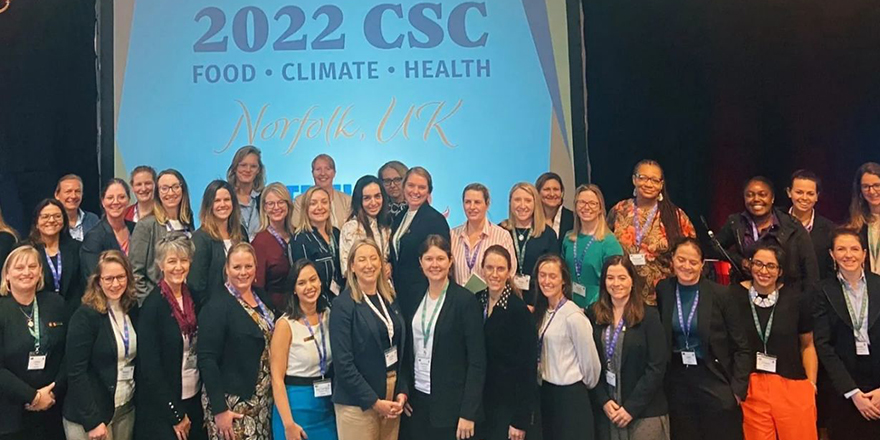
2026 Nuffield NZ Farming Scholarship. Apply by 17 August 2025. Read More...

Apply for 2026 Nuffield NZ Farming Scholarship by 17 August 2025. More details...

Mackenzie Charitable Foundation and Rural Leaders renew Strategic Partnership

The New Zealand Rural Leadership Trust (Rural Leaders) is pleased to announce the renewal of its Strategic Partnership agreement with the Mackenzie Charitable Foundation.

The Foundation’s desire to assist in the amplification of entrepreneurial and emerging leaders in the food and fibre sector finds significant alignment with Rural Leaders’ purpose of growing world-class leaders for our country.

To this end The Mackenzie Charitable Foundation undertook research alongside Rural Leaders, in collaboration with Otago Business School and the Department of Economics, to investigate the contribution of Kellogg and Nuffield Alumni to Food and Fibre.

This report, a world-class evidence base, measures the within-person gains in entrepreneurial leadership capability that occurs because of participation in the Kellogg and Nuffield programmes.

You can download the Mackenzie Study here. 

Pictured above is Don McFarlane (MNZM, JP), Mackenzie Charitable Foundation Trustee and 1981 Nuffield Scholar, and Lisa Rogers, CEO, Rural Leaders.

Mackenzie Charitable Foundation background.

The Mackenzie Charitable Foundation was formed in 1976 when brothers Alan and Don Mackenzie made the decision to leave their estates to the community of Mid-Canterbury.

Both brothers were diagnosed with cancer in the mid-1970’s and it was then that they decided to leave a legacy to the community they had lived in and loved so much.

The Foundation assists the province of Canterbury in Agriculture, specifically in the areas of research, development, education and training, and expansion of the science and practice of agriculture.

The Foundation supports Cancer Research, treatment, provision of equipment, and education and training. It also supports young people that may have challenges that put them at disadvantage to their peers.

We are proud to be working with an enterprise that has given, and continues to give so much to Canterbury, its communities and people.

The Rural Reader: Kawai. Review by Dr Patrick Aldwell.

In this Rural Reader, Dr Patrick Aldwell reviews Kawai. A book by Monty Soutar, 2022

When an old friend suggested I read this book, I wasn’t too sure about it. First, it is a novel, and second, it is the first of a trilogy; neither of these is my strong suit in terms of reading. 

When a second friend recommended it to me, I took the bait, and I am pleased I did. Monty (affiliated with Ngati Porou, Ngati Awa, Ngai Tai ki Tamaki and Ngati Kahungunu) is an accomplished historian with knowledge steeped in military history. These two attributes are fundamental to the character growth and leadership development of the main protagonists and antagonists in this novel. 

While this is not a comfortable or “nice” read, it is, in my opinion, helpful in terms of understanding aspects of te ao Māori prior to the arrival of Europeans – and even how some of that world plays out today. In particular, it is an introduction to the power of lineage (Kawai) and the responsibilities, consequences, and leadership associated with that lineage. 

With considerable curiosity,  I look forward to the next book in the trilogy.

The search for our 2025 Nuffield Scholars begins.

Just 189 Scholars in nearly 75 years.

The Nuffield network in New Zealand is a small group, doing big things, humbly. We’re looking for our bold, grounded and community-minded to step up as Nuffield Scholar 190, 191, 192, 193 and possibly 194. 

If you’re ready to undertake a truly unique learning experience. If you are ready to give back to your community, industry and sector, Nuffield is for you.

Nuffield is a unique learning experience.

A Nuffield Farming Scholarship is one of the most valued and prestigious awards in Aotearoa New Zealand’s Food and Fibre sector. Nuffield is part of a global food network promoting global vision, leadership and innovation.

The Nuffield global network provides scholars with access to international leaders and the best production, management and marketing systems around the globe.

You can read more about the Scholarship by downloading the 2025 Brochure here.

Six attributes of a Nuffield Scholar.

The scholar selection process will look for evidence that these attributes exist or have the potential to emerge in an applicant.

Bold

The will to step forward, to challenge conventional thinking, to act, to make decisions with confidence. 

Innovative

Someone who can develop and express original thinking and ideas.

Motivated 

Driven to go above and beyond to accomplish a goal. Someone who can find the energy and confidence needed to do so. 

Perceptive  

Possesses the cognitive, observational, and critical thinking abilities to assess challenges and generate usable insights.   

Community-minded 

Motivated to contribute to community by collaborating and sharing skills, knowledge, experience, and ideas, forging ever-stronger connections with people and place. 

Grounded

The practical, pragmatic and down-to-earth people in the Sector, ready to get things done.

Sound like you – or some you may know?

Apply by 18 August here, or refer someone in your network below.


Alumni in the Spotlight – Michael Tayler, Tessa Appleby and more.

It has been a busy time for alumni. This selection of news items is a nowhere near  adequate summary – possibly a good problem to have. For now the Spotlight is on Michael Tayler, Tess Appleby, Lucie Douma, Matt Iremonger, James Allen, and Carlos Bagrie.

Michael Tayler, 2012 Nuffield Scholar.

Michael featured in Farmers Weekly recently in an article covering both he and his brother’s work in Japan. In the article Michael said there are a small number of Canterbury growers supplying carrots to Juice Products New Zealand for health-conscious consumers in Japan.

“It is an interesting story, and really satisfying to see New Zealand carrot juice on the supermarket shelves in Japan,” says Michael Tayler.

Take a read of the Farmers Weekly article.


Lucie Douma, 2022 Nuffield Scholar.

Lucie Douma will be speaking at E Tipu 2024. Another great reason to attend, either in-person or online. Lucie’s report ‘Data sharing to achieve data interoperability’ discusses the need to find a better way of collecting, managing, and using information on our farms as part of the decision-making process – and for this we need data interoperability and data sharing of systems.


Lucie is Head of Client Strategy and Advice at FMG Lucie has been instrumental in shaping strategies that resonate with the needs of the modern farmer, focusing on innovation and resilience in the face of changing agricultural landscapes.

See Lucie’s full bio for E Tipu here.

Get your tickets for E Tipu 2024 here.


Matt Iremonger, 2023 Nuffield Scholar.

Matt was interviewed a couple of weeks ago on the CountryWide Podcast. Where his Nuffield report ‘What’s the beef? Opportunities for beef on dairy in New Zealand’, was discussed, specifically the issue of non-replacements (1.8 million calves are slaughtered annually at 4-7 days).

Listen to the podcast here.

Matt’s Nuffield report looks at the opportunity for beef on dairy to shift the value chain from dysfunctional to functional.

In a supporting article by Sarah Perriam-Lampp, he also featured in CountryWide, Beef Country Autumn, pages 15-18. Check the article, ‘World’s best grass-fed steak’. To partially quote the article flavour text, ‘Handpicked genetics, farm systems and top-notch grading to be crowned the best…’

You can read the article here.

James Parsons also features in this issue on the use of Halter in hill country. Nick Jolly, 2023 Kellogg Scholar lends his expertise with an article on page 13. Upcoming 2024 Kellogg Programme Two Scholar and John Daniell Memorial Trust Scholarship winner, Rachel Joblin has written an article on integrated farm planning (pages 20 and 21).


James Allen, 2023 Nuffield Scholar.

James was also interviewed on the CountryWide Podcast where he discussed his report, ‘Redefining excellence in agribusiness advisory. The role of the rural advisor in the modern world’.

You can listen to this podcast here.

James’ report explores the challenges faced by the rural advisor in a farming world striving to feed an ever-increasing population whilst also reducing its environmental footprint. This report gives guidance as to how the rural advisor might continue to add value to farmers in this fast-changing context.


Tessa Appleby, 2023 Kellogg Scholar.

Tessa features in several recent articles, including Farmers Weekly. This piece covers the impact of Cyclone Gabrielle and the loss of her home.

The article also covers Tessa’s Kellogg research which aimed to review and analyse the current understanding and perception of Bovine TB among farmers and industry professionals.

The research report explored aspects of BovineTB management strategy and a human-centred approach to its eradication. 

One significant aspect of the findings was the importance of storytelling in creating empathy and understanding. 

“Sharing people-centered stories and case studies can complement technical information and foster a deeper understanding of disease management strategies,” Tessa said. 

You can read Tessa’s Kellogg report ‘Eradicating complacency’ here.


Carlos Bagrie, 2024 Nuffield Scholar.

Most readers will know about Royalburn’s new beer Swifty. Carlos Bagrie worked closely with Garage Project to produce a refreshing and highly accessible beer, made from the Station’s own barley. You can read the article here (scroll to page 34). 

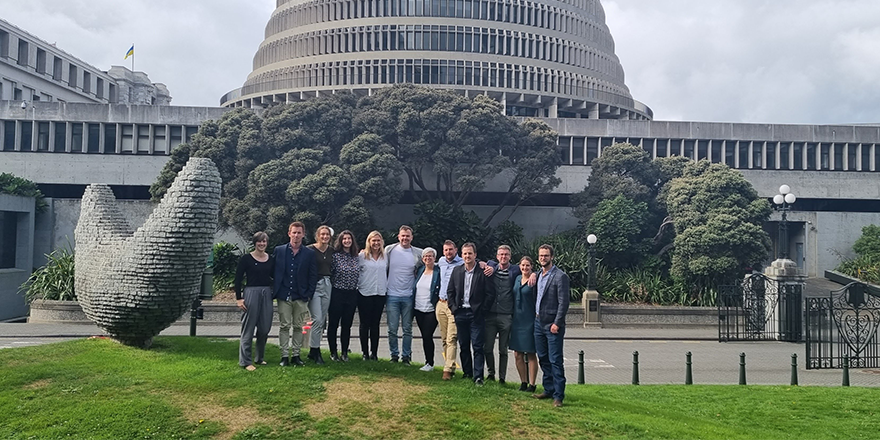
Nuffield featured on an episode of Nadia’s Farm recently Season 2, Episode 6. If you are all signed up for TV3 OnDemand, check it out. (Image is on the steps of the Beehive just prior to the Nuffield Awards, November 2023).

Introducing Paul Crick – NZRLT Independent Trustee.

The NZRLT Board and Leadership Team welcomed Independent Trustee Paul Crick, to the NZRLT Board late last year.

On the appointment Kate Scott, Chair, said, “Paul’s diverse range of skills, his deep passion for the Sector, and his extensive governance experience in both education and in industry, make him a valuable addition to the Board. We’re excited by the mix we now have on the governance team.”

Paul and partner Dayanne Almeida lease an 850ha sheep, beef and deer farm in the Wairarapa.

Paul has an extensive 30-year background in agriculture and education, both nationally and overseas; from working and managing large-scale properties in the North and South Islands to farm consultancy in Chile and Brazil, along with developing the next generation of NZ farmers in his previous executive role, Director of Farms for Taratahi Agricultural Training Centre. 

Paul has been involved in many agricultural and social research projects in conjunction with Massey University, AbacusBio, Alliance Group, Beef + Lamb Genetics New Zealand, and AgResearch. He is currently operating the hill country sheep and beef central progeny flock on the AgResearch property.

Paul is also a Council Member on Muka Tangata, the Workforce Development Council for People Food and Fibre, the Chair of the Beef and Lamb Farmer Council Executive and adds Independent Trustee, New Zealand Rural Leadership Trust, to his governance commitments.

Realising Leadership Potential in New Zealand’s Food and Fibre Sector.

From a concept that originated nearly two and a half years ago, a new leadership report draws on extensive research and from hundreds of perspectives of people working in food and fibre.

A Path to Realising Leadership Potential in Aotearoa NZ’s Food and Fibre Sector’ is the result of a collaboration between Food and Fibre Centre of Vocational Excellence (CoVE) and the New Zealand Rural Leadership Trust (Rural Leaders).

The report, enriched by the concepts of Te Ao Māori and of Pacific cultures, does not claim to provide a definitive answer to leadership, but instead offers a principles-centred model for leading in the Sector, encouraging leaders to find their personal leadership approach and to embark on their own path.

Recognising that leadership development is not a linear path and acknowledging the diversity and complexity of the sector, the research proposes a dynamic, living ecosystem. An ecosystem that can be interacted with, leveraged, adapted, shared, and yet retain a common essence that can be spread across the way we work, interact with others, and envision the future. 

“A sustained flow of capable and self-aware leaders is critical to the Food and Fibre sector remaining vital and vibrant into the future. The Sector needs leaders that are continuously developing themselves and the teams they work with”, said Lisa Rogers, CEO, Rural Leaders.

This latest report follows previous research which looked at the state of leadership development in NZ, and also proposed a principles-centred leadership model for the Sector.

The report synthesises the thinking from the first two reports and provides a framework for the Sector to develop a flow of prepared leaders to step into ever more impactful roles.

“This work is an important step in the pathway to providing a tangible framework for leadership development for the whole of the Food and Fibre sector, which will not only be for the betterment of our sector’s people but for the betterment of the country,” said Kate Scott, Chair, NZ Rural Leadership Trust.

Dr Lilla du Toit, Portfolio Manager, Food and Fibre CoVE commented, “This research project holds immense importance for the Food and Fibre sector, significantly shaping the development of leadership roles across all the industries it serves. It will also play a crucial role in fortifying two other key leadership initiatives, namely the Horticulture NZ Leadership Programme redesign by Rural Leaders, and the Food and Fibre CoVE and Muka Tangata backed Food and Fibre Māori Leadership Development Framework.”

Rural Leaders wish to sincerely acknowledge the authors for their tireless work on this report, and acknowledge too, project collaboration partners, Food and Fibre CoVE, and the generous support of Strategic Partners DairyNZ, Beef + Lamb New Zealand, FMG, AGMARDT, Mackenzie Charitable Foundation, and Programme Partners LIC, Farmlands Co-operative, Zespri, MPI, FAR, Horticulture NZ, and Rabobank.

You can download the latest report here.

Campbell Parker – Leading with authenticity in a fast-changing sector.

Farmers Weekly Managing Editor Bryan Gibson speaks to Campbell Parker, Chief Executive Officer at DairyNZ.

Campbell discusses his involvement with the Kellogg Rural Leadership Programme and how leading with authenticity can go a long way to helping us achieve big things in a time of rapid change.

Listen to Campbell’s podcast here or read the transcript below.

Bryan GibsonManaging Editor of Farmer’s Weekly.

Kia Ora, you’ve joined the Ideas That Grow podcast, brought to you by Rural Leaders. In this series, we’ll be drawing on insights from innovative rural leaders to help plant ideas that grow so our regions can flourish. Ideas that Grow is presented in association with Farmers Weekly.

Bryan Gibson, Managing Editor of Farmers Weekly.
You’re with Ideas That Grow, the Rural Leaders podcast. I am Farmers Weekly Managing Editor, Bryan Gibson, and with me today is Campbell Parker, Chief Executive of DairyNZ. G’day Campbell, how’s it going?

Campbell Parker, CEO DairyNZ
How are you, Bryan? Yeah, I’m pretty good, thanks.

BG: Now, you’re not an alumnus of the Kellogg or the Nuffield Programmes, but you have been called upon to work with some of the Kellogg cohorts, to talk to them about leadership. What does that involve?

Sharing leadership experiences with Kellogg scholars.

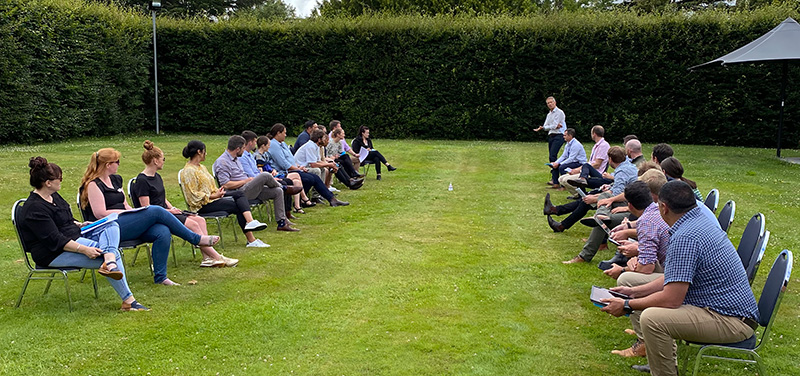
Image: Campbell Parker with 2024 Programme One Kellogg Scholars (K51).

CP: I had the opportunity in the end of January to go down and talk to the most current cohort. They were looking for a view around the dairy industry. Obviously, I’m CEO of DairyNZ, but that was where it started.

Ultimately, what you find in those conversations is that you start talking about the Sector, but then you start talking about leadership. The conversation with them ended up in a very interesting space around what are some of the challenges the sector has and where does leadership fit in.

What I also find interesting with a group like that is they’re interested in your own personal leadership journey and where they are in their own journey. How do we learn together and what is the role of leadership? You always find those sessions really stimulating; when you get to talk about what that is and what are we all trying to achieve from a leadership perspective.

BG: Leadership is an interesting thing. For myself, I hold a leadership position in our business. But to tell you the truth, a while back, I wouldn’t have thought leadership was for me. I’m a quiet person. I’m a listener, like journalists often are.

You quite often don’t marry that to what you stereotypically look for in a leader. What do you think about how leadership has evolved over time and what qualities are important?

Leading well starts with understanding yourself.

CP: I think leadership is an evolving subject, and it continues to evolve. But one of the things I’ve seen, I think people have a frame around what they think leadership is. I personally believe everyone can be a leader. First of all, you’ve got to lead yourself. That’s where it starts.

Some of the best leaders I’ve worked with aren’t necessarily the gregarious and outgoing people. But to sum it up, I think one of the most important traits around leadership is authenticity and being really clear about who you are as a person, what your impact on others is, and how you try and lead people.

It does start with having a good understanding of yourself, what motivates you, what drives you, how you react to certain circumstances, and then ultimately, how do you lead people to be the best that they can be. To me, that authenticity is not necessarily about corporate messages, because the people that have the ability to take people with them are the people that are trusted and are authentic. They have very honest conversations around where things need to be.

If I had to put it down to one thing and one word, I would say authenticity is one of the most important things.

BG: Yeah, I guess people are more likely to believe in and get in behind someone who they feel personally, or in a business sense, has their back, that you’ll be listened to, and that you have the chance to thrive on your own as well as within a collective. That’s really important, isn’t it?

Authenticity is key in a sector with little appetite for BS.

CP: It is. I think I was asked a question by the board when I was going through the interview process for this role. They asked me a question around what are the things you’re most proud of in your career. I said to them, and I was very genuine around this, it’s not an event or something, there’s been lots of those. But what I’m most proud of is the people I’ve had the opportunity to work with and the things that we’ve been able to achieve together. To me, that’s the important part of leadership, because when you work with teams and people, and you achieve something you didn’t think was possible, that’s inspirational.

I remember one person that I worked with externally who used to often say, the biggest limitations are those that we put on ourselves. I think we’re all a lot more capable of things from a leadership perspective than what we think we are. It’s through time and experience that you gage those things and you learn from them. If you’re a continuous learner, you want to continue to grow as a human being – I think if you can do that and do that well, then leadership can be really enjoyed and enjoyable

BG: You don’t know what you’re capable of until you give it a go, I guess. That lifelong learning thing.

CP: And sometimes you’re put into situations that are really challenging. Ultimately, you have to be prepared to make a decision and then live with those decisions, but you also need to be, I think, open enough to reflect on and admit when you didn’t get things right or be vulnerable enough to then change. Because, again, back to that point around authenticity and trust, that gives people the ability to trust you and then come with you.

The one thing I would say in our sector, in agriculture, and particularly with farmers, they’re pretty good at reading the ‘BS’ barometer, and that level of authenticity is incredibly important.

Remaining positive about the Sector’s future.

BG: Now, you mentioned you talked to the Kellogg cohort earlier in the year about some of the issues in our food production sector at the moment. Obviously, it’s been a time of rapid change. We’ve had global events, pandemics, that sort of thing, and also lots of regulation come down from government in the previous term. What do you think is the path going forward? How do we align ourselves to make sure we’re doing the best we can do for our sector?

CP: I think one of the things that we really need to make sure that we continue to do is respect all the really good work that have been done by farmers. This is something that’s really important. It’s not just dairy farmers, that’s all farmers. When I look across the Sector and I look at the progress that farmers have made over the last 10 years, we’re in a very different place today than what we were 10 years ago, particularly when you go to things like on-farm practices, and in the environmental space. You get into animal welfare, all those really important, which are quite big global topics and are not going to go away.

It’s really important that as a sector, we continue to have progress around that because it’s expected, whether it be from global players who buy our products or consumers, ultimately. But equally, when you talk to farmers, farmers care deeply about animals on the land, and they ultimately want to leave it better than what they found it. I think hope around that is really important. This sector contributes so strongly to New Zealand from a GDP, but it’s not just that. It’s not just the financial, it’s the communities.

When farming is doing well, communities thrive, and when communities thrive, towns do well. The whole impact on our nation is incredibly important. Yes, we’ve had some tough times. We’ll go through cycles, and we always have in terms of economic cycles and political cycles. But I think we’ve got to have the courage to continue to be passionate and positive about what our future is, because the world needs high-quality food produced in a way that’s sustainable for the environment.

Our farmers ultimately also need economic returns for that to remain viable themselves. It’s an industry that I certainly find not hard to get out of bed every day and get excited about because it’s got a really, really important role to play.

BG: Just a year or two back, it seemed we had a bit of a flash point, I guess, in terms of rural leadership. It was over the emissions pricing process. A lot of farmers and people in rural communities got the feeling that they hadn’t been communicated to well enough by the people who were advocating for them inside the beltway. That led to changes in leadership in various places. That communication and gaining and representing a mandate, that seems to be really important as you go and represent your community outside of it, if you know what I mean.

Learning from the past.

CP: I agree, and I think it is. I think the reality is if you’re talking around things like He Waka Eke Noa processes and things like that. Look, a lot of people put a lot of effort into those processes and tried to communicate things. Unfortunately, there was a bit of a void, and I think it’s important we learn from that because out of that comes this distrust and this concern around what are we advocating for.

It’s interesting because since being in the role, I’ve talked to a lot of dairy farmers, and a lot of farmers have raised that issue with me. When you reflect back on it and say, well, the alternative was we went straight into the ETS, we ended up with pricing, and we didn’t end up with a split gas approach, do you think we should have played that role? They unequivocally say, Absolutely, you should have. Somehow it got lost in translation. I think we do have to learn and reflect on that. I think we do have a role, particularly as industry good organisations to stand up and be clear about what we do stand for and be prepared to take a leadership position.

I know that from my predecessors and people in the business, that absolutely was the case. Somehow that got lost.

Getting the mojo back.

BG: You mentioned farming being not just a driver of economic wealth, but of social well-being. Often when you hear about farming, though, outside of the likes of the Farmer’s Weekly or that sort of thing, it seems to be always on the defensive, if you know what I mean? Farmers have been accused of this and here’s such-and-such from Federated Farmers to defend themselves. It seems we need to maybe front foot things a bit more and believe in what we are and what we bring and that sort of thing and change the conversation a little bit?

CP: I think as farmers and the industry, should be incredibly proud of what we do as a sector. Also, and look, times are tough. When you look directionally through and not just at the financial, the impact that the sector has on communities, people growing, schools, all those things should not be lost sight of.

If I cast my mind forward, I’m 54, if I go back to when I left school in 1987, post the share market crash, everyone said the agricultural sector was a sunset industry. It has certainly not played out that way, and it’s been really, really important for New Zealand. If I cast my mind then forward, I go, absolutely, will it be important in 15- or 20-years’ time? Absolutely. Can we balance both environmental and profitable outcomes? Absolutely. Lots of farmers are doing that. But somehow, we have to try and have a positive voice and get our mojo back.

BG: It does relate to a top-down approach with the likes of Government regulation, that leaves farmers in a place where they don’t feel in control of their own destiny. They’re being given rules with no contextual meaning. Whereas if, say, the likes of the current process of driven plans around scope-three emissions, they lead to premiums. There’s information from customers around the ‘why’. That seems to be a better way to do things in some ways.

CP: I think you’ve always got to understand the context of what you’re trying to drive in. Self-regulation is always better than regulation. I think as an industry, we’ve got to take responsibility for our role to play in those pieces. We’re signed up to things like the Paris Accord. That’s all okay. We’ve just got to make sure that we are contributing and take ownership for our issues.

I think one of the observations I would make, Bryan, in talking with politicians, whether it be regionally or centrally now, is they don’t only want to know what the problems are, they want to know what the solutions are.

We see ourselves as being part of those solutions. But to your point, when people are uncertain, and that’s why we need enduring policy, that’s fear and pragmatic and can be implemented. We did get too much complexity into some of that space. Some of that’s got to be undone. But we need enduring policy that also gives farmers confidence to invest in the things that they need and to continue the direction of travel. If we don’t have that, then it becomes very hard. Confidence is a really important part of anyone’s psyche.

When you feel good about what you’re doing and you’re upbeat about where things are going, you’re more likely to have a positive mindset.

Kellogg - for leaders who want to make a difference.

BG: Just going back to your work with the Kellogg Programme, that must have been… I’ve been to a couple of their alumni events, and they’re amazing events because they’re just full of a wide range of people from all different backgrounds, all different professions. But they’re all just incredibly excited about the Programme, about being with each other and what they’re doing. How did you find it?

CP: They’re always energising. You get in a room with this year’s intake. In January, there was probably 20 people in the room. They’re all passionate about what they do. They ask good questions, which is good and challenging. But they’re there for a reason because they want to make a difference, ultimately.

They also want to challenge themselves to grow as leaders. I think any of those programmes that galvanise people towards that, but more importantly, that self-reflection around where you are and how do you grow and how do you learn from others, is a really good thing to be part of. 

The alumni piece around how they continue to connect themselves up; I talked with one of our directors, Tracy Brown, and she remembers doing Kellogg 20 years ago, when she was in her early 20s, and the people she went through at that point. She’s gone on to do a Nuffield and sits on our board, and sits on a number of boards. Some of that started with Kellogg. I think that’s where sometimes the passion gets ignited, but they get drawn to do the Programme, generally, because they’re drawn towards doing it for a deeper personal reason.

BG: Thanks for listening to Ideas that Grow, a Rural Leaders podcast in partnership with Massey and Lincoln Universities, AGMARDT, and FoodHQ. This podcast was presented by Farmers Weekly. 

For more information on Rural Leaders, the Nuffield New Zealand Farming Scholarships, the Kellogg Rural Leadership Programme, the Engage Programme, or the Value Chain Innovation Programme, please visit ruralleaders.co.nz

Kerry Worsnop, Matt Iremonger, James Allen and Kylie Leonard – 2023 Nuffield reports.

(Image. Left to right: Kerry Worsnop, Kylie Leonard, Matt Iremonger, James Allen). 

After over a year of immersion within the global Nuffield network; whether that be on the key programme milestones such as the GFP, CSC or on research travel, the 2023 Nuffield Scholars’ have completed their reports.

A brilliant group of people, a pleasure to spend time with and all great at what they do. Check out the report titles/summaries below or take a closer look at their reports here.

—–

Here are the report summaries.

Kerry Worsnop – The mountain we need to climb. Designing agricultural policy for a future in farming.

Kerry’s report addresses those in leadership, agricultural policy makers and others with an interest in how we deliver better outcomes for those on the land and for the land itself. Kerry’s report hopes to bring into focus what we need to comprehend about our operating environment if we are to navigate agricultural policy well.

Go to Kerry’s report.

James Allen – Redefining excellence in agribusiness advisory. The role of the rural advisor in the modern world.

James’ report explores the challenges faced by the rural advisor in a farming world striving to feed an ever-increasing population whilst also reducing its environmental footprint. This report gives guidance as to how the rural advisor might continue to add value to farmers in this fast-changing context.

Go to James’ report.

Matt Iremonger – What’s the beef? Opportunities for beef on dairy in New Zealand.

Over 1.8 million non-replacement calves are slaughtered annually at 4-7 days.
Matt’s report looks at the opportunity for beef on dairy to shift the value chain from dysfunctional to functional.

Go to Matt’s report.

Kylie Leonard – Boots on the ground are part of the solution. Transitioning agriculture towards sustainability together.

A reduction of Greenhouse gases is being demanded through our value chains. Kylie’s report focuses on the need for farmers to be at the table of this change (not on the menu) in order to steer agriculture toward greater sustainability outcomes.

Go to Kylie’s report.

The NZRLT board welcome Jack Cocks, Associate Trustee.

The NZRLT Board and Leadership Team are pleased to announce Jack Cocks’ appointment as Associate Trustee.

Jack replaces Olivia Weatherburn. As the role is for one year, Olivia now steps aside after her exemplary service on the board. Olivia’s positivity, energy and contribution has been valuable – and valued.

Jack now joins Kate Scott, Chair, and Rebecca Hyde, Murray King, Steve Wilkins, Trustees, and Hamish Fraser and Paul Crick, Independent Trustees.  

“The board is excited to welcome Jack to the role of Associate Trustee. Jack brings a diverse background in farming, consultancy and the importance of personal resilience to his passion for developing others”, says Kate Scott, Board Chair.

Jack is an Otago high country farmer. He holds a bachelor’s degree in farm management from Lincoln University and a masters in agricultural economics from the University of Illinois. Prior to farming Jack was a Dunedin based agribusiness consultant.

Jack suffered a life-threatening brain aneurysm eleven years ago which saw him spend eight months in hospital over six years and undergo fifteen major surgeries. Following this experience he has studied and researched how ‘Resilient Farmers Thrive in the Face of Adversity’ through the Kellogg Rural Leadership Programme.

He has been asked to do many talks to corporate, farmer, and student groups on his ideas around how farmers can be more resilient to thrive in the face of adversity.

“It’s a real privilege to join the NZRLT board for the next twelve months. I’m looking forward to the opportunity. I’m sure I will learn a huge amount, and I hope to add value to the organisation”, says Jack Cocks.

The Associate Trustee role offers valuable governance in practice experience to those appointed, while providing the opportunity to contribute to the Board’s objectives and to the wider sector in a meaningful way. 

Jack’s first official NZRLT board meeting will be 3 July. 

John Daniell Memorial Trust – supporting Kellogg.

The John Daniell Memorial Trust has kindly agreed to support two Kellogg Rural Leadership course participants annually.

This support comes in the form of two scholarships per year of $5,000.

Successful applicants will be expected to present to the trust either in person or online within three months of the conclusion of their Kellogg research project.

Learn more about the Trust and applicant eligibility below.

Aims of the trust.
To perpetuate John Daniell’s enthusiasm, love and philosophy in all aspects of pastoral farming.

To further promote and assist in achieving his long-held objective of increasing research effort into hill country and pastoral farming.

To recognise John Daniell’s significant contribution to the NZ farming industry.

Objectives of the trust.
To encourage or promote any idea, activity or project that is seen as capable of furthering understanding, knowledge or appreciation of any aspect of farming practice.

To encourage places of learning, person, organisations or government departments to participate in research and demonstration associated with specific farming projects.

To provide and/or assist in the provision of scholarships, bursaries, lectures, seminars, trophies and other benefits of incentives.

To promote research and demonstration of means of achieving the maximum volume and value of products consistent with the maintenance of a high standard of animal and pasture management.

To promote research and the demonstration of management systems to enable pastoral farmers to achieve optimum production and profitability on an ongoing basis.

The advancement of education in the farming of pastoral property.

To invest in any farming resource which will enable the research and demonstration of modern farming practices.

Eligibility.
1). Scholarships will be awarded to those who are focused on practical pastoral livestock farming or leadership in the pastoral livestock farming

2). Preference is be given to participants from the Wairarapa region in the first instance

3). Applicants must be NZ citizens

4). Applications to be lodged with the intended start date of the Kellogg Rural Leadership Programme

5). The scholarship will be paid by the trust direct into the applicants nominated bank account at the commencement of the course.

Applications.
Applications for a John Daniell Memorial Trust Scholarship to attend Kellogg Programme One 2026, will need to be submitted to Delwyn Pringle at the email below by Sunday 5 October 2025.

NB. You will need to submit your Kellogg application by this date as well. Please indicate on your application that you are applying for this scholarship.

To start the process please email Trust Secretary Delwyn Pringle for an application form at delwyn@bakerag.co.nz