2026 Nuffield NZ Farming Scholarship. Apply by 17 August 2025. Read More...

Apply for 2026 Nuffield NZ Farming Scholarship by 17 August 2025. More details...

The Rural Reader. July book review.

A matter of fact – Talking truth in a post-truth world – Jess Berenston-Shaw (2018).

At a time when information creation and access have become so democratised it has become increasingly difficult to determine the validity and credibility of information sources – and indeed the truth of information itself.

Jess investigates how organisations and individuals generate information to influence public opinion – something that I think is likely to be of particular interest to the Food and Fibre sector. She presents many examples of how information is misused intentionally as well as unintentionally, and the pitting of evidence against beliefs and values.

Other important issues she addresses include conspiracy theories, false balance and bias. Kelloggers who have read this short book tell me that they have found it most helpful in their work lives and in helping them evaluate and better understand the complexities of the environment within which New Zealand trades. 

The current discussions on genetic modification are a case in point. Jess is a New Zealand author, an experienced journalist and academic. This BWB book is readily accessible and reasonably priced at about $15.

Patrick Aldwell
July, 2023

The Rural Reader. June book review.

Mindset – changing the way you think to fulfil your potential – Dr Carol S. Dweck (2017).

Occasionally, you come across one of “those airport books” that is really worth reading. This is one of them. Based on research, the book focuses on two principal mindsets: the fixed mindset and the growth mindset. The fixed mindset relates to those who think they cannot change. The growth mindset shows that people can change and can improve themselves. 

The model suggests that mindset varies along a continuum and, for any one person, changes according to circumstance. For me, the main point in this idea is that we can and do change our behaviours and capabilities, and we can change how we see the world – otherwise, why would we bother doing leadership programmes or learning something new?

I see this, to some extent, in people on Kellogg programmes; those who underestimate themselves and who are frustrated by the confidence-sapping mindset of “imposter syndrome”. A Professor of Psychology at Stanford, Carol’s key point is that “… the view that you adopt for yourself profoundly affects the way you lead your life.”

Patrick Aldwell
June, 2023

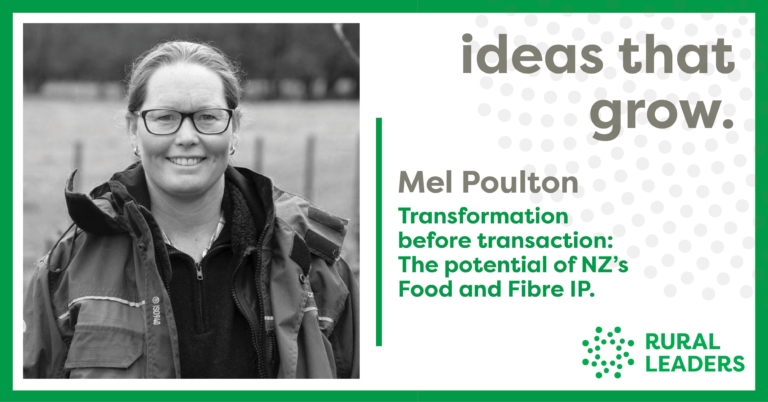
Mel Poulton – Transformation before transaction: The potential of NZ’s Food and Fibre IP.

Mel Poulton is a farmer first and foremost, running a sheep and beef farm based in the Tararua District. She is also finishing her tenure as New Zealand’s Agriculture Trade Envoy.

Awarded a Nuffield Scholarship in 2014, Mel completed her research on
Capturing Value: Building a sweet spot between trade negotiations, market access and the exports of expertise.

Listen to Mel’s podcast above or read the transcript below.

Bryan GibsonManaging Editor of Farmer’s Weekly.

Welcome to the ‘Ideas that Grow’ podcast. I’m Bryan Gibson, Managing Editor of Farmers Weekly. This week I’m talking to agricultural trade specialist and farmer Mel Poulton. Now, you were a Nuffield scholar in 2014, is that correct?

Mel Poulton 
– 2014 Nuffield Scholar, farmer, Special Agricultural Trade Envoy.
Correct.

BG: I understand you did your Nuffield Scholar Report on agricultural IP and how to best send it out into the world and also get the best value for it. Can you tell us a little bit about what you found out?

The untapped potential of New Zealand’s agricultural IP.

MP: At the time, as a food producer and somebody who, through our levies was investing in New Zealand science, research, and development for New Zealand farming to give us a competitive edge in the world, it was a concern to me to hear that our IP was being effectively given away in the hope of an FTA for market access. That was how I was certainly interpreting it at the time.

I spent a bit of time traveling to different nations around the world looking at IP trade, market access, and looking at what went well and what didn’t, what could we learn from that, and is this even a good idea for New Zealand? I came back with the conclusion that actually, given who we are and what we do and our constraints, leveraging our IP is a really good strategy for New Zealand.

But I wasn’t convinced that we were doing it well, and I felt like we needed to better value or recognise our IP, value our IP, package our IP, and then be able to leverage value from it, not just by way of the hope of market access through an FTA, because we’ve seen in recent years what can happen with economic coercion and suddenly markets being closed to us. 

Food and Fibre’s intellectual property opportunity.

So, if you end up giving away your IP and then those markets close, what have you got left? Some people might disagree, but I think that’s a relevant concern that New Zealand needs to be really mindful of with regard to its strategy and how it navigates its way in the world and how it leverages its IP.

How do we do it in such a way that those that have invested in that IP can extract value from it, short, medium, and long term, for the good of New Zealand and for the good of our Food and Fibre Sector and our people who have invested.

BG: A better strategy needed on the intellectual property front. Very good. Now, of course, you’re just finishing up a term as the Special Agricultural Trade Envoy (SATE), which means in terms of market access and trade deals and the world food system, you’d have widened your scope on things to more than just intellectual property, to food itself. But are there similar themes at play there as we try and extract value from our agricultural sector.

MP: There’s an enormous amount of opportunity for us to extract value from our IP in ways that we haven’t really considered before, or broadening it a whole lot more than what we do. Thinking about that in the context of a growing global population with a real concern around food security and even more importantly, nutrition security.

Then given the challenges of climate change and the environment and the constraints that’s putting on food production in different parts of the world, I feel confident given what I’ve seen in recent years and the travels that I’ve done both on my Nuffield Scholarship and since then as SATE for New Zealand. I think there’s an enormous opportunity for food production to increase in many parts of the world and especially those countries with developing agriculture. I think there could be small changes made that generate big gains.

Working together with developing agricultural nations for mutual benefit.

Some of these countries with developing agriculture have potential to really lift production. Whereas New Zealand and parts of Europe, for example, feeling more and more constrained as to how much more food production they can actually lift.

The talk is that New Zealand feeds 40 million people. Well, that’s barely feeding one city. Mexico City itself is 40 million people. When you think about the scheme of things in our place in the world, how do we strategically position ourselves to be good in the world and good for the world and continue with a transaction strategy that grows really awesome food and beverages that are highly nutritious and safe?

And also has the integrity behind it with regard to environment and climate and all the other factors around labour and all of the environmental, social, and economic factors that make up the back story to our product.

So we’ve got to be able to have that integrity, but also recognise what our potential for lifting things further for New Zealand. How do we leverage off the strengths that we have as a nation? I think there’s huge potential to be able to work with, learn together with, and build together with, other countries with developing agriculture and leveraging our IP, but not selling it as it is, but leveraging it and adapting it to create something new.

BG: So, it’s far more than just selling a product or an idea and leaving it at that. It is working with the people on the other end of the transaction long term.

A shift to transformation before transaction.

MP: Well, it’s effectively transformation before transaction. If you were to put value on or weighting on it, historically, we’ve had a transaction approach to things. I think there’s still a future for us in that because we grow and sell food to the market – that earns us revenue. I think it’s going to be for the growing needs of New Zealand and the economic growing needs of New Zealand, that we need to figure out how we grow further.

If we’ve got constraints here, then how do we grow together with others being good for the world and good in the world? It’s actually going in there with humility and saying, well, we’ve learned some stuff in our context, we recognise that you’re operating in a different context, we understand you’ve got goals and vision for growth for yourselves, so how can we work together, learning from our IP and a principles approach, to develop something entirely new that could actually help you achieve your goals and help us achieve our goals.

BG: That makes sense. In a finite environment, if one sector has reached their limit, then the only logical place to go is to help others up their production to a level where they can sustain themselves better. 

Further trade ties with India and the role of humility.

MP: I was just in India a short while ago, and they really want us to be investing there. The challenge for New Zealand is that we’ve got stories, we’ve got examples, we’ve got experience investing in other countries. Some of the challenge around that is sometimes we’ve gone in a little bit proud and arrogant, taking a copy and paste approach that hasn’t necessarily worked because you’re operating in a completely different system, a completely different environment, and operating context.

Copy and paste won’t work. It won’t work in many countries because New Zealand is unique in that it is an island nation, small, tight-knit ecosystem, driven by a temperate maritime climate. Just copying and pasting that, there’s very few places in the world you can do that in. That’s why we’ve got to shift our thinking to learning, growing and working together with others to create something entirely new that works in the operating context for them and also works for us.

BG: When you read about the possibilities of doing more trade with India, quite often the first thing you hear is, ‘yeah, but they won’t take our dairy products’. And so deal’s off the table. But I think what you’re saying might be that it’s a bit more nuanced than that, and there are things we can do and we should be doing?

MP: It’s most certainly more nuanced than that. I suppose my take home message from my time in India is – there’s a bunch – the first one is, we really do have to conduct ourselves with humility. I think from those that I engage with in India, they have an allergic reaction to anything remotely arrogant, remotely hinting of a colonialism approach. So, if we even begin to think that we can conduct our way without humility and without deep, deep respect and without a hunger to learn and understand and focus on building relationships, I think we’re going to go nowhere fast.

At the same time, they really do want to grow. They’re grappling with some big challenges, and they’ve got enormous potential to lift by doing small things really well. Talking to the Indian High Commissioner to New Zealand, they really do want us to be investing there.

But again, this is where we’ve got to be thinking about a broader picture than just a single process investment. We’ve actually got to be thinking about how do we grow the whole ecosystem. It’s government to government, industry to industry, farmer to farmer, company to company, people to people.

It’s building all of the ecosystem that is an Indian centric one, or whatever country it might be in the world, something that really works so that whatever investment we do there, it’s going to be successful. But we can be guaranteed it’s not going to be a copy and paste of what we see here in New Zealand. We have to completely shift our thinking altogether.

BG: Now, I mean, our food production ecosystem here in New Zealand is pretty well developed and pretty really well thought of, do you think it’s well placed to meet some of these global challenges?

The value of New Zealand’s Food and Fibre ecosystem and its people.

MP: I have no doubt in my mind that one of our greatest strengths and most undervalued strengths is our ecosystem. By that, I mean all of the folks that are working for New Zealand and in New Zealand companies and the Food and Fibre Sector offshore, including our diplomatic teams. I think we’ve got amazing people in the MFAT and MPI and different government ministries who are working hard for the success of our sector offshore when they’re engaging on the certification and standards and all sorts of things.

We’ve got great people across our sector, good organisations who are absolute experts in doing things that food producers wouldn’t even dream of doing. These people are technically competent, highly skilled, and very effective at their job. Then we have all the folks working in our industry good organisations. You’ve got all the processors, exporters, packers, all exceptionally good at what they do for our sector. Then we’ve got all of our service sector too. No farmer would be able to operate without our service sector.

Then underpinning the whole lot is the science, academia, and research that goes on, that’s delivered the knowledge over the years. We’ve got to keep investing in that science, research, and development because they underpin our success. Then without the food producers themselves who are innovative, creative, solutions focused, businesspeople who are juggling so many variables and navigating their businesses without subsidies, to generate revenue for New Zealand. It’s just an exceptional ecosystem that works together.

The ecosystem is tight, it’s well linked, and relative to similar ecosystems in other countries, New Zealand has something special where we can turn on a dime, we can make decisions, and we can react and can also pre-empt and get ourselves on the front foot to capture opportunities globally as well. I think that was most recently best demonstrated through COVID – just watching how the whole ecosystem came together to navigate it. I’m not saying it was easy. But relative to other countries, New Zealand navigated that well. Our sector navigated it well. There’s a lot we can be proud of about that.

Staying nimble, flexible, and adaptable in a fast-changing world.

BG: And as we know, there are a lot of other shocks around the world now that need to be navigated. So it looks like it’s all shoulders to the wheel again, isn’t it?

MP: It’s all on. What we’ve got to work hard to do is make sure the top two inches of our thinking and our head space is in the right place, make sure we’re positive, we’re constructive, we’re focused on the priorities, we’re rational and logical in the decision making that we’re doing. That we’re taking an integrated systems approach to it, and that we stay nimble, flexible, and adaptable.

Sometimes life happens where a shock is something you can bounce back from. Sometimes it’s a shock where things are forever changed and it’s never going to be the same again. That’s where we’ve got to have plasticity, where we’ve got to be able to be sure of our core values, who we are, what’s important, and be able to reshape ourselves to be optimally placed to navigate what’s in front of us.

A Food and Fibre Sector under the pump.

BG: So, Mel, we’ve been talking about big picture issues for global farming, how does that square with what New Zealand farmers are facing at the moment? How will that work for them?

MP: I suppose when we’re talking about a big picture strategy for New Zealand, we really need to be thinking about how we strategically position ourselves on the global stage in the long term in such a way that we try to deliver short-, medium-, and long-term return back to New Zealand. We’ve also got to acknowledge the fact that right now, there are many farmers, food producers, packers, exporters that are really under the pump big time right now, especially those that have been hit by the weather.

There are folks down in Ashburton and West Coast that are still recovering from the damage that they sustained in recent severe weather events. We’ve got to be mindful that people are under enormous environmental, social, and economic pressure right now.

We need to keep in mind that when we discuss these big picture strategies, we’ve got to be able to look after our people, look after our businesses, look after our environment with the here and now. And how we build the recovery to be able to be best positioned from a market facing point of view, but also just how do we find our place here in New Zealand in this new operating context we’re in at a domestic level, but also at an international level too.

There’s a lot of balls that we’re juggling and it’s complex. I suppose my point really is it’s all fine and well talking about big picture strategy, but we’ve got to look after the people and be acutely aware that we need to be able to get the support, the enabling infrastructure, the enabling business environment, and context to be able to help people recover and stand back up.

Remoulding and reshaping to fit a changed environment.

In some cases, that whole plasticity piece, we do have to remould and reshape, and that might look entirely different to what it was in the past. Because in some cases, with some life events it’s never going to be the same again.

So we need to be giving people scope and space to be able to remould, reshape and create something that is still true to its core values, but looking quite different because it’s in a different operating context – it can’t go back to what it was before.

BG: Thanks for listening to Ideas That Grow, a Rural Leaders Podcast in partnership with Massey and Lincoln Universities, AGAMRDT and Food HQ, this podcast was presented by Farmers Weekly.

For more information on Rural Leaders, the Nuffield New Zealand Farming Scholarships, the Kellogg Rural Leadership Programme, or the Value Chain Innovation Programme, please visit ruralleaders.co.nz

Eights years, three chairs and almost two triennials.

Nuffield and NZRLT Trustees Craige Mackenzie and Michael Tayler have stepped down after eight years of service. NZRLT Chair, Kate Scott provided the numbers on their tenure (above). We asked both about the highlights and challenges during their eight years.

What was the biggest challenge you encountered in your 8 years on the board?

Craige:
Being part of Nuffield International board but being able to turn it around to being in a positive growth organisation and in a sound financial position.

Michael:
Pulling together another Nuffield Triennial conference after our first one was cancelled at the eleventh hour. I was just one of a hardworking committee who rolled their sleeves up and just made it happen.

As a board and leadership organisation, one of our biggest challenges is to make sure we continue to stay relevant. To ensure the different programmes we offer are always “fit for purpose”.  

What was a highlight for you during your time on the board?

Michael:
The way everybody involved in the Triennial conference worked as a team towards a common goal. Everyone working long hours without complaint.

Meeting and getting to know the programme applicants was always a highlight. I was always impressed by the high calibre of the people involved in our Food and Fibre Sector. It gives me confidence that the future of NZ’s biggest export earner is in good hands.

Another highlight was getting to know and work alongside all the other trustees and NZRLT staff. Being a small part in a great team.

Craige:
The transition of a startup NZRLT to where we are today. The growth has been significant and to be part of this journey has been a real pleasure.

People, the role, and why you got involved?

Craige:
We have an awesome team which drives the organisation and each time we have new people come in they just add a new perspective and help with the growth.

I got involved because I wanted to give back to Nuffield and the NZRLT. I had the benefit of a Nuffield Scholarship which opened a lot of doors for me both nationally and internationally.

Michael:
I got involved as Trustee because I personally got so much out of my Nuffield Scholarship and felt it would be a small way to give something back.

What’s next for you?

Craige:
I have started a role with the UN so will see where that takes me but it is always nice to support agriculture and other production systems. I am interested in continuing to look for mitigation options to reduce our Climate Change footprint within farming systems and help shape sensible direction in policy.

Michael:
I would like to continue to be involved in different governance roles alongside our farming business. I have just started a new role as board chair of United Wheat Growers (NZ). UWG run a levy-based Crop Insurance scheme as well as an audited Quality Assurance Programme. 

We wish you well and thanks.

The Team at Rural Leaders.

Kellogg Programme One 2023 graduates.

A preview of next month's Kellogg Reports.

Kellogg Programme One 2023 graduated on July 7 after completing their Phase Three at Lincoln. Though in the aftermath of recent weather events, several North Island Scholars have chosen to defer their Phase Three until 2024.

Reports fell into three broad themes, with a total 16 reports. We’ll share those in the next Rural Leader. For now, you could make a note of any reports that may be of interest to you. 

Pictured: First post-presentation panel discussion with Duane Redward, Vanessa Thomson, and Brian Henderson.

Theme 1 – People in Food and Fibre.

Duane Redward – The consequences of the competition for farmer sentiment.

Brian Henderson – What leadership is required to achieve change in New Zealand agriculture?

Vanessa Thomson – How effective are existing psychosocial services in supporting New Zealand Farmers after adverse events.

Steve Hydes – How do early stage Agritech founders use professional
assistance?

Sol Tejada – Women in beekeeping: how to champion the ladies in the
apiculture industry.

Laura Hancock – Bridging the gap: Exploring the impact of musculoskeletal health on performance and injury risk in the food and fibre sector.

Theme 2 – Future production and processing systems, and market opportunity.

Birch Jenkinson – Current lean production tool use in arable crop production.

Kate Gower-James – How can the opportunity in the expanding global pet food industry be achieved? Pet food growth and opportunities.

Grace McLeay – How might central North Island sheep and beef farmers future proof for the effects of climate change?

Richard Dawkins – Addressing mortality in New Zealand lambing systems.

Theme 3 – Farming, growing and the environment.

Anna Sing – How might freshwater regulations provide certainty for farmers,
while enhancing ecosystem health of Aotearoa’s waterways?

Emily Clark – Aquaculture shellfish processes and 3rd party certification.

Jemima Snook – ESG reporting: measuring and reporting on sustainability for mid to large size farms.

Kristopher Bailey – Regenerative agriculture: how might it fit into New Zealand
farming systems?

Kathryn Broomfield – Utilising technology to achieve sustainable agriculture in New Zealand.

Tracey Reynolds – How do we motivate New Zealand dairy farmers to uptake practises which reduce greenhouse gas emissions on farm?

Make a note of any titles for closer review in next month’s Rural Leader.

The Rural Reader. May book review.

Farm – The making of a climate activist. By Nicola Harvey (2022).

After a phone call from her dairy farming dad, Nicola and her partner return to New Zealand having spent 17 years of city life in Melbourne and Sydney to start a farming life near her family farm. She has strong ideals about farming beef, reducing GHG generation and improving animal welfare.

Early in the book, the reader has an inkling that this is not going to go well “How do you catch a calf?” Nicola quickly upsets her father with her views on how beef could be farmed better. This is a story of a strong person pushing boundaries that stretch the couple financially and that come between Nicola and her father.

It is also a story about tenacity, courage, community and hope in the face of a worthy challenge. For me, this (true) story, in different ways, reflects what many in New Zealand agriculture are dealing with at present.

Patrick Aldwell
May, 2023

The Mackenzie Study – Nuffield and Kellogg latest results.

The Mackenzie Charitable Foundation have initiated research alongside the New Zealand Rural Leadership Trust, in collaboration with Otago Business School and the Department of Economics, to investigate the contribution of Kellogg and Nuffield Alumni to Food and Fibre.

Research covering 72 years of Nuffield and 43 years of Kellogg Rural Scholarship.

The objective of the research has been to collect data measuring within-person gains in entrepreneurial leadership and capability-building that occurs because of the Kellogg and Nuffield programmes.

The first survey was conducted with the New Zealand Nuffield Alums (178 at the time of the survey – with 68 survey participants). Through this process, the Team learned several ways to refine the survey and then ran a similar survey with Kellogg Alums (960 at the time of the survey – with 234 survey participants).

Entrepreneurship is frequently measured as the proportion of people in self-employment. By that broad measure, the Study has found that rural entrepreneurship is very much alive and well among alums.

This latest Mackenzie Study report builds on the progress report from February 2022 and as such, offers a recalibration of some earlier published headline results.

The methods used to measure entrepreneurial leadership skills (ELS) draw on international peer-reviewed academic literature in experimental economics, psychology, and management science.

The Study measured real-world entrepreneurial achievements by counting new business starts, FTE jobs created, export revenues, and leadership roles. This contributes to the participant’s ELS profile.

Characteristics of the Nuffield and the Kellogg Scholar.

Nuffield Scholars are, on average, in their 40s. They are rigorously selected and undertake a self-guided international exploration of Food and Fibre challenges and opportunities.

The Nuffield Scholarship is runs over 15 months and includes at least 16 weeks of international travel.

Nuffield aims to develop the insight and foresight to keep New Zealand at the global forefront of Food and Fibre-producing nations. Leadership development is an outcome of each Scholar’s experiential journey rather than an output of the Programme.

By contrast, Kellogg Scholars are, on average, in their 30s. The Kellogg

The Programme is facilitated and runs over six months. Each programme can take up to 24 Scholars, meaning more Kellogg Scholars graduate than Nuffield Scholars. Leadership capabilities are a defined learning output of the Programme.

This is likely a first-of-its-kind cross-sectional study, designed to compare each participant at multiple time points and will give New Zealand’s Food and Fibre sector a world-leading insight into the art and science of building entrepreneurial capability.

Here are the headline results from the Study.

Nuffield.

The average Nuffield alum has started 3.6 businesses, played a direct role in creating 47.0 FTE jobs, and served in 14.0 senior leadership roles.

Over 40% of Nuffield alums have served in government-appointed or elected leadership roles. At the time of survey, 178 Nuffield alums had collectively served in an estimated 2,488 leadership roles (other than government roles), played a direct role in creating an estimated 641 businesses, and 8,295 FTE roles. 

Kellogg.

The average Kellogg alum has started 1.7 businesses, created 35.0 FTE jobs, and served in 14.0 senior leadership roles.

Approximately 26.9% of Kellogg alums have served in government-appointed or elected leadership roles. Since the inception of the New Zealand Kellogg Rural Leadership Programme, 960 Kellogg alums have collectively served in over 26,858 leadership roles (other than government roles), played a direct role in creating an estimated 1,632 businesses, and 33,600 FTE roles.

The collective Nuffield and Kellogg Alum’s results.

These collective results include the creation of an estimated 2,273 businesses, 41,895
jobs,
 and service in 29,347 leadership roles.

Just as importantly, both alum groups reported better personal outcomes after attending the programmes, including better well-being, expanded social networks, and higher earnings. This is an impressive contribution.

Both alum groups demonstrated economic, social, and environmental contributions to New Zealand’s Food and Fibre sector. One of the notable findings is the very high rate of self-employment compared to New Zealand as a whole (over 60% for Nuffield and Kellogg, compared to 7.5% nationally, 28% in the dairy industry, and 30% in the red meat and wool industry).

The Team have seen very few data sets in New Zealand with self-employed proportions this large.

Where to next for the Mackenzie Study?

The Mackenzie Study also includes foundational data for longitudinal research. The analysis of this is currently underway. The longitudinal study is focused on collection of before-after survey data for just the Kellogg Programme.

The intention is for this data collection to continue as future cohorts’ baseline and exit surveys are added. This, in order to achieve greater statistical precision and an ever-strengthening evidence base documenting gains in entrepreneurial leadership associated with participation in the Kellogg Programme.

Download the full Mackenzie Study Report here.

Changes to Nuffield NZ and NZRLT Boards.

Craige Mackenzie and Michael Tayler step down - Murray King and Steve Wilkins join Boards.

We can’t really do justice to the service given to the Nuffield NZ and NZRLT Boards by Craige Mackenzie and Michael Tayler in this short piece. So we will another time.

However, after serving eight years on the the Nuffield NZ Board they are stepping down and will be hugely missed. Their passion and enthusiasm for the Sector will see them both involved in Nuffield and with Rural Leaders in the future, we’re certain.

With Craige and Michael’s departure, the Nuffield NZ/NZRLT Boards welcome Steve Wilkins, 2013 Nuffield Scholar and Murray King, 2003 Nuffield Scholar. Both Murray and Steve bring a wealth of knowledge and experience.

Here’s a short introduction to the new Trustees.

Steve Wilkins, 2013 Nuffield Scholar.

Steve farms in Northern Southland in a mixed cropping and livestock family farming business. He is a Director and Vice Chair of FAR ( Foundation for Arable Research).

Steve is also a director of United Wheat Growers and past Chair of Federated Farmers Southland Arable. Steve was awarded a Nuffield Scholarship in 2013, and studied the synergies between the dairy and arable industries.

He has three daughters and lives with his partner Amanda in Athol.

On his appointment Steve says, “It’s great to be joining the Board and getting a feel for the workings of the Trust. Looking to the future there are challenges across the primary industries more than ever. It is increasingly important we have the pathway to develop leadership within agriculture to deal with these challenges as they present themselves.

I look forward to being able to build on the work of the current and past directors including Craige and Mike who have shaped the Programme to what it is today.”

Murray King, 2003 Nuffield Scholar.

Murray King and his wife Sarah farm a number of dairy properties, plus associated support blocks, in North Canterbury and Nelson.

Murray has a background in farm management consultancy and has other business interests in Canterbury as well as in overseas dairying and food processing. Murray was elected to Rural Leaders’ Investing Partner LIC’s Board in 2009 and has been chair since 2012.

Murray was awarded a Nuffield Scholarship in 2003 and studied staffing solutions for primary industries. He is also a graduate of the Te Hono Stanford Bootcamp.

Active in the sector Murray’s knowledge and experience is evident in the range and number of other directorships he holds, these include: Appleby Limited, Callura Dairies Management Limited (Chair), Cawthron Institute, and New Zealand Dairy Dessert Company Limited (Chair) (Director and Shareholder), to name just a few.

Like fellow Nuffield NZ/NZRLT Trustee Steve Wilkins, Murray is excited about the opportunity to build on the excellent work of Craige Mackenzie and Michael Tayler.

Hamish Marr – Glyphosate, Nuffield, and cropping today.

Hamish Marr is a fifth generation mixed arable farmer from Methven, Canterbury. He received a Nuffield Scholarship in 2019, completing his research on the topic
Can we farm without glyphosate?

Hamish is Vice Chairman of the New Zealand Seed Authority and is involved in two groups at the foundation for Arable Research, the Research and Development Advisory Committee, and ARG – the Arable Research Group here in Mid-Canterbury. 

Listen to Hamish’s podcast above or read the transcript below.

Bryan GibsonManaging Editor of Farmer’s Weekly.

Welcome to the ‘Ideas that Grow’ podcast. I’m Bryan Gibson, Managing Editor of Farmers Weekly. With me today is Hamish Marr. G’day, Hamish, how’s it going? 

Hamish Marr – 2019 Nuffield Scholar and mixed arable farmer.
Good thanks, Bryan.

BG: And where are you calling from today?

HM: I’m calling from Methven, about an hour, southwest of Christchurch. Lovely winter’s day here.

BG: And you run a farming operation there?

One farm, five generations of farmers.


HM: Yes, we’ve got a 500-hectare mixed arable farm, 400 hectares of different cereal crops and small seed crops, and we have pasture enterprise on the side of that. So, we run dairy heifers twelve months of the year, and we have finishing lambs in the autumn and dairy cows in the winter.

BG: How’s the year been for you so far?

HM: Well, it’s been mixed. I mean, we had a tremendous harvest with great weather at harvest time and good yields across the board, and a pretty good autumn. So Canterbury is flush with feed this year as opposed to other seasons just gone.

BG: That’s good to hear. And have you been doing that for a while?

HM: Yes, our family has been on our place since 1873. I’m the fifth generation. If any of my children decide to carry on, they’ll be 6th generation. So, you were here for a wee while.

BG: It’s great to see a farm that’s handed down through the generations and is still thriving.

HM: Yeah. I mean, me personally, I did a BCom Ag in the late the late nineties. And then was a Field Officer for Ravensdown Fertiliser for four years and then came home to the farm in about 2005. So, I’ve been farming not quite 20 years now.

The Nuffield experience.

BG: You were a Nuffield Scholar a couple of years ago. How did you find that experience?

HM: Look, there’s probably not words that can describe it.

A once in a lifetime, life changing, very humbling, eye-opening, eye-watering year of my life. Looking at everything in food production, how we live, farming and politics and everything in one year, it was amazing. Fascinating. I think you ask every Nuffield Scholar; they would say the same thing – beyond their wildest dreams.

Glyphosate use in New Zealand.

BG: Now, your studies focused on the use of glyphosate, which is often a contentious issue in agriculture these days, isn’t it?

HM: Well, it’s very contentious, and that’s the reason why I chose it. I chose it because it was in the news a lot at the time, and there were rumours in New Zealand and certainly around the world, that it was going to be deregistered.

Our farming systems, certainly the farming systems in Canterbury here, and most of New Zealand, where the use of Roundup underpins how we do things and how we move between pastures and crops. If we took that away, it would completely change the way we do things. I wanted to understand how our production systems would look if we were to do away with it.

BG: Obviously, as part of your studies, you do a bit of travel abroad. What did you find out about how different nations use glyphosate around the world?

Glyphosate use overseas.

HM: I spent a year looking at farming systems all around the world, and I hate the term conventional farming, but I looked at conventional farming: organics, regen Ag and inverted commerce, rice farming, horticulture orchards, vegetable production, indoor animal agriculture, extensive and intensive farming all around the world.

There’s a whole lot of conclusions, and the first one is that everywhere you go around the world is different. New Zealand is unique in the way we do things. Unique in the fact that we’re dominated by animal agriculture.

Our animal agriculture is predominantly outside, so the animals go to the food, as opposed to many countries where the food goes to the animals. Because those countries are cutting and carrying feed to animals, their systems are predominantly arable based. By very nature of that, the usage of Roundup compared to what we do here in New Zealand is significantly higher.

We have a real point of difference in this country. If you think about the Roundup story in isolation, we don’t use a lot of it just because of the way our farming system is. And also, the fact that our farming systems are pasture based is, again, another point of difference compared to a lot of other places.

BG: Do you think it’s one of those situations which quite often comes up when global conversations around food production make their way to New Zealand, that we’re not really part of the mix because we have our own way of doing things?

Glyphosate application rates in NZ compared to abroad.

HM: Yes. Look, I visited a place in the UK, a large place, and this was a lightbulb visit for me. They reduced their glyphosate usage on this farm. Big place. When I say big, about 30,000 ha. They reduced their glyphosate usage by 90% simply by adding sheep into their farming mix. And I suddenly thought, well we’re already doing that in New Zealand. That’s standard practice.

So, when you look down into the numbers and the application rates on a total per hectare basis in this country, we’re so far down compared to a lot of other developed countries for that fact.

I also saw the impacts of the other extreme Roundup ready crops in the Northern Hemisphere, United States and Canada, where applications of four or five times a year are not uncommon. When you multiply that up by the millions of hectares involved, it’s easy to understand how Roundup is now in the food chain in a lot of those countries.

BG: Now, despite finding out about the issues with some of those Roundup ready crops and those problems that they can have in some parts of the world here in New Zealand, while we don’t have those, Roundup is still pretty important to some of our farming systems, isn’t it?

Glyphosate as a strategic farming tool.

HM: I think in that sense we are a real outlier. That starts from the simplest of things. We’re a small island nation in the middle of the Pacific Ocean, so we’ve got this lovely temperate maritime climate. A lot of our competitors are continental countries. So in its simplest form, their weather patterns are completely different. And the weather patterns dictate what you do.

The way people farm, say, in Europe, it’s evolved over 2000 years. Well, agriculture in this country, we’ve only been really at it for a couple of hundred years. We’re a very young country compared to a lot of other places. With that, when some of the things aren’t ingrained in us as a population of people.

BG: And then you have the flow on effects of tilling the soil, which has been found to be bad for soil loss and releases carbon.

HM: Yeah, all that stuff. The nuts and the bolts of it is that we can’t on a global scale or even a national scale, do away with that as a strategic tool. Because what it does in sort of broad-acre farming, and I term pastoral farming in this as well, is that it reduces the amount of time in between crops because it takes away the work that cultivation used to do prior to its use.

Prior to Roundup’s use the way to control weeds and to establish a new pasture or a new crop, it involved about six-months-worth of cultivation because it was the cultivation that killed the remnants of the pre pasture, as it were, or crop. Roundup does that in one application, and you can sow your next pasture or crop or whatever it is that day. 

To go backwards, away from that, you think about take six months of production out and that has huge impacts.  I’m not saying that’s true in every situation because it 100% isn’t true in every situation, but it is a reality in a lot of cases.

BG: How did the report received? Once it came out?

Taking the Nuffield research to the people.

HM: Well, I have done probably between 50 and 60 little talks around the country and town halls and to Lions clubs and to farm groups. I’ve been to two garden clubs. All sorts of different groups have been interested in what I have to say.

I think I just tell the story of exactly how farming systems work and how all these things that we do on farm work and why we do them. I found myself, in a lot of cases, having to compare farming to your vegetable garden and to think about a cropping farm as a vegetable garden, and your dairy farm or your sheep farm as your lawn. Your lawn stays down for infinitum, as does a lot of pasture. So, we don’t actually do anything to them.

Your vegetable garden, on the other hand, is being turned over all the time into something new. There’s a very clear rotation involved and all of those things I had to think about things a wee bit, but hopefully I got the story across.

BG: Now you’ve completed your report. What’s life been like for you since then? You back on the farm?

Nuffield, Kellogg and giving back to the Sector.

HM: I have been on the farm, and that keeps me very busy. But also, I am the Vice Chairman of the New Zealand Seed Authority. That’s an industry good group involved in setting policy within the certified seed industry. I sit on that board as a representative from the herbage seed subsection of Federated Farmers. We, as the name suggests, represent the farmers that grow herbage seeds: ryegrasses, clovers, cocksfoots, fescues, etc.

I’m involved in two groups at the foundation for Arable Research, the Research and Development Advisory Committee, and ARG – the Arable Research Group here in Mid-Canterbury. I’m on a couple of other things in our local town, so, no, I keep pretty busy, to be honest.

BG: They don’t call it rural leaders for nothing, I guess. Certainly sets you up to be one.

HM: Yeah, it’s a privilege. It’s a privilege to represent farmers on those things, and I do enjoy it.

Anyone involved in food production should consider a Kellogg or a Nuffield. It opens your eyes to so many other things and it challenges your perspective. I went away with these preconceived ideas about what we do and why we do it, and then went and looked at all these other things and came home with a completely different understanding and perspective of how things are done. Also, how things fit together and what we’re doing right and what we’re doing wrong.

BG: Just before we wrap up Hamish, what are some of the issues you’re facing right now as an Arable farmer?

The main issues facing arable farmers.

HM: Well, that’s a great question, Bryan. I think the first one, and I think every arable farmer would agree with me on, is one of viability. I mentioned at the start we had a great harvest, and we did. But we face, like a lot of other farmers, increasing costs, and very static prices for our produce at the other end.

So, yes, our prices have increased a wee bit, but nowhere to the extent that our input costs have. And a lot of crops we grow now, we are barely breaking even when you consider our fixed costs of production.

We grow a lot of high value small seeds in this country for our own export, but also for domestic use. Our domestic production takes up about 20% of the total produced of the 80% that’s left.

Prices have really fallen away, and demand has fallen away over the last twelve months. To the extent that there is seed sheds full of seed that would have been exported, that is not going to be exported in the next twelve months.

Those supply chain issues will have effects on the ground for farmers, and there will be challenges with what arable farmers do produce on their farms in the next twelve months, two years, three years, because these things take a little while to unwind.

“It’s not all beer and skittles out there.”

Options for cropping farmers in the next two years are going to be challenged by not only profitability, but actually by options as well. It’s not all beer and skittles out there.

It’s interesting, we had a wonderful harvest, as I said, but that wonderful harvest has filled up the stores in this country, and we’ve seen prices drop domestically for grain because of the surplus. So what’s good on one hand is not so good on the other. The industry has got its own challenges.

I would finish that by saying now, of course, that the world wants plant-based food, so the future variable farming I see is rosy. We just have to get there.

BG: Hopefully just a matter of waiting out this next couple of years and you can thrive after that.

HM: Yeah, that’s it.

BG: Thanks for listening to Ideas That Grow, a Rural Leaders Podcast in partnership with Massey and Lincoln Universities, AGAMRDT and Food HQ, this podcast was presented by Farmers Weekly.

For more information on Rural Leaders, the Nuffield New Zealand Farming Scholarships or the Kellogg Rural Leadership Programme, please visit ruralleaders.co.nz

Precision Selling – New Zealand: Building Relationships with Large Farmers.

A new partnership with Purdue and Lincoln Universities.

Rural Leaders, in partnership with Purdue University’s Center for Food and Agricultural Business, and Lincoln University, bring this exciting (and essential) new programme to Aotearoa New Zealand. 

Precision Selling: Building Relationships with Large Farmers – Lincoln June 21-22 and Hamilton June 26-27.

Managing key accounts requires a diverse skill set – skills often more closely aligned with management than traditional sales.

Programme content will be very similar for both locations with the same content being presented, but different examples tailored to each region.

During this two-day seminar, Dr. Scott Downey, will lead you in specifically addressing strategies for working with large-scale producers in the evolving agricultural marketplace.

You’ll explore the complexities of working with growers and delve into the areas of strategic account planning, resource allocation, information analysis and the use of sophisticated selling tools.

This programme is especially beneficial if you are responsible for: serving and selling to key accounts, managing relationships with key clients, serving local and regional markets, developing strategies for evaluating customers on profit and growth potential, and integrating technical and sales efforts with customers.

To find out more or to register head to Purdue University’s programme page.

For questions about this programme or more information on who should attend, please contact:

Hamish Gow – hamish.gow@lincoln.ac.nz / 021 423 380,
Lisa Rogers – lisarogers@ruralleaders.co.nz / 021 1396 881 or
Taryn Nance – tnance@purdue.edu / 00 + 1 + 765 496 2447.

The Rural Reader. April book review.

The Rural Reader – Book reviews by
Dr Patrick Aldwell.

Late in 2022, with the advent of ChatGPT, Artificial Intelligence (AI) took a great leap into our everyday lives, especially in education.

ChatGPT, one of several generative chatbots, is just one of many AI applications that more and more of us use every day. Kissinger (one of the world’s leading statesmen) and friends, highlight many other uses especially in business, agriculture, and medicine (including the identification of an antibiotic that until now was unknown to humanity).

Led by an author who is a genuine big-picture thinker, this book provides a dispassionate view of current uses and opportunities that new AI tools could provide. In my view, this book helps us better understand the considerable implications and opportunities for our young people as they navigate their AI-derived futures.

Patrick Aldwell
April 13, 2023

The Rural Reader. March book review.

Tragedy at Pike River. How and why the 29 men died. Rebecca MacFie (2013)

Rebecca MacFie, one of New Zealand’s leading investigative journalists, has produced what is arguably a master class in governance – as it should not be practised.

Updated in 2022, this gripping and at times frustrating read, backed by intensive research of documents and personal interviews, challenges the quality of governance behind the decisions leading to the deaths of “The Pike 29”, the coal miners who died on that fateful day: November 19, 2010.

Professional directors who have spoken to Kellogg courses, and Kelloggers who have since read it, have encouraged participants to read and learn from this important book – as do I.

Patrick Aldwell
21 March, 2023

The 2023 Nuffield Triennial Conference. 

On summing up the Summit and Triennial Murray King, Rural Leaders’ Summit Chair said, 

“We couldn’t have hoped for a stronger group of people to share this experience with. From our hosts to our delegates, and from our Summit speakers to those who attended the Nuffield Triennial Conference and the Rural Leaders’ Summit. 

It was an incredible opportunity to share knowledge, ideas and for deeper connection to the people in the global food and fibre sector.”


Nuffield Triennial Conference Committee Chair, Michael Tayler, “…it has been a privilege to spend the past week with delegates. 

We hope that they have enjoyed themselves, renewed old friendships, made new ones and have gained insights and knowledge they can take back to their respective fields. 

We now look forward to visiting Ireland in 2026.” 

We’ll do a full wrap up of the Triennial in April’s Rural Leader, including sharing some of the professional images and video taken during the tours and a few key statistics. 

For now, we share some of the best images from delegates and few of our own too. 

The 2023 Nuffield Triennial Conference in images. 

Friday 24 March 

2023 Nuffield Triennial Welcome Function and Dinner – Cardboard Cathedral. 

Image One: Two Nuffield Tractors welcome guests at the front of the venue. 

Image Two: Lucie Douma, 2023 Nuffield Scholar, with her Nuffield Ireland counterparts.


CULTURE: Traditional Banks Peninsula Tour.  

Image One: Matt Iremonger speaking about Willesden Farm. 

Image Two: Don Macfarlane, James Parsons and others listening. 

Image Three: Onuku Marae, near Akaroa.


Sunday 26 March 

LAND: New Approach to Scale.  

Image One: Dinner, The Tannery. Video of deceased Australian Scholar, Chris Reichstein. 

Image Two: Pamu Farms dairy operation, Eyrewell. 

Image Three: Tour group at King’s Truffles. 

Image Four: Bill Lee, 1987 Nuffield Scholar, talking black truffles. 

Monday 27 March 

2023 Rural Leaders Agribusiness Summit. 

Image One: The final panel discussion of the Summit. 

Image Two: Lunch break in the Town Hall foyer. 

Tuesday 28 March 

Tekapo. 

Image One: Delegates are met with snow in Tekapo.

Wednesday 29 March 

LAND: Mackenzie Basin Majesty. 

Image One: Haldon Station – Mackenzie Basin. 

Image Two: Hosts address the tour at Haldon Station. 

Thursday 30 March 

LAND: Natural Delights. 

Image One: The road south. 

Image Two: Cardrona Distillery. 

Friday 31 March 

LAND: The Seeds of Change. 

Image One: Wilkins Farming. Steve Wilkins, 2013 Nuffield Scholar, on left. 

Future: A Centre for Growth. 

Image Two: Plant and Food Research Summerfruit Breeding Programme.

Saturday 1 April 

Image One: International delegates on a morning swim. Lake Wakatipu. 

Image Two: The Gala Dinner, circa midnight.

Image Three: Nadia Lim and Steve Wilkins, Royalburn Station. 


Sunday 2 April 

Technical Tours begin. 

Image One: Alliance operation. 

Image Two: In the Woolshed. 

Image Three: Eric Watson and David Weath explaining world record wheat production.

Monday 3 April 

Technical Tours begin: Arable and Innovation/Animal Pasture. 

Image One: Last stop – Lorne Station. 

Image Two: Back to the start! Tour arrives back at Distinction Christchurch.

A Rural Leaders Agribusiness Summit Summary.

By the time 2023 Rural Leaders Agribusiness Summit attendees heard from Devry Boughner Vorwerk, she had spent two days visiting local farming operations and attending functions on the Nuffield Triennial Conference’s opening weekend. There was also an interview with Rural Exchange – REX too. 

As Keynote Speaker at Monday’s Summit, Devry helped set the tone of the day, with ‘Getting Grounded in the Humanverse’. The Humanverse, as Devry explained it, is this, 

“The Humanverse challenges us to remain focused on the human condition and to end human suffering.” 

It does this by “…disrupting today’s business practices, profit models, static industry infrastructure, organisational cultures and designs, investment strategies, leadership decisions, public policies, and all other underlying factors impacting food security and nature, to ensure that humanity flourishes now and into future generations.” 

You can learn more about the Humanverse by listening to March’s Ideas that Grow Podcast. Or, take a look at a recent post below. In the lead up to the Summit, Devry outlined the concept stating that [in the Humanverse], 

“We’re not anti-technology. We are not anti-capitalism. We are pro-humanity.” 

Here’s a recent LinkedIn post giving more detail

Devry’s talk was pitched well and provided a plausible and actionable reframe of the ‘how do we do this’? 
 
What is humanity asking of you? What are people asking of you? What is nature asking of you? 
 
Here’s a breakdown of the Summit’s speakers through the posts and thoughts of those in the audience.  

Our World: Our Natural Environment.

Erica van Reenen: Climate Change 101. 

Erica bravely stepped into the programme after a speaker withdrew at the last-minute. Erica delivered a fantastic talk, summed up in a post by Ariana Estoras here, 

“Erica put the extensive facts on the table on what farmers have to work with to lower methane emissions (not a lot, yet), in a compelling and pragmatic way without any spin or agenda. Except to remind us all that there is still a long way to go and we need to be bold and brave and stay the journey together. 

Ka mau te wehi e hoa!” 

Karin Stark: The Power of On-Farm Renewables. 

Karin flew in from Australia to deliver an excellent talk on the role of on-farm renewables in reducing energy costs and emissions. It was a strong example of the real solutions that underpinned the Summit. 

Tom Sturgess: Balancing the Needs. 

Tom discussed the importance of embracing global challenges through conversation, innovation, and collaboration, as well as changing behaviour at scale.  

As Olivia Weatherburn summed up in a post, 

“Tom Sturgess, owner of Lone Star Farms and founder of methane mitigation ventures, woke us up with his insightful and to the point thoughts on food production and emission reductions. ‘We can do this but let’s use the science.’” 

And Penny Clark-Hall offered her take out too, quoting Tom in a post, 

“We can do it without gutting the Ag sector. History has shown it comes down to the consumer, their perception, and desires.” 

Simon Love enjoyed this quote from Tom, on his focus on on-farm sustainability: “It’s good for the animals – they have a lovely life. Except one bad day…” 

Volker Kuntzsch: Algae and the Blue Wave Economy. 

Volker spoke about the potential value of algae and the sustainability opportunities that lie within our oceans which make up an unbelievable 96% of our economic zone. 

Penny Clark-Hall quoted Volker in a post, “We’ve got an indigenous knowledge base which is amazing.”   

Our People: Consumer Trends and Trade.

Vangelis Vitalis: New Zealand Agriculture and Global Trade. 

Discussing a global view of trade, from a New Zealand perspective, Vangelis delivered an informative talk. Penny Clark-Hall’s key take out, in her post, “The environment is featuring strongly in FTA’s and we need a China+ strategy.”

Simon Love enjoyed this quote from Vangelis Vitalis on maintaining and growing our exports through sustainable practices:  

“Doing nothing is not an option, and we have to be able to prove that we’re taking action”.

Lain Jager: GM and the Future of Agriculture. 

Lain looked at the current conversation on alternative proteins, innovation and genetic technology. Within that, where the opportunities are and the critical conversations required to grow value for New Zealand’s Food and Fibre Sector. 

Penny Clark-Hall posted a quote of Lain’s, “Our sector is like a big dining room where we have the privilege of knowing everyone.” 

Lain also issued a challenge, captured in an image by Hamish Marr. 

‘Doubling export revenue – while halving emissions.’ 

Emma Parsons: Managing Sustainability and Change. 

Emma discussed how customers are playing a greater influence on what happens behind the farm gate and how farmers can and need to adapt to changing customer expectations.  

On Emma’s talk, Penny Clark-Hall posted her take-out, 

“What is good for the environment needs to be good for the farmer and the cow.”  

David Foote: Alternative Sources of Capital for Food and Fibre. 

Chairman of the Australian Cattle Council, David talked about how businesses in the food and agriculture industries access capital. 

On the business of running a farming operation, we love this quote from David,  

“The best form of fertiliser for a farm is the owner’s boots.”  

Our Future: Entrepreneurship and Leadership.

Chris Parsons: Developing our Future Leaders.

Chris spoke about the current state of leadership development in New Zealand’s Food and Fibre Sector. He drew on some of the findings from recent research conducted between Rural Leaders and the Food and Fibre Cove.  

Chris also discussed the roles of Kellogg and Nuffield on rural leadership.  

Penny Clark-Hall’s key take-out from this talk was, “The real value of leadership is to unleash the potential of others. [We need to] Move from an ego-system to an eco-system.” 

Olivia Weatherburn added a quote from Chris in her summary of his talk, “‘We need to grow people like we grow hoggets’, nurture them from the start, unleash their power and build on their potential.’” 

John Penno: Innovation and Entrepreneurship 

In a post Olivia Weatherburn said, “John Penno from Leaft Foods highlighted the importance of holding our decisions up to the lens of climate change as it isn’t going to go away and every decision will influence it.” 

John’s work in developing Rubisco Protein Concentrate from the leaves of common forage crops, is another tangible example of real solutions in practice.  

Mark MacLeod-Smith: Modern farming – Thinking Differently. 

Mark MacLeod-Smith, CEO of Halter, talked about modern methods of farming and their role in simplifying farming while also combating issues like climate change. 

A key take out from Mark’s talk, for Penny Clark-Hall was, 

“If you want abnormal results you have to act abnormally.”

Dr Ellen Joan Nelson: The Future of Work. 

Dr Ellen Joan Nelson spoke about her research and ideas on the future of work in New Zealand and further afield.  

As Olivia Weatherburn eloquently summed up in a post,  

“Dr Nelson was a bundle of energy and passion that just jumped off the stage at us. 

She highlighted that if you give leaders belonging, autonomy and purpose they will have the ability to be authentic and authentic leaders are the best leaders because they are themselves.” 

Julia Jones: Working Together for the Greater Good. 

Julia spoke about collaboration in order to meet customer needs and sustainability goals while remaining profitable. 

Olivia Weatherburn neatly sums up her talk in a post, 

“…the powerhouse known as Julia Jones gave everyone’s abs a workout with her to the point yet humorous and thought provoking talk. It’s pretty simple, ‘…Life is not fair get over it and get on with it. Support people on how not to fear change. If you’re driving the fear then you are not leading.’” 

And from Julia herself, in a post-Summit post on her talk, here are three key points,  

“😥 Life isn’t an eternal road of joy, (be super boring if it was). Shit really does happen, pretending it doesn’t, or trying to side step it never ends well. Trust me it’s good for the soul to hit it head on sometimes. 

🤷‍♀️ If we want to attract talent into your sectors, let’s not spend 90% of the time complaining about it. It’s cool to be honest about some challenges but there is a fine line between complaining and explaining. 

💨 It’s healthy to vent but be aware of the impact your venting is having on those around you. If you are reinforcing fear you are not leading.” 

In summing up the entire 2023 Rural Leaders Agribusiness Summit. 

In a post by Emily Walker, the top takeaways for her were: 

The time to change is now. To get to where we need to and want to be is going to require radically different action.

Take people on the journey, tell the story, empower teams and communities. Be transparent, evidence-based, share the data. (This applies locally, nationally and to our international customers).

Get out of the ruck and into the helicopter.

Simon Love gave this summation in a post-Summit post, 

“The conference on Monday was an incredible line-up of speakers. A couple of highlights for me were the infectious energy (and to-the-point language) of both Tom Sturgess, and Julia Jones, the insights from Mark MacLeod-Smith into Halter’s journey, and Dr Ellen Joan Nelson’s insight of belonging, autonomy and purpose being at the core of a healthy and exciting workplace.” 

And the final word to Julia Jones,  

“Thanks for this opportunity Rural Leaders to be part of this event, it was such a special gift to make a pig of myself at the trough of knowledge is hugely appreciated. Lessons galore were gleaned from speakers and attendees a like 🙏”  

Nuffield Scholars on the move. 

With Scholar research reports coming in and travel itineraries being finalised, the first half of 2023 is a busy period for Nuffield – and there’s the Nuffield Triennial in the mix for Scholars too.  

The higher than usual activity for Scholars in 2023 is because Rural Leaders and Nuffield are in catch-up mode. The backlog of COVID disrupted plans plays out this year. 

We share a quick breakdown of upcoming key moments for Nuffield, including travel for 2020, 2021, 2022 and 2023 Nuffield Scholars. 

2020 Scholars 

One Scholar to complete their Global Focus Programme (GFP) and international travel. 

2021 Scholars

Daniel Eb, David Eade and Ben Anderson will all begin their GFP mid-year. 

2022 Scholars

Anthony Taueki will do his Contemporary Scholars Conference (CSC) in Vancouver 10 March. Anthony will also do his GFP in March, starting with the Nuffield Triennial. 

Parmindar Singh does her GFP in June. 

Lucie Douma also does her GFP in June.  

2023 Scholars 

All 2023 Scholars will do the CSC in Vancouver 10 March. 

Kylie Leonard and Matt Iremonger will begin their GFP in March, beginning with the Nuffield Triennial. 

James Allen and Kerry Worsnop will do their GFP in September/October. 

2023 Scholar research reports are due in March 2024.

That’s eleven Global Focus Programmes for 2023, when a normal year might be six.

The state of leadership development in New Zealand’s Food and Fibre Sector. 

In August 2022, The Food and Fibre Centre of Vocational Excellence (FFCoVE) requested the New Zealand Rural Leadership Trust conduct research into the current state of leader development in the Food and Fibre sector. 

Click on the image to access the report.

The Food and Fibre sector includes the primary production industries (other than mining) and the related processing industries. It also includes service industries along the value chain from producer to final consumer, including providers of transport, storage, distribution, marketing, and sales.  

Working with sector stakeholders, the project will collaboratively define, design and develop an integrated approach tailored to Food and Fibre to help establish leadership development pathways for our people to grow and succeed. 

Interviews have and continue to be conducted, along with focus groups. The research rigour ensures perspectives are fully understood from across the span, strata, and demography of the sector.  

Interviews have also been conducted with United Kingdom and Australian counterparts, and conversations with selected individuals outside of the sector. Most of the interviews were with people in senior roles.  

The first report is now complete. It delivers findings on the state of leadership development in our Food and Fibre sector. The report suggests six principles of leadership that are relevant to the sector. 

You can read the full report at the link at the top of this article.

The second phase of the research will seek wider perspectives. To achieve this the research team will run several focus groups during March and April.  

We’ll keep you posted on the research as it progresses.

Olivia Weatherburn joins NZRLT Board as Associate Trustee. 

Olivia Weatherburn
Olivia Weatherburn

The NZRLT Board and Leadership Team are pleased to announce Olivia Weatherburn’s (Nee Ross) appointment as Associate Trustee. Olivia replaces Albert ‘Alby’ Hanson. We’ll share more on Alby’s positive and valuable contribution to the board in next month’s Rural Leader. 

Olivia joins Kate Scott, Chair, Michael Tayler, Rebecca Hyde and Craig Mckenzie, Trustees, and Hamish Fraser, Independent Trustee.  

In the appointment Kate Scott said, “We’re pleased to welcome Olivia to the NZRLT board. Olivia will bring a deep connection to the sector and a passion for the development of people.” 

Olivia is based in Southland living on a 700ha sheep and beef operation supporting her husband. 

“I am a farmer, rural professional and all-round advocate for the rural sector and its people. I see the opportunities as endless and am honoured and excited to be part of the red meat and wider food and fibre sector.” 

“Throughout my community roles with both New Zealand Young Farmers, Lions International, and day-to-day role at Beef + Lamb New Zealand (B+LNZ), I meet many people who have been positively impacted by the New Zealand Rural Leadership Trust and the programmes they deliver.”  

“I see the confidence and drive it gives our future leaders. In 2017 I was also privileged to complete the Kellogg Rural Leadership Programme and the outcomes from the experience and learnings have and continue to open doors for me”, says Olivia. 

An Associate Trustee role is for one year. It offers valuable governance in practice experience to those appointed, while providing the opportunity to contribute to the Board’s objectives and to the wider sector in a meaningful way. 

Olivia’s first official board meeting will be 19 April. 

Rural Leaders Agribusiness Summit: One day, 12+ speakers, and a Town Hall full of Food and Fibre leaders.

With the Summit less than a month away now, registrations are strong, and the speakers, host, panellists and organising team, are set to deliver a stand out day for our sector.

On Monday, 27 March, The Christchurch Town Hall will see food and fibre leaders, agribusiness professionals and growers from all over New Zealand, get together with international agriculture delegates and speakers.

Here’s a summary of the day, which includes a couple of new speakers since the last update.

Welcome Scene Setting

Snapshotting the imperative for change and the opportunities landscape – supercharging the discussions to come.

Devry Boughner Vorwerk CEO, DevryBV Sustainable Strategies

Embracing change while balancing shareholder and stakeholder expectations. To set the scene for the day, Devry’s Keynote piece ‘Getting grounded in the humanverse’, will outline the mechanisms to succeed where geopolitical volatility, climate change, and societal expectations are putting pressure on traditional business models.

Our World: Our Natural Environment (10am-11:45am)

Speakers: Tom Sturgess, Volker Knutzsch, Karin Stark, Harry Clark.

Exploring leadership and innovation in the advancement and restoration of the natural resources critical to the future of agribusiness.

This stream will showcase champions nurturing and restoring our environment while remaining profitable, and early adopters building their business toward a carbon neutral future. It will also provide an oversight of the role of the public sector in delving outcomes for the natural environment, while touching on how NZ is shaping its future in the agriculture, food and fibre sector.

Our People: Consumer Trends & Trade (12:45pm – 2:30pm)

Speakers: Vangelis Vitalis, Lain Jager, Emma Parsons, Mark Foote, Anna Benny.

Businesses responding to the unstoppable international trends of power shifting to the consumer, business models being challenged, and the eastern movement of the world’s economic centre of gravity.

Our Future: Entrepreneurship & Leadership (3pm – 4:30pm)

Speakers: Julia Jones, Marl McLeod-Smith, Dr Ellen Joan Nelson, Angus Brown.

Concentrating on the future social, economic, and environmental wellbeing of agribusiness.

This stream will traverse the areas where value will be derived in generations to come, showcasing world-leading business exemplars and responsive new business models.

Presenters from a wide range of industries will show how economic viability will be the key to family business succession and intergenerational business value growth.

Consolidation and Wrap Up

A consolidation of discussions and a focus on the key takeaways and action commitments. Presented by panel and interviews from Corin Dann, Master of Ceremonies.

Learnings of agri-food and consumer businesses front footing the challenges of changing demographics, food trends and fads, and changes in consumer values.

To secure your seat for the Summit today, head to
https://ruralleaders.co.nz/rural-leaders-international-summit-day/

Changes at the helm of the New Zealand Rural Leadership Trust.

New Zealand rural Leadership team 2022
From left: Matt Hampton, Lisa Rogers, Hon Damien O'Connor, Annie Chant, Chris Parsons

Chris Parsons, CEO Rural Leaders has resigned after three years leading the Trust. Chris will take up a role with MyFarm Investments in May, where he will work closely with former NZRLT Chair and MyFarm CEO, Andrew Watters.

Under Chris’s leadership, characterised by strong purpose and gentle (but persuasive) direction, Rural Leaders has enjoyed a busy, effective and stimulating period of achievement.

“Chris’s contribution to NZRLT has been significant and impactful. Chris has helped to shape our purpose and contribute to growing world class leaders for New Zealand.

Under his leadership we have navigated many trying circumstances, including a global pandemic, but have emerged with a clear understanding of the needs of future leaders,” said Kate Scott, NZRLT Chair.

Here are some of the successes Chris has generated over the last three years. We have grouped these across four key areas: Programme Innovations, Projects, Presence and Partnerships, and Thought Leadership.

Programme Innovations

  • Kellogg PG Cert through Lincoln and RPL through Massey and Lincoln (96% uptake and 63 PG Certs awarded in the first 18 months).
  • Value Chain Innovation Programme, with Lincoln – to increase the entrepreneurial capabilities within the sector and to extend NZ Rural Leader’s impact.
  • undaunted by Covid, NZRLT actually increased the number of Kellogg Scholars and ran two regionally located programmes to increase the rural leadership bench in our regions.
  • Introduced geopolitics into Kellogg to better equip Scholars for a changing global environment.
  • Revitalised the Nuffield Scholarship, including a full review of the selection criteria.

Projects

  • Mackenzie Study, a world-class longitudinal study on the impact on NZ made by Nuffield and Kellogg Scholars over the last 72 years.
  • High-Performance Study with Lincoln University on behalf of MPI
  • Commissioned by the Food and Fibre CoVE to complete a major body of work to design an ecosystem for leadership development in NZ Food and Fibre Sector.

Presence and Partnerships

  • MoU with Massey, Lincoln and AGMARDT
    finalists in the inaugural B+LNZ & Rabobank people development awards.
  • Forged a relationship with the Australian Rural Leadership Foundation.
  • Built a closer working relationship with AWDT
    developed several regional partnerships (Whangarei A&P, Whanganui and Partners) to promote regional leadership growth.

Promote Thought Leadership

  • Established the Ideas that Grow podcast, hosted by AgriHQ to promote the thought leadership of our Scholars.
  • Established the Kellogg Insights Series that takes gives a thematic summary of Kellogg reports (eg Horticulture, dairy, Māori Agri business).
  • Upgraded the website and lifted the report quality to make Scholars thought leadership more accessible.

The Rural Leaders Team continue to build on many of these achievements. Chris, the NZRLT Board and leadership team have set into motion several initiatives set to generate further positive outcomes in the near future.

On the strong foundations Chris has helped set, we will continue to deliver outstanding leadership for the sector and look forward continuing to work alongside Chris in his new role,” added Kate Scott, NZRLT Chair.

Dr Scott Champion – Seeing beyond the boundary fence: Strategic leadership development for Food and Fibre now.

Dr Scott Champion has a wealth of sector knowledge, gained not just from tenures at the top of organisations such as Beef+LambNZ, but from possessing a genuine passion for helping our rural leaders grow. 

As Facilitator and Programme Director of the Kellogg Rural Leadership Programme, Scott plays a vital role lifting rural leadership capability. 

Bryan Gibson – Managing Editor of Farmer’s Weekly.

Welcome to the ‘Ideas that Grow’ podcast. I’m Bryan Gibson, Managing Editor of Farmers Weekly. With me today is Dr Scott Champion, who is the programme leader for Kellogg. G’day, Scott. How’s it going? 

Scott Champion – Facilitator and Programme Director of the Kellogg Rural Leadership Programme

Yeah good thanks Bryan. Great to be with you. 

Bryan: We often talk to the scholars themselves about their individual research projects, but with the Kellogg Programme, you’re in charge of running the programme as a whole. How long have you been with Rural Leaders?

Running the Kellogg Rural Leadership Programme – what’s involved.

Scott: I’ve been running the programme for about five years now and had actually spoken at the programme as a guest speaker prior to that. So it’s been a real delight to be involved over the last five years. And it’s a programme now that’s been going for close on 50 years and has put through over 1000 graduates in that time. 

Bryan: What’s involved in running the programme? Obviously, there’s attracting people to get involved, there’s organising their meetings and get-togethers and what they’re going to study and marking assignments. What else is there? 

Scott: The focus really, from my time as course director, is on the face to face interaction and the way we connect between what we call phases. So the programme itself is divided into three of these phases.  

The Kellogg Programme’s three phases – Phase One.

Scott: The first one is nine days long, second one is five days long, and then the third one is five days long. So they’re quite intense, particularly that first phase, across the nine days. So we run two programmes a year.  
 
Each programme has about 24 participants. Sometimes it’s a little bit less, sometimes it’s a little bit more. And the focus in each of those, really the nine day intense phase one, is all about getting to understand concepts of leadership. Where also we use the analogy of a toolbox. We’re trying to give our Kellogg participants tools that they can use to go out and be more effective and contribute both into their own businesses or the business that they work in, but also in the sector more broadly.  
 
We think about things like presentation skills, leadership models, and tools. And then also in that first phase, we’re trying to introduce them into aspects of the different components of the broader food and fibre sector that they might not be aware of. 
 
For example, if you work in Horticulture, giving you an opportunity to understand what are the big picture issues that are happening in dairy and vice versa across that sort of plethora of industries that are operating in New Zealand. So that’s our focus around phase one.  

Kellogg Phase Two.

Phase two is completely different. We come to Wellington, so I should say phase one and phase three are both typically held at Lincoln.

We come to Wellington for phase two, and that’s all about the economy, politics, and concepts of influence, models of government communications, the role of media, things like that.  

Kellogg Phase Three.

Then in phase three, we come back to Lincoln again. I think you might have mentioned earlier, the Kellogg Scholars are undertaking a project through the five or six months that they’re on the Kellogg Programme and that’s on a topic of their own choosing.

It’s quite a significant piece of work and they’re presenting those back to the group. We also get some industry people coming along to those presentations and then we tie the programme together. So that’s the broader structure across the five or six months of the Kellogg Programme. 
 
Bryan: So someone turning up, as a newly minted Kellogg Scholar, and that first phase one, those nine days, it’s sort of full on workshops and a lot of listening and a lot of talking, and you bring together people from all around the Sector, and all around the country into that?  

What to expect on Kellogg.

Scott: Absolutely. We’re deliberately trying to do that and to get a real mix of different industries. So one of the things we’re trying to do is expose people beyond the boundaries of their day to day and give them an opportunity to think more broadly. So that’s pretty important to us.

It’s really interesting when you talk to the Kellogg Scholars at the end of the programme about what’s been most valuable. One of the things that they often talk about is the fact that they got to understand things outside the boundaries of the industry they typically work in.  
 
What many of these people will do is they’ll be in that transition from technical roles to general management and focusing more on people and managing teams and those sorts of things. So creating that broader understanding and giving them an opportunity to think beyond their technical skill set is one of the things that we’re really trying to do. But the first nine days is quite full on. It’s a real immersion. 

One of the things we try to do is have lots of speakers coming to present. We might have Chairs or CEOs or Directors, quite senior people from around the sector and make sure in those sessions we’re opening up lots of time for discussion and Q and A. It’s not just that monologue from the front.

One of the things I always say, is at the start of phase one, that you’re going to learn as much from one another as you do from those that you hear presenting at the front of the room. 

The Kellogg Final Research Project.

Bryan: Do people applying to be Kellogg Scholars have an idea in mind of what they’re going to do their project on, or are those formed as the programme goes forward? 
 
Scott: I guess the answer to that question is yes and no. So we do get Kelloggers to think about their project topic prior to joining us in Phase One. We kicked off a couple of weeks ago, and we actually ran a video conference prior to the start of the face to face programme to give them an opportunity to get more information on the nature of their projects, to do a bit of thinking about what they wanted to focus on when they came into Phase One.  
 
Some of the conversations we have around project topics happen here. But often what people do is they’ve got a broad idea of the area that they want to work in, but as they get exposed to some of the content in Phase One, even as we head sometimes towards phase two, they’ll refine the topic, narrow it down, and get more focus. I think the answer, Bryan, is yes, they do. But often the interactions with one another, the interactions with the content, will help refine that and give it a real impact as they go through the programme. 
 
Bryan: I’ve interviewed 20 or 30 of the Rural Leaders Scholars and a number of them said to me, I had what I thought was a fantastic idea for the project and after sitting through this or talking to one of my fellow Scholars, I realised that my angle was wrong and it went this way – and it was much better for it. 
 
Scott: Absolutely. And you’re right, that’s often a point of feedback, and we talked about that at the start, just saying, this is probably going to happen and that’s fine. Be aware that your topic might change and shift a bit as you go through and you learn more and you start to think about things from other perspectives you might not have been exposed to before.

The Kellogg Rural Leadership Programme and the Nuffield New Zealand Farming Scholarship. What are the differences?

Bryan: Maybe it may not be clear to some, but what is the difference between a Kellogg and a Nuffield Scholarship?
 
Scott: Sure, it’s a great question which we get asked all the time. They’re quite different programmes. So the Nuffield Programme is a year-long experience. It’s individually directed.  
 
The Nuffield Scholars are really focusing on a project topic and then designing their own experiences – gathering information and data as they write the report. So there’s a report that comes out of a Nuffield Scholarship as well. They design that themselves in conjunction with the trust and mentors that they’ve put together.  Obviously, travel is a big component of a Nuffield. So going offshore, immersing in other agri-contexts is a really key part and has always been a key part of Nuffield.  
 
The Kellogg Programme is six months long and more structured in the sense that we are running the phases I described previously. Where we have content that we’re putting in front of Kelloggers and getting them to think about and interact with. And their project is obviously shorter in duration and more compact in terms of what’s required. So Kellogg is more structured and shorter.  

Scott: They’re different rather than staircasing one way or the other. In fact, recently we’ve had someone who had previously done a Nuffield Scholarship, come back and do the Kellogg Programme. There have been a number of people who’ve done Kellogg Programmes and then gone on to do Nuffield Scholarships. So, different in scope and focus, and I guess, the degree of self-direction that there is in them. 

What academic support is available to Kellogg Scholars?

Bryan: I guess there are lots and lots of people in the food and fibre sector who would get really excited about leadership training and being in the room with all these people. They might be a bit daunted by the sort of academic aspect of putting together a large project. Is there support for that and how academic are they? How does that work? 
 
Scott: There is support, absolutely. So I’m really fortunate to have a colleague, Dr Patrick Aldwell, who was previously one of the Deans at Lincoln. Patrick is involved in the programme. He was the Course Director prior to me and he still looks after the project component. Patrick’s enormously experienced in the sector, but also in terms of just how do you do a really good piece of research?  
 
One of the things we say to our Kellogg Scholars is, look, you might not have done one of these before, and actually, you might not have to do another report like this again.  
 
If you think about the core skillset that we’re trying to encourage you to experience and build into your toolkit, it’s about how do you identify a really great problem?

How do you define a solid research question or a problem definition around that?

How do you go out and collect data and talk to people and assemble information to analyse that? And then, how do you craft a really compelling response to what it is that you’ve been working on over the last six months and to respond to that research question? 
 
If you can generalise those skills, they can be used in a really significant array of different contexts, whether that’s a family, farming or growing business. Whether that’s working with a bunch of colleagues, whether that’s reporting up to a management team, a senior leadership team, or a board. That logic and argument is something we’re really trying to give people an opportunity to experience.  

Yes, lots of support, and I think, as we say, even if you haven’t done it before, and even if you’re not doing it again, there are really core skills here about logic and how you create really compelling arguments to have impact and influence as well. 

Kellogg Programme Director Scott Champion – background.

Bryan: Now, you yourself have a background in academic study, and you’ve been at the top of industry good groups in New Zealand. Tell us a little bit about how your journey to where you are now. 

Scott: As you can probably tell, I’m an Australian from the accent, which hasn’t faded. I’ve been here for about 20 years now, so I’m a city kid who did agriculture, sort of stumbled across agriculture when I was trying to work out what I wanted to do when I finished school.

I’ve just had a really wonderful professional career and opportunities to date. I love the broader food and fibre sector and have had fabulous experiences here in New Zealand. I did an undergraduate degree at the University of New South Wales in Sydney and it’s actually a programme that doesn’t exist anymore. It was called Wool and Animal Science. It had a sort of a textile component – as well as an Ag component.  

My technical background is in wool and I then did a PhD in Animal nutrition and ended teaching after that in the School of Agriculture at the University of Tasmania in Hobart.

The school had lots of really close connections with industry and Tasmania’s economy was a lot like New Zealand’s. Very food and fibre dependent. I was teaching Animal Nutrition and Physiology and Introduction to Ag and Hort. I did that for six years.  

New Zealand and the path to Kellogg.

Scott: I then came across here to New Zealand to work for the New Zealand Merino Company, as Research, Development and Product Innovation Manager. I had four and a half years there. Again, wonderful experience working with a great bunch of people who were doing interesting things and really trying to think about Merino fibre in a different way and that tight connection to growers.  
 
Then I went to the industry body, which was then Meat and Wool New Zealand, which then became Beef+LambNZ. I had ten years there. I had a GM role, looking after policy and promotion, and then the last seven and a half years as CEO.

Then almost seven years ago now, we started a little consulting practise called Primary Purpose. There are three of us in the business. We describe ourselves as sort of a niche research, advisory and analytics firm, working across food and fibre in New Zealand.

So, yeah, we work across all of the sort of major industries and then for about probably a quarter to a third of my time, is the Kellogg work. So it’s a lovely mix. 
 
Bryan: Now, having led Beef+LambNZ for quite a long time and then being away from it for a while, what are your thoughts on the industry group’s advocacy efforts in the last few years and do you think the criticism of them is valid? 

Common challenges beyond the boundary fence.

Scott: I’ve been thinking about this a bit lately having had a number of conversations with people, that in my time, so almost seven years ago I left, a lot of the focus was around productivity improvement.

In my time with Beef and Lamb, I think from memory, it was the 2006/2007 season, was sort of the worst year in 50 years in real terms for profitability in the sheep and beef sector.  
 
So that’s, how do we stay profitable as individual farming businesses and how do we stay in the game? The challenges around that was a real theme that ran through my time there. One of the things that really strikes me now is, we look at the dominant conversations that hit the front pages of your publications, and we talk about them in the Kellogg Programme too.  
 
There are these big cross sector issues around environment, animal welfare, social licence and all of the different components of that. How do we maintain that social licence with the public onshore and offshore in our export markets to continue to be able to export and deliver the products that people want? 
 
It’s a really significant shift. The boundaries of the problems now and the things that we talk about, they don’t line up with the boundaries of an individual business. They don’t stop at an individual farm or an orchard’s fence line. How you deal with that is quite challenging. The ability of the sectors to work with one another and operate with one another, I think is really critical. 

We’ve seen various models and approaches like that developed over the last while. That feels like it’s quite different to what it was ten years ago, 15 years ago, in terms of what’s required, in terms of focus, but also at an individual farm and business level. Of course, there’s still the requirement to make those individual productivity improvements and to focus on the business and stay in the game.  

So one of the things that has been pretty challenging, both for individual businesses, and for the service sector and also for the industry bodies, is it’s an ‘and’ conversation as well as supporting individual businesses to continue to improve. We have to connect across the sector to address these big cross sector issues as well. So it’s a pretty full agenda.

Gaining perspectives on the sector’s big challenges with Kellogg.

Bryan: I think that point you made about these issues being far wider than the boundary fence is quite important, because I almost feel that if more in the industry did the Kellogg Programme, they’d realise at the moment, a lot seem to take the ‘my farm’ attitude to an all of world issue.

Whereas if you had a more holistic view of what consumers are feeling overseas, the social licence position in New Zealand, then there would be a different perspective on things. 
 
Scott: Yes. I think one of the responses we often get, and we run a little activity on the last day of the Kellogg Programme with a conversation about what was most valuable to you as you’ve gone through the programme. One of the responses we’ll often get from participants is ‘I got insights into other sectors beyond my own and I learnt that I can generalise and they’re actually dealing with many of the same issues that I am’.  
 
So the context might be different if I go from horticulture, to dairy, to sheep and beef, to forestry, whatever it might be. But if I push that level up, that issue up, and think about it at a slightly more strategic level, there are really similar things here that we’re trying to grapple with.

I think when you do that, it does give you opportunity to connect with others, to get different insights, to think about things in different ways.  
 
So, in terms of the context of the Kellogg Programme, what we’re trying to do with our 50 or so Scholars each year, is to get them to think about ‘how do I look across to other sectors and other places and beyond the boundaries of food and fibre as well other things going on in tech or manufacturing or whatever it might be.

Where I go, the context is a bit different, but actually, there’s an analogy there. There’s something I could really learn from that. I think about how to adapt it. I might be able to bring it back into my own context and do something a bit better, or a bit faster, or with a bit more impact, or whatever. 

The Kellogg Programme in 2023.

Bryan: All right, so two and intakes a year into the Kellogg Programme. So I guess you’ve got another cohort kicking off mid-year, is that right? 

Scott: Yeah, sometimes three intakes, but that’s right. We kicked off our last programme two or three weeks ago, last week of January, first week of February. That programme goes through to July, and actually we start our second programme of the year just before we finish our first programme of the year. So we’ll have a programme running from mid-June through to the end of November. Applications are closing, I think about 16 April, for that second programme of the year. 

Bryan: So anyone interested can get all the details on the Rural Leaders website, I guess? 

Scott: Absolutely. If they go and have a look at the Rural Leaders website, they’ll see some blue coloured links there through into the Kellogg Programme, and that will give them all the details.  

Thanks for listening to ‘Ideas that Grow’ the Rural Leaders Podcast in partnership with Massey and Lincoln Universities, and Agmardt. This podcast was presented by Farmers Weekly.

Kellogg Rural Scholars Series: Horticultural Insights

Kellogg Rural Scholars Series: Horticultural Insights

New Zealand’s food and fibre sector is full of capable and purpose driven people. Supported by Horticulture New Zealand and an incredible group of
Partners, the New Zealand Rural Leadership Trust is privileged to be entrusted with growing many of these people in their leadership journey.

A key aspect of the rural leadership approach is research-based scholarship. The clarity of thought and confidence this approach promotes is transformative.

Many Kellogg and Nuffield Scholars go on to live their research. They build businesses. They advance community and social enterprises. They influence
policy and they advocate for animal and environmental outcomes, informed by an ability for critical analysis and their own research-fuelled passion.

The relevance of research by emerging strategic leaders – with their sleeves rolled up – is no more apparent than it is in New Zealand’s Horticulture Sector.

In the following pages we are delighted to précis 14 horticultural research reports by Kellogg Scholars. The full reports can be found at
https://ruralleaders.co.nz/kellogg-our-insights/

The reports traverse topics as wide and timely as horticultural futures, social impacts on Iwi, the potential for impact investing, technical production and
profitability topics.

Ngā mihi,  
Chris Parsons

and the NZ Rural Leaders Team 

Download and read the full report here:

Kate Scott: Meeting food and fibre’s challenges, together.

Kate Scott is a 2018 Nuffield Scholar and Chair of the Board of the New Zealand Rural Leadership Trust and is part of the team behind Forefront: 2023 Rural Leaders Agribusiness Summit and its line up of speakers and panelists.

Pulling together a speaker ensemble of this calibre has been no easy task, but as Kate explains the chance to bring industry together for one day – makes the effort well worthwhile. 

Forefront, the Summit theme, will focus on those businesses making change now – those providing solutions to the sector’s and the world’s biggest agribusiness challenges and opportunities.

Forefront - Rural Leaders Agribusiness Summit

Bryan Gibson – Managing Editor of Farmer’s Weekly.

I’m Bryan Gibson, Managing Editor of Farmers Weekly. And with me I have my first repeat visitor to the podcast, Kate Scott. How’s it going?

Kate Scott – 2018 Nuffield Scholar and Chair of the Board of Rural Leaders.

I’m good. Thank you, Bryan. And yourself?

The 2023 Rural Leaders Agribusiness Summit - Together for a day.

Bryan: Yeah, really good. So, today we’re here to talk about the upcoming Rural Leaders Agribusiness Summit, which is at the Christchurch Town Hall on the 27 March. Kate, you’ve been involved in putting this together.

Kate: Yes, I have. There’s a great team of people have been working hard to bring not only the one-day, Rural Leaders Agribusiness Summit together, but also the Nuffield Triennial Conference together too.

We started planning this event back in 2020, but we were a casualty of Covid like many events. And so, we’re now looking forward to March when we can host our Summit. It’s going to be amazing to not only welcome some of our international guests who will be attending the as part of their involvement with the Nuffield Triennial, but also really looking forward to getting a broad and diverse range of New Zealand farmers, agribusiness and rural professionals along to hear our great line up speak at the Agribusiness Summit.

Bryan: Now, when we talked a while back, your [Nuffield] research was on the evolution of New Zealand farming into a more sustainable place and I guess that’s something that’s going to be a focus of the [Summit] day, isn’t it?

Challenges and opportunities in a fast-changing world.

Kate:  Yeah, it is. And it will probably be of interest to some of the listeners that we’ve chosen to theme our conference for the day ‘Forefront’.

The reason behind choosing Forefront was about not only getting in front of all the challenges that the primary sector are facing, but also looking at it through a lens of opportunity.

How can we be at the front of this change and find ways to innovate and take advantage of a changing world? I guess that’s then gone on to help us to create the speaker themes for the conference.

Summit day themes and speakers – Our World.

Kate:  We’ve split the day into three broad topic areas. The first is taking a more global picture. It’s called Our World. Here we’re talking about some of those big challenges in our natural environment.

We’ve got some speakers touching on climate change. Doctor Harry Clark will share his incredible breadth of knowledge [on climate change] with us.

We’ve got a speaker talking to us about the role of solar, particularly from a farming perspective – a woman by the name of Karin Stark. Karin and her husband farm in Australia. She’s done a lot of work using solar energy and developing solar panels within their farming business and how they integrate that more generally. So that’s going to be an interesting part of that first Our World theme.

Then we also have a speaker talking about the opportunity the sea brings and how we utilise our oceans as a resource and as an opportunity to grow our primary sector.

Summit day themes and speakers – Our People.

Kate:  Then we move into our second, which is Our People. That will look at consumer trends and trade. I guess we’ve seen a massive shift in international trends and how that’s changed over the last few years, particularly on the back of COVID and what other trends might emerge around the agrifood and the consumer side of things.

So, to help us to understand both the challenges and the opportunities there, we have Vengalis Vitalis who many of you will know as our Deputy Secretary of Trade here in New Zealand. He’ll be talking about a global view of trade from a New Zealand perspective.

We have Lain Jager joining us to talk about what the role of future food and genetic modification might mean for food production in New Zealand. Then we’ve also got Emma Parsons from Fonterra who’s going to be talking to us about what Fonterra see from that consumer trends and trade perspective. Already a great line-up of speakers.

Summit day themes and speakers – Our Future.

Kate:  Our last session for the day is called Our Future. We’re wanting to try to change that up a little bit. So, we’ve got four or five speakers who are going to talk for a shorter period of time – a little bit snappier – talking about all those opportunities around entrepreneurship, leadership, the future, social, economic and environmental wellbeing.

We have Traci Houpapa talking to us about future leadership and a Te Ao Maori perspective – and possible new business models. We have Angus Brown from Arepa, Mark McLeod Smith from Halter, and we also have Dr Ellen Nelson, who will be talking to us about the future of work.

I’ve just given you a big download of the programme! But it’s exciting to have a broad range of topics and people to be able to come together to look at our sector in a positive light. To take some motivation and opportunity to challenge what we’re doing, look for what’s new and the what next? for our sector.

Bryan:  It’s great that with the world opened up again, getting some of these global perspectives on the shared challenges that agriculture faces. Some of those people will be in the room. Sometimes these changing consumer perceptions, along with the ins-and-outs of trade deals and that sort of thing, sometimes is second hand knowledge to a lot of the agricultural community here – so it’s good to get a view from the ground, but a different ground.

Devry Boughner Vorwerk - Rural Leaders Agribusiness Summit Keynote Speaker.

Kate:  Exactly. I think it’s an integral part of what we do, but unless we’re actively doing it, it’s almost one of those back-end functions. We don’t always think about these things if we’re down on the farm driving our tractor or milking our cows.

To that point, our keynote speaker is a woman by the name of Devry Boughner Vorwerk. Devry is coming out to see us from the States and she has amazing background in terms of having been Chief Communications Officer and Global Head of Corporate Affairs at Cargill.

She has her own sustainability entrepreneurship business and is going to be talking big picture setting for us around international business and development. She’s going to be able to do an amazing job of setting the scene initially and then helping us to draw in all the pieces of the puzzle as we hear from our other speakers throughout the course of the day.

Bryan:  I did some reading on her earlier in the week and sounds like she’s going to bring some real amazing insight. I mean, Cargill is one of the biggest meat producers in the United States – and then she moved to, I think, Grubhub for a while, didn’t she?

Kate:  That’s my understanding as well. And then having done both that policy side of things and the international business, I’m really looking forward to hearing Devry speak. The fact that she’ll be able to join us in person is really a good outcome given only a few years ago we were having to cancel the Summit.

Bryan:  In that last session too, when we talk about challenges, quite rightly, I guess people often see that as cost and loss of opportunity. But in fact, there are people out there capitalising on meeting those challenges and there’s going to be some real-world examples of how you can do that.

Kate:  Listeners may have heard of Ellen Nelson through her role in helping to secure places for the Afghani refugees last year. Ellen has done a world of research into the way in which we work. She challenges us to think about can we look at the world with ‘can we work school hours’?

Ellen has some interesting insights on how we leverage a lot of our mums and dads who might want to actually be able to work different hours, and how do we do that within our farming business? So, a slightly different perspective, but one that is as applicable to agriculture as any other sector.

Open to farmers, growers, agribusiness professionals and anyone who cares about the future of food and fibre.

Bryan:   So, what sort of people are you hoping to attract?

Kate:  We’re open to all comers, but we’re keen to make sure that our on-the-ground farmers have the opportunity to attend. I guess one of the reasons we decided to make the Summit a one-day event was that we know how difficult it is for people to get off their farm for too long. We’re wanting our farmers to come. We’ve had a great number of registrations already, as you’d expect.

We’ve got a bunch of our agribusiness representatives from our food companies, from other consultancies, we’ve got bankers, we’ve got some of our more senior leaders from government organisations. A real cross section of our sector. I think that’s where we’re trying to go – that the more views and perspectives we can get in the room, the greater the conversation and the questions.

One of the key things that we wanted to be able to do through the Summit was to provide the platform for a safe and robust conversation, where when you break out from morning tea, you can pick up one of these interesting topics that we would have heard about, talk to some people about their views and get the conversation going.

So, trying to kickstart the conversations on some of these big topics.

Bryan:  And of course, everything will be kept on time, on track and on message from some pretty cool people running the show.

Bringing the Summit to life and the sector together.

Kate:  Yes, we have got Corin Dann, an experienced journalist most will probably have heard of through the National Program – on breakfast in the mornings. Corin has very kindly agreed to come and facilitate our sessions for the day. A big part of the sessions will be the panel discussions and the conversations.

At the end of the day, we’re going to have a wrap up session where we get Devry back on stage with our other guests and Corin, to have an in-depth conversation around what’s happening, what the future looks like and the opportunities.

[From] the back end, the chair of the Summit, Murray King, and a small committee of volunteers will all be working hard in the to make sure people are well fed and well-watered, and that everything is kept to time.

For those who haven’t been to an event at the Town Hall in Christchurch before, one of the highlights is always the food. They do a great job there of showcasing local produce – they try to support their local Canterbury growers. The food is also something that’s always good to look forward to in those events.

Bryan:  The building itself is something quite special. It’s such a wonderful piece of architecture.

Kate:  It is iconic, so it’s great.

Bryan:  And there’s a dinner.

The Rural Leaders Agribusiness Summit Dinner.

Kate:  Yes, we have a dinner that will be hosted after the Summit. So, there are still some tickets available for that, although they are selling out very fast. The dinner will allow people to come together and to take the conversation to that next step. We will also be joined at the dinner by Minister O’Connor, who is going to be speaking. And we have some evening entertainment from Te Radar.

Another exciting part of the Summit is that it will include our international Nuffield guests who are actually going to be here in New Zealand as part of a ten day conference – where we kick off on the Saturday or the Friday night actually, prior to the Summit. It’s a bit of a traveling trip from Canterbury all the way [down the South Island] and finishing in Queenstown the following weekend. So, it’ll be a great opportunity to connect with a wide audience from around the globe.

Bryan:  Excellent. Well, that sounds [like] something for everyone to think about attending. How do people go about getting tickets if they’re interested?

Kate:  Yeah, go and have a look on the Rural Leaders website. There’s a big headline that flashes up that says Forefront. Click on that to head to the registration page to attend the Summit and/or the Dinner.

Rebecca Hyde – Collaboration, cooperation and finding the common ground. 

Rebecca Hyde - Ideas that grow podcast interview

Ideas That Grow: Rebecca Hyde, 2017 Nuffield Scholar and 2021 Kellogg Scholar

Lynsey Stratford has discovered farmers make a few assumptions that aren’t very helpful – like accepting the fact that work might be dangerous and there’s nothing anyone can do about it. As Lynsey explains, “There are changes we can make, but those assumptions and those mindsets have been deeply held for quite some time.” 

As a consultant, Lynsey helps the primary sector with people management and development services and training. And, when it comes to health and safety she says, “We shouldn’t expect people to just know this stuff, but rather teach them and support them as they develop skills.” 
 
Lynsey’s research report unpacks the paradox that while farmers care about their people, farms as workplaces are overrepresented in fatal accident and injury statistics. So, what can be done to improve this?

Bryan Gibson – Editor of Farmer’s Weekly.

I’m Bryan Gibson, Farmers Weekly Editor. And with me today I have Rebecca Hyde. 

Rebecca Hyde – 2017 Nuffield Scholar and 2021 Kellogg Scholar, Oxford, North Canterbury.

Thanks, Bryan.

Bryan:  So, where are you calling in from? 
 
Rebecca: I’m based at Oxford in North Canterbury. 

Bryan:  And what keeps you busy down there? 

Working with Catchment Groups. 

Rebecca: I’m a Farm Environment Consultant, so I spend a lot of my time dealing with farmers and actually at the moment I’m working predominantly with a catchment group. It’s great to be dealing with farmers in the same area and focusing on the catchment within that region. 
 
Bryan: And with catchment groups, it’s a system that really seems to be working quite well in a lot of places. 
 
Rebecca: Yes, it is. What I’m enjoying about it is you’re getting a good idea of what farmers are really facing, the challenges within the catchment or sub-catchments, and then you’re able to be quite tailored and specific to those areas. So, you see a lot of common themes coming through when you’re talking to farmers in the same area, which then allows you to be quite specific and help the catchment group or farmers in the best way possible, all working together. 
 
Bryan:  Yes, and all for positive outcomes, really, isn’t it? 
 
Rebecca:  Yes, absolutely. 

Nuffield research into collaboration. 

Bryan:  Now that kind of works in quite nicely with your Nuffield Scholarship, doesn’t it? Because you looked at collaboration for environmental gains. 
 
Rebecca:  Correct, yes. So actually, the catchment group I’m now working on, we’ve had an MPI funded project for the last two-and-a-half years, but that was established back in 2016. It came off the back of a plan change for the Hurunui District Landcare Group. It was a plan change for the Hurunui regional area. It was through that the collaboration or collaborative process was being worked through.  
 
At that time, I was working across other areas in Canterbury, but they had the zone groups set up and the word collaboration kept coming up a lot. It was often used in the frames of how do we collaborate better, or why aren’t we able to collaborate on this? So, this word continued to come up and at the time I was involved in a few other things with Beef+LambNZ as well, and I thought, well, what’s happening globally and how can we better understand this? So that was really a key trigger for me to look at Nuffield. 

Same, same but different. 

Bryan:  So what did you find when you went around the globe looking at this issue? 
 
Rebecca:  I looked at a lot of places within land use, but also outside of it. I met with some people in Silicon Valley, for example, because collaboration isn’t something that’s unique to agricultural land-based activities, it is something that is right across the board. What I found was there was often a common good or a common purpose, that people were trying to achieve.  
 
The other thing that was common was that often there was sort of a burning platform, so some decisions were needing to be made and that was where collaboration was being used. But the other thing that stood out quite a lot was the word collaboration gets used regularly or often, but it might be partnership or cooperation that might be needed.  
 
It’s understanding how you’re needing to work together and then working in the most appropriate way. There are some key differences between, say, a partnership, collaboration, and cooperation. So even though they’re just words, there is quite a difference there. 
 
Bryan:  Yeah, I guess in some ways people might need to work together to reach a singular goal and in other cases there are people doing the same thing who could get efficiencies if they work together. 
 
Rebecca:  Exactly. So, for example, cooperation might be working together for those efficiencies, but you’re working in isolation still. Whereas collaboration really is about coming together for a common good. So, let’s say you’re a catchment group with some dairy farmers and sheep and beef farmers and maybe some Iwi there as well – you might be all representing your certain areas, but once you start collaborating, it’s about that mutually beneficial area.  
 
Let’s say a water body, that becomes the key purpose as opposed to what you might have been representing. That’s often where we get it a bit wrong because we’re still strongly aligned to what we were representing. It’s a change of focus. 
 
Bryan:  I guess if you bring other stakeholders into a situation, then what success looks like changes, doesn’t it? Because you’re sort of ticking boxes that you wouldn’t have ticked on your own. 

The foundations of successful collaboration.

Rebecca:  The other thing too is that is quite time consuming – collaboration. One thing I noticed was where there were some good examples of it abroad, a lot of time put into building the relationships, the understanding, getting on that common ground.  
 
Often in New Zealand we were just rushing through that foundation piece and then with human nature, we’re very good at focusing on what you don’t agree on rather than what you do agree on. 
 
We tend to get into the stuff we don’t agree on a bit too soon because that sort of foundational trust and understanding is not there yet. That was one of the key things we saw when it was successfully happening – there was a good base understanding of what was all agreed on and then sort of reflecting back on it as well. Like, are we still on the same track? Are we still trying to achieve the same goal? Has the goal changed? Because things can change when you start a project. It’s that conscious effort of reflecting and reviewing on the process. 
 
Bryan:  Is it just a matter of taking the time and getting an understanding of all the players involved? Or are there frameworks or structures you can put in place to help you along the way? Or both? 

The importance of neutral facilitation. 

Rebecca:  Yeah, both. The other thing too was having someone that can facilitate it. A couple of examples that I saw where the facilitator worked effectively – they had government backgrounds, so they had been quite familiar about how the structure works within government. These were in areas like environmental regulation so that facilitator knew what needed to be bundled up to get it back to government.  
 
They were very neutral with the parties that they were all dealing with. Having that person as neutral as possible in that Facilitation process – that was something that I observed coming back home. I’m just talking about the Environment Canterbury (ECAN) examples that I was dealing with at the time. But the Facilitators were often ECAN staff members, so they weren’t neutral in the process. There again, that trust piece wasn’t quite there with the stakeholders. The person that’s trying to pull together everyone’s thoughts and help with the direction of the group is pretty key as well. 
 
Bryan:  Catchment groups seem to work because you have the common goal. You have support from people who are like you, and they face the same challenges. You also have that kind of almost friendly competition thing going on. You don’t want to be the one who’s not doing the work, I guess. Is that fair? 
 
Rebecca:  Are you meaning like peer pressure? 
 
Bryan:  Sort of, yeah. 

The strengths of Catchment Groups. 

Rebecca:  Yes but hopefully in a positive way. We’ve noticed that in the project that I’m working on now in the Hurunui, we’re doing a one-on-one approach. We’ve found that once we got to that critical mass, there were farmers that were just wanting to be involved because everyone else was and they didn’t want to be the odd ones out.  
 
There’s absolutely that effect that catchment groups can have. I suppose it’s a bit of FOMO – people do want to be involved and it’s a good thing to be involved with as well, because to me, it’s sort of about putting all the pieces to the puzzle together. It’s a real strength of catchment groups as well, because you are across a common area, say a sub catchment – you can then work with everyone within that and that’s a real strength. 
 
Bryan:  Yeah, I guess it’s also a way of switching things from having to live up to regulations or expectations and turning it into, here are some goals we want to reach, and it will help us in these ways and so it’s more of a positive mindset, I guess. 
 
Rebecca:  It is. I think the beauty of a catchment group and working with the community is that you’re working with the people that live there and they want the best for the environment that they’re living in. Often there’s generational farmers there as well, or people living within those catchments, they’re not necessarily doing things intentionally wrong, but there’s some tweaks or improvements that can be made to get a better outcome.  
 
That’s the beauty of a catchment group as well, because farmers are very good at dealing with what’s in their farm gate, but sometimes struggle beyond the farm gate. Where a catchment group also has a real strength, is around pulling together all those pieces of that puzzle to get an overview, to then help those farmers understand what occurs beyond the farm gate and how they can help to minimise those risks or improve the environment around them. 

On Nuffield and Kellogg. 

Bryan:  Now, I think you are one of the first two-time scholars we’ve had on the podcast because you did the big one first at Nuffield, then you went on and did a Kellogg sometime later. Can you tell me about why you wanted to do that? 
 
Rebecca:  Sure. When I did my Nuffield, I was at a bit of a crossroads. Do I want to look more high level on New Zealand and its place in the world? I certainly felt at the time a Nuffield was more appropriate for what I was wanting to do than a Kellogg and so I was fortunate to get my Nuffield. That was 2017.  
 
Fast forward about three years and I’d started my own business and we went into COVID, and I’d been an Associate Trustee on the New Zealand Rural Leadership Trust as well.  So, I got a bit more exposure to the Kellogg Programme and I was particularly interested in the second module, which is Wellington based, looking at how Wellington operates.  
 
I thought it was a great opportunity to have a go at a Kellogg because I had started my own business – I knew the value of a network. And the cohort you have on Kellogg is a very broad network within Food and Fibre in New Zealand. That was appealing to me. Understanding Wellington or getting a bit of a front row seat into Wellington for a week in a sort of post COVID environment. 

Professional and personal development.  

Things have changed quite a lot and I’ve always been quite big on personal development, so I saw Kellogg as a great opportunity for me to do that within my own business. That was one of the key reasons I looked at a Kellogg and I did have people go,” …is this not (a step) backwards?” A few people made comments like that – and it’s like, no, they’re just very different programmes. They absolutely complement each other – they are standalone programmes.  
 
I thoroughly enjoyed my Kellogg, and (as part of my research) I was able to collaborate between Iwi and Farmers in the Hurunui District where I’ve been working. So that was just an opportunity as well. I do quite like the research aspect as well in these programmes. I suppose, looking at a specific topic that I could do a bit of a deep dive into.  
 
Bryan:  As I was going to say, you came back for a second crack. So, you must really value the Rural Leaders ethos and programmes? 
 
Rebecca:  I absolutely do. I’m a big believer that if you ever put yourself into something, you will only get as much out of it as what you put into it. I think certainly the Kellogg is such a well put together programme, and that it was really appealing for me at the time. And having, as I said, started my own business and wanting to expand some networks into other areas as well – it was great. 

Is the food and fibre sector collaborating well? 

Bryan:  So do you think in the last five or six years, that word collaborate, is it being used as intended now? Are we doing a better job at it in the Food and Fibre Sector? 
 
Rebecca:  I think we are. I must admit, every time I hear a news story or something like that and the word collaboration comes up, my ears certainly prick up. I think we are getting a lot better regarding how it’s being used, when it should be used, and what we need to do to make it effective. I do see improvements. I think we’ve still got a wee way to go, though, in ag. I think the last 18 months, probably twelve months, we’ve got a bit fragmented again. 
 
That was another comment that came from people I was meeting abroad (on Nuffield). They’re like, “God, New Zealand is so small, how can you all not be on the same page together?” And you would think that, but we do seem to be quite good at that fragmentation within the sector. Hopefully 2023 might see us a little less fragmented. I think what’s good for the Food and Fibre Sector is good for New Zealand. We need to remember that. 
 
Bryan:  Thanks for listening to Ideas that Grow, a Rural Leaders podcast in partnership with Massey and Lincoln Universities, AGMARDT and Food HQ. 
 
This podcast was presented by Farmers Weekly.  

Seeking applications for an Associate Trustee. New Zealand Rural Leadership Trust.

NZRLT Board and 2023 Scholars
Current Board of Trustees with 2023 Nuffield New Zealand Farming Scholars, November 2022.

The Board of the New Zealand Rural Leadership Trust (NZRLT) is seeking applications for an Associate Trustee. 

This appointment is for 12 months starting February 2023 and finishing in February 2024. 

The NZRLT Board meets six times per year and holds additional meetings as required. The duration of each meeting typically runs to half a day.  

The NZRLT is seeking applications from Programme Alumni (Nuffield, Kellogg and Value Chain Innovation Programmes). 

Role of the board 

The Board operates under the NZRLT Trust Deed. Its role is to represent, and promote the interests of, the Trust and, thereby, industry investors and alumni. Having regard to its role the board directs, and supervises the management of, the business and affairs of the NZRLT including: 

  • Strategy. ensuring the NZRLT’s goals are clearly established, and strategies are in place for achieving them, 
  • Policies. establishing policies for strengthening the performance of the NZRLT including ensuring management is proactively seeking to build the business through innovation, initiative, technology, new products, and the development of its business capital, 
  • Performance. monitoring the performance of management appointing the CEO. 
  • deciding on whatever steps are necessary to protect the NZRLT’s financial position and the ability to meet its debts and other obligations when they fall due, and ensuring that such steps are taken, 
  • Fiduciary Responsibilities. ensuring the NZRLT’s financial statements are true and fair and otherwise conform with law, 
  • Standards. ensuring the NZRLT adheres to high standards of ethics and corporate behaviour, 
  • Risk. ensuring the NZRLT has appropriate risk management/regulatory compliance policies in place. 

In the normal course of events, day-to-day management of the NZRLT is left to management. All Trustees are expected to operate objectively in the interests of the NZRLT. The board is collectively responsible for the success of the NZRLT.  

As Associate Trustee your voice will be welcomed at the Board Table, but as a non-voting member you will not be required or accustomed to act or exercise controls and powers required of the permanent Trustees. 

Timing and location of board meetings, and time commitment 

The board normally meets six times per year and holds additional meetings as the occasion requires. The duration of each meeting typically runs to half a day. You will receive the board papers for the meeting by one week prior. 

In addition to routine board meetings, you should allow for preparatory work and travel, and ensure that you are able to make the necessary overall time commitment. All Trustees are expected to have carefully reviewed all board papers and related material sent to them for meetings. 

Remuneration 

This is an unpaid role. However, the NZRLT will reimburse all direct and indirect expenses such as accommodation and travelling expenses, reasonably and properly incurred, and documented. 

To apply

Written application and CV should be emailed to Chris Parsons, CEO, NZRLT at chrisparsons@ruralleaders.co.nz.

Or alternatively, feel free to email Chris to arrange a time for a confidential discussion. 

Applications close midnight, January 9, 2023. 

We look forward to receiving your application, and if successful, working with you to grow world-class leaders for our country.