2026 Nuffield NZ Farming Scholarship. Apply by 17 August 2025. Read More...

Apply for 2026 Nuffield NZ Farming Scholarship by 17 August 2025. More details...

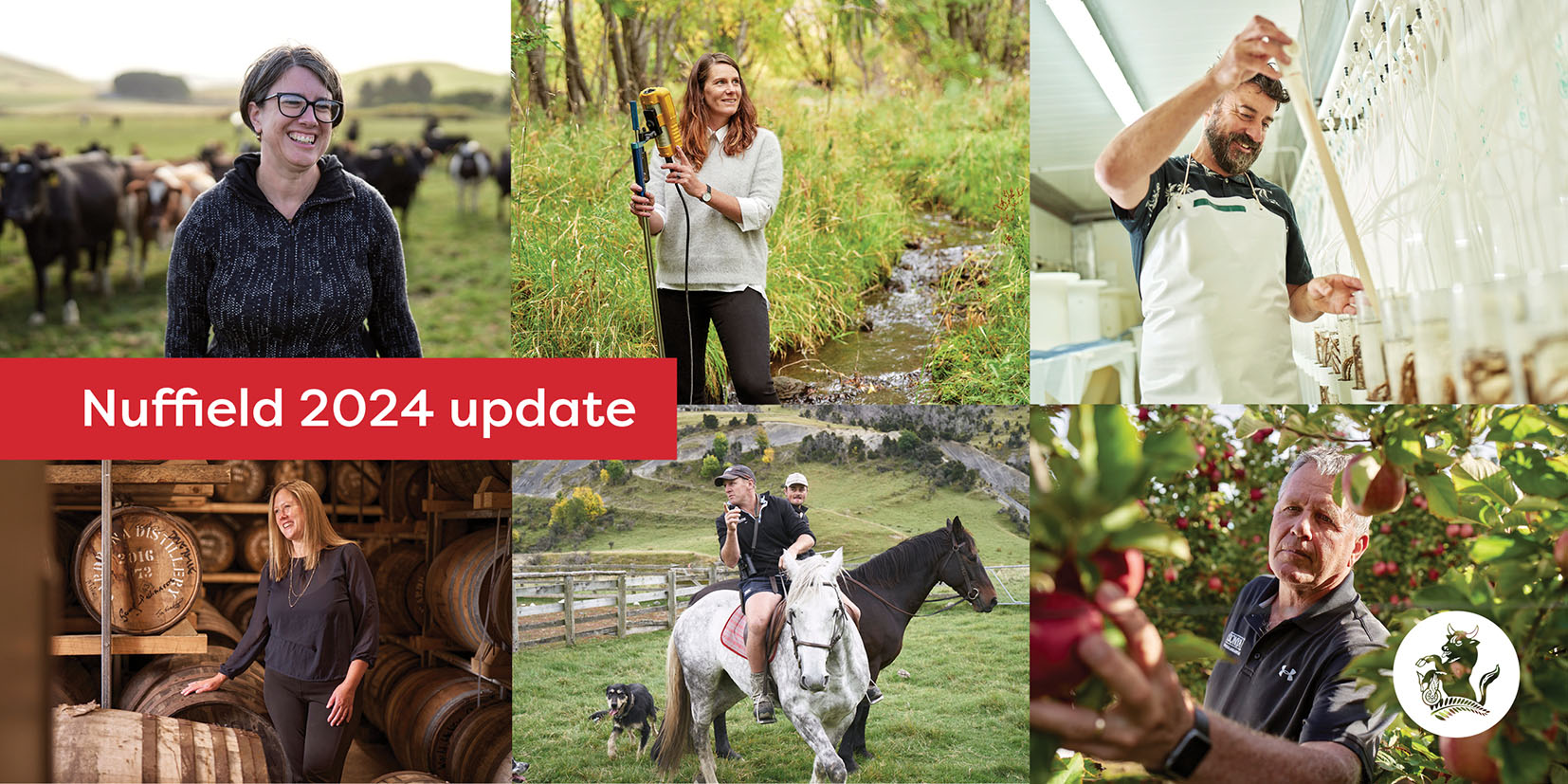
Alumni in the Spotlight – Alison Bentley, Hamish Marr, Wayne Langford, Tracy Brown, Cam Henderson and Ben McLauchlan.
Here are just a few of the media pieces covering the impact of Rural Leaders’ Programme Alumni in industries and communities across the sector. 
Alison Bentley, 2023 Kellogg Scholar.

Alison Bentley (Tikitere Farm) spoke yesterday at the event ‘Global and Local Approaches to Climate-Resilient Land Use: NZ’s Path Forward.’

Alison joined Angela Clifford (Eat New Zealand), in Session 2: Resilient Food Systems: Small-scale and Local? 

Alison and Angela’s presentation was titled, ‘Resilient Food Systems: small-scale and local?’

Keynote speakers at the event were: Ada Ignaciuk (OECD) and Katarzyna Zawalinska (IRWiR, Polish Academy of Sciences).

Head here to read a short article on Alison’s (and Angela’s) presentation.

While this event has been and gone the registration page has plenty of information about its purpose and the speakers. Head here to learn more.

Ben McLauchlan, 2020 Nuffield Scholar.

Marlborough wine producer and grape grower, Balvonie New Zealand, has released Marlborough’s first Prosecco from Glera grapes planted in the Rapaura sub-region.

The 2023 Balvonie Prosecco has been a three-year project for owners Ben and Helen McLauchlan, who first fell in love with Prosecco while living in the UK. The well-loved wine is made from a little-known grape called Glera, widely planted in Italy, but largely unknown in New Zealand.

Take a read of Balvonie’s Press Release here.

And more about the Balvonie Prosecco here (includes the all important tasting notes).

Tracy Brown, 2020 Nuffield Scholar. Cam Henderson, 2019 Nuffield and 2017 Kellogg Scholar.

Tracy Brown and Cameron Henderson have been confirmed as Chair and Deputy Chair of the DairyNZ Board, respectively.

Tracy Brown had previously been announced as Chair-elect in June 2024 when former Chair Jim van der Poel signalled his retirement from the role.

Take a read of DairyNZ’s press release here.

Hamish Marr, 2019 Nuffield Scholar.

In a recent REX podcast, Dominic George spoke to Hamish Marr about his role in connecting New Zealand agriculture with global markets.

Hamish explains how he navigates international conversations on sustainability, trade demands, and consumer preferences while advocating for New Zealand’s unique farming standards.

He highlights the importance of collaboration and adapting to global demands, offering a rare perspective on New Zealand’s role within the larger agricultural landscape.

You can listen to Hamish here.

Wayne Langford, 2014 Kellogg Scholar.

Federated Farmers national president Wayne Langford features in a recent Farmers Weekly article stating that both the general public and farmers are still unsure about what GE or GM means, and whether it is or isn’t already allowed in this country. 

In the article Wayne Langford says comments from farmers are generally positive and tend to be around meeting climate targets.

You can read the full article here.


Reimagining Local Economies: How Small-scale Farming and Community-based Models can Build Climate Resilience.

Alison Bentley (Tikitere Farm and 2023 Kellogg Scholar) spoke yesterday at the event ‘Global and Local Approaches to Climate-Resilient Land Use: NZ’s Path Forward,’ at Lincoln University. Alison joined Angela Clifford (CEO, Eat New Zealand), in Session 2: Resilient Food Systems: Small-scale and Local? 

As the effects of climate change and economic instability become harder to ignore, it’s clear that the current models of economics and land use are proving challenging. Enter Angela Clifford and Alison Bentley, two forward-thinkers who are shaking up how we think about local economies, food systems, and sustainable land use. 

Their ideas offer an alternative vision for a future where community-based economies and small-scale farming can not only help us better contend with climate crises but could also transform the way we live, eat, and work.

The Missing Link: Community-Based Economies.

Angela Clifford, CEO of Eat New Zealand, has been championing the power of local economies for years. In her view, traditional economic models are overly focused on macro-level concerns like national GDP, and micro-level issues, like business profits. But there’s a massive gap in between: the community economy. This often-overlooked space is where, Clifford argues, the real power lies, particularly when it comes to addressing environmental and social challenges.

For Clifford, redefining economic success isn’t just about how much a country makes or how many businesses thrive. It’s about creating systems that prioritise sustainability, local self-reliance, and social equity.

But Clifford’s vision goes beyond just localising industry; she sees a radical rethinking of food systems as central to building climate resilience. Despite the growing urgency around food security and sustainability, little has been done to strengthen local food systems, she argues.

Small Farms: Big Impact.

Alison Bentley, a small-scale farmer from Tikitere Farm near Rotorua, is proving that small farms can be a game-changer for climate resilience. Through her research with the Kellogg Rural Leadership Programme, Bentley has been exploring the role of small-scale farming, especially on plots of 10 hectares or less, in building a more sustainable food system. Unlike larger scale commercial agriculture, which can depend on chemical-intensive practices, Bentley argues, small-scale farming often works in harmony with natural ecosystems, fostering biodiversity and improving land use resilience.

“An increase in scale is more of the same to gain efficiency, whereas an increase in scope can give us diversity and resilience”, Says Bentley. In other words, rather than always pushing farms to become bigger and more industrialised, we should be looking for ways to diversify farming practices to build long-term resilience. By aligning farming methods with the natural capabilities of the land, small-scale farms could deliver more sustainable and climate-resilient outcomes.

One of the key issues Bentley identifies is the underuse of “lifestyle blocks”, small rural properties that often sit idle or are used for residential purposes rather than food production. In New Zealand alone, there are 870,000ha in such blocks on productive land, with 140,000ha on prime land. And just 10% of this land is run by landowners serious about producing a primary income from their blocks. The other 90%, if managed properly, could become a vital resource in strengthening local food systems and reducing reliance on large-scale agricultural exports.

Bridging Urban and Rural Food Systems.

But there’s a catch: connecting these small-scale producers to urban markets. As cities grow and sprawl outwards, rural land gets encroached upon, and small farmers face significant challenges in accessing urban consumers who increasingly want locally grown, chemical-free food. Bentley’s Kellogg research highlights a growing demand for this kind of food, but there are major obstacles to getting it to the people who want it, infrastructure, limited market access, and high transaction costs are just some.

Still, Bentley is optimistic. There’s a clear market for sustainably grown local food, and consumers are often willing to pay a premium for it. What’s needed is a rethinking of food systems that can help small-scale farmers tap into that market while overcoming the logistical barriers that can stand in the way.

A New Economic Framework.

Both Clifford and Bentley advocate for a new economic framework that goes beyond GDP and focuses on values like environmental sustainability, local self-reliance, and social equity. Clifford believes that, in the face of climate change, it’s more important than ever to build local systems that can withstand global disruptions. For Bentley, small-scale farming offers a practical way to increase food security, reduce carbon footprints, and create stronger communities.

While neither discount the importance of New Zealand’s food and fibre exports to our economy, they both argue that we do need to think differently about how we use land and produce food.

A Path Forward: Empowering Communities, Supporting Small Farms.

Together, Clifford and Bentley make a compelling case for reimagining the future of food and land use. Their vision isn’t just about protecting the environment or boosting local economies, it’s about creating a more resilient, equitable society where both people and the planet can thrive.

They conclude by stating that by empowering small-scale farmers, supporting community-based economies, and rethinking how we use our land, we could build a future where local food systems play a central role in creating more sustainable and just communities. Food for thought.

You can read more on the subject in Alison Bentley’s 2023 Kellogg Report here.

Esther Donkersloot on leading research into cooler cows.

In this podcast, Esther Donkersloot, 2024 Kellogg Scholar, talks to Bryan Gibson, Managing Editor at Farmers Weekly, about her research with LIC on breeding heat tolerant cows.

Esther came to New Zealand to do her Masters’ thesis and never left. Good thing too. Having studied at the prestigious Wageningen University, she has steadily built a career looking into better genetic outcomes for our dairy herd – especially as the planet gets warmer.

Along with her research at LIC, Esther discusses her Kellogg report insights on genetics’ social licence to operate.

Listen to the podcast here.

Bryan GibsonManaging Editor of Farmer’s Weekly.
You’ve joined Rural Leaders’ Ideas That Grow podcast. In this series, we’ll be drawing on insights from innovative rural leaders to help plant ideas that grow so our regions can flourish. Ideas that Grow is presented in association with Farmers Weekly.

Bryan Gibson, Managing Editor of Farmers Weekly.
You’re with Ideas That Grow, the Rural Leaders podcast. I am Farmers Weekly Managing Editor, Bryan Gibson. This week, our special guest is Esther Donkersloot, who is a recent Kellogg Scholar and works with LIC. G’day Esther, how’s it going?

Esther Donkersloot, 2024 Kellogg Scholar, Scientist LIC.
ED: Yeah, really good thank you.

BG: I usually start these conversations by just getting a bit of life history, I guess. Now, you’ve come a long way to your life in New Zealand and your role at LIC.

The Netherlands’ loss, New Zealand’s gain.

ED: Yeah, this was an overseas experience for six months that turned out to be a bit of a life move to the other side of the world. So, my background is Dutch. I grew up in rural Netherlands, and I was always very interested in doing my master’s thesis somewhere else. Just by chance, I ended up in New Zealand with LIC, and have been here for 10 years now. So yeah, it’s been great.

BG: I understand you went to Wageningen, if I say that correctly.

ED: Yeah, it’s a tricky one. Wageningen University research centre. It was very close to home for me, probably about 20ks away from where I grew up. I I studied animal sciences there. Wageningen University is our main agricultural university in the Netherlands. It’s a highly regarded university, and it’s all around food, sustainability, and environment studies.

BG: Yeah, I used to work at Massey University, and they had a lot of partnerships with that university, and I always wanted to go and visit because it just sounded like an amazing place, that food valley environment.

ED: It’s an interesting place because it’s actually a very small town that the University is based in. So the town is the University, and it’s the combined effort of the University side as well as a big arm for research, which is a great environment to learn in. Definitely look back at it very fondly.

BG: So you came over here to do your master’s?

ED: To do my master’s thesis yeah. In our master’s, we had the opportunity to either do two thesis or to do a thesis inside an internship. I did two thesis. So, it took away the opportunity to learn outside of the University. I was still keen to get my main thesis done in a company somewhere else. By chance, my professor did his PhD with our head of research at LIC, Richard Spellman.

So, I ended up with the chance to do my (main) thesis over here in New Zealand with LIC, on gestation length. And then from there, I just enjoyed it so much that I rolled into a temporary contract, then a fixed-term contract. Now I’m well and truly settled in.

LIC research into heat stress in cattle.

BG: I understand your role here now is related to heat stress in cattle.

ED: Yes. I started my career with LIC in animal evaluation, and then had a little time in our international team. I got the opportunity to travel around a bit and learn a lot more about dairy around the world. I then came back to the research and development team to lead the Slick Heat Tolerant Breeding Programme, which I’ve been doing for the last six and a half years, alongside my colleagues. Nothing in research is ever an individual piece. It’s always a team effort.

BG: Could you just tell us a little bit about the work you do and why it’s important? I mean, we know things are warming up, so I guess it’s finding ways to get genetic markers for animals that are more tolerant of the warming world.

ED: Exactly. We found the slick gene. The slick is a dominant gene that we found in the Senepol breed in 2014. It is originally a beef breed from the Caribbean. Then we started the breeding programme to incorporate that into our New Zealand dairy animals.

Back then in 2014, the focus was very much around the potential of this gene for international, knowing that a lot of our dairy still comes out of tropical environments, and this is a huge opportunity for growth.

Then when we started to focus a lot more on environment and climate change, we changed the breeding objective to focus on what this gene could do for New Zealand. Because especially here in New Zealand, where animals are outside 24/7, we don’t have the opportunity to shelter them so much from heat stress as they would be in barn-based systems. So the opportunity of having a genetic solution was just amazing.

So, we started incorporating it by just traditional breeding into our crossbred animals in LIC with the hope of launching this as a commercial product in 2029.

BG: Obviously, a lot of this stuff goes above my head, but I do know that when you’re looking at these genes for certain traits, the first thing you’ve got to look at is, does it cancel out other traits you’re after as well? Like, I guess, milk production and mastitis tolerance, that sort of thing.

ED: Yes, absolutely. I’ve been leading the breeding side, where we’ve been trying to dilute this beef breed that we got the gene originally from, into our dairy animals. We’re trying to get the genetic merit and the genetic gain up to be producing milk and getting all those traits that we require for our New Zealand dairy systems.

Then alongside, my colleague has been looking at the effects of this specific gene, not just on heat tolerance, because we know that it does create a benefit for heat tolerance, but also what could this mean to the cold sensitivity of these animals?

We’ve been doing some research ourselves as well as a project in collaboration with Lincoln University, to understand, especially in calves, when they’re born in winter here in New Zealand or very early spring, what this gene would mean to them. Because we know it did create a shorter hair coat.

We found there’s been no negative consequences to this gene, and we’re hoping to publish some of this data very early in 2025. It’s very important for us that we make sure that before we commercialise, especially knowing that we’re on a seasonal system here, once it’s out there, you can’t control what animals are being born. So, we need to totally understand everything we need to know about this gene and making sure there’s no negative consequences.

BG: Well, we look forward to reading some of your research findings and then seeing some of this technology hit the market.

ED: Yeah, it’s a super exciting project. Having being part of it now for this last six and a half years, we just see these animals produce more and more. It’s so exciting to follow them from the sideline and being able to do research on them in different locations in New Zealand.

Kellogg research into genetics’ social licence to operate.

BG: If that didn’t sound like a lot of work, you were part of the first cohort of Kellogg Scholars this year.

ED: Yeah. I was part of Cohort 51, and lucky enough to be there on an LIC Scholarship.

BG: Oh, nice. Tell us a little bit about what you focused your scholarship studies on.

ED: Yeah, that’s an interesting one. Being a scientist, doing social science in leadership is quite different to my normal day-to-day activities. But what I was interested in is this aspect of this term ‘social licence to operate’ and how that applied to my area of expertise, which is genetics.

I was keen to understand how people were, first of all, to learn from other technologies. Other examples of things out there that we can learn from how people discovered and built this social licence to operate. Then understanding how people felt about genetics and what that social licence looked like. That was the main focus of my Kellogg Individual Research Project.

BG: I’m a journalist, and that seems very newsworthy because in New Zealand we’re right in the middle of having a rethink of our gene editing laws. One of the big issues that we’re all grappling with is, even though you can do it, should you? That comes down to social licence. It comes down to the marketing of your food story and all that thing, doesn’t it?

ED: Yeah. Part of why I was really interested doing this is that I felt quite often that social licence or that public perspective always came in during the commercialisation stage, and not that much during the research stage. But especially when you’re in a cooperative like LIC, everything we do is returning value to our farmers. If it doesn’t tick that social licence box, we need to pivot.

For me, it was how do we bring that conversation all the way through our research phases, from brainstorming to commercialisation? And then how do we also keep a finger on the pulse? How do we understand that the market is reacting to when we have a product in market? Because as you know, things change.

We’re living in a world where everything is changing faster than ever. So we can’t just put a product out there and just assume everything is all right. So, how do we do that? And who do we involve? Who are our stakeholders? And how do we carry that as an industry? Big questions.

BG: Oh, big questions. Did you manage to come up with some insight about how the licence was going for genetic technology?

The Kellogg research insights.

ED: It was a big question. I only scraped the surface. But one of the things that, first of all, really captured me, all the stakeholders I talked to were very passionate about genetics. Everybody understands the value of it, and it’s something that’s a cumulative that we can create and maintain. But not everybody felt like they were part of the conversation. So there’s definitely work to do there.

Then it brought up a lot of conversations around New Zealand Inc. How can we collectively take responsibility of all the aspects of our dairy towards not just our direct community here in New Zealand, but also our consumers overseas? That was really fascinating. Also, one of the other things that came up was the term ‘trust’. How do we build trust? But also what level of transparency do we get down to?

As I said, I’m Dutch. I like to think I’m a very open and almost, oversharing person. For me, a big learning curve was that sometimes by creating almost too much transparency, you actually raise more questions, or you highlight probably the negatives a bit too much. How do you balance that?

By building that trust, having transparency, but not oversharing where you just create confusion. There was some really interesting learnings in there.

BG: I was going to ask that because you’re uniquely placed to give insight into things. The Netherlands is one of the big food tech, animal production powerhouses of the world. I guess the general population on the street probably has a pretty fair idea about what’s going on over there. I wondered how it differed from New Zealand.

ED: Probably not at all. I would think that there’s a closer connection here to our farming communities just because a lot more people live rural. There’s a real urban-rural divide in the Netherlands, where a lot of people probably wouldn’t really understand where their food is coming from.

Then for me as well, I was very interested in that stakeholder piece around consumer versus customer, versus your direct community. But because we’re an export country here in New Zealand, what does that look like and how do we do that? In the Netherlands, it’s similar. Here, people feel very connected to farmers. They see it on their way to school, they see it on their way to work. Probably not so much in the Netherlands.

Food security and farming systems – Netherlands vs New Zealand.

BG: That’s interesting. I guess another thing to think about is that because we export so much of our food, we kind of don’t have the same food security concerns that places like the Netherlands do, and who have relatively recent major issues in terms of keeping everyone fed.

ED: Absolutely. Animal health as well, and diseases, things like that. This is a very different ball game. That’s what makes it so fascinating to be here in New Zealand. Also just the seasonal pasture system, I think it’s absolutely fantastic what we’re doing here and how we convert our basics into profit.

But at the same time, it brings its own challenges. As I mentioned before, when we have a product like genetics going out and it’s being used in spring, next year, we get millions of calves, and it could be thousands of the same sire line, for example.

That brings very different complex systems with it than we have in Netherlands where you have barn-based systems and you get a calf every second or third day. It’s just absolutely fascinating to compare the systems and understand the strengths and weaknesses.

Connecting with the Kellogg network.

BG: How did you find the Kellogg programme on the whole? It’s quite a big deal. There’s a bit of work involved. Of course, you’ve got cohort of people doing it with you.

ED: You walk in that room the first day and you get really bad imposter syndrome. Being a scientist, I’m like, wow, there’s all these leaders here in the room, what am I doing here? But I think the beauty of Kellogg is not just the content and the amazing speakers you get, but it is that cohort.

Just being able to banter with others, understand what they do, what drives them, understand their farming systems or their organisations. Especially for somebody like me that didn’t grow up in this industry. It was really important to set those networks and understand a bit more about the drivers of other people on the course.

BG: You’re here in Aotearoa to stay, you reckon?

ED: Yeah, I am a permanent resident. I’m living just outside of Te Awamutu rurally, so absolutely here to stay.

BG: It’s been great chatting to you, Esther. All the best for the rest of your work there at LIC.

Thanks for listening to Ideas That Grow, a Rural Leaders podcast presented in association with Farmers Weekly.

For more information on Rural Leaders, the Nuffield New Zealand Farming Scholarships, the Kellogg Rural Leadership Programme, the Engage Programme, or the Value Chain Innovation Programme, please visit ruralleaders.co.nz

Beef + Lamb New Zealand and Rural Leaders renew partnership.

The New Zealand Rural Leadership Trust (Rural Leaders) is pleased to announce the renewal of its partnership agreement with Beef + Lamb New Zealand (B+LNZ).

Pictured: Lisa Rogers, CEO, Rural Leaders (left). Justine Kidd, GM Extension, B+LNZ (right).

One of the New Zealand Rural Leadership Trust’s (Rural Leaders) earliest industry partners is Beef + Lamb New Zealand (B+LNZ).  

The signing of a new partnership agreement between the two organisations aligns strongly with B+LNZ’s People and Capability Strategy focused on improving on-farm talent retention. Core to delivering on the objective of increasing the retention of people from their first day on farm to their third year is the role of on-farm leadership. Leadership that creates great work environments, communities and futures for people in the sector.

Justine Kidd, General Manager Extension, Beef + Lamb New Zealand, says, “On-farm leadership is critical to solving the challenge of our people’s future on farm. We are attracting enough young talent to the sector, but we aren’t holding them. Rural Leaders’ world-class delivery of leadership programmes supports our strategy, and we are looking forward to our continued joint effort growing great rural leaders across New Zealand.”

“B+LNZ’s partnership with Rural Leaders is a strong fit with two of our three investment pillars; ‘On-Farm’ focused on talent retention directly on farm and ‘Energising’ focused on growing leadership capability, celebrating and sharing stories of success.”, adds Justine Kidd.

To this end, B+LNZ recently announced farmers Richard Cameron and Natasha Cave would be the 2025 recipients of the B+LNZ Leadership Advancement Scholarships. They each receive full sponsorship to complete the Kellogg Rural Leadership Programme in 2025, along with mentorship from a B+LNZ leader aligned with their interests.

Lisa Rogers, CEO, Rural Leaders says, “The Rural Leadership Advancement Scholarships will become a flagship opportunity for the sheep and beef industry’s farmer-leaders. We look forward to playing a key role in these leaders’ development and future, both as people and as change-makers.”

The next available Kellogg places are for Programme Two 2025, 24 June start. Applications close April 13, 2025.

2025 Nuffield New Zealand Farming Scholarships awarded in Parliament.

Four Food and Fibre sector leaders were awarded 2025 Nuffield New Zealand Farming Scholarships last night in Wellington by Hon Nicola Grigg.

Rt Hon Christopher Luxon, Prime Minister of New Zealand, was also in attendance.

Hon Nicola Grigg announced the new Scholars as:

Dani Darke, King Country. (Farmer, Governance).
Dani, her husband Anthony and their three daughters, farm a 630ha sheep + beef operation in Aria, Waitomo.

“In a great rural community – farms grow many things, one of the most important is growing great humans”, says Dani Darke.

Dani is passionate about promoting sustainable and profitable farm businesses that support vibrant rural communities. “Rural communities make up the heart of New Zealand and I want to be part of ensuring this way of life continues for generations to come”, added Dani Darke.

After earning a degree in Agriculture, Dani embarked on a career in agri-banking and later was Livestock Manager for a meat exporter. An AWDT Escalator graduate, Dani has also held leadership roles including Chair of Beef + Lamb Mid-Northern Farmer Council, and in 2019 Dani served as Associate Director with Ospri. Dani is a Partner at Rural Coach and a Director with Ballance Agri-Nutrients.

Dani is interested in organisations supporting rural people and their communities and enjoys spending time with rural folk, and the ‘doers’ in our communities who make stuff happen. In her downtime, she enjoys tramping, horse riding, boating and skiing.

Alan McDermott, Golden Bay. (Business Owner, Entrepreneur).
Alan is founder of Pearl Pastures, which works with dairy farmers and finishers to produce rose veal from surplus dairy calves.

Pearl Veal is marketed to premier restaurants in New Zealand and internationally.

The business brings together many strands that are core to Alan – sustainability, human and animal wellbeing, and creating delicious food.

Alan is also a partner in AgriFood Strategy, a consultancy working with businesses and the wider sector on significant strategic issues such as sustainability, value chain performance, and establishing premium end-to-end value chains.

Alan led the collaboration that brought together farm assurance for the red meat sector and the development of the sector’s sustainability assurance programme. He recently worked with Headwaters on Lumina lamb, was a director of Red Meat Profit Partnership and has been involved in, and chaired, advisory boards for several other entities.

Alan grew up on a sheep and beef farm in the hills of Hawke’s Bay and studied at Massey University and now thrives in Golden Bay.


Jon Pemberton, Southland. (Farmer, Governance).
Jon, his wife Birgit and their 3 school-aged children, operate two dairy farms either side of Edendale, Southland.

Jon currently holds roles including, Environment Southland Southern Ward Councillor, Ag Proud NZ Chair, National Lamb Day steering group chair and committee member of Three Rivers Catchment and Edendale Aquifer groups.

Jon and his family try to make the most of any spare time they have by getting out and enjoying Southland. That can be doing anything from sea fishing and camping through to hunting and skiing.

Jon was highly motivated to apply for a Nuffield because of the engagement he has had with Nuffield alumni over the last few years. 

“They are often such critical and analytical thinkers – I’ve found this refreshing. The discussions I have had around the big challenges facing the sector that we need to address now and, in the future,”, Said Jon Pemberton.

Lisa Portas, South Wairarapa. (Agri-business).
Lisa is a South Wairarapa, regenerative sheep and beef farmer with her husband Kurt and their two boys. They have called the area home for 16 years.

At Palliser Ridge, Lisa wears many hats, as director, shareholder, and Expansion Manager. Lisa oversees diversification ventures, such as agri-tourism, exports, manufacturing, and managing both B2C and B2B relationships. A key part of her role is the creation and protection of the farm’s brand.

Lisa is passionate about sharing the farm’s natural fibres with the world, and a recent highlight has been securing contracts for their entire 40-tonne wool clip at prices that cover shearing costs.

Lisa is interested in taking a deeper dive into the strong wool space and to explore the international landscape.

Outside Palliser Ridge, Lisa also holds three directorships in tourism and manufacturing and delivers guest lectures on strong wool at Auckland University of Technology.

Congratulations to the recipients of the Nuffield Farming Scholarships for 2025, the 75th Year of Nuffield and Year of the Rural Leader.

The Nuffield Scholarships are funded by Rural Leaders’ Strategic Partners DairyNZ, FMG, Mackenzie Charitable Foundation, AGMARDT, and Programme Partners Beef + Lamb New Zealand, Ministry for Primary Industries, Farmlands, LIC, Rabobank, FAR, HortNZ, and Zespri.

Alumni in the Spotlight – Ben Todhunter, Jen Corkran, Paul Crick, Nathan Guy.

Here are just a few of the media pieces covering the impact of Rural Leaders’ Programme Alumni in industries and communities across the sector. 

Ben Todhunter, 2006 Nuffield Scholar.

Ben Todhunter is an experienced Angus breeder, and operates a Merino stud on his farm Cleardale Station. He was recently appointed to the Board of Angus Australia.

In addition to the skillsets mentioned, Ben also breeds Cleardale SX Fine Wool sheep and is a successful competitor in Mustering Dog Trials. 

You can read more in this short article from Angus Australia on the appointment.

Jen Corkran, 2023 Kellogg Scholar.

Jen Corkran, is a Senior Analyst for meat protein with Rabobank. Jen features heavily across several pages in the Sheep Country issue. Jen says the long term view for sheep meat is positive.

She says farmers can be assured that global sheep meat prices are past the bottom of the cycle. “I’m reasonably confident we won’t see less than $6/KG for some time”, said Jen Corkran.

You can read the full article ‘Green shoots emerging after a tough season’ here. (Scroll to page 20).

Paul Crick, 2015 Kellogg Scholar.

As we mentioned, the “Sheep Country’ issue of CountryWide featured many Kellogg Alumni.

Paul Crick, Independent Director of the New Zealand Rural Leadership Trust, featured in an article ‘Testing genetics in commercial hill country conditions’. Paul farms ‘Glenside Station’ a 850ha, 7700 stock unit operation with his partner Dayanne Almeida.

The Wairarapa property was formerly the Taratahi Farm Training Institute’s. Paul and Dayanne took control of the property in 2019 and with it the Beef + Lamb New Zealand Hill Country Central Progeny Test Flock (CPT).

You can read more about the work Paul and Dayanne are doing here – work underpinned by the philosophy,  ‘if you look after the individual, the flock will take care of itself’.

(Scroll to page 62).

Nathan Guy, 1999 Kellogg Scholar.

Nathan is Chair of the New Zealand Meat Industry Association and says that in a time of challenging conditions it is critical that we do not scale back on marketing – specifically the telling of our farmers’ stories.

You can read more from Nathan Guy here.

(Scroll to page 19).

Jack Cocks – How resilient farmers thrive in the face of adversity.

In this podcast Jack Cocks, 2021 Kellogg Scholar talks to Bryan Gibson Managing Editor Farmers Weekly, about his research into resilience in the face of adversity.

Jack faced his own adversity in the form of a brain aneurysm that sparked a recovery journey spanning 15 surgeries over six years. 

Jack works on Mt. Nicholas Station with his family. He shares the three things all resilient and thriving farmers have in common here.

Bryan GibsonManaging Editor of Farmer’s Weekly.
You’ve joined Rural Leaders’ Ideas That Grow podcast. In this series, we’ll be drawing on insights from innovative rural leaders to help plant ideas that grow so our regions can flourish. Ideas that Grow is presented in association with Farmers Weekly.

Bryan Gibson, Managing Editor of Farmers Weekly.
You’re with Ideas That Grow, the Rural Leaders podcast. I am Farmers Weekly Managing Editor, Bryan Gibson. This week our special guest is Jack Cocks from Mount Nicholas Station. G’day Jack. How’s it going?

Jack Cocks, Mt. Nicholas Station.
G’day Bryan. I’m good, thanks. How are you?

BG: Yeah, good. Now, you were part of the Kellogg Programme two or three years ago, and you focused on farmer resilience, which is obviously a very important issue, but you’ve got a special reason for doing that, don’t you?

Well qualified to share insights on resilience.

JC: Yeah, I stumbled into it. It wasn’t something I really intended to be studying or to get involved in. Probably something I probably couldn’t define 20 years ago, what resilience was. But my wife and I have been farming here for about 16 years. About 11 years ago, I had a brain aneurysm caused by a rare form of inflammation between some blood vessels in my brain. Almost died, expected to die, had a number of complications, got a lot of time in surgery, in hospital, and a lot of surgeries over the next six years.

Then out of that experience, I got told I was a resilient character for bouncing back from adversity, and I didn’t really think I was that particularly resilient, and I didn’t think I knew what I was talking about – talking about resilience to a group. I felt everybody faces adversity.

Kate, my wife, and I were talking about this one morning over breakfast, and she said, why don’t you do the Kellogg Programme and study resilience? So, that’s how I got involved in Kellogg and how I ended up studying resilience.

BG: Tell us a little bit about what you found through your studies and how it made you understand your journey better or relate to it, or see any difference there, I guess.

Thriving in the face of adversity.

JC: I wanted to figure out how resilient farmers thrive in the face of adversity, which I use as a definition of resilience, that is, their ability to thrive in the face of adversity. So, to answer that question, I found five farmers throughout the South Island who had all faced major adversity, and they’d thrived in the face of that.

I sat down with each of for two or three hours, and we talked about their life pre-adversity, what it was they’d gone through, and then how they felt they’d been resilient. Out of that, there were some very strong similarities across those five farmers that all unknowingly, and independent of each other, had done the same things to be resilient and get through adversity. It all came together quite nicely in a simple little model.

Purpose, why, and connection.

BG: Because I guess often, we think about resilience as a moral quality, if you know what I mean, like courage or something like that. But it seems what you’re saying is resilience is something that anyone can do if they have the tools or know the process.

JC: Yeah, very much so. It’s something you can learn. Some people will be naturally more resilient than others and able to handle adversity. But it is something you can learn. I guess the model that came out of my Kellogg project was trying to develop some tools that people could utilise in their own lives to be more resilient.

So, when they faced the next challenge, and we all face challenges. They’re able to better handle that and get through that adversity.

BG: What is the model?

JC: So, there was three things that these five farmers all did. They all had very strong purpose, so they understood why they were doing what they were doing, and they were all very good at keeping connected. So, they surrounded themselves with people who could help them through adversity, and they all understood their wellbeing, or what they needed in their lives to be well and to be happy.

It came together visually in the form of a triangle with purpose at the top. That’s the ‘why’, connection being the glue in the middle of the triangle. That’s the ‘who’. And then wellbeing as the ‘what’ at the base of the triangle. That’s what came out of my Kellogg project. I’ve since done a couple of papers with a friend of mine, Joanne (Jo) Stevenson, a farmer in North Canterbury, and Hamish Gow at Lincoln University, which we’ve talked about and published in different journals.

Telling the resilience story.

BG: Tell me a little bit about that process. Are you from an academic background

JC: No, not at all. I’m probably quite academic for a farmer. I’ve got a postgraduate degree, but the first one was for the Institute of Primary Industry Management that Jo and I did. And then the second paper was for the International Farm Management Congress, which Jo, Hamish and I put together, and I presented that in Canada.

I guess where that came from, and this was Jo’s idea, Bryan, but one of the things that really came through when I’ve done probably 30 talks over the last five or six years about my health story, and resilience and the outcomes of my Kellogg research.

One of the things that came through to me was that people really resonate with the stories, the individual stories, my story of what I’d gone through from a health perspective and these five farmers I studied in the Kellogg Project.

So, Jo saw this, she’s got a background in resilience and found that there’s actually a lot of literature that suggests we can build our own resilience through understanding stories, through the stories we build ourselves on how we’ve navigated adversity, and hearing stories about how other people have navigated adversity.

So, if I hear a story about how you’ve gotten through a financial challenge or a family challenge, or whatever, and been really resilient, that might in-turn develop my own resilience and say, Oh, actually, I know Bryan got through that challenge by doing this. He’s come through the other side really well, so that suggests I can do the same. That most recent paper that I presented in Canada was based around that.

Resilience in a time of rapid change.

BG: Having presented internationally on this, are places like Canada, other places doing this work as well? Do they have the same take on it?

JC: I think it resonated certainly with the audience in Canada. It really did. I think resilience is something that increasingly is needed by everybody in the world. I think something that resonates with people, is that we all face adversity and we all need to be resilient. It’s not just me, in my family that’s had a health challenge. Everybody goes through challenges.

BG: Sometimes you hear people say a focus on resilience means you’re adapting people to deal with broken systems, and perhaps we should deal with the broken systems. But that’s simplistic as well, I guess. There’s always going to be obstacles, challenges in front of everyone, and it’s having the tools in the toolbox to be able to deal with them. Is that something you’d agree with?

JC: Yeah, I think so. There’s a lot of interpretations of resilience. Sometimes it’s being tough. Traditionally, it’s been bouncing back from adversity. But people that work in the resilience field now think because adversity is so common and constant, we’ve had COVID, climate change, a cost-of-living crisis. We actually need to be able to thrive in the face of adversity rather than just bounce back. So, that’s the current thinking from people that are working in the field of resilience.

Resilience is our ability to thrive in the face of adversity. But it’s a word that gets used a fair bit these days, and that’s possibly misinterpreted and mis-defined.

BG: I guess that’s something important as well. You mentioned we have seen resilience as returning to whatever we thought normal was or what was beforehand as quickly as possible. But to have an enduring effect, it’s actually about doing the right things and coming out stronger and more able to cope. And that might take longer and might look different for different people, I guess.

JC: Yes. I guess these three strategies that I came out of this Kellogg research, the idea was that they’re applicable to anyone, be it a farmer, be it a health challenge, or be it a financial challenge, you can apply these. It’s important to be resilient, to have a strong sense of purpose, a strong reason why your dairy farming in the Manawatu makes it easy for you to recover from a flood, or sheep farming in the Wairarapa makes it easier for you to get through a dry spell if you’ve got that strong reason why you’re farming where you are. And then connection and wellbeing are really important as well. But those three strategies, I think, are applicable to all farmers and everybody.

A sense of purpose.

BG: Now you’ve done all this work, the Kellogg Scholar Report, other papers written, obviously presented around the place. How do you feel now when looking back before you did all this through your health issues? Did you do what you now put on the tin, so to speak?

JC: Did I achieve what I wanted to by doing Kellogg?

BG: No, it was more talking about how you got through your challenge. Did you do it in a way that you would now prescribe as the way to do it?

JC: Oh, yes. Yeah, I see what you mean. I guess I’d been okay or all right. I’d been connected with other people. I had a huge network of support, my family and friends that helped me through that health challenge. I was probably reasonably good at understanding my wellbeing and figured out what I needed to do to keep happy and well.

People have asked, were you depressed or did you suffer from depression? And I got pretty annoyed at times with being in hospital, but I don’t think I did suffer depression. Those two things I was probably not too bad at, Bryan. The purpose was something that came out of the Kellogg research. These five farmers all had that strong sense of purpose, and that’s something I’ve tried to put in place in my life since. And that’s been a really valuable thing.

Kellogg and life on Mt. Nicholas Station.

BG: Those five farmers, what were their challenges? Just to put some context around how this resilience method can be applied. What had they gone through?

JC: So, one was a health challenge, one was climatic, one was financial, one was family, and then one was grief, personal loss. So, the five typical most common forms of adversity that farmers face, not all forms of adversity, but five of the more common forms. These farmers were from Southland to Marlborough and scattered in between. So, a pretty good spread across different farming systems.

BG: Different types of people, too, different age ranges and that sort of thing?

JC: Yeah, probably 30 years difference in age from the youngest to the oldest.

BG: I guess it just goes to show that if you have the building blocks there about how to navigate these things, it doesn’t matter who you are, where you’re from, you can apply them to your own situation.

JC: Yes, absolutely.

BG: The Kellogg Programme itself, it seems like a lot has come out of it for you. What was that like for you, doing the work?

JC: It was a fantastic programme. It’s very well structured, it’s well organised and facilitated. Great speakers, great content, a peer group that you go through with. So, for me, it was probably… It sounds a bit flippant Bryan, but it was probably a life-changing experience for me because I’d been pretty well in my mid-30s, and then almost died.

I’d been on a walking frame and had to regain my speech and learned to walk again multiple times to get to the level where I was able to contribute and take part in that programme. But it’s a great programme. I can’t really say enough good things about it.

BG: How are things for you now, Mount Nicholas? Obviously, a lot of work involved there. Things going okay?

JC: Yeah, and I think it’s pretty good. It’s been a pretty good climatic season for us over the last 12 months. It’s quite challenging financially as it is for all farmers in the country or all businesses, all people in New Zealand at the moment. But yeah, climatically, it’s been a good season for us.

BG: And if prices go down a bit further or the snow comes in or whatever the challenges are, you’ve got the magic triangle to fall back on, I guess.

JC: Yeah, that does help. It certainly does help. I wouldn’t advise this at all, Brian, to anyone, but you’re having a life, a near-death experience certainly puts things in perspective. When things are a bit turning a bit pear-shaped, you’ve still got your life and your health and your family. At the end of the day, you’re going to have challenges. That’s what I’ve really learned over the last 10 or 11 years.

Thanks for listening to Ideas That Grow, a Rural Leaders podcast presented in association with Farmers Weekly.

For more information on Rural Leaders, the Nuffield New Zealand Farming Scholarships, the Kellogg Rural Leadership Programme, the Engage Programme, or the Value Chain Innovation Programme, please visit ruralleaders.co.nz

Alumni in the Spotlight – Kate Scott, Isabelle Coates, Matt Iremonger.

Here are just a few of the media pieces covering the impact of Rural Leaders’ Programme Alumni in industries and communities across the sector. 

Isabelle Coates, 2022 Kellogg Scholar.

In what is potentially a first (at least for a while), a Kellogg Scholar writes about a Kellogg Scholar.

Cheyenne Wilson 2024 Kellogg Scholar wrote an article for Farmers Weekly a few weeks back covering Isabelle Coates in the publication’s Rural Living series which highlights the people of Aotearoa’s rural communities.

Isabelle talks to Cheyenne about her work, mentorship and more. Isabelle is Muka Tangata engagement and partnerships manager.

Take a read of the Farmers Weekly article.

Kate Scott, 2018 Nuffield Scholar.

Rural Leaders’ Chair and Nuffield Scholar Kate Scott has been appointed chief executive officer of Horticulture New Zealand.

Kate Scott has been working in agribusiness for 20 years with strong experience in policy and planning and stakeholder engagement. Kate is also executive director of environmental consultancy Landpro, and is deputy chair of Thriving Southland.

“I am confident Kate will navigate the sector’s complexities and be able to unpick and understand the key issues while remaining focused on delivering results that will make a difference for growers and the wider horticulture industry,” Said Barry O’Neil, chair of HortNZ.

Kate has also written a piece for ‘Eating the Elephant’ in Farmers Weekly, September 16. 

Take a read of this article on Kate’s appointment.

Matt Iremonger, 2023 Nuffield Scholar.

“The New Zealand pastoral farming industries have a great opportunity to shift the dysfunctional bobby calf output to functional beef-on-dairy production”, 2023 Nuffield scholar Matt Iremonger believes.

“By shifting from a production-driven to a consumer-demanded beef-on-dairy value chain there is a prospect to enhance value and provide an opportunity for beef on dairy and the non-replacement dairy calf.”

Read the full Farmers Weekly article here.

DairyNZ and Rural Leaders renew Strategic Partnership.

The New Zealand Rural Leadership Trust (Rural Leaders) is pleased to announce the renewal of its Strategic Partnership agreement with DairyNZ.

This latest partnership renewal follows a long-standing relationship with DairyNZ that dates to 2017.

The new agreement means we can continue to help build stronger, more capable dairy industry leaders and in-turn contribute to meeting DairyNZ’s new strategic priorities: accelerating on-farm productivity, powering more adaptable and resilient farms, and enabling sustainable and competitive dairying.

Much of this is underpinned not just by world-leading research and advocacy, but also by fostering evermore capable leadership capability.

DairyNZ’s high-impact partnerships make the most of the Food and Fibre sector’s expertise, connections and strengths. They help to expand their knowledge, access greater resources, and ultimately better meet the needs of New Zealand dairy farmers. We’re proud to play a part in this positive and purposeful ecosystem of change.

The partnership supports Rural Leaders’ purpose to grow world-class leaders for our country. We do this by delivering several of the sector’s most highly regarded and trusted leadership programmes.

DairyNZ CEO, Campbell Parker’s involvement with Rural Leaders is often as a popular speaker on the Kellogg Rural Leadership Programme. During these sessions Kellogg scholars learn about DairyNZ’s strategy and enduring value to the sector. They also want to know about Campbell’s own leadership journey, experiences and insights.

Rural Leaders, like DairyNZ, believe dairy has a strong and positive future and we are proud to partner with this key organisation and the industry it supports.

(Pictured – Campbell Parker, DairyNZ CEO, and Lisa Rogers, Rural Leaders’ CEO).


Rural Leaders deliver food security programme for US Gilman Scholarship alumni.

Key food security programme delivered in US-NZ partnership.

‘Mission New Zealand – Navigating Geopolitical Tensions and Climate Change as an Agri-based Economy’, was a week-long programme delivered by Rural Leaders in Christchurch.

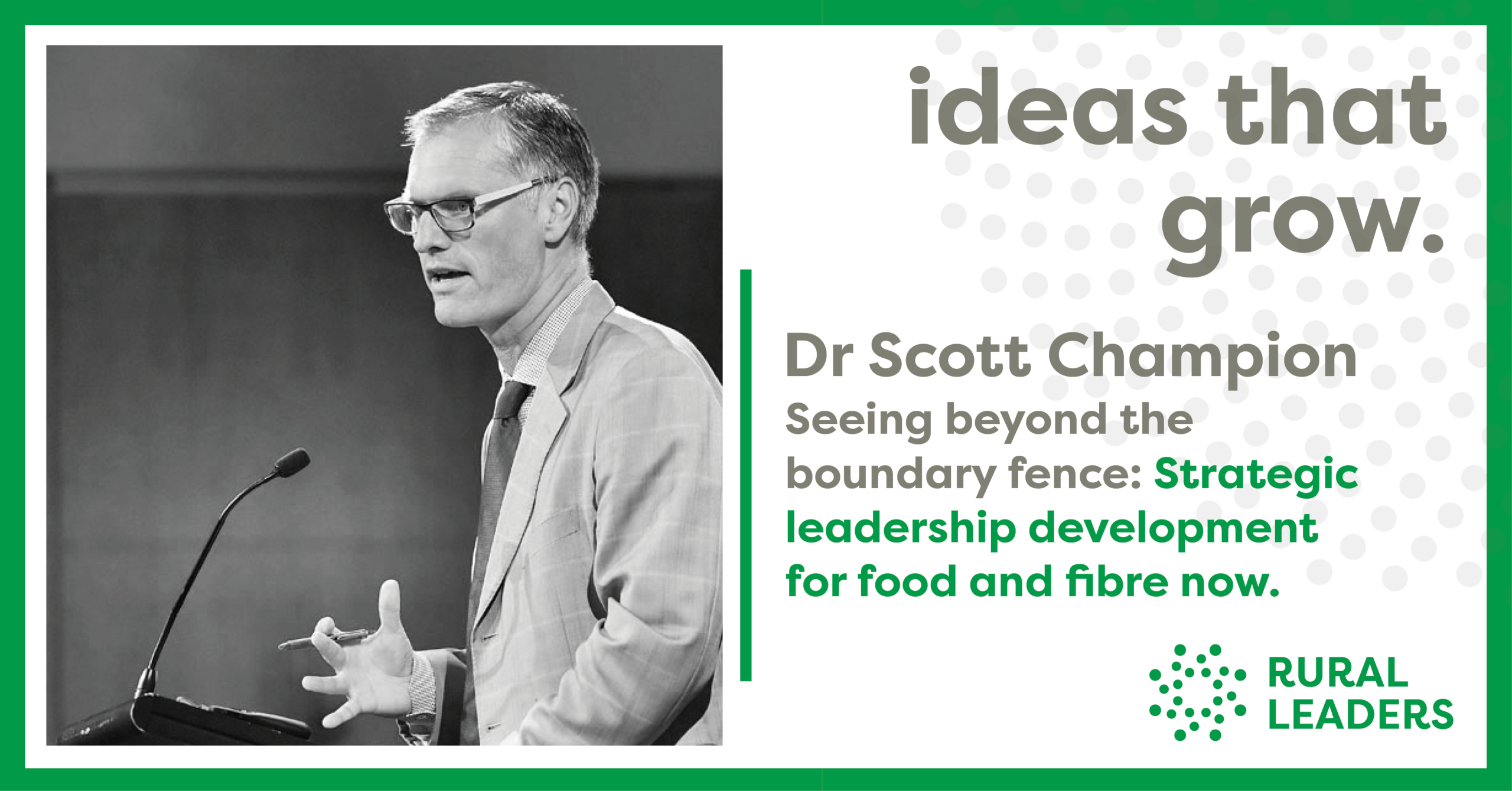
Facilitated by Dr Scott Champion, the programme was designed to give a group of 25 visiting Gilman Scholarship alumni a deep dive into global food security.

Participants gained insights into the policies, technologies, and adaptation measures that aim to secure the New Zealand agricultural sector and reduce environmental impacts.

The programme was an opportunity to explore New Zealand’s innovation and initiatives towards food security. It included modules on global food security, trade, food and fibre value chains, a NZ Government perspective on food security, a Te Ao Māori perspective, food safety, precision agriculture, as well as presentations from supply chain, biosecurity, regulatory, and sustainability leaders.

For Rural Leaders the programme represented the strengthening of an important relationship between both enterprises, and more broadly, between the US and NZ.

Lisa Rogers, Rural Leaders’ CEO said, “We were pleased to be asked to host and deliver this Global Food Security focussed programme for the Benjamin A Gillman Scholarship from the US.

The week provided the opportunity to showcase NZ Food and Fibre’s innovative and entrepreneurial approach to food production.

With presenters to the group including politicians, officials and innovative producers, the group of scholars had an immersive week within our Food and Fibre sector.

The opportunity to hear external view points about our sector and its food production systems was as invaluable as it was refreshing.”

For the Benjamin A. Gilman International Scholarship Program and the US Department of State, ‘Mission New Zealand’ has been a valuable cross-pollination of ideas and knowledge sharing, for food security and for the platform it has provided for discussing some of the challenges both countries face.

Gilman Scholarship Alum Darrin Vander Plas – REX podcast.

One attending Gilman Scholarship alum, Darrin Vander Plas (pictured above), took time to chat to Dominic George and REX online about what he and his colleagues learned on their trip to NZ, his role with the US Department of Agriculture Farm Loan Program in Maui and his time helping farmers in The Gambia and Uganda.

Darrin Vander Plas, from the US Department of Agriculture, is one of these people who has ventured over and he explains further what the goal of the trip is as well as some of the highlights so far.

Vander Plas, who manages the USDA Farm Loan Program in Maui County, Hawaii, highlights the resilience of Kiwi farmers despite the absence of government subsidies. 

Additionally, he discusses his experiences in The Gambia and Uganda, where he supported local farmers through various agricultural initiatives and his experiences during last year’s wildfires in Hawaii.