
2026 Nuffield NZ Farming Scholarship. Apply by 17 August 2025. Read More...

Apply for 2026 Nuffield NZ Farming Scholarship by 17 August 2025. More details...

Non-Financial Reporting: Generating Value and Improving Sustainability from Non-Financial Farm Information.

Executive summary

Background
The New Zealand agriculture industry is being challenged to prove food and fibre is produced in a way that is considered sustainable by their export markets and local community. This is leading them to question what sustainable production looks like and how they show this. Increasing levels of regulation also mean there is greater financial risk from non-compliance, and their stakeholders are asking them for more detailed non-financial information. Non-financial reporting (“NFR”) is a way to help businesses manage their nonfinancial
risk areas, meet trade requirements, and communicate effectively with stakeholders.

Aims & Objectives
The research project aimed to understand how farmers are using NFR to generate more value in their business, and how they communicate their non-financial information to stakeholders, with the research question being: “How do farmers use non-financial information to measure sustainability performance and report to stakeholders?” This is important as farmers need to be able to generate value for their business and themselves from NFR, instead of it just being an additional cost and compliance obligation.

Methodology
The methodology comprises of a literature review to provide context around the changes in NFR and the requirements of the sector, farmers, and stakeholders. This aimed to provide clearer understanding of what NFR is, why it is important for sustainable development and stakeholder relationships, and how it can be developed in a farming business. Qualitative, semi-structured interviews were used to obtain insights and findings from farmers and stakeholders concerning non-financial reporting outcomes and effectiveness, how
sustainability was defined, and whether integrated reporting would be useful.

Key Findings
Analysis of the themes arising from the literature and interviews found:

  • Non-financial information and reporting should be an important part of the business planning and strategy process, and integrating reporting with financial results can help to drive investment decisions.
  • In managing their banking relationships, farmers should also look to show their financial understanding of environmental implications and their financial investment in environmental/social sustainability in their budgets and financial results.
  • An important driver of sustainability is having good people employed on farm that understand how they contribute to farm sustainability.
  • While farmers are adapting to compulsory measures of NFR for compliance, and some are going above and beyond compliance, others are struggling to understand what these numbers mean for their business.

Recommendations for Farmers
1. Identify what non-financial Key Performance Indicators (“KPIs”) are relevant to your business and use these as part of your business planning process to help ensure these are effective.
2. Engage support from your trusted advisory team to help you implement effective non-financial reporting.
3. Provide balanced NFR alongside financial reporting to shareholders and financiers to help provide whole-farm focus in discussions around results.
4. Engage with employees effectively as part of the sustainability process, to build a sustainable culture on-farm that will help generate desired results.
5. Drive farmer-led benchmarking to understand where you sit on the sustainability bell curve.
6. Understand the cost of being an early adopter, and target investment in sustainable actions gradually that will help to set up long-term business resilience.

Recommendations for Stakeholders
1. Engage early with farmers as part of the pre-audit process to gain buy-in and engagement for compliance requirements.
2. Build advisor capability to help farmers with the sustainability journey.
3. Use technology effectively and invest in systems that reduce time and input requirements for farmers to report on sustainability efforts.
4. Support early adopters of sustainable actions, through either financial assistance, industry recognition, or market premiums.

Jemima Snook

Regenerative Agriculture: How might New Zealand benefit?

Executive summary

New Zealand agriculture is grappling with change as it seeks to find a new balance between feeding the world’s growing population while maintaining profitability and reducing negative environmental impacts.
There is a lot of doubt whether regenerative agriculture (RA) can provide a better way to address this global challenge and there is concern that it may increase emissions intensity, lower farm profitability, and struggle to feed the growing population.

RA is regarded by some as the solution to the global food crisis. Positive environmental outcomes can, in some cases, be achieved with the use of RA. High rates of carbon sequestration have been proven, albeit in depleted USA soils rather than in NZ.

RA is not well defined and there is a lack of scientific evidence backing some of its claims. Results from the system have proven to be unpredictable and highly variable. Some successful farm practices such as minimum tillage, avoiding bare ground, and using mixed pasture species are attributed to RA when in fact
they were used well before the RA concept emerged. These are already considered best management practices in a NZ conventional system.

There is evidence that greenhouse gas emissions and N leaching can be reduced on a per-hectare basis using RA. However, this appears to be achieved mainly through reducing inputs, resulting in lower production and farm profitability. When analysed per unit of production, these environmental gains were
much less apparent.

The benefits of altering soil microbiology are frequently discussed among RA communities. The claimed benefits have not been thoroughly tested and will require more research.

Some farmers using RA concepts say they are achieving similar levels of production with fewer inputs. RA systems must be tested over many years to see if any initial benefits can be maintained. For example, if high levels of soil fertility existed before changing to RA, these can be ‘mined’ for several years before production levels then crash.

This report suggests that, while there are positive aspects of RA, it is unlikely to match the productivity and profitability that can be achieved with conventional agriculture. If this is the case, RA may be able to reduce environmental impacts, but it will fail to help grow the food supply to meet the needs of the world
population increase or to maintain NZ export income.

If, as appears likely, that agricultural outputs such as meat and milk produced using RA methods have higher emissions intensity, there is a real risk for the farmers involved. Offshore customers for NZ agricultural products look very favourably at NZ’s low emissions intensity and demonstrate little interest in
NZ’s internal debate about sector-by-sector total emissions. Higher emission intensity products may be discounted in value. Further, NZ farmers will soon have to start paying more for their emissions. Improved efficiency and lower emissions intensity will be the key to viably adapting to this change.

NZ farmers and growers should note how RA has been used in marketing to obtain a “green premium”. The industry can learn from RA about leveraging these advantages.

Recommendations
1. Treat investment into regenerative agriculture with caution due to the lack of scientific evidence, and variation in its outcomes and likely reduction in farm profitability. This applies to farmers, growers, and processors.
2. Research the untested claims of regenerative agriculture. Particularly soil microbiology and the effect it has on plant growth. Such research is difficult to carry out at farmer level and will likely require input from CRIs.
3. Introduce practices such as minimum tillage, avoiding bare ground, and mixing low numbers of pasture species, to those farms that are not doing so already.
4. Develop marketing strategies for NZ food and fibre which leverage the consumer positivity associated with ‘greener’ farm practices. This will likely require input from both processors and industry-good organisations.

Kris Bailey

The Competition for Farmer Sentiment.

Executive summary

Sheep and beef farmer sentiment is profoundly negative, impacting how farmers view the world around them, how they respond to change and their mental health. The decline in farmer sentiment has coincided with a perceived increase in the competition for sentiment from industry representatives, lobby groups and advocates and has important ramifications for future industry cohesion.

This research project seeks to explore if industry leaders, representatives and lobby groups are further reinforcing and exacerbating negative sentiment by the way they are communicating with farmers and the potential future consequences of their approach.

This project first researched trends in farmer sentiment including the underlying drivers of sentiment, then sought to understand how and why industry leaders are communicating with farmers, including the use of social media. Finally, the project looks at future consequences arising from how industry organisations are competing for farmer sentiment and makes recommendations for industry leaders to consider when communicating with and attempting to influence farmers.

The methodology comprises a literature review; investigative interviews to uncover and discuss research on this topic; 16 semi-structured interviews with industry leaders, industry organisations and rural media; and an analysis of media releases and social media posts from industry organisations to understand the focus, content and engagement of their communications.

Key findings
Negative farmer sentiment is manifesting as decreased trust in government and industry representatives, increased fear and anxiety, and uncertainty for the future. Farmers feel threatened and consider they are not valued, understood, or listened to.

While industry organisations are not consciously competing, part of their approach is to use media and social media to underscore to farmers that they are being heard and supported, ensuring relevancy, attribution and ongoing financial support. This is resulting in the use of emotional language, topics and targeted campaigns that permeate fear and anxiety among farmers.

The methods and media channels used by industry organisations to influence farmers’ perceptions are conceivably exacerbating negative sentiment and distrust of these industry organisations, risking becoming counterproductive to their original objectives.

Moreover, this strategy could result in damaging consequences for the farming sector such as polarisation, cohesiveness, perception and social licence to operate.

Industry organisations are using social media platforms to connect to farmers, however, these platforms are designed to promote high levels of engagement, often through reinforcing divisiveness and polarisation. By using social media as an effective method to reach widespread audiences and contributing to messages of fear, uncertainty and anxiety for the future, industry organisations may unwittingly be creating an environment where disinformation and polarisation thrive.

Recommendations
Recommendations for industry leaders and organisations to consider when communicating with farmers to prevent further exacerbating negative sentiment and potential unintended consequences include:

• Consider the potential impact of communication on farmer sentiment.
• Model best behaviour.
• Create a safe space for industry discussion and debate.
• Develop communication strategies that bring farmers on the journey.
• Raise industry awareness of the presence and impact of mis- and disinformation.

Duane Redward

How might freshwater regulations provide certainty for farmers to innovate?

Executive summary

There has been a considerable amount of regulatory change in the freshwater space over
the last 15 years which has been difficult to implement for both regulators and farmers. Whilst
these regulations have lifted the bar on some practices impacting waterways it has also
created some uncertainty for farmers.

The purpose of this research is to investigate the relationship between changing freshwater
regulations and farmers appetite to innovate on farm to achieve freshwater improvements.

The aim of this research is to determine what impact changing regulation has had on farmers
adopting innovative freshwater management practices on farm, to understand the scope of
emerging and accepted mitigations to achieve freshwater outcomes through innovation
and to develop practical recommendations for how freshwater regulations can be drafted
to provide certainty to farmers whilst improving the quality of Aotearoa’s waterways.

The methods of this research project consisted of semi-structured interviews with dairy
farmers, a regulatory scan of current freshwater regulations under development, a thematic
analysis of interview responses and a policy assessment of options against chosen criteria
analysis to investigate how freshwater regulations can be drafted to provide certainty for
farmers to innovate.

The findings showed that further regulations for freshwater management are required to
implement the National Policy Statement for Freshwater Management 2020 within regional
plans by the end of 2024. An approach to freshwater management that meets the criteria of
flexible, enforceable, practical, and ambitious would provide certainty to farmers to
innovate and meet regulatory requirements. Three options of regulatory approaches were
analysed against these criteria: an input-based approach, a risk-based approach and a
catchment collective approach. The options analysis showed that a risk-based approach
which regulates through a farm planning regime like Freshwater Farm Plans is the most
effective way to regulate for freshwater management whilst providing certainty for
innovation. A mixed approach including input-based regulations and catchment
collectivism is likely to be needed to meet all objectives of the NPS-FM, however a risk-based
approach should be heavily relied upon by regulators.

The following recommendations were made in response to the research questions; How
might freshwater regulations provide certainty for farmers to innovate?

• Regional councils should utilise a risk-based approach to regulations including the
Freshwater Farm Plan scheme when implementing the NPS-FM 2020 in regional plans.
• Central government (in particular MPI and MFE) should support the implementation of
Freshwater Farm Plans in a way that ensures they are flexible, enforceable, practical and
ambitious.
• Political parties should avoid using freshwater regulation as campaigning tool, instead a
non-partisan approach should be taken with any further regulation required (relating to
freshwater) developed effectively outside of three-year political cycle.
• Farmers should utilise Freshwater Farm Plans to capture evidence of all mitigations
implemented on farm, including those that were innovative or early-adoption.
• Processors should continue to develop and integrate recognition programmes for good
practice and where possible provide a premium as a way to encourage and
acknowledge early adopters of innovative practice.

Anna Sing

Bridging the gap: Exploring the impact of musculoskeletal health on performance and injury risk in the Food and Fibre Sector.

Executive summary

Working in the food and fibre sector is undoubtedly renowned as a ‘manual’ career. Good musculoskeletal health is essential in allowing workers to move, without pain or restriction, in life and work. To ensure the longevity of their career, workers must have sufficient levels of musculoskeletal health to allow the physical capability and capacity to perform at work every day, now and into the future.

This research seeks to understand the nature and extent of work-related musculoskeletal disorders in the food and fibre sector and how musculoskeletal health may correlate with injury risk and performance outcomes. The aims of the research are to:

  • Review the nature and extent of work-related musculoskeletal disorders in the food and fibre sector.
  • Explore any potential correlation between musculoskeletal health, injury risk and performance outcomes.
  • Investigate sector understanding of injury risk factors.
  • Investigate how musculoskeletal injury risk is currently managed in the food and fibre sector.
  • Evaluate the potential benefits and barriers to adopting a more integrated and holistic approach to
  • managing performance and mitigating injury risk in the food and fibre sector.

The methodology comprises a literature review to form the theoretical foundation from which to compare and contrast qualitative and quantitative data collected through multi-method data collection. A three-stage process was created to engage with industry employees: an online questionnaire, enrollment on a health and wellbeing app called Symmio, and a follow-up online questionnaire. A three-stage process was created to engage with food and fibre sector leaders responsible for injury risk management, comprising of an online questionnaire, a semi-structured interview, and a post-interview follow-up online questionnaire. Data was also collected and analysed through a Functional Movement Screen in the wool harvesting industry. Results were collected and explored from the industry employees’ engagement with the Symmio app. Closed questions for the online questionnaires were analysed, and a thematic analysis approach was taken to look at the open questions from the questionnaires and the interviews.

Work-related safety is about creating a safe working environment, eliminating or minimising the risks at work that can impact a worker’s health. Data analysis shows that the proportion of work-related injuries attributed to musculoskeletal disorders is twice as high in the food and fibre sector than is demonstrated across the general population, with 60% of the overall burden of harm from work-related injury. However, work-related health is also about the way worker health may impact working safely; therefore, worker health and wellbeing are injury risk factors. Results showed the importance of musculoskeletal (MSK) health and its contributing factors in influencing future injury risks and that the presence of risk factors may have a detrimental effect on the performance and productivity of the workforce. Opportunities to design holistic and educational approaches into the workplace as standard protocol and as just part of ‘what we do’ was seen as a requirement.

Recommendations from this research were:

  • Co-investment is required from MPI, MBIE, WorkSafe NZ, ACC and industry good organisations to collaboratively resource the development of an over-arching strategy that bridges the gap between wellbeing and injury risk management. The strategy must align with the future Primary Industry Wellbeing Strategy.

To guide this strategy, further research is needed in the following areas:

  • ACC and WorkSafe should conduct research on the nature and extent of MSK health risk factors, pain, and movement dysfunction sector-wide using an evidence-based screening tool. Subsequently, objective data could be provided about sector-specific requirements.
  • Current government-funded injury risk management research projects should look to integrate evidence based screening tools into their data collection and intervention development process to provide objective evidence about the effectiveness of interventions.

Laura Hancock

How might Manawatū-Rangitīkei sheep and beef farmers futureproof their land?

Executive summary

Farmers adapt to the weather as part of their everyday decision-making on farm. Evidence suggests that, for New Zealand, the climate will change more significantly in the years between 2040 and 2090. How might Manawatū-Rangitīkei sheep and beef farmers adapt to the changing climate and futureproof their land?

The purpose of this report is to translate scientific climate modelling into practical contexts for Manawatū-Rangitīkei sheep and beef farmers and consultants.

This report aims to provide knowledge of:
1. Climate change predictions within the century.
2. What risks and opportunities are associated with climate change predictions.
3. What practical short to long-term actions could be considered that might future-proof farming businesses?

The methodology involved a literature review, followed by semi-structured interviews which formed qualitative research into futureproofing solutions.

The key findings are four climatic attribute changes to be aware of:
1. The frequency and intensity of drought.
a. By mid-century, a rainfall deficit of 50mm – 75mm per year.
2. The number of ‘hot days’ over 25oC.
a. By mid-century an increase of ‘hot days’ over 25oC, between 40% and 100% per year.
3. The frequency and intensity of adverse and compounding weather events.
a. El Niño and La Niña natural weather cycles exacerbated by climatic changes globally.
b. More severe adverse weather events, their frequency requiring more research.
4. An increase in temperature.
a. By the end of the century, an increase of 0.7oC – 3.1oC under the Representative Concentration Pathway’s (RCP) 2.6 and 8.5.

Recommendations to Manawatū-Rangitīkei sheep and beef farmers and consultants:
1. Use credible, trusted, and up-to-date sources of information to inform opinions about the changing climate.
2. Learn from advisors who collaborate closely with the scientific community and can translate data into meaningful, practical contexts.
3. Assess the current farming system concerning the top four climatic attribute changes and identify relevant, attainable, short to long-term actions, that may futureproof the business.
4. Build financial resiliency to be able to absorb hits and invest in futureproofing mitigation solutions.
5. Identify primary land use resources and their potential alternate use, if the existing system needs to change in the future.

Grace McLeay

What leadership characteristics are required for the New Zealand primary industry to achieve the transformational change required?

Executive summary

The New Zealand primary industry is operating in challenging times. There is much pressure for the primary industry to instigate change, with a level of tension not seen since the 1984 deregulation and removal of subsidies. The reality facing our industry is that time has been allowed to march on without enough progress having been made to address the global and national challenges upon us. New Zealand farmers and growers are no longer able to manage their business within the four pegs of their boundary in isolation. Instead decisions made inside the farm gate increasingly have consequences on others in our communities, district/region, and beyond.

This research considered what leadership characteristics are required to support the primary industry in bringing about change. The project explores case studies of transformational change that have been successful and/or which could have been carried out better and/or achieved more. The report also reflects on characteristics and examples of good and not-so-good leadership gained through semi-structured
interviews.

The aim and purpose of the research was to identify what leadership is and how it can facilitate or hinder transformational change. The research aimed to critically assess, compare and contrast characteristics of leadership which are displayed while undertaking transformational change. This type of reflection is important because change commonly has aspects that are unknown or ambiguous. Leadership, by virtue of its definition, is leading people to navigate ambiguity. This report provides insights and frameworks for tools to support leaders.

The methodology comprised a literature review, three case studies and semi-structured interviews analysed using a deductive approach. The research demonstrates the need to address challenging issues early in order to gain agreement as to the way forward, with collective buy in and a shared understanding around the urgency to change. For this to occur, the research demonstrates that people want to understand ‘the why’ and be ‘taken on the journey’ when being led.

Given the extent of the challenges facing famers and growers to make changes on farm, New Zealand farmers and growers deserve the best leadership. This project is important when considering the issues facing leadership within the industry, and seeks to challenge the status quo with a view to encouraging change and how we are leading our industry (across primary sectors) in these extraordinary times.

Recommendations;
1. The chair of the Board’s for Beef + Lamb New Zealand and Dairy NZ to conduct a review of their Director’s appetite to support leading change on climate emissions reductions jointly with Ministry for Primary Industries.
2. All of the primary industry levy bodies to implement a change framework, be transparent about what it is, and have accountability to achieve milestones, within a stepped process.
3. The Ministry for Primary Industries, in collaboration with levy bodies to survey farmers about what farmers and growers are seeking in terms of leadership, providing a foundation for opinions to be heard on these matters.

Brian Henderson

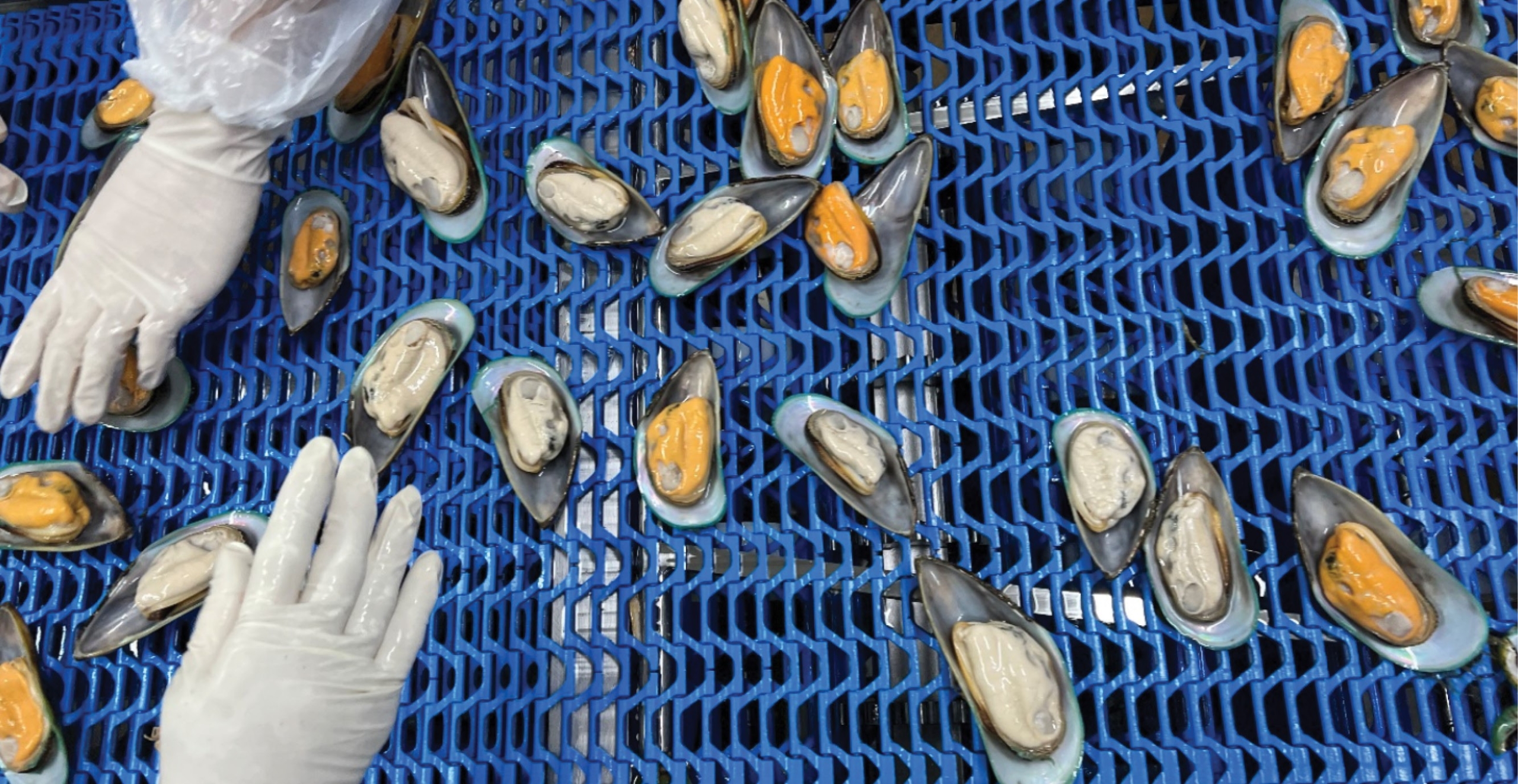
New Zealand Aquaculture Shellfish Processors and Third-Party Certifications.

Executive summary

New Zealand aquaculture shellfish processors face a deluge of options when considering whether to participate in any third-party certification programmes. There are countless third-party certifications on the market and numerous certifying bodies accredited to audit against these. It can be a difficult process to determine what, if any, third-party certifications will be most beneficial to individual New Zealand aquaculture shellfish processor operations and prove most valuable to their customers.

The aim of this report is to assist New Zealand aquaculture shellfish processors when determining what third-party certification is best for their operations based on current industry practices, consumer opinions, and by providing an overview of the most prevalent third-party certifications.

Third-party certification participation can be a costly undertaking for an operation (both monetarily, and in time and resources), and often with ambiguous return for investment.

Thematic analysis has been undertaken of customer and processor questionnaire responses, semi-structured
interview findings, and literature review.

The report identifies the most widely used certifying bodies operating in New Zealand, and explores the most prevalent and customer preferred third-party certifications. Customer opinion of third-party certifications, certifying bodies, and New Zealand base standards are evaluated. New Zealand aquaculture processor certification status is investigated, addressing why they have chosen their current certifications or do not participate in third-party certifications if that is the case.

Other processor aspects explored are satisfaction with their certifications, how these are used, approximate
costs of achieving and maintaining, and knowledge of other certifications.
Key findings:
1. Third-party certifications are not essential for a processor’s success, but customers who purchase large volumes of products annually are likely to require suppliers to hold some form of third-party certification.
2. New Zealand’s base requirements are highly regarded internationally. In many cases, customers are willing to accept company policy documents in place of third-party certification for the food safety and ethical employment aspects of a processor’s operations.
3. Most leading certifications incorporate ISO management systems principles, are Global Food Safety Initiative (GFSI) benchmarked, and many share a large portion of their requirements.
4. The cost involved and doubtful return on investment is the leading factor in a processor choosing not to participate in (or looking to change) third-party certification.
5. The decision of a processor to participate in a third-party certification and which is chosen is often driven by their customer requirements.

Recommendations (all aimed at New Zealand aquaculture shellfish processors):
1. Develop a company policy document outlining food safety systems (RMP and HACCP etc.) regularly audited by MPI.
2. Develop a company policy document stating a commitment to compliance with New Zealand employment law.
3. Before selecting any third-party certification programme processors should speak to customers to determine whether they require their suppliers to hold these.
4. If customers require third-party certification inquire what their preferred certifications are, then investigate these certifications to determine if they are suitable for the processor’s operations.
5. Consider whether individual certifications align with company values, if they will assist in achieving company objectives, and what is the organisation trying to accomplish by participating in the certification.
6. When selecting a certification standard consider what aspects of operations it covers, a certification covering multiple aspects is often a better option.
7. Seek quotes from several certifying bodies when considering adopting a certification standard as some may prove a more cost-effective option than others.

Emily Clark

Mel Poulton – Transformation before transaction: The potential of NZ’s Food and Fibre IP.

Mel Poulton is a farmer first and foremost, running a sheep and beef farm based in the Tararua District. She is also finishing her tenure as New Zealand’s Agriculture Trade Envoy.

Awarded a Nuffield Scholarship in 2014, Mel completed her research on
Capturing Value: Building a sweet spot between trade negotiations, market access and the exports of expertise.

Listen to Mel’s podcast above or read the transcript below.

Bryan GibsonManaging Editor of Farmer’s Weekly.

Welcome to the ‘Ideas that Grow’ podcast. I’m Bryan Gibson, Managing Editor of Farmers Weekly. This week I’m talking to agricultural trade specialist and farmer Mel Poulton. Now, you were a Nuffield scholar in 2014, is that correct?

Mel Poulton 
– 2014 Nuffield Scholar, farmer, Special Agricultural Trade Envoy.
Correct.

BG: I understand you did your Nuffield Scholar Report on agricultural IP and how to best send it out into the world and also get the best value for it. Can you tell us a little bit about what you found out?

The untapped potential of New Zealand’s agricultural IP.

MP: At the time, as a food producer and somebody who, through our levies was investing in New Zealand science, research, and development for New Zealand farming to give us a competitive edge in the world, it was a concern to me to hear that our IP was being effectively given away in the hope of an FTA for market access. That was how I was certainly interpreting it at the time.

I spent a bit of time traveling to different nations around the world looking at IP trade, market access, and looking at what went well and what didn’t, what could we learn from that, and is this even a good idea for New Zealand? I came back with the conclusion that actually, given who we are and what we do and our constraints, leveraging our IP is a really good strategy for New Zealand.

But I wasn’t convinced that we were doing it well, and I felt like we needed to better value or recognise our IP, value our IP, package our IP, and then be able to leverage value from it, not just by way of the hope of market access through an FTA, because we’ve seen in recent years what can happen with economic coercion and suddenly markets being closed to us. 

Food and Fibre’s intellectual property opportunity.

So, if you end up giving away your IP and then those markets close, what have you got left? Some people might disagree, but I think that’s a relevant concern that New Zealand needs to be really mindful of with regard to its strategy and how it navigates its way in the world and how it leverages its IP.

How do we do it in such a way that those that have invested in that IP can extract value from it, short, medium, and long term, for the good of New Zealand and for the good of our Food and Fibre Sector and our people who have invested.

BG: A better strategy needed on the intellectual property front. Very good. Now, of course, you’re just finishing up a term as the Special Agricultural Trade Envoy (SATE), which means in terms of market access and trade deals and the world food system, you’d have widened your scope on things to more than just intellectual property, to food itself. But are there similar themes at play there as we try and extract value from our agricultural sector.

MP: There’s an enormous amount of opportunity for us to extract value from our IP in ways that we haven’t really considered before, or broadening it a whole lot more than what we do. Thinking about that in the context of a growing global population with a real concern around food security and even more importantly, nutrition security.

Then given the challenges of climate change and the environment and the constraints that’s putting on food production in different parts of the world, I feel confident given what I’ve seen in recent years and the travels that I’ve done both on my Nuffield Scholarship and since then as SATE for New Zealand. I think there’s an enormous opportunity for food production to increase in many parts of the world and especially those countries with developing agriculture. I think there could be small changes made that generate big gains.

Working together with developing agricultural nations for mutual benefit.

Some of these countries with developing agriculture have potential to really lift production. Whereas New Zealand and parts of Europe, for example, feeling more and more constrained as to how much more food production they can actually lift.

The talk is that New Zealand feeds 40 million people. Well, that’s barely feeding one city. Mexico City itself is 40 million people. When you think about the scheme of things in our place in the world, how do we strategically position ourselves to be good in the world and good for the world and continue with a transaction strategy that grows really awesome food and beverages that are highly nutritious and safe?

And also has the integrity behind it with regard to environment and climate and all the other factors around labour and all of the environmental, social, and economic factors that make up the back story to our product.

So we’ve got to be able to have that integrity, but also recognise what our potential for lifting things further for New Zealand. How do we leverage off the strengths that we have as a nation? I think there’s huge potential to be able to work with, learn together with, and build together with, other countries with developing agriculture and leveraging our IP, but not selling it as it is, but leveraging it and adapting it to create something new.

BG: So, it’s far more than just selling a product or an idea and leaving it at that. It is working with the people on the other end of the transaction long term.

A shift to transformation before transaction.

MP: Well, it’s effectively transformation before transaction. If you were to put value on or weighting on it, historically, we’ve had a transaction approach to things. I think there’s still a future for us in that because we grow and sell food to the market – that earns us revenue. I think it’s going to be for the growing needs of New Zealand and the economic growing needs of New Zealand, that we need to figure out how we grow further.

If we’ve got constraints here, then how do we grow together with others being good for the world and good in the world? It’s actually going in there with humility and saying, well, we’ve learned some stuff in our context, we recognise that you’re operating in a different context, we understand you’ve got goals and vision for growth for yourselves, so how can we work together, learning from our IP and a principles approach, to develop something entirely new that could actually help you achieve your goals and help us achieve our goals.

BG: That makes sense. In a finite environment, if one sector has reached their limit, then the only logical place to go is to help others up their production to a level where they can sustain themselves better. 

Further trade ties with India and the role of humility.

MP: I was just in India a short while ago, and they really want us to be investing there. The challenge for New Zealand is that we’ve got stories, we’ve got examples, we’ve got experience investing in other countries. Some of the challenge around that is sometimes we’ve gone in a little bit proud and arrogant, taking a copy and paste approach that hasn’t necessarily worked because you’re operating in a completely different system, a completely different environment, and operating context.

Copy and paste won’t work. It won’t work in many countries because New Zealand is unique in that it is an island nation, small, tight-knit ecosystem, driven by a temperate maritime climate. Just copying and pasting that, there’s very few places in the world you can do that in. That’s why we’ve got to shift our thinking to learning, growing and working together with others to create something entirely new that works in the operating context for them and also works for us.

BG: When you read about the possibilities of doing more trade with India, quite often the first thing you hear is, ‘yeah, but they won’t take our dairy products’. And so deal’s off the table. But I think what you’re saying might be that it’s a bit more nuanced than that, and there are things we can do and we should be doing?

MP: It’s most certainly more nuanced than that. I suppose my take home message from my time in India is – there’s a bunch – the first one is, we really do have to conduct ourselves with humility. I think from those that I engage with in India, they have an allergic reaction to anything remotely arrogant, remotely hinting of a colonialism approach. So, if we even begin to think that we can conduct our way without humility and without deep, deep respect and without a hunger to learn and understand and focus on building relationships, I think we’re going to go nowhere fast.

At the same time, they really do want to grow. They’re grappling with some big challenges, and they’ve got enormous potential to lift by doing small things really well. Talking to the Indian High Commissioner to New Zealand, they really do want us to be investing there.

But again, this is where we’ve got to be thinking about a broader picture than just a single process investment. We’ve actually got to be thinking about how do we grow the whole ecosystem. It’s government to government, industry to industry, farmer to farmer, company to company, people to people.

It’s building all of the ecosystem that is an Indian centric one, or whatever country it might be in the world, something that really works so that whatever investment we do there, it’s going to be successful. But we can be guaranteed it’s not going to be a copy and paste of what we see here in New Zealand. We have to completely shift our thinking altogether.

BG: Now, I mean, our food production ecosystem here in New Zealand is pretty well developed and pretty really well thought of, do you think it’s well placed to meet some of these global challenges?

The value of New Zealand’s Food and Fibre ecosystem and its people.

MP: I have no doubt in my mind that one of our greatest strengths and most undervalued strengths is our ecosystem. By that, I mean all of the folks that are working for New Zealand and in New Zealand companies and the Food and Fibre Sector offshore, including our diplomatic teams. I think we’ve got amazing people in the MFAT and MPI and different government ministries who are working hard for the success of our sector offshore when they’re engaging on the certification and standards and all sorts of things.

We’ve got great people across our sector, good organisations who are absolute experts in doing things that food producers wouldn’t even dream of doing. These people are technically competent, highly skilled, and very effective at their job. Then we have all the folks working in our industry good organisations. You’ve got all the processors, exporters, packers, all exceptionally good at what they do for our sector. Then we’ve got all of our service sector too. No farmer would be able to operate without our service sector.

Then underpinning the whole lot is the science, academia, and research that goes on, that’s delivered the knowledge over the years. We’ve got to keep investing in that science, research, and development because they underpin our success. Then without the food producers themselves who are innovative, creative, solutions focused, businesspeople who are juggling so many variables and navigating their businesses without subsidies, to generate revenue for New Zealand. It’s just an exceptional ecosystem that works together.

The ecosystem is tight, it’s well linked, and relative to similar ecosystems in other countries, New Zealand has something special where we can turn on a dime, we can make decisions, and we can react and can also pre-empt and get ourselves on the front foot to capture opportunities globally as well. I think that was most recently best demonstrated through COVID – just watching how the whole ecosystem came together to navigate it. I’m not saying it was easy. But relative to other countries, New Zealand navigated that well. Our sector navigated it well. There’s a lot we can be proud of about that.

Staying nimble, flexible, and adaptable in a fast-changing world.

BG: And as we know, there are a lot of other shocks around the world now that need to be navigated. So it looks like it’s all shoulders to the wheel again, isn’t it?

MP: It’s all on. What we’ve got to work hard to do is make sure the top two inches of our thinking and our head space is in the right place, make sure we’re positive, we’re constructive, we’re focused on the priorities, we’re rational and logical in the decision making that we’re doing. That we’re taking an integrated systems approach to it, and that we stay nimble, flexible, and adaptable.

Sometimes life happens where a shock is something you can bounce back from. Sometimes it’s a shock where things are forever changed and it’s never going to be the same again. That’s where we’ve got to have plasticity, where we’ve got to be able to be sure of our core values, who we are, what’s important, and be able to reshape ourselves to be optimally placed to navigate what’s in front of us.

A Food and Fibre Sector under the pump.

BG: So, Mel, we’ve been talking about big picture issues for global farming, how does that square with what New Zealand farmers are facing at the moment? How will that work for them?

MP: I suppose when we’re talking about a big picture strategy for New Zealand, we really need to be thinking about how we strategically position ourselves on the global stage in the long term in such a way that we try to deliver short-, medium-, and long-term return back to New Zealand. We’ve also got to acknowledge the fact that right now, there are many farmers, food producers, packers, exporters that are really under the pump big time right now, especially those that have been hit by the weather.

There are folks down in Ashburton and West Coast that are still recovering from the damage that they sustained in recent severe weather events. We’ve got to be mindful that people are under enormous environmental, social, and economic pressure right now.

We need to keep in mind that when we discuss these big picture strategies, we’ve got to be able to look after our people, look after our businesses, look after our environment with the here and now. And how we build the recovery to be able to be best positioned from a market facing point of view, but also just how do we find our place here in New Zealand in this new operating context we’re in at a domestic level, but also at an international level too.

There’s a lot of balls that we’re juggling and it’s complex. I suppose my point really is it’s all fine and well talking about big picture strategy, but we’ve got to look after the people and be acutely aware that we need to be able to get the support, the enabling infrastructure, the enabling business environment, and context to be able to help people recover and stand back up.

Remoulding and reshaping to fit a changed environment.

In some cases, that whole plasticity piece, we do have to remould and reshape, and that might look entirely different to what it was in the past. Because in some cases, with some life events it’s never going to be the same again.

So we need to be giving people scope and space to be able to remould, reshape and create something that is still true to its core values, but looking quite different because it’s in a different operating context – it can’t go back to what it was before.

BG: Thanks for listening to Ideas That Grow, a Rural Leaders Podcast in partnership with Massey and Lincoln Universities, AGAMRDT and Food HQ, this podcast was presented by Farmers Weekly.

For more information on Rural Leaders, the Nuffield New Zealand Farming Scholarships, the Kellogg Rural Leadership Programme, or the Value Chain Innovation Programme, please visit ruralleaders.co.nz

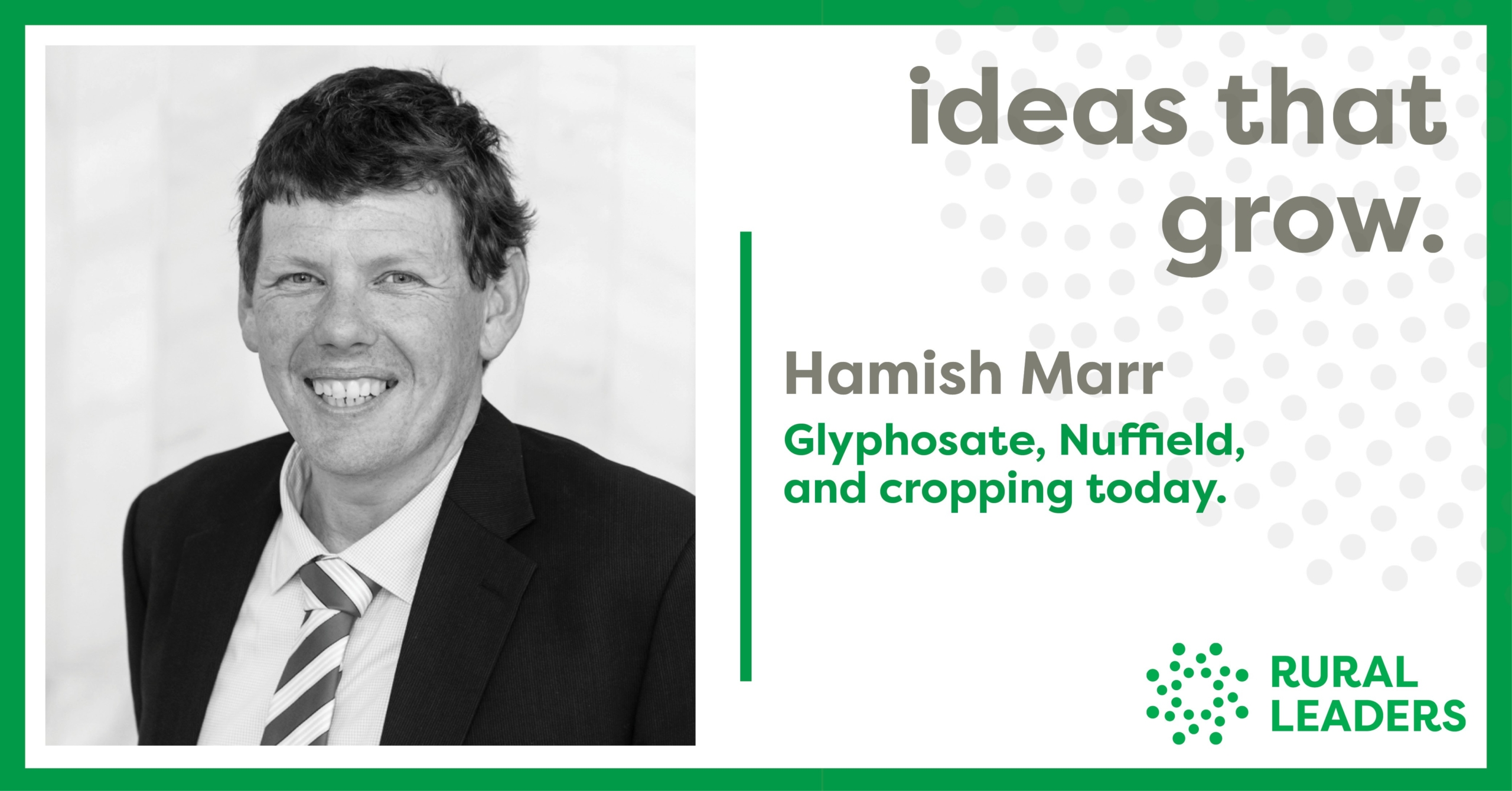
Hamish Marr – Glyphosate, Nuffield, and cropping today.

Hamish Marr is a fifth generation mixed arable farmer from Methven, Canterbury. He received a Nuffield Scholarship in 2019, completing his research on the topic
Can we farm without glyphosate?

Hamish is Vice Chairman of the New Zealand Seed Authority and is involved in two groups at the foundation for Arable Research, the Research and Development Advisory Committee, and ARG – the Arable Research Group here in Mid-Canterbury. 

Listen to Hamish’s podcast above or read the transcript below.

Bryan GibsonManaging Editor of Farmer’s Weekly.

Welcome to the ‘Ideas that Grow’ podcast. I’m Bryan Gibson, Managing Editor of Farmers Weekly. With me today is Hamish Marr. G’day, Hamish, how’s it going? 

Hamish Marr – 2019 Nuffield Scholar and mixed arable farmer.
Good thanks, Bryan.

BG: And where are you calling from today?

HM: I’m calling from Methven, about an hour, southwest of Christchurch. Lovely winter’s day here.

BG: And you run a farming operation there?

One farm, five generations of farmers.


HM: Yes, we’ve got a 500-hectare mixed arable farm, 400 hectares of different cereal crops and small seed crops, and we have pasture enterprise on the side of that. So, we run dairy heifers twelve months of the year, and we have finishing lambs in the autumn and dairy cows in the winter.

BG: How’s the year been for you so far?

HM: Well, it’s been mixed. I mean, we had a tremendous harvest with great weather at harvest time and good yields across the board, and a pretty good autumn. So Canterbury is flush with feed this year as opposed to other seasons just gone.

BG: That’s good to hear. And have you been doing that for a while?

HM: Yes, our family has been on our place since 1873. I’m the fifth generation. If any of my children decide to carry on, they’ll be 6th generation. So, you were here for a wee while.

BG: It’s great to see a farm that’s handed down through the generations and is still thriving.

HM: Yeah. I mean, me personally, I did a BCom Ag in the late the late nineties. And then was a Field Officer for Ravensdown Fertiliser for four years and then came home to the farm in about 2005. So, I’ve been farming not quite 20 years now.

The Nuffield experience.

BG: You were a Nuffield Scholar a couple of years ago. How did you find that experience?

HM: Look, there’s probably not words that can describe it.

A once in a lifetime, life changing, very humbling, eye-opening, eye-watering year of my life. Looking at everything in food production, how we live, farming and politics and everything in one year, it was amazing. Fascinating. I think you ask every Nuffield Scholar; they would say the same thing – beyond their wildest dreams.

Glyphosate use in New Zealand.

BG: Now, your studies focused on the use of glyphosate, which is often a contentious issue in agriculture these days, isn’t it?

HM: Well, it’s very contentious, and that’s the reason why I chose it. I chose it because it was in the news a lot at the time, and there were rumours in New Zealand and certainly around the world, that it was going to be deregistered.

Our farming systems, certainly the farming systems in Canterbury here, and most of New Zealand, where the use of Roundup underpins how we do things and how we move between pastures and crops. If we took that away, it would completely change the way we do things. I wanted to understand how our production systems would look if we were to do away with it.

BG: Obviously, as part of your studies, you do a bit of travel abroad. What did you find out about how different nations use glyphosate around the world?

Glyphosate use overseas.

HM: I spent a year looking at farming systems all around the world, and I hate the term conventional farming, but I looked at conventional farming: organics, regen Ag and inverted commerce, rice farming, horticulture orchards, vegetable production, indoor animal agriculture, extensive and intensive farming all around the world.

There’s a whole lot of conclusions, and the first one is that everywhere you go around the world is different. New Zealand is unique in the way we do things. Unique in the fact that we’re dominated by animal agriculture.

Our animal agriculture is predominantly outside, so the animals go to the food, as opposed to many countries where the food goes to the animals. Because those countries are cutting and carrying feed to animals, their systems are predominantly arable based. By very nature of that, the usage of Roundup compared to what we do here in New Zealand is significantly higher.

We have a real point of difference in this country. If you think about the Roundup story in isolation, we don’t use a lot of it just because of the way our farming system is. And also, the fact that our farming systems are pasture based is, again, another point of difference compared to a lot of other places.

BG: Do you think it’s one of those situations which quite often comes up when global conversations around food production make their way to New Zealand, that we’re not really part of the mix because we have our own way of doing things?

Glyphosate application rates in NZ compared to abroad.

HM: Yes. Look, I visited a place in the UK, a large place, and this was a lightbulb visit for me. They reduced their glyphosate usage on this farm. Big place. When I say big, about 30,000 ha. They reduced their glyphosate usage by 90% simply by adding sheep into their farming mix. And I suddenly thought, well we’re already doing that in New Zealand. That’s standard practice.

So, when you look down into the numbers and the application rates on a total per hectare basis in this country, we’re so far down compared to a lot of other developed countries for that fact.

I also saw the impacts of the other extreme Roundup ready crops in the Northern Hemisphere, United States and Canada, where applications of four or five times a year are not uncommon. When you multiply that up by the millions of hectares involved, it’s easy to understand how Roundup is now in the food chain in a lot of those countries.

BG: Now, despite finding out about the issues with some of those Roundup ready crops and those problems that they can have in some parts of the world here in New Zealand, while we don’t have those, Roundup is still pretty important to some of our farming systems, isn’t it?

Glyphosate as a strategic farming tool.

HM: I think in that sense we are a real outlier. That starts from the simplest of things. We’re a small island nation in the middle of the Pacific Ocean, so we’ve got this lovely temperate maritime climate. A lot of our competitors are continental countries. So in its simplest form, their weather patterns are completely different. And the weather patterns dictate what you do.

The way people farm, say, in Europe, it’s evolved over 2000 years. Well, agriculture in this country, we’ve only been really at it for a couple of hundred years. We’re a very young country compared to a lot of other places. With that, when some of the things aren’t ingrained in us as a population of people.

BG: And then you have the flow on effects of tilling the soil, which has been found to be bad for soil loss and releases carbon.

HM: Yeah, all that stuff. The nuts and the bolts of it is that we can’t on a global scale or even a national scale, do away with that as a strategic tool. Because what it does in sort of broad-acre farming, and I term pastoral farming in this as well, is that it reduces the amount of time in between crops because it takes away the work that cultivation used to do prior to its use.

Prior to Roundup’s use the way to control weeds and to establish a new pasture or a new crop, it involved about six-months-worth of cultivation because it was the cultivation that killed the remnants of the pre pasture, as it were, or crop. Roundup does that in one application, and you can sow your next pasture or crop or whatever it is that day. 

To go backwards, away from that, you think about take six months of production out and that has huge impacts.  I’m not saying that’s true in every situation because it 100% isn’t true in every situation, but it is a reality in a lot of cases.

BG: How did the report received? Once it came out?

Taking the Nuffield research to the people.

HM: Well, I have done probably between 50 and 60 little talks around the country and town halls and to Lions clubs and to farm groups. I’ve been to two garden clubs. All sorts of different groups have been interested in what I have to say.

I think I just tell the story of exactly how farming systems work and how all these things that we do on farm work and why we do them. I found myself, in a lot of cases, having to compare farming to your vegetable garden and to think about a cropping farm as a vegetable garden, and your dairy farm or your sheep farm as your lawn. Your lawn stays down for infinitum, as does a lot of pasture. So, we don’t actually do anything to them.

Your vegetable garden, on the other hand, is being turned over all the time into something new. There’s a very clear rotation involved and all of those things I had to think about things a wee bit, but hopefully I got the story across.

BG: Now you’ve completed your report. What’s life been like for you since then? You back on the farm?

Nuffield, Kellogg and giving back to the Sector.

HM: I have been on the farm, and that keeps me very busy. But also, I am the Vice Chairman of the New Zealand Seed Authority. That’s an industry good group involved in setting policy within the certified seed industry. I sit on that board as a representative from the herbage seed subsection of Federated Farmers. We, as the name suggests, represent the farmers that grow herbage seeds: ryegrasses, clovers, cocksfoots, fescues, etc.

I’m involved in two groups at the foundation for Arable Research, the Research and Development Advisory Committee, and ARG – the Arable Research Group here in Mid-Canterbury. I’m on a couple of other things in our local town, so, no, I keep pretty busy, to be honest.

BG: They don’t call it rural leaders for nothing, I guess. Certainly sets you up to be one.

HM: Yeah, it’s a privilege. It’s a privilege to represent farmers on those things, and I do enjoy it.

Anyone involved in food production should consider a Kellogg or a Nuffield. It opens your eyes to so many other things and it challenges your perspective. I went away with these preconceived ideas about what we do and why we do it, and then went and looked at all these other things and came home with a completely different understanding and perspective of how things are done. Also, how things fit together and what we’re doing right and what we’re doing wrong.

BG: Just before we wrap up Hamish, what are some of the issues you’re facing right now as an Arable farmer?

The main issues facing arable farmers.

HM: Well, that’s a great question, Bryan. I think the first one, and I think every arable farmer would agree with me on, is one of viability. I mentioned at the start we had a great harvest, and we did. But we face, like a lot of other farmers, increasing costs, and very static prices for our produce at the other end.

So, yes, our prices have increased a wee bit, but nowhere to the extent that our input costs have. And a lot of crops we grow now, we are barely breaking even when you consider our fixed costs of production.

We grow a lot of high value small seeds in this country for our own export, but also for domestic use. Our domestic production takes up about 20% of the total produced of the 80% that’s left.

Prices have really fallen away, and demand has fallen away over the last twelve months. To the extent that there is seed sheds full of seed that would have been exported, that is not going to be exported in the next twelve months.

Those supply chain issues will have effects on the ground for farmers, and there will be challenges with what arable farmers do produce on their farms in the next twelve months, two years, three years, because these things take a little while to unwind.

“It’s not all beer and skittles out there.”

Options for cropping farmers in the next two years are going to be challenged by not only profitability, but actually by options as well. It’s not all beer and skittles out there.

It’s interesting, we had a wonderful harvest, as I said, but that wonderful harvest has filled up the stores in this country, and we’ve seen prices drop domestically for grain because of the surplus. So what’s good on one hand is not so good on the other. The industry has got its own challenges.

I would finish that by saying now, of course, that the world wants plant-based food, so the future variable farming I see is rosy. We just have to get there.

BG: Hopefully just a matter of waiting out this next couple of years and you can thrive after that.

HM: Yeah, that’s it.

BG: Thanks for listening to Ideas That Grow, a Rural Leaders Podcast in partnership with Massey and Lincoln Universities, AGAMRDT and Food HQ, this podcast was presented by Farmers Weekly.

For more information on Rural Leaders, the Nuffield New Zealand Farming Scholarships or the Kellogg Rural Leadership Programme, please visit ruralleaders.co.nz