2026 Nuffield NZ Farming Scholarship. Apply by 17 August 2025. Read More...

Apply for 2026 Nuffield NZ Farming Scholarship by 17 August 2025. More details...

The mountain we need to climb. Designing agricultural policy for a future in farming.

“People love innovation almost as much as they hate change.” Jack A Bobo

This report primarily addresses those in leadership, and to a lesser extent agricultural policy makers and others with an interest in how we move forward in delivering better outcomes for those on the land and the land itself. The findings and conclusions are also relevant for the wider agricultural sector as the issues at the heart of our policy landscape are not confined to Government.

New Zealand has a legacy of leadership, pioneering and innovating in the face of challenges, and culturally we are often eager to ‘lead the way’. However, we are less accomplished at reviewing ourselves objectively and understanding what about our leadership or innovations have proven effective, or where we have gone astray. This means that our perspective regarding what we do, how, and why we do it sometimes lacks clarity.

This report hopes to bring into focus some of what we must clearly comprehend about ourselves and our operating environment if we are to navigate agricultural policy more successfully going forward.

New Zealand is a unique nation amongst food producers globally, operating almost entirely without subsidies and relying on volatile variables (weather, input costs, international markets, currency movements) to underpin the national economy. We have relied heavily on market forces to guide investment decisions since deregulation in the 1980’s and this responsiveness has fostered a vigorous drive for efficiency and profitability within the primary sector, to the extent that we lead the world by many measures of primary sector success.

This leadership has not come without cost and increasingly regulators are seeking to address public concerns regarding the unintended impacts of our highly responsive primary sector, in light of the markets failure to do so. However the New Zealand approach has been to add cost via regulation, essentially undermining the on farm efficiencies which enabled the primary sector to operate in the absence of subsidies in the first place. Naturally, in the face of perceived threats to their viability, there is strong farmer resistance to such a shift.

At the heart of this issue lies the conflict between what society desires in theory and what it desires in practice. The first is advocated publicly via public narratives, media, social networks, advocacy, activism and electoral choices, while the second is advocated privately via the everyday actions of individuals making purchasing decisions on a daily basis.

Policy makers in democratic systems are bound to respond to what people say, while producers in New Zealand (more so than anywhere else) have little choice but to respond to what people pay.

This difference is currently breeding cynicism in primary producers all around the world as many grapple with how to produce food more sustainably, while facing strong resistance to higher prices and receiving immaterial incentives from corporate customers who continue to compete in the retail environment primarily on the basis of constraining price.

In Europe, subsidies are increasingly masking this discrepancy, applying farm and environmental payments for those attributes which fall into the ‘intention gap’ between what consumers want and what they will pay for. New Zealand is largely

alone in continuing to lean on regulation to deliver ‘good’ in the absence of market rewards, and this represents a massive challenge, and perhaps an opportunity.

The opportunity lies in designing a future where policy is created in service of those who will use it, working with, rather than against those whose hands will bring it to fruition. We need to better acknowledge that our growers, unlike others, are being asked to raise the bar under their own steam, from pre-existing resources.

This shift in narrative, and a determined effort to develop the best stable of agricultural policies in the world could deliver something that no one else in the world has done: Deliver world class food with increasingly higher environmental integrity from unsubsidised food systems.

New Zealand is small and innovative enough to achieve this, but it requires a shift in mindset and a commitment to delivering policy which prioritises people. This report highlights the potentially powerful possibilities that emerge if people are put at the heart of policy making, and if organisations, tools and values are designed to facilitate this.

Distinguishing between real insights with regards to what should change within the farmed environment and how change can happen, can only be achieved by investing heavily in the capacity of policy makers and the primary sector to understand one another again. This requires investment in drawing closer together, developing common language and deeper relationships based on trust and a shared long-term view of the future.

The New Zealand public service is not currently oriented in a way that would enable policy making which is capable of grappling with the myriad of complex issues across multiple portfolios with deeply social and cultural implications. However, the need for such capacity has been recognised by the previous Government and enabling features given legitimacy via the Public Service Act 2020.

Whether or not the promise of this new direction comes to fruition will depend on the final point in this report, that of political will, and its role in defending the space for change. For those in leadership, this is your batten to take up and carry. Create and then defend the space for a system wide shift from a public service which prioritises processes and outputs, toward one that prioritises people and outcomes.

The evidence is there, the benefits outweigh the risks.

Keywords for Search: Kerry Worsnop
Redefining excellence in agribusiness advisory. The role of the rural advisor in the modern world.

The farming world is striving to feed an ever-increasing population from a declining land area whilst at the same time reducing its environmental footprint. As farmers evolve their practices to meet these challenges, the rural advisor working alongside the farmer must also evolve to meet the needs of the industry and the wider community – or run the risk of becoming obsolete.

This Nuffield report explores the trends and issues facing the rural advisor and provides guidance for the future roles and necessary skillsets of the advisor so they can continue to add value to the primary sector.

The objectives of this Nuffield research report were:

1. To understand the trends in the use of technology in the agricultural sector, and how these trends will affect the role of the agricultural advisor.

2. To provide recommendations on the future role of the agricultural advisor, and to investigate optimal business models for the agricultural advisory sector.

The desired outcomes from this research are to redefine what excellence looks like in agribusiness consultancy, and as a result increasing productivity in the agricultural sector, whilst at the same time reducing the environmental footprint of the primary sector.

A rural advisor, also known as a farm advisor, farm consultant or rural professional, works within the agricultural sector to support farmers in the theory and practice of farming. The intention is to add value to the farming business, recognising that the definition of value will vary between clients.

To anticipate the future role of the rural advisor it was necessary to understand some of the key trends facing farmers:

i) Scale and complexity: Farms continue to increase in size, and as a result complexity. The amount of information available to each farming business is increasing each year at a rapid rate, and this makes it more challenging to analyse and interpret the data.

ii) The commodity cost-price squeeze. Farmers who are producing a commodity face the continual challenge of increasing input costs and a decreasing margin, whilst at the same time being scrutinised more closely.

iii) A declining (farm) labour force is forcing farmers to adopt new technology that will reduce labour requirements, as well as altering the skill set requirements of farmers.

iv) Social licence to farm: Farmers around the world are facing an increased level of scrutiny by the public and the consumer. This scrutiny includes the areas of animal welfare, environmental impacts and labour treatment.

v) Increasing use of technology on farm. As farmers adopt new technologies, so too must the rural advisor become proficient with the technology in order to stay relevant.

vi) Land ownership versus management. There is a worldwide trend towards a separation between the ownership of land and the management of land.

Developments in Agri-tech are impacting on both how farmers manage their farms, how rural advisors are interacting with their clients, and how they are managing their own businesses. However, for Agri-tech to have maximum impact, there are two fundamental issues that continually frustrate those working in the New Zealand primary sector:

a) Lack of internet connectivity.
b) Lack of data sharing and interoperability.

These issues are not new, but until they are resolved the ability for Agri-tech to influence farming in New Zealand will be constrained.

From an agri-tech perspective, the increasing of artificial intelligence (AI) in agriculture has the potential to have a significant impact on the role of an advisor. Around the world there are already many instances where AI is replacing the traditional knowledge transfer role of the advisor. For example, Climate FieldView is auto-scripting corn sowing rates and fertiliser recommendations for US crop farmers. Farmer. Chat is an AI system providing agronomy advice for small scale cropping farmers in Ethiopia, Kenya and India. Closer to home, wearable technologies for cattle such as Halter are providing detailed farm management insights directly to the farmer.

The role of a farm advisor or rural professional varies widely throughout the world, between sectors and between organisations. For those advisors whose role is purely focused on providing only technical advice, the impact of technology may be rapid and profound, to the point that their role may not exist in the future.

Keywords for Search: James Allen

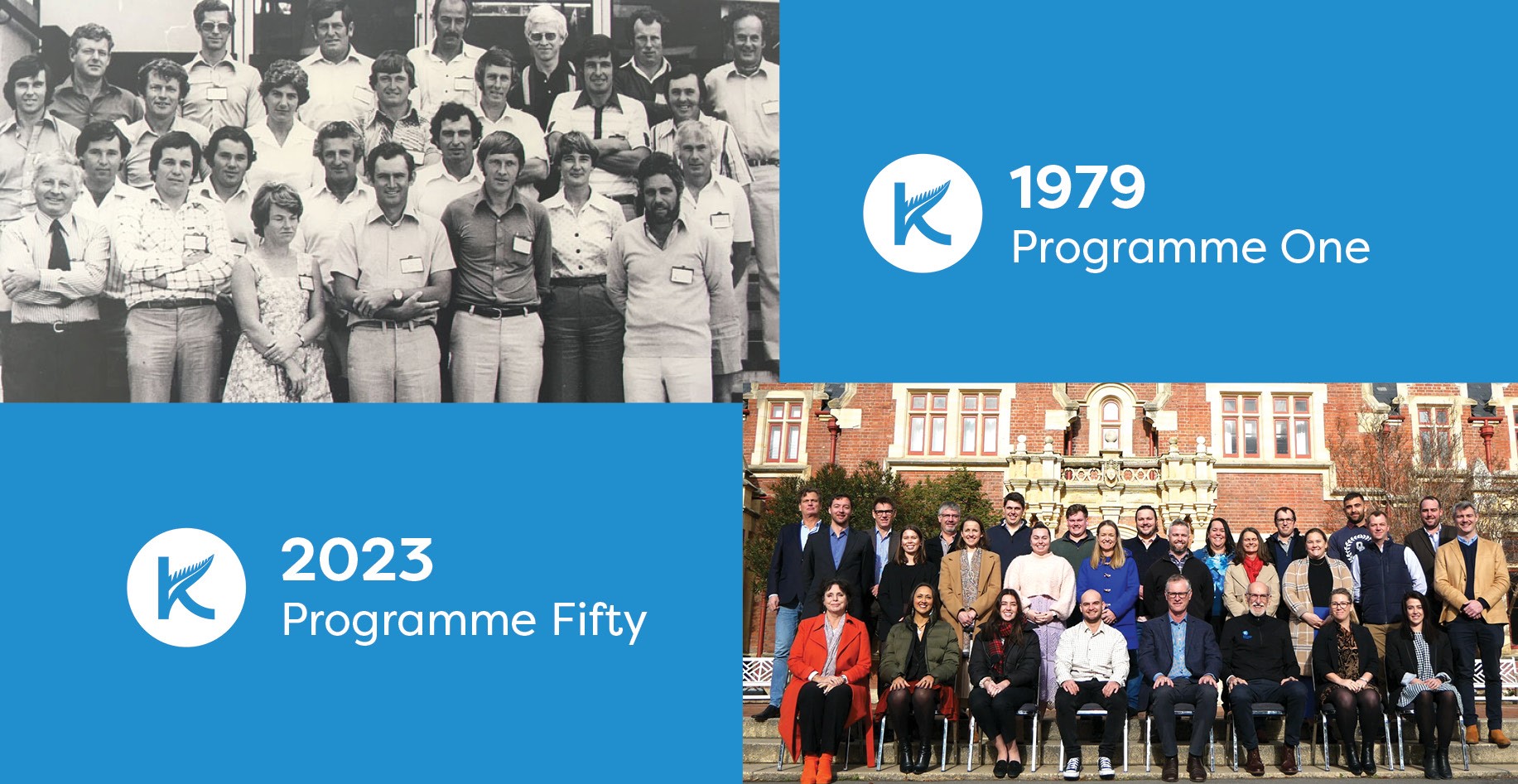
The 50th Kellogg Rural Leadership Programme graduates.

With Alumni now numbering 1075, the Kellogg Rural Leadership Programme has had a long and rich history of leadership capability lift across the food and fibre sector.

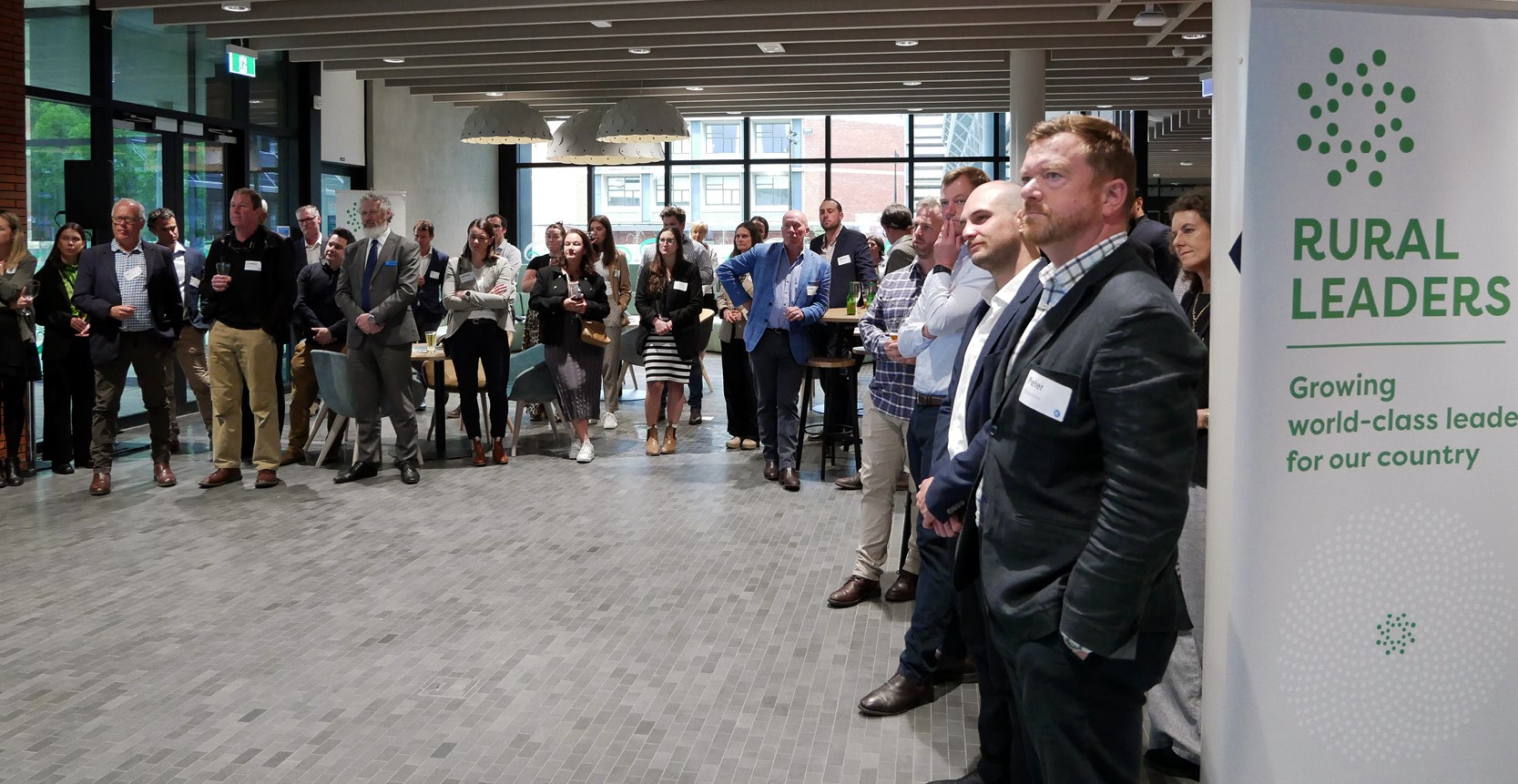
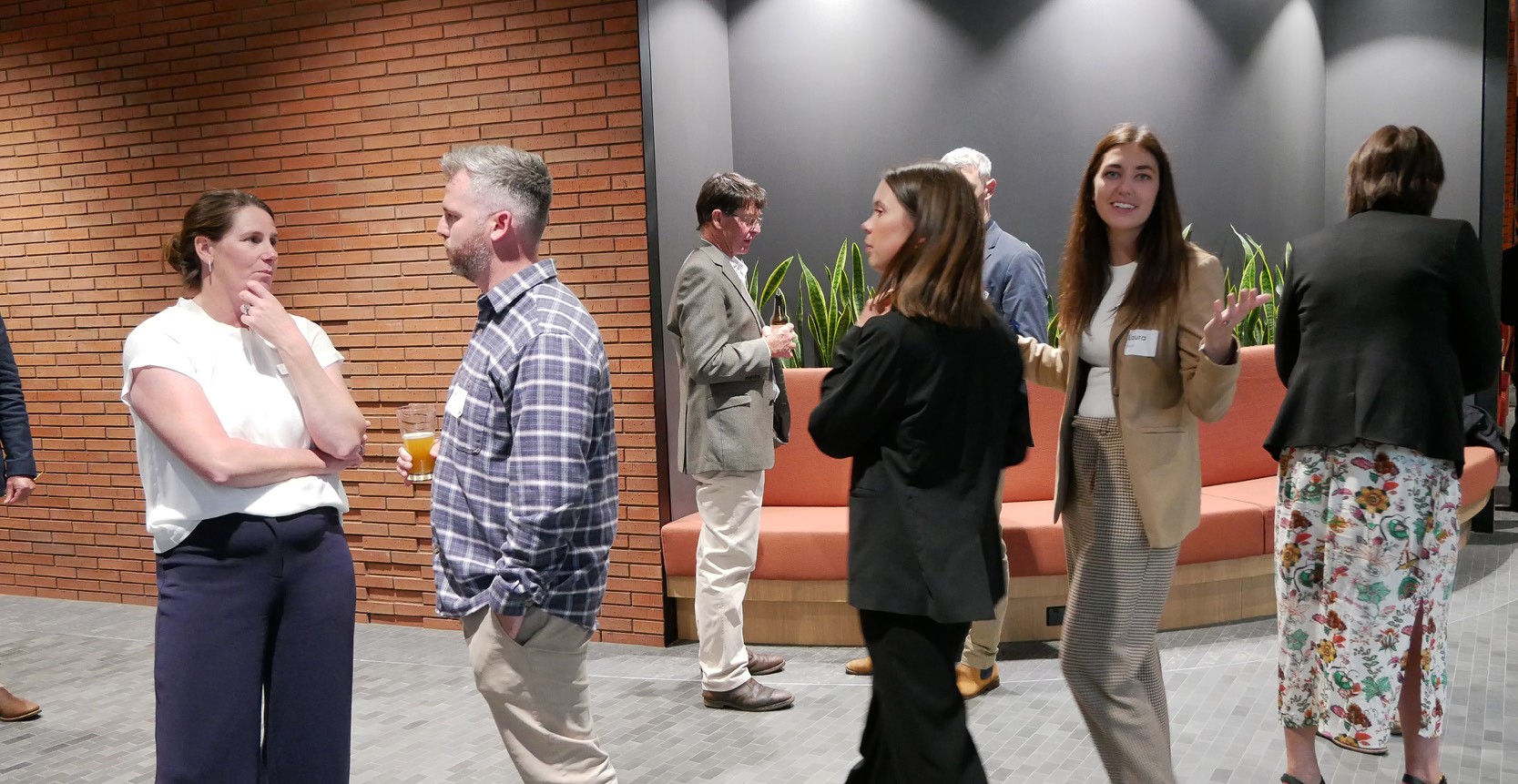
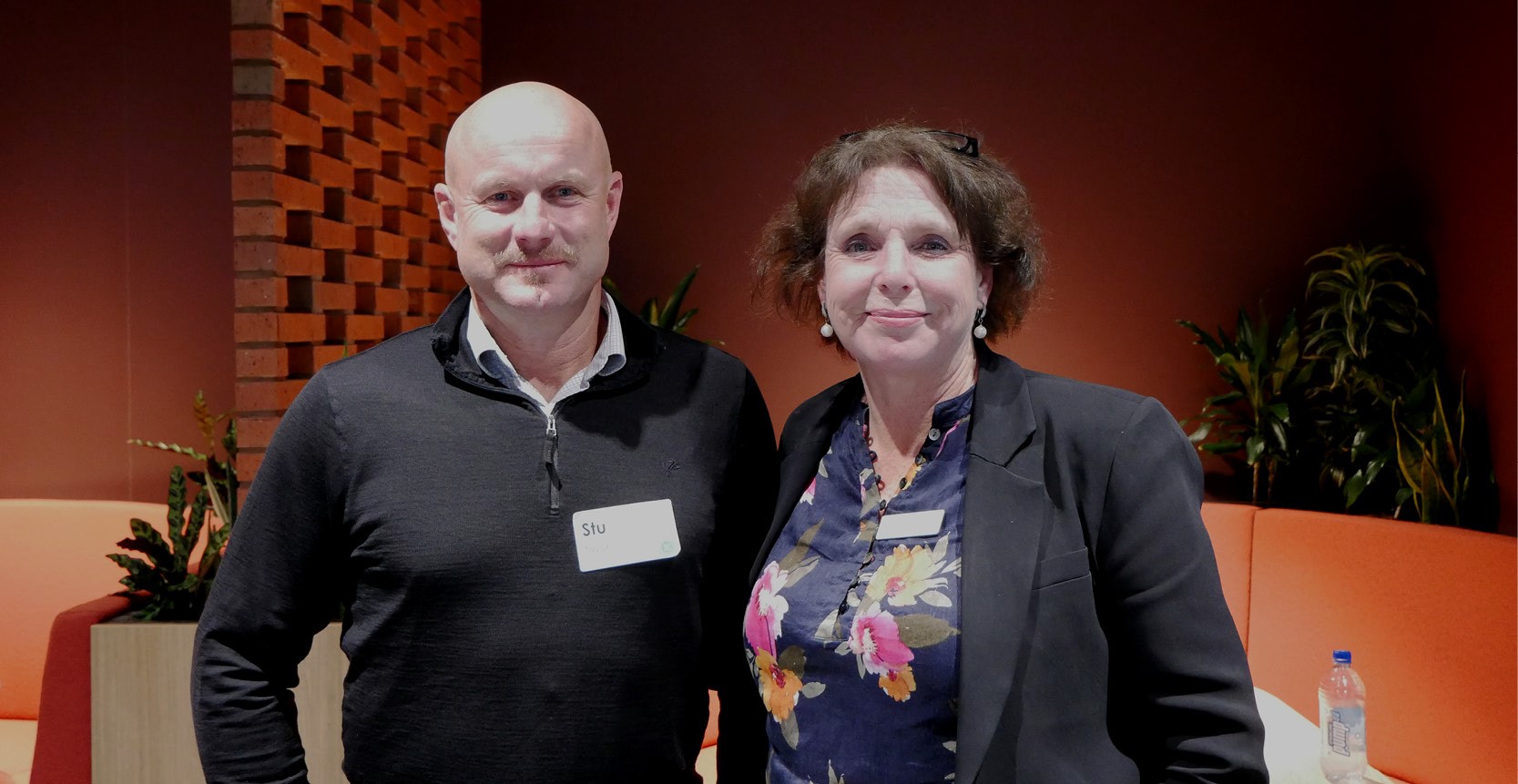
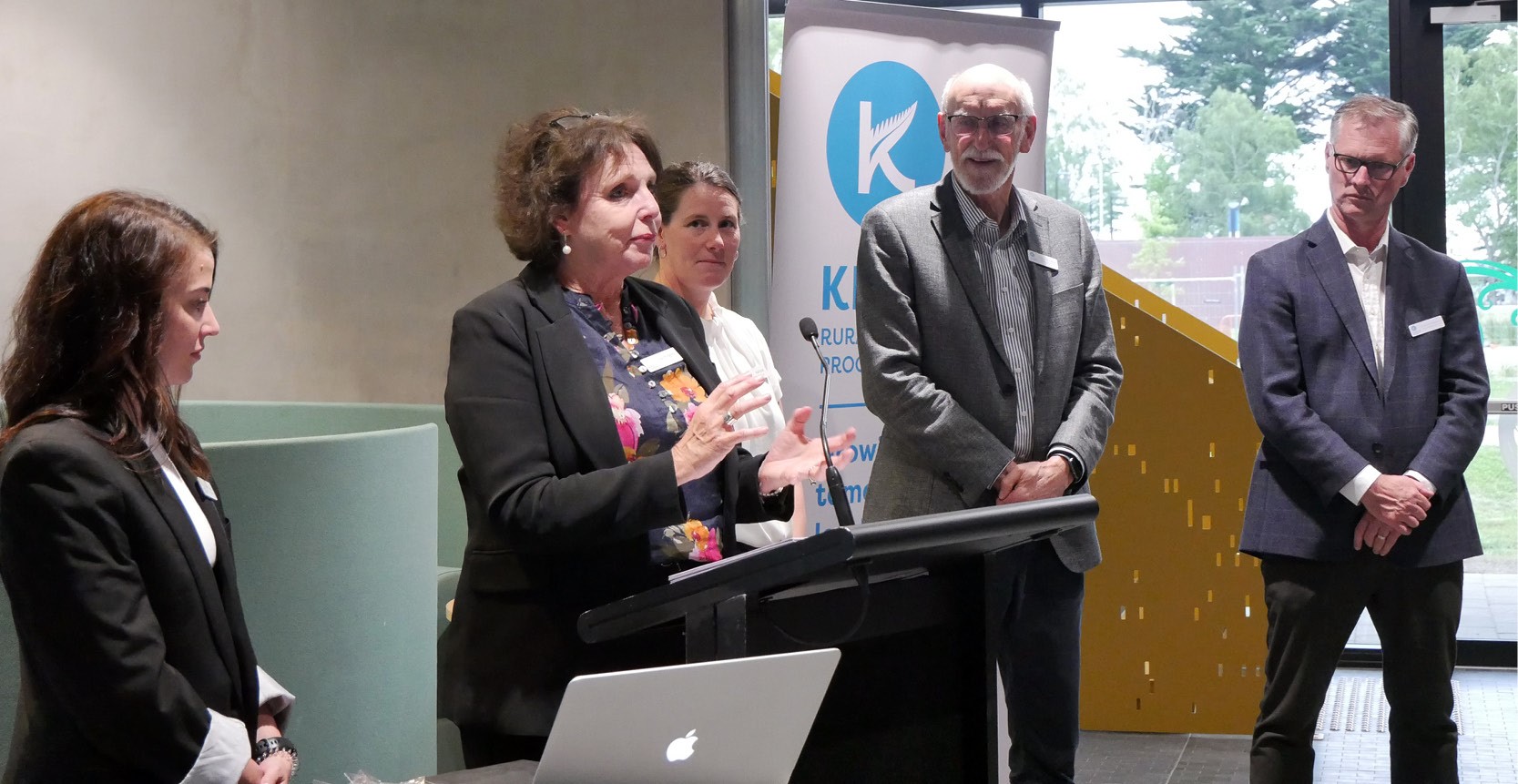
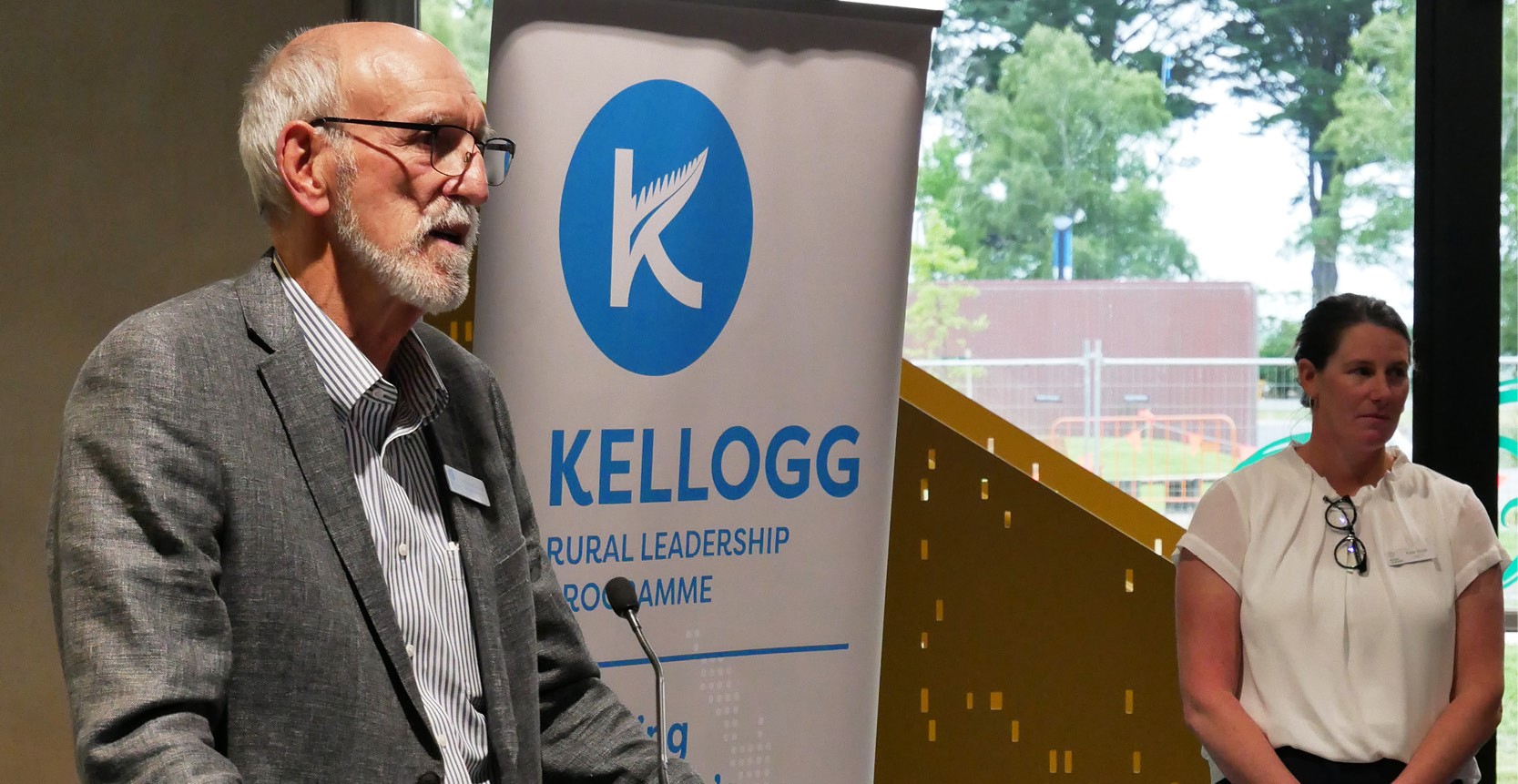
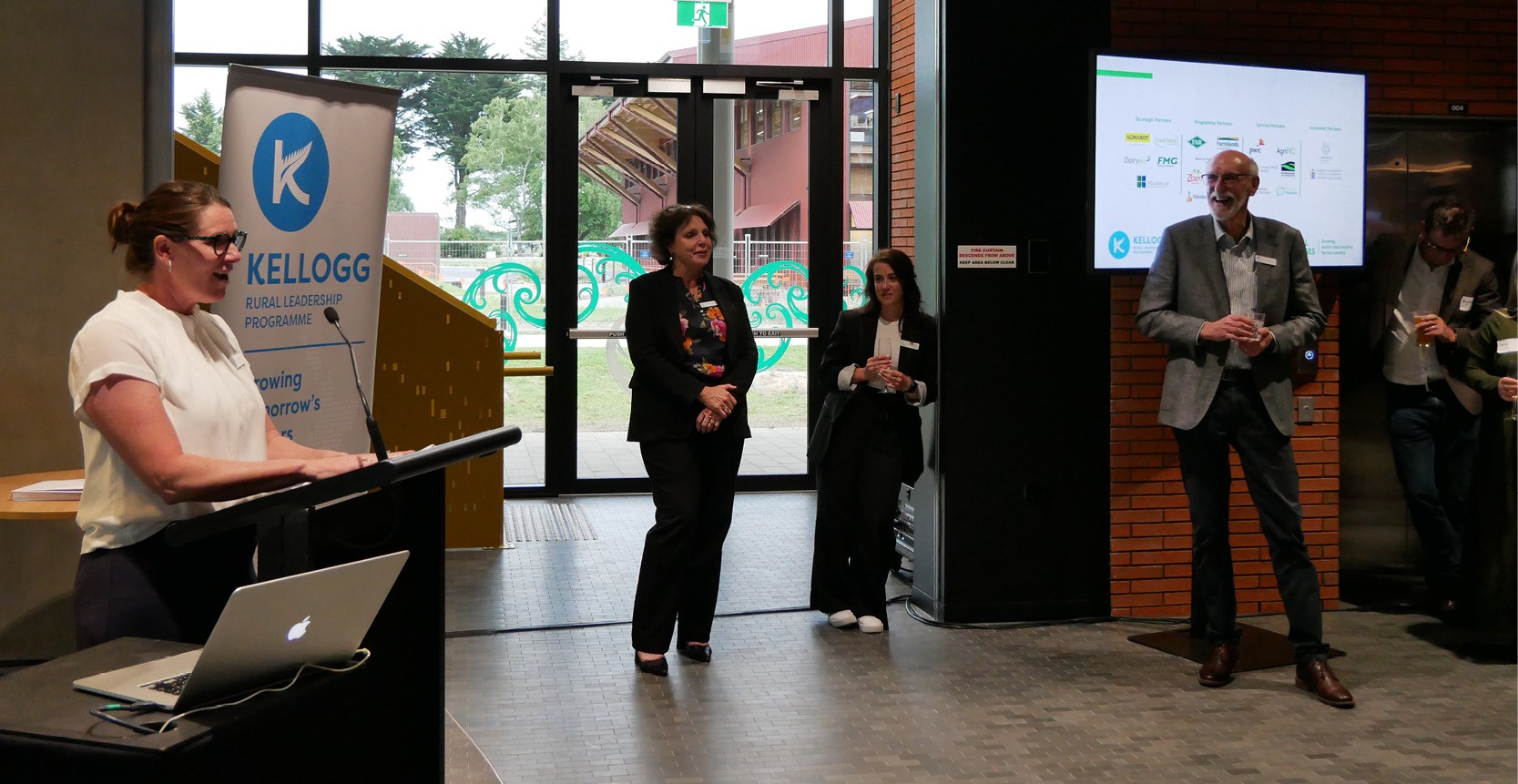
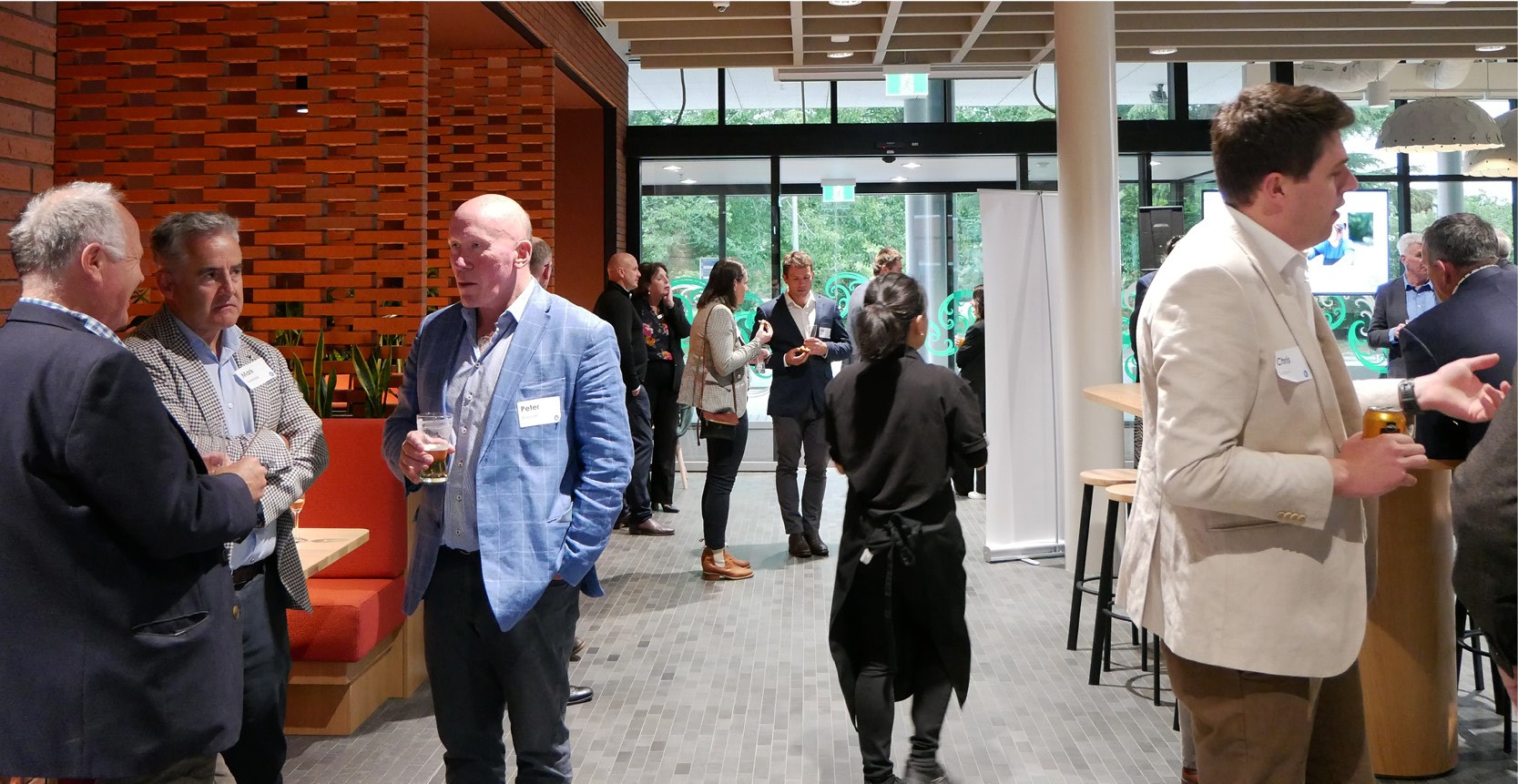
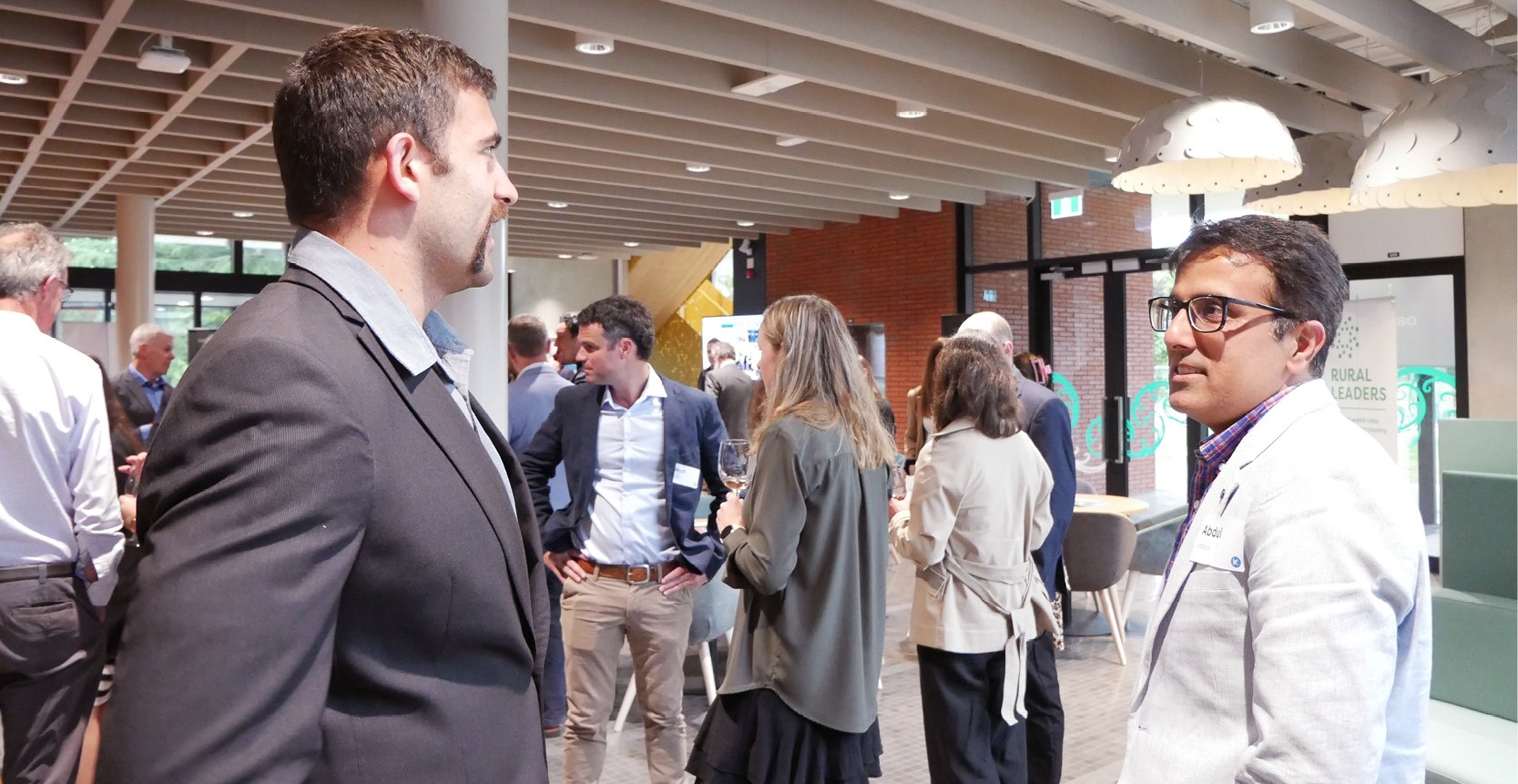
To celebrate the 50th cohort’s graduation, the collective impact of alumni, and the Programme’s history, the NZ Rural Leadership Trust (Rural Leaders) hosted an event at Lincoln University’s Waimarie Building.

Kate Scott, Lisa Rogers and Dr Patrick Aldwell, spoke at the event, with Dr Aldwell sharing more the Programme’s genesis. 

Serial impact.

The William Keith Kellogg Foundation (WKKF) was established in 1930 as a philanthropic organisation, running alongside the Kellogg’s Breakfast Cereal Company (Kellogg’s).

William Keith Kellogg initially set up Kellogg’s to support his brother’s business – a sanitarium.

Over his lifetime (1860-1951), William donated nearly $70m in stock to the WKKF, as he put it “to help people help themselves.” He wanted to equip people with the knowledge and solutions for better health and wellbeing outcomes.

He left simple instructions to future trustees and staff, “…use the WKKF’s money to promote the health, wellbeing and happiness of children.”

Incidentally, Kellogg’s has recently been rebranded ‘Kellanova’ in New Zealand and Australia, while in North America the brand will appear as WK Kellogg and Co. on supermarket shelves.

1075 Kellogg Scholars since 1979.

Eventually, part of the WKKF’s grants were used to establish rural leadership programmes in the US, Australia, and NZ.

One bold individual, John Pryde, CE of Federated Farmers 1964-1975 and Lincoln University Senior Fellow 1975-1991, persistently tried to set up a Rural Leadership Programme, finally succeeding in 1979 with funding from the WKKF for the first five years for a programme.

Since 1979 the Kellogg Rural Leadership Programme has helped deepen leadership capability in industries across our sector – and since 2017 it has been delivered by the New Zealand Rural Leadership Trust (Rural Leaders).

Thanks to the additional support of Rural Leaders’ investing partners, New Zealand Food and Fibre has more capable, and purpose driven people. 1075 of these individuals are Kellogg alumni. 

Celebrating the Kellogg Programme’s impact.

As the Mackenzie Study has shown, the impact Kellogg alumni have made, and continue to make, cannot be underestimated. In fact, we thought it was something well worth celebrating. And so we did.

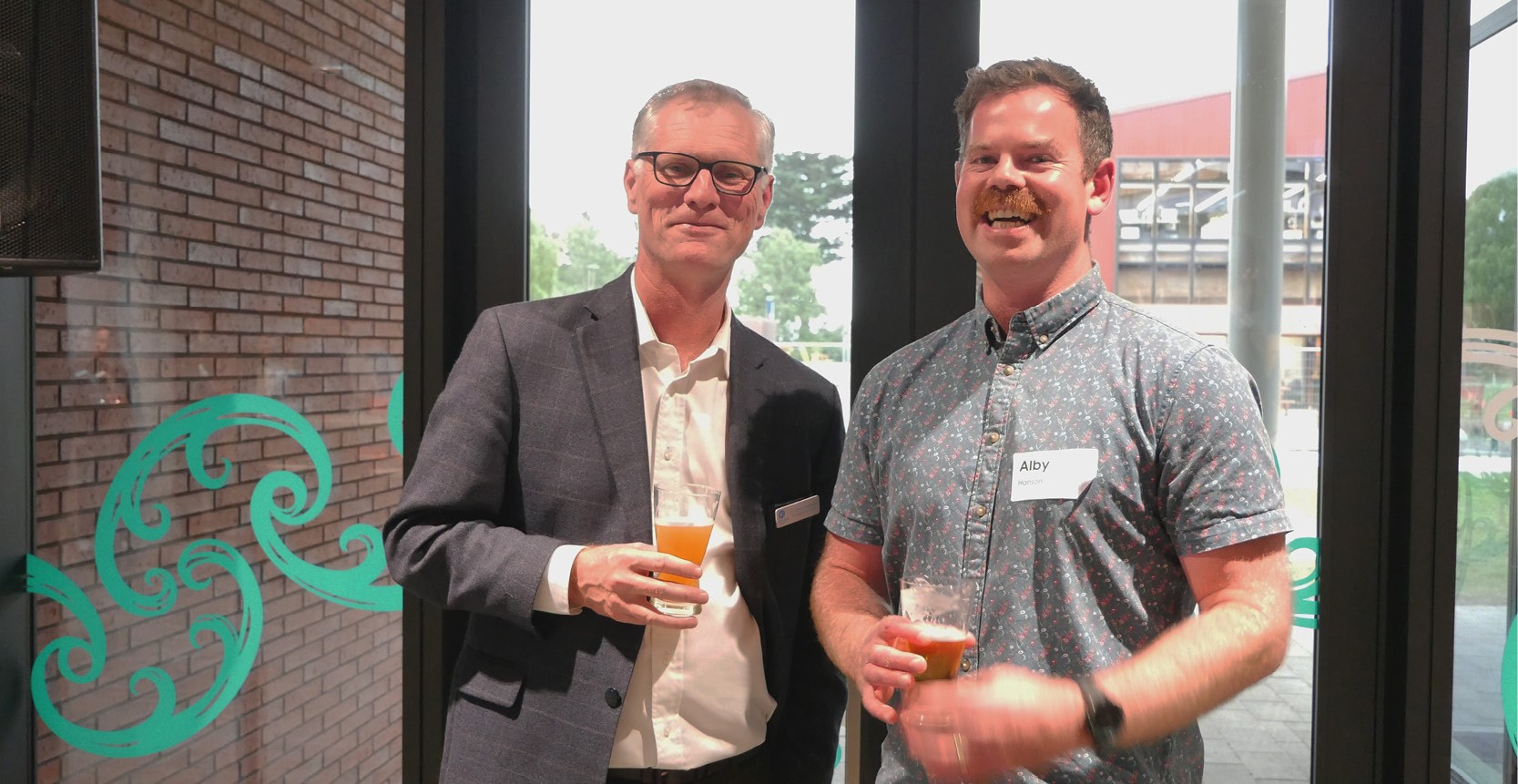
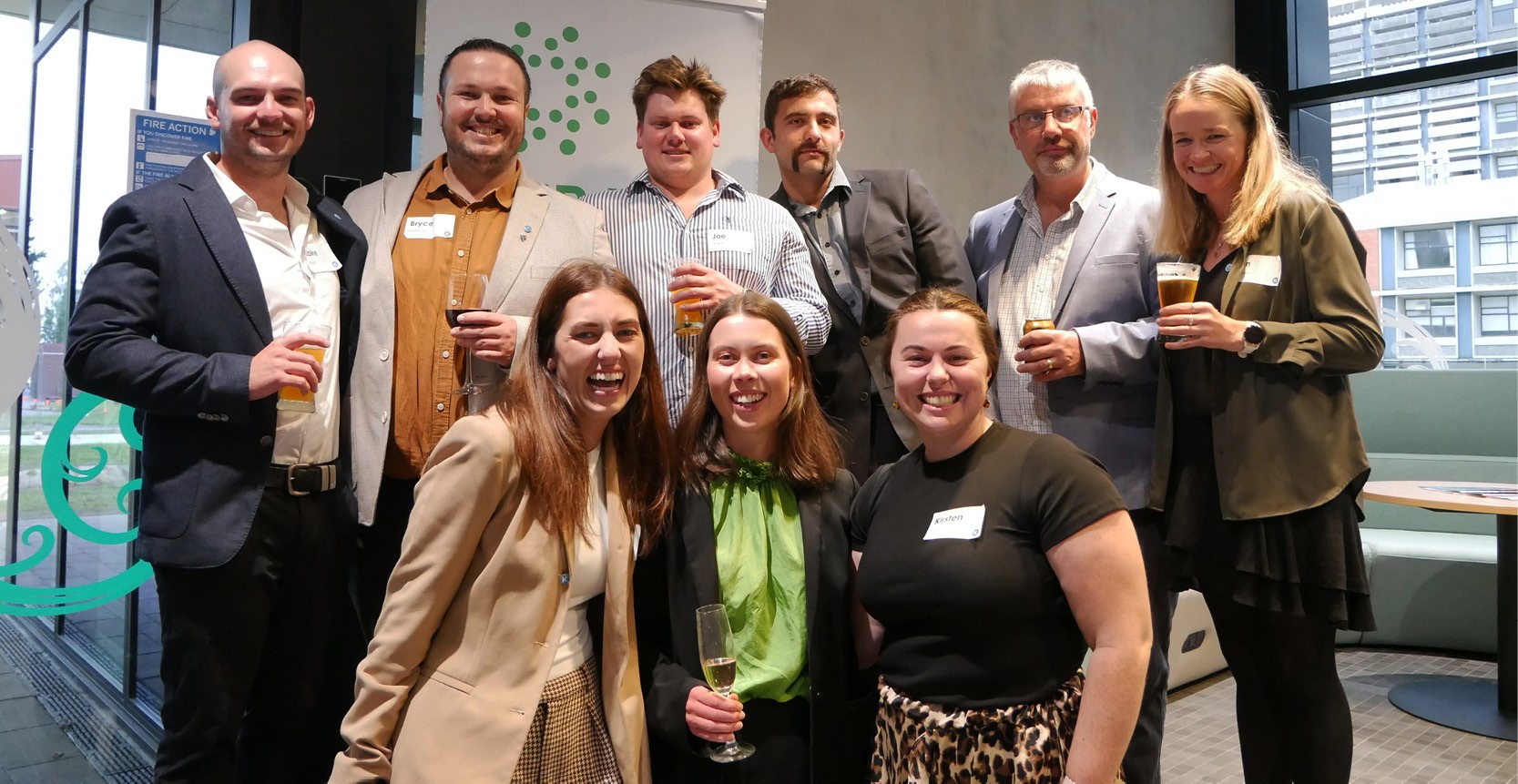
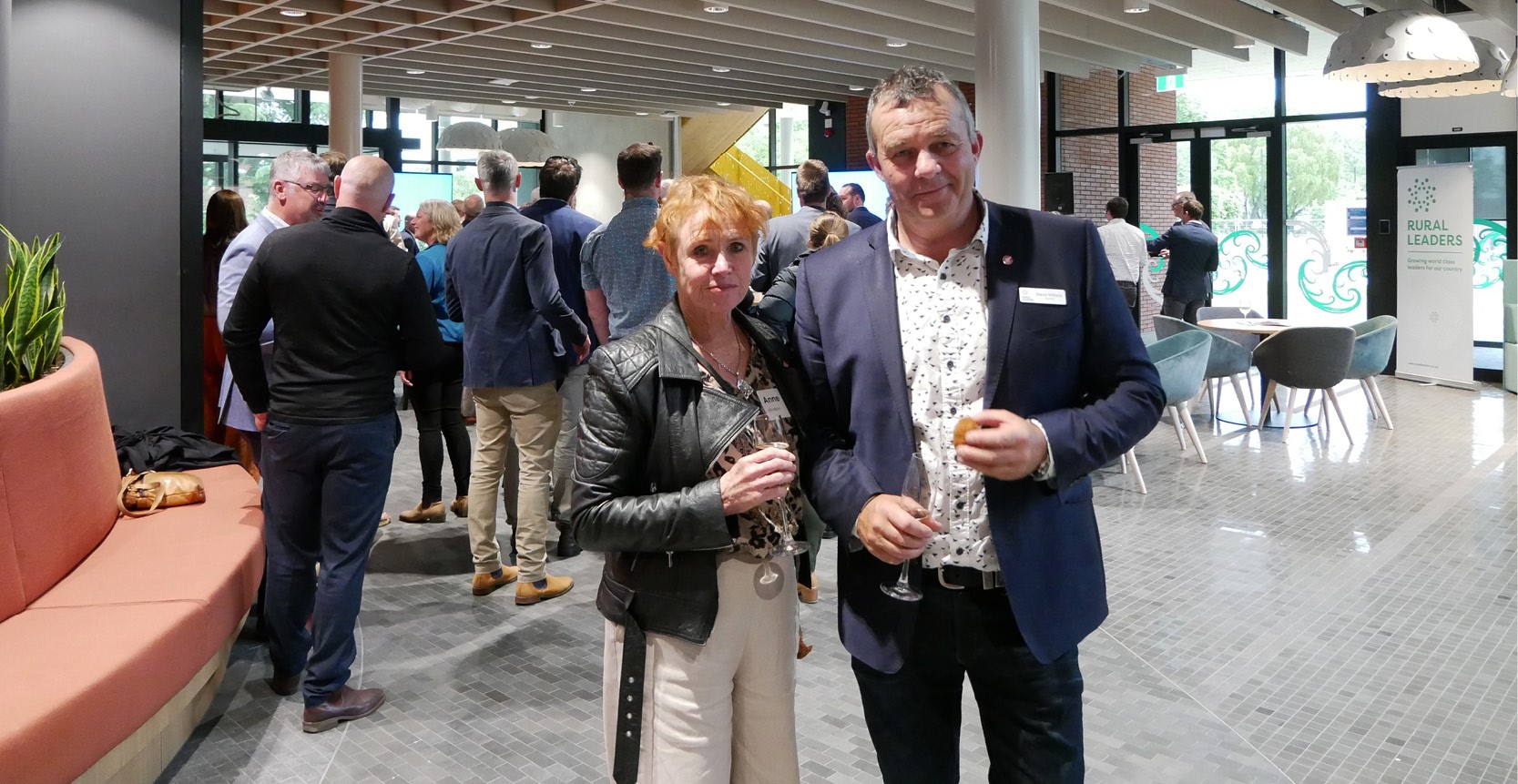
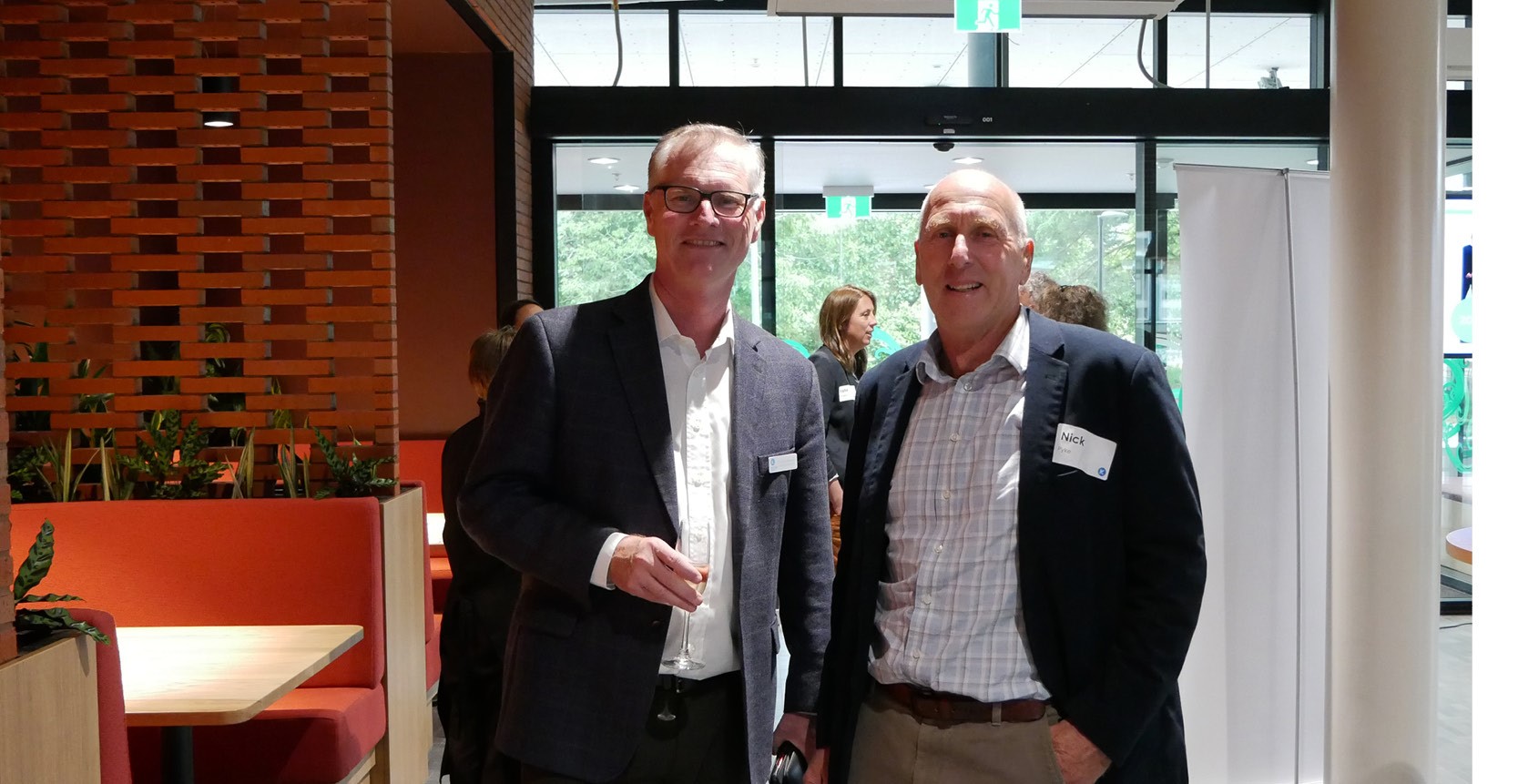
About 80 alumni, investing partners and industry leaders came together on Thursday 30 November to celebrate not only the 50th Kellogg cohort’s graduation, but also the rich history of the Programme and the collective impact of Kellogg alumni.

Kate Scott, NZ Rural Leadership Trust Chair, opened by defining the the two types of future leaders Ta Tipene O’Regan believed we would see, “…

Future takers who accept the future for what it is, feeling powerless to change what will be, and allowing today’s realities to obscure tomorrow’s potential, ready to respond to change; and future makers who shape the future by reading the signs, determined to create future spaces for people to excel, undaunted by today’s problems, and ready to lead change.”

Kate Scott drew on the powerful demonstration of achievement and impact catalogued by the Mackenzie Study and closed her speech by challenging the graduates gathered to become future leaders, “…ask yourself; how will I unleash the potential in others so that we can grow rural leaders together?”

Dr Patrick Aldwell, who has a long history of involvement with Kellogg spoke passionately of the Programme’s history, especially of William K Kellogg’s desire to ‘help people help themselves’. “May you have the skills, confidence, awareness and networks to take the next step, no matter what that may be. I congratulate you on your Kellogg achievements…”, Dr Aldwell said in closing.

Lisa Rogers, Rural Leaders CEO, gave a note of thanks to partners, the board and industry before leading the awarding of the certificates for the 50th Kellogg cohort. 

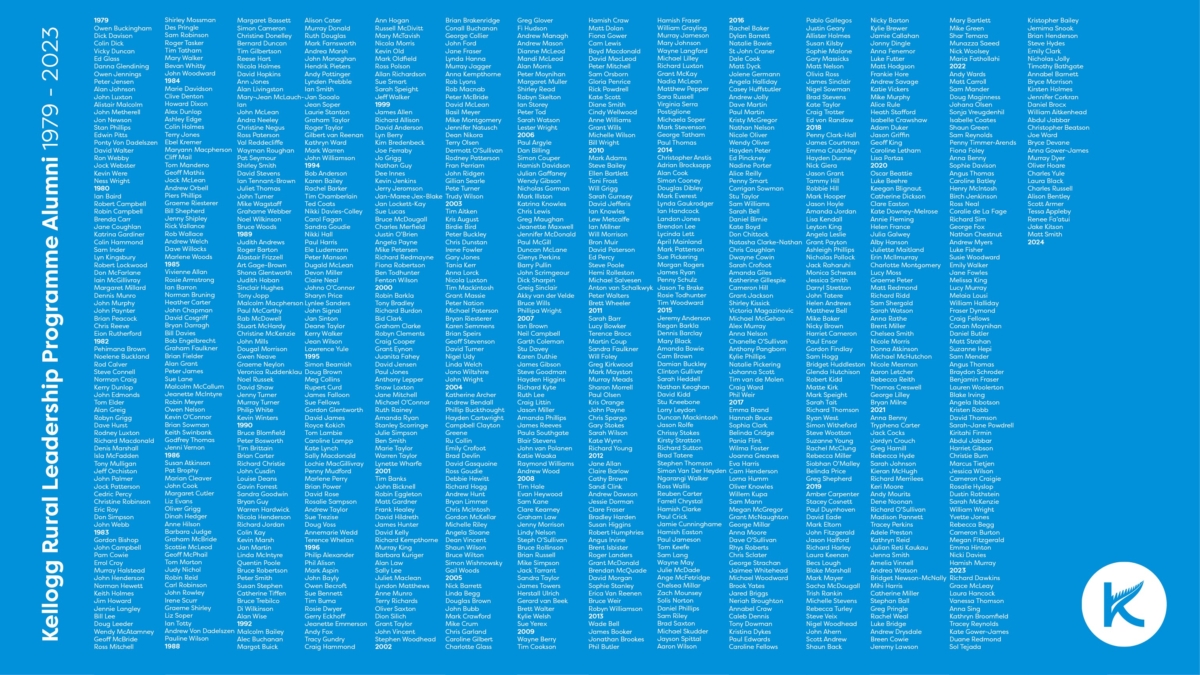
Pictured below – the alumni list.

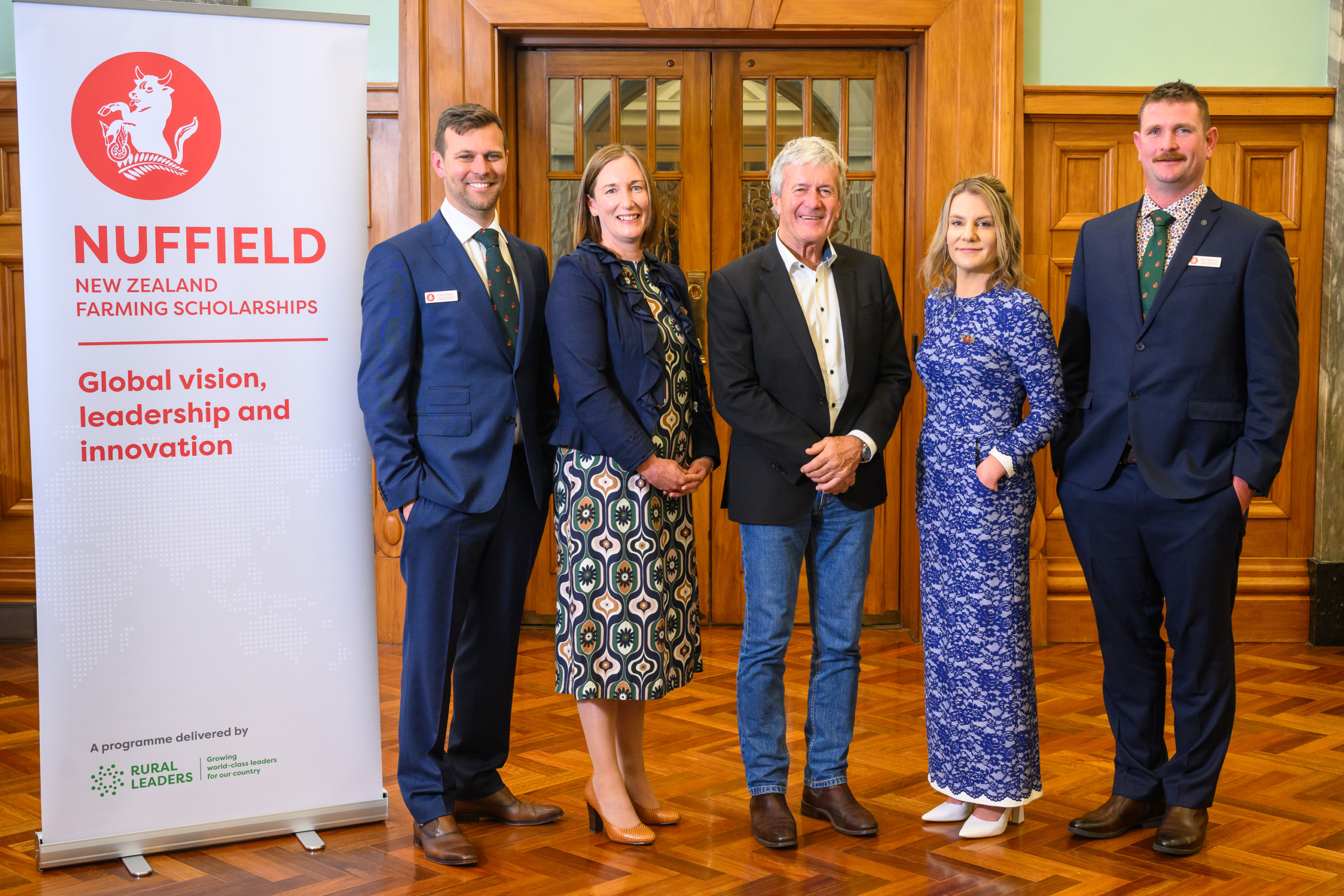
Four 2024 Nuffield New Zealand Farming Scholarships awarded.

Four food and fibre sector leaders have been awarded 2024 Nuffield New Zealand Farming Scholarships.

The Nuffield Awards Ceremony was hosted by Minister O’Connor and the New Zealand Rural Leadership Trust (Rural Leaders) at the Grand Hall in Parliament, Wellington last night.

Growing interest in the Nuffield Scholarships.

With the number of scholarship applicants rising each year, competition has been strong.

To ensure the 2024 Nuffield Scholars can travel and gain international insights in a climate of rising travel costs, the value of the Scholarships increased in 2023. This has also meant that four scholars were selected this year instead of the maximum five, making competition for scholarships tougher still.

Each scholar brings an impressive track record of performance and a corresponding level of passion. The scholars will now need to apply this experience and passion to finding those insights that will benefit the food and fibre sector.

“The four scholars represent up to eight industries, four separate regions, and over fifty years’ food and fibre experience. 

This cohort’s combined knowledge and skill range will enable them to hit the ground running and support each other. The group’s first scholarship component is the Value Chain Innovation Programme – which starts next week.

We are as interested and excited to see each scholar’s impact on community, industry, and the sector, as we are the collective impact of the cohort”, Said Lisa Rogers, CEO, New Zealand Rural Leadership Trust (Rural Leaders).

The 2024 Nuffield Scholars.

The new 2024 Nuffield Scholars were announced by Kate Scott, Chair, NZ Rural Leadership Trust as:

Carlos Bagrie – An Otago based Sheep and Beef/Arable Farmer. Carlos will focus his research on circular farming systems that reduce waste while improving the bottom line.

Rachel Baker
Rachel is a Central Hawke’s Bay based Agri-investments Portfolio Manager, and Dairy Farmer. Rachel’s research will look at the impact of existing and proposed global food strategies on food producers.

Jenna Smith
A Waikato based Māori Agribusiness CEO, and Dairy Farmer. Jenna’s research will focus on climate change related land use changes.

Peter Templeton
A Southland based fifth generation Dairy Farmer. Peter’s research interest is in the future of farming and the role of innovation.

Leadership and change in food and fibre.

Before the Scholar announcements, Kate Scott, Chair, New Zealand Rural Leadership Trust, spoke about a global and national context of relentless change, saying that the challenges our sector faces within this require high-performing leaders for the teams they serve.

To this end the New Zealand Rural leadership Trust was commissioned by Food and Fibre Centre for Vocational Excellence in September 2022, to research and design a leadership development ecosystem for Aotearoa New Zealand’s food and fibre sector. Kate Scott drew on some of the work in the two project reports completed so far.

“Our leaders need to be more adaptive than ever before, creating healthy and diverse, high-performing environments that allow teams to acquire the skills and to build the resilience they need to thrive in a volatile, uncertain, complex and ambiguous world”, Said Kate Scott.

The first report presents research into the current state of leader development in the food and fibre sector.

The second report, ‘A Principles-centred Leadership Model’, proposes that Leaders who truly lead unleash their potential and that of those around them.

Kate Scott further acknowledged the support of Rural Leaders’ Partners, including that of Strategic Partners, AGMARDT, DairyNZ, Beef+LambNZ, Mackenzie Charitable Foundation, and FMG, and Programme Partners, MPI, Farmlands Co-operative, FAR, Horticulture NZ, Zespri, LIC and Rabobank.

Nuffield Scholar Research.

The 2023 Nuffield Scholars’ research topics will address several of our biggest food and fibre challenges and opportunities. They will bring a valuable global perspective to these with insights gleaned from an intensive travel itinerary of visits, meetings and experiences, designed to lead to a period of transformative personal growth.

The four new Scholars will join the over 180 Nuffield Alumni, awarded scholarships over the last 73 years.

Jessie Chan – Impact Story

Jessie Chan, MNZM – 2012 Kellogg Scholar.

Among her many accolades, Jessie became a member of the NZ Order of Merit for services to dairy and agriculture in 2022. Jessie was the recipient of Canterbury’s Institute of Directors aspiring director award in 2014 and was Fonterra Dairy Woman of the Year in 2017.

A respected leader in the dairy industry, Jessie is a director on boards including, NZ Pork, AgResearch, and AgriZero, and has served in the past on boards such as Ngai Tahu Farming, RuralCo and Alpine Energy.  

Always interested in science, Jessie’s first role at the age of 17, was in Palmerston North’s Fonterra research lab, where she was exposed to product development.

University came soon after with study toward an animal science degree – graduating with honours.

After four years study Jessie went to Wellington where she held various primary sector roles, eventually heading a Federated Farmers’ policy team.

Marrying and moving to Canterbury, Jessie, and her then husband, took a share-milking job just south of the Rakaia River. Eventually they took over the lease and grew their herd from 750 to 1700 cows.

Jessie is now an equity partner with friends in her own dairy farm at Springston in Canterbury, an arrangement that works in well with her directorships.

Having held many senior sector leadership roles and understanding well the hard work required on the path to farm ownership, Jessie believes farming must adapt to meet challenges like environmental and climate change.

Jessie believes many of the answers will come from science, and to this end serves on the board of AgResearch and AgriZero. AgriZero support science-based solutions to some of the sector’s, and the world’s, trickiest challenges.

AgriZero is world-first partnership between agribusiness and the government and aims to reduce agricultural emissions 30% by 2030. A recent investment by AgriZero has been to build more methane chambers where a product’s effectiveness in reducing a cows’ methane output can be measured. 

Jessie continues to apply science and entrepreneurship to Primary Sector challenges – along with her own enthusiasm, a lead-by-example style, and a long-held passion for science, for her industry and for the sector.

Jessie takes this quote she made in a recent Farmers Weekly article, “Let’s keep combining that science piece with that entrepreneur piece that goes, actually we can take that science and apply it on – farm this way and get a really good outcome’, I think we all want to move forward and do better for the land.”

We look forward to seeing the positive impact Jessie has made continue to influence change in dairy and the food and fibre sector.

Corrigan Sowman – Impact Story

Corrigan Sowman – 2016 Kellogg Scholar, 2019 Nuffield Scholar.

Corrigan is the owner, director, and business manager of the 400ha Uruwhenua Farms in Golden Bay, a family-owned dairy unit where technology is used to manage a large herd in a small herd way – especially in terms of attention to individual animals. He is a graduate of Massey University and has a Bachelor of Applied Science.

Corrigan is both a Nuffield and Kellogg Scholar who completed his Nuffield research on how to better understand the way pressure on farmers impacts decision making.

His Kellogg research looked at the critical success factors of an agriculture non-profit in knowledge creation and dissemination.

Corrigan is LIC Chair, succeeding fellow Nuffield Scholar Murray King, who says of Corrigan’s appointment, “He has a deep understanding of farming, its challenges and what farmers need both now and in the future in order to be more profitable and sustainable.”

He is a member of the Fonterra Sustainability Advisory Panel, a group providing independent advice to the Fonterra Senior Management Team and Board. He has been a former Consulting Officer with DairyNZ and a Farm Consultant with FarmRight, in Canterbury. 

In the past Corrigan has been Chair and Independent Director of the South Island Dairy Development Centre (SIDDC), which operates the Lincoln University Dairy Farm. He has also been Deputy Chair of the DairyNZ Dairy Environmental Leaders Forum, an initiative fostering environmental stewardship and community leadership amongst New Zealand dairy farmers. 

We look forward to seeing Corrigan continue to support work encouraging farm practices that strengthen the integrity of the food we produce.

The Rabobank People Development Award – Beef+LambNZ Awards 2023.

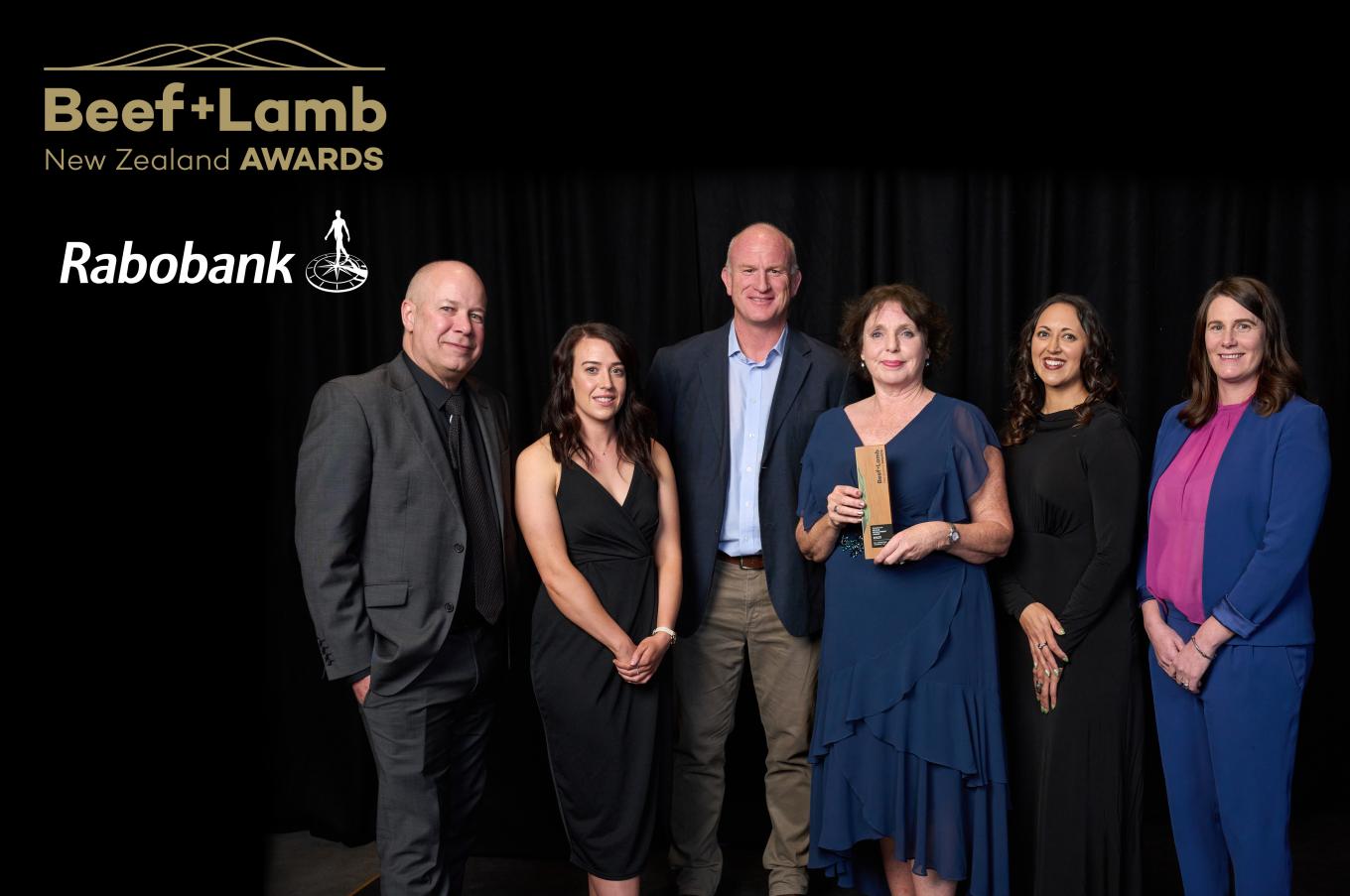
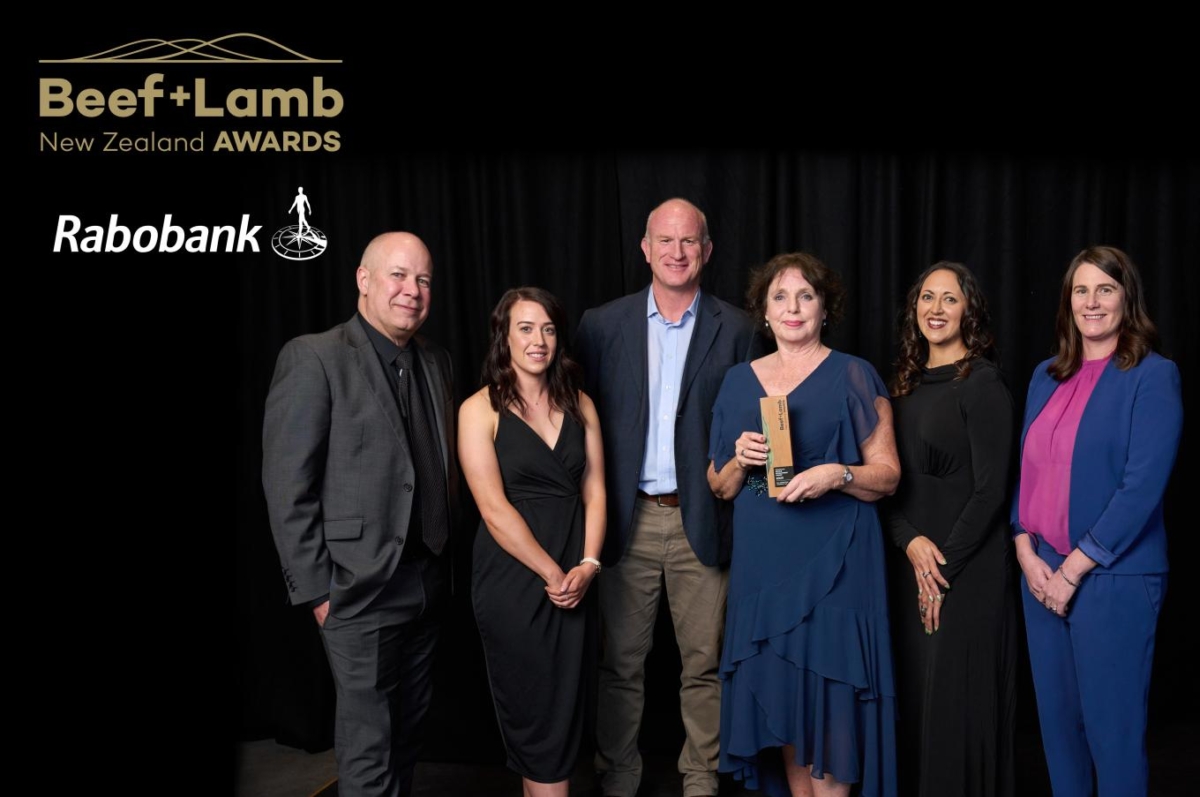
The Beef + LambNZ Awards were held in Christchurch last night (October 19). The Rural Leaders Team are proud to have won the Rabobank People Development Award. It’s a win that represents the mahi and support of so many, including our board, our investing partners and our alumni. 

The judges said, “The Trust, which manages the Nuffield Farming Scholarship and the Kellogg Rural Leadership Programme alongside other initiatives, offers high quality, fit-for-purpose leadership programmes for the primary sector.

They added that the Trust was well known, highly regarded and had demonstrated longevity in the sector. The Trust had impact across all primary industries.”

Lisa Rogers, Rural Leaders CEO, said of the win, 

 “Our programme alumni continue to make a positive impact in communities, businesses and for industries across food and fibre. We’re honoured and humbled to receive this award, and privileged to be part of so many people’s leadership journey.”

On the night, Rural Leaders shared a table with all the 2024 People Development Award finalists – Growing Future Farmers and Whangarei Agricultural and Pastoral Society Farm Intern Programme, “The work both organisations are doing for young people entering the sector; giving them a sense of purpose, direction and pride, is inspiring”, said Lisa Rogers.

Congratulations to Beef+LambNZ for organising such a successful and enjoyable event. And congratulations to all the finalists and winners across all eight categories. 

The full results are available here. 

Independent Trustee – New Zealand Rural Leadership Trust.

The New Zealand Rural Leadership Trust (NZ Rural Leaders) is seeking an Independent Trustee to join its board. This is an exciting opportunity for a food and fibre leader with strategic and governance experience, strong industry networks and a passion for leadership development, to build on their governance journey.

Background summary

NZ Rural Leaders is a registered charitable trust. The Trust’s purpose is to: Establish and operate leadership programmes for New Zealand’s food and fibre sector, advance education in agricultural practices, and contribute to the general welfare of New Zealand’s rural population.

In pursuit of this NZ Rural Leaders aim to grow world-class leaders for our country.    

Board meetings

The Board meet up to 8 times per year with some meetings coinciding with longer events. 4 “in person” meetings are typically held in Christchurch or Wellington, with video conferencing utilised for the balance.

Meetings are scheduled where possible around Kellogg and Nuffield programme events to enable Board members to be introduced to each cohort of both programmes and contribute as per above role. Meeting dates for the year are set at least 6 months in advance.

Please note, this is an unpaid, voluntary role. Air Travel, accommodation, and meals are covered (where required).

The core competencies sought in all Board members are;

  • Strategic focus and experience.
  • Previous governance experience.
  • Innovative thinking and entrepreneurship.
  • Professional expertise in one or more of the following areas: food and fibre sector, adult education or training, business skills, marketing.
  • Passion for and understanding of leadership development.
  • Strong industry networks and connections.

Applicants with one or more of the following attributes are particularly sought;

  • Strong financial skills and understanding.
  • Affinity for leadership in Māori and Pacifica agri-business.
  • Horticultural, forestry or aquaculture industry knowledge.
  • Regional capacity building.
  • Partner engagement including local, regional, and central government.
  • Global perspective.

You can find more information on the Terms of Reference here.

Applications close on 15 November 2023.

CV and cover letter should be sent to Lisa Rogers, Rural Leaders’ Chief Executive at lisarogers@ruralleaders.co.nz

For any questions, please feel free to contact Chairperson, Kate Scott at kate@landpro.co.nz

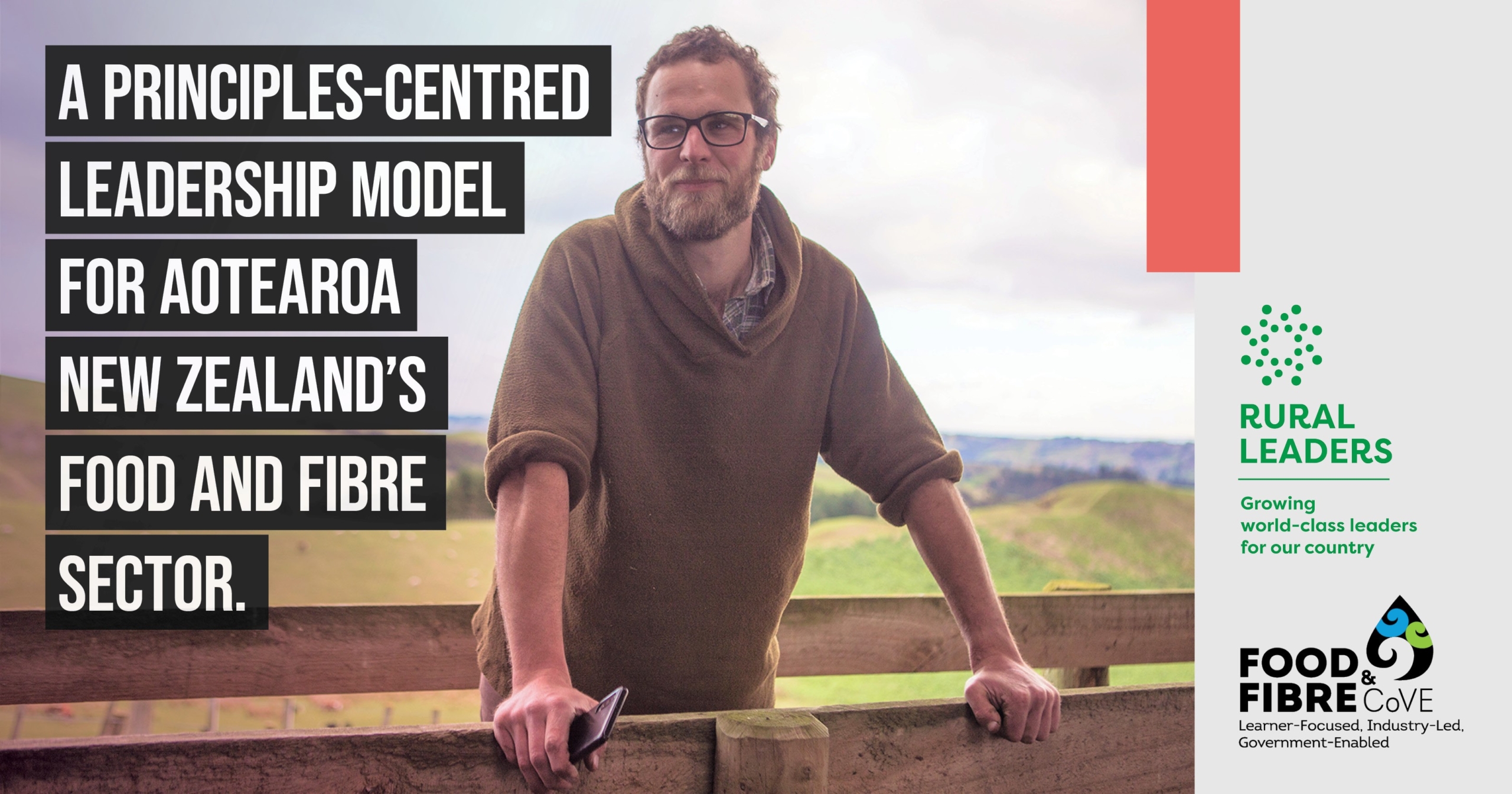
A principles-centred leadership model for Aotearoa New Zealand’s Food and Fibre sector. 

In 2022, the Food and Fibre Centre of Vocational Excellence commissioned New Zealand Rural Leadership Trust to research and design a leadership development ecosystem for Aotearoa New Zealand’s Food and Fibre sector.

The first report looked at the state of leadership development in the sector.

This new report, A Principles-centred Leadership Model for Aotearoa New Zealand’s Food and Fibre Sector, builds on the findings of that first report.

The Principles-centred Leadership Model proposes three impactful elements. Each element can be considered separately, though real power comes from all three elements being applied together.

The Model states that leaders who truly lead unleash their potential and that of those around them. In doing so, they create an exponential impact for the Food and Fibre sector and for Aotearoa New Zealand.

The Model combines three major elements to be applied holistically:

  1. The Food and Fibre context, which is significant to New Zealand’s wealth and wellbeing, is founded on an entrepreneurial spirit and requires leaders to be grounded practically, environmentally, culturally and in their communities.
  2. Food and Fibre Principles. Feedback from the sector has been distilled down into three leadership principles, people, service, and teams.
    1. Leadership starts with knowing and understanding people – if you wish to influence others, first know yourself.
    2. Leadership is about the service and accountability, not status – you wish to lead, serve.
    3. Leadership is a team sport. Leaders build teams and teamwork – if you wish to generate power, share it.
  3. Three dimensions of true leadership.
    Who we are is at the core of why, what, and how we lead. To truly lead requires more than physical and practical behaviours, it requires more than the psychology of hearts and minds, true leadership requires the leader to do the internal work to truly know themselves, their wairua, and lead from within.

    The best leaders then also see beyond the horizon and lead those they serve through the changing context, for the purpose of a thriving future and in a way that unleashes the potential of those they lead.

If we create pathways for people to develop and take on increasing responsibility in the Food and Fibre sector can have a multiplier effect on Aotearoa’s future prosperity that goes beyond the impact that leadership systems in other sectors can create.

The next phase of this project is the development of the leadership handbook – available 2024.

We look forward to sharing more on the project over the next few months, but should you wish to discuss the leadership model further, please reach out to Lisa Rogers, CEO Rural Leaders, at lisarogers@ruralleaders.co.nz

Click on the image to access the report.

Know Your Why – Motivations for a Sustainable Future.

Executive summary

With growing demands for sustainability in the food and fibre industries, there is mounting pressure from consumers to produce environmentally responsible products. This report addresses the necessity for the New Zealand dairy industry to prioritise climate change concerns and associated greenhouse gas emissions to secure a sustainable future.

The report aims to understand the motivations behind the adoption of new innovations by dairy farmers and learn how to accelerate the uptake of practices that reduce greenhouse gas emissions, thereby ensuring the long-term sustainability of farming in New Zealand. Additionally, the report aims to create a resource to inform government, industry bodies, and non-governmental organisations (NGOs) about alternative approaches to motivate farmers in reducing greenhouse gas emissions positively.

The research question guiding this study is: How can we motivate New Zealand dairy farmers to embrace practices that effectively reduce greenhouse gas emissions?

A literature review was conducted to gain insights into the significance of greenhouse gases in the New Zealand dairy industry. The review examined the impact and relevance of greenhouse gases within the New Zealand dairy industry. 23 semi-structured interviews were used to uncover the motivations that would drive New Zealand dairy farmers to adopt practices aimed at reducing greenhouse gas emissions on their farm. Responses were categorised into the following high-level themes:

WHY (belief): Explored the aspects of purpose, motivation, social structure, and trust.
HOW (actions): Focused on leadership, communication, and pathway implementation.
WHAT (result): Addressed knowledge acquisition, problem definition, and barriers encountered.

Information gathered from the literature review and semi-structured interviews, highlighted the importance of understanding the “WHY” behind motivations and the utilisation of effective communication strategies (“HOW”) to drive the adoption of sustainable practices within the New Zealand dairy industry.

Recommendations:

  • Leverage the intrinsic values and purpose that farmers already possess. When developing GHG related communications to dairy farmers, industry partners should inspire farmers towards transformative change by building on farmers’ existing intrinsic values and encouraging mastery to drive toward continuous improvement.

  • Emphasise the importance of the economic benefits and social licence to operate. Milk processors need to communicate to farmers and rural professionals the potential advantages of being market leaders in greenhouse gas emissions reduction and the consequences of falling behind.

  • Create a single location for information regarding greenhouse gas related resources. Ministry for the Environment should provide and manage a resource location (i.e. website) for reputable GHG related literature, policies, regulations and general resources related to climate change specifically for the dairy sector.

  • Provide greenhouse gas emissions resources for veterinarians. New Zealand Veterinarian Association (NZVA) should curate a list of reputable sources of information regarding greenhouse gas emissions regulations, mitigation strategies, and the economic advantages of adopting practices that reduce GHG emissions. As a trusted source of information, veterinarians can disseminate this information to dairy farmers.

Tracey Reynolds