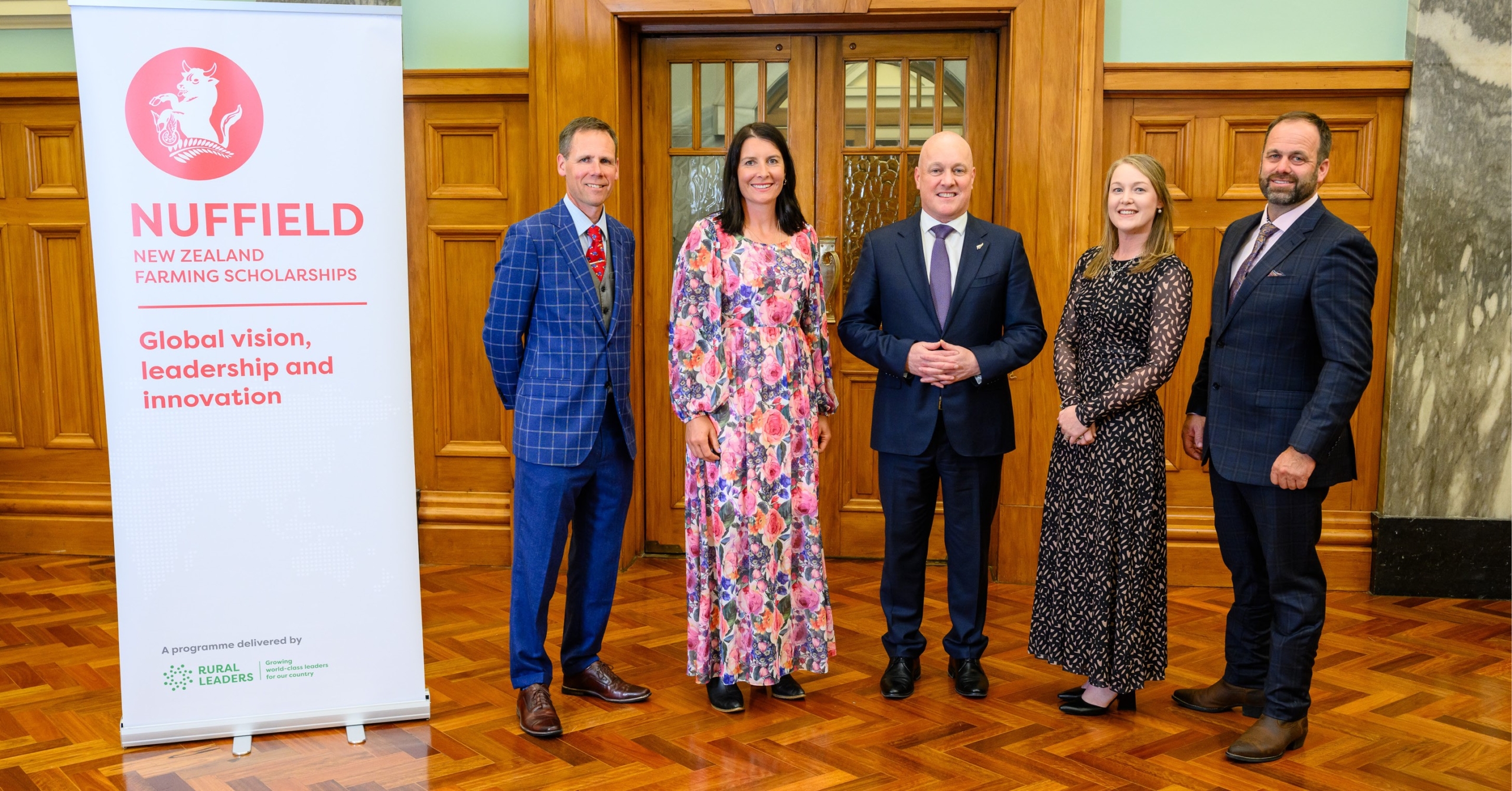
2026 Nuffield NZ Farming Scholarship. Apply by 17 August 2025. Read More...

Apply for 2026 Nuffield NZ Farming Scholarship by 17 August 2025. More details...

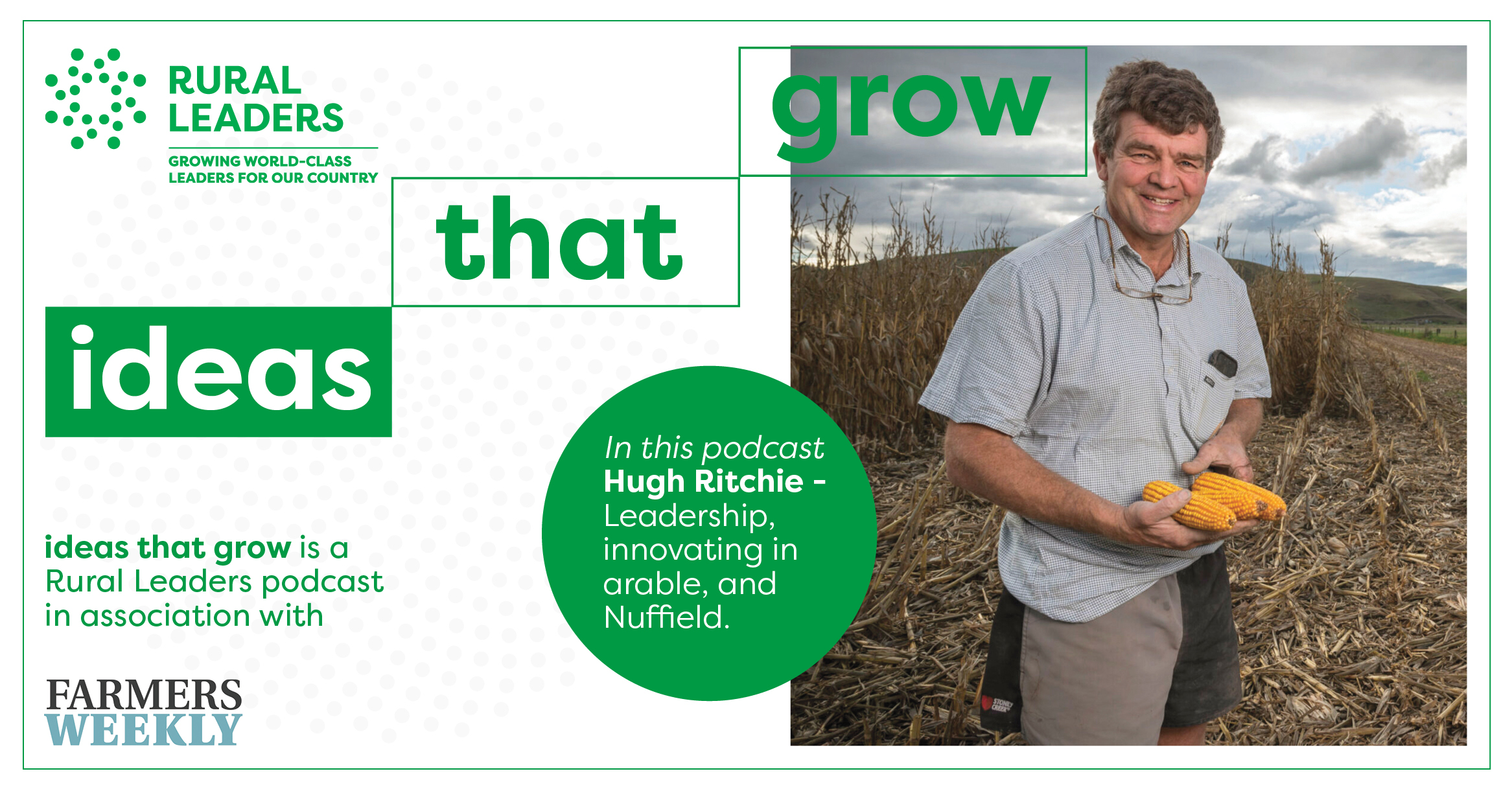
Hugh Ritchie – Leadership, innovating in arable, and Nuffield.

In this podcast, Hugh Ritchie, 2000 Nuffield Scholar and Hawke’s Bay farmer, shares his leadership journey and insights with Bryan Gibson, Farmers Weekly Managing Editor.

Hugh discusses growing Drumpeel Farms into a diverse 2000-hectare operation, the impact of his Nuffield experience on his personal growth, on innovation in irrigation and strip tillage, and on the need for better water access and infrastructure.

Hugh emphasises collaboration, global learning, and the importance of leadership development as vital to strengthening NZ’s food and fibre future.

Listen to this episode of Ideas that Grow, or click on one of the platform icons below to listen on your favourite player:

Episode Transcript

You’ve joined the Ideas That Grow podcast, brought to you by Rural Leaders. In this series, we’ll be drawing on insights from innovative rural leaders to help plant ideas that grow so our regions can flourish. Ideas That Grow is presented in Association with Farmers Weekly.

Bryan Gibson, Managing Editor of Farmers Weekly.
You’re with Ideas That Grow, the Rural Leaders podcast. I’m Farmers Weekly Managing Editor, Bryan Gibson. This week on the show, we have Hugh Ritchie from Drumpeel Farms. Gidday Hugh, how’s it going?

Hugh Ritchie, Farmer, 2000 Nuffield Scholar:
Good thanks, Bryan. And yourself?

BG: Yeah, pretty good. How are things over in Hawke’s Bay?

HR: We’ve got a very nice day. Had pretty big winds last night, which was good. I know we’re just finishing off the carrot washing harvest, and then we’ll get back into maize again. But no, it was a pretty good wind last night. But other than that, we’re good. Been a good summer for growing grass, so can’t complain.

BG: Very good. You operate a pretty diverse farming system over there.

A little about Hugh and Drumpeel Farms.

HR: Yeah, we’re just over 2000 hectares in total. We do about 800 hectares of annual cropping. So half of that’s processed vegetables. The other half is seeds and cereals with a little bit of vegetable seed production as well. And then we have 1500 bull beef on a pastoral block.

We normally finish between 8500 and 10,000 lambs – winter lamb trade as well. So that keeps the business going on many fronts. We haven’t got dairy, and we had deer, but haven’t got deer anymore. So, we do most things.

BG: Has running that operation been the bulk of your farming career?

HR: It has, yes. I left school and did a Bachelor of Ag at Massey. Production and Management was more my side. Then I came home to run the block. In those days, it was 300 hectares. We’ve grown the business quite significantly in that time as a family business. We’re reasonably proud of the fact that it’s up over 2000 hectares, and it’s quite diverse and quite intense.

We have great staff helping. I have a very good stock manager who runs the livestock site, and I tend to stick to the overall management in the cropping. It gives me a wee bit of flexibility and scale to go and do other things.

I’ve been on the Federated Farmers Board. I’ve spent some time on the Nuffield Trust, and recently on the FAR board and HortNZ board as well. So yes, I have done quite a lot of off-farm stuff as well as farming. Currently trying to get water storage across the line in Hawke’s Bay, which is proving rather tricky.

BG: Yeah, that’s been years in the making, hasn’t it?

HR: Yeah, it has.

BG: You were a Nuffield scholar in 2000?

2001: A Nuffield Odyssey.

HR: Adrian (Gault) and I travelled in 2001. I looked at irrigation efficiency and direct drilling till type systems. From there, we brought back the basis of the irrigation New Zealand design and monitoring system. I came back from a course I did at Cal Poly/University with Charles Burt, the director there, on how to evaluate irrigation systems for distribution uniformity.

Went through the Midwest and strip tillage was a big thing happening there in min till. So I brought back a strip till and worked a lot with landwise, which was a sustainable cropping programme here in Hawke’s Bay, where we developed strip till to run in New Zealand.

So, the trip itself had big impact on bringing knowledge back, which I’m pretty proud about. But equally, the trip itself, in terms of forcing you to be off-farm and allow people to run the business and do it for you also created, I suppose, opportunity within to make sure that you didn’t just then beaver away with your head down and not really looking at the bigger picture. So it was a very useful journey to go on.

BG: It sounds like it was useful not only personally for you, but in terms of the way New Zealand Food and Fibre has progressed since then.

Giving back to New Zealand food and fibre.

HR: I’d like to think that that is the core of Nuffield. It’s a personal development journey in leadership, but it’s also because it is funded by people (Rural Leaders’ investing partners), I think there’s a responsibility to bring things back that can be useful. That was the whole concept of it, to my mind, was to go and learn and explore things and bring ideas back that we could utilise in New Zealand.

I know everybody says that we lead the world in agriculture, but there’s some really clever people overseas that are more than willing to share their ideas and learning. You don’t have to re-invent the wheel. You can go and learn from people. That’s a pretty good thing.

BG: And was getting out and seeing the way farming is done in other parts of the world at that young age, good for you in terms of your way of looking at things back home?

HR: It certainly got me out of my shell. I remember driving down the interstate in the US, and 2000 was when the UK had foot and mouth. So, I moved to the US pretty quickly. And again, obviously, irrigation and direct drilling was probably their forte.

Nuffield and getting out of your comfort zone.

HR: But It was quite interesting driving in the States and I’d just see something that was interesting or something going on, and I pull over to the side of the road and jump the fence. And you could see these guys looking at you a bit sideways for a while, and eventually they’d stop and you’d go and have a chat. I wouldn’t do that in New Zealand necessarily, but over there, they probably are never going to see you again. If it went badly, you could just walk away.

But it was an incredible journey to see people, they really explained what they were trying to achieve. I visited the conservation information centre, again, because timings were out with the universities, And Dan Tauri, who was running that centre, and he just rang people up and said, hey, I’ve got this New Zealander looking at these things.

I think it’ll be interesting if we talk to you and just set up a whole lot of visits. So it was very spontaneous. Which is something we probably don’t always do a lot of – and just taking the opportunities and meeting people, and then they would send you on to somebody else. I was probably not that outgoing at that stage. And so you had to get over not wanting to push people or ask for things.

It was quite a learning journey there, but it was just amazing how willing people were to give their time and information to help. I think New Zealand reflects that and does that too. It’s a two-way street, but certainly that was eye-opening to me, just how open people were to share.

BG: You’ve gone on to take on some pretty big leadership roles in the farming sector. Obviously, Nuffield might have been a good base for that, good grounding.

Nuffield and the global perspective.

HR: Certainly, I think, as I said, Nuffield gave you that broader picture of what was happening in the world. We could sit back here and moan about things or moan about pricing. You really had to understand that we are a small part of a very big system, especially within the cropping scene in terms of direct import and things like that.

There was no point moaning about price because if someone could import it cheaper, that’s what was going to happen. We had to really get on side with how do we make our systems better, more efficient, more cost-effective, and grow that way. That was very useful.

I think coming back and sitting in Fed Farmers meetings when people were trying to give the millers or the bakers a hard time about not paying enough for wheat, and you just had to say, well, occasionally it is what it is. And so we can either agree to grow or not. But there’s no point beating the guys that are going to buy your crop, because it’s probably not going to do anything for your relationship.

BG: It’s funny. I was in a conference last week talking to someone, and they thought the goal should be that all of New Zealand’s agricultural sector should be like our arable sector, which has always been small and nimble and knows its place in the world and has innovated to make sure it’s sustainable. That’s a good model.

Innovating in the arable sector.

HR: It is. But again, I’ll be the first to admit at the moment, it’s really hard work making arable pay and sitting on the HortNZ board and looking at what IP good varieties of apples can make in the market. Or you look at kiwifruit and how well that’s going with dedicated export and serious funding around marketing and driving the supply. I mean, a really good example to follow.

I am really proud that we set up the Cultivate Ventures thing and during my time with FAR to try and create that work stream to find ideas and innovation that we can be nimble about and follow. But Certainly, we do have to, I think, do things differently going forward within the arable sector because things haven’t really changed. There’s big players out there that can produce volume commodity crops.

We’ve really got to look to what is the alternative? Where’s our niche play and where can we really drive value? If there’s a frustration I have, it’s probably the fact that just in the recent times, we see the influence of the primary sector pulling New Zealand’s economy around and making trade surplus. And yet, where is the science, technology, or the resource running?

Water is the key.

HR: We’re getting better, but trying to get water on the side to provide reliable supply should be easy, especially when it’s going to backstop a primary sector that can then grow and do things. And where’s market or trade and industry helping? I just think we don’t really get a strategy that lines all the things we can do up to really make the most of it. We leave it to the individual, and sometimes that becomes a very hard push.

BG: Yeah, the water piece is really interesting. You brought back some innovative ideas in 2000, but we’re still having the same conversations about how, where, and why when it comes to water storage and that sort of thing.

HR: What I brought back was efficiency and distribution uniformity and how do we make what we’ve got go as far as it possibly can? Because as we all know, it’s not cheap to pump water and put it through irrigators. So, you have to make sure you get the best bang for your buck from that. 

So that was the efficiency side. And that, I think, goes without saying, we should be striving for that when it comes to water. But when it then comes back to at the moment, this mentality, I think, is almost how do we cut the pie up, the current pie up smaller and smaller and make all those things happen. Whereas we actually aren’t water short in New Zealand.

We’ve got a huge primary resource there. I’m not saying we waste it, but I think we shouldn’t be afraid to utilise it to the best extent. I just look across the ditch at Australia, Murray, Darling Basins somewhere like 115 % allocated. Canterbury and here in Hawke’s Bay, probably the max out at about 7% and 3% respectively. We’re not even getting close to pushing the boundaries of the available water, but absolutely, we have to do it as efficiently as we possibly can and be mindful of the environment.

I just think we shouldn’t be afraid to look at how do we grow that pie because that’s what we can then grow value and further productivity gains on.

The trickle-down effect.

BG
: Yeah, and with the climate getting a bit more unpredictable, it’s a great opportunity to build resilience into communities as well, like people who are not part of food and fibre or maybe are supported through their work.

HR: Absolutely. If you look at the Opuha Dam when that was put in, it’s about the only study that’s being done. I think that showed on a MAF report, it was about $6.50 further value created from every dollar spent on farm, on water. And a lot of that went into the businesses, the support businesses in the town.

I think Temuka Transport before Opuha was 20 odd trucks, and now it’s 100 and something. Businesses support businesses, and hence the communities that support those businesses really do grow off the back of getting good water. So to my mind, it’s the enabler. We can talk about everything we like, but it’s the first stage in the process. We’ve got great soils and good climate. We just have to manage the water.

On Nuffield and leadership.

BG
: You mentioned earlier, you’ve been part of the governance group for Rural Leaders. It’s obviously something you believe in, something you’d recommend to someone looking to get a good grounding in leadership.

HR: Look, absolutely. I mean, leadership does have to come from within, but the Nuffield Programme has developed so much from when I went through.

I remember going into my interview and there were nine primary sector leaders sitting in a semicircle, and I was sitting in the middle, and they each had a question to fire at me, and you went home.

Now, there’s still the interview process, but we’ve got the global tours that get the scholars together and look at different areas. There’s different focus tours around the world. We do a lot of training with getting the scholars ready to go on their journey. And it is a journey, and it’s a lifelong journey, and the network that you become part of and that you can link into.

It is a very big network that I think if it came together, it would be great. So absolutely I believe in it. And obviously there’s coupling it in now with some of the other programmes, like Kellogg and things, almost a progression, but it doesn’t have to be.

I think the opportunity of creating leaders or supporting leaders is more the thing. As I said, it’s time out of your life, it’s a commitment you have to make, and it’s an ongoing commitment. I’d like to think that part of the nature of the Nuffield Scholar is how to give back to the industry or the bigger picture. Certainly an opportunity not to be missed.

I know it’s difficult with a lot of people with young families and things like that. How do they make the time? And so you have to think carefully about that. But I really encourage partners to be involved because it is quite a liberating experience to go and see and visit and get your mind open to the opportunities and the scale.

You can come back quite a different thinking person. So Again, having partners involved to explore and understand that, I think, is quite critical to success.

BG: For more information on Rural Leaders, visit the pages for Nuffield New Zealand Farming Scholarships, the Kellogg Rural Leadership Programme, the HortNZ Leadership Programme, the Engage Programme, or the Value Chain Innovation Programme.

Jenni Vernon – Insights from a career built on taking the lead.

In this podcast, Jenni Vernon, 1994 Nuffield Scholar, Farmer, and former Chair of Environment Waikato, talks to Bryan Gibson, Managing Editor at Farmers Weekly, about how a lifetime of leadership in rural communities began with a strong connection to farming and a willingness to step forward.

Jenni also talks through her Nuffield research, the Nuffield experience, and on not underestimating the power of face-to-face communication in a sometimes-disconnected social media age.

Listen to this episode of Ideas that Grow, or click on one of the platform icons below to listen on your favourite player:

Episode Transcript

You’ve joined the Ideas That Grow podcast, brought to you by Rural Leaders. In this series, we’ll be drawing on insights from innovative rural leaders to help plant ideas that grow so our regions can flourish. Ideas That Grow is presented in Association with Farmers Weekly.

Bryan Gibson, Managing Editor of Farmers Weekly.
You’re with Ideas That Grow, the Rural Leaders podcast. I am Farmers Weekly Managing Editor, Bryan Gibson. This week on the show, we have a very special guest, Jenni Vernon, who is the very first woman to graduate with a Nuffield Scholarship. Kia ora, Jenni. How’s it going?

Jenni Vernon, Farmer, 1994 Nuffield Scholar:
Kia ora, Bryan. It’s great.

BG: You did the Nuffield Programme in 1994. What drew you to that? Do you have a background in farming? Did you grow up on one?

A strong connection to farming.

JV: My father was a rural bank manager, but my mother’s parents were farmers in the Ruahine Ranges at a little place called Rangawahia. My farming life really started following my grandfather around learning to ride ponies. In those years, 50% of his income was from wool. We used to do sheep dipping – plunging them in the sheep dip.

We used to have to pluck wool off dead ewes and off the barbed wire fences. That was my introduction to farming at a very early age. I always had a passion, really. Then I was led by a very good school friend to join the Young Farmers Organisation. And from there, just got involved with Young Farmers, became National President, and actually always worked in rural areas when I was a primary school teacher in Waipukarau.

Through Young armers I met my husband. We settled, or he lived on the Raglan Coast at Tāwhata on a small dairy farm. So, that was my real hands-on, ownership, full nine yards of being a farmer, and have done so ever since.

BG: What drew you to Rural Leaders and to apply for the Nuffield Scholarship?

From Young Farmers to a Nuffield Scholarship.

JV: I guess it was my experience through Young Farmers. I did 13 years there and went on to be National President. In 1985, I first did the Kellogg Rural Leadership Programme.

Just through opportunities and leadership roles, I could see that to do something like a Nuffield, where it really does extend you, not only your personal development, education-wise, but your international perspective too.

We are at the bottom of the world, all our exports, everything is offshore. That was one of that bigger picture issues. I guess Nuffield for me was a bit of a circuit breaker in my career because prior to winning my scholarship I was actually a divisional director for the New Zealand National Party. I was working there for eight years managing; I always said, ‘…people, paper and money.’

Many thought I would head down the line of becoming a central MP, but I don’t think that was really me. This opportunity to have a go at applying for Nuffield and gaining further leadership roles and a bigger worldview – came up, and I was fortunate to be selected and travelled in 1994.

It definitely met my expectations of being extended personally. But I’ve had a lifetime now of connection and value and actually being able to mix and meet, not just internationally. Within New Zealand we have amazing rural leaders, and I feel very privileged that I have learned a lot from those people. Our paths would never have crossed if I hadn’t done that.

That led me into a whole lot of other leadership opportunities. It really was a diving board into my future leadership roles, passion for rural communities and agriculture in general.

BG: What did you focus your scholarship on?

Nuffield research still relevant 30 years later.

JV: My research looked at the deregulation of the Milk Marketing Board, which was big thing in the UK at the time, and also looking at cooperatives.

Just by chance, one of my fellow Nuffield friends from Zimbabwe, Helen Locke, was the first woman to be selected from Zimbabwe, that same year. She was studying the Dutch flower industry because she had a huge flower enterprise. They exported their flowers to Europe through the Dutch market. That really was probably, for me, the highlight of my Nuffield because that really opened my eyes to the consumer market and how fickle consumer markets can be for something a fragile product like flowers.

It also opened my eyes to the amount of research and development that the Dutch government was spending – because flowers and seeds are a big export market. That was probably the highlight.

Even today, that study, and it’s what, 31 years ago that I did my scholarship, that is still relevant today, the consumer market. One day they want red roses, and the next minute, they want some dried weed that you find in the back garden or in the paddock.

We were privileged to see the back of the Dutch flower market, it’s absolutely huge. If it’s not sold, it’s just thrown out. It’s the equivalent is something like eight football fields and all these flowers had been flown in. If they didn’t want them that day, they were gone.

That meant that back in the countries like Zimbabwe and quite a lot of South American countries, they didn’t get any income. That was it. You’d produce that flower or product, and it took how long to grow it and then export and everything else.

What was equally interesting, an so was the deregulation of the Milk Marketing Board, because I looked at a company which is well known nationwide or worldwide, Kerry, in Northern Ireland, an island, and the influence of how they diversified their portfolio out of milk and into other industries. Then, of course, we I’ve got cooperatives, Fonterra, for example. Actually, 31 years later, my topics haven’t actually become obsolete, and I still look back and think I was very privileged to have that understanding way back then.

BG: Now, obviously, you went through this leadership programme, and as you touched on, it led to decades of leadership roles since then. Can you walk me through some of the greatest hits?

A career in leadership.

JV: Some of the greatest hits. Well, I had the privilege of being on the New Zealand Rural Leadership Trust (Rural Leaders) Board for six years. We went through that transition where we amalgamated the Kellogg and the Nuffield Programmes together.

I look at where the Trust is now with the other programmes. I was asked this question recently because I do a little bit of mentoring for women in leadership. One of the greatest hits was really to be actually Chairman of Environment Waikato, where we led the protection of Lake Taupo.

My greatest achievement was that my signature was on that paper protecting that lake forever. Now, it was a huge challenge. It was the first time farmers had to be consented. It was tough. There’s a lot of Māori, undeveloped land that will never be able to be developed to its economic potential to save the lake.

But that whole process and programme – to think that forever. I mean, we know that the lake’s water quality is going to deteriorate a little bit before it gets better, but it’s not long term. It’s going to have a better future than what it was probably looking like.

The most productive conversations are face-to-face.

BG: It seems we live in a bit of a sound bite world with social media and that thing. Being angry is commodified in some ways, which doesn’t help with actually thinking about the bigger picture as a nation.

JV: I guess I was privileged or otherwise that my term in local government, we didn’t have the influence of social media. I mean, yes, people could get angry with you, and yes, we were yelled at, but it was more face to face. It was in the local community hall or it was out in the field, standing on the ground, talking face to face.

There wasn’t this anonymous or down the line Facebook stuff. I mean, it was the beginning of, but certainly we didn’t have those anonymous Facebook conversations where nobody has any ownership. We owned it and we had to face up to it. I openly admit that there were times when it wasn’t very pleasant, but it was face to face.

It’s much harder to have a face to face conversation and be really nasty because there’s always a way through it. You can at least talk through the issues even if you want to raise your voice for the first ten minutes, generally, people calm down.

You’re right, the social media, I mean, I’m really glad, sounds very selfish, but I’m glad I’m not in local government or even central government now, where I think it’s sad that people find the need to hide behind the social media tool instead of actually upfronting. I mean, you can write submissions, that’s fine, but upfronting, honestly, within hall meetings and face-to-face. It’s a different world, a very different world. It’s one I struggle with at times.

BG: Now, you mentioned you still do some leadership mentoring? Do you have some work in that space? Yes. Are the attributes and skills and qualities of a good leader in the Food and Fibre sector, are they the same as they’ve always been?

Rural leadership pathways.

JV: They are, Bryan. In actual fact, one of the things that really concerns me is that we had a nice pathway into leadership roles in rural communities. When I first started, like young farmers or federated farmers, and then say your dairy board or apple and peer marketing board or whatever you wanted to do it. People seemed to want to embrace that.

Today, it seems harder for that pathway. I do have concern about people, how do you get into that leadership role? I do think sometimes that people have this view that once you’re a director or you’re on a board, that it’s easy, but it isn’t. It’s not fluffy stuff. It’s absolutely you’ve got a fiduciary duty. I think probably it’s harder now, because of time to run your business and the pressures and the responsibilities to take up some of those leadership roles. But certainly, if you do, it is exciting, and that’s where you can influence.

If you want change, it’s no good sitting in the back paddock and complaining. You’ve got to come to the front gate, and you’ve got to get out of your farm gate, and you’ve got to engage, and you’ve got to be part of a group, and that will lead you.

Some of the catchment groups, I look at them now. Some of those leaders, like Anna Nelson, for example, started off leading a big catchment group in, and now she’s Chairman of Silver Fern Farms.

It’s great to see that there is a pathway, but it is challenging. It’s still not easy for any generation to take it up because you have to, well, sometimes your business does suffer, but we do need to see people wanting to do that because we need a strong rural voice. The issues are not going to go away. They’re going to be more challenging, whether it’s environmental, whether it’s markets, or whether it’s political, dealing with your local councils or whatever. I mean, the issues are not going to go.

That’s the other thing that I look at and reflect is it’s harder for succession for family farms as well. That’s one of the other things that I have a bit of a concern about.

BG: Now, you mentioned that some of those tried and true pathways weren’t as strong as they used to be. But of course, there are the Rural Leaders Programme, obviously something you’d recommend to people.

Applying for a Nuffield.

JV: Totally, Bryan. It’s interesting. A lot of people go, Oh, I could never do that. I look at them and I go, Why not? The only thing stopping you is not applying. Because I’ve had questions like, how come you won a Nuffield Scholarship? Because, I mean, to be honest with you, Gordon and I only milked 180 cows on the Raglan Coast. We weren’t big-time farmers. But it was because I applied.

I applied myself in making sure that I was well prepared. I understood the dynamics of agriculture in New Zealand, the primary sector, but also internationally, and had a go. I also had mentors. I don’t mind saying it that John Kneebone was my… until he passed away, he was my mentor through my Nuffield, through being on the regional council for a lifetime.

If you can find somebody like that that helps you gain that confidence, because a lot of it is about confidence. That’s what Kellogg and Nuffield gives you – that confidence. People could say, I don’t have those qualities. Well, I could have looked in the mirror and said, well, neither did I. But actually, you’re surprised when you lift the lid, what’s underneath, and you can actually do it if you really want to.

I mean, I would never have guessed that my leadership pathway would have been what it has been over the last 50 years. Because if you looked at my school record, I was not a school prefect. I never won any prizes. Nothing. Absolutely nothing. So, it’s that one opportunity that taps into that reserve. When people say to me, I couldn’t do what you do. I say, No, you just don’t want to – but you can.

BG: For more information on Rural Leaders, visit the pages for Nuffield New Zealand Farming Scholarships, the Kellogg Rural Leadership Programme, the HortNZ Leadership Programme, the Engage Programme, or the Value Chain Innovation Programme.

Phil Weir on Nuffield’s global perspective, sheep and beef farming, and industry good.

In this podcast, Phil Weir, 2020 Nuffield Scholar, Farmer, Director B+LNZ and Associate Director AGMARDT, talks to Bryan Gibson, Managing Editor at Farmers Weekly, about the positive value industry good brings to farming.

Phil also talks through some of the challenges and opportunities for sheep and beef farming and how his Nuffield Scholarship and research has given him a valuable global perspective.

Listen to this episode of Ideas that Grow, or click on one of the platform icons below to listen on your favourite player:

Episode Transcript

You’ve joined Rural Leaders’ Ideas That Grow podcast. In this series, we’ll be drawing on insights from innovative rural leaders to help plant ideas that grow so our regions can flourish. Ideas that Grow is presented in association with Farmers Weekly.

Bryan Gibson, Managing Editor of Farmers Weekly.
You’re with Ideas That Grow, a  Rural Leaders podcast. I’m Bryan Gibson, Managing Editor of Farmers Weekly. With me on this week’s show is Phil Weir, 2020 Nuffield Scholar. G’day Phil, how’s it going?

Phil Weir, Farmer, 2020 Nuffield Scholar, Consultant, Farmer Director B+LNZ and Associate Director AGMARDT:
Hey, Bryan. How’s it going?

BG: Pretty good thanks. Now, you’re a farmer in the Waikato, and also sit on a board or two, don’t you?

PW: Yeah, I’m, first and foremost a farmer in Te Pahu in the Waikato. We’re sheep and beef farming here, and I’ve been doing that for about seven years. Had a range of other roles in an agribusiness prior to that, and then did a Nuffield Scholarship in 2020, which we’ll probably touch on because it was an interesting time to do that.

Since then, I’ve become a farmer elected director for Beef + Lamb New Zealand, and that also involves the New Zealand Meat Board and an Associate Trustee with AGMARDT. And then do a little bit of consulting for AgFirst Waikato. So, I keep myself busy enough and a nice diversity of things going on. So nothing never gets too boring, right? That’s great.

BG: That’s where I met you the first time was when you turned up for your first Nuffield weekend, wasn’t it?


Doing a Nuffield Scholarship during COVID.

PW: Yeah, I think so. I think we were getting media training at that point, Bryan, about how to talk to journalists and then that thing. So hopefully, some of that flashes back to me, I guess, today. But yeah, we were down in Wellington at that point preparing for… That would have been 2019, and we would have been preparing for what a Nuffield Scholarship was to look like.

Ultimately, the experience I had was a wonderful one, but probably one that was a little bit different than when we were sitting when I first met you and in 2019. But I think the whole Nuffield thing, I think this year is 75 years of Nuffield, and I was really lucky to get a scholarship. As I mentioned, did it during COVID, which meant that some of the travel arrangements didn’t happen right away, but absolutely, we did at some point get to go around the world and see some fantastic agribusinesses.

I think one of the cool things was reflecting prepping for this was we did the first Value Chain Programme around New Zealand, so Rural Leaders are now running a programme which looks at how good New Zealand agribusiness and agriculture and growing is.

And we were lucky to be the forced guinea pigs for that because we couldn’t go abroad. And so we got the chance to go and have a look at the best growers and best Agribusiness is in New Zealand, and I think it’s fantastic that programme now has been created probably out of the back of that.

I think it’s so valuable to go and look at what’s in your own country because we do so many things really well. That was one of the lucky things, I guess, about a COVID disruption. Every cloud has a silver lining.

BG: That programme’s going great guns these days. As the old ad used to say, ‘don’t leave town until you’ve seen the country’. Did you grow up in a farming family? Have you always been rurally focussed?


A call back to the farm.

We grew up in a small dairy farm, so I showed Ayrshire Cows as a teenager and a child. My wife brings up some of the photos with me leading cattle around the ring.

We grew up on a small dairy farm on the outskirts of Hamilton. In. It was fantastic. It was the classic family farming upbringing. We were probably fairly poor, but we didn’t want for anything, I guess. We were lucky, we were on the outskirts of town, so we got the best of both worlds. Then after high school, I probably tried to get as far away from agriculture as I could, to be honest.

I went and did a social… I started doing engineering and found that wasn’t quite for me. And then social science. And then went and did a master of marine management in Canada. So, for someone to get seasick, it was a bit of a novel thing to go do, but it was probably just a case of seeing the world, right?

Then I ended up living in Sweden with my wife in a range of places before we made it back to New Zealand via Australia and then worked at AgResearch. In a few business roles there. Then the opportunity to come farming on my wife’s family farm presented itself in 2017. We took that opportunity. So, it was full circle, I guess. Probably I tried pretty hard to get away from it, but kept nagging away to come back and have a crack. When the opportunity presented, we took it.

BG: I get that story a lot when I talk to your alumni in the Nuffield and Kellogg Programmes. A lot of them grow up in farming, head off and pursue other things, do things in other fields, see the world. Then, I don’t know, something nags at them, and they find themselves back where it all started.

I think it’s pretty hard to get past the fundamentals of rural life. Particularly, as you become a parent, you have plenty of space, and you have fresh air, and you don’t have some of the challenges associated with having children in urban environments. I think It’s not all roses going back from a corporate or agribusiness to a farming role. Farming is quite hard work, and there’s different challenges to it.

PW: I think that’s probably one of the big drivers. I think that’s what we reflect on that we really like about it, is that life It’s still an opportunity for both us and probably our children as well.

BG: On the sheep and beef farming side of things, it’s been a pretty tough few years, hasn’t it?

Sheep and beef farming now.

PW: It has. Yeah, there’s no doubting it. It’s been tough. Everyone experienced rapid inflation, so your costs escalated significantly. At the same point, we had the global commodities really dipped. So it was tough, particularly for sheep farmers.

There hasn’t been a whole lot of love from wool for a for a long time, and some of the high pricing that existed around COVID for sheep came off at a really unfortunate time. So it has been really hard. I think it’s great now there’s a sense that most people’s budgets are able to balance.

When I hang out with other farmers, I see more confidence. It’s partly just because you know you can make the box balance, and ultimately, you’re working for a profit or to be able to have some improvements. I think, really, there’s across the country, we got smacked with weather events amongst that as well, whether it be Gabriel or Northland weather events.

I think most of the North Island anyway had an event that costs significant amounts to farming businesses. It’s been a hard couple of years with interest rates and other things. But I think it’s on the right trajectory now. One’s going down and the prices are going up. So, I think make hay while the sun shines, Bryan.

BG: Yeah, I’ve been talking to AgriHQ analysts a bit over the past few weeks, and they’re surprised but happy with the way things are looking in terms of export demand and farm gate returns. They don’t see a downside coming soon. It looks like it’s going to be pretty good throughout the season. So that’s great stuff.

The outlook is positive.

PW: I think it’s nice to know that the strong prices are projected to continue. The world’s not without a fair dose of crazy right at the moment, but things could change. But I guess the fundamentals is a bit of a deficit of protein, and the protein that we produce. It’s nice to be in that position at the moment.

BG: Just getting back to your Nuffield experience. Obviously, you investigate an idea, I guess. Your report was on the changing world in farming and diversification and resilience and that sort of thing, wasn’t it?

PW: My Nuffield report, I guess when I entered it, I’d come from a research environment. I believe there’s a whole lot of value in farmers and growers investing collectively. I looked the industry good bodies and how they might best arrange themselves.

I had a particular focus on commodity levies bodies. But I guess probably what I found through that was that there’s a whole lot of industry good activity that goes on. And ultimately, New Zealand does a really good job in doing a lot of that.

We’ve got Beef + Lamb New Zealand, DairyNZ and other organisations, but we’ve got a whole range of other industry good bodies. And to be honest, it probably worked pretty well together. I think I probably looked at it from the angle and I proposed some change that could happen.

The value of industry good to farmers.

PW: I suppose the starting point was, and I guess it’s why I’ve become a beef and land director, is that I see massive value in individual farmers contributing a small amount of money in the form of a levy or a relatively small amount of money in the form of a levy to enable certain activities to happen that we otherwise couldn’t do.

The R&D work and the helping farmers to perform better in areas where you’ve got market values, the stuff that I’ve always been interested in. I don’t know whether it was ‘Tragedy of the Commons’ reading that when I was at university or something like that, but that whole pooling of resources to get a better outcome and stuff that the market won’t fund the area I was interested in.

I was lucky to look at the New Zealand system, but also to look at the United Kingdom and some European examples, Australia and the US as well. I guess probably what the outcome of it was is that when it’s all finished, I don’t think any system’s perfect, but our one does a pretty good job.

BG: That’s really good to hear because I guess in terms of the industry good organisations, you could argue we’ve been through one of the more turbulent times in recent memory, I guess, fuelled by the emissions pricing process, which ended up with a lot of people questioning how farming side of things went through it.

We seem to have evened out on the other side of that now. Of course, this government doesn’t have such a strong hand of regulation on the sector. It’s good to hear that through your insights globally, we look pretty good compared to others.

PW: Yeah, Bryan, I think the He Waka Eka Noa and water and those big media issues are often what people think of as the work that some of this industry good stuff does. But I think probably the thing we often forget is the amount of other work that goes on.

So whether it be the benchmarking work that can enable a farmer through Beef + Lamb’s economic service or a dairy base or some other tool to work out, well, hey, if I have this property and I’m running this system, then how are my peers going economically? What are they spending their money on? How does that work? Those data sets that have been prepared on behalf of industry for many years are really powerful and really important and can help us farm better.

I think there’s also areas where industry good bodies can ultimately collect some resources and they can make determinations around where some of our investment is spent from an R&D perspective. If we look at facial eczema in our area, if it rains today, then I’ll be happy. But in another level, I’ll be worrying a wee bit about facial eczema.

The fact that there’s an industry good body, in our case, doing work on that’s great. It’s not something I can afford. I can’t afford to do that work, but it’s stuff that very much underpins my business. I think we often forget or get caught up in those couple of big political critical areas where there’s a bit of conflict that clouds our overall perspective of all the good stuff that goes on.

BG: And of course, New Zealand being so unique in the world of farming, with its geography, climate farming systems, we’ve really got to do all that stuff here. We can’t just import IP or knowledge from other places because no one does it quite like we do.

PW: We’re so unique, right? There’s not many people produce sheep meat or kiwifruit, for that matter at any real scale. We’re the leaders in that, or us in Australia, and it depends maybe on what product you’re talking about.

Ultimately, we do have a unique primary production system based on grass, and so we have some unique challenges we need to deal with. I think it’s great that for the most part, growers have, whether it be onions, or potatoes, or tomatoes, or dairy beef, sheep, whatever, pulled little bits of funds together to help out the collective. It’s probably builds a problem like cooperatives and other collective models that have been really effective and efficient to helping New Zealand Ag, I think.

Despite your Nuffield experience being curtailed or hit, I guess, with the pandemic, how did you find the whole thing?

The Nuffield experience.

It was a life-changing experience, Bryan. To that point, we were on Tangalooma Island, which is off the Coast of Brisbane, like a tropical paradise, doing this scholar conference for Nuffield when the world fell apart during COVID. I think the group this year are coming to New Zealand. And so what happens there is that 100 scholars from each year converge on one location and discuss global agriculture. So we got the start of that, and then things changed.

But I guess probably what Nuffield provides as perspective, I think. Perspective as to where New Zealand’s agricultural system fits. So the basic thing of it is you get to travel and then you do a report. But through the travel piece, I suppose from a perspective, you get to see a range of different agricultural systems. Our group visited North Carolina, we visited Argentina, we visited Chile, we visited a range of places.

So, we saw agriculture in the United Kingdom. We saw agriculture being done on a range of scales, from massive feed lot systems, to avocados and lemons being growing on areas where there was basically no soil left, and it was all irrigation and social licence issues to do with that.

Then right down to small scale producers, 20,000 sheep, milk, dairy sheds, 100,000 hams hanging up in Iberian ham factories. So, you got the range of scale and perspective. And so I think that made me think about what is the role for New Zealand agriculture. I think the other one that it does is it provides a significant amount of confidence. And I think that’s across all leadership programmes.

Gaining confidence through leadership development.

I did Kellogg a number of years ago, and I think it provided the same thing. Both programmes empower the individual to think that they are credible contributors, that they can have an opinion, that their ideas are important, and that they can discuss and work through those with a range of different people in the industry.

So you get to interact with the people that are running the big businesses, whether it be Fonterra or Zespri, or others, and you get to hear their perspectives. I think that confidence is something that I’ve definitely taken from it. I think, yeah, confidence and perspective are probably the two . I think the other one that’s probably also stuck with me is, I remember Julian Raine talking to us, who’s been heavily involved with rural leadership in New Zealand.

He’s saying that a lot of it’s about how spending as much time as you can to really understand a problem. I guess part of it is it’s a programme, and I think Kellogg as well, they really encourage you to critically think about an issue to go a bit past the social media grab or the particular part of spin or headline grabbing that might be going on and actually think, what is this? Whose perspective is this from? What does it mean for me? What does it mean for the people I might represent?

For me, that was a really powerful learning experience. I’m very grateful for the Nuffield and for the sponsors that sit behind it.

BG: So, you’d recommend it to those thinking about doing it?

Investing in yourself.

You often speak with people that are looking at doing it and there’s no great time to do it. But the reality is you’ll probably have young kids, you’ll probably have… You will have business commitments. And what it makes you do is drop all of that and invest time in yourself and understanding agribusiness or agriculture globally. They used to stick you on a ship and send you off for six months, but now it’s more like five or six weeks. But regardless, it is a circuit America.

The programmes when you’re abroad are so busy, you can’t be running your own business at home. You struggle to deal with the family affairs, and so it provides a real disconnect. That is one of the strengths of it. I think that the best time to do it is now. It’s not going to get any easier to do it. I feel scholarship-wide, very young kids. I have a very supportive wife. I was very lucky in that sense. But I think it’s something you just need to do. The immersive learning component of it is something that’s really unique. I really encourage people to have a crack at it.

BG: Thanks for listening to Ideas That Grow, a Rural Leaders podcast presented in association with Farmers Weekly.

You can read Phil’s Nuffield report here.

For more information on Rural Leaders, the Nuffield New Zealand Farming Scholarships, the Kellogg Rural Leadership Programme, the HortNZ Leadership Programme, the Engage Programme, or the Value Chain Innovation Programme, please visit ruralleaders.co.nz

Lisa Lunn on genetic technologies in agriculture

In this podcast, Lisa Lunn, 2024 Kellogg Scholar, talks to Bryan Gibson, Managing Editor at Farmers Weekly about her Kellogg research into the use of genetic technologies in agriculture. Lisa’s research presents a balanced view that unpacks the challenges, and the opportunities genetic technologies offer the food and fibre sector.

Listen to this episode of Ideas that Grow, or click on one of the platform icons below to listen on your favourite player:

Episode Transcript

Bryan GibsonManaging Editor of Farmers Weekly.
You’ve joined Rural Leaders’ Ideas That Grow podcast. In this series, we’ll be drawing on insights from innovative rural leaders to help plant ideas that grow so our regions can flourish. Ideas that Grow is presented in association with Farmers Weekly.

Bryan Gibson, Managing Editor of Farmers Weekly.
You’re with Ideas That Grow, the Rural Leaders podcast. I’m Bryan Gibson, Managing Editor of Farmers Weekly. With me on this week’s show is Lisa Lunn, who is a recent Kellogg scholar.

Lisa Lunn, 2024 Kellogg Scholar and Category Manager for Crop Protection at Farmlands:
LL: Hi, Bryan. Thanks for having me.

BG: Where are you speaking from?

LL: Currently in beautiful Morrinsville in the Waikato, where I’m based.

Lisa’s Journey and Passion for the Food and Fibre Sector

BG: Nice. Now, you work for Farmlands, is that right?

LL: Yes, I do. I’m the Category Manager for Crop Protection at Farmlands.

BG: That sounds like a big job.

LL: Yes, essentially, it’s looking after anything related to agrochemical with an agronomy focus across the country. Working in really close with our team of talented TFOs, our agronomists, and our supply chain team as well.

BG: What knowledge and education do you need to get that job?

LL: I went through Lincoln University and got an Agricultural Science Degree, and I spent quite a few years in the sector working in various technical sales roles. I’ve had pretty good on-the-ground experience around the industry. Then this opportunity came up to get into the merchandising team. On my side of things, I bring a bit of technical on-the-ground knowledge, in an incredibly supportive environment with a lot of resources to help on the category side of things as well.

BG: Was the food and fibre sector always going to be your career of choice?

LL: Yes, I think so. I grew up on a small farm in the North Waikato. I think I always lean towards science and agriculture. Heading down to Lincoln to get my qualification was a natural step – Just so passionate about the food and fibre sector. It’s obviously everything starts and stops the food we grow. I’m proud to be involved with a sector that puts food on people’s tables around the world every day. It’s a pretty exciting industry to be part of.

Genetic technologies and the Kellogg research report

BG: We know the food and fibre sector in general, and New Zealand has a few challenges ahead of it. One of them we’re grappling with at the moment is whether to relax the rules around genetic technologies. And your Kellogg’s scholarship report looked directly at that, didn’t it?

LL: Yes, I was part of Cohort 51 that kicked off about a year ago. At the time, it was being talked about, but obviously a lot more has happened in the past year since then. The coalition government proposed some rules, a rethink of the rules, I suppose, that govern the genetic technology space. My report looked into if a change were to happen, what do we need to understand, as a country ,to make sure that any changes implemented are sustainable and the best thing for the country and our export markets.

Kellogg research process and key findings

BG: How do you go about getting the information and putting it together?

LL: Every Kellogg report generally involves a literature review. There’s a fair bit out there on this topic. Genetic technologies are very prevalent overseas, so there’s plenty of information there, and there’s quite a bit of information as well as to how it may impact our export markets.

The other part of that was semi-structured interviews. I spoke to about 16 key stakeholders from across the industry and also environmentalist groups as well, to make sure it was balanced. I had some interviews, and analysed the data as to the main trends that came out of it.

BG: Can you tell us a little bit about what those trends were?

LL: I spoke to a number of stakeholders representing a lot of sectors throughout the primary industries, and environmental groups, to make sure it was a fair and balanced discussion. In the groups I spoke to, no one was outright against a change, but there was plenty of those that were for it, and a portion were supportive but proceed with caution.

There were definite trends there in that a lot of people did support a change, and then probably the main group was ‘proceed with caution’. It was, ‘have a look at what other countries have done, make sure there’s a very good national conversation had so that everyone’s brought up to speed and understand what it means for us as New Zealanders, what it means for our export markets’. All of these things, that if we are to do it, we’ve got to do it right. We’ve got to take our lead from other countries that have done it and who’s been successful and who hasn’t.

Legislation and Global Considerations

LL: There was a group of individuals that I spoke to that were a bit more, ‘let’s find out a bit more information before we can make a decision, and potentially, are there other areas we should be focusing on first?’

A big thing that came out of it was that there are a lot of uses of genetic technologies. One of them, that’s been heavily spoken about, is the ability to reduce our greenhouse gas emissions. The group of respondents I spoke to were very clear on saying, ‘this is not a silver bullet’.

It has to be part of a holistic approach that means that we can use other technologies and other mechanisms to help reduce our greenhouse gas emissions. This isn’t just going to be a set and forget. We’ve got to look at the bigger picture and make sure we are using everything we can to make sure we’re hitting the targets we’ve set ourselves and doing the right thing to be sustainable farmers. It’s not something that’s just going to come in and solve all our problems overnight.

BG: The legislation we’re working to now was written in the mid ’90s, wasn’t it? Considering how far the science has moved, it’s definitely time to have another look at this.

LL: Yes, scientific consensus is that basically the technologies have moved faster than our legislation has. As you said, it was written a long time ago, the HSO Act, which governs the space. Initially, when it was written, genetic technologies was a lot more cisgenesis.

There was a lot more inter-species genetic transfer. Nowadays, it’s much more specific with CRISPR-Cas9, and those technologies. There’s also some cases where certain modifications that might happen in the market that’s been exported to, might not even be considered a genetic modification because it’s something that can occur in nature anyway. It’s about having clarity on the definitions and what our export markets would consider genetic modification or genetic gene-editing. And bringing that legislation up to date with the technology we have available to us these days.

BG: That’s the big thing. I think I often find in the correspondence I get on this, that some people think we can do this, so we should, whereas there’s a bigger discussion to have around what does that mean for other things outside of science in terms of society and the way we market ourselves to the world.

The Kellogg Experience and Future Outlook

BG: You mentioned trade agreements already. There are a lot of places who have different ideas what is acceptable or not. There’s a lot to get through, isn’t there?

LL: Absolutely. A lot of the competing nations in the agriculture space do use it, and in some areas it has given them an advantage. But we tend to trade on ‘clean green’ with the NZ Inc. image.

We need to be conscious of the fact that just because we can do it, it doesn’t mean we should. That’s an absolutely fair argument. There are a lot of very valid concerns out there. To name a few, it would be what impact is it going to have on our export market? There’s concerns around the corporate regulations around it.

There’s concerns about coexistence. Can an organic farmer still do what they want to do and be nearby to a farm that’s using GE products? I think it needs to be balanced. It needs to be fact-based.

I think you have valid concerns on both sides of the coin, and they need to be heard and understood and addressed. Some of the literature I read spoke to the fact that our export markets are probably more concerned with us moving in the right direction with our greenhouse gas emissions, water quality, animal husbandry, those things, even though we’re already very good.

But there were areas that, potentially, they’d like to see improvement, whereas in some markets, genetic technologies was less of a buying decision for them. But can we coexist? Can we still have the non-genetic technologies with farms operating alongside ones that choose to take up these technologies? The government has drafted a bill that’s already available for viewing and submissions.

It’s making sure that the discussions that are had our fact base, and it is an emotional topic. Hearing both sides of the coin and looking into what’s best for us as a country, as an agricultural export nation, and as New Zealand does as well, it goes beyond agriculture. Just understanding the technologies that may be available to us – what benefits are they going to bring?

BG: I understand the bill that’s been drafted is loosely based on the Australian system that they’ve got in train. Is that correct?

LL: Yes, it is.

BG: That there is some aligning with our close neighbours, is not a bad place to start, hopefully.

LL: Yes, absolutely. Just taking a lead on some of the nations that have done it and what their learnings have been and going more risk-based assessments as opposed to reviewing the individual technology itself, what’s the end product. They’re definitely taking a lead from Australia’s legislation.

A Transformative Leadership Experience

BG: Your report is out there. What was it like doing it? What was the Kellogg experience like for you?

LL: Fantastic, I absolutely loved it. I couldn’t recommend it more. I was very fortunate to be sponsored by Farmlands to do it. Farmlands are very generous with allowing me the time to head down and do the in-person courses. It was a lot of work putting the report together and doing the interviews, but the whole experience was absolutely incredible – The people you’re able to connect with both throughout the cohort.

The speakers that came to see us, conducting themselves under Chatham House rules meant they were just able to be so free and frank, and you could ask them questions you probably could never normally ask an industry leader or a CEO or a high-powered scientist or politician. You could be very open and transparent and learn whatever you needed to for your own personal development journey.

It was just absolutely unreal. The scope of people that were in the cohort, the knowledge they had, the questions they asked, just a wonderful cross-section of people from across the industry. The main thing we all had in common was we were passionate about the industry and the future of the sector.

BG: You mentioned it is personal development. What does the future look like for you?

LL: I touched on it before: Food and Fibre is my passion. I love being part of the sector, and I will always remain a part of the sector. I’m excited to be part of it here in New Zealand. It’s such a small industry. Everyone knows everyone. It’s a great thing. Everyone’s genuinely passionate to turn up to work every day.

I’ve been with Farmlands for about two and a half years now, so I’m really happy to get stuck in there and keep building on my role and working with a fantastic team I’m lucky to be a part of. Whatever I do, it’ll be involving the sector.

BG: For those out there who might be thinking about getting to work on something like the Kellogg programme, you’d recommend it?

LL: Absolutely. Rural leaders do a fantastic job of giving you all the resources you need, all the tools you need in your toolbox to become a better leader, to be more self-aware, to understand the skills you do have and the skills you could improve on.
The networks are astounding, and it gives you really good context for both internal
New Zealand-centric trends and aspects of the sector here, and also a really good handle on geopolitics and things that are happening overseas.

It helps you understand what trends may be emerging and how they could affect us here, as well as teaching us really good soft skills, like improving your critical thinking skills and time management and all sorts of things that come out of it.
Everything I gained from that is absolutely invaluable, and I’ll continue to use it in my career.

Thanks for listening to Ideas That Grow, a Rural Leaders podcast presented in association with Farmers Weekly.

You can read Lisa’s Kellogg Report ‘Understanding a future with genetic technologies in New Zealand agriculture’ here.

For more information on Rural Leaders, the Nuffield New Zealand Farming Scholarships, the Kellogg Rural Leadership Programme, the Engage Programme, or the Value Chain Innovation Programme, please visit ruralleaders.co.nz

Dave Nuku on Kaitiakitanga and adopting a long term view.

In this podcast, Dave Nuku, 2024 Kellogg Scholar, talks to Bryan Gibson, Managing Editor at Farmers Weekly, on his work with Ngamanawa Incorporation and about how adopting a philosophy of Kaitiakitanga can be in alignment with a strong and profitable business.

Listen to the podcast here.

Bryan GibsonManaging Editor of Farmer’s Weekly.
You’ve joined Rural Leaders’ Ideas That Grow podcast. In this series, we’ll be drawing on insights from innovative rural leaders to help plant ideas that grow so our regions can flourish. Ideas that Grow is presented in association with Farmers Weekly.

Bryan Gibson, Managing Editor of Farmers Weekly.
You’re with Ideas That Grow, the Rural Leaders podcast. I’m Bryan Gibson, Managing Editor of Farmers Weekly. This week, I’m talking to Dave Nuku. How’s it going?

Dave Nuku, 2024 Kellogg Scholar, Ngamanawa Incorporation.
DN: Hi, good Bryan and you?

BG: Going good, thank you. You’re one of the very recent Kellogg scholars. I understand your report has only just come out.

DN: I’ve had a fantastic experience with Kellogg. Just finished my report, so glad to have had that completed. Yeah, it’s good to be here with you today.

BG: Just tell us a little bit about yourself. Where are you from?

Bringing a global perspective to New Zealand food and fibre.

DN: I’m from the Bay of Plenty, up here in Tauranga, and have some strong whakapapa connections back here. My family have been here for a long time. I’m currently working for Ngamanawa Incorporation, managing a block of Māori land of around 4,000 hectares in the lower Kaimai.

BG: Awesome. I was born in Tauranga, so I know the place pretty well. Has most of your career been in the food and fibre sector, or is that something relatively new to you?

DN: To be completely honest, it’s very new to me. I do not have a background in the food and fibre sector. I actually spent two decades overseas working through Southeast Asia, Hong Kong, Singapore, Philippines, Indonesia, Thailand, Malaysia. So I lived based in Malaysia, Hong Kong, and Singapore for several years in a completely different industry.

I was working for a multinational company over there running health clubs and resorts across Southeast Asia. So, it’s a big change from that perspective. I moved back home to Aotearoa a few years ago, just after COVID, and was fortunate enough to make a transition into the food and fibre sector with the Incorporation which our family have got long-standing connections with. It was a nice fit, but a very different industry – and all the differences that come with changing industries and countries.

BG: Yeah, that is quite a change, isn’t it? How did you find your time overseas? You’re obviously there a long time. environment.

DN: Absolutely loved being overseas, loved travel. My wife and I have got two kids as well, and so they were born overseas. So very much an international whanau. We did a lot of travel when the kids were young, and as they grew up. It was a constant part of our lives.

We were working in these different markets, so it was quite dynamic. Quite different to New Zealand. We were living in Malaysia and Singapore – so that’s closely connected to a lot of other countries, very easy to be mobile and get around. Businesses, languages, all of those things are very different, more nuanced, more complex than New Zealand in industries that we’re working at, but loved it. Absolutely loved it.

Having said all of that, it’s great to be home. I think Aotearoa, New Zealand is the best country on Earth and absolutely love living here, working here, and being home with my family.

BG: Tell me a little bit about the Incorporation you’re working for now.

Managing, leading, and stewardship.

DN: Yeah. So, Ngamanawa Incorporation has a large land block up in the lower Kaimai’s. Mainly the Incorporation has its roots in forestry. It’s around 2000 hectares of pine, radiata pine, and around 2000 hectares of native forest. In the native forest, we have a conservation team of five full-time Kaimahi or staff who are involved in our predator control efforts there.

We do everything from monitoring the waterways, the habitat for native species, whether it’s tuna/eels or kōkako, or kiwis. We have a lot of those really special native species up on the block. As well as forestry, we’re also involved in horticulture. We have a kiwifruit orchard with golden and green kiwi fruit in the Kaimai area, a little bit closer to Tauranga.

Then we also have some investments in other horticulture crops, strawberries on Matakana Island and some rocket apples in the Hawke’s Bay. So, quite a mix of different business interests across the Incorporation. It keeps you busy and it’s varied.

BG: Yeah, a lot of variation and diversity there. I guess there’s a lot of different farming techniques, business management, and you’ve got the native block as well, which is more of a conservation approach, I guess. A lot to keep on top of.

DN: I think it’s the variety and that diversity that makes it fascinating for me. I have a really strong international business background, but it’s nice to be doing something that is very, I suppose, organic and something working for an entity that we’ve got a long-standing connection to.

The block, the incorporation is made up of a number of different blocks of traditional Māori land, that has been in Māori ownership for hundreds of years. It’s nice to be taking that and really making sure that it’s productive in terms of our forestry, and then also in the indigenous forest space and the native bush, really looking at preserving the native species there.

We also have a lodge for our shareholders, so you can book the lodge and go up there and enjoy it with your family. It’s nice on a lake with lots of waterways in the middle of the bush.

It’s also about connecting people to land as well. Then the horticulture and the kiwifruit is really that’s a lot of the day-to-day operations. Long time between drinks in terms of the business model for forestry, but with Kiwifruit. They’ve got a more seasonal cash flow in business requirements and operations there.

BG: How are things tracking for you guys at the moment? Has it been a good year? Things looking pretty good?

DN: It’s been a fantastic year for kiwifruit in general across the Bay. It’s been something that the industry has really needed. We had a couple of rough years there with COVID, and there were a number of weather events.

Also, some of our growers down in the Hawke’s Bay area were really affected by cyclone Gabrielle. But overall, the industry has had a great season, a really strong crop. I think a record season, just under 200 million trays, which is around about a 25% increase on the previous highest year for Zespri overall, who sell our kiwifruit into market.

It’s been a record crop. Growers have really benefited from it. Last year’s growing conditions were excellent. Not only did we get good volume, but it also got really good fruit quality, which has held up well in the markets. We sell that through into Europe, China, and other places.

You’ve got to celebrate the wins, and we’ll take those because horticulture can be challenging. There’s always weather events, and you’re always on your toes, and no two seasons are the same. We’ll just take the win and then really focus on trying to do that again this season.

A background into how a Māori Land Incorporation works.

BG: Now, probably most of our listeners have a bit of an idea about how a Māori Incorporation functions and is structured. But could you just give us an overview of how that works?

DN: Absolutely. The Incorporation is governed by a committee of management. They function more or less like a board, I suppose, if you could think of it in that way, with some really small, subtle differences. But if you think of them as a board that are duly elected by the shareholders to represent the shareholder interests in the land block.

The Incorporation itself is an amalgamation of five different blocks in the lower Kaimai area that were all brought together just for the economies of scale that comes with a motivating all that land, which led to the 4,000 hectares that we currently have. Then what ends up happening is all of the owners in those individual land blocks more or less get shares in the Incorporation as opposed to a direct ownership in the land itself. That’s the governance structure and the ownership structure is more like a shareholding reporting into the committee of management.

The big difference between a Māori Land Incorporation versus a trust where the owners of the land still retained a slightly different ownership model. The Incorporation has been around for around 50 years and came together in the 1970s to amalgamate the land blocks to secure the land over the long term.

At that time, we were facing some challenges with the confiscation of land through the Public Works Act for the hydro scheme that’s currently up in the in the Kaimais. As I said, that was the origin story of the Incorporation. It’s come together as a result of that. We got into forestry and then have diversified over the years.

Kaitiakitanga – guardianship/stewardship. Adopting the long term view.

DN: So, generally speaking, Māori Land Incorporation, long term holders of assets in land, long term view, primary in nature, forestry, horticulture, looking to diversify. We have some other stocks and portfolio financial products. But everything we do isn’t really driven on a quarterly basis in terms of returns. It’s much more about where we want to be in 5, 10, 15, 20 years.

BG: That’s something that a lot of people are thinking about more and probably should think about more is having that longer term view of where you’re going. Because you’re right, that quarterly reporting makes you overegg the omelette in some ways.

You can drive production to meet targets and then have some issues to clean up afterwards. Whether a more measured approach with more long term targets seems to be a better way to take care of our land?

DN: I think so. That’s definitely our view on it. It’s more of the Kaitiakitanga view. Kaitiakitanga, meaning guardianship or stewardship. I’d describe it in that way – which was the subject of my report. What I wanted to do, having come back from extensive experience overseas in more international markets, where stewardship, guardianship, long term, intergenerational ownership, wasn’t really anything that I worked in overseas.

I worked for companies, many of whom were private equity owned. So, a different modus operandi, so to speak, a different timeframe, buying and selling companies, building them, selling them to the next person.

Coming back into this environment with a much more long term view, real care for land and nature, led me to study Kaitiakitanga, which is the subject of my Kellogg report. The concepts and all of the different influences, in fact, as they tie into Kaitiakitanga, I thought that would be a good way to educate myself and bring myself back up to speed so I can use that philosophy when managing the Incorporation assets and people.

Kellogg and Kaitiakitanga as a pathway to enduring prosperity.

BG: So, your report, as we said just out very recently, is called ‘Kaitiakitanga as a pathway to enduring prosperity’. I was interested that you kicked off by saying a lot of us have a simplistic view of what Kaitiakitanga is.

DN: Yeah, I think it’s most often thought about or used as a term in reference to guardianship or stewardship with regard to the natural environment. Whilst that is a part of Kaitiakitanga, that’s only a small component of Kaitiakitanga.

The broader application of Kaitiakitanga is the idea that one has a relationship not only with the environment, but also with your family members, also with everything within that environment. And with that, we call it Whanaungatanga or kinship. And with that kinship, our relationship, comes responsibilities. And the responsibilities that come from that, Whanaungatanga, or kinship, are responsibilities of care and Manaakitanga, looking after the environment, looking after others, looking after yourself, respecting the spiritual dimension that are imbued in all things.

We believe as Māori that things have a spirit, they have a Wairua, they have a Mana, they have a life force, or Mauri. Just acknowledging and respecting those things, particularly in the Taiao, but also one’s self. It’s a real all-encompassing philosophy in terms of how one can approach their life.

For me, in the way in which I think about it for the Incorporation. I see myself as a Kaitiaki of the assets that are within my responsibility, making sure that they’re not only produce good results, but they don’t do harm, whether it’s to the environment.

We look at things like forestry and our aspirations there to convert more of that into indigenous forests over time, perhaps retire parts of that. We also take the responsibility quite seriously and invest a lot into the conservation space, trapping possums, predators, to be able to restore some of the natural bird life on our block, to get the bird numbers up. To do that, you need to suppress the predators because they tend to kill all the chicks and the eggs and so on and so forth. That’s an example of Kaitiakitanga there.

Our team have rituals or practises that they use each day when they go out into the bush. They protect their Wairua or their Mauri. They’ll say special Karakia or incantations or prayers to protect themselves.

They’ll also ask for blessing and protection when they do the work in the bush. Then likewise, within the organisation itself, our philosophy is driven by Kaitiakitanga in terms of starting meetings with Karakia, with prayer, acknowledging people within the meeting or anyone who may have, for example, for us as Māori, in speaking back to that kinship and relationship connection.

We’ll also acknowledge those who may have passed on, their family connections and those within the region or the Mutu of Tauranga, the rohe of Tauranga will acknowledge them and do a Mihi to them and their family. So, all of these different practises that feed into Kaitiakitanga are all a part of the way you operate the way that you live and aspire to live.

Can you have alignment between Kaitiakitanga and propseprous business?

BG: As the title of your report suggests, Kaitiakitanga is not in opposition to having a prosperous and profitable business operation, is it? I mean, enduring prosperity, you can make a good living for all of your shareholders.

DN: Absolutely. That’s the aim. I suppose that was really what drew me to the subject  they’re not opposing forces. One can be a good steward of the land, good steward of themselves and a guardian, and still prosper and have good economic returns, whether it’s for your shareholder, whether it’s for your Whanau or your business or whatever it is. Those are not things that are opposing their nature. I think that comes back to the long term view.

Then also considering in a broader sense what the return on an investment might be. An example of that would be we most often measure return on investment in dollar terms. Whilst that’s an important metric, it’s not the only metric. For example, we have businesses we’ve invested in, and they have a really good social return for our people.

It’s about unlocking the potential of some of our Māori land, by our people, for our people and creating employment opportunities. Like growing high-value horticulture crops. The case in point is the blueberry investment we’ve made. We know that that investment is not just about a hard and fast financial return. That is also about investing in capability and building skills in high value horticulture.

We can accept that for that type of investment that may carry a higher risk, so to speak. But we think the returns are going to be social in nature as well as ultimately a sustainable, profitable business. We’re prepared to take on a bit more risk because we can see that we measure success differently, so to speak. You have the right size that for your Incorporation in your business.

We’re not going to put all your eggs in that type of investment, but we do take a number of smaller investments that allow us to be more adventurous. Then as those businesses grow and perform, then we can scale them up knowing that they have a good return for our people, for our land, and then also from a financial or Putea perspective for our shareholders.

BG: Obviously, your report looks at this quite in-depth. You’ve looked at the literature, of course, and case studies. You’ve made some recommendations about how to incorporate more of a Kaitiakitanga mindset into a food and fibre of sector business. What are some of those?

Three recommendations to include Kaitiakitana principles into business.

DN: What came out of the report that I did were a series of recommendations that I think I did expect would be the outcome. They are, first and foremost for Māori entities where there’s an opportunity to include Kaitiakitana principles. Those are things like in the culture of the organisation, having Tūkanga, what we call Tūkanga or Māori protocols around the Karakia, Mihi, acknowledgement of people, those who have passed special occasions, opening meetings with Karakia, finishing meetings with Karakia, welcoming new guests into your office with Mihi and Whakatau. That would be one example of something that the Incorporation does.

Also, there are some tools out there that one can use to exercise the Kaitiakitanga in regards to waterways. There’s a really cool tool called the Mauri compass, which allows you to measure the habitat of certain wildlife, wild species. For example, the native silverbelly tuna (or eels) that we have here. We do a lot of work in that space. So, water quality, habitat cover, abundance of life within the waterways, et cetera. Creating benchmarks using the Mauri compass across those different areas. Then setting some goals based on that.

One of the other recommendations that came out of the report was the importance of really capturing Kaitiakitanga and incorporating it into what we call our SAIPO, our strategic investment priorities and objectives document that outlines how we invest in different things and incorporating Kaitiakitanga as a guiding principle. So, that one, we’re investing in things that we’re proud of, that we want to be in, that are going to be good for the Taiao and the environment as opposed to things that aren’t.

That we are also making investments for a certain portion of our asset base. We’re looking at that as a good financial return, but also a good social return as well. And so, we have the lens of Kaitiakitanga, that’s our perspective, and we look at different investments.

Those were the three recommendations, what you can do on a daily basis in your Incorporation to make it part of what you do. Two is, tools that you can use in the natural environment. Three is, how you can weave it into your governance structures or your investment structures so that you’re getting involved with things where you can exercise your Kaitiakitanga.

BG: I talk to a lot of people and do a lot of reading in my job running Farmers Weekly. It seems to me that there’s a lot in the Incorporation’s view of how to run things that everyone could learn whether they’re a family farm in Canterbury, or wherever they are.

It gives a story to someone about the weighing up all of the externalities and the balance sheets of what you’re doing in terms of sustainability, social responsibility, social licence to operate, profitability, that sort of thing. Is that something you think?

Kaitiakitanga - universal principles for a long term view.

DN: I think the principles are universal. I really do think they’re universal. We’re talking about them in a Māori context here, but these are principles that you find in many indigenous populations across the world. I think you’ll find them in non-indigenous populations as well.

Part of the research that I looked into, you’d see new concepts emerging, for example, in the US, around steward ownership models that are really very similar to Kaitiakitanga, where entities that are in the environmental space, in the education space, or the charitable space in the US. They have come up with certain corporate structures that allow them to separate the stewardship values as a separate and enduring part of the governance structure that oversees those companies.

Irrespective of who the owners might be, they’re still held accountable to those principles of stewardship, and that’s really aimed at enshrining those principles of guardianship over these different assets, more common in the environmental space. I suppose my point is that that’s an example of the same concept halfway across the world being implemented and enshrined in legislative corporate law. Because I think it’s a lot of people are wanting to do that.

I think there are a lot of entities out there that are saying, Hey, look, these are really good principles of long term view, not just measuring the bottom line from a dollar perspective, but also from a social perspective. I think that a more holistic view and long term view is better. I mean, anything, even from an investment perspective, if you invest in it for longer, it’s generally better. I think there’s a lot of principles that could apply to any business.

BG: I was reading just the other day about something that applies to the other end of the supply chain, NZ Story, which is part of New Zealand Trade and Enterprise, did its most recent survey with Chinese consumers.

They found that after COVID, they were connecting more with their history and felt that New Zealanders, the fact that we embrace our indigenous culture and what we do more than some other colonised countries, was a point of difference for us. So, it’s an interesting thing to think about as well.

DN: I think we’ve got a great story. I think we’ve got the greatest country in the world. I really do. I think New Zealand is an incredible country. I think we do food and fibre really, really well. I hope there’s opportunities to lean into these indigenous narratives and concepts because they’re good for their environment, good for people.

That also sounds, as you’ve said, that they have a powerful resonance with other people abroad and other cultures. In typical New Zealand fashion, we’re probably too humble about it, quite modest. I think it’s okay to say, hey, look, these are things that we do really well. We do lean into it. That’s a part of our culture and our history, and we should be proud of.

The Kellogg Rural Leadership Programme.

BG:Now, how did you find the whole process of going through the Rural Leaders’ Kellogg Programme?

DN: I can absolutely say without any word of a lie or doubt that it was the best leadership programme that I’ve ever done. The most complete and thorough. The quality of the information from the presenters that you’re exposed to is really world-class.

We’ve got some of the best educators presenting content, a wide variety, too. People with military backgrounds, doctors, professors, politicians, farmers, horticulturalists, you name it. Te Ao Māori educators and specialists too. The broader array of leaders in all of these different fields and to be able to listen to them, to interact with them, to learn from them was just incredible.

It was a very, very special experience. Throughout that all, you’ve also got this report that you need to produce. You’re constantly taking in information from these presenters. You’re learning a lot from some of the best young minds, and probably I wouldn’t put myself in that, but more of a more mature vintage, shall we say myself. But they’re really, really great leaders in their own right who come in to do this course. You end up learning a lot from the people around you. That’s very motivating. Iron sharpens iron, so the whole experience has been exceptional.

If I was to say one thing to someone considering doing it, is to absolutely do it, go for it, but do not underestimate the amount of time it’s going to take you, and the focus and commitment that you’re going to need to get the most out of it. It’ll be worth it, but it’s a lot of great work.

You can read Dave’s Kellogg Report ‘Kaitiakitanga as a pathway to enduring prosperity’ here.

Thanks for listening to Ideas That Grow, a Rural Leaders podcast presented in association with Farmers Weekly.

For more information on Rural Leaders, the Nuffield New Zealand Farming Scholarships, the Kellogg Rural Leadership Programme, the Engage Programme, or the Value Chain Innovation Programme, please visit ruralleaders.co.nz

2025 Nuffield New Zealand Farming Scholarships awarded in Parliament.

Four Food and Fibre sector leaders were awarded 2025 Nuffield New Zealand Farming Scholarships last night in Wellington by Hon Nicola Grigg.

Rt Hon Christopher Luxon, Prime Minister of New Zealand, was also in attendance.

Hon Nicola Grigg announced the new Scholars as:

Dani Darke, King Country. (Farmer, Governance).
Dani, her husband Anthony and their three daughters, farm a 630ha sheep + beef operation in Aria, Waitomo.

“In a great rural community – farms grow many things, one of the most important is growing great humans”, says Dani Darke.

Dani is passionate about promoting sustainable and profitable farm businesses that support vibrant rural communities. “Rural communities make up the heart of New Zealand and I want to be part of ensuring this way of life continues for generations to come”, added Dani Darke.

After earning a degree in Agriculture, Dani embarked on a career in agri-banking and later was Livestock Manager for a meat exporter. An AWDT Escalator graduate, Dani has also held leadership roles including Chair of Beef + Lamb Mid-Northern Farmer Council, and in 2019 Dani served as Associate Director with Ospri. Dani is a Partner at Rural Coach and a Director with Ballance Agri-Nutrients.

Dani is interested in organisations supporting rural people and their communities and enjoys spending time with rural folk, and the ‘doers’ in our communities who make stuff happen. In her downtime, she enjoys tramping, horse riding, boating and skiing.

Alan McDermott, Golden Bay. (Business Owner, Entrepreneur).
Alan is founder of Pearl Pastures, which works with dairy farmers and finishers to produce rose veal from surplus dairy calves.

Pearl Veal is marketed to premier restaurants in New Zealand and internationally.

The business brings together many strands that are core to Alan – sustainability, human and animal wellbeing, and creating delicious food.

Alan is also a partner in AgriFood Strategy, a consultancy working with businesses and the wider sector on significant strategic issues such as sustainability, value chain performance, and establishing premium end-to-end value chains.

Alan led the collaboration that brought together farm assurance for the red meat sector and the development of the sector’s sustainability assurance programme. He recently worked with Headwaters on Lumina lamb, was a director of Red Meat Profit Partnership and has been involved in, and chaired, advisory boards for several other entities.

Alan grew up on a sheep and beef farm in the hills of Hawke’s Bay and studied at Massey University and now thrives in Golden Bay.


Jon Pemberton, Southland. (Farmer, Governance).
Jon, his wife Birgit and their 3 school-aged children, operate two dairy farms either side of Edendale, Southland.

Jon currently holds roles including, Environment Southland Southern Ward Councillor, Ag Proud NZ Chair, National Lamb Day steering group chair and committee member of Three Rivers Catchment and Edendale Aquifer groups.

Jon and his family try to make the most of any spare time they have by getting out and enjoying Southland. That can be doing anything from sea fishing and camping through to hunting and skiing.

Jon was highly motivated to apply for a Nuffield because of the engagement he has had with Nuffield alumni over the last few years. 

“They are often such critical and analytical thinkers – I’ve found this refreshing. The discussions I have had around the big challenges facing the sector that we need to address now and, in the future,”, Said Jon Pemberton.

Lisa Portas, South Wairarapa. (Agri-business).
Lisa is a South Wairarapa, regenerative sheep and beef farmer with her husband Kurt and their two boys. They have called the area home for 16 years.

At Palliser Ridge, Lisa wears many hats, as director, shareholder, and Expansion Manager. Lisa oversees diversification ventures, such as agri-tourism, exports, manufacturing, and managing both B2C and B2B relationships. A key part of her role is the creation and protection of the farm’s brand.

Lisa is passionate about sharing the farm’s natural fibres with the world, and a recent highlight has been securing contracts for their entire 40-tonne wool clip at prices that cover shearing costs.

Lisa is interested in taking a deeper dive into the strong wool space and to explore the international landscape.

Outside Palliser Ridge, Lisa also holds three directorships in tourism and manufacturing and delivers guest lectures on strong wool at Auckland University of Technology.

Congratulations to the recipients of the Nuffield Farming Scholarships for 2025, the 75th Year of Nuffield and Year of the Rural Leader.

The Nuffield Scholarships are funded by Rural Leaders’ Strategic Partners DairyNZ, FMG, Mackenzie Charitable Foundation, AGMARDT, and Programme Partners Beef + Lamb New Zealand, Ministry for Primary Industries, Farmlands, LIC, Rabobank, FAR, HortNZ, and Zespri.

Is a more holistic approach to risk management and risk identification needed on Canterbury dairy farms?

Executive summary

This report examines risk management practices on Canterbury dairy farms and explores whether there is a need for the development of an Enterprise Risk Management (ERM) framework specific to the dairy sector.

The report also identifies the supply of diesel to farms as critical to ensuring business continuity after an adverse weather event or seismic natural disaster. It studies the likelihood of an earthquake on the Alpine Fault on New Zealand’s South Island, or a tsunami caused by a rupture in the Hikurangi subduction zone off the east coast of the North Island. The report also considers the supply of diesel in New Zealand and looks at a number of factors that might disrupt the diesel supply chain.

2.1 Just some of this report’s Key Findings are:

  1. Dairy farms in Canterbury are heavily reliant on diesel generators for electricity backup, with most farms having at best a month’s supply of diesel to maintain operations.
  2. The likelihood of a significant earthquake (M8+ or more) at the southwestern end of the Alpine Fault is statistically relevant with one researcher estimating the probability of a rupture of this magnitude within the next fifty years at approximately thirty percent. In this circumstance, Canterbury’s roading and transport infrastructure is likely to be significantly compromised.
  3. Similarly, Canterbury’s ports are susceptible to both near source tsunami and distant source tsunami potentially damaging fuel import terminals at Lyttelton and Timaru.
  4. The COVID-19 pandemic and incidents like the Suez Canal blockage have highlighted vulnerabilities in international supply chains, leading to increased costs and delays for New Zealand.
  5. The closure of the Marsden Point oil refinery in 2022 has reduced New Zealand’s flexibility in fuel supply and increased its vulnerability to supply chain disruptions and global security threats.

2.2 Just some of this report’s Recommendations are:

  1. On farm – for farmers regular refilling of the diesel tank is important. Most farmers are on a regular fuel distribution route managed by their fuel supply company. Remote monitoring might also be an option for farmers who use a lot of diesel and need more regular topping up.
  2. On farm – where the well for stock water is close to the dairy shed, the pump could be run from the same electricity mains switchboard as the dairy shed to minimise the need to have a second generator to run a stock-water pump.
  3. Generation technology – farmers looking at their back-up electricity supply options could look at new generation technologies, such as PV solar and batteries, which are becoming more affordable and provide the farm with a layer of generation capacity that doesn’t rely on off-farm inputs such as diesel.
  4. AF8 and SAFER – given the high probability of a significant rupture of the Alpine Fault, it would be prudent for the New Zealand Government and local councils to continue its research and preparedness training alongside local councils and other relevant statutory bodies. Possibly, Tsunami should also be taken into account during these planning and training exercises.
  5. ERM research – there is need for further research into the topic of risk management on farm, and the need for the development of an ERM framework for dairy farms and potentially the wider farming community.

Peter Saunders

Cultivating the sun – challenges and opportunities of solar farming for dry stock farm diversification.

Executive summary

Aotearoa New Zealand (NZ) has attracted significant interest as a potential location for solar farming in recent years. Solar panels located on land presents both opportunities and challenges to conventional pastoral farming systems.

This report investigates the challenges and opportunities of solar farming as a potential diversification strategy for drystock farming (beyond just self-sufficiency for powering homes or farm energy demands). The objectives of this study were to:

  • Investigate and analyse the current challenges and opportunities in NZ.
  • Inform policy makers, drystock farmers, and other agricultural stakeholders about the potential implications of integrating solar farming as part of a diversified farm strategy, and
  • Propose future recommendations for industry, Government, and drystock farmers looking to potentially diversify with solar farming.

A literature review was undertaken to understand existing knowledge. To gain a better understanding in a NZ context, thirteen semi-structured interviews were completed. An inductive thematic analysis method was used to interpret themes in the context of Rogers diffusion of innovations theory.

Findings reveal that solar farming has potential to be a viable diversification strategy, however, based on location and network limitations, it will not be a silver bullet solution for every drystock farmer. For farmers that can viably consider it, lease terms with solar development companies can provide significant returns compared to traditional drystock farming. Agrivoltaics has potential to address environmental, economic and social effects associated with solar farming. However, it needs to be appropriately managed through regulation and collaboration, to address challenges and optimise solar integration with NZ agriculture.

Recommendations for industry and Ministry for the Environment, Ministry for Business, Innovation and Employment, and Ministry for Primary Industries include:

  • NZ based research to inform policy and challenges and opportunities for NZ pastoral systems and climate. Investment in research is needed.
  • Development of publicly available resources for both drystock farmers and communities. This should include a guide to solar farming and agrivoltaics for farmers, which should share learnings of solar farming and agrivoltaics to date in NZ. There is also a need for resources including performance standards.

For drystock farmers specifically, recommendations include:

  • Having clarity on long-term aspirations for farming operation and community.
  • Having discussions with developers, or local Electricity Distribution Business.
  • Due diligence is important, such as finding a developer that aligns with aspirations, and seeking legal and financial advice where appropriate.
  • Thinking about how diversification with solar may change management practices moving forward and talking to other farmers to understand the practicalities of going down this path.

Jesse Brennan

Campbell Parker – Leading with authenticity in a fast-changing sector.

Farmers Weekly Managing Editor Bryan Gibson speaks to Campbell Parker, Chief Executive Officer at DairyNZ.

Campbell discusses his involvement with the Kellogg Rural Leadership Programme and how leading with authenticity can go a long way to helping us achieve big things in a time of rapid change.

Listen to Campbell’s podcast here or read the transcript below.

Bryan GibsonManaging Editor of Farmer’s Weekly.

Kia Ora, you’ve joined the Ideas That Grow podcast, brought to you by Rural Leaders. In this series, we’ll be drawing on insights from innovative rural leaders to help plant ideas that grow so our regions can flourish. Ideas that Grow is presented in association with Farmers Weekly.

Bryan Gibson, Managing Editor of Farmers Weekly.
You’re with Ideas That Grow, the Rural Leaders podcast. I am Farmers Weekly Managing Editor, Bryan Gibson, and with me today is Campbell Parker, Chief Executive of DairyNZ. G’day Campbell, how’s it going?

Campbell Parker, CEO DairyNZ
How are you, Bryan? Yeah, I’m pretty good, thanks.

BG: Now, you’re not an alumnus of the Kellogg or the Nuffield Programmes, but you have been called upon to work with some of the Kellogg cohorts, to talk to them about leadership. What does that involve?

Sharing leadership experiences with Kellogg scholars.

Image: Campbell Parker with 2024 Programme One Kellogg Scholars (K51).

CP: I had the opportunity in the end of January to go down and talk to the most current cohort. They were looking for a view around the dairy industry. Obviously, I’m CEO of DairyNZ, but that was where it started.

Ultimately, what you find in those conversations is that you start talking about the Sector, but then you start talking about leadership. The conversation with them ended up in a very interesting space around what are some of the challenges the sector has and where does leadership fit in.

What I also find interesting with a group like that is they’re interested in your own personal leadership journey and where they are in their own journey. How do we learn together and what is the role of leadership? You always find those sessions really stimulating; when you get to talk about what that is and what are we all trying to achieve from a leadership perspective.

BG: Leadership is an interesting thing. For myself, I hold a leadership position in our business. But to tell you the truth, a while back, I wouldn’t have thought leadership was for me. I’m a quiet person. I’m a listener, like journalists often are.

You quite often don’t marry that to what you stereotypically look for in a leader. What do you think about how leadership has evolved over time and what qualities are important?

Leading well starts with understanding yourself.

CP: I think leadership is an evolving subject, and it continues to evolve. But one of the things I’ve seen, I think people have a frame around what they think leadership is. I personally believe everyone can be a leader. First of all, you’ve got to lead yourself. That’s where it starts.

Some of the best leaders I’ve worked with aren’t necessarily the gregarious and outgoing people. But to sum it up, I think one of the most important traits around leadership is authenticity and being really clear about who you are as a person, what your impact on others is, and how you try and lead people.

It does start with having a good understanding of yourself, what motivates you, what drives you, how you react to certain circumstances, and then ultimately, how do you lead people to be the best that they can be. To me, that authenticity is not necessarily about corporate messages, because the people that have the ability to take people with them are the people that are trusted and are authentic. They have very honest conversations around where things need to be.

If I had to put it down to one thing and one word, I would say authenticity is one of the most important things.

BG: Yeah, I guess people are more likely to believe in and get in behind someone who they feel personally, or in a business sense, has their back, that you’ll be listened to, and that you have the chance to thrive on your own as well as within a collective. That’s really important, isn’t it?

Authenticity is key in a sector with little appetite for BS.

CP: It is. I think I was asked a question by the board when I was going through the interview process for this role. They asked me a question around what are the things you’re most proud of in your career. I said to them, and I was very genuine around this, it’s not an event or something, there’s been lots of those. But what I’m most proud of is the people I’ve had the opportunity to work with and the things that we’ve been able to achieve together. To me, that’s the important part of leadership, because when you work with teams and people, and you achieve something you didn’t think was possible, that’s inspirational.

I remember one person that I worked with externally who used to often say, the biggest limitations are those that we put on ourselves. I think we’re all a lot more capable of things from a leadership perspective than what we think we are. It’s through time and experience that you gage those things and you learn from them. If you’re a continuous learner, you want to continue to grow as a human being – I think if you can do that and do that well, then leadership can be really enjoyed and enjoyable

BG: You don’t know what you’re capable of until you give it a go, I guess. That lifelong learning thing.

CP: And sometimes you’re put into situations that are really challenging. Ultimately, you have to be prepared to make a decision and then live with those decisions, but you also need to be, I think, open enough to reflect on and admit when you didn’t get things right or be vulnerable enough to then change. Because, again, back to that point around authenticity and trust, that gives people the ability to trust you and then come with you.

The one thing I would say in our sector, in agriculture, and particularly with farmers, they’re pretty good at reading the ‘BS’ barometer, and that level of authenticity is incredibly important.

Remaining positive about the Sector’s future.

BG: Now, you mentioned you talked to the Kellogg cohort earlier in the year about some of the issues in our food production sector at the moment. Obviously, it’s been a time of rapid change. We’ve had global events, pandemics, that sort of thing, and also lots of regulation come down from government in the previous term. What do you think is the path going forward? How do we align ourselves to make sure we’re doing the best we can do for our sector?

CP: I think one of the things that we really need to make sure that we continue to do is respect all the really good work that have been done by farmers. This is something that’s really important. It’s not just dairy farmers, that’s all farmers. When I look across the Sector and I look at the progress that farmers have made over the last 10 years, we’re in a very different place today than what we were 10 years ago, particularly when you go to things like on-farm practices, and in the environmental space. You get into animal welfare, all those really important, which are quite big global topics and are not going to go away.

It’s really important that as a sector, we continue to have progress around that because it’s expected, whether it be from global players who buy our products or consumers, ultimately. But equally, when you talk to farmers, farmers care deeply about animals on the land, and they ultimately want to leave it better than what they found it. I think hope around that is really important. This sector contributes so strongly to New Zealand from a GDP, but it’s not just that. It’s not just the financial, it’s the communities.

When farming is doing well, communities thrive, and when communities thrive, towns do well. The whole impact on our nation is incredibly important. Yes, we’ve had some tough times. We’ll go through cycles, and we always have in terms of economic cycles and political cycles. But I think we’ve got to have the courage to continue to be passionate and positive about what our future is, because the world needs high-quality food produced in a way that’s sustainable for the environment.

Our farmers ultimately also need economic returns for that to remain viable themselves. It’s an industry that I certainly find not hard to get out of bed every day and get excited about because it’s got a really, really important role to play.

BG: Just a year or two back, it seemed we had a bit of a flash point, I guess, in terms of rural leadership. It was over the emissions pricing process. A lot of farmers and people in rural communities got the feeling that they hadn’t been communicated to well enough by the people who were advocating for them inside the beltway. That led to changes in leadership in various places. That communication and gaining and representing a mandate, that seems to be really important as you go and represent your community outside of it, if you know what I mean.

Learning from the past.

CP: I agree, and I think it is. I think the reality is if you’re talking around things like He Waka Eke Noa processes and things like that. Look, a lot of people put a lot of effort into those processes and tried to communicate things. Unfortunately, there was a bit of a void, and I think it’s important we learn from that because out of that comes this distrust and this concern around what are we advocating for.

It’s interesting because since being in the role, I’ve talked to a lot of dairy farmers, and a lot of farmers have raised that issue with me. When you reflect back on it and say, well, the alternative was we went straight into the ETS, we ended up with pricing, and we didn’t end up with a split gas approach, do you think we should have played that role? They unequivocally say, Absolutely, you should have. Somehow it got lost in translation. I think we do have to learn and reflect on that. I think we do have a role, particularly as industry good organisations to stand up and be clear about what we do stand for and be prepared to take a leadership position.

I know that from my predecessors and people in the business, that absolutely was the case. Somehow that got lost.

Getting the mojo back.

BG: You mentioned farming being not just a driver of economic wealth, but of social well-being. Often when you hear about farming, though, outside of the likes of the Farmer’s Weekly or that sort of thing, it seems to be always on the defensive, if you know what I mean? Farmers have been accused of this and here’s such-and-such from Federated Farmers to defend themselves. It seems we need to maybe front foot things a bit more and believe in what we are and what we bring and that sort of thing and change the conversation a little bit?

CP: I think as farmers and the industry, should be incredibly proud of what we do as a sector. Also, and look, times are tough. When you look directionally through and not just at the financial, the impact that the sector has on communities, people growing, schools, all those things should not be lost sight of.

If I cast my mind forward, I’m 54, if I go back to when I left school in 1987, post the share market crash, everyone said the agricultural sector was a sunset industry. It has certainly not played out that way, and it’s been really, really important for New Zealand. If I cast my mind then forward, I go, absolutely, will it be important in 15- or 20-years’ time? Absolutely. Can we balance both environmental and profitable outcomes? Absolutely. Lots of farmers are doing that. But somehow, we have to try and have a positive voice and get our mojo back.

BG: It does relate to a top-down approach with the likes of Government regulation, that leaves farmers in a place where they don’t feel in control of their own destiny. They’re being given rules with no contextual meaning. Whereas if, say, the likes of the current process of driven plans around scope-three emissions, they lead to premiums. There’s information from customers around the ‘why’. That seems to be a better way to do things in some ways.

CP: I think you’ve always got to understand the context of what you’re trying to drive in. Self-regulation is always better than regulation. I think as an industry, we’ve got to take responsibility for our role to play in those pieces. We’re signed up to things like the Paris Accord. That’s all okay. We’ve just got to make sure that we are contributing and take ownership for our issues.

I think one of the observations I would make, Bryan, in talking with politicians, whether it be regionally or centrally now, is they don’t only want to know what the problems are, they want to know what the solutions are.

We see ourselves as being part of those solutions. But to your point, when people are uncertain, and that’s why we need enduring policy, that’s fear and pragmatic and can be implemented. We did get too much complexity into some of that space. Some of that’s got to be undone. But we need enduring policy that also gives farmers confidence to invest in the things that they need and to continue the direction of travel. If we don’t have that, then it becomes very hard. Confidence is a really important part of anyone’s psyche.

When you feel good about what you’re doing and you’re upbeat about where things are going, you’re more likely to have a positive mindset.

Kellogg - for leaders who want to make a difference.

BG: Just going back to your work with the Kellogg Programme, that must have been… I’ve been to a couple of their alumni events, and they’re amazing events because they’re just full of a wide range of people from all different backgrounds, all different professions. But they’re all just incredibly excited about the Programme, about being with each other and what they’re doing. How did you find it?

CP: They’re always energising. You get in a room with this year’s intake. In January, there was probably 20 people in the room. They’re all passionate about what they do. They ask good questions, which is good and challenging. But they’re there for a reason because they want to make a difference, ultimately.

They also want to challenge themselves to grow as leaders. I think any of those programmes that galvanise people towards that, but more importantly, that self-reflection around where you are and how do you grow and how do you learn from others, is a really good thing to be part of. 

The alumni piece around how they continue to connect themselves up; I talked with one of our directors, Tracy Brown, and she remembers doing Kellogg 20 years ago, when she was in her early 20s, and the people she went through at that point. She’s gone on to do a Nuffield and sits on our board, and sits on a number of boards. Some of that started with Kellogg. I think that’s where sometimes the passion gets ignited, but they get drawn to do the Programme, generally, because they’re drawn towards doing it for a deeper personal reason.

BG: Thanks for listening to Ideas that Grow, a Rural Leaders podcast in partnership with Massey and Lincoln Universities, AGMARDT, and FoodHQ. This podcast was presented by Farmers Weekly. 

For more information on Rural Leaders, the Nuffield New Zealand Farming Scholarships, the Kellogg Rural Leadership Programme, the Engage Programme, or the Value Chain Innovation Programme, please visit ruralleaders.co.nz

John Daniell Memorial Trust – supporting Kellogg.

The John Daniell Memorial Trust has kindly agreed to support two Kellogg Rural Leadership course participants annually.

This support comes in the form of two scholarships per year of $5,000.

Successful applicants will be expected to present to the trust either in person or online within three months of the conclusion of their Kellogg research project.

Learn more about the Trust and applicant eligibility below.

Aims of the trust.
To perpetuate John Daniell’s enthusiasm, love and philosophy in all aspects of pastoral farming.

To further promote and assist in achieving his long-held objective of increasing research effort into hill country and pastoral farming.

To recognise John Daniell’s significant contribution to the NZ farming industry.

Objectives of the trust.
To encourage or promote any idea, activity or project that is seen as capable of furthering understanding, knowledge or appreciation of any aspect of farming practice.

To encourage places of learning, person, organisations or government departments to participate in research and demonstration associated with specific farming projects.

To provide and/or assist in the provision of scholarships, bursaries, lectures, seminars, trophies and other benefits of incentives.

To promote research and demonstration of means of achieving the maximum volume and value of products consistent with the maintenance of a high standard of animal and pasture management.

To promote research and the demonstration of management systems to enable pastoral farmers to achieve optimum production and profitability on an ongoing basis.

The advancement of education in the farming of pastoral property.

To invest in any farming resource which will enable the research and demonstration of modern farming practices.

Eligibility.
1). Scholarships will be awarded to those who are focused on practical pastoral livestock farming or leadership in the pastoral livestock farming

2). Preference is be given to participants from the Wairarapa region in the first instance

3). Applicants must be NZ citizens

4). Applications to be lodged with the intended start date of the Kellogg Rural Leadership Programme

5). The scholarship will be paid by the trust direct into the applicants nominated bank account at the commencement of the course.

Applications.
Applications for a John Daniell Memorial Trust Scholarship to attend Kellogg Programme One 2026, will need to be submitted to Delwyn Pringle at the email below by Sunday 5 October 2025.

NB. You will need to submit your Kellogg application by this date as well. Please indicate on your application that you are applying for this scholarship.

To start the process please email Trust Secretary Delwyn Pringle for an application form at delwyn@bakerag.co.nz