2026 Nuffield NZ Farming Scholarship. Apply by 17 August 2025. Read More...

Apply for 2026 Nuffield NZ Farming Scholarship by 17 August 2025. More details...

Japan Global Focus Programme 2017: David Kidd

David Kidd, 2017 Nuffield Scholar

As part of my Global Focus Programme, I was fortunate enough to join scholars from Australia, Ireland, Northern Ireland, England, the Netherlands and Brazil on a six-and-a-half-week tour of Singapore, Indonesia, Japan, Israel, England and the US. 

The result of such an intense tour is a greater understanding of the global trends in agriculture and the part that agriculture plays in societies around the world.

Throughout the course of the tour, we were hosted by ‘in-country’ hosts who worked to provide us with a broad and valuable range of experiences.  These experiences included but were not limited to visits to the Indonesian Puppet Museum in Batavia, Jakarta, a Buddhist monastery in Japan, Jerusalem in Israel on a Jewish holy holiday, York Minster Cathedral in England, and a series of monuments and buildings in Washington DC. 

These visits gave not only a high level of appreciation of the culture and history of the people/places visited, but also assisted in providing an introduction and background to the various business visits completed in each location.

Singapore

Singapore is a melting pot of Eastern and Western culture, reflecting its history of formerly being a British colony in Asia and now a key port for trade between the East and the West. 

Singapore has a GDP in-excess of $300bn USD which is impressive given it is only 130sq km in size.  It is the 4th largest hub in the world for energy trading and the 2nd largest for metals and agriculture. 

It is a finance hub, with over 200 banks financing shipments of vast volumes of agricultural products, some of which will never touch the ground in Singapore.  Due to it being regarded highly for low levels of corruption, it is used as a major trading hub for agricultural products into Asia, particularly into China. 

Singapore constantly seeks to add value to services and products to generate further returns including processing fresh food into finished product to add value.

Locally, it services a high net-worth population with a trip to a local supermarket showing almost exclusively imported products.  All food is labelled by country of origin, with premium produce sold at high margins.  It was particularly noticeable that some companies proudly branded which country their product came from and extolled its virtues. 

NZ products however were generally not as well marketed or branded.  Our products did not appear to ‘leap out’ from the supermarket shelf in the way other countries/companies branding had achieved.

Indonesia

Indonesia provided me with new insights into the politics of agriculture, a theme which continued during our tour in Japan.  The agricultural industry is heavily regulated in Indonesia. 

Current government policy is targeted towards Indonesia being self-sufficient with food production, although with a growing economy and more money to spend on food, this is unlikely to be achieved.  
Whilst the government regularly reviews and changes policies and procedures to limit supply or cap market prices where they can, there continues to be a significant amount of imported food products. 

For example, the retail price of beef is controlled by the government to assist in ensuring that people can afford to buy meat.  Indonesia currently consumes around 730,000t/annum or approximately 2.8kg beef/capita/annum. 

A proportion of beef is imported live from Australia under very strict conditions (due to a scandal around the slaughter of animals in the 2011).  Due to the price of animals currently rising (alongside relatively high global beef prices), Indonesia has been importing less live beef cattle from Australia, and instead importing buffalo from India. 

They are also looking to ship live cattle from Mexico due to this option being slightly more cost effective than equivalent Australian animals. 

Government policy also dictates that the Indonesian beef industry must import 20% of the live animals as breeding cattle (in-calf cows), in an attempt to build their own herd.

Japan
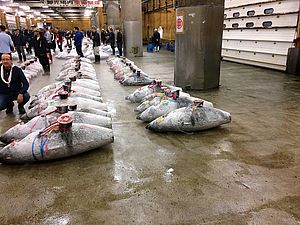
Japan was an absolute highlight of this trip.  Our group was lucky enough to view a wide and varying range of businesses from the Kobe beef auction to a wagyu beef farm, green tea plantations and processing facilities, a dairy and ice cream business, small horticultural businesses selling high end produce, and even a popcorn farmer selling his own product in microwave popcorn bags!

The Japanese people are very polite with long established business structures and an extremely formal manner in which they conduct business. 

Farmers are held in a very high regard as they are perceived as the people responsible for feeding the nation.  Consumers will typically pay 20-25% more to purchase Japanese product over similar imported products.

Farms tend to be quite small (average around 2ha) with vast subsidies paid to keep the sector profitable (these subsidies total more than the GDP generated by the sector).  In agriculture, most of the farming inputs and outputs are controlled by a business called ‘JA’, a government established, farmer controlled monopoly. 

JA has huge control over the sector and is averse to any change in subsidies or reduction in tariffs on imported food.  Despite this, the Japanese Government is starting to try and change the sector with a view to loosening the trade barriers and allowing more imported food into Japan, a real opportunity for NZ.

Japan has a major issue with ageing farmers now retiring from farming, with not a lot of young people looking to enter the industry. 

The average age of farmers is approximately 67, with some farmers we spoke to being unsure regarding who would farm their land following their retirement. 

In order to bolster the sector, a program has been developed to allow some foreign workers (particularly from China) to assist with working the land.

Israel

The Israeli people are incredibly resourceful, innovative and world leading in some of the technology they use to generate agricultural production from what is generally a very harsh environment. 

We travelled extensively through Israel, looking at research institutes and farming operations to gain an understanding of some of the technology used to cope with the challenges they face.  Due to the climatic conditions, all livestock are housed in sheds and open side barns, with the result being very intensive operations that must be efficient to be profitable. 

Water usage is a major concern with most recycled water used to irrigate high value crops with large amounts of desalinated water used due to the lack of fresh water availability. 

Of particular note, was the fact that some of the water being used for irrigation of crops contained high levels of dissolved salts, making the salinity of the water higher than would otherwise be expected in a horticultural environment. 

Despite this, they are still managing to harvest above average yields, a feat that impressed the horticultural farmers on our tour.
Israel is well known for its kibbutz arrangements (groups of families that live and work in a semi-socialist structure where the community rather than individual people own and operate the assets for the benefit of all). 

However, they are not averse to the change in society, with many kibbutz members now becoming older and a number beginning to struggle with succession issues.

Agriculture is not viewed with the priority it once was and large numbers of young people are focussing on entering technology industries, with less choosing to work within agriculture.  However, we did see some interesting technology being used within agriculture from milk meters in a dairy shed (that split high value milk from low value milk at the cluster) to Bio Bee (a business where bumble bees are grown in boxes to develop colonies which can then be sold to horticultural businesses for pollination of crops).

England – The Triennial

The Triennial was an amazing opportunity to catch-up with not only the other groups who were also travelling on their GFPs, but also to meet and interact with a range of scholars from all countries and years. 

They provided a fascinating insight into the Nuffield Scholarship and the opportunities and discussions that have resulted following completion of their scholarship programmes.

Although several impressive businesses were viewed, many of which were using new technology to improve their profitability, sustainability and environmental impact, discussion was very much influenced by the upcoming BREXIT and what this will potentially mean for these businesses. 

Some appear to be embracing the opportunity, while others were quite apprehensive about the challenge of competing against lower cost or more efficient operators from other parts of the world (NZ very much included). 

There was considerable discussion regarding the potential for subsidies in farming to be reduced or removed, and NZ was discussed at length as a model as to how this could work.  Many of the businesses that we were shown relied heavily upon manual labour which invariably came from Eastern Europe, a challenge that the UK government will face as they work through discussions with the EU.

Some of the businesses that we were fortunate enough to visit really focused on two key points of interest, the first being the provenance of the food they were selling and ensuring the quality of that produce. 

Consumers are becoming increasingly focussed on the ‘story’ of their food.  They want to know how it has been made, where it comes from and what makes it unique. 

We cannot underestimate the importance of this, however any ‘story’ must be supported by a strong and secure supply chain that backs the integrity of claims on the packaging. 

I was also struck by the high importance of consistent quality and the impact of this quality on the price that is received.  At Hall Hunter Partnership, the managing director Harry Hall was only interested in supplying berries of ‘A’ quality.  Berries that did not meet ‘A’ quality standards were discarded regardless of any income that could be received from them. 

Together with his level of supply, this meant he had the ability to engage in meaningful discussions with his in-market partners (Waitrose and Marks & Spencer) when it came to Marketing his products and achieving the highest possible price (and therefore the best return on his assets).

USA: Washington D.C and Wisconsin

The chance to visit Washington, D.C. was an absolute highlight.  The number of historic events that have occurred in this city and the influence that it continues to have on world affairs is immense.

The impact of decisions made here can have a significant impact on NZ agriculture (for example, the withdrawal from TPP by President Trump). 

However, with the slow process of appointing his Secretary for Agriculture and the fact that the rest of the agriculture cabinet is yet to be appointed, it swiftly became apparent that President Trump does not have a major focus on the agriculture sector. 

Despite this, agriculture remains well supported in the US with a vast network of universities across the country being primarily set up to support agricultural research.

Wisconsin is typically known as a ‘dairy state’ (due to the large number of dairy farms in the area) although they differ significantly from NZ in that they are largely indoor based systems with high volumes of crops grown to feed the stock. 

There were a range of automated and traditional parlour based systems, however with access to labour becoming a significant issue there is likely a trend towards automated parlours to reduce labour requirements. 

There is a focus on environmental impacts, with strict controls on the spreading of animal waste and some quite innovative farmers who are trialling different grazing systems with the aim of reducing their impact on the environment.

Key trends and how they relate to NZ

A few key trends and insights I observed/developed during the course of the GFP have been summarised below:

Provenance is of major interest to consumers
The most successful businesses and farmers that we engaged with on our travels make it a priority to constantly talk to their consumers about what is happening within their business, and the impact that this will have on production and when consumers will be able to purchase their products. 

An example was a high-end vegetable producer in Japan who sold all his produce on-line and had a huge twitter following.  He was consistently updating consumers with information about what was fresh and new, when products would be available, and keeping them updated with photos of his products.  The more we interact, the better the consumer understands our business and the ‘story’ behind our produce.

Quality and traceability is incredibly important
Consumers are becoming more and more interested in understanding the production story and exactly what that story entails.  People understand the “organic” story and are prepared to pay for it.

If we are to maximise the value of our product, we need to also demonstrate that we are being incredibly efficient with what we use to produce it and why it is necessary. 

It is also incredibly important to ensure that the quality of product is maintained at a high level, and that we are consistent in our interactions.

Constant innovation is key
The product created and sold today will not necessarily be what the consumer desires tomorrow. 

The horticultural businesses visited were constantly exploring new varieties and innovations to present to the consumer.  The technology implemented in Israel to reduce cost by separating milk at the cluster rather than at the factory will also assist in improving returns to the farmer in the long term.

Succession in agriculture is a global issue
Every country visited was experiencing difficulties with succession planning and encouraging young people to enter the agricultural industry. 

Attracting and retaining talent in the industry is a key issue, with land in some countries no longer being farmed due to nobody being interested in taking on the responsibility of such a venture. 

Increasing the interaction between urban people and rural businesses will not only improve the understanding of the issues that we face in this area, but also maximise the potential future ‘talent pool’ of people available and willing to enter the industry in the longer term.

I would like to take the opportunity to thank the NZ Nuffield Trust and all the sponsors including AGMARDT, Beef and Lamb NZ, Dairy NZ and FMG for the opportunity to engage in this incredible journey. 
 

India Global Focus Programme 2017: Rebecca Hyde

Rebecca Hyde, 2017 Nuffield Scholar

I set off from Christchurch on the May 8th, 2017 to embark on a trip that would open my mind and change my views of how I perceived global agriculture and how we feed the world.

I selected the India Global Focus Programme (GFP) as I’d travelled there 10 years earlier. It was a place I didn’t particularly enjoy at the time but a place that has always stuck in my mind. I wanted to know more about what made this chaotic place function. The India GFP also included Qatar.

There were ten Nuffielders in our group which included scholars from Australia, UK, Ireland, Holland, Brazil and New Zealand. The group travelled through Singapore, India, Qatar, Denmark, UK and America.

Having done the post Contemporary Scholars Conference (CSC) tour, I was looking forward to the dynamics of group travel and the added value the diversity of the group would bring. The diversity of the group was great during our daily debrief, it was something we all looked forward to as it was an opportunity to harvest others thoughts and ideas and help develop our own thinking.

Singapore

We started our GFP in Singapore. It was great to catch up with friends I had met at the CSC but wouldn’t be travelling with. The foundation was set with some very good meetings in Singapore which showed the role that Singapore plays in global trade and how it is a hub for multi-national companies to be based from. It left me feeling that Singapore is the puppeteer of global trading logistics, especially for China.

India

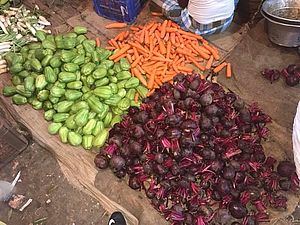
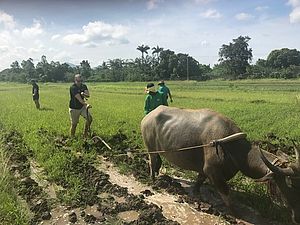
The colours, smells and sounds of India hit you as soon as you arrive. Our time there, took us from the south to the north visiting vegetable growers, dairy farms, coffee plantations, vegetable processing plants and universities. Going forward India faces some huge issues with water supply. Water table levels in the north are reducing by three feet a year in some places and the south has seen once large rivers not flowing for the last three years. With a growing population expected to surpass China, I think they are being unrealistic about their ability to feed themselves which is a goal of the government. This is a great opportunity for New Zealand with a rising middle class who love to eat. A belly is a sign of prosperity.
Qatar

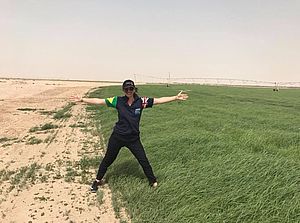
Qatar is well named as ‘The Sandpit’. The phrase ‘more money than sense’ came to mind a number of times. In a country where 99% of the food consumed is imported they are at the mercy of world trade. There has been hundreds of millions spent on farms that are inefficient to say the least. There are opportunities here for New Zealanders in consulting. For New Zealand, I think it’s a good entry to the Middle East. There is a very strong Australian presence, the same can’t be said for us.

Denmark

We were the first group to have Denmark included as part of the GFP. The key things that stick in my mind are orderly, efficient, high standards and high debt in family farms due to succession laws. The Danes are very patriotic and consumers will buy Danish products whereever possible, price is not the main driver. The same cannot be said about New Zealand. Do NZ consumers know our story well enough? I don’t think so.

United Kingdom

The UK had the 3 GFP groups meeting up again and join the moving Triennial conference. It was great to meet with Nuffield alumni from around the world. The topic of conference day was “Farming Fit for Food”. We need to remember we are producing food. I see an opportunity for New Zealand farmers and industry to link the environmental message in with the health benefits of the food we produce. Emotion will win over fact every time. The question needs to be asked ‘How much are we prepared to pay for a healthy family?’

USA

It was great to get behind the scenes in Washington DC and try to understand the complexity of American politics. It became very clear that agriculture is not a priority for the current administration. I was surprised to hear that 80% of the Farm Bill budget is spent on food stamps and nutrition, leaving 20% for farm related spending. Our time in Iowa was a highlight. The birthplace of global brands such DuPont Pioneer, John Deere and Noble Peace Prize winner Norman E Borlaug.

The farmers there just seemed to be getting on with what they do best which is farming and they do it well. It was refreshing to see a side of America that was humble and took pride in what they do. Bill Northey, Iowa Secretary of Agriculture, needs a special mention. He popped up everywhere we went, he was so proud to be showing off his state and he knew about farming and farmers. He was appreciative of our group spending time in his home state. This was all during a time he was meeting with Secretary Perdue and President Trump to be part of the administration. We were hopeful of getting to meet the President but it wasn’t to be!

As always, I was proud to be travelling as a Kiwi. We are well respected but we are better known for our scenery then our great quality produce. A number of presentations we had didn’t even include New Zealand on the world map. We need to be shouting from the roof tops what we have because grass fed, GMO and antibiotic free food is on an upward trend. We need to spell out what we do in a simple message that plays on the emotions. If we don’t fill this space, someone else will.

China Global Focus Programme 2017: Jason Rolfe

Jason Rolfe, 2017 Nuffield Scholar

The China Global Focus Programme (GFP) group was one of the more diverse groups this year, with our group comprising of representatives from Australia, Ireland, Wales, Netherlands, England, South Africa, and myself from New Zealand. The GFP tour was a once in a lifetime experience made better by the diversity of our group, which created great internal discussion and debate following all our visits each day. I would like to thank Nuffield New Zealand (NZ) once again for this opportunity.

Our group was lucky enough to travel to seven different countries on our journey, which included: Singapore, Philippines, Hong Kong, China, Germany, United Kingdom (UK), and the United States of America (USA).

During our travels each country brought different themes to mind which I have highlighted in the title of each country overview. The overall theme I observed for NZ was that the rest of the world thought very highly of NZ as a beautiful country and a great food producer. However, this has led us to becoming complacent in many markets.

A key improvement for NZ in the international market could be to remain active in our export markets and continue to sell ourselves and our products. Just because we are selling a product in a market now doesn’t mean someone else won’t be tomorrow.

Singapore – “Emotional Branding”

Visiting a large supermarket in Singapore, it was great to see so much NZ product in the stores, however, this was met with disappointment that our products were some of the lowest priced items in the supermarket.

Our friends from Australia, Switzerland and the USA, were consistently gaining a premium across most primary products including red meat and milk. The biggest difference following a quick survey of some consumers in the store was the branding difference between NZ and our competitors.

NZ products were branded functionally with minimal fuss over labelling and a small ‘NZ made’ triangle on the packet. This was in contrast to other international products that used pictures and stories to advertise and brand their products. This played on the consumer’s emotions and they were more likely to pay for a dairy product with a picture of a happy family in front of a cow and a link to a farmer’s story.

New Zealanders are historically humble when it comes to ‘talking ourselves up’, however, in order to obtain premium we need to be ‘louder’ or more strategic in our branding to be noticed by the consumer.

Philippines – “East meets West”

The Philippines was a great example of where western culture particularly the USA was having an influence on the traditional eastern diets of the Filipinos. A large number of branded western products were sold in smaller packets to be affordable and the locals preferred these products as they showcased wealth.

The highlight of the trip was being hosted by the International Rice Research Institute, where we got to experience first-hand the different techniques employed by farmers to grow rice. We also had an update on GMO rice varieties and the scientific evidence that these new varieties could feed 13-14 billion people (if approved) with no impact on food safety.

Some of the debate centred around who was responsible to feed the world and it was agreed that New Zealand’s strength to this battle was our knowledge and farming skills that we could share rather than our produce, given our size and land limitations.

Hong Kong – “Changing the purchasing experience”

Hong Kong was a very interesting city with a large number of global businesses who do business in China basing their headquarters in the city.

Traditionally Hong Kong has been a port hub for China, but recently due to the creation of greater shipping lanes in and around China, this is now changing. Rather than dwell on this Hong Kong is embracing change and focussing on the service industries such as finance.

While in Hong Kong we were lucky enough to be hosted by the Hong Kong Jockey Club and witnessed first-hand how a business had combatted the threat of online sales and changed the purchasing experience to increase ticket sales and income.

It was certainly a model that the New Zealand Racing industry as well as the New Zealand Rugby Union should investigate further.

China – “NZ complacency and guaranteed food source”

China was a real eye opener for me personally given the population base, it really did take some getting used to.

Three key themes that came out of our visit was the importance of ‘country of origin’ in China, how complacent NZ was in the market, and reasons why the Chinese were buying up land around the globe.

Everywhere we went it became very clear that the Chinese people did not trust Chinese food, and preferred imported product. NZ had managed with our free trade deal to get into china early, however, from what I witnessed in two examples we have rested on our laurels a fair bit.

First example was at the at the SIAL expo in Shanghai (which is China’s largest food expo) where I saw only two NZ companies in attendance in the Honey and Seafood sectors, and no show from the beef or dairy sectors.

This was in contrast to all other export focussed countries that had large stands at the show promoting both their countries and their products. The second example was in the local supermarkets where NZ infant formula was the lowest priced out of all imported formula.

The third major learning was around Chinese investment offshore in places like New Zealand. The acquisitions of land were all about guaranteeing future food for their growing population. Interestingly, the comment most Chinese businessmen made was that they would actually prefer to lease farmland in our countries on long term agreements of 20-30 years than take the risk of purchasing the property.

Germany – “Great hospitality and renewable energy”

The highlight of Germany was the people and the landscape, which was not dissimilar to NZ. We were lucky enough to be hosted by Stefan and Liz Teepker, mixed farmers from Western Germany, who went above and beyond to organise some great farm visits, and to ensure we enjoyed our time in Germany.

The key theme from the German farms was renewable energy; with most of the farms we visited having some form of wind, sun or bio generated power as the main income source for the property.

While the building of the turbines or bio digesters was largely government supported, the on-going cash flow from these power generators had allowed these farmers to invest in their original businesses.

Many of these original farm production systems were now just hobbies and this had meant many had lost efficiencies in cost of production compared to the likes of New Zealand.

United Kingdom – “Attitude towards Agriculture and Subsidies”


In the UK, we were lucky enough to attend the Nuffield Triennial Conference, where we got to mix and mingle with many previous Nuffield scholars from around the world.

This was a valuable opportunity to make some contacts for further travel and research later in the year. The common topic of the conference was around ‘Brexit’ and what the future looked like for British Agriculture as they transitioned out of the European Union (EU).

The debate naturally centred around farm subsidies currently received by farmers and whether these would continue and for what. Interesting for me was the large amount of Farmers, including UK Nuffielders, whose attitude was that they would not survive without subsidies and were very resistant to change.

Delegates at the conference were in agreement that due to Agricultures relatively small contribution to GDP that subsidies were going to be greatly reduced if not removed.

This potentially would create opportunities for the younger generation if older farmers chose to exit the industry. It was clear that the process of leaving the EU was going to be very long and drawn out. Due to this and the inward focus it brings, they may miss global market access opportunities.

United States of America – “Trump, Migrant labour and Water”

In the US we were fortunate to visit two areas; Washington DC and California. Washington was a great opportunity to meet a number of government officials including a Senator, as well as learning how the US political worked.

It became very clear early on that President Trump was not prioritising Agriculture at all with the Senator for Agriculture the last one to be selected in his team.

This was further reinforced once we arrived in California, where the majority of the rural labour force is migrant labour, mainly from Mexico, which was something Mr Trump very publically wanted to clamp down on.

In California the farmers were coming off a five year drought and water was the main topic of conversation. With ground water levels dropping 2.5 feet per year during the drought, many restrictions were in place and only the rich farmers were likely to be able to afford to farm moving forward.

More storage of surface water was the obvious solution; however, most farmers had their ‘heads in the sand’ over the issue and were content to flood their paddocks with excess water this year in an attempt to re-charge the ground water. When questioned they could not offer any scientific evidence to support this practice.

General Manager Update

Anne Hindson, August 2017

The countdown until the close of Nuffield applications for the 2018 scholarships has started with this year’s closing date on the 13th August, one week earlier than usual to allow more time for the selection process.  The announcement of the successful scholars will be held on the 2nd November, at Parliament. The returning (2017) scholars will present some of their key insights at this event also.
With the help of Denitsa Stoeva, who has been on a two month contract with us, we have been able to review the Nuffield Scholarship marketing programme. Denitsa has increased the social media marketing and reviewed the content and messaging on the website. Following up with those who have registered interest in the scholarship over the last three years has also prompted some renewed interest and requests for more information.

Taranaki Evening


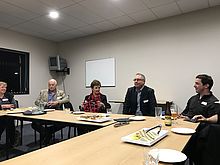
We held one regional Nuffield recruitment event this year – in New Plymouth. Lisa Harper, with support from alumni, Phil Luscombe, Marise Stephens and Noel Schrider shared their Nuffield experiences and the impact on their leadership pathways and careers. The event was also attended by two successful Kellogg alumni –  Bronwyn Muir and Shona Glentworth who shared their experiences from that programme.  We had some very interested potential scholars for the programme this year and in the future.  These regional events provide an opportunity for alumni to catch up with each other, but also provide an opportunity to introduce future scholars, particularly farmers and growers who are our target market. 

Scholar Update


The six 2017 scholars are fully immersed in their study and travel programme with three of the six still away, and three just returned from part of their personal research. A feature of this group which I have found positive has been the close friendship and sharing of information and ideas which has consistently happened on their travels. I think we will get some great insights and challenges to current thinking when the group present back. Like most scholars, their topics have morphed over time and we should see some insights and recommendations that will build on the issues raised by Ian Proudfoot in the KPMG Agenda. In this E Nuff you can read their insights from their Global Focus Programmes – Nadine, Mat and Ryan completed their GFP in March/April, while Jason, Rebecca and David undertook their GFP in May/June. They all experienced very different parts of the world with a range of social, environmental, political and financial issues to consider and understand. The 2016 scholars are active in getting their reports and research discussed at forums and in media. They will have the opportunity to present at the Nuffield Australia Conference in Darwin at the end of September this year. If you have not read their reports, there are some interesting topics:

Jessica Bensemann        

Defining our Kaupapa:  New Zealand’s role in the future of global Agriculture

Tom Skerman 

Agribusiness Governance – Finding the Green Zone

Richard Fowler 

An Investigation into Synthetic Food and the Implications for NZ Agriculture

Sam Lang       

Community-Centric Innovation and the Regenerative Farming Frontier

Bede O’Connor   

China Dairy: the growth of an industry

Management Developments

New Entity

The transition from an informal partnership between Nuffield NZ and Lincoln University to an Incorporated Charitable Trust has now been completed and the new Trust began operations on 1 June 2017. There have been some challenges, as anyone recently setting up a Trust will know. The New Zealand Rural Leadership Trust will manage both the Nuffield Scholarships and the Kellogg Rural Leadership Programme and continue to provide effective and co-ordinated leadership pathways.  The office will remain on the Lincoln campus site, and will be totally independent of the University operations.

Staff Changes

With the transition to a new entity, Desley Tucker, our Programme Coordinator for three years, chose to stay in employment with Lincoln University (she was contracted by us from LU) rather than move to the new Trust.  We will miss Desley and her great people skills as many of you will appreciate having liaised with her over the last three years. However, we have secured a great new replacement for the role with Lisa Rogers who started in late June. Lisa comes to us from a recent contract in the IT sector, and has previously worked in a financial contract role for Nurse Maude, and in a similar role of project and event managing with a large Canterbury golf club. Lisa brings strong financial and administration skills to the role. Lisa is a keen golfer and skier and has two teenage sons.   

Upcoming Nuffield Events

Nuffield New Zealand Conference – 10-13 May 2018 Dave Hurst and his team have been working hard on confirming venues, visits and a detailed programme with dates & Tauranga location already confirmed – see overview in this edition of E Nuff. Further details will be sent out shortly including registration information. It is important that you put the dates 10-13 May in your diary now! Nuffield International Triennial 2020 The Nuffield International Triennial was held in the UK in mid June with more than 20 New Zealanders attending, including some of our younger scholars who were given some fee sponsorship to enable them to attend.  The three mid-year Global Focus Programmes for current scholars also included the Triennial as part of their schedule to engage them in this wider Nuffield event. New Zealand was confirmed as the host for the 2020 Triennial. The year also coincides with our scheduled biennial Nuffield NZ Conference so some creative thinking is being done to manage the outcomes for both. An organising committee is being set up to consider dates, venues, theme etc. The challenge for NZ is finding the right timing to showcase our fabulous corner of the World and also work with the Northern Hemisphere calendar. I wish to thank all Nuffield alumni for their ongoing support in recruiting future scholars, assisting with regional events and presentations.  Please continue to promote the programme to our sponsors who along with alumni, make it possible for the programme to continue as New Zealand’s premium award in the Agrifood sector.  Kind regards Anne Hindson Beef+Lamb NZ

Chair Update: Juliet Maclean

Those of you who have read the KPMG Agri Business Agenda will have noted the multiple references to leadership and its importance to the growth and sustainability of an innovative and resilient food and agri business sector for New Zealand.
In his introduction, Minister Guy made particular mention of the investment made by MPI into the Kellogg and Nuffield programmes. This is a respected and valuable contribution, both financially and as tangible demonstration of support for our organisation.

The KPMG survey asks agri-business leaders to rank a range of priority items depending on their view on the importance and urgency of action required by the industry. Not surprisingly, maintaining a world class bio security system is ranked number one.

Recent threats to the biosecurity of our cattle population is a reminder of why this is so crucial to our livelihoods. Creating New Zealand provenance brands featured at number two. Innovation with customers is number five and developing future leaders is number nine. It would be difficult to find any better endorsement for the relevance of Nuffield New Zealand, with our tag line of “Global vision, leadership and innovation”.

The KPMG Agenda is a future focused, interesting read. If you would like to peruse the contents further, you can find it via this link
https://home.kpmg.com/nz/en/home/insights/2017/06/agribusiness-agenda-2017-the-recipe-for-action.html

Regardless of this confirmation of the importance of our organisation, we mustn’t become complacent and I am determined that Nuffield remains appropriate and effective in an ever- changing global environment. Each generation of scholars has, and will face, new challenges and opportunities, even if they fall within consistent themes.

Technology, social media, the internet of things, transport, robotics, education – we are part of a rapidly evolving and exciting world and Nuffield must keep pace with this if we are to stay truly relevant.  The qualities and skills required to build relationships, navigate negotiations, demonstrate leadership, display grit and resilience will, I believe, remain invaluable for us as individuals and contributors to business and rural communities.

Focusing on how Nuffield can contribute to each scholars’ learning experience is an exciting challenge and one which both your Trustees and management consider regularly. If you have any ideas, please share them with me.

I’ve had enthusiastic and complimentary reports from those of you who attended the Triennial in the UK. With your feedback in mind, we are now underway with planning for the 2020 conference which we will host here in the South Island. Stay tuned for updates over the next few months.

Applications for this year’s scholarships close in mid-August, with selections and interviews taking place in September and October. Meeting our scholar applicants and considering their potential to contribute to Nuffield and New Zealand, is a highlight of the year for me. I look forward to announcing the successful applicants in our next update.

As the days lengthen and those mid winter Xmas celebrations become a fun but distant memory, the matters of calving, lambing, crop establishment and the elections focus our attention. These will bring different responsibilities and involvement for each of you. Whatever part you play, be sure to ‘get amongst it’, make a real difference and have fun too.

Kind regards
Juliet 

2018 Nuffield Scholars Announced

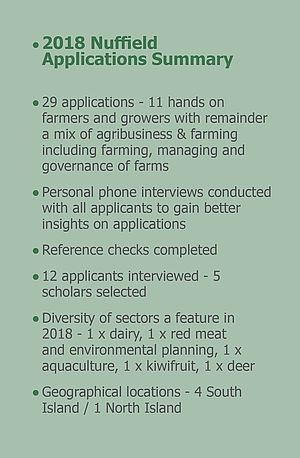
Simon Cook is a kiwifruit grower from Te Puke, owns an orchard a contracting business. 

Andy Elliot, working for Wakat? Incorporation in Nelson, has 20 years’ experience in New Zealand’s aquaculture industry.

From Banks Peninsula, Canterbury, Turi McFarlane works for Ravensdown Environmental utilizing his experience in agricultural systems and sustainable land management. 

Solis Norton from near Port Chalmers, Dunedin manages the industry funded national animal health and productivity  programme for the New Zealand Deer Industry.

With a background in dairy farming, Kate Scott, from Central Otago, owns her own environmental planning and surveying business which services a broad range of agri sector businesses.

The five new 2018 scholars join more than 140 New Zealand agricultural leaders, over more than 60 years, to have been awarded a Nuffield Scholarship – a highly respected and prestigious award in the primary sector.

The 12 month scholarship programme with up to 20 weeks spent overseas, allows participants to spend time away from their business and to travel to observe, immerse, reflect and learn about global agricultural practices and the contexts they are operating in. A research topic, which focuses on an issue /challenge for the New Zealand primary sector, will be a focus of individual travel and investigation.

Nuffield and Kelloggs combine resources

Media release

24 September 2013

Kellogg and Nuffield combine resources

The Nuffield Farming Scholarship Trust and Lincoln University are combining their efforts to improve leadership capability within the rural and primary sectors in New Zealand. The two organisations have agreed to establish a rural leadership consortium to manage two prestigious leadership programmes that have operated in New Zealand since the late 1970s.

The two programmes will continue to operate distinctly and maintain their strong existing brands and alumni networks, but will be managed by a shared full-time General Manager. This position will be advertised shortly.

The Kellogg Rural Leaders Programme (Kellogg) is owned and administered by Lincoln University and the Nuffield Farming Scholarship Trust (Nuffield) is owned and administered by the Nuffield Farming Scholarship Trust. Over 650 New Zealand alumni have completed the Kellogg programme and there are around 150 Nuffield New Zealand alumni. 

“There is a natural synergy between the two programmes and they combine logically to form a leadership pathway within the rural and agribusiness sectors”, says Nuffield Trustee Juliet Maclean.

Chancellor of Lincoln University, Tom Lambie adds “By combining our resources, the University and the Nuffield Trust will be able to strengthen both of these programmes, and ensure the essential leadership capabilities are maintained and enhanced within rural New Zealand”.

Both the Nuffield Trust and Lincoln University expect that the combined resources of the rural leadership consortium, with the support of both programmes’ industry partners and sponsors, will enable the Kellogg and Nuffield programmes to better meet the leadership development needs of the wider rural and primary sector.

Background information

Lincoln University and the Kellogg Rural Leaders Programme

Lincoln University is New Zealand’s specialist land-based university delivering research informed education and training, along with research and commercial activities to support growth in the land based industries. Land based industries are referred to in the widest sense of the word including land, land resources and waterways.  

Lincoln University has administered the Kellogg Rural Leaders Programme since 1979 when it was launched with a grant from the Kellogg Foundation, USA. The programme provides an opportunity for twenty men and women who live and work in rural New Zealand to participate in residential workshops, seminars and personal study over an 11 month period.  The objectives of the Kellogg programme are to:

  • Develop solid leadership skills
  • Build the confidence to take the next big step in business, professional development, politics, industry governance or community service
  • Learn how political, cultural, social, economic and physical forces impact on New Zealand agribusiness
  • Establish networks with leaders from New Zealand and beyond.

The Kellogg programme is generously supported by DairyNZ, Beef+Lamb NZ, Zespri, Pipfruit NZ, and Deer Industry NZ.

The Nuffield Trust and Nuffield Scholarships

The Nuffield Trust is a charitable New Zealand Trust set up in 1978 and is part of an international network of Nuffield Trusts that provides scholarships to emerging leaders in the agricultural industry.

The Nuffield Trust is governed by four Trustees and managed through a part-time director and secretariat, with around 150 active alumni members (all the alumni are Nuffield scholars).

The Nuffield Trust’s mission is to develop leadership and excellence in all aspects of New Zealand agriculture through its function of providing scholarships to around five scholars.

The objectives of the Nuffield programme are to:

  • Select scholars with high personal integrity, a close connection to farming or a practical hands on farming background, who are self-disciplined but flexible, focused on innovation and high achievement and who are likely to “give back” to the agricultural industry over their life time
  • Increase thought leadership
  • Create a full international immersion experience for scholars
  • Develop global networks

Nuffield scholarships are provided to future leaders chosen because of the positive difference they will make to their relevant primary sector, and for the life-time contribution they make to New Zealand agriculture. 

Scholars are linked into the Nuffield international network and supported to undertake projects or research that will fuel intellectual debate within their communities and industries.   Nuffield New Zealand also provides an alumni network through circulating newsletters, publishing information on the Trust’s website and running conferences. 

The Nuffield programme is generously supported by DairyNZ, Beef+Lamb NZ, FMG, AGMARDT, FAR, the Mackenzie Charitable Foundation, and Landcorp.

Triennale Nuffield Conference 2017: United Kingdom

David Kiss and Jason Rolfe, 2017 Nuffield Scholars

England – The Triennial

The Triennial was an amazing opportunity to catch-up with not only the other groups who were also travelling on their GFPs, but also to meet and interact with a range of scholars from all countries and years.  They provided a fascinating insight into the Nuffield Scholarship and the opportunities and discussions that have resulted following completion of their scholarship programmes.

Although several impressive businesses were viewed, many of which were using new technology to improve their profitability, sustainability and environmental impact, discussion was very much influenced by the upcoming BREXIT and what this will potentially mean for these businesses.  Some appear to be embracing the opportunity, while others were quite apprehensive about the challenge of competing against lower cost or more efficient operators from other parts of the world (NZ very much included). 

There was considerable discussion regarding the potential for subsidies in farming to be reduced or removed, and NZ was discussed at length as a model as to how this could work.  Many of the businesses that we were shown relied heavily upon manual labour which invariably came from Eastern Europe, a challenge that the UK government will face as they work through discussions with the EU.

Some of the businesses that we were fortunate enough to visit really focused on two key points of interest, the first being the provenance of the food they were selling and ensuring the quality of that produce.

Consumers are becoming increasingly focussed on the ‘story’ of their food.  They want to know how it has been made, where it comes from and what makes it unique. 

We cannot underestimate the importance of this, however any ‘story’ must be supported by a strong and secure supply chain that backs the integrity of claims on the packaging.  I was also struck by the high importance of consistent quality and the impact of this quality on the price that is received.

At Hall Hunter Partnership, the managing director Harry Hall was only interested in supplying berries of ‘A’ quality.  Berries that did not meet ‘A’ quality standards were discarded regardless of any income that could be received from them. 

Together with his level of supply, this meant he had the ability to engage in meaningful discussions with his in-market partners (Waitrose and Marks & Spencer) when it came to marketing his products and achieving the highest possible price (and therefore the best return on his assets).

David Kidd

*****


United Kingdom – “Attitude towards Agriculture and Subsidies”

In the UK, we were lucky enough to attend the Nuffield Triennial Conference, where we got to mix and mingle with many previous Nuffield scholars from around the world. This was a valuable opportunity to make some contacts for further travel and research later in the year.

The common topic of the conference was around ‘Brexit’ and what the future looked like for British Agriculture as they transitioned out of the European Union (EU).

The debate naturally centred around farm subsidies currently received by farmers and whether these would continue and for what. Interesting for me was the large number of farmers, including UK Nuffielders, whose attitude was that they would not survive without subsidies and were very resistant to change.

Delegates at the conference were in agreement that due to Agricultures relatively small contribution to GDP that subsidies were going to be greatly reduced if not removed.


This potentially would create opportunities for the younger generation if older farmers chose to exit the industry. It was clear that the process of leaving the EU was going to be very long and drawn out.

Due to this and the inward focus it brings, they may miss global market access opportunities.

Jason Rolfe

New Harvest Conference New York: Synthetic Food Debate

Richard Fowler, 2016 Nuffield Scholar

The hype and debate around synthetic food seems to keep ramping up with a continuous stream of articles in the farming papers and mentions from so called futurists, but when I attended the New Harvest 2017 conference in New York last month, I got the impression that the rhetoric and the marketing is still out of tune with actual production and sales.

New Harvest is a non-profit group that aims to fund and coordinate research into ‘Cellular Agriculture’ and covers the extreme end of synthetic food including in-vitro meat production, and milk protein synthesis without the need for cows.

When I attended the 2016 conference, I got the impression that despite the incredible amount of funding and interest in the field, there were some serious hurdles like the use of bovine foetal serum for cell growth and the need to get USDA approval for novel technologies. There was also an obvious lack of farmers and food processors in the room, so there was no balanced debate or real-world experience.

This year, after giving my feedback on the 2016 conference, I was asked to speak on a panel alongside a Welsh farmer (also a Nuffield scholar) and two of the leaders from the Cell Ag world. The questions put to us included “what will happen to all the farm animals when they’re not required any more” and “is clean meat the right term to be using to describe cell cultured tissue?”

It was always going to be a tough crowd and there’s a real need to get more farmers and researchers in on the conversation. But I think we managed to get a couple of points across like “YouTube doesn’t represent different farming systems very well” and that “animal agriculture is actually a rich part of human culture.”
To me, the thing that needs the most attention from a New Zealand Agriculture point of view, is pushing back on the claims that are being made by the synthetic food companies.

Stats like ‘98% less water consumption to make cultured milk’ and ‘95% less land to make a veggie burger’ are presented like they are facts when they’re quite frankly rubbish.

I strongly believe that once some real research (instead of modelling) is done on the actual production (instead of forecasts) of synthetic food, then pastoral farming will prove more efficient and therefore cheaper and better for the environment.

That message is being diluted by the millions of dollars being pumped into the marketing of synthetic food and animal agriculture still runs the risk of being shot without a fair trial.

Update from the General Manager

Anne Hindson, November 2017

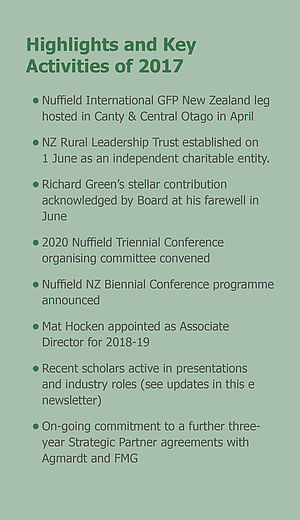
There has been lots going on since I last updated you in August. This is my summary of the key activities and the highlights of the year.Earlier this month we announced our 2018 Scholars. This edition follows up on our brief, pre-media announcement to you with photos and bios of the scholars. I hope that many of you will get to meet the scholars during their scholarship year.

The 2018 Awards Ceremony was hosted in Parliament by the new Minister of Agriculture, Damian O’Connor in his first few days in office. Having the Minister able to present the awards had special significance given both his father and brother are Nuffield alumni.
 
A second highlight of the Awards evening was hearing the progress of the current scholars. Each shared their preliminary insights on their research topic. With greater emphasis on scholars studying topics that will add value and offer solutions to some of the challenges facing the primary sector, there was strong interest from those attending. The value of this has been reinforced with MPI Director General, Martyn Dunne requesting a presentation from the scholars to MPI staff in the new year.

Having shared information and experiences with the 2017 scholars, the 2018 scholars will have a two-day New Zealand and Industry sector briefing in Wellington on 7/8th December. This is to ensure they understand the global positioning, strategy and key markets of our primary sectors, as well-informed ambassadors of NZ and Nuffield.

New Entity

The New Zealand Rural Leadership Trust has now been operating for 6 months, managing the Nuffield Scholarships and the Kellogg Rural Leadership Programme.

The transition to a standalone entity has taken time, but the organisation is now well set up to meet opportunities and challenges for the future. The legal and accountancy advice required has been significant and I wish to acknowledge the generous support of Mark Tavendale of Tavendale & Partners (legal) and Andrew Hawkes & team at KPMG Christchurch office (accounting) and encourage alumni to support them for any future needs.

The office at Lincoln University has been retained with myself and Lisa Rogers, our Programme Coordinator based there. The Kellogg Rural Leadership Programme is still delivered using Lincoln University venues and facilities.

Investing Partners

Our Strategic Partners are now contributing to leadership pathways by supporting both programmes and are actively involved in the development of leaders for the sector.

During the year, FMG and Agmardt have recommitted to a three-year partnership with the Trust, while Dairy NZ and Beef+Lamb NZ have continued their support.

For our organisation, the value of these industry partners comes in many ways with the National Advisory Group (representatives of the four organisations) providing regular industry insights, developments and views on future leadership needs to help us better shape the programmes. In addition, they have provided meeting space, special project support & Nuffield selection specialist HR support.

Our Programme Partners have grown in number, and their support is equally valuable providing marketing and speaker support to the programme.

Associate Director appointment

The Board recently invited alumni from the last 5 years to expression interest in the Associate Director role being vacated by Dan Shand in November. After considering the five applications, Mat Hocken was selected and will take on the position in January 2018 for 18 months. This is part of our commitment to provide ongoing leadership development opportunities to scholars, with governance a key goal for some.

Upcoming Events

Dave Hurst and his team have finalised the exciting programme for the 2018 Nuffield NZ Biennial Conference in May 2018 in Tauranga and surrounds. They are confidently anticipating a great turnout! You will be receiving information and regular updates over the next few months.

The programme will begin at 2pm on Thursday 10th May to accommodate presentations from the eleven scholars, including the six 2017 scholars with their reports “hot off the press”! The programme features some interesting field visits reflecting the agri-food and business strengths of the Bay of Plenty region.

The 2020 Nuffield Triennial Conference organising committee has been convened under the chairmanship of Michael Tayler with Murray King, Jane Mitchell, Steve Wilkins, Desiree Whittaker (Reid), John Wright, Rebecca Hyde, Anne Hindson and Lisa Rogers on the planning committee. Other alumni will be brought in to assist with specific activities as required.

This event will be a major undertaking so thanks to the team that have taken on the challenge.

We plan to hold the 2020 Nuffield NZ Biennial Conference in conjunction with the Triennial but with a separate programme.
Thank you for your support during the year.

We particularly value the role you play in identifying and encouraging applications from potential and successful new Nuffielders. You are our most powerful and respected advocates.

I look forward to seeing you all in May, in Tauranga for the conference.

Anne Hindson