2026 Nuffield NZ Farming Scholarship. Apply by 17 August 2025. Read More...

Apply for 2026 Nuffield NZ Farming Scholarship by 17 August 2025. More details...

How do rural women define their success?

Executive Summary

Recognition among our rural women and their success is a topic I don’t think is acknowledged or emphasised enough. Being able to confidently believe and recognise you make an impactful contribution to meet your values, and have a definition of your success while being content with your moral compass is essential.

The aim of this project was to talk to a cross-section of rural women and then make an informed decision about the definition of their success, and how they believe it impacts over their lives and communities.

For this study I interviewed 11 rural women in a semi-structured format as well as recording these conversations and then completing a thematic analysis on the results. Then along with reading plenty of books and articles I have built on these themes to cover the key take-home points.

The importance and relevance of defining these characteristic become the main points to understanding and finding the women’s definition of success:

Identifying success and whether it is measurable

Support systems

Health and wellbeing

Challenges and adversity

Primary industry perceptions and pressures

Following on from these points I then created an understanding and gave clarity to these themes. Having women identifying that their success is a way of how you make others feel and their own needs being met, and that it is measured in reaching a goal or making an achievement.

Having the right support systems around to be able to grow and prosper while finding your purpose has proven central to the women interviewed. Creating a life where health and wellbeing needs are being met and can you identify where change can occur also emerged as a central theme.

It was recognised that facing challenges and adversity and having the resilience to carry on forwards when these may occur was key to success for many interviewees. And finally, having an understanding of the perception of others on what it is you do and how that represents you, while comprehending the effects this may have on our wider industry and the markets that it involves also impacts on women’s understanding of success.

The following are the key observations and recommendations I have discovered during this research:

A need to recognise that rural women’s success comes in different ways;

Measuring success and taking the time to recognise and reward during this process is a constructive exercise;

Having support systems in place to streamline the objectives you want to achieve is essential;

The importance of recognising when you need to address your wellbeing and implement strategies to do this.

Being able to make good clear decisions to know when things align with you values and morals is a clear priority for successful rural women.

Being able to rise above others perceptions and keep focussed on your realities is an important message for rural women.

Joining in with liked-minded groups, such as Rural Women NZ or the Dairy Women’s Network, can provide further opportunities and support.

Resolutions to these themes were then identified in the conclusion and key characteristics of success were identified among these women.

Having the confidence to create and lead change is a defining part of understanding success. Knowing your place within your role, your community, and the industry, and having a plan to implement clear pathways to affect others perceptions is essential. It is clear that believing in the cause and knowing that you can always create and work towards positive change is a key driver for many rural women. I believe these are the key take home points to rural women defining their success.
A proposed plan of action for meeting the immediate requirements and future expectations of the New Zealand honey industry.

Executive Summary

New Zealand relies on bees to pollinate crops and pasture worth at least $5 billion annually to its economy. In 2019/20, honey export value reached $425 million. In July 2020, the Government released its Fit for a better world vision. While it did not separate the impact on the New Zealand honey industry individually, the numbers infer the industry is being tasked to add $65 million in export earnings cumulatively over the next 10 years. This task falls to the 935 export registered beekeepers (about 10% of total registered beekeepers) to supply Mānuka and/or non-Mānuka honey for export. So, how well is the industry set up to accomplish this task?

Industry members were asked via survey, what was working and not working in the industry across the six areas below. These areas were selected by applying a human psychology lens to understand the motivation behind the behaviour within the industry. Of the 57 respondents, over half indicated they wanted change across five of the six areas.

  1. Sustainable livelihood: 54.4% said the industry was not providing them with a sustainable livelihood, primarily because non-Mānuka honey prices have dropped below cost of production. They also voiced concerns about the oversupply of honey, the overstocking of bees, and the low demand for products like beeswax and propolis. Haar et al. (2017) explains income predicts work-life balance and job satisfaction, and concerningly, Stats NZ (2020) found average 2020 weekly wage and salary earnings in the industry was $1,090 per week, $259 per week less than average 2019 weekly expenditure. Respondents who were getting a sustainable livelihood from the industry credited Mānuka’s high prices and profitability, and their business acumen.
  2. Industry structure: 72.2% said having a more united industry would be an advantage. They believe “we are stronger together” and becoming more unified would mean more collaboration and agreed priorities, better influence over Government and regulators, and greater ability to enforce rules and stop the rogues and cowboys. Respondents happy with the industry structure cited having multiple organisations kept the others honest, ensured all voices are heard and allowed for personal autonomy. However, Coulet (2019) warns there should only be one industry body to represent the ‘voice’ of the industry as Government and regulators find it easier to talk to an industry body vs. every organisation active in the industry, and industry body board members must serve the interest of the whole industry (Boleat, 2001).
  3. Effective communication: 57.9% said the industry did not communicate effectively with them. They cited lack of an accessible national database, lack of communication, lack of one voice, lack of allowing their input, and lack of belief of information communicated were pressing issues. Laundry (2019) explains ineffective communication means important information can be misinterpreted, causing relationships to suffer, and ultimately create barriers that hinder progress.
    Respondents happy with the industry communication said it was because they were a member of ApiNZ and/or had built up personal networks which kept them informed.
  4. Good leadership: 61.4% said the industry leaders were not doing a good job. They cited lack of leadership courage, lack of listening, putting personal agendas first, lack of a unified voice, lack of communication and lack of leader visibility as the reasons. Sinek (2006) advises leadership is not about being in charge but about taking care of those in your charge and Hogan et al. (2005) asserts leadership should be viewed by the ability to build and maintain a group, and evaluated by the performance of the group over time. Respondents happy with the industry leadership said advocacy at Government level and communication with the industry is done well, they are producing results with limited resources, and they are doing their best.
  5. Clear vision: 84.2% said the industry did not have a clear vision. They felt no vision existed as the industry is too fragmented to have a united vision. Sinek (2018) explains a vision is the starting point, the basic building block. A vision provides a sense of purpose and direction and when everyone is pulling toward the same goal, people start trusting each other. Mollenhauer (2015) warns without a vision the industry is going nowhere, because members are inspired by seeing a clear vision forward and can align their energies and resources to achieving progress. Respondents happy with the industry vision cited ApiNZ’s vision of “a thriving long-term future for New Zealand honey and bee products” and universal visions of ‘bee aware’ and making good quality honey and caring about the bees.
  6. Self-fulfilment: 80.7% said their work in the industry fulfilled them. They love the bees, the lifestyle and being outdoors in nature, producing something natural, the sense of achievement from solving problems and supporting others. Respondents who did not feel fulfilled said they were worried about survival of their business and the industry. Concerningly, their feelings of fulfilment are lower than New Zealanders feeling of fulfilment as Stats NZ (Mar 2021 quarter) found 86% of their respondents reported high life satisfaction.

This research shows respondents are calling out for better returns, a unified industry, effective communication, strong leadership, clear vision and greater self-fulfilment. So, is it possible for the industry to create these outcomes? Yes it is, and this report supported by literature recommends a two-phase plan of action to accomplish it:

Phase 1: What does the industry need to change? This is about finding all industry members and capturing their voice for change following a three-step process, which looks like this:

  1. Developing a national database.
  2. Creating a national communication campaign.
  3. Sending out a national survey.

Phase 2: How does the industry change? This is about listening to all industry members responses and guiding them through change by following Kotter’s (2012) proven eight-step process of leading change, which looks like this:

  1. Creating a sense of urgency.
  2. Forming a powerful coalition.
  3. Developing the change vision.
  4. Communicating the vision.
  5. Empowering industry members to act.
  6. Creating quick wins.
  7. Building on the change.
  8.  Anchoring the change into industry culture.

Can this two-phase plan of action work? According to Moore’s (1991) adaptation of the Law of Diffusion of Innovations it can work if 15%-18% of industry members commit to creating change in the industry.

How resilient farmers thrive in the face of adversity.

Executive Summary

Farmers face adversity from a range of sources, many of which are outside their control and include: health; natural disasters, weather, and climate challenges; financial; family; and personal loss.

There are established and establishing systems, strategies, support networks, and techniques for recovering quickly from this adversity, or being ‘resilient’. However these tools don’t appear to be conveyed in the form of a simple ‘all-encompassing resilience focused’ model specifically for farmers. Such a model could be utilised by farmers when facing adversity to ask themselves, their family, and their business; “am I, or are we, living and implementing the key strategies and techniques both as an individual and as a team of individuals that we need to be resilient in the face of this adversity”. Be that a flood, an earthquake, a cancer diagnosis, or a commodity price fall.

As a farmer I’ve experienced adversity from a life threatening brain injury which saw me in a coma and suffer a cardiac arrest. Day one in hospital my family was given a prognosis that their husband, dad, and son would be dead today; best case he’d survive but spend the rest of his life in an institution. I obviously did survive, however the following six years saw me undergo many major surgeries and spend considerable time in hospital.

From this experience and my recovery I’ve been told I’m a resilient character and have been asked to give several talks to farmers on my experience and how I became resilient. This has been a humbling and surprising experience for the feedback I’ve had, however this is just one farmer’s thoughts and I wanted to test my theories.

To achieve this I’ve done the Kellogg course and this research project. Resilience literature in farming concentrates on climatic and financial resilience. Due to the apparent lack of a theoretical model for ‘personal resilience’ for farmers within the literature, I’ve taken a grounded theory (Strauss & Corbin 1994) approach to this research through the form of instrumental case studies (Stake, 1998).

The focus has been on developing a theory for how farmers become resilient and thrive in the face of adversity. I have had the privilege of interviewing five resilient New Zealand farming individuals and couples about adversity they’ve faced and how they’ve become resilient. From these interviews there have been strong commonalities across these five case study participants for how they’ve become resilient. The theoretical model developed through the grounded theory research process can best be described in the form of a three level triangle comprising three primary strategies the case study participants have employed to become more resilient (Figure 6):

  • Purpose – this is the direction the participants are moving in their lives and why. This is the direction of the triangle;
  • The middle of the triangle is keeping connected. This is the glue that holds the triangle together. This is keeping connected with other people; friends, family, and networks. These connections are the people in our lives who often buoy us up and encourage us to achieve, to rise above and have courage when going through adversity; and
  • The base of the triangle is keeping well. This is ‘what do I need in my life to be well’, or to be happy and content. This is the foundation for resilience.

Within each of these three common primary strategies there are various secondary techniques that two or more of the case study participants employ to thrive in the face of adversity. Furthermore there were six common characteristics across the five case study participants; driven people, high achievers, emotionally intelligent, unrelentingly positive, grateful, and humble.

My recommendation is the model developed from this research be refined into a format that can be delivered to farmers across New Zealand; ideally by other farmers who have faced severe adversity and have thrived in the face of this adversity and become resilient. How these resilient farmers ‘live’ the model and their stories will facilitate communicating the model to other farmers.

The benefits of carbon farming inclusion into pastoral farming.

Executive Summary

Carbon farming at present is a hot topic in New Zealand, ongoing pressure from the government and industry leaders to be Zero carbon in all the food we produce.

The purpose of this report is to understand the ongoing factors and importance carbon farming has in New Zealand agriculture now but more so in the future. To understand the opportunities farmers have in making a more profitable business and farming more sustainably through planting trees in low productive land.

Forestry plantings are driven by farmers for many reasons. These include reducing carbon, utilising unproductive land, additional avenues of income, and helping with succession.

These opportunities are not just limited to farmers utilising land for off-setting carbon. On a larger scale the commercial sector are actively looking to off-set their main business in carbon for example Air New Zealand, Contact, Genesis & Z are in partnership, who are trying to convert on marginal productive land.

A small percentage of forestry integrated into a farming enterprise utilising the ineffective more contoured areas will not significantly impact stock production. This can increase income and off-set the farms carbon emission footprint.

The methodology I used in this report was a literature review where I did a lot of reading and research where similar themes became apparent. The themes are:

Forestry returns for farmers are variable for farmers but positive if well managed.

Good cash flow and also carbon returns are possible. It has enabled the ability to match the land to best use in a sustainable way.

Climate change in New Zealand is becoming more topical, with farmers needing to be accountable for their emissions and actively offsetting them.

Climate change is at the forefront of media and importance to knowing your business and environmentally farmers are needing to know their emissions with ways of accounting for them and also a straightforward ways to offset these. With the latest draft of the government’s climate change policy there is some real uncertainty and pressures for farmers. A lot of farmers will lag behind and some will leave the industry. They need support to adapt to changes and regulations to keep up with the new farming regulations.

Further education, understanding and active embracement of the impact of Climate change is, and will continue to be, required by farmers.

A lot of education is needed to fully understand emissions on farm and environmental impacts. Environmental standards are only going to get tougher.

A common theme was that forestry was going to have huge impact in off-setting emissions. When examining this we have to be careful as some opinions explore that there is not enough land in New Zealand for this to occur fully or at the current rate that it is happening.

Some of my recommendations for farmers integrating forestry into their farming systems indicates it to be worthwhile diversification, but through my research it is clear that it is key for farmers to achieve the best results they must get the correct advice from professional consultants right from the start on plantings and schemes.

With the latest Climate Commission draft we are seeing more changes with environmental responsibility and if a farmer can off-set their own carbon use it will put them ahead of the legislation, whilst also offering tax saves and including a new revenue stream.

How do we successfully manage multicultural teams in the agriculture sector?

Executive Summary

The agriculture industry has grown from early Maori, the first settlers in the 1800s through to our second largest export (pre COVID-19). Due to the growth in the industry, roles have been created that cannot be filled by New Zealanders because of a skill shortage. To solve this problem, many businesses now employ migrant staff, from all over the world, to help them run their operations.

New Zealand has a reputation for being naturally beautiful, a safe place to live and work and bring up a family. Ranking 11th in the 2019 Future Brand Country Index (FCI), which is done every five years, put New Zealand in an excellent position. Quality of life and wellbeing of citizens in New Zealand was a key factor in the ranking. We can live up to the reputation where New Zealand is seen to be a great place to both work and live by taking the time to understand people (and their cultures) who migrate here to work and making a conscious effort to acknowledge this when they start employment.

The focus of this report is to understand the management of multicultural teams in New Zealand agriculture. The history of New Zealand agriculture has been researched with key moments reflected upon to tell the story of where the industry has come from and what the current situation is. The contribution migrants make in terms of the workforce and benefits to the New Zealand economy will be mentioned. Reports based around migrant exploitation will be delved into with some examples from various sources added. With migrant employees now playing a critical role in the production of our agriculture products it is crucial that employers have the knowledge to manage multicultural teams effectively. Culture and cultural diversity will be discussed with cultural differences and management styles explored alongside a survey, undertaken for this report, to support the recommendations.

The main findings from this report include the need for migrant staff to be part of our teams to produce our food products for the world. The characteristics of migrant staff are discussed and multicultural teams in agricultural evaluated along with how to have strong multicultural teams. Each of these points are supported with examples from the surveys and interviews conducted as part of this report.

Recommendations from this report include sharing the story of New Zealand agriculture and the importance of migrant staff, being aware of the various reports around migrant employee exploitation and improving processes and practices to ensure everyone working in New Zealand has the same rights with those employers that do not do this being held accountable, providing employers with education to up-skill themselves on how to have culturally revealing conversations with their staff and continue to gather data around managing multicultural teams in the agriculture industry to provide further insight.

Building collaboration with farming communities and Rūnanga in the Hurunui District.

Executive Summary

This has been a very personal journey for me as I have been exploring my heritage. I’ve have always known that I had connections to Ngāi Tahu and that it was from Southland, but I didn’t know much more than that. I am a 10th generation New Zealander through my maternal grandfather, I Whakapapa back to the Awarua Rūnanga and Rakiura (Stewart Island) to Tomuri and Te Iri. 

I have in recent years discovered my whakapapa and visited Rakiura. This report is a combination of a personal and professional interest that has led me to want better understand Māori cultural values and how these can be woven into farming businesses to build resilient farm systems.

Engaging with Iwi and Rūnanga is becoming common for farming communities and yet it is still a foreign concept for many of us. Many farming communities know more about their European settler’s history than that of tangata whenua (local people). As we continue to see more Freshwater Policy being regulated on farm, there is an ever-increasing use of Te reo (Maori Language) that is not understood my many farmers and rural professionals.

The aim of this report is to help farmers and rural professionals better understand Māori cultural values and to see how collaborative relationships can be built between farming communities and Rūnanga in the Hurunui district. There is common ground between Māori and farming because of the connection to land. The Hurunui District is covered by two Rūnanga of Ngāi Tahu. Te Rūnanga o Kaikoura, also known as Ngāti Kurī, cover north of the Hurunui River and Te Ngāi Tūahuriri Rūnanga, centred on Tuahiwi, to the South of the Hurunui River (Te Rūnanga o Ngāi Tahu 2021).

Weaving cultural values into farming decisions and discussion has not been regular practice in our farming communities. Some people have little or no understanding of Te Tiriti o Waitangi (Treaty of Waitangi) and therefore fear it as it is a change in thinking. Building understanding and knowledge reduces this fear and allows our farming communities to move forward to healthier relationships.

The information gathered to compile this report is of people’s experience of gaining understanding of Māori culture, and information that was publicly available but not necessarily known about. Te Rūnanga o Kaikoura’s Environmental Management Plan and the consultation process addresses issues of concern to tangata whenua associated with natural resource and environmental related activities and topics of importance to Rūnanga. The intention is to provide an understanding of some of the background, information and plans that are readily available to help build collaboration between farming communities and Rūnanga in the Hurunui District.

This report gives a base level of knowledge regarding the Treaty of Waitangi (Te Tiriti o Waitangi) as it is important to know our country’s history. The Treaty of Waitangi is New Zealand’s founding document. It takes its name from the place in the Bay of Islands where it was first signed, on 6 February 1840. The Treaty is an agreement, in Māori and English, that was made between the British Crown and approximately 540 Māori rangatira (chiefs) (NZ History, 2021) .

Building collaboration between farming communities and Rūnanga in the Hurunui District offers many opportunities to build long, sustainable relationships. The district is split over two Rūnanga that have similar values. The recommendations from this report are:

  • Have positive Rūnanga connections with Amuri Irrigation Company (AIC) and the Hurunui District Landcare Group (HDLG). Much of the farming community is connected by these two groups. There is an opportunity for these groups to form initial connections with Rūnanga to explain their purpose and values, and what they do to help and enable the farming community. It is a way to start connecting with a larger group of farmers.
  • Share information regarding the Treaty of Waitangi and the history of how it was signed in the local area through community groups.
  • Develop a workshop for Rural Professionals that are working within the Hurunui District about the history of the area. This could be co-developed between Rūnanga, Environment Canterbury, AIC and HDLG.
  • Acknowledge the knowledge gap of understanding between farming communities and Iwi, and that in most cases it has not been intentional.
  • Make connections with Māori values that align with farmer values.

Two Kelloggers are finalists for the Fonterra Woman of the Year Award

Belinda Price

Rebecca Miller

We’re very excited for two of our 2018 Kelloggers Belinda Price and Rebecca Miller (along with one other finalist) who were named this month as this year’s finalists for the Fonterra Dairy Woman of the Year award.  Belinda who is a sharemilker based in Whanganui and Rebecca who is a Dairy Farmer from Ashburton are both in the running for the respected industry award managed by the Dairy Women’s Network.

Well done Belinda and Rebecca, and we wish you both well at the Award’s Ceremony on 8th April, when the recipient of the Award will be announced.

Read the full story here:

Fonterra Dairy Woman of the Year finalists focus on supporting other dairy farmers

Developing Whanganui region’s agribusiness sector

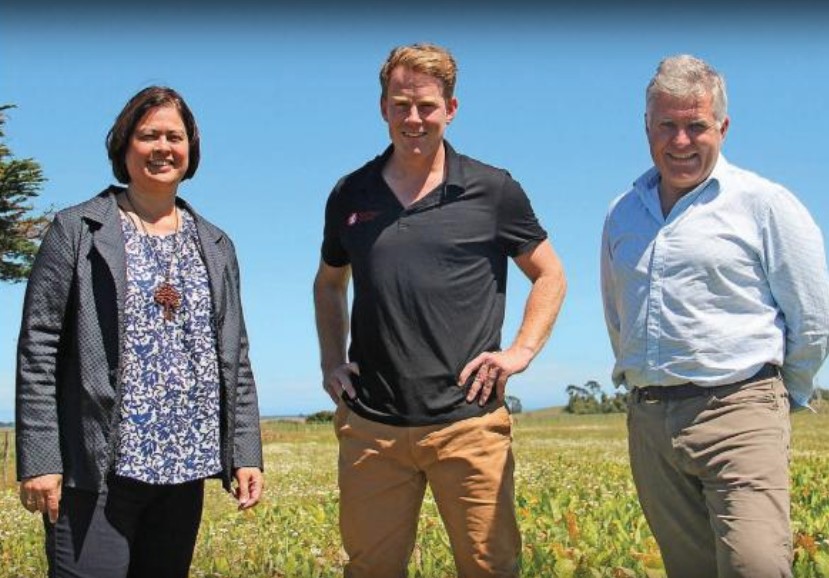
From left to right: Colleen Sheldon, Whanganui & Partners, David Eade, 2021 Nuffield Scholar, Andrew Watters, NZ Rural Leaders Chair

Rural Leaders & Whanganui & Partners

developing Whanganui region’s agribusiness sector

NZ Rural Leaders and Whanganui & Partners entered into a multi-year agreement last year to offer scholarships to Whanganui residents who directly contribute to the regions agribusiness sector. To be eligible for a Scholarship, candidates must undertake either a Kellogg Rural Leadership Programme or Nuffield Farming Scholarship.

David Eade, 2021 Nuffield NZ Scholar was selected as the first recipient of a Scholarship.

Read more about our partnership with Whanganui & Partners, and about David Eade in this article on page 10 in the Farmers Weekly virtual newspaper:
https://farmersweekly.co.nz/topic/virtual-publication/view/farmers-weekly-nz-15-02-2021