2026 Nuffield NZ Farming Scholarship. Apply by 17 August 2025. Read More...

Apply for 2026 Nuffield NZ Farming Scholarship by 17 August 2025. More details...

Nine tips to nailing your Nuffield application. 

1. Identify Nuffield’s goals.

As simple as it sounds, applicants often don’t fully understand what the broader goals and objectives of Nuffield are.  

If your application is written with consideration to ‘giving back’ for example, this will go some way to increasing your chances of gaining an interview. 

2. Get your Nuffield referees sorted soon.

There’s still time to get your three referees locked in. This is something that often needs a little time, so if you don’t have three lined up yet, make it a priority. 

3. Include what you’ve done for your rural community or assisting others.

Tell us about it. We’re often surprised to learn of the above and beyond participation some applicants have done without mention in their application.  

Have you served on any boards, committees, in any community organisations? Any rural groups, or in any voluntary capacity? Have you written any articles?

Dig, think, tell us. 

4. Keep an eye on the close date – 17 August.

For some reason time seems to be getting away on us all at the moment. This next few weeks will be no different. Take five minutes to plan your approach to applying.  

Start planning what needs to be done and by when. Aim to finish on Friday 15 August – or sooner. 

5. Get in touch with our Programmes Manager.

Our Programmes Manager can help you through any queries you may have. she’s within earshot of CEO Lisa Rogers, so you get Lisa’s 8+ years’ experience as well.

We just asked Lisa for a gem, and she said, 

“Be very explicit about what being awarded a Nuffield Scholarship will allow you to do for the sector, not necessarily what it will do for you.” 

Who knows, five minutes on the phone with the Rural Leaders Team, or a quick email, might be the difference.

6. Focus on your strengths.

Find ways to both answer the questions accurately and get your ace cards down. 

An average application isn’t necessarily a badly written one, however, it is definitely one that doesn’t get across how suited you are to being a Nuffield Scholar. That said, you might want to pay attention to this next tip for a well written application.

7. Check your application.

Spell check. Grammar check. Read check – how does your answer sound when read aloud?

Check the questions. Check your answers. You get the idea.  

8. Read a few back issues of the Rural Leader.

Not as strange as it sounds. The Rural Leader has much information entwined throughout  that may spark topical responses to application, and potentially, interview questions.  

Of note are the Ideas That Grow podcasts and Alumni in the Spotlight articles. School up – read the Rural Leader. 

9. If you know a Nuffielder, get in touch with them.

As Kate Scott, 2018 Nuffield Scholar, said of the Nuffield Alumni, (they are) ‘A network open to you picking up the phone or flicking them and email’.  

Kate may have been talking about being part of the Alumni, but if you know, or know of, a Nuffielder, reach out and ask their advice.  

Good luck with your application. 
Investment Management meets Agriculture.

Emily Walker_Investment management Decision making_Kellogg report image

Executive summary

The traditional model of primary production in New Zealand is facing significant challenges from internal and external forces, which are only expected to increase over the coming years. These include water security and quality, climate change, carbon emissions, labour availability, market forces and biodiversity. To continue in business and remain sustainable for future generations, transformational change will be needed requiring sector wide strategic and capital investment programmes.

This research report attempts to provide specific support for agri-business leaders. It focuses on answering the question: Does an evidence-based approach to decision making improve outcomes for small agri-businesses in New Zealand?

Research was undertaken using an inductive approach to thematic analysis, allowing the data to determine the themes, rather than be driven by the researcher’s theoretical interest or specific questions (Braun & Clarke, 2006). The data corpus was constructed through a literature review and semi structured interviews. The outcome of the analysis was a thematic map, showing two themes: the decision maker and decision framework.

Key Findings

  • There is significant opportunity to support agri-businesses through a decision-making approach that uses evidence to consider the environmental, social, cultural, and economic impacts of their actions.

Decision Maker

  • Whilst maintaining an understanding of the current operating environment can be challenging (for decision makers), it allows business leaders to be agile and take advantage of opportunity early. The key is in knowing what topics you must be informed of, then focusing efforts on those domains.

  • Decisions must be aligned to an organisation’s purpose, else there is potential for mismatched decision making, detracting from the business’s momentum, diluting leader and team focus, and ultimately, diminishing the purpose the business is working to achieve.

  • Decision makers need to be more ambitious. The interviews found that many organisations were simply ‘playing not to lose, rather than to win.’ The case studies revealed that this could lead to the continual investment in tried and tested solutions.

Decision Framework

  • Robust analysis of the problem ensures the issue itself is being solved, rather than only managing symptoms. This avoids unintended consequences and rework, increasing the likelihood of developing an enduring solution.

  • Decision-making process matters six times more than analysis to producing impactful decisions (Health & Health, 2013). However, process should be flexible, allowing for the idiosyncrasies of individual agri-businesses, and is improved through collaboration.

  • In addition, the inclusion of testing into the decision-making process reduces risk through proof of concept, testing assumptions and bias, checking decision makers haven’t inadvertently jumped to a solution, and provides awareness of different perspectives to enable continual improvement.

  • Analysis of two options rather than just one also improves likelihood of success by a factor of six (Health & Health, 2013). Widening the set of options evaluated improves discussion and debate, increasing the probability of strategic decision making occurring.


Implementation

  • Evolutionary implementation, the compounding effects of numerous small changes, has a higher probability of creating successful, enduring change.

  • Development of a strategic plan to support implementation of the investment across the business can support accountability for action, prepare for opportunity, understand risk, measure results, and build credibility with stakeholders.

Recommendations

As a result of the findings and discussion presented in this report, the following recommendations are made to the leaders of small agri-businesses:

  • Develop and maintain an understanding of the operating environment in which the reader is acting.

  • Align all decisions with the business’s purpose and principles/values.

  • Engage a multi-skilled advisory board to collaborate on and support decision making. This board may include professional advisors, accountant, banker, lawyer, and an independent member.

  • Utilise structured processes and evidence to support decision making.

  • Prepare a strategic plan to create accountability for action, prepare for opportunity, understand risk, measure results, and build credibility with stakeholders.

Julian Raine:
The apple of a horticulture robot’s eye.

Julian Raine podcast_apple orchard_featured image

Ideas That Grow: Julian Raine, 1997 Nuffield Scholar.

Julian Raine is a 1997 Nuffield Scholar who quietly gets on with things worth shouting about.  
 
Julian runs a mixed Dairy and Horticulture operation and no matter what he’s producing, the one constant is innovation. From robots to getting back to milk in glass, Julian has an entrepreneur’s motivation and an innovator’s foresight. 

In this podcast, Julian talks with Farmer’s Weekly Editor Bryan Gibson about his diverse operation, some of the challenges he faces and some of the innovations he’s making to meet them – including moving to robot-ready on horticultural sites.  
 
Julian also talks about his Nuffield travel, what he learned and how his research played a role in helping shape an industry.  

The interview took place in May 2022 and the version below was edited for clarity. Listen to the podcast above for the original conversation.

Bryan Gibson – Editor of Farmer’s Weekly.

I’m Bryan Gibson, editor of the Farmer’s Weekly. And today we are talking to Julian Raine. How’s it going? 

Julian Raine – 1997 Nuffield Scholar, Dairy and Horticulture farmer/grower, Nelson. 

Good. Thanks, Bryan. 

The apple of a robot’s eye.

BryanAnd where are you calling in from today?

Julian:  I’m in Nelson. We have a farming operation, which includes dairy and horticulture, just south of Nelson in the Tasman region.

BryanThat’s quite a diverse business you got going there? 

Julian:  Yes, it is. The agricultural bit has been in the family for 180 years, so we’ve been around a while. Whereas the horticultural bit, I started with my business partners about 40 something years ago.

Innovating in a diverse operation.

Bryan: What do you focus on in the horticulture side of things? 

Julian: We have about 200 hectares of apples. I’m just trying to do the quick numbers off the top of my head – about 40 hectares of berries, all boysenberries. About 45 hectares of kiwifruit, and about five hectares of a new crop for us, feijoas. 

Bryan: Fantastic. And how have things been going this year? 

Julian: It’s been a good year in terms of growing. Been a lot more difficult to get things harvested with the shortage of staff. We completed harvest nearly a couple of months ago for all crops, so that’s good to have that behind us, although we were still packing apples well into July.  

There’s plenty of challenges with shipping and trying to get containers. We were running about a month behind with our shipping program, so that’s been a bit of a worry. 

Bryan: You haven’t had any of the weather or climate related yield issues they’ve had up in the North Island? 

Julian: No. No, we’ve been a bit fortunate thankfully, there was enough to contend with from COVID. 

Bryan: And the agriculture side of things, can you just tell me a little bit about that? 

Julian: Yes. We operate a fresh milk business. We deliver to about 3,000 households in the top of the South Island, Marlborough-Nelson-Tasman. We operate two dairy farms, and we buy and milk from another two dairy farmers. 

Bryan: So, it’s direct to the consumer. 

Julian: Yes. The home delivery is to the letter box, or to the back door, or front door. To cafes, restaurants. And we have several vending machines dotted around Nelson as well. 

Bryan: That seems to be a growing industry, isn’t it? 

Julian: It’s kind of back to the future really. When I was a lad, all the milk was basically bought at the front gate. And occasionally when you ran out, you went down to the dairy. So, we’ve kind of gone back to that model. 

Bryan: My first job I did all through high school was pushing a milk cart round the streets. I was there for the change from glass to the tetrapaks. 

Julian: Right. We’ve gone back to glass as part of what we do. 

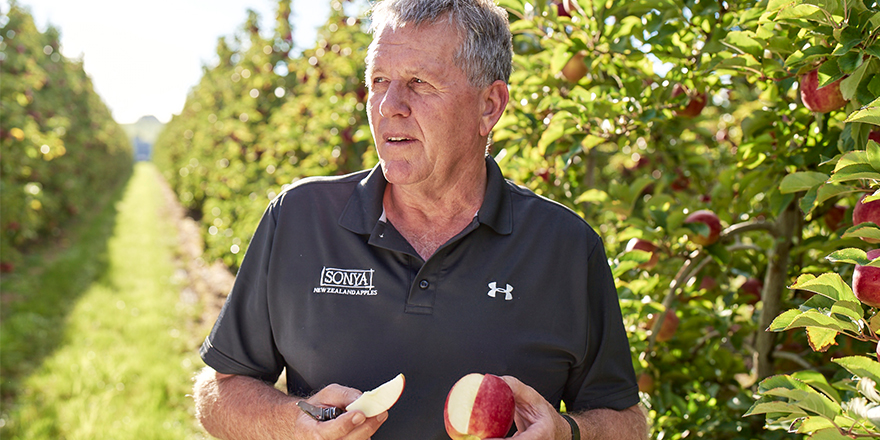
We visited Julian at his apple orchard in April, where he has trees producing mostly the variety ‘Pink Lady’.

Julian spoke briefly about a new 500 cow, all-weather shed he has built, giving his operation ‘the tick’ from the SPCA, one of the first dairy farms in New Zealand to receive this endorsement. This dairy operation supplies Appleby Farms (Ice cream), a business collaboration between himself and Murray Taggart, a fellow Nuffield Scholar.

A Nuffield report creating impact.

Bryan: Now, it’s been a little while since you did your Nuffield report, 1997 I think you did it. But integrated fruit production, still relevant, I think. What do you remember of writing that report? 

Julian: As you say, it was 25 years ago. So, a bit of a distant memory, but many of the issues are still relevant today. What came from that report was a system I wrote called Green Grow, which was to deliver three things: Fruit with no residues, have some environmental indicators, and have a food safety system under something relatively new then called HACCP.  

This was a hazard analysis control point, which was what NASA used to send their astronauts into space. Because if you’re sick up there because of food, you’ve got a major problem. So, they wrote a food safety programme, and I adopted the bones of that, or the principles of that. 

They wanted to know whether the product was safe. The only way that we could guarantee the product being safe was essentially to take residues away. So, in terms of how we produce it, it’s up to us to battle the elements, with insects and fungi. 

When the consumer comes to consume it, they want to know that there’s nothing on there that can harm them or their kids. And then as part of that, some environmental indicators that say we haven’t harmed the environment in producing that fruit. 

Bryan: Space age fruit production, that sounds awesome. 

Julian: Yes, years later, I chaired the Apple Futures Programme, that was a three-year programme to deliver wider systems to get to the same point for the average grower. That’s pretty much about 80 something percent of the New Zealand industry now, with a fair chunk of the balance being organic. I wasn’t pretending to be organic. And yeah, we converted a whole industry in less than a decade. 

Bryan: The industry as a whole – horticulture, pip fruit and candy fruit, and that sort of thing has come a long way in the last decade or two, hasn’t it? 

Julian: It has. That was late 2000s, and since then it’s advanced even further. 

Setting up for horticultural automation.

Bryan: Do you have any other observations on how things have changed, running a kiwi fruit growing business in that time? 

Julian: We’ve set up our orchard systems now for being robot ready. We can’t keep going how we are. And so, investing in an orchard production system is a long timeframe. We must think about what the future will look like when we spend hundreds of thousands of dollars a hectare setting up an orchard.  

We’ve set our orchards up in anticipation for robots to be able to harvest. We think about how they’ll optically see the fruit, how they’ll pick it, and then how they’ll get that fruit from the tree into a bin. That’s what we’ve been busy at in the last decade. About 30 something percent of our orchards, anything we’ve planted in the last 10 years, are robot ready. 

Bryan: That’s interesting. You often think about building robots to pick the fruit as it sits. But there are a lot of things, I guess, row spacing and the way you propagate the trees, that sort of thing. 

Julian: Yes, and how we set the structure up. So single plane trees. It’s like a single plane hedge row, so the robotics and the sensors sensing the fruit, can’t go through the tree. So, it’s got to be on a single plane essentially. 

Bryan: That’s amazing. How far off do you think you are from getting the robots? Are you involved in any of that? 

Julian: The Americans and the Europeans are leading that race. We don’t have the technology here that’s needed for it. Although, there’s a small group headed by Steve Saunders in the Bay of Plenty who are working on kiwifruit robotics. They’ve tended to go more into the pack house and look at optics and how you pack fruit. 

In ten-years-time, we’ll have lights out factories packing apples. Again, to try and get 24 hour a day, seven day a week packing businesses going, we need to do the same thing with our harvest processes. When the sun goes down, we don’t all go home – robots will carry on. 

Bryan: Sounds very high tech and quite cool.  

Julian: There’s a lot of work to get it to that point. A few of us, I suppose, think about these things in the middle of the night, when other people are sleeping.  

You’ve got to work out where your business is going. About how you make it more efficient and keep a lid on cost. Because everyone is really cost conscious now, the consumer wants to buy more for less. And we’ve got to get cost out of our business and keep a high standard, because that’s really what our New Zealand brand is built on. 

Nuffield and the international travel experience.

Bryan: Now, going back to 1997, you also did a bit of travel as part of your studies? 

Julian: Yes. Through Southeast Asia, Europe, and Eastern Europe. It wasn’t long after the wall came down, I was in Hungary looking at soft fruit production. I was also in South America looking at what they were doing in Chile and, North America, in Washington.  

Really interesting to get a handle on what the leading lights were doing at that point in terms of their growing systems. 

Bryan: And in the time since, how would you say being involved in the Nuffield Programme has informed what you’ve done in those years?

Julian: Well, for me it was about the personal experience and honing my leadership skills and trying to lead producers through changes. Also, trying to think about things holistically, looking at a problem, not from just a single plane, but being able to not only go around and see the other person’s view, but be able to walk right around that issue and look at several points of view.  

I’m probably not finished yet – I’m always willing to give back to the industry. 

Bryan: The Rural Leaders, Nuffield Programme would be something you’d recommend? 

 Julian: Without Nuffield I wouldn’t have got to where I am today. It gave me not only a critical thinking ability, but it’s also given me a lot of resilience as well.  

I am also able to call on the experiences I saw around the world – the interactions not only with other primary producers, but also government officials and how government thinks.  

And how the EU operates, rightly or wrongly. And then most importantly, how consumers think, and always interacting with your customer to keep yourself up to date with what the customer wants to pay for, and what they don’t want to pay for.

Thanks for listening to Ideas That Grow, a Rural Leaders podcast. This podcast was presented by Farmers Weekly.

For more information on Rural Leaders, the Nuffield New Zealand Farming Scholarships, or the Kellogg Rural Leaders Programme, please visit ruralleaders.co.nz 

The future of food and fibre is in the hands of our bold and our grounded people – those who give back to their communities and industries.

Sound like you?

Red meat traceability with blockchain.

William Halliday Kelogg report image

Executive summary

New Zealand’s agricultural industry has a reputation for being at the forefront of technological innovation.

Challenges such as nutrient deficient soils and distance to market have been met with novel fertilisers and refrigerated shipping. World renowned animal welfare standards and freedom from significant agricultural pests and diseases give our farmers significant advantages compared to their overseas counterparts.

It may be a surprise to learn, therefore, that the means of certifying products and providing assurance to global markets continues to rely on a paper-based system.

Importers must trust the paperwork provided by the exporter. Exporters must trust the paperwork provided by the producer. Producers must trust the paperwork provided by the supplier, and so on. This “one up, one down” traceability is becoming less acceptable to the global market, especially when it comes to food safety and claims of provenance.

A potential solution is to adopt blockchain technology, where a decentralised ledger allows supply-chain-wide visibility of product flows and immutable proof of claims.

While blockchain was developed for, and is still chiefly used in, the field of cryptocurrencies, it has found utility in other sectors including finance and supply chain management. The global diamond trade demands absolute proof of provenance to avoid stones mined using forced labour or where proceeds fund violence – it has found a solution to this using blockchain.

Blockchain has become a technological buzzword which has garnered plenty of attention, confusion, and misunderstanding. The purpose of this research report is to understand what a blockchain is, what it can (and cannot) do, what barriers exist to its adoption in red meat traceability, and what opportunities it presents.

Analysis of the literature and interviews with industry stakeholders leads to the general conclusion that while blockchain has some significant advantages over traditional, centralised databases, there is doubt as its maturity as a technology.

This represents significant risk to those interested in adopting it, and, coupled with the cost of replacing or upgrading systems across the supply chain, it is widely held that existing systems are fit for purpose and to make a shift to blockchain would represent an unnecessary disruption to the industry.

That said, there are potential drivers for blockchain adoption to consider. Government regulations regarding food safety and animal traceability are updated continually and can require the adoption of new technologies (the NAIT Act 2012 for example).

Import requirements are subject to change, especially in the face of food fraud and the global spread of animal and human diseases. Then there is the industry itself, which has an impressive track record of adopting and adapting technologies for the improvement of sustainability and productivity.

The convergence of blockchain with technologies such as the Internet of Things and machine learning could change the way farmers go about their business altogether.

It is therefore recommended that stakeholders in the New Zealand red meat sector keep an open mind to the possibility of adopting blockchain technology and be prepared to invest in further technological innovation as more demands are placed on existing systems. Being “blockchain-ready” will undoubtedly leave the sector better prepared for the future of global red-meat trade.

How does a dwindling mohair industry in New Zealand learn to play the infinite game?

Susie Woodward Kellogg report image

Executive summary

With conscious consumerism (Nguyen, 2020) on the rise, natural fibres are making a comeback. The rise in awareness of the damage which is caused by synthetic materials on the environment has led to the growth of natural materials, including growth of natural fibres like mohair (Data Bridge Market Research, n.d.).

Mohair fibre, produced by the Angora goat is one of those natural luxury fibres that has seen a resurgence in popularity in recent years.

Unfortunately, the New Zealand Mohair Industry has been rapidly declining along with the world production of mohair fibre. New Zealand mohair production peaked in the late 1980’s, producing up to 0.6 million kilograms of greasy mohair (2.4% of world production), dropping to current levels of 0.03 million kilograms or just under 1% of world mohair production (Hunter, 2020).

This decline in production is not the basis for this report, but instead the reason for finding out how the industry can be helped to stay alive and relevant, taking advantage of the increase in demand for more natural fibres over the use of synthetic materials.

The New Zealand mohair industry is not in a place to capitalise on the global trend of increasing use of natural fibres in its current state. The industry has seen an ageing base to its producer group form. The lack of new entrants coming into the industry has meant it has struggled to remain relevant and viable.

Despite the global mohair production decline, the demand has remained very strong, especially for top-end quality fibre and prices for mohair have remained high as demand continues to exceed supply (J. Woodward, personal communication, February 10, 2022).

With this global trend playing in favour of the mohair industry, the purpose of this research project was to identify what the New Zealand Mohair Industry organisation could do to help the industry stay relevant and thriving long into the future.

Research was conducted to explore what makes other organisations and businesses successful. Interviews were conducted with leading innovators to identify the reasons for their success and how the learnings could be adapted to help the New Zealand Mohair Industry.

For the New Zealand Mohair producer’s organisation to be successful, there were several key factors identified. They included the following:

  • Leadership – having the right person(s) guiding the organisation with a meaningful vision and empowering its members to create change.
  • Innovation – finding solutions to existing problems by challenging the status quo.
  • Resilience – learning how to adapt to change and analysing past failures to be stronger in the future.
  • Collaboration – successful businesses work effectively with others both inside and outside their organisations to develop their ideas or processes.

Another key element that was identified was having the right people on board, who demonstrated courageous leadership, adopted an infinite mindset, who were able to share their vision with others and whose behaviours reflect their values.

Together, with these key factors, several recommendations were made to assist the New Zealand Mohair Industry going forward.

The recommendations from this project include:

  • Utilise the findings from the Mohair New Zealand Incorporated SWOT analysis conducted in 2018 to help guide the strategy for the organisation going forward.
  • Adopt an infinite mindset; a mindset where the members of the Mohair New Zealand Incorporated organisation challenge the status quo, looking beyond the present to remain relevant long into the future. This will improve the levels of trust, cooperation, and innovation among the members of the mohair producer’s organisation and its leaders.
  • Undertake a step change and guide Mohair New Zealand Incorporated members through that process by following John Kotter’s (2012) proven eight-step process for leading change. The three phases of the step change are as follows:

– Phase 1: Create a Climate for Change
– Phase 2: Engage and Enable the Organisation
– Phase 3: Implement and Sustain the Change

By adopting the above recommendations, the New Zealand Mohair Industry can successfully implement a step change and help turn themselves from a declining industry, into something that’s innovative and relevant long into the future.

Achieving successful family farm succession in the New Zealand dairy industry.

Ross Neal Kellogg Succession planning in the dairy industry_eport image

Executive summary

Family farm businesses are the backbone of the New Zealand dairy industry, with many farms being handed down generation after generation to be retained under family ownership today.

The dairy farming landscape, however, is changing. Dairy businesses are increasing in size, scale, and value.

There are also many challenges looming in the sector as the country navigates towards being more environmentally sustainable, and the consumer demands more sustainably produced food. These challenges will largely need to be handled by the next generation of farmers. To ensure family farm businesses, and the New Zealand dairy industry, can continue to thrive it is important that succession is done well.

The aim of this report is to understand the key challenges that farming families face when trying to navigate through the succession process and identify solutions to these challenges.

The methodology includes a literature review, followed by semi structured interviews to gain insights from farmers and experts on their experiences. Interview responses were thematically analysed with key themes then critically analysed to gather findings.

Key challenges to succession were found to be poor communication, incorrect legal structure, a reluctance from farmers to start the process, and a lack of clarity.

Solutions to these challenges were identified as improving family communication, getting the legal structure right, reading literature to improve understanding, putting a plan in place, and engaging the help of an independent facilitator.

Recommendations for farming families:

  • Start discussions early regarding succession with your children and trusted advisors. Know that the succession process takes time. Early discussions help establish clarity for parents on potential successors, and clarity for children on how they may organise their lives.

  • Plan for succession. Parents to establish what the desired outcome for succession is. It is important that this plan comes from the parents. It is also important that this is a formal and written plan and is followed up on regularly.

  • Look to establish good family communication habits from a young age. For families who struggle to communicate effectively, all family members should be encouraged to read two books which provide great insight into effective family communication. These books are ‘The Secrets of Happy Families’ by Bruce Feiler and ‘The 7 Habits of Highly Effective Families: Building a Beautiful Family Culture in a Turbulent World’ by Stephen Covey.

  • Establish a company/trust structure:

– When first setting up the farming business with a solicitor or accountant, the company/trust structure should be put in place. This should be right at the beginning of the farming journey and well before succession is thought of.

– If the farming business is not currently in a company/trust structure it is important that this structure is set up and assets are transferred to this structure before proceeding with succession.

  • Engage with an experienced succession facilitator who is an expert in their field. The facilitator will help to start the process, lead the process and, along with a support team of trusted advisors, help the family to achieve success. A facilitator can also help to improve family communication and the formation of a written succession plan. Funding is available through MBIE and your Regional Business Partner under the Management Capability Development Fund.

  • Read the 2nd Edition of ‘Keeping Farming in the Family’ written by Ian Blackman. This is a well-thought-out book that has been specifically written to help New Zealand farming families through the succession process.

Recommendations for the dairy industry:

  • Industry bodies to engage with accountants and solicitors who deal with farming families to help them better understand:

– The implications of setting up partnership and trust structures for family farming businesses and the subsequent challenges that arise with these structures when the succession process begins.

– The importance of the company/trust structure for family farm succession and the all-around benefits that this structure provides to family farm businesses.

  • Industry bodies to create awareness about independent facilitators. Specifically:

– That there is a number of experienced succession facilitators available.

– There are significant benefits that independent facilitators can provide to make the succession process easier.

– That there is funding available through MBIE to help cover the cost of this service.

Escaping low value supply chains.

Richard Sim_Escaping Low Value Supply Chains_ellogg report image

Executive summary

New Zealand farmers are being asked to change how they operate their farming businesses. The sectors that are more likely to thrive in this new world are those which not only adapt to change but, become the drivers of change.

The Fit for a Better World roadmap offers a vision where production-oriented goals of the past will be realigned with core values shared by farmers, society and our overseas consumers.

This vision can be a catalyst for the creation of end-to-end value chains to take food and fibre products to markets in New Zealand and around the world. While the ‘volume to value’ mantra is not new, it is not clear how, or who will build these value chains for the arable industry.

Value chains differ from supply chains in that the product or service generates value as it flows between the participants to the final buyer.

This report aims to offer insights into how the utilisation of value chains by arable growers will enable them to create and capture more value from their products.

The research methodology was comprised of a literature review, semi-formal interviews and case studies across the entire supply chain to gain insights into their experiences.

Key Findings

Growers are trapped in low value supply chains. As a grower, if you cannot identify the other participants in the supply chain through to the end consumer, then it is likely you do not hold significant power. As a result, you will be a price taker.

Value is created by consumers. Therefore, the shift for growers from competing on price to optimising customer experience requires the alignment of the values of participants in the supply chain to those of the consumer.

Value can be created via innovation or branding. Irrespective of the pathway taken, growers will need to contribute time and capital to the co-creation of value chains for future food products.

Recommendations

This report proposes that for the arable sector to thrive, a mindset change from the good of the individual to the collective is required. This new mindset will foster the co-creation of value chains for new food products that create and capture greater value for all growers.

Specific recommendations include:

Define arable sector values. The shift from operational excellence and competing on price requires a new business strategy. The transition to customer intimacy requires the alignment of values of the participants of the supply chain to those of the consumer. The Fit for a Better World vision and the principles of Te Taiao could offer a worldview and a starting point for an industry discussion.

Foster a culture of innovation and value-add at the sector level. Develop a pathway to value-add through encouraging a ‘prototype – iterate – test’ culture in a start-up environment for future food products. This could be funded by the current levy body.

Take collective ownership of value chains. To disrupt existing supply chains a new grower-led investment model is proposed. This will overcome some of the current barriers to investing in value-add beyond the farm gate.

Green value chain.

Nathan Chestnut Kellogg report image

Executive summary

New Zealand has a unique position in the global market for its agri-food exports. Farming systems are world class in producing high quality, safe and environmentally sustainable agri-food products.

Processors and manufacturers are readily working to leverage additional value from raw materials into value-add goods, utilising tangible product qualities and intangible assets of product and people in the form of technological and cultural IP.

Consumers base purchases on a decision-making framework influenced by functional value (price, quality), conditional value (available alternatives, discounts), social value (social/self image, social values) and emotional value (personal favouritism, brand loyalty, nostalgic factor).

Products must find themselves containing authenticated quality and credence attributes which hit these value markers in order to gain consumer response. Better understanding of what product quality and credence attributes consumers desire is critical.

  • Continual data collection is a necessity to enable NZ agri-food producers and exporters the best chance at maximising consumers’ willingness to purchase. Without up to date data from markets on attitudes towards credence attributes, products may not be successful despite meeting functional and conditional values.

Authentication of attributes should be sought by global or locally recognised and reputable agents. By holding authenticated and verified quality and credence attributes consumers are willing to pay a premium on standard pricings for similar products.

Natural variability of willingness to pay increased price and willingness to purchase based on credence or quality attributes is market specific.

  • NZ should strive for globally recognised authenticators to be NZ companies or be NZ based. This aligns with the desire for NZ agri-food producers to operate under the highest standards of production in the world and attract off-shore brands for authenticating product to the NZ economy. The need for a NZ based globally recognised authenticator could either be offset or work in conjunction with a national provenance authentication marker. There has been lack of leadership from MPI and NZTE in implementing such a tool, leaving NZ agri-food exporters without a bona fide COO provenance marker, creating a fragmented marketing space for NZ product. It has left the NZ brand open to counterfeiting, damaging the reputation of NZ agri-food producers.

The New Zealand Government is mechanising change to production systems and product procurement through public policy, such as the National Policy Statement for Freshwater 2020 and Emissions Reduction Plan. Which is acting upon domestic environmental outcomes, and capturing the desires of consumer sentiment of agri-food credence qualities.

The use of public policy as a gearing mechanism for private enterprise to leverage value from the market is a consequence of New Zealand’s reputation as a world leader in environmentally sustainable and quality assured agri-food producers.

  • There has been a lack of effective communication from processors and manufacturers on the attitude of consumers toward credence and quality attributes. This oversight may be affecting their relationship with producers and suppliers over system changes that are required due to change in public policy. This can be overcome by making data more visible to producers and suppliers. It will enable a better understanding of the relationship between market demands and auditing requirements from processors and public policy.

Lead your people – they will stay.

Melissa King Kellogg report image

Executive summary

A highly skilled and valued staff member resigning can damage any team or business. Impacts can include significant loss of sales, productivity, and intellectual property loss, not to mention the costs of replacing a staff member. In this current era of low employee engagement and high employee turnover, organisations are losing good and valued people.

This research aimed to understand the impact of leadership on engagement and retention and provide recommendations on how organisations can identify the problem and introduce a meaningful approach to improve culture, engagement, and retention in their organisations.

The reasons for disengagement and turnover in organisations were discovered by comparing, contrasting, and evaluating the significant factors contributing to thriving organisational cultures with engaged and committed people.

This research project consists of a literature review, semi-structured interviews, and a thematic analysis to identify themes. From the analysis, data were evaluated to pinpoint key areas of importance.

Leadership’s impact on staff fulfilment, engagement, and retention is significant and is the fundamental driving factor that can make or break an organisation’s culture, engagement, and retention.

Organisations and leaders recognise the need and underlying benefits of creating a people-centred culture.

Employees will flourish in an environment that is focused on care, support, and growth.

Leadership is instrumental in driving these outcomes, and not enough focus is being placed on this. More significant investment in leadership is the denominating factor in improving culture, engagement, and retention.

Recommendations

  • Make leadership a genuine focus on strategic imperatives.
  • Identify strategies that cultivate a people-centric leadership model to deliver successful engagement and retention outcomes.
  • Cease relying on engagement survey data as the sole feedback for workplace engagement.
  • Convene a working party with a cross-section of people across the business that will meet to review the current organisational culture to create meaningful, authentic, and transparent guiding principles of leadership for the organisation.
  • Commission a case study that investigates people-centric businesses that are achieving success.
  • Prioritise a leadership recruitment strategy with clearly defined guidelines that identify specific leadership skills and attributes that will support recruiting the right people and align with the guiding principles of leadership.
  • Invest in setting up a leadership development programme to deliver the training and skills for a people-centric leadership model.

Pasifika subsistence farming in New Zealand.

Melaia Lousi Kellogg report image

Executive summary

A new narrative for New Zealand-based Pasifika farmers is required. The primary industries and government have an opportunity to contribute through shared principles of productivity, inclusivity, and sustainability. Supporting the upliftment of Pacific indigenous farmers in the long run can only contribute to the New Zealand global food story and help reduce social and income inequities.

The aim of this report is to gain an understanding into the New Zealand Pasifika subsistence farming operations, identify the skills and values being developed/maintained in this setting, assess the sustainable livelihood opportunities, and understand the potential values and skills New Zealand-based Pasifika bring to the Primary Industries.

Key findings:

  • There is a lack of formal research on Pasifika subsistence farmers in New Zealand to allow baseline assessments.
  • When assessed against the livelihood assets of the sustainable livelihood framework (SLF), New Zealand Pasifika subsistence farmers are challenged to access the capital assets (natural – land, physical – buildings, technology, financial – generate income, or investments) required to move from subsistence to surplus and generate income. Pasifika farmers’ strongest assets are human and social capital.
  • Pasifika’s key skills include traditional knowledge of horticulture production, intercropping, nutritional management, agronomy, crop rotation, seed/germplasm banks, entrepreneurship, biodiversity, agroecology, companion planting, hunting and gathering, and animal husbandry.
  • Pasifika’s key values identified were, kinship, stewardship, and reciprocity.
  • Absence of clearly defined policies that support the economic development of New Zealand Pasifika subsistence farmers.

Recommendations:

  • Data – undertake further research to map the current New Zealand-based Pasifika subsistence farming landscape to inform future investment/development.
  • Partnership – form partnerships between New Zealand Pasifika subsistence farmers and Primary Sector e.g., horticulture and pork industry in exchange for shared livelihood assets to create sustainable livelihoods.
  • Workforce development and mobility – use the findings from this research to enhance primary sector workforce development plans that include opportunities for the development, attraction, improved participation of Pasifika peoples in their sector.
  • Collaboration – bring together NZ Government, Pacific Governments, and FAO to discuss and consider opportunities to extending capacity building in the Pacific to include New Zealand-based Pasifika subsistence (indigenous Pacific Island peoples) farmers and their communities as long-term investment in agriculture and horticulture developments in the wider Pacific diaspora.
  • Road map – develop a road map for Pasifika subsistence farmers aspiring to create livelihood through successful Pasifika Agribusiness opportunities. Government agencies (MPI, MFAT, MBIE, TEC, MPP) to lead.
  • Transformation – development and delivery of compliance-based training by the regional/local and central Governments to help transform Pasifika subsistence farming businesses from informal to formal. In addition, help shift non-compliant mindsets towards voluntary compliance.