2026 Nuffield NZ Farming Scholarship. Apply by 17 August 2025. Read More...

Apply for 2026 Nuffield NZ Farming Scholarship by 17 August 2025. More details...

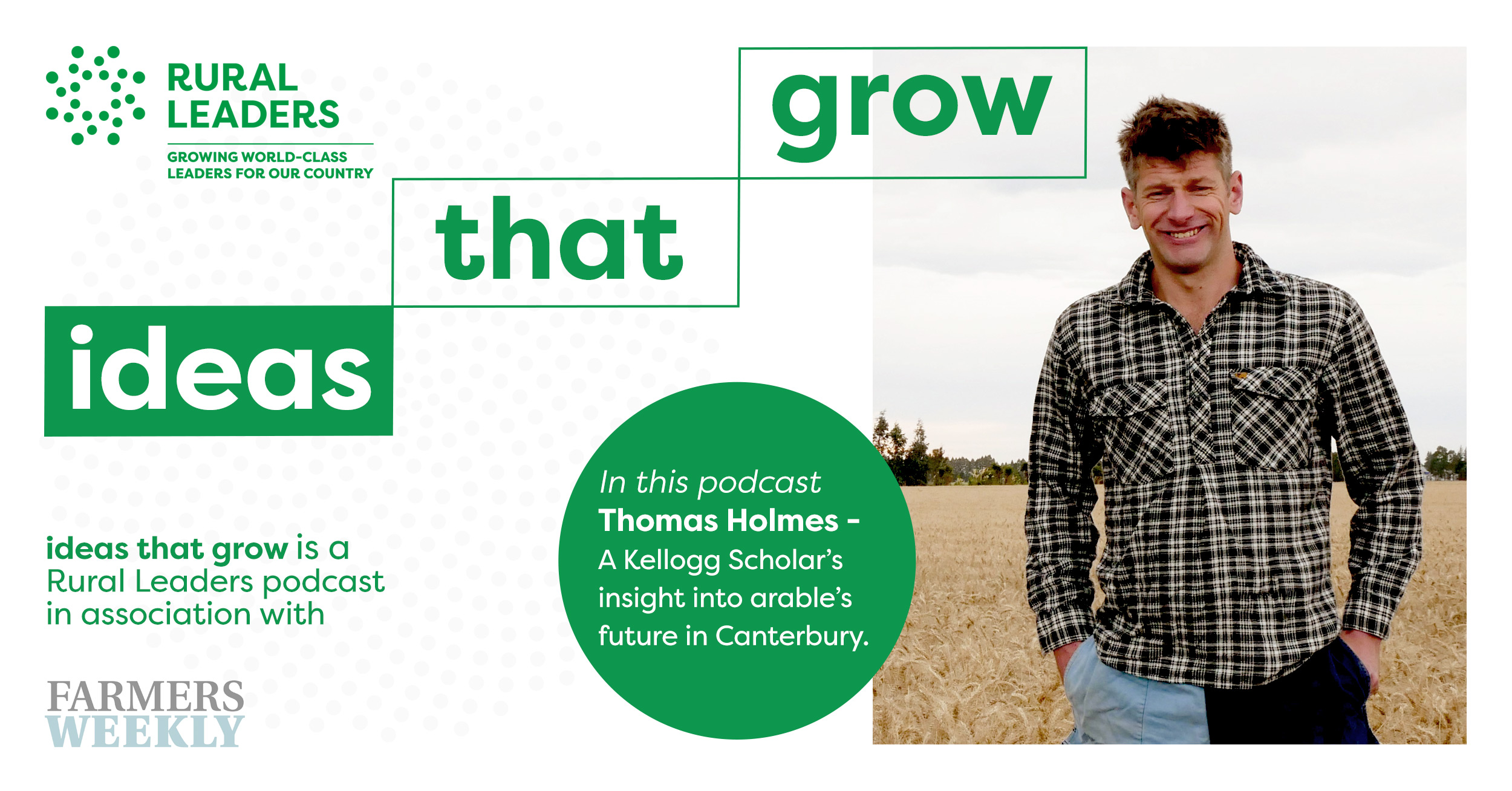
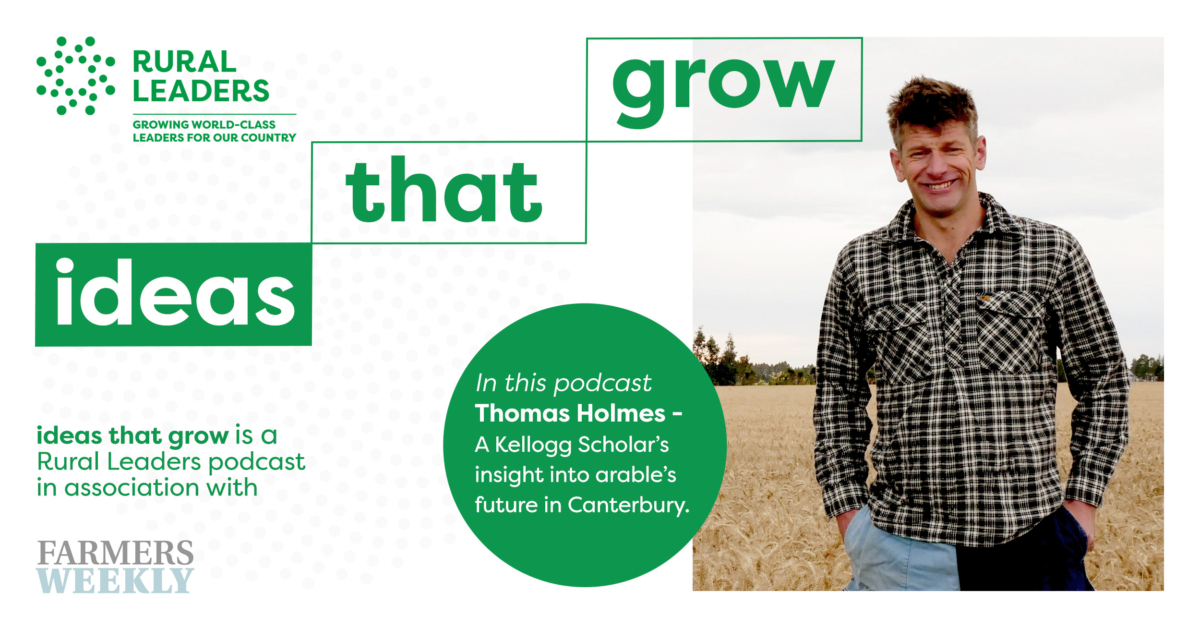
A Kellogg Scholar’s insight into arable’s future in Canterbury

In this episode of Ideas That Grow, Bryan Gibson, Farmers Weekly Managing Editor, talks to Thomas Holmes, arable farmer and a 2024 Kellogg Scholar.

Thomas discusses his family farm’s evolution, overseas experience, his Kellogg research report and his Kellogg experience.

Thomas unpacks his report’s ‘what next’ view of arable farming in Canterbury.

He discusses profitability challenges, diversification, and integration with other sectors. Thomas advocates collaboration, mindset change, and leadership from younger farmers to adapt to climate, market, and technological shifts.

Listen to this episode of Ideas that Grow, or click on one of the platform icons below to listen on your favourite player:


Episode Transcript

You’ve joined the Ideas That Grow podcast, brought to you by Rural Leaders. In this series, we’ll be drawing on insights from innovative rural leaders to help plant ideas that grow so our regions can flourish. Ideas That Grow is presented in Association with Farmers Weekly.

Bryan Gibson, Managing Editor of Farmers Weekly:
You’re with Ideas That Grow, the Rural Leaders podcast. I’m Bryan Gibson, the Managing Editor of Farmers Weekly, your host, as always. With me on the show this week, we’ve got a very recent Kellogg scholar, Thomas Holmes, arable farmer from Canterbury. G’day, Thomas. How’s it going?

Thomas Holmes, Arable Farmer, 2024 Kellogg Scholar:
Good, thank you. How are you doing?

BG: Pretty good. You did the Kellogg programme just last year?

TH: Yes, I was in cohort one in 2024, #52 was our cohort. It’s still fairly fresh in the mind.

BG: Have you recovered?

TH: I think the brain has. It’s a lot. It’s a full-on programme. You can’t really mentally prepare for it. It’s one thing going in there with all these perceived ideas, but it’s another just sitting there and listening. It’s very eye-opening. It takes a lot of time.

Family Farm Background and Evolution

BG: You’re obviously an arable farmer. Tell me a little bit about your journey there. Did you grow up on a farm?

TH: Yes. I’m a fifth-generation mixed-growing farmer in Methven. My family has been there for coming up 150 years, one of the founding families of the local township. The farm has decreased over the generations. It started off at around 6000 acres. We’re now down to about 550. It’s the journey of succession and having a farm for a long time. It gets smaller and has changed a lot.

I guess when I was on the farm full-time, we were doing mixed arable, so just doing many crops, about 300 hectares of crops, 650 bull beef. So, finishing to 600kg plus and 2000 lambs. But recently, in the last year, we’ve downscaled. Just the family farm’s left, so it’s about 220 hectares. It’s a never-ending change, really. What’s next? There’s a lot going on in the industry, and it’s working out what, individually, you can do.

Career Path and International Experience

BG: Did you always know or want to carry on the family farm?

TH: I did the typical Lincoln Uni, Ag-Sci. I went farming straight out of uni. I did various jobs overseas and here, everything from large-scale arable farming in the UK, in Canada, and a big beef finishing farm in Scotland. I’ve dabbled in robotic milking, did a little bit of organic cropping, and then worked on a large-scale farm in Dore, which gets all the processed vegetables, and then the family farm.

I’ve always wanted to be a farmer, and I think it’s a fantastic career. Obviously, at the moment, the arable industry is at a lull. I think it’s still a fantastic industry. Growing crops, growing animals, I think it’s probably the best job in the world, but it just doesn’t pay that well at the moment, so you have to do everything that you can to make it work.

Kellogg Research Focus: The Future of Arable Farming

BG: Touching on your Kellogg report, you look to see some ways for the success of arable farming in Canterbury in the future. Obviously, as you mentioned, times are pretty tough for arable farmers right now. But what brought you to that topic?

TH: I wanted to really dive into the sector. It wasn’t necessarily the dynamics. It was more about ‘what next for the sector’ because the profitability side of things has not improved for a long time. It’s been hidden with growers increasing yield to basically beat inflation, and inflation has caught up. We’re in a situation where we can’t really out-compete inflation. There needs to be more options available to growers, whether it’s different crops or different opportunities that aren’t necessarily arable.

I guess it got me thinking, ‘where do growers see themselves in the next 25-50 years?’ I was looking at my career, lifetime and beyond. It’s really easy to look a year ahead or two years ahead. But I thought, well, why don’t we just push it to 25-50, because people don’t think like that, necessarily. And this industry is very much on the point where they are at a crossroads. They need to make some real dramatic changes to actually improve the profitability for the growers to enable them to still do what they love to do, and that’s grow crops. They’re mixed, so they have animals, but predominantly, their passions are machinery and growing crops for the end users.

I think that’s what really drove me to look at ‘what next for the industry’, where are we going and where are the opportunities as a sector as growers. To work together was my thing, being involved in a few discussion groups. With FAR Growers Leading Change groups, it’s really important to have those connections and talk to growers of similar ages and stages, and some of them are of similar sizes and bigger, but they’re all in that same boat of ‘what does the arable sector look like’, because you can’t just keep on doing what we’re doing.

Farmer Perspectives: Looking 25-50 Years Ahead

BG: You mentioned that we’re not very good at thinking further out, and you were looking 25 to 50 years. What was the range of views you got when you talked to arable farmers?

TH: For a lot of them, they were taken back by that view, because at that current time, last year, we had one of the wettest harvests in history, and people were pretty, dare I say, depressed and a little bit in a slump. It wasn’t the best timing to do a Kellogg, but I knew it was going to be a challenge to talk to them. Because from my opinion, when you’re in the lowest point, you usually make some very strategic decisions because you need to. You can’t carry on doing what you’re doing, so you’ve got to get out of the hole and change. A lot of them were like, ‘we’re looking at diversification. We’re looking at off-farm income in some way, shape, or form’.

And then there was guys that were looking at doing berry fruits or apples. They looked at the analysis. At the moment, it doesn’t work for them, but they’re looking beyond arable, a lot of them. And some of the guys that I interviewed are already at that stage, they’re doing processed vegetables, they’re doing onions, potatoes, carrots, and their specialty seeds as well. But they’re looking beyond arable because the margins just don’t stack up. But they’re important to be part of any rotation. You need your cereals, you need your grass, you need clover in your crop rotation to keep the system going, but it wasn’t necessarily their money maker. It’s a harsh reality of things and I think growers understand that. There’s a lot that do deer grazing or beef animals, a lot do lamb finishing when it stacks up financially.

So they’re always doing something different to enable them to do what they love. And I think that’s the key point. And maybe that takes away the value of ‘I’m an arable farmer’, but the reality is, you’re still an arable farmer, you’re just going to be a very diverse arable farmer – more integrated with multi-different revenues coming off farm. And Arable might not bring a lot to the table. But at the core, I think that’s where people get a bit frustrated, because it’s what they love, and it’s a hard thing to watch. But you’ve got to make the right choices.

Key Recommendations: Integration and Collaboration

BG: Obviously, there was diversity of opinion amongst the people you talked to. You wrapped it all up in your report and came up with a set of recommendations?

Integration with Other Agricultural Sectors

TH: My recommendations for the industry was looking at when you become more integrated as a sector, and we’re already well-integrated into dairy with providing your specialty seeds, so your grass, your clovers, your straw. A lot do grazing. So you’re already there. There’s opportunities to be more integrated into your chicken and pig operations. I think there’s a real opportunity for the likes of your trading of straw for nutrients. The one thing that crop farmers need is nutrients to grow crops, and it might not be the usual thing, but it’s a common practise overseas to spread cattle muck and pig muck and chicken muck. And it’s not really a common practise here in the arable sense. I think it’s that trading of nutrients. It’s looking at how we can integrate into their supply chains and be part of that because, individually, Arables is not going to do it, and we need to be smart about that.

Breaking Down Competitive Barriers

TH: Another one was probably looking at collaboration. I think the big thing with the industry being so small, we’re very competitive, we’re very individualistic. We compete for contracts. It gets pretty cutthroat at points, especially when there’s not a lot of contracts around. Some clover markets, especially, are very tightly held, very contestable, and at the moment, still in a slump overseas with oversupply from Europe and America. We’re looking at another year or so of actual tough times.

I think that’s where, in the industry, groups need to actually form to collaborate, whether that’s through sharing machinery, going together to buy input costs, to go bulk, to get a little bit cheaper deals, share chemistry. That mindset, I think, really needs to change because we’re so focused on doing our own stuff, growing our own crops. When the reality is, I’m in a group of ten people, different farms within ten kilometres of Methven, and we’re all pretty similar sizes, similar operations. There’s a little bit of difference, obviously, but there’s no reason why we can’t actually work together.

You could buy a bigger machine, cultivator, and go cultivate all these guys’ crops. We’ll do the ground prep and all that stuff. You could just do that. Builders don’t just do our own thing. It’s just very set. It comes down to control, but also it’s your farm, you do what you want to do. But that’s the mindset that I think needs to change of where we can actually work in together, help each other out, actually spread the costs over a large area. And contractors do that. That’s why they’re so successful in terms of their scale, because they’ve got so much land they’re actually covering, doing various jobs with people that don’t have time.

Overcoming Traditional Barriers

TH: Farmers just don’t do that. They don’t seem to do it. I think it becomes too hard because if you own a piece of machinery with somebody and someone breaks it, then it gets into a bit of a fight on who’s paying for what. Maybe there needs to be systems in place that you can just split the costs. That’s why a number of growers are involved in it. It’s just this simple mindset change that I just don’t think is there, but it needs to be.

The Challenge of Farm Independence Culture

BG: It comes up a lot, and it’s often a hurdle that’s hard to clear in the food and fibre sector. It goes back to that traditional feeling of whatever’s inside the boundary of these fences is mine, and I am the sovereign of what happens here. People have trouble taking advice from people that maybe they don’t trust or having the government tell them how to do things. That’s a pretty hard barrier to break through.

TH: Yes, I think so. But if you go back 100 years or so, you had 50 men and women on your farm doing your work for you. Why is that any different? It’s just in a modern context. But I feel it’s just the community has changed. Over time, obviously, you’ve got different people coming in and out. Farm communities are very tight, but they’re not tight in the respect that they’re actually working together. There’s obviously aspects of it across the country, and there’s communities that are doing really well, and they do work together, but I don’t see it enough, especially in the arable sector.

I question a lot, and it’s more what can you do about it to make some of these things actually improve the bottom line? Because ultimately, it is about the bottom line for arable. I think that was the main challenge: profitability. A lot of these opportunities are about helping to solve profitability, not necessarily entirely solve the profitability issue. It’s not going to be one thing. It’s going to have to be a magnitude of things to actually make any real change.

Personal Leadership Development Through Kellogg

BG: Now, as well as the scholar report, obviously, the Kellogg programme is focused on leadership development. How has that changed you? How do you approach life and work now you’ve got these tools in the toolkit?

TH: For me, I just take any opportunity I can to do projects. For work, to use the knowledge that I’ve got, but also to just put my hand up for things. Locally, I’m involved with my local catchment group. It’s in the farm, it goes through the farm. We’ve got a bit of a potential flooding issue with the creek. It’s just actively getting involved in the community a bit more. Also just keeping involved in those Grower Leading Change groups is really important to keep a bit more stabilisation on what’s going on on the ground. For me, long term, it’s looking at opportunities in leadership. I think there needs to be more people, dare I say, my age on those boards because we are the future.

The reality is people my age and younger than me are the ones that are going to be farming in the next 35 to 40 years, 50 years. It’s actually getting their opinions across, and I think that’s probably something that I’m very passionate about, actually getting our seat at the table and getting our opinions heard because we haven’t got 30 or 40 years life experience or business experience. You’ve got to start somewhere and I think that’s really about putting your hand up and not being afraid to actually just try things. Well, this podcast. I think it’s good to be able to get your opinion across. It’s a different way of messaging, really.

The Need for Disruption and Adaptation

BG: Like you say, your studies discovered that there needed to be some change or some new thinking in the arable sector. It takes people to usher that in or help get that message across and get the wheels turning for that to happen.

Adapting to Climate and Market Changes

TH: I think so. You’ve got to disrupt the system. It’s not necessarily about criticising what the system is. It’s about actually looking at, well, ‘are we fit for purpose? Do we actually need to change?’ And the reality is we do. And I think that’s been pretty apparent in the last decade with the likes of trade, the likes of volatility we’ve had with the weather, the way harvests have been. We need to change how we do things because we’re not getting the same climatic conditions that we had in the early 1980s and 1990s. The Nor’westers aren’t as prominent. We’re not actually getting the great harvest of those days. It’s certainly not as hot where I am in summer as it used to be.

We need to change how we farm with all that technology and what’s coming for us. I think there’s plenty of other opportunities for arable to be part of that story, whether it’s plant proteins or these new food trends that are coming forward. We need to be part of that story instead of just the guys that grow grain and seed, because we are more from that. I think that’s where we need to actually put a hand up and try. I think that’s probably really taking us off the farm a bit more than we’re comfortable with, because the reality is we need to go beyond what we’re doing. It is changing your mindset and it’s not an easy thing to do.

The Value of Being Challenged

TH: For me, Kellogg has definitely changed my mindset because you become so siloed and rigid in your own thoughts because you just get so set in what you do and how you think, and you think you’re right, and you get challenged. I think it’s fantastic to get challenged because there’s so many people with different opinions from various backgrounds, it just really gives you an open mind. Because no one’s right. It’s just actually just listening to someone else’s opinion. Regardless whether you disagree with it or not, I think it’s actually just it gives you that understanding of where they’re coming from and why they think like that.

I don’t think it’s a bad thing to be challenged. I think that in the Ag sector in New Zealand, they need to be challenged because I don’t think they’re necessarily adapting to what is happening out there. I think it is pretty hard to change at the speed that things are going, especially with the tech and the way supply chains are working and the market’s always changing. It is hard, but we need to be a bit more nimble instead of reactive, I think.

Recommendation for the Kellogg Programme

BG: Having more colleagues with that mindset, AKA, going through the Kellogg programme, would be good, so, something you’d recommend to others?

TH: Yes, 100%. I think the Kellogg programme is a fantastic programme. It not only challenges you on your thoughts and your views, but it just gives you an eye into what the food and fibre sector is beyond your sector. You’re in it with like-minded people. It’s a really enjoyable process. I think the big part of it is actually just the networking, the talking to industry leaders in the Chatham House rules sense, where you can get some real open discussions, where you don’t get that in the real world. I think that’s one of the beauties of Kellogg. It opens a lot of doors. I got a lot of interviews just based on that I was doing Kellogg, obviously, being an average farmer helped.

But I think people just love the programme. They think it’s a really great programme. It’s a good thing to do if you want to push yourself to try something different and find a project. If you got a project that you really want to find something about, just do it. I think it’s a great thing to do. Don’t be afraid to change your mind on it either because I think you get challenged, you get on it, and it’s a good learning process.

BG: Thanks for listening to Ideas That Grow, a Rural Leaders podcast presented in Association with Farmers Weekly.

Find out more about Ideas That Grow.

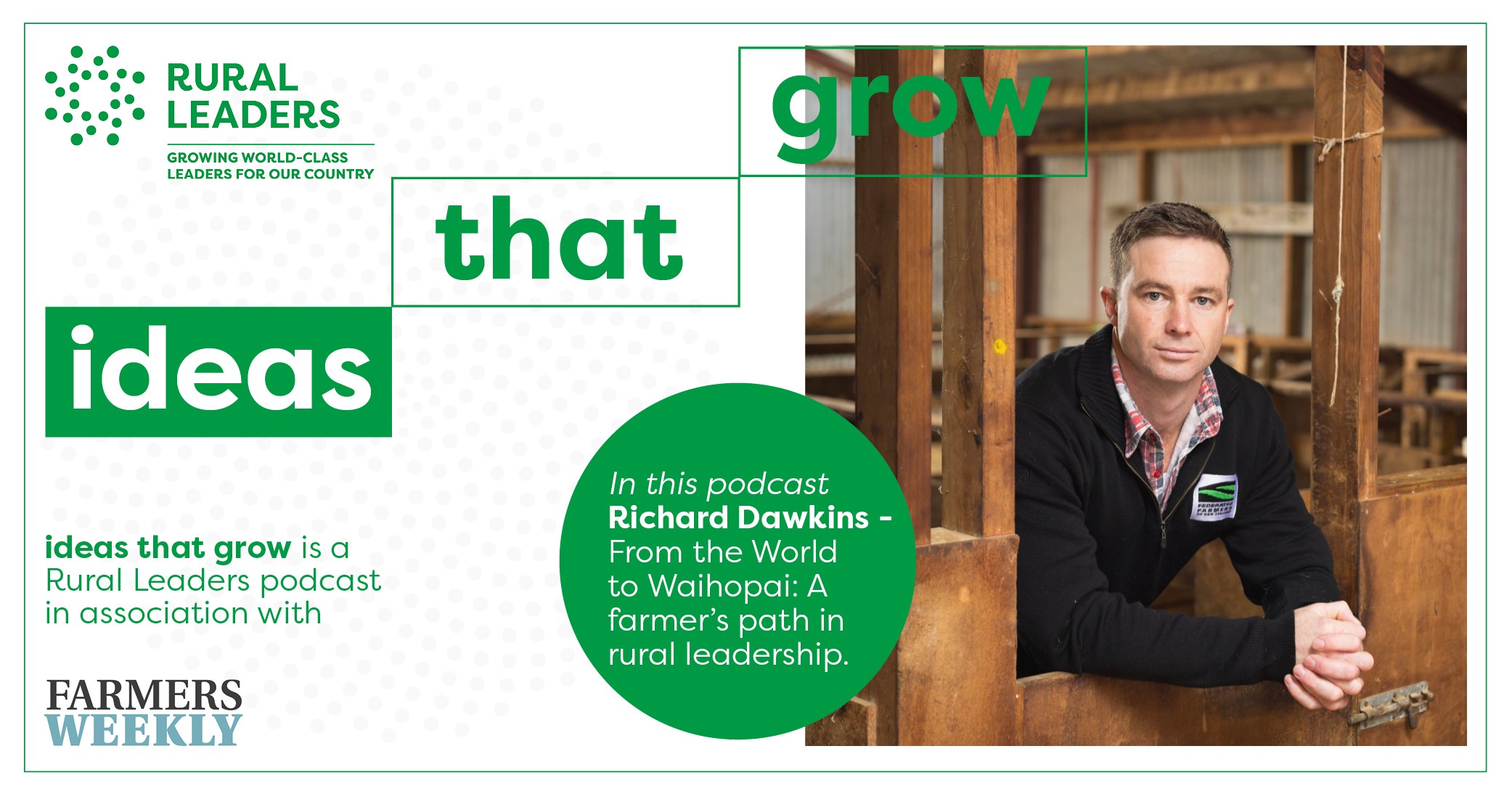
Richard Dawkins – from the World to Waihopai. A farmer’s path in rural leadership.

In this episode of Ideas That Grow, Bryan Gibson, Farmers Weekly Managing Editor, talks to Richard Dawkins, 2023 Kellogg Scholar and Marlborough sheep and beef farmer. Richard is also the new Meat and Wool Chair for Federated Farmers.

Richard discusses his family’s diverse 602-hectare farm operation, which includes sheep, cattle, forestry, and viticulture. He shares his experiences abroad and how returning home reignited his passion for farming.

Richard speaks about his Kellogg Rural Leadership Programme journey and research on lamb and ewe mortality, emphasising the need for better data and body condition scoring.

The discussion also covers leadership, collaboration, and the importance of timing when engaging in personal development.

Listen to this episode of Ideas that Grow, or click on one of the platform icons below to listen on your favourite player:

Episode Transcript

You’ve joined the Ideas That Grow podcast, brought to you by Rural Leaders. In this series, we’ll be drawing on insights from innovative rural leaders to help plant ideas that grow so our regions can flourish. Ideas That Grow is presented in Association with Farmers Weekly.

Bryan Gibson, Managing Editor of Farmers Weekly.
You’re with Ideas That Grow, the Rural Leaders podcast. I’m Bryan Gibson, the Managing Editor of Farmers Weekly. This week on the show, we have the new Meat and Wool Chair for Federated Farmers and Marlborough Sheep and Beef Farmer, Richard Dawkins. Richard, how are you?

Richard Dawkins, Farmer, 2023 Kellogg Scholar:
Yeah, good. Thanks, Bryan. The sun’s threatening to shine here, so we’ll take that as a win.

BG: Yeah, being pretty wet down your way, hasn’t it?

RD: Yeah, absolutely. We recorded 138mls in 24 hours, which was a record for us since 1954, but certainly, none of the damage compared to over the hill.

Farming to suit your environment.

BG: You farm up behind Blenheim, and you’re the latest in a long line of people in your family who have farmed there.

RD: Yeah. We’re 30 kilometres southwest of Blenheim, up the Waihopai Valley, or the Avon Valley, just off the Waihopai. I’m the third generation on the land, and my children will be the fourth. My wife, Jess, and I came home a decade ago and since have taken over and have three children.

BG: Excellent. Can you just Can you tell us a little bit about your farming business?

RD: We’re 602 hectares. The livestock side of the business is a composite ewe flock. We’re about 60% sheep and 40% cattle. We also do Jersey bulls, service bulls for the dairy industry, and some Friesians, which are just a straight fattening proposition for the works.

Our motto here has always been, you farm to suit your environment. You don’t modify the environment, you modify your farm systems to suit. We start lambing next week, late July, and main weaning is in November, and we sell all the lambs at weaning.

Last year was a record for us, actually. We sold 96% of the lambs straight off mum at 43. 5kg’s. Composite ewe flock, Jersey Bulls, a few Friesians, but we also have 20% of the property in farm forestry and 135 hectares of viticulture.

BG: Quite a diverse operation you’ve got going.

RD: Yeah, you have to be these days, don’t you? My father said in the late ’80s, 65% of his income was from wool. We’re now down under 1%, so yeah, just need to diversify those income streams a bit.

BG: Now, you mentioned you came back to the farm about a decade ago. You grew up there, I guess. What did you do after school?

Seeing the world before farming.

RD: Jess and I spent significant time in Western Australia. Funnily enough, we were in a different industry. We spent a fair amount of time working in the mines in WA near Kalgoorlie, and Jess was further north in Karata. But then we spent time in the United Kingdom as well, and it was really interesting to see their farm systems. I did a bit of labouring on farms. I worked on a dairy farm, more of an indoor system over there, and did a harvest up in Norwich, drove a lot of tractors.

So, yeah, that was a good experience. Good experience in Australia as well, but really glad to be home now and setting the foundation for the future, I suppose. We’re certainly not planning on going anywhere.

BG: Many, many, New Zealanders in their 20s head off to see the world. In a farming sense, do you think it’s good for people to go off and see, say, the likes of how you did a harvest a Norwich or a dairy farm in the UK?

RD: I think it is, Bryan, but there’s opportunity costs to everything isn’t there. Coming home in my mid-20s and seeing fellows in their teens who were a bit more advanced than me and had left school and gone straight into farming. It took a fair bit of catching up, which was a bit of a wake-up call.

You spend your childhood on the farm, but boy, there’s a big difference between helping dad shift some sheep and doing the tailing and things and helping in the sharing shed versus actually running a farm business. It took some catching up.

That’s what’s been fantastic about Federated Farmers is getting those farmer networks and rapidly expanding your knowledge. But at the same time, look, learning other industries, living in other countries, that was really valuable too.

Building knowledge and leadership skills.

I’ll tell you one positive was when we did come home, we were so full of enthusiasm. We hit the ground running and haven’t stopped, to be honest. Whereas some of my friends who did leave school and go straight into Ag, some of them are just thinking it’s a big wide world out there. Maybe I could go and try something else. I mean, it’s up to the individual, isn’t it? But there’s pros and cons with everything.

BG: Yeah, I often think that we see a lot of exporters and processors take farmer shareholders into export markets to give them an idea of actually what it’s like there and how people buy their food and how chefs cook it, or various other things. I think that global view and getting a first-hand understanding about how the fruit of their labour here in New Zealand is used, it can be really helpful in understanding why certain things have to happen.

RD: Yeah, for sure. I was fortunate enough to go on the Silver Fern Farms and Market Tour last year. We went through China and Korea, South Korea of course. Like you say, fantastic perspectives and quite mind-blowing, to be honest.

BG: Now, you’re a relatively recent Kellogg scholar. You went through the programme just a couple of years ago?

The Kellogg Rural Leadership Programme experience.

RD: So 2023, Phase One, part of K49. The timing for me was perfect, to be honest, in that I’d done a lot of industry stuff by that point. I had a few connections and a reasonable understanding of the bigger picture. But look, to go into Kellogg, it just really supercharged that foundation I had.

Getting those cross-sector connections, people from all walks of life, and hearing those different perspectives as well was hugely valuable and empowering. I guess since I’ve just carried on that journey, I would find very well-invested, I must say.

BG: That network that you build and the people you meet is really important. Of course, another thing they do is you find out quite a lot about yourself, which is good to what you’re good at, what you perhaps need to invest time into improving.

RD: Yeah, look, self-awareness is just absolutely essential. That was a big thing that I took out of it. It can be very confronting, but I think you go in as a bit of an unpolished diamond, and you have those courageous conversations and have that self-awareness.

You may be smooth off some of those rough edges. But some of those things you need to embrace, too. I’ve recognised that. Hey, I’m pretty extreme in this area, and maybe I need to tone it down sometimes. But look, maybe that makes me the man for the job with certain tasks. So, embrace those things as well.

Lamb and ewe mortality, leadership, and learning.

BG: Totally. Now, of course, a big part of the Kellogg Programme is the report you write. You looked at mortality in lambs and ewes?

RD: Yeah. I called it ‘Addressing Mortality in New Zealand Lambing Systems’ because I didn’t want to just purely focus on the lambs. Mortality in ewes is a huge issue as well. The findings were quite interesting. I guess the major takeaways were there’s not actually strong data sets out there.

The actual extent and understanding of the issue is not particularly good as an industry. Probably the lowest hanging fruit for progress is simply body condition scoring and feeding.

On the farm here, we take it to the enth degree, and we lamb our triplets indoors to give them extra care and attention. But look, as an industry, I think getting those body condition scores up and getting those pasture covers up prior and post-lambing is where we’d see the biggest gains.

BG: Now, you talk about data. I guess in a lot of cases, what happens on the farm stays on the farm in some ways in terms of the snow rolls in or whatever down in the high country and losses that no one quantifies in some ways.

RD: Yeah. It’s a real catch-22, isn’t it? In that our strategic advantage, our point of difference is those outdoor lambing systems. It’s free range for sure. How do you balance the welfare aspect versus that strategic advantage? I think the absolute majority of New Zealand farmers and farm systems are geared towards that low input, medium fecundity type breeding.

We do the indoor lambing here because we’re a highly fecund composite ewe flock, and it’s pretty simple at the end of the day, isn’t it? A ewe’s got two teats, and when she’s spitting out three or four lambs, I don’t think it’s controversial to say she needs a bit more TLC.

BG: Yeah, totally. In the drive for efficiency, which has been excellent over the years in the sheep and beef sector, that’s something everyone keeps in mind, I think.

RD: Look, and these composite ewes are amazing. Those ewes that leave the shed with three lambs, their average weaning weights, the combined weight of their three lambs was 110 kilos. That was at 105 days of age. So three lambs, straight off mum to the works, that’s about the most efficient ewe in the country. They’re big ewes, they’re 80 kilos at mating. But when you’re weaning 110 kilos of lambs, it’s worth putting the effort in. I mean, that’s just 1% of the flock, Bryan. Certainly not every ewe, but it is very rewarding when you get to weaning and all your effort pays off.

BG: Your project obviously completed, submitted, but it seems to have been read by some of the organisations that matter in our sector.

RD: I won’t take credit for that, I suppose. But it’s great, really cool to see Beef + Lamb  New Zealand pick up a lamb survival module now. I was involved behind the scenes, just having those discussions and organising a few things, bit of a working group. I’ve had a few podcasts and also going to have workshops around the country just focusing on lamb survival. That was one of my key recommendations. So full credit to them. It’s great to see.

Federated Farmers Meat and Wool Chair and further study.

BG: Now, obviously, the Kellogg Programme is based around growing rural leaders in our sector. You’ve come up through Federated Farmers, and you’re the new Meat and  Wool Chair. So it looks like you’re taking the ball by the horns in terms of leadership roles.

RD: Like I said earlier, it really did turbocharge things. I did learn a lot, learnt a lot through the process, but I think the biggest thing it gave me was confidence. Like, look, I can go through 500 hours or whatever I invested in. I was part of those deep conversations. I understood everything, had a really good cohort, and it just gave me that confidence to push to the next level.

It made me realise, hey, you are ready for those leadership positions. But it really was a foundation. One of the biggest takeaways for me was it’s fantastic work by the Rural Leaders team. I’ve actually connected the Kellogg Programme through Lincoln and Massey, and actually you can achieve a Postgraduate Certificate in Commerce.

That actually gains you entry to a master’s-level programme. After the Kellogg Programme, I went on to studying a Master of Business, and that’s taken all of that stuff I learned through Kellogg to a whole other level. That’s a fantastic opportunity for anyone. If they’re considering it, I’d be happy to talk people through that process.

BG: That’s excellent. I didn’t know about that. How are things going with Feds? How are you enjoying being on the National Exec?

RD: Look, it has been an absolutely flat out first fortnight. I probably look a bit tired at the moment. AGM and conference, followed by a lot of conversations. Obviously, a lot of media. We’ve had our oral submission to the select committee, and then on to the Silver Fern Farms Conference and all of the governance work that goes on in the background, the advocacy, the exciting stuff, the fun stuff.

But hey, this is a fantastic organisation. You have to govern as well. So, yeah, it’s been absolutely completely flat out. I think that may slow down a little bit, but with advocacy, the work never ends, and then we’ll be full steam ahead, trying to achieve what we want to achieve for not only the meat and wool council, but obviously every member too.

BG: It’s a big job and a big responsibility being the voice of our farming sector to not only the Beehive, but also the wider population of New Zealand, I guess, that you really are the window into that world.

Putting leadership development into practice.

RD: Yeah, you absolutely are. Look, it is a real privilege. When you come under a bit of pressure and you’re finally in this position, I guess your natural style comes out, shines. I’ve just realised that I’m more of a collaborator and a facilitator of these discussions. I don’t have a monopoly on good ideas. I have a fantastic council behind me, 24 men and women who volunteer their time and seven on the executive.

I think you need a bit of courage. Courage takes many forms. It’s putting a line in the sand and saying, this is not good enough, it needs to change. You probably saw that with the oral submission, the bill as it stands, isn’t fit for purpose. But courage is also saying, hey, I don’t know everything. Can I facilitate this discussion? Let’s get four or five people in a room and work out the pathway forward.

I mean, you’re never always going to agree, but at least have that talking to a friend or someone close to you and saying, This needs to change, that needs to change. We need to tidy up this area or that area. Actually, one thing I’m struggling with, which takes a bit of courage, is just learning to delegate. As a farmer, you see a problem, you want to go and fix it. But takes a bit of courage to say, Hey, I’ve got a bit much going on, or, You’re actually better at this than me, so could you please take care of it?

Again, we’ve got this council full of enthusiasm. So, yeah, quite often they’re willing to take up that mantle. And look, it’s just hugely appreciated these people volunteering their time, not for me, but for the whole sector.

BG: If someone’s out there thinking about developing their leadership skills to maybe looking at governance or just their own personal growth, the Kellogg Programme, something you’d recommend?

Get involved, be part of the bigger conversations.

RD: Look, it is, but I think it’s all about timing. I would really I encourage people to do a bit of that local provincial, maybe it’s volunteering any leadership position, and just do a bit of that.

Be part of those bigger conversations, those sector-wide conversations. Join your Federated Farmers and get involved. Join your Beef + Lamb New Zealand, various councils or working groups they have, or your rural advisory groups, things like that. Just get a bit of experience on that side of things, then go for Kellogg.

I think if you were just starting your leadership journey, you might not get as much out of Kellogg as you potentially could. But once you’ve done that foundation work, it’s absolutely fantastic.

BG: Thanks for listening to Ideas That Grow, a Rural Leaders podcast presented in Association with Farmers Weekly.
For more information on Rural Leaders, visit the pages for Nuffield New Zealand Farming Scholarships, the Kellogg Rural Leadership Programme, the HortNZ Leadership Programme, the Engage Programme, or the Value Chain Innovation Programme.

Reimagining Local Economies: How Small-scale Farming and Community-based Models can Build Climate Resilience.

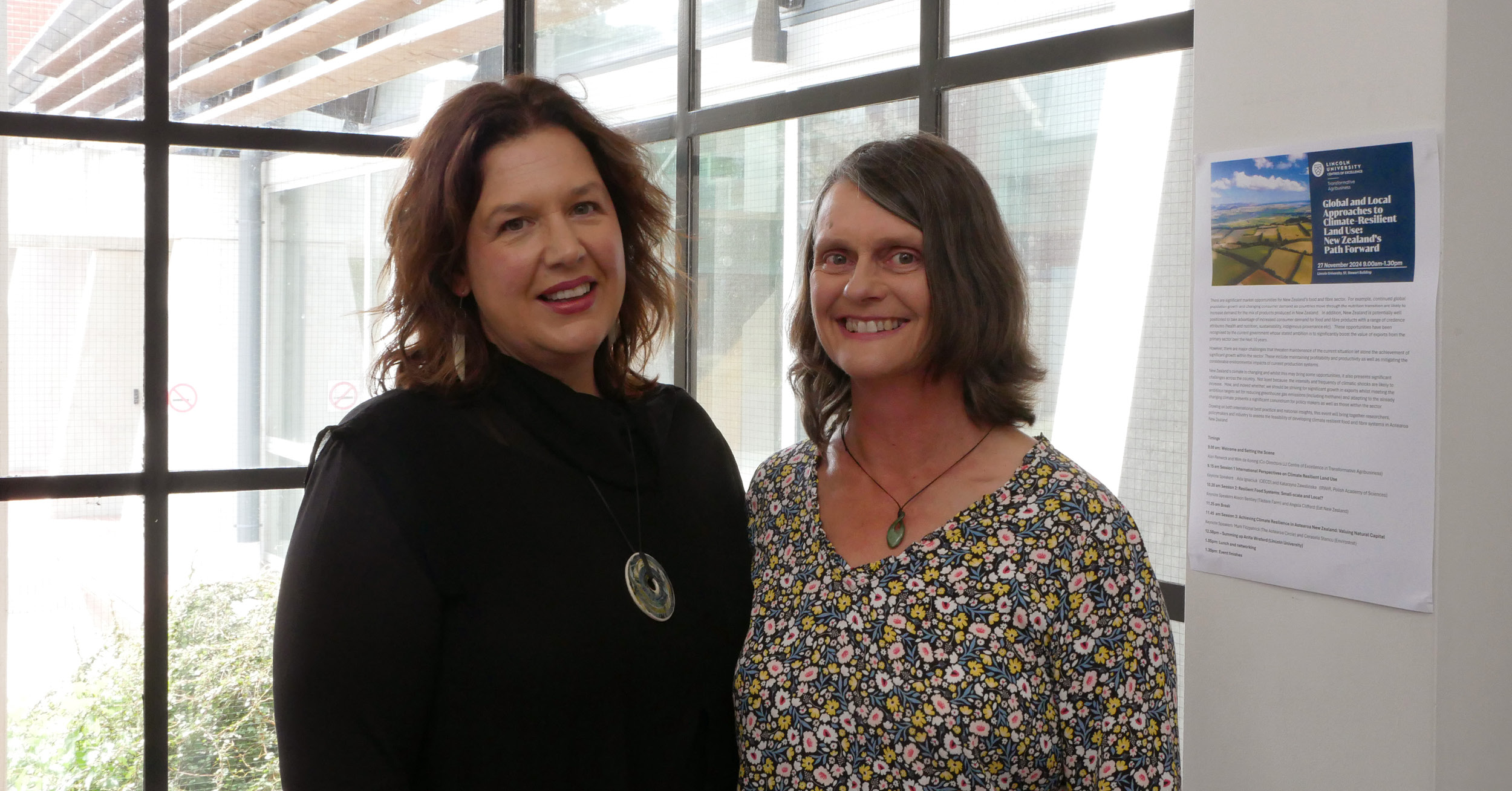
Alison Bentley (Tikitere Farm and 2023 Kellogg Scholar) spoke yesterday at the event ‘Global and Local Approaches to Climate-Resilient Land Use: NZ’s Path Forward,’ at Lincoln University. Alison joined Angela Clifford (CEO, Eat New Zealand), in Session 2: Resilient Food Systems: Small-scale and Local? 

As the effects of climate change and economic instability become harder to ignore, it’s clear that the current models of economics and land use are proving challenging. Enter Angela Clifford and Alison Bentley, two forward-thinkers who are shaking up how we think about local economies, food systems, and sustainable land use. 

Their ideas offer an alternative vision for a future where community-based economies and small-scale farming can not only help us better contend with climate crises but could also transform the way we live, eat, and work.

The Missing Link: Community-Based Economies.

Angela Clifford, CEO of Eat New Zealand, has been championing the power of local economies for years. In her view, traditional economic models are overly focused on macro-level concerns like national GDP, and micro-level issues, like business profits. But there’s a massive gap in between: the community economy. This often-overlooked space is where, Clifford argues, the real power lies, particularly when it comes to addressing environmental and social challenges.

For Clifford, redefining economic success isn’t just about how much a country makes or how many businesses thrive. It’s about creating systems that prioritise sustainability, local self-reliance, and social equity.

But Clifford’s vision goes beyond just localising industry; she sees a radical rethinking of food systems as central to building climate resilience. Despite the growing urgency around food security and sustainability, little has been done to strengthen local food systems, she argues.

Small Farms: Big Impact.

Alison Bentley, a small-scale farmer from Tikitere Farm near Rotorua, is proving that small farms can be a game-changer for climate resilience. Through her research with the Kellogg Rural Leadership Programme, Bentley has been exploring the role of small-scale farming, especially on plots of 10 hectares or less, in building a more sustainable food system. Unlike larger scale commercial agriculture, which can depend on chemical-intensive practices, Bentley argues, small-scale farming often works in harmony with natural ecosystems, fostering biodiversity and improving land use resilience.

“An increase in scale is more of the same to gain efficiency, whereas an increase in scope can give us diversity and resilience”, Says Bentley. In other words, rather than always pushing farms to become bigger and more industrialised, we should be looking for ways to diversify farming practices to build long-term resilience. By aligning farming methods with the natural capabilities of the land, small-scale farms could deliver more sustainable and climate-resilient outcomes.

One of the key issues Bentley identifies is the underuse of “lifestyle blocks”, small rural properties that often sit idle or are used for residential purposes rather than food production. In New Zealand alone, there are 870,000ha in such blocks on productive land, with 140,000ha on prime land. And just 10% of this land is run by landowners serious about producing a primary income from their blocks. The other 90%, if managed properly, could become a vital resource in strengthening local food systems and reducing reliance on large-scale agricultural exports.

Bridging Urban and Rural Food Systems.

But there’s a catch: connecting these small-scale producers to urban markets. As cities grow and sprawl outwards, rural land gets encroached upon, and small farmers face significant challenges in accessing urban consumers who increasingly want locally grown, chemical-free food. Bentley’s Kellogg research highlights a growing demand for this kind of food, but there are major obstacles to getting it to the people who want it, infrastructure, limited market access, and high transaction costs are just some.

Still, Bentley is optimistic. There’s a clear market for sustainably grown local food, and consumers are often willing to pay a premium for it. What’s needed is a rethinking of food systems that can help small-scale farmers tap into that market while overcoming the logistical barriers that can stand in the way.

A New Economic Framework.

Both Clifford and Bentley advocate for a new economic framework that goes beyond GDP and focuses on values like environmental sustainability, local self-reliance, and social equity. Clifford believes that, in the face of climate change, it’s more important than ever to build local systems that can withstand global disruptions. For Bentley, small-scale farming offers a practical way to increase food security, reduce carbon footprints, and create stronger communities.

While neither discount the importance of New Zealand’s food and fibre exports to our economy, they both argue that we do need to think differently about how we use land and produce food.

A Path Forward: Empowering Communities, Supporting Small Farms.

Together, Clifford and Bentley make a compelling case for reimagining the future of food and land use. Their vision isn’t just about protecting the environment or boosting local economies, it’s about creating a more resilient, equitable society where both people and the planet can thrive.

They conclude by stating that by empowering small-scale farmers, supporting community-based economies, and rethinking how we use our land, we could build a future where local food systems play a central role in creating more sustainable and just communities. Food for thought.

You can read more on the subject in Alison Bentley’s 2023 Kellogg Report here.

Regenerative farm blueprint.

Executive summary

Aims and Objectives
The study examines how New Zealand’s agricultural sector can integrate business strategy, regenerative design, and sustainability legislation to create regenerative farm blueprints that enhance Freshwater Farm Plans. These blueprints aim to thoroughly evaluate environmental impacts and tailor practices to individual farmers’ strengths, promoting sustainable farming methods that preserve freshwater ecosystems and support long-term ecological health, economic viability, and social well-being.

Methodology
This study included a thorough literature review to provide context on sustainable farming practices. A survey with 22 long-answer questions was conducted, divided into seven sections targeting specific aspects of sustainable farming. Insights were gathered from 161 participants in agriculture and scientific fields. Thematic analysis techniques were employed to ensure validity and gain a detailed understanding of participants’ perspectives. The goal was to triangulate knowledge between farming professionals and literature, enabling a SWOT analysis for developing the Regenerative Farming Blueprint.

Key Findings
The thematic analysis revealed several critical themes, providing valuable insights into the study’s problem:

Regenerative Practices: Mentioned 280 times, these practices emphasise holistic management principles and adaptive strategies. Participants noted benefits such as improved soil health and biodiversity but highlighted challenges like financial barriers and resistance to change.

Soil and Water Management: With 1123 mentions, this category was most frequently discussed, underscoring its critical importance. Key themes included soil health, effective water management practices, integration strategies, and significant regulatory and resource challenges. This indicates the need for targeted support and resources to overcome these obstacles.

Biodiversity: This theme, highlighted by 720 mentions, underscores biodiversity’s essential role in ecological health and farm resilience. However, challenges such as cost constraints and a lack of awareness were noted, suggesting increased education and financial incentives were needed.

Legislation and Compliance: Mentioned 177 times; this reflects concerns about regulatory impacts and the necessity for better understanding and support for compliance. This indicates more explicit guidelines and support mechanisms to help farmers meet regulatory requirements.
These findings indicate that while adopting regenerative practices has significant benefits, it also presents considerable challenges that must be addressed through targeted support, education, and financial incentives.

Just some of the recommendations for Farmers

  1. Identify Relevant Non-Financial KPIs: For comprehensive effectiveness, incorporate metrics like soil health, water usage efficiency, biodiversity, and carbon footprint into business planning.
  2. Engage Advisory Support: Collaborate with trusted advisors to implement robust non-financial reporting systems tracking sustainability progress.
  3. Provide Balanced Reporting: Include detailed non-financial reports, such as environmental impact assessments and sustainability audits, alongside financial results for a complete view of farm performance.

Just some of the recommendations for Stakeholders

  1. Engage Early with Farmers: Proactively communicate about upcoming compliance requirements and provide clear, actionable guidance to ensure early engagement and buy-in.
  2. Build Advisory Capability: Enhance advisors’ skills and knowledge through specialized training programs focused on regenerative farming techniques and sustainability practices.
  3. Use Technology Effectively: Invest in advanced technology systems, such as precision agriculture tools and digital platforms, to simplify and streamline farmer reporting processes.

Richard Pedley

Regenerative Agriculture: How might New Zealand benefit?

Executive summary

New Zealand agriculture is grappling with change as it seeks to find a new balance between feeding the world’s growing population while maintaining profitability and reducing negative environmental impacts.
There is a lot of doubt whether regenerative agriculture (RA) can provide a better way to address this global challenge and there is concern that it may increase emissions intensity, lower farm profitability, and struggle to feed the growing population.

RA is regarded by some as the solution to the global food crisis. Positive environmental outcomes can, in some cases, be achieved with the use of RA. High rates of carbon sequestration have been proven, albeit in depleted USA soils rather than in NZ.

RA is not well defined and there is a lack of scientific evidence backing some of its claims. Results from the system have proven to be unpredictable and highly variable. Some successful farm practices such as minimum tillage, avoiding bare ground, and using mixed pasture species are attributed to RA when in fact
they were used well before the RA concept emerged. These are already considered best management practices in a NZ conventional system.

There is evidence that greenhouse gas emissions and N leaching can be reduced on a per-hectare basis using RA. However, this appears to be achieved mainly through reducing inputs, resulting in lower production and farm profitability. When analysed per unit of production, these environmental gains were
much less apparent.

The benefits of altering soil microbiology are frequently discussed among RA communities. The claimed benefits have not been thoroughly tested and will require more research.

Some farmers using RA concepts say they are achieving similar levels of production with fewer inputs. RA systems must be tested over many years to see if any initial benefits can be maintained. For example, if high levels of soil fertility existed before changing to RA, these can be ‘mined’ for several years before production levels then crash.

This report suggests that, while there are positive aspects of RA, it is unlikely to match the productivity and profitability that can be achieved with conventional agriculture. If this is the case, RA may be able to reduce environmental impacts, but it will fail to help grow the food supply to meet the needs of the world
population increase or to maintain NZ export income.

If, as appears likely, that agricultural outputs such as meat and milk produced using RA methods have higher emissions intensity, there is a real risk for the farmers involved. Offshore customers for NZ agricultural products look very favourably at NZ’s low emissions intensity and demonstrate little interest in
NZ’s internal debate about sector-by-sector total emissions. Higher emission intensity products may be discounted in value. Further, NZ farmers will soon have to start paying more for their emissions. Improved efficiency and lower emissions intensity will be the key to viably adapting to this change.

NZ farmers and growers should note how RA has been used in marketing to obtain a “green premium”. The industry can learn from RA about leveraging these advantages.

Recommendations
1. Treat investment into regenerative agriculture with caution due to the lack of scientific evidence, and variation in its outcomes and likely reduction in farm profitability. This applies to farmers, growers, and processors.
2. Research the untested claims of regenerative agriculture. Particularly soil microbiology and the effect it has on plant growth. Such research is difficult to carry out at farmer level and will likely require input from CRIs.
3. Introduce practices such as minimum tillage, avoiding bare ground, and mixing low numbers of pasture species, to those farms that are not doing so already.
4. Develop marketing strategies for NZ food and fibre which leverage the consumer positivity associated with ‘greener’ farm practices. This will likely require input from both processors and industry-good organisations.

Kris Bailey

How might Manawatū-Rangitīkei sheep and beef farmers futureproof their land?

Executive summary

Farmers adapt to the weather as part of their everyday decision-making on farm. Evidence suggests that, for New Zealand, the climate will change more significantly in the years between 2040 and 2090. How might Manawatū-Rangitīkei sheep and beef farmers adapt to the changing climate and futureproof their land?

The purpose of this report is to translate scientific climate modelling into practical contexts for Manawatū-Rangitīkei sheep and beef farmers and consultants.

This report aims to provide knowledge of:
1. Climate change predictions within the century.
2. What risks and opportunities are associated with climate change predictions.
3. What practical short to long-term actions could be considered that might future-proof farming businesses?

The methodology involved a literature review, followed by semi-structured interviews which formed qualitative research into futureproofing solutions.

The key findings are four climatic attribute changes to be aware of:
1. The frequency and intensity of drought.
a. By mid-century, a rainfall deficit of 50mm – 75mm per year.
2. The number of ‘hot days’ over 25oC.
a. By mid-century an increase of ‘hot days’ over 25oC, between 40% and 100% per year.
3. The frequency and intensity of adverse and compounding weather events.
a. El Niño and La Niña natural weather cycles exacerbated by climatic changes globally.
b. More severe adverse weather events, their frequency requiring more research.
4. An increase in temperature.
a. By the end of the century, an increase of 0.7oC – 3.1oC under the Representative Concentration Pathway’s (RCP) 2.6 and 8.5.

Recommendations to Manawatū-Rangitīkei sheep and beef farmers and consultants:
1. Use credible, trusted, and up-to-date sources of information to inform opinions about the changing climate.
2. Learn from advisors who collaborate closely with the scientific community and can translate data into meaningful, practical contexts.
3. Assess the current farming system concerning the top four climatic attribute changes and identify relevant, attainable, short to long-term actions, that may futureproof the business.
4. Build financial resiliency to be able to absorb hits and invest in futureproofing mitigation solutions.
5. Identify primary land use resources and their potential alternate use, if the existing system needs to change in the future.

Grace McLeay