Listen to this episode of Ideas that Grow, or click on one of the platform icons below to listen on your favourite player:




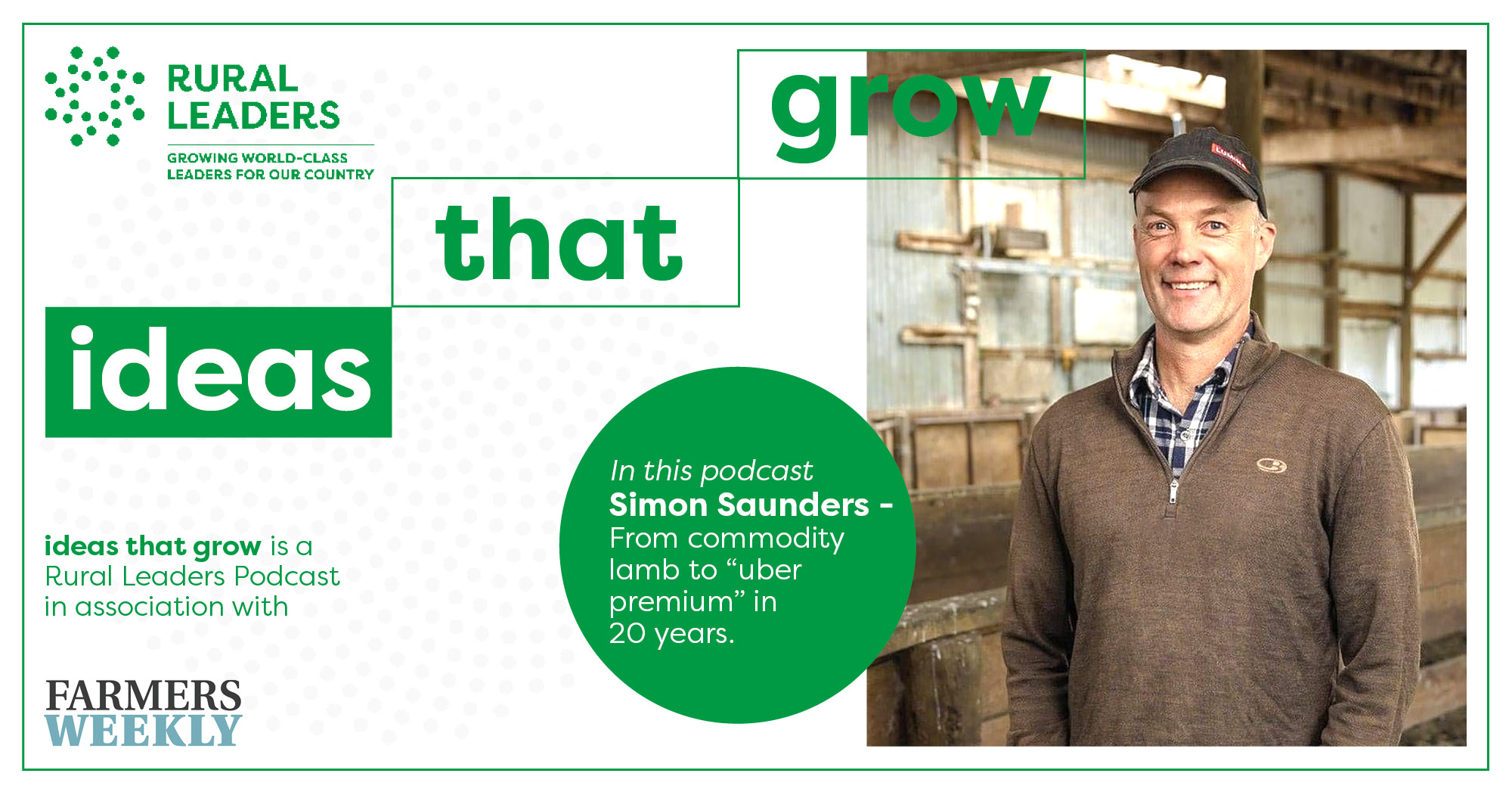
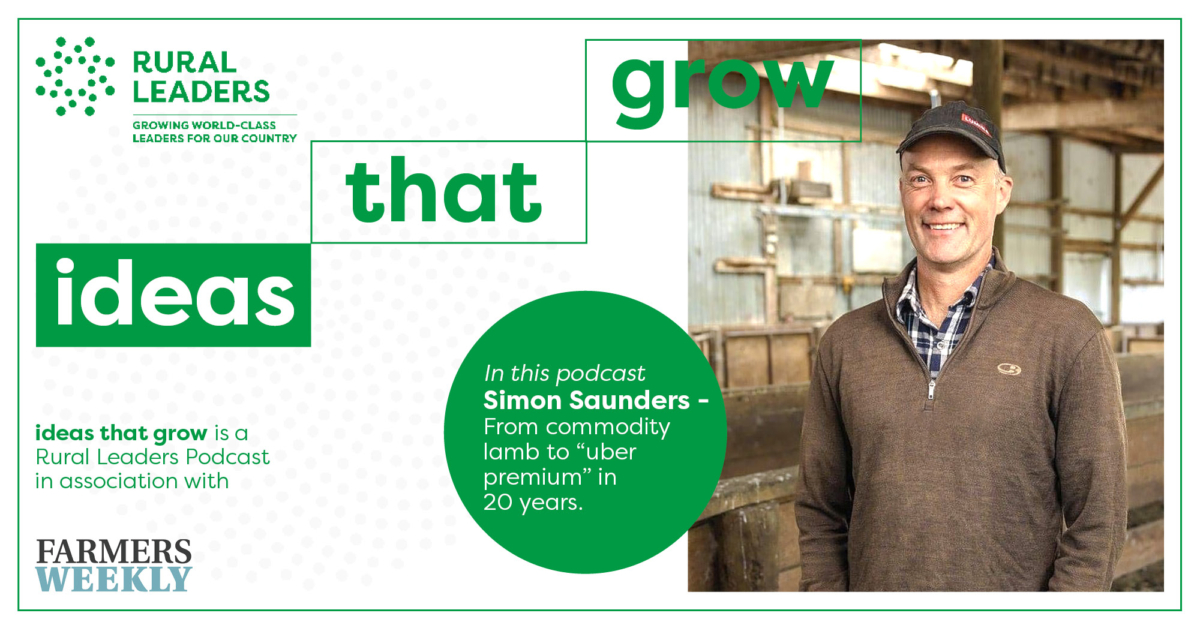
In this Ideas That Grow podcast, Simon Saunders, Southland farmer and 2025 Value Chain Innovation Programme participant, explains how Lumina Lamb went from a group of frustrated farmers in 2007 to an “uber premium” brand on menus across Asia and the Middle East. He covers consistency, the Alliance partnership, and why farmers need to think about where they sit in the value chain.
Applications for the 2027 Value Chain Innovation Programme close 22 Nov 2026.
Episode Transcript
Bryan Gibson, Managing Editor, Farmers Weekly, 2026 Kellogg Scholar.
You’ve joined the Ideas That Grow podcast, brought to you by Rural Leaders. In this series, we’ll be drawing on insights from innovative rural leaders to help plant ideas that grow so our regions can flourish. Ideas That Grow is presented in association with Farmers Weekly.
Welcome to another episode of Ideas That Grow, the Rural Leaders Podcast. I’m your host, Brian Gibson, managing editor at Farmers Weekly, and our very special guest this week is Simon Saunders from Lumina Lamb. Kia ora, Simon. How are you?
Simon Saunders, the ‘Match Maker’ at Lumina Lamb, and 2025 Value Chain Innovation Programme participant:
Hi, Brian. Good, thanks.
BG: Tell us a little bit about Lumina Lamb, your part in it, and what you do.
SS: Yeah, so my day job, I’m actually a farmer. So my wife Annabel, we farm Stag Valley, which is just west of Lumsden in northern Southland. We’re a 1,400-hectare rolling sheep and beef farm. And many, many moons ago, I was lucky enough to be one of the founding farmer shareholders in Headwaters, which is the genetics business that we set up nearly 20 years ago and is a 50% JV partner with Alliance in Lumina Lamb. So that’s how I got involved in the Lumina programme.
BG: A couple of decades in, I mean, it’s been around a while, but what was the thinking behind putting the Headwaters programme together?
Born out of frustration in 2007.
SS: Well, if you go back to 2007, when we first founded, Andy Ramsden got a bunch of farmers and other people together. We were having another boom of dairy farming conversions across Southland. A lot of the plains were disappearing to dairy farms. Farming, and I guess returns in those days were pretty poor. I think we were below $100 return for a lamb. And so there was a few of us that really felt something had to change and we had to try and do something different. And it was really about, one, wanting some genetics that would suit the hill and high country better, but also perform like a Downs genetics programme or sheep. And secondly, how could we add some value? How could we really do something different, differentiate our product from, I guess, standard or commodity lamb and try and extract more value? So that was the kind of founding premise of we got together and put some money in and made a start.
BG: The programme, the Headwaters programme, and I guess Lumina Lamb appears to be really successful. But of course, having the genetics and the farming side of things sorted and under control, I guess, is one thing. But as you know, there is a value chain right through to the person who buys it, and that’s important to get that right as well.
Building a brand is tougher than breeding lambs.
SS: Yeah. And I used to think that genetics and getting lambs ready to leave on a truck was a pretty tough gig, but trying to build a value chain and trying to build a brand and grow a successful brand out of New Zealand and export to the world is way tougher. It’s really challenging. And I guess 20 years and we just feel like we’re starting to really make some progress and we’re starting to be really successful in the market, especially over the last 4 or 5 years with Lumina, with our product and starting to just return some meaningful returns back to our farmers. It is really challenging. It takes a huge amount of effort and we’re probably really lucky that, that we went into a joint venture with Alliance and having their support and their ability to reach into a wide range of markets and process the lambs and make sure we can deliver lamb into pretty much any market we want on time and for 12 months of the year is absolutely critical.
BG: The term ‘value chain’ signifies the need for everyone along that chain to extract value and make the extra effort worth their while. I mean, Alliance is one of the oldest and most experienced processors in the country, so they know what they’re doing, but how is this different to all the other stuff they do, do you think?
A niche within a niche.
SS: Well, from an Alliance perspective, I guess they have had a number of brands, but really trying to do a premium or uber premium, as we like to call it, is quite different. Where our customers are chefs and high-end food service all around the world. And so being able to deliver lamb to meet their requirements 12 months of the year, it is very niche. I mean, lamb itself is pretty much a niche. So it’s a niche within a niche. And so it is quite a different value chain from what alliance is useful, but they’ve been able to adapt and through the partnership and the joint venture, we’ve found a way of making it really successful.
BG: You were a participant in the Rural Leaders Value Chain Programme a couple of years ago. How did that add to your understanding about what you did and had been doing and what you could be doing in the future?
Pulling value chains apart to see what works.
SS: It was incredibly useful. I mean, I thought I understood the Lumina value chain and having spent time with Hamish Gow, who runs the programme, and 12 or 14 other participants on the programme for a week where we spent the first day and we looked at a lot of the theory behind value chains and some of the models that drive value chains and how they differentiate between different value chains. And then took a deep dive at looking across the key primary sectors from apples to kiwifruit, dairy, red meat, and also looked at some technology and really pulled those value chains apart and looked at what worked and what failed and why they were being really successful and what were the drivers were. And it just gave me great insights and a real framework to then think about the Lumina value chain and not only the value that we’re trying to extract in the market, but all the way along the value chain where we can unlock blockages, make the value chain more efficient, drive down costs. Because all of those pieces are what drive a better margin and better return at the end of the day back to farmers.
SS: So it was incredibly useful for me to understand more about how those value chains functioned. And as a director in Headwaters and in Lumina, where, from a strategic perspective, we need to position ourselves and where we need to invest is really critical in the value chain. You know, is it better we invest in genetics at the farm end, or should we be investing more in the market end? So all of those parts to it were incredibly useful for me in terms of the Lumina value chain.
BG: Yeah. Funnily enough, I was at a conference last week and Hamish Gow was speaking and someone in the audience asked him, what’s one of the reasons New Zealand food exports, the value chain they have, what’s one of the reasons that they’re successful that we often don’t think about? And he says, well, it’s often the consistency because we can create high-value products consistently for years and years and years. No one can tell the difference from one batch to the next and actually not very common in the world of food exporting. So I guess that’s one of the key parts to it, isn’t it?
Consistency is the secret ingredient.
SS: Absolutely. And probably one of the key secrets to Lumina that we’ve developed over the years is just having a super consistent product. Look, it’s got a fantastic amount of attributes, whether it’s, you know, the intramuscular fat, the taste, the subtle flavours. And, but it’s the consistency around the size, the flavour. It’s just exactly the same every time. I was lucky enough to spend a week in market, uh, just got back last week actually, through Asia and the Middle East. And that is the absolute feedback that every distributor we talk to, every chef, um, every customer that’s using Lumina, is that consistency. And I think that’s one of the key nuts that we have cracked over the past 20 years. Absolutely he’s dead right on that. And I think it’s really important. And it was interesting while I was in market and some of the other lamb brands, and there were plenty about, and we’ve got some massive amount of competition, especially in Asia from Australia, but you go into the Middle East, into Dubai, and we had a distributor that, and he had utilised probably 10 other lamb brands from all around the world. And so it’s really competitive and You’ve gotta be able to differentiate yourself and really be able to show those distributors where you can win and why it’s so important for them to be using your brand and paying the money they are, or the, over the extra value that they’re paying over and above what they might be paying for a commodity lamb or another brand.
BG: It seems to me if we look at how things are going right now in the livestock markets, it’s possibly something, you know, more farmers need to think a bit more about. You know, we’ve got a bit more feed around. Farmers are often, could be holding those lambs back from being processed to get a bit more weight on them. But of course, if they’re bigger, then that reduces the options that the processor has. And so there are sort of stumbling blocks sort of set for those further down the chain. That’s something that perhaps some of our farmers need to take on board, perhaps?
Knowing where your farm fits in the value chain.
SS: Yeah, and I think as a farmer, it was probably the other insight that I really gained from the Value Chain Innovation Programme was really thinking about, you know, what we do behind the farm gate and who we might partner with and how do we position the products that we are growing behind the farm gate. I think one of the, probably the big learnings for us on our farm through the value chain is, you know, we are very much focused on the premium end of lamb and it’s all contracted and, and very specific supply and, and specifications around how we supply. And for that, we’re starting to extract some really meaningful returns, which is fantastic. But then in our beef, we’ve looked at a number of premium options in our beef operation and really struggled to see how we could drive a return given our geography and the type of farm system we were running. It was a real eye-opener for me in the value chain programme in thinking about who should actually we be partnering that’s going to fit our farm system the best and drive the best return for our farming system. And so we’ve actually gone and then made some, you know, quite big tweaks to how we’re going about managing our beef programme on farm to try and fit and partner with a partner that’s, that’s got the same philosophy around the value chain.
SS: I think that’s the great thing about the value chain programme is that it’s not only beyond the farm gate, but I think it’s farmers thinking about where they position themselves, who they partner with, and how do they make sure they’re extracting the full value, whatever it is, whether it’s really efficient commodity or, or going into a fully contracted premium business, just really thinking about where they’re positioning, where their farm’s best suited and the skillset they have and where their interests are. So absolutely, totally agree with you, Brian.
BG: Yeah, yeah. I’ve heard a little bit about how, you know, the Lumina system works. And you mentioned the very sort of narrow and specific quality parameters you work to in that. But could you just talk a little bit more about it? I mean, it’s small numbers of animals sort of on time, every time to various places depending on the contract. Is that right?
Genetics, chicory and tight specs.
SS: How the Lumina programme works is obviously Headwaters owns the genetics and they’re a 50/50 joint venture with Alliance. And so to be able to provide lambs into the programme, you need to obviously use headwaters genetics. And we’ve got a maternal and a terminal ram that we’ve spent the last 20 years really focused on not only its maternal traits, but also the meat quality traits to make sure that we can produce a lamb that’s got great levels of intermuscular fat and the polyunsaturated fats, which are really critical to not only human health, but the mouthfeel and the subtle flavours of Lumina. You then need to, obviously if you’re a breeder, once you breed the lambs, breed a finisher, they’ve got to spend their last 35 days on chicory or red clover. And we’ve got a great finishing programme, contract finishers as well for those that can’t finish the lambs on chicory and red clover. And then they’re all processed at 4 processing plants of Alliances. So in a nutshell, that’s the programme. We have reasonably tight specifications of 17 through to 22 kilos. And so yeah, farmers are killing reasonably regularly to make sure that they’re within those specs.
SS: And once they’re in those specs, then they go into the programme. And if they’re in spec, then at the end of the season, on the extra value we’ve been able to create in the market washes back to farmers.
BG: That’s amazing. You were someone who was sort of already deep into this value chain sort of mindset, but having done the Rural Leaders Programme. you kind of discovered a lot more. So I guess there’s something in there for everyone involved in food and fibre.
SS: Yeah, absolutely. There’s a great mix of people on the programme from right across the whole value chain. We did have quite a lot of farmers, but they were from all parts of the primary sector in New Zealand. Hamish really challenges your thinking beyond the farm gate and really stretches your thinking and challenges you around the value chains that we’re looking at. You all travel in one bus and you, you just get a lot of time to really think deeply about how well those value chains are functioning. How they’re set up, what are the policy, the government policy, the framework that those different value chains function under and what’s been successful and what hasn’t. So absolutely, I’d highly recommend it to anyone, any parts of the primary sector as a great programme to be a part of.
BG: And the 2027 Value Chain Programme applications are open till November 22nd. And you can go to the Rural Leaders site to learn more about that. Thanks so much for your time, Simon.
SS: Thank you, Brian. That was great.
Thanks for listening to Ideas That Grow, a Rural Leaders podcast presented in association with Farmers Weekly. For more information on Rural Leaders, the Nuffield New Zealand Farming Scholarship, the Kellogg Rural Leadership Programme, and the Value Chain Innovation Programme, please visit ruralleaders.co.nz.