Listen to this episode of Ideas that Grow, or click on one of the platform icons below to listen on your favourite player:




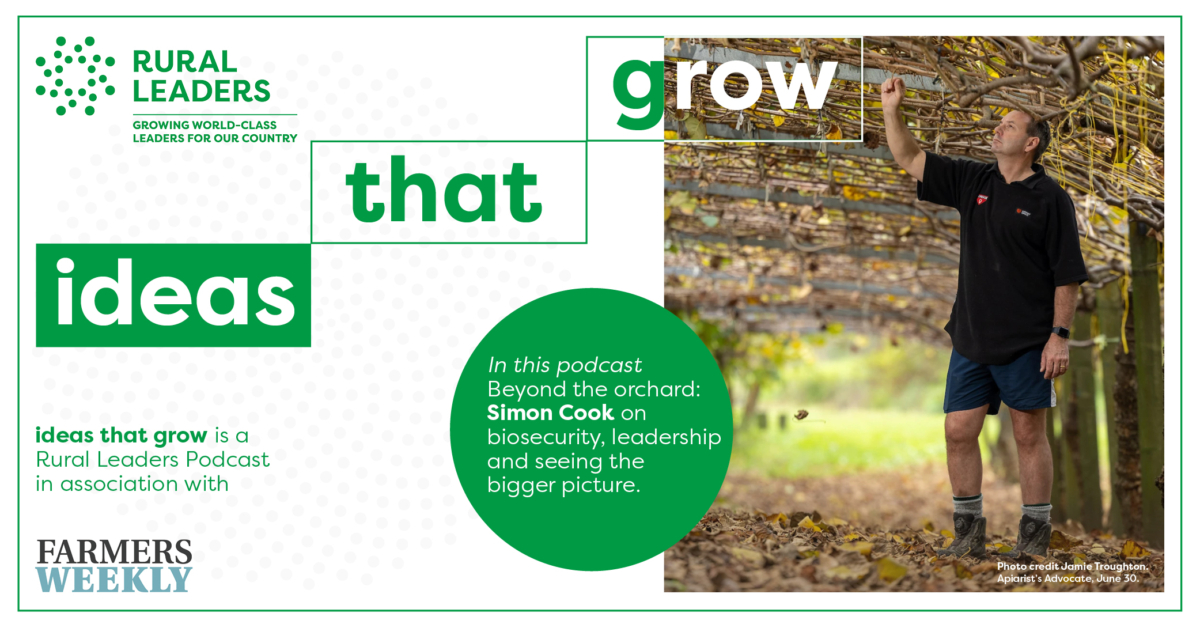
In this Ideas that Grow Podcast. From surviving PSA to studying biosecurity around the world, Simon Cook, 2018 Nuffield Scholar, shares how stepping beyond the farm gate broadened his perspective, strengthened his leadership, and reinforced the importance of preparing industries for tomorrow’s challenges.
Episode Transcript
Bryan Gibson, Managing Editor Farmers Weekly, 2025 Kellogg Scholar.
You’ve joined the Ideas That Grow podcast, brought to you by Rural Leaders. In this series, we’ll be drawing on insights from innovative rural leaders to help plant ideas that grow so our regions can flourish
Ideas That Grow is presented in association with Farmers Weekly. Welcome to Ideas That Grow, the Rural Leaders podcast. I’m your host, Bryan Gibson, Managing Editor of the Farmers Weekly, and this week on the show, we are joined by 2018 Nuffield Scholar, Simon Cook. G’day, Simon, how are you?
Simon Cook, Nuffield Scholar (2018), Grower, Horticulture NZ Board member.
Good, thanks, Bryan. Glad to join you.
BG: So you’re, in the horticulture industry growing avocados and kiwifruit up in the Bay of Plenty.
SC: My family have been on this property since 1950, so I’m third generation in my family growing kiwifruit. On this orchard and yeah, also grow a small area of avocados.
BG: You know, if we think about how you got into this game, you were kind of born into it.
SC: Yeah, the family been involved in it long term through my dad. We didn’t actually live on the property when I was young. I grew up elsewhere with dad having commercial roles. So I went through university, did a business degree and spent 4 years working in food industry primarily in Auckland. And yeah, then had an opportunity to get out of Auckland and go back to rural life and jumped at it.
BG: Tell us a little bit about the growing operation you have at the moment.
SC: We have 5 hectares of kiwifruit. There’s half a hectare of the gold variety, 4.5 of the green variety, and 0.3 hectares of avocado. So just a small size operation.
From Family Orchard to Industry Leadership
BG: Your time is also taken up by a fair bit of governance and industry body administration.
SC: Yeah, I think it came from, I guess, having that commercial background to start with. And so I’ve always been interested in what happens past the farm gate, the industry as a whole, and particularly this supply chain. And so yeah, I always had an interest in being involved in the wider industry and what happens beyond the farm gate in particular. So that kind of got me started on that path of governance, I guess, a long time ago.
BG: At the moment you’re on the Horticulture New Zealand board?
SC: Yeah, joined Horticulture New Zealand’s board about a year ago. I’d spent 10 years on Kiwifruit Industries equivalent KGI. So spent a lot of time in living organisations that that work on behalf of growers or farmers doing advocacy roles.
BG: Those levy bodies, they play a really important role in, you know, driving a sector forward, advocating on behalf of, you know, growers and processors, that sort of thing.
SC: Oh, they’re absolutely critical. And yeah, just every industry has some sort of advocacy body that works on behalf of farmers or growers. So yeah, I’ve had the opportunity to sit on a couple of them now.
Why Nuffield? Broadening Perspectives Beyond the Farm Gate
BG: You went through the Nuffield Programme in 2018. What interested you in committing to that?
SC: That’s going back a wee way now. I’m just trying to think what it was that really got me going. I think it was an opportunity that had been discussed within the industry. So the industry had talked about Nuffield in the past, and I guess I was at a time of my life where it was a good opportunity to look at something like Nuffield.
We were, as an industry, just starting to grow again. You know, we’ve been through some bad times with PSA, with the biosecurity incursion in our industry, and we’ve kind of evolved through that, had got through that, and we’re just starting to build again. And yeah, it just was a good time for me to look at something different. And Nuffield was an opportunity to travel the world and look at different practices.
It’s an opportunity to get outside of your industry as well. So, I mean, we get so hemmed in with our own industry, with what’s happening day to day, and you know, you kind of sit there with a lens which doesn’t go beyond your own industry a lot of the time.
Nuffield was really a chance to, I guess, break out of that and to look at, um, different agriculture industries and really see, you know, where we fit in the world and what we can learn from other people.
BG: And you mentioned the big challenge the kiwifruit sector had with the PSA incursion. You chose to take a look at biosecurity as your topic.
Lessons from PSA and Global Biosecurity
SC: Yeah, so when PSA hit our industry, I actually lived about a kilometre from where it started here in Te Puke. So we were kind of right in the middle of it, right from the start. And at that stage we were spraying contractors. So we were, I guess, one of the front lines for helping people and supporting people. So we got dragged in very early, very early on by MPI to work on their behalf and the response.
I guess that was my first introduction to biosecurity, being part of it, being on the front line of it. So it, that I guess really triggered an interest for me and It developed from there. It knocked our industry heavily and it was gutting to see, you know, a lot of the customers we’ve had, a lot of the guys we worked with very closely taking chainsaws to their orchards and you’d go around and what used to be a lovely flourishing orchard, um, was just stumps because it had all been chain sawed off. And in those days you were kind of wondering whether there was a future in our industry. That was that bad for a while.
And so looking at it as a spray contractor in the kiwifruit industry, I was a very good spray contractor in a kiwifruit industry, but if there’s no kiwifruit industry, then you don’t have much of a business plan. So looked at it and decided, well, you know, you can focus on yourself and focus on your own business and be the best, you know, at your own business.
But if your industry fails, then you’re done for. Or you can try and support industry, grow industry, and make sure the industry’s still there. And then as a portion of it, you know, your own business will carry on. And so that was kind of where I stepped outside of our contracting business. I put in a manager and went to work for KVH, which was the biosecurity body and did tech transfer for them and worked for them for a couple of years on the ground effectively.
BG: And during that year of the Nuffield program, you know, where did you go? What sort of things caught your eye?
SC: I mean, there’s two components to it really. There’s the travel that you do as a group, which is the global, you know, eye-opening one where you get to see all kinds of fascinating things. And, you know, one day you’re somewhere like, uh, Dubai looking at a fish farm in the middle of a desert, you know, and the next day you’re on a dairy farm in France and then, you know, a potato field in Alabama.
It’s just all kinds of really different things, different ways of, what people are doing all around agriculture, but really does open your eyes up to the breadth of what our industry is.
It does take you away from your own little world. And yeah, it gives you that opportunity to look much wider. And then later on you do your focus travel. That gave me the opportunity to go and look at a number of different biosecurity incursions around the world and study what had happened there and what had gone wrong and how they were recovering from it. And that was really eye-opening. The one I really remember was going through Florida.
The citrus industry in Florida has been devastated by citrus greening. It’s one of their worst pests. And going back into seeing orchards over there that all that’s left is a stump. You know, that always took me back to the days of PSA back here in Te Puke and how devastating that was.
Seeing an industry that, you know, this was 10 years after it had hit that area, they were still at the stage of trying to get stumps to grow again. And so it was really reinforcing me how lucky we were as a Kiwifruit industry to have recovered as well as we did. We were extremely lucky.
We had a tolerant variety that enabled us to get through PSA, but it was sheer luck built on a fantastic breeding programme, but it was sheer luck that we had this tolerant variety and we could recover. But yeah, you go and visit an industry like that that just hasn’t been able to recover. And it really brought home to me just how lucky we were, how privileged we were.
BG: A lot of people I talk to for this podcast, you know, going away, they kind of have these You mentioned the widening of the horizon of your experience through the programme. And a lot of people have these, you know, light bulb moments. And it seems to me that might be one for you.
Just people face the same things, you know, whether it’s the oranges in Florida or the PSA here, and everyone wants to recover as quickly as possible, but the way people do it can be very different.
SC: You look at Florida, there used to be 100 post-harvest facilities. There’s 10 left. This whole industry, it was a $9 billion industry that’s about a tenth of what it used to be. And so if our industry had not recovered the way we would, we wouldn’t have a kiwifruit industry in New Zealand. We pretty much would have disappeared as well. Instead we’re now, about $6 billion turnover and leading horticulture within New Zealand. And so, you know, fantastic success story, but it could have easily been the opposite.
It does really wake you up and remind you, you know, just how much of a risk biosecurity is and how quickly things like that can turn.
BG: And of course, you know, while PSA was a massive challenge here, you know, the next version of PSA could just be around the corner, couldn’t it?
SC: That was probably one of the strengths of the kiwifruit industry now with KVH, Kiwifruit Vine Health, is that we start to look at what’s next. Most of these other organisations I’ve looked at, or industries, they’re still facing the threat that they had to start with and they haven’t ever been able to get past that. Because we were able to get on top of and live with PSA to an extent, it still causes problems and we still have to manage it, but we can live with it.
But it then got us into that situation as an industry where we could look ahead and say, alright, we’ve kind of got past this. What’s next? What could the next thing be? And we’d been caught horribly with our pants down as an industry when PSA arrived. We weren’t prepared at all for it.
Now we’ve actually got a specialist organisation whose role it is to look ahead, look at what the threats are, and to prepare plans. So if something does arrive, at least we know how we’re going to react and what we’re going to do about it.
BG: It’s almost a case of you get wounded, the wound heals, and that scar tissue makes you a bit stronger for next time around.
SC: Absolutely, yeah. And it’s one of the few industries that actually has got into that space of looking ahead and, you know, thinking what’s next and preparing plans. And it does make it a much stronger industry for that.
The Lasting Value of the Nuffield Alumni Network
BG: Just more broadly about the Nuffield programme, obviously both personally you get a lot out of it, your industry learns a lot from what you discover, but there’s also, I guess, the cohort you’re with, the people you meet along the way, that’s a big part of what makes Nuffield so rewarding.
SC: So, you know, I still have probably 3 or 4 different scholars from all around the world come and visit and stay with me every year wanting to understand the Kiwifruit industry. And I get the opportunity to introduce these people to my industry and show them around. It’s really rewarding for me because, you know, I love my industry.
I’m extremely proud of what we have and what we’ve achieved as an industry. And so the opportunity to share that with people from all around the world, you know, to me is fantastic. And I get to meet scholars from all kinds of different walks of life and just, once again, talking with them, learning from them, understanding what they’re going through.
It’s a fascinating part of it. It’s just that ongoing relationships that you do have within Nuffield New Zealand, within Horticulture New Zealand. Our current (HortNZ) CE is Kate Scott, who was a 2018 Nuffield Scholar with me. So, you know, that was actually part of what attracted me to wanting to be a director there was the opportunity to work with Kate again, because I’ve got a huge amount of respect for her.
BG: It seems evident that the Nuffield programme seemed to have been, in part at least, a catalyst from you moving from that sort of micro, within the fences of your own block of land sort of thinking, to that more macro, good of the industry, go and see the world, let’s solve the big problems together. That seems to have been part of, you know, what kicked that off for you.
SC: Yeah, it’s a big part of it Bryan. And you need something like Nuffield to actually kick you out of your comfort zone and kick you out of what you’re doing. It’s a fantastic way of taking the blinkers off and showing you the opportunities and where you fit in. It was fantastic for that.
Stepping Back to Lead Better
BG: The Nuffield programme, it’s a big ask of people. You know, you kind of take a year off work. There’s probably a lot of people out there who maybe people have, you know, tapped them on the shoulder and thought, maybe give this a thought. And, you know, most people probably think ‘oh, I’m not ready’. What would you say to them?
SC: I think it’s one of the common sayings, isn’t it? If you’re too busy to do a Nuffield, then you’re the person that we want. If you’re heavily involved in what you’re doing and you’ve got a passion for what you’re doing, then those are the people that really are the ones that should do Nuffield.
It does take a lot of planning and a lot of support from other people. So for me, I left 3 young kids at home with my wife while I was travelling, had an orchard that I had to put manager into, a contracting business that I had to put a manager into.
There’s a lot of stuff you’ve got to do to be able to step back yourself. But it’s also a good thing to do because by being able to step back, you can actually then look at your own businesses and work out what you’re doing.
When you’re in a business and you’re firefighting every day, you don’t get to see the big picture and you don’t get to kind of look at the opportunities – and wider. You know, my dad and I, when we had our contracting business, we were so focused on our business and it was, you know, everything that we were doing.
We were so involved in it. And eventually we actually got an industry consultant, Mike Miller, who was a huge part of our industry for a long time. And we actually got him in for some coaching for the two of us. And he sat my dad down and basically Mike was very blunt with people. So you either liked Mike or you didn’t, because he told it to you exactly what he thought. And he was great.
He told us that that’s exactly what we needed to do – was to step back from our business. And actually take the opportunity to organise it, to plan it, you know, to see what was happening, to look at opportunities rather than just being in it firefighting every day. And so we’d had that kick in the ass, you know, 20 years ago from Mike. And that was, yeah, kind of reinforced.
So we started to put a few structures in, like getting a manager in to take some of the load off us. And that kind of really built on with Nuffield being able to step back for that long. It is something that people do need coaching on and probably do need support on when they start that Nuffield journey is how to step back.
And it’s probably something as a Nuffield cohort, we probably could be doing more of to support new Nuffielders into how to do that. It is a big part of what you’re doing because we all have farms, orchards, et cetera, that we’re all flat out running. And to be able to step out of that for a year is not easy.
BG: Part of being a good leader though is knowing, being able to see that big picture and also being able to trust people to do that firefighting for you.
SC: And it’s probably why a lot of us ended up with better organisations after we’ve done something like Nuffield, because of those structures that we’ve kind of been pushed into doing.
BG: Thanks for listening to Ideas That Grow, a Rural Leaders podcast presented in Thanks for listening to Ideas That Grow, a Rural Leaders’ podcast presented in association with Farmers Weekly. For more information on Rural Leaders, the Nuffield New Zealand Farming Scholarship, the Kellogg Rural Leadership Programme, the Horticulture New Zealand Leadership Programme and the Value Chain Innovation Programme, please visit ruralleaders.co.nz