Listen to this episode of Ideas that Grow, or click on one of the platform icons below to listen on your favourite player:




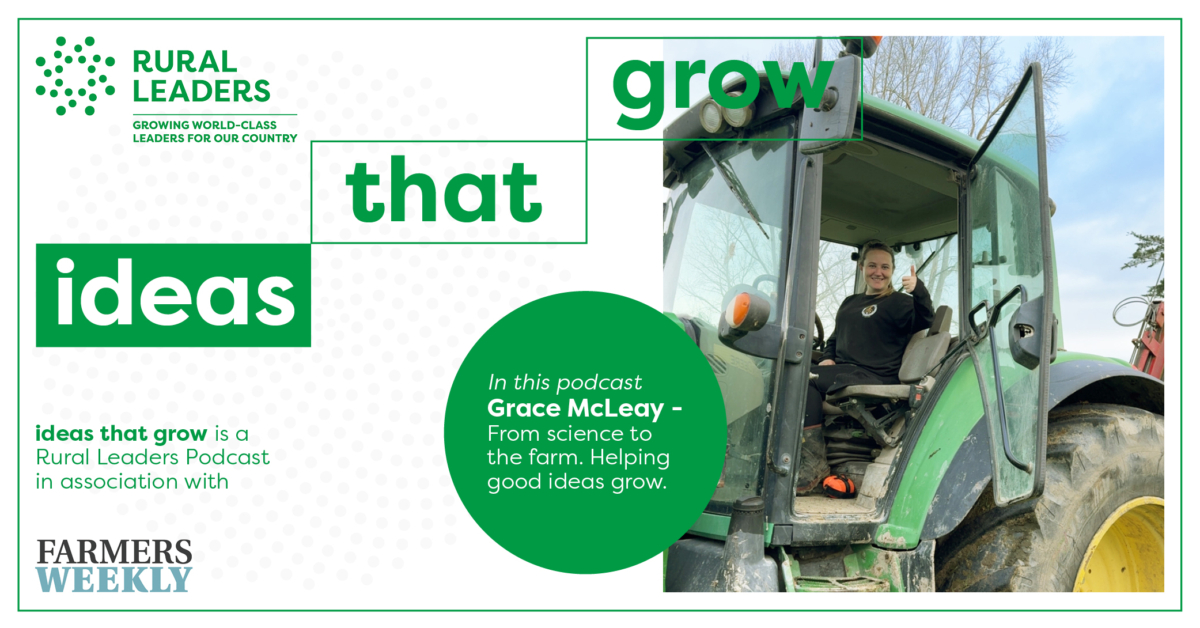
In this Ideas that Grow Podcast Grace McLeay, 2023 Kellogg Scholar, farmer and Bioeconomy Science Institute commercialisation specialist, discusses turning science into practical outcomes for farmers. She explores climate adaptation, farm resilience, diversification and the challenge of getting research into the hands of farmers. Grace also reflects on leadership, self-awareness and the lasting impact of Kellogg.
Episode Transcript
Bryan Gibson, Managing Editor Farmers Weekly, 2025 Kellogg Scholar.
You’ve joined the Ideas That Grow podcast, brought to you by Rural Leaders. In this series, we’ll be drawing on insights from innovative rural leaders to help plant ideas that grow so our regions can flourish
Ideas That Grow is presented in association with Farmers Weekly. Welcome to Ideas That Grow, the Rural Leaders podcast. I’m Bryan Gibson, your host. I’m Managing Editor of The Farmers Weekly, and this week our guest is Grace McLeay. Hello, Grace, how are you?
Good, thanks, Bryan. Glad to join you.
Bryan Gibson, Managing Editor Farmers Weekly, 2025 Kellogg Scholar.
Yeah, good. I’m in Manawatu at the moment in Fielding. You’re just up the road, aren’t you?
GM: I sure am. I am in the Turakina Valley, just on our farm, joining this podcast today. So thanks for having me.
BG: You were a Kellogg Scholar a couple of years ago, 2023?
GM: Yes, 2023. I was part of the K49 cohort.
BG: Very good. What’s your day job at the moment?
GM: I have recently joined the newly formed Bioeconomy Science Institute, formerly known as AgResearch. That’s four Crown Research Institutes that have just recently merged. So part of my role is working with wonderful scientists and helping support their ideas and identifying commercial opportunities. It’s a really rewarding job.
BG: Right. So you’re right at the coalface of tech transfer, knowledge transfer, that sort of thing from researchers to the actual farm businesses.
GM: Yeah, absolutely. It’s a role that is a connector of sorts, Bryan. So understanding scientists and what they do and bringing my commercial and farm knowledge and connecting that with industry and commercial partners.
BG: You mentioned the family farm, your fourth generation on the farm there.
GM: Yeah, that’s right, Bryan. So my husband and I came back to the family farm in May 2024. So we’ve just started our third season. So it’s been a really great time to come back to the family farm.
From the family farm to the science sector.
BG: Could you just tell us a little bit about the operation you’ve got there?
GM: So it’s a sheep and beef farm. We currently run just under 3,000 stock units on 330 hectares. Sheep and beef, we’re breeder finishers. We’ve got 120-odd weaners on at the moment, and we’re looking to finish about 2,200 lambs this season.
BG: And the Turakina Valley can be quite tough country, can it?
GM: We’re very lucky. We have about 100 hectares of flats, so that’s flats that we can get a tractor on, and then the rest is sort of rolling to steep hill country.
BG: Those valleys are in recent history been known to have some weather issues, that sort of thing. I remember going up there and being covering cutoff communities up that way, that sort of thing.
GM: Yeah, absolutely. You know, one reason why I chose to study what I’ve studied at Kellogg, actually.
BG: We’ll get into that in a tick. Could you just tell us a little bit about your career path?
GM: I went on a bit of an academic career, really. Out of high school, I went to Telford Polytechnic down in Balclutha. I went to high school in Feilding. Yeah. And I just couldn’t wait to kind of explore the world. And so I started my academic, agricultural career at Telford. And then subsequently went to Lincoln University for a few years and came into the corporate farming space. So multi-farm, large-scale farming. And so I was involved in that kind of sector for a decade. You know, supporting multi-farm operations, whether through rural servicing. And then, just recently joined the science industry that underpins the primary sector.
Turning science into something farmers can use.
BG: In your job now, what is a typical day like?
GM: Gosh, it could be anywhere. It’s just removing barriers, basically. So a big part of that is just, is building relationships with our scientists and industry and clients, understanding it is what they do, and then identifying commercial opportunities and helping see those opportunities turn into projects and then just removing the barriers for scientists to get that work underway.
So contracting for work and making sure that their ideas get out there to the world and what that actually means for the end user. And I always come back to the, the so what, you know, from a farmer perspective, how will farmers implement this in the future? Yeah, helping support in that sort of space.
BG: Because that is, you know, one of the longstanding challenges in the farming world I guess. There’s often a lot of good research that goes on. Outside of that, there’s a lot of innovation and technological advancement, and farmers have a lot of stuff pitched to them as the next big thing or the silver bullet or the thing that’s going to change their lives. And quite often, either that’s a misguided claim or the ROI doesn’t stack up or, you know, the opportunity cost is hard to judge. And so getting the good stuff to the good people can often be a challenge.
GM: It absolutely can, Bryan, and it’s been quite a learning curve the last 12 months and really understanding how the science industry works, understanding the breadth and capability within the Bioeconomy Science Institute, and understanding or trying to support how we get those ideas to implementation, right?
Because a lot of the stuff, it takes a long time to commercialise. It takes a long time to get it into the hands of farmers. So it’s, yeah, it’s something that is very rewarding
BG: And I guess, you know, as is often the case, you have the sort of first movers who are always engaged in this type of thing. And if you can get them on board with their catchment groups or discussion groups or that sort of thing, because farmers like to learn from farmers, don’t they?
GM: They absolutely do. They want to know what works and how it works. How that might work for me.
What climate adaptation really means on-farm.
BG: Now, just going back to your time at the Kellogg Programme, as we said, it was 2023, and you looked at climate adaptation in your own district.
GM: That’s right. Climate change, climate adaptation, they were really keywords that were getting banded around at the time. And I was quite curious as to what this looks like in our future and how do we future-proof our land to prepare for climate adaptation.
BG: How did you gather information on that?
GM: It was a challenge. There’s so much information and misinformation out there. One of the learnings that I came away from it was actually trying to find credible and trusted information and drawing conclusions or opinions from that. And so I looked at several significant reports and I thought, oh my goodness, like these are hundreds of pages long. Farmers are time poor already. They’re not going to read significant research projects. So I tried to kind of translate of sorts and significantly summarise what I felt was relevant, and I put it in my Kellogg report.
What I found was that we could potentially be looking at an increase of more hot days over 25 degrees, the frequency and intensity of compounding weather events, You know, an increase of the exacerbated natural cycles like El Niño and La Niña, which is a hot topic at the moment, as we know. So it was really fascinating stuff.
BG: You mentioned those big reports, you know, and the difficulty they have in getting cut through into people’s lives. I guess the other thing is that, you know, even if you put individual farmers’ views on climate change aside, they are actually like, they get up every day and, look out the window and take care of their stock and pastures and that sort of thing, and things are changing for them, isn’t it?
GM: Yeah, totally. And look, making decisions on the weather forecast is nothing new for farmers. We’re making decisions every day based on what the weather is doing. So what I did find was that farmers are already doing significant things to future-proof their land, whether that’s by implementing learnings from previous adverse weather events like the 2004 floods, for example. And really building that capacity to withstand future events and just building financial resiliency as well.
So, using our really good years, like we have recently been experiencing and building a bit of a buffer on how might I build financial resilience to withstand future adverse weather events? Or, how might I react to an increase of more hotter days? I need to increase my storage capacity. What might that look like over the next few years for me?
Building resilience through diversification and better land use.
BG: I’ve seen a kind of recent change in the way people talk about their farms, which is quite heartening in that, you know, it used to be the fact that if you retired some country into, say, riparian or native planting or that sort of thing, you know, then it was a loss from your productive platform. But people are sort of switching that to say, well, no, it’s actually an enabler of the best productive platform I have.
It helps build resilience into that physical system. And, you know, it’ll protect the good bits so the hill won’t slide down or the water won’t rise so high, that sort of thing. Do you think that’s sort of catching on?
GM: Absolutely, Bryan. I think we’ve always talked about the right tree in the right place and using that as a tool to adapt to a changing climate. You know, how might I put some extra shelter in place for my stock to combat heat stress? That’s really, really important. And we can also use it as an income diversifier. You know, if I might have some manuka that could potentially be used for making honey, having some bees on the place, for example.
BG: That diversification is front of mind for a lot of people, whether it is those different types of food production or whether it’s, agritourism or even forestry blocks, that sort of thing, in the right place. It really does help insulate you from the ups and downs of the commodity markets.
Why leadership starts with knowing yourself.
BG Cont’d: Of course, the Kellogg Programme, it gives you a lot more than just a sort of specific research insight. It’s, you know, it’s about leadership, it’s about networks, that sort of thing. How did you find that whole process?
GM: It was incredible. You’ve just recently done Kellogg as well, Bryan, so you’ll definitely relate. It was just a fantastic opportunity to spend six months doing a deep dive on who I am as a person, who I am as a leader. It gave me time to pick a topic that I was quite interested in and have that time available to me to be able to really come away with some tangible stuff that I could implement myself, but I could also talk to other people about.
I did find that you learn a lot about yourself. You do a lot of self-reflection, a lot of understanding your personality and what drives you. How do you handle some of your stronger personality drivers and values as well.
It’s a great opportunity if people haven’t done that before, to really understand what are my underlying values, what helps me, you know, make decisions in life, and what’s my sort of North Star. Yeah, it’s just a really, really great personal development opportunity, and I got so much from it.
BG: The thing you find is that you don’t have to be the person who kind of fits the bill of what you think a leader looks like, because there are many ways to approach things. And as long as you are self-aware and know what you are good at and not so good at, then you can tackle anything, can’t you?
GM: Totally. And I love what you touched on there, Bryan, that I do feel that leadership isn’t necessarily a formal title. You can be a leader and have significant influence on the people around you. It doesn’t necessarily have to be a hierarchical position. You come away with so many tools to be able to be that influence.
BG: You know, the Kellogg Programme, something that you’d recommend to others if they’re curious about the world, curious about themselves, seeing what they’re capable of?
GM: Absolutely. Just dive in would be my recommendation. Don’t wait till the time is right because you’ll potentially always find an excuse to, to say, oh, I don’t have the time for that. But I guarantee you’ll make the time and you’ll get so much from it.
BG: Excellent. Thanks so much for that, Grace.
GM: Thanks, Bryan. It’s been a pleasure.
BG: Thanks for listening to Ideas That Grow, a Rural Leaders podcast presented in Thanks for listening to Ideas That Grow, a Rural Leaders’ podcast presented in association with Farmers Weekly. For more information on Rural Leaders, the Nuffield New Zealand Farming Scholarship, the Kellogg Rural Leadership Programme, the Horticulture New Zealand Leadership Programme and the Value Chain Innovation Programme, please visit ruralleaders.co.nz