Listen to this episode of Ideas that Grow, or click on one of the platform icons below to listen on your favourite player:




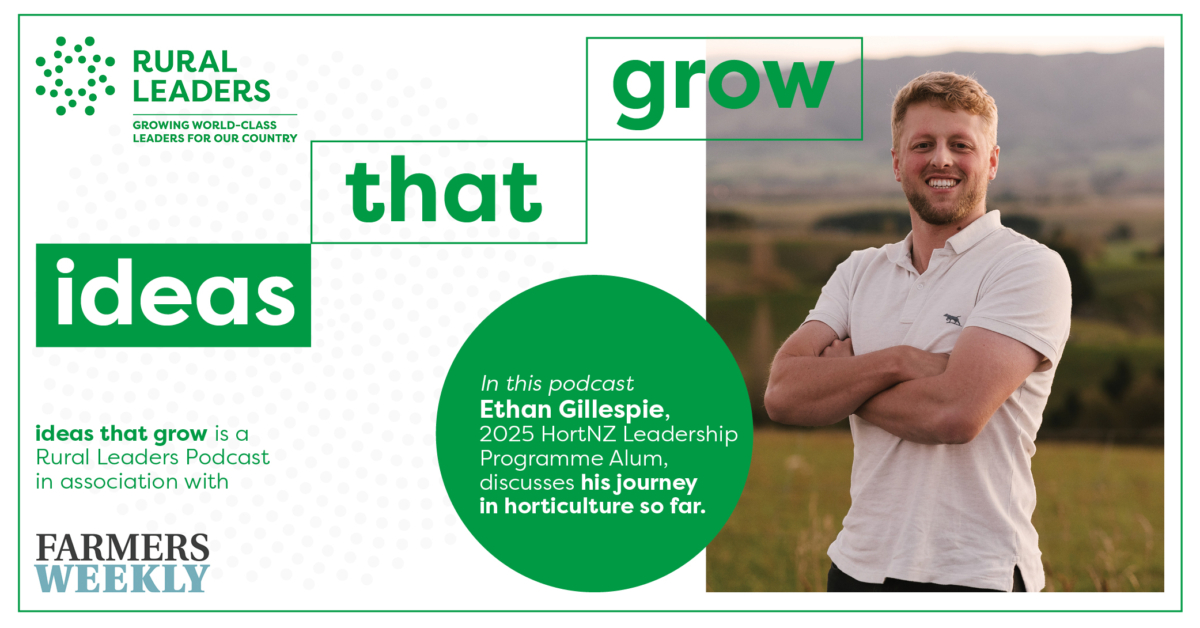
In this Ideas that Grow Podcast, Ethan Gillespie, 2025 HortNZ Leadership Programme alum, talks to Bryan Gibson, 2025 Kellogg alum, and Farmers Weekly Managing Editor, about his programme experience. Ethan discusses how it broadened his understanding of leadership, advocacy, and strategic decision-making.
Ethan shares insights into his own leadership development, industry collaboration, and the pathways available for emerging leaders in New Zealand’s horticulture sector.
Episode Transcript
Bryan Gibson, Managing Editor Farmers Weekly, 2025 Kellogg Scholar.
You’ve joined the Ideas That Grow podcast, brought to you by Rural Leaders. In this series, we’ll be drawing on insights from innovative rural leaders to help plant ideas that grow so our regions can flourish.
Ideas That Grow is presented in Association with Farmers Weekly. Welcome to Ideas That Grow, the Rural Leaders podcast. I’m your host, Bryan Gibson, Managing Editor of the Farmers Weekly.
This week we’re going to talk about the Horticulture New Zealand Leadership Programme, delivered by Rural Leaders. And we’ve got an alumnus of that programme, Ethan Gillespie. Kia ora, Ethan, how are you?
Ethan Gillespie, 2025 Horticulture New Zealand Leadership Programme.
EG: Yeah, very well. And yourself, Bryan?
BG: Yeah, really good, thanks. You’re working in the horticultural sector in Hawke’s Bay at the moment?
EG: Yep. I work for Brownrigg Agriculture. We grow a range of different crops, but primarily squash, pumpkins, onions, and some maize for grain, as well as our livestock side of things. But yeah, so I’m primarily focusing on squash and pumpkins as sort of my area.
Ethan and his role in Horticulture.
BG: What specifically do you bring to growers there?
EG: My official title is agronomist, but I wear a couple of hats throughout the business. I am involved in a lot of the growing side of things, do a lot of our pre-harvest scouts, checking up on crops before we go into harvest, but then also our pumpkin side of things, which is relatively new to us. I manage the post-harvest through to the packhouse side. That’s where I’m mostly involved in nowadays.
BG: Where do those pumpkins and squash end up?
EG: Squash, we export that to primarily Japan and Korea with a little bit of it being kept here in the New Zealand domestic market. But then all of our pumpkins and butternut and those items, they go to supermarkets around New Zealand. So for the domestic market.
From Dairy Farming to Horticulture.
BG: Have you always been working in or interested in horticulture?
EG: No, not quite. I grew up dairy farming in the North Manawatu,, so have always had a farming background and loved the rural lifestyle. I enjoyed milking cows in early mornings throughout the holidays, but then I went to university and studied agriculture, primarily crops and soil and a little bit of animals. Then following that, I decided I was keen to be involved in growing crops and ended up down the horticulture route, involved in vegetable production.
BG: I often think of the Hort and the Arable side of things as a bit more, almost dicey in a way. You know, you can wipe out entire seasons with one bad factor. You’ve got to get it right, don’t you?
EG: Yes, absolutely. A lot riskier business, you might say.
Why pursue the HortNZ Leadership Programme?
BG: Now you’ve been through the HortNZ Leadership Programme. That’s one we don’t cover a lot on the podcast here. When did you go through it?
EG: I was a part of the 2025 cohort, found out about it sort of mid-year, about this time last year probably. We had a week up in Auckland together in September. I think it was last year, and then another few days in Wellington in October. End of 2025 was my sort of time through the course.
BG: What was your thinking behind, you know, pursuing one of these leadership programmes?
EG: A lot went into me deciding whether I wanted to do this or not. I guess I’ve probably been involved in aspects of leadership for a number of years now, but being relatively new into horticulture, I came across it and saw it as a way of learning a bit more about what goes on behind the scenes in the industry, looking at a governance level and all the legislation and submission process, a lot of the work that HortNZ does, but then also the wider general issues that horticulture is facing.
So, I came across it and was like, this is the way I can expand on what I know and what I do, and hopefully bring something new back to Brownrigg as part of my role.
BG: You mentioned you had been involved in some leadership in the food and fibre sector previously. What was that?
EG: Previously, probably not as much been involved in food and fibre, like had a little bit through university. We were part of a few case studies that I was part of at university and a team that I was involved in, we prepared for an international competition that was held in Christchurch.
It was looking at, given a sort of case business, and this was our problem we were trying to solve. So that’s kind of where sort of some of the strategic thinking that I’ve been involved in sort of came from. But then outside of that, I’ve been involved in youth leadership for a number of years. My wife and I, we did a stint over in Canada at a camp which, yeah, we ran leadership development courses for both youth and for companies and adults coming through.
BG: Just getting back to the leadership programme itself, obviously it involves a couple of intense contact course aspects to it. What were some of the things that were perhaps outside your day-to-day work that were really interesting and rewarding?
EG: Erin Simpson was the course facilitator for our cohort, and he brought a wealth of knowledge being in the horticulture industry for a number of years. But on top of that, we also had a few different CEOs from different companies come to speak to us about the running of high-level big companies and what goes into the governance level behind them and their boards and decision-making.
But then we also had a couple people from Horticulture New Zealand come and speak to us about about what’s involved in taking submissions from the growers they represent and taking that to government and figuring out the bigger picture of horticulture.
Understanding governance and industry advocacy.
BG: On both those things, they’re kind of almost, for want of a better word, kind of like the dark arts of how the system works. You don’t hear a lot about what happens around the board table because that is behind the closed doors, obviously. So getting that insight into how these people make decisions, work together, look at the wider world, figure out the strategy and direction. That’s really interesting, eh?
EG: Oh, certainly. it’s definitely like the area that I’m keen to be involved in. It’s not just the on-the-ground operations and running of it. It’s thinking long term. It’s figuring out what is the current path that we’re on. Is it the right path? Are there other avenues we need to be exploring? So yeah, it’s complex, but yeah, certainly interesting stuff.
BG: And then in terms of advocacy work, obviously, in the Farmers Weekly world, that gets quite a bit of airtime, how industry groups react to proposed government regulatory changes, that sort of thing. But, you know, these groups represent a broad spectrum of individual growers or businesses, and they’ve got to collate the hopes and dreams of that wide cohort, put it into a succinct submission. And hope they get their way in some ways. It’s, it’s also very complex.
EG: 100%. There’s so many different opinions in amongst the same food group growers and yeah, trying to kind of keep everyone happy, I’m sure, is a complex beast that a lot of people work very hard to do.
Leadership lessons and career aspirations.
BG: Does having done the programme now give you a new perspective in your
day-to-day role?
EG: I guess I look at some of the higher decision-making now and have a huge amount of respect for what goes into that. Yeah, within our business, looking at the growth that Brownrigg’s had over the decades that it’s been running and the way that the two Brownrigg brothers have grown the company.
BG: Yeah.
EG: Massive respect for them.
BG: Well, you know, these things usually are ever evolving. Do you have a plan for your future in the industry or your career?
EG: Yeah, I love being part of horticulture and see it as an industry that is so, I guess, complex and so many different avenues to it that the world’s my oyster in terms of where I end up within it. I went to university and studied agriculture science and did that with a very open mind in the sense that I was keen to be involved in agriculture. I wanted to stay in the industry, but wasn’t sure where I wanted to end up.
But at the same time, I knew going into that there was so many different avenues that I could explore. Within horticulture, but then also you’ve got so many different sectors of sheep and beef, dairy, horticulture that all sort of make up the sort of agriculture sector of New Zealand. So I’m keen to be involved. I love what I do at Brownrigg. So yeah, I’m pretty happy with what I’m doing and sort of see progression there.
BG: What would you say to someone who is thinking about either broadening their leadership skill base or perhaps is just inquisitive about the way the wider food and fibre sector works? I mean, would the HortNZ Leadership Programme be something you’d recommend to them?
EG: I said to a few different people post the course that, like, I think even without people who don’t necessarily sort of see them as a little itself as a leader or have, like, come from a leadership background, the course was great at opening up key ideas that people may not be used to, along with introducing the cohort to other members of the industry.
I think leadership is not necessarily something that you have to be in a certain position for. The place I worked at over in Canada, their leadership definition as per se was a leader is someone who looks at their own world, like not necessarily the world around them, but their own picture. They say it doesn’t have to be this way and they do something about it. So it was, yeah, even within everyone’s own journey and industry and job, there’s always things that they can see and do and improve on.
‘So yeah, and I would recommend the course for anyone who’s keen to learn more about the industry.
The lasting value of industry networks.
BG: One of the other things that everyone who goes through Rural Leaders programmes reports back to me is that, you know, one of the most rewarding things is the ongoing relationship you have with your cohort and the people who went through on the same journey you did. Is that what you found as well?
EG: Yeah, my wife and I have just had a child and a couple of people from the course have reached out. Congratulating us. And even within our group chat, people have sort of had a few problems that they’ve come across or issues they’ve faced that they haven’t been used to. And like, they’ve just chucked it in the chat and other people from within the industry or within our group have been able to come back and say, oh, I’ve actually already been through that and this is what we did, or this is a person you could talk to about the problem you’re facing.
So yeah, within our cohort, we had different aspects of our industry and each sort of had their own wealth of knowledge that’s been really useful both during the course when we’re in person and then like afterwards. So it’s been cool.
BG: Excellent. And Rural Leaders is currently open to applications for the 2026 programme, and there are 12 scholarships on offer.
Applications close June 28th, and you can find more information at ruralleaders.co.nz/hortnz
Thanks, Ethan.
EG: Awesome. Thank you very much.
BG: Thanks for listening to Ideas That Grow, a Rural Leaders’ podcast presented in Association with Farmers Weekly. For more information on Rural Leaders, the Nuffield New Zealand Farming Scholarship, the Kellogg Rural Leadership Programme, the Engage Programme, the HortNZ Leadership Programme and the Value Chain Innovation Programme, please visit ruralleaders.co.nz