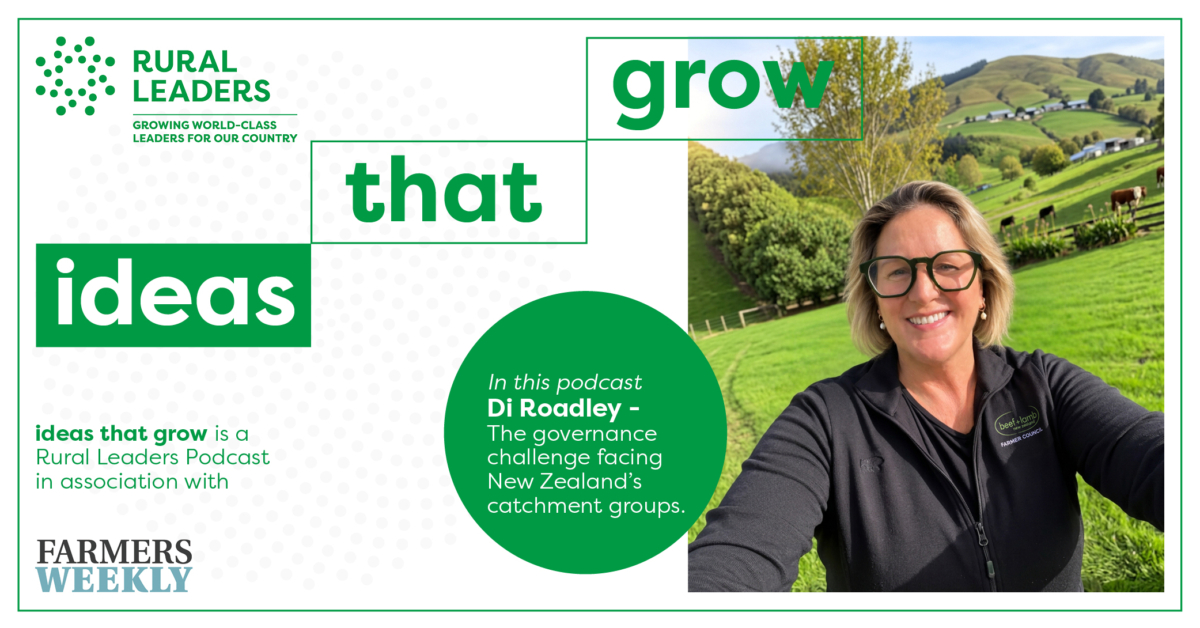
Listen to this episode of Ideas that Grow, or click on one of the platform icons below to listen on your favourite player:




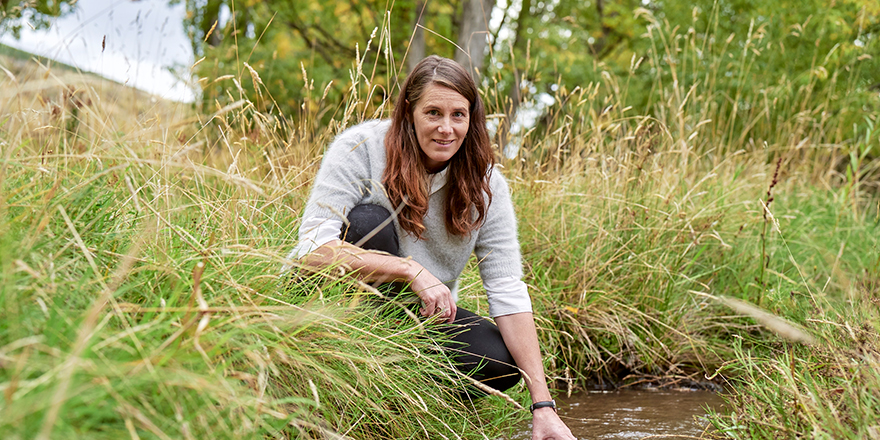
In this Ideas that Grow Podcast. What happens when grassroots catchment groups suddenly find themselves responsible for millions of dollars, complex governance and growing expectations? Di Roadley, 2026 Kellogg Scholar, explores the leadership challenges facing New Zealand’s catchment groups, from succession and funding to trust, capability and the importance of playing the long game.
Di Roadley was a recipient of the B+LNZ Rural Advancement Scholarship.
Episode Transcript
Bryan Gibson, Managing Editor, Farmers Weekly, 2026 Kellogg Scholar.
You’ve joined the Ideas That Grow podcast, brought to you by Rural Leaders. In this series, we’ll be drawing on insights from innovative rural leaders to help plant ideas that grow so our regions can flourish. Ideas That Grow is presented in association with Farmers Weekly.
Welcome to another episode of Ideas That Grow, the Rural Leaders Podcast. I’m Farmers Weekly managing editor Bryan Gibson, and our guest this week is 2026 Kellogg Scholar, Di Roadley. G’day, Di, how’s it going?
Di Roadley, Hawke’s Bay Regional Councillor, 2026 Kellogg Scholar.
Good morning, Bryan, and thanks so much for having me on your show.
BG: You’re a sheep and beef farmer in northern Hawke’s Bay?
DR: That’s correct. We farm what is classified as predominantly steep, hard hill country, and we are about 40 minutes north of Wairoa, inland. So most people would consider us pretty remote.
BG: You’re also involved in local governance.
DR: I am. So I have the very dubious honour of being a regional councillor for the Hawke’s Bay Regional Council.
BG: Now, of course Rural Leaders and the Kellogg Programme is interested in solving the big issues or looking at the big challenges we face in New Zealand’s food and fibre sector. You’ve taken a look at how our catchment groups are governed.
DR: I have, and that’s actually born out of a, not only a deep interest in governance and the role of governance, but actually a really deep belief that good governance drives good outcomes. And what I’m really interested in, along with probably all my fellow rural folk, including farmers, is those outcomes and getting good outcomes for both our farming businesses, but also for the environment that we farm within.
BG: I guess the challenge within the catchment groups around the country is that, you know, while they’ve started out as grassroots communities, sort of self-actualised, with the need for funding and the growing interest in them, and I guess even the growing demands, you know, regulators are often placing on them, getting the governance right and having it be able to grow into an effective structure, that’s a real challenge, isn’t it?
When community leadership becomes complex governance.
DR: Well, it certainly is. And it’s actually one that’s potentially up there with one of our wicked problems, because what we have is community groups that are driven by the outcomes and actions they want to see on ground, thrust into these roles through necessity. And often the governance structure stands up at the point where the group goes for funding, because at the point where you go for funding, you have to have certain things in place.
You have to have a chair. You have to have someone who’s taking minutes and organising meetings. You have to have a bank account. You have to be recognised as a structure, whether that be a trust or a charity or whatever the group chooses to go through. But until you have those things in play, you actually cannot receive funding.
And so often what happens in reality is the community looks around and finger points at those who are already in governance roles. So what it might look like is one moment you are on the committee for the local hall or the dog trial group, or you were on the board of trustees or some other small group, maybe it’s the kids’ dance or swimming groups. And the next thing the community goes, well, you’re obviously good at governance, so you’ve got the job.
Most of those people are in those roles already because they do have a real passion for their community and they can see the need and they generally sort of go, you know, yeah, okay, I’ll help out. What is actually the issue with catchment groups or the difference between catchment groups and those other groups is often those other groups are around community coordination. They’re just organising, you know, the working bee at the hall or who washes the jerseys for the rugby team.
When they get into the catchment group space, very, very quickly, in fact, you’d say suddenly, they’re in these complex governance positions. And they hold considerable power. both professionally and personally to the people who are within them. And that risk involves everything from health and safety to employment obligations, to expectations from the community around how we engage with them, with mana whenua, with Crown agencies, how they’re represented.
And actually not the least is the quantum of money. Most local halls or football clubs, they might be lucky to have a few thousand dollars. Many of our catchment groups are handling funds in the multimillion-dollar bracket, and that brings its own complexities as well.
The succession problem nobody saw coming.
And so what we have is these volunteers who are thrust into these roles almost unwittingly without realising what they’re putting their hand up for. And then the real kicker is, is once they get in these roles, it’s really hard to get out of them because the rest of the community looks at the role and goes, heck no.
So succession becomes a real problem. And whilst they start off with a hiss and a roar and you end up in this wonderful honeymoon phase where everybody’s enthusiastic and things are happening and it’s all great, as time goes by and the energy wanes a little, perhaps a few projects have completed, it’s really hard to get people to take up the reins and continue on the good work that’s been started. So to me, that is one of the key differences and the key issues that catchment groups are facing.
BG: It seems to come back to one of the big issues that we face in a lot of areas of life is that, you know, we often don’t know what we don’t know. And, um, that kind of, um, getting into the job and then having your eyes opened by what it actually entails. If at all possible, we want to avoid that kind of scary aha kind of moment.
DR: Absolutely. And I think that’s why succession becomes so incredibly difficult because remember, we’re talking to many of these groups are only are very new. The majority are 5 years, less than 5 years. There’s a few that are sort of around the 7, 8 years, and there’s a few older ones, of course, like Thriving Southland, etc, have been around for a long time, and they’re quite different as they mature. But the newer groups, the vast majority are less than 5 years old.
A perfect storm of funding and fatigue.
There’s a lot facing this problem right about now. And one of the key triggers has been that what started in a landscape of plenty of money. There was quite a lolly scramble post-COVID, and many groups stood up in that time. And so they’ve only known a world where money is freely available. And we all know that money makes things so much easier. You just employ someone when you need to.
That landscape has shifted considerably. And so now most groups are finding funding very challenging. Many groups are, having to relook at processes that have worked previously by paying people to do some jobs they can no longer do. And it sort of collides with this time where many of those key volunteers are actually really fatigued.
And so we have this sort of almost perfect storm of the money drying up, so the ability to employ people is colliding with people’s lack of energy or reduced energy.
BG: Irony in all this is that, you know, you’ve got everyone from politicians, industry group leaders. I’ve even talked about this in the Farmers Weekly, saying that ground-up catchment model is the way to achieve the sustainability outcomes we want. So they’re almost being given more to do, more weight is put on these groups, yet here we are in this kind of crisis of governance.
Trust is catchment groups’ greatest strength and their greatest risk.
DR: It is almost an irony, but actually when you step back, it was inevitable. I think the core issue is then when you phrased that the government and government agencies and everybody from politicians to councils recognising the power of catchment groups and their ability to engage and get people engaged.
But the reason that that works is because they are highly trusted by their community. They are the community. So there is no gap between them and the aspirations. So when a catchment group calls the willing to a hui at the local hall, generally you get a pretty good turnout.
When the council or the Crown calls a hui at the local hall, you’re lucky to find someone to make the tea. So the problem, of course, is that there is a real risk that ability for catchment groups to draw the people together, to build on that trust or lean on that trust, and to use it for their own aspirations is actually a real risk to catchment groups.
And I think it’s one of the things we are going to see coming, particularly in the next 2 months or so as we move through the election cycle, of how many politicians we are going to see looking for photo ops and handshaking opportunities to reflect their connectedness to the rural communities.
However, actually that is really counterproductive because I think I’d speak for all rural people that we can smell a rat a fair way off. And that lack of authenticity of turning up with your clean red bands and freshly minted Swandri, actually does not make you a community member and it does not guarantee you a warm reception. Particularly if we think you’re coming to use us for your own ends. In fact, you could end up with a perverse outcome.
BG: You’ve obviously taken a really hard look at various governance models around our catchment groups, with groups at various stages of maturity. You’ve got a long background in community and local governance yourself. I mean, what do you think we need to do? How do we lay the foundation for success?
Learning from those who have gone before.
DR: The opportunity exists within the catchment group sector, if you like. It’s not a sector, but the Kaupapa, let’s say. where we can see in real time groups at different stages. I mean, it’s human nature to learn from our mistakes, right?
But if we can somehow leverage and learn off the mistakes of others who are similar to us and also learn off their successes so that we can create a bit of a win-win, so that would be really helpful.
I think the core issue for me is around understanding and learning and shaping what the structures need to be those structures and frameworks for good governance, some bottom lines that could be freely available for catchment groups to utilise and to shape. So, not a rubber stamp, but maybe some core principles that need to be considered and shaped to fit into the uniqueness of every catchment group.
Then some absolute upskilling and learning opportunities for the people who are going to step into those roles so that they really understand how to leverage the frameworks that are available, to leverage the opportunities around them and build strength on strength through their good governance so that they continue to move forward and continue to survive the storms.
I think what we see through these more mature groups, not just in catchment group spaces, but more mature community groups, is that they have a deep understanding that things come in cycles and that there is an absolute need to have a strong purpose. If your purpose is deeply held and resonates with your community and all your work is framed by achieving that purpose, then the little bits in between, the ebbs and flows, the changing of personalities, the changing landscape of funding or government preferences actually becomes somewhat irrelevant and you can keep striving towards that long purpose.
I draw on the Māori worldview and there’s a, plan that was done by, called Te Pai Tawhiri, which was done by the Iwi around the top of the South Island. And theirs is a 500-year plan. And so when you start thinking in 500 years, actually the people who are currently there, the work streams, the funding, the personality clashes, they become really irrelevant.
Play the long game.
I like the analogy of, you know, there’s a really strong waka that you’re moving towards your purpose and the paddlers will get on and off the waka. The paddles themselves will change, but actually the trajectory continues on towards achieving that purpose.
And there will be some deviations and there’ll be some failures, and there’ll be some times when things are going really fast and fabulous, and other times where they’re not so much. But actually it becomes irrelevant if you’re looking long-term.
There was some great work done by New Zealand Landcare Trust, and it was called Lasting the Long Game. So that’s a great piece of work that people can dig into. It’s freely available. And it just sets out some ideas of how you set that purpose, and then how you shape up your action plans so that they become the mini steps heading towards that longer vision.
But another thing that I’m thinking about is how we address equity, because that’s the other thing across the catchment space. It’s particularly around funding, but also around capability and access to people and skills.
So, how we look at equity across the whole of Aotearoa New Zealand, support groups that are still at kitchen table thinking this might be an idea and how we address them to get what they need. Equally, groups such as Thriving Southland, which are a force in themselves. So how do we find equity?
And, you know, like the boats in the harbour, how do we bring the tide up so that everybody is floating, everybody is moving forward, everybody is getting what they need? And I’m not saying that equity is equal, but how do we support groups at their different stages.
So, that brings me very quickly to where the Crown needs to step in because actually as groups of volunteers, it’s a crazy notion that groups of volunteers would be able to see what they can’t see and know what they don’t know. That’s literally asking the impossible. So how do we do that? And so that’s a really big question that I think it’s probably as an industry, but also as Catchment Groups Inc., how do we actually address that? And I don’t think that piece can come from the ground up.
BG: Thanks for listening to Ideas That Grow, a Rural Leaders podcast presented in association with Farmers Weekly. For more information on Rural Leaders, the Nuffield New Zealand Farming Scholarship, the Kellogg Rural Leadership Programme, and the Value Chain Innovation Programme, please visit ruralleaders.co.nz