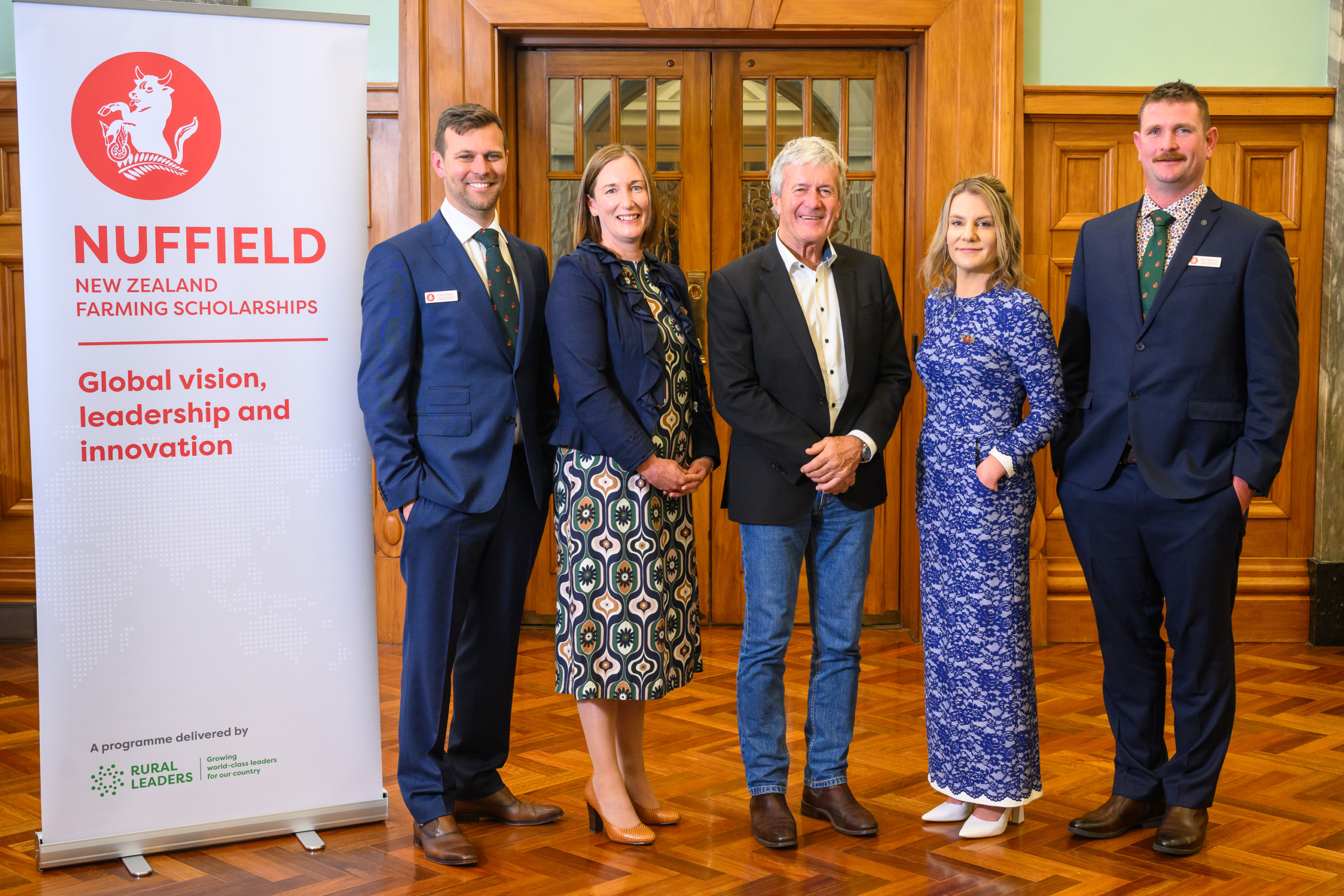
2026 Nuffield NZ Farming Scholarship. Apply by 17 August 2025. Read More...

Apply for 2026 Nuffield NZ Farming Scholarship by 17 August 2025. More details...

Isabelle Coates – networking, leadership, and giving back.

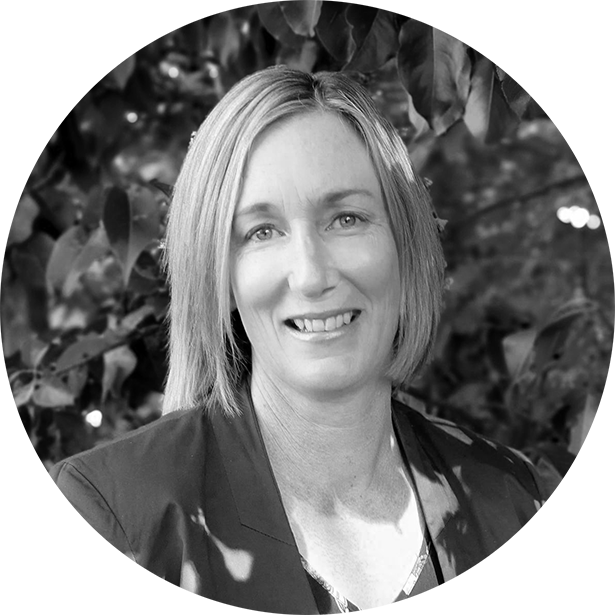
Isabelle Coates, 2021 Mackenzie Charitable Foundation Scholarship Winner, 2022 Kellogg Scholar.

For young professionals in the food and fibre sector, finding the right opportunities to grow and make a meaningful impact can be challenging. But for Isabelle Coates, the Mackenzie Charitable Foundation and the Kellogg Rural Leadership Programme provided both a transformative experience and a vital network of connections that has helped to shape her career path and her passion for supporting others.

Motivations for Applying: A Desire to Give Back.

The journey began while working for a not-for-profit, where limited resources sparked a desire to make a bigger impact. The organisation faced the common challenge of workforce attraction and retention, a theme that has become central to Isabelle’s career path. “I was working for a not-for-profit at the time, so we didn’t have a lot of money, but we were trying to do a lot with what we had,” said Isabelle. “The role opened my world to the power of workforce retention. Like many in my network, I wanted to do so much.”

Isabelle’s background in the meat industry, where she had previously been supported by the Meat Industry Association, further fuelled her drive. She wanted to give back to the industry that had supported her and had an ambitious vision for a project that aimed to secure funding to help improve workforce challenges within the meat processing industry. Gaining consensus from a large number of meat processors proved difficult – leaving the project in limbo. Despite this, Isabelle continued to look for opportunities to make a difference.

Winning the Mackenzie Charitable Foundation Scholarship: A Vote of Confidence.

Winning the Scholarship enabled her to complete the Kellogg Rural Leadership Programme. It also marked a pivotal moment in her career. “Being so early in my career, winning the Scholarship meant a lot,” she shared. “It was a vote of confidence that the Mackenzie Charitable Foundation were willing to invest in me and, more broadly, in young people wanting to advance and grow in the sector.”

At a time when many young professionals can often feel uncertain about their place in food and fibre, the Scholarship offered not only financial support but a vital network of peers, mentors, and industry leaders. “There’s over two and a half million dollars’ worth of scholarships in the food and fibre sector, but so many people don’t know about them or don’t have the confidence to apply,” she explained. “Winning The Mackenzie Charitable Foundation Scholarship to do Kellogg, showed me that there’s a need for young talent and that the sector wants to invest in our growth.”

Kellogg didn’t just provide Isabelle with technical skills and knowledge—it also helped her grow her confidence and broaden her professional network, an invaluable asset early in her career. “Kellogg helped me grow my confidence. It gave me the tools to think more critically, be more efficient with my time, and to avoid my own past mistakes like falling into the work habits that lead to burnout,” said Isabelle.

After Kellogg: A New Outlook and Career Path.

Since completing the Kellogg Rural Leadership Programme, Isabelle’s career trajectory has shifted. She transitioned from PGG Wrightson to Muka Tangata, where she worked on qualifications and standards for nine months, engaging heavily with the forestry and agricultural industries. From there, Isabelle moved internally to a role focused on engaging with the dairy, sheep, beef, and deer industries. “I really enjoyed the human connection in my role. It was the huge motivation for applying,” she said. “I love meeting farmers and understanding the challenges and opportunities they face across New Zealand’s diverse farming regions.”

Alongside her career, Isabelle has also found time to start a Young Farmers Club in the Waihora Banks Peninsula area, offering a platform for young people to connect, share experiences, and build leadership skills. “I was a little bit lonely in my previous role to be honest, so I wanted to create something that could help others feel connected,” she said. “We’ve got about 16 members right now, and it’s been really rewarding to see people build their networks.”

A Commitment to Creating Impact.

As Isabelle’s career progresses, she remains focused on creating real impact. Whether that’s connecting farmers to policymakers or helping young people build the confidence to lead, she believes change begins with listening. “Making a difference starts with someone listening,” she said. “The change happens at the intersection of people doing clever things for the right reasons, and then you connect the dots.”

For Isabelle, the future is about more than advancing her own career. It’s about driving human-centred change and creating a supportive, connected network that just might help shape the future of New Zealand agriculture.

You can view Isabelle Coates’ Kellogg Research report here.

Alumni in the Spotlight – Murray King, Penny Timmer-Arends, Alison Bentley, and Mihi Harris.

Alumni in the Spotlight - Feb 2025

Here are just a few of the media pieces covering the impact of Rural Leaders’ Programme Alumni in industries and communities across the sector. 

Murray King, 2003 Nuffield Scholar, ONZM

On Friday 7 February, Prime Minister the Rt Hon Christopher Luxon, Minister for Infrastructure Chris Bishop, and the new South Island Minister James Meager, Murray King ONZM and others, opened the Waimea Community Dam.

As the Prime Minster noted, this project is an “incredible legacy”, albeit one “we wish we’d got onto sooner”. And as MP Boyack noted, the region now has water security.

In no small part, thanks to the tenacity and leadership of Murray King and his colleagues.

Take a read of an article on the Waimea Water website here. https://waimeawater.nz/2025/02/10/dam-opening-ceremony/.

Penny Timmer-Arends, 2023 Kellogg Scholar

Penny contributed to a DairyNZ ‘Inside Dairy’ article recently. The article, ‘Decoding Rumination Data’, looks at the data wearables such as collars and tags can provide to measure a cow’s wellbeing. This technology has made monitoring rumination easier.

Take a read of the article that suggests visual monitoring and physical examinations should also be used to monitor rumination rates. https://www.dairynz.co.nz/news/decoding-rumination-data/.

Alison Bentley, 2023 Kellogg Scholar

Alison spoke to Radio New Zealand a couple of weeks ago about growing beef cattle, hazelnuts and a wide range of fruit on her small farm near Rotorua.

Alison says small farms have a pivotal role to play in addressing domestic food security and the environment.

“Seven hectares can produce a magnificent amount of food.”

Take a listen to the RNZ interview here: https://www.rnz.co.nz/national/programmes/countrylife/audio/2018976890/could-small-scale-farms-be-the-best-way-to-feed-the-country.

Mihi Harris, 2021 Kellogg Scholar

B+LNZ continues to build its support for Whenua Māori, with the establishment of a Kāhui (Māori agribusiness advisory group). Mihi Harris is now part of this seven-strong group that will represent the needs of Whenua Māori entities.
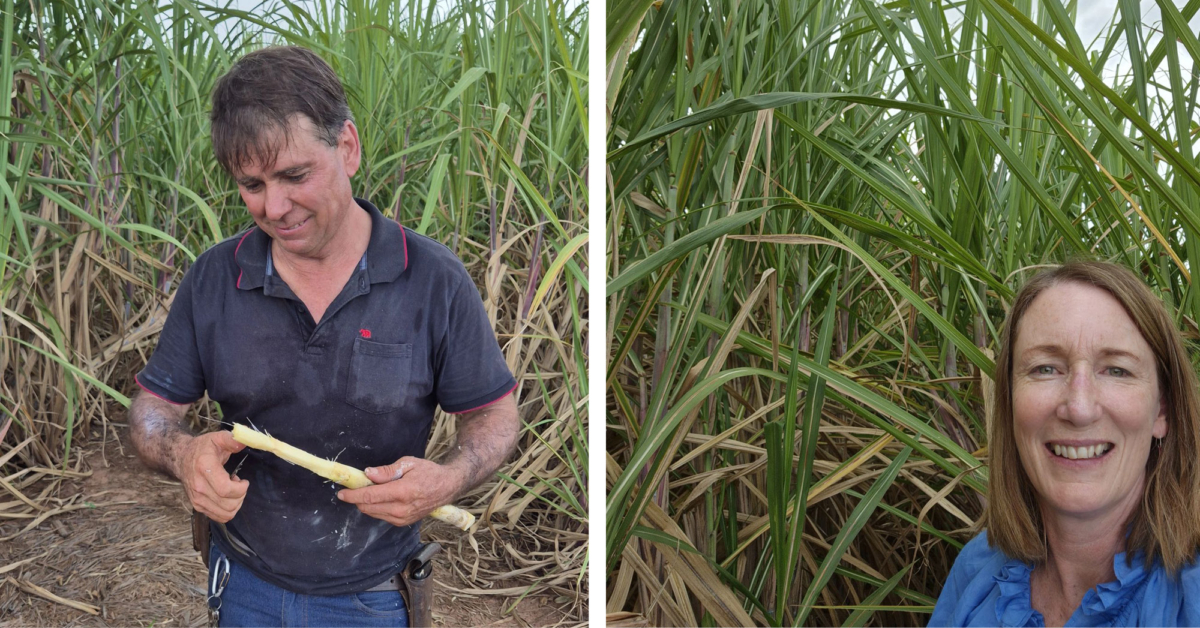
Read more about the Kāhui and about Mihi here: https://beeflambnz.com/news/meet-blnzs-maori-agribusiness-advisory-group.

The 2025 Food and Fibre CoVE Research and Insights Forum.

Food and Fibre CoVE Forum

The 2025 Food and Fibre CoVE Research and Insights Forum.

The 2025 Food and Fibre CoVE Research and Insights Forum showcased crucial projects delivered throughout the last year, that have helped address the challenges our sector faces, specifically around workforce talent, the pace of change in technology and uncertainty.

The two-day Forum got underway at Wharewaka in Wellington yesterday, with Rural Leaders’ CEO Lisa Rogers in attendance.

The following is a summary of the excellent posts (and photos) from Food and Fibre CoVE.

Day One.

The Honourable Andrew Hoggard opened and shared his vision for advancing a thriving skilled food and fibre workforce while Shamubeel Eaqub gave the economic realities and implications for NZ as a trading nation – a lot of it good news.

A session ‘Talent for our Future’ followed and brought the Skills Framework to life. This was conducted by Kathryn Koopmanschap, Nicky Murray and HTK Group’s Neala Rosandich.

The Skills Framework focuses on a skills-first approach encompassing: mōhio (understanding). mātau (expertise) and mārama (enlightenment).
Alongside this, a Te Ao Māori Skills Toolkit has been developed as a guide and support for learners, employers and providers.

View the Skills Framework toolkits here: Food and Fibre Skills Framework.

Forum goers also heard about the Secondary School Transitions and Pathways to Vocational Education, Training, and Employment project from Josh Williams of Skills Group.

To view the policy review by Josh Williams and Arthur Graves, or for more on the project, click here: Secondary School Transitions and Pathways to VET and Employment.

The second session captured a key range of projects focussed on workforce retention. Adam Barker of Scarlatti on insights looking into the possibility of coordinating New Zealand’s seasonal workforces between sectors and regions.

The final report is due to be published shortly.

Emma Boase of PwC New Zealand profiled the Employer Toolkit that has been developed for the ‘Retaining our People – Food and Fibre Retention Pilots’ project.

This toolkit for supervisors, managers and employers developed alongside industry provides free online information for better workplace wellbeing and culture, Māori cultural confidence, mentoring and more.

Head to www.employertoolkitnz.org to see this valuable work.

Sector snapshots from Dr Lesley Petersen included a sneak peek into the Aquaculture New Zealand mentoring and coaching pilot programme and the results from an impact evaluation of Mr Apple New Zealand Ltd’s internship, called Growing Future Horticulturalists. Both these pilots provide learning and guidance to take programmes like this to other food and fibre sectors.

Moerangi Vercoe and Daniel Wallwork of Muka Tangata Workforce Development Council shared the Te Haumako – Māori Workforce Development Plan recognising the significance of Māori agribusiness and growing demographic within food and fibre, with the opportunity to enhance qualifications and training that work for Māori.

You can read more on Te Haumako here: mukatangata.nz/te-haumako/

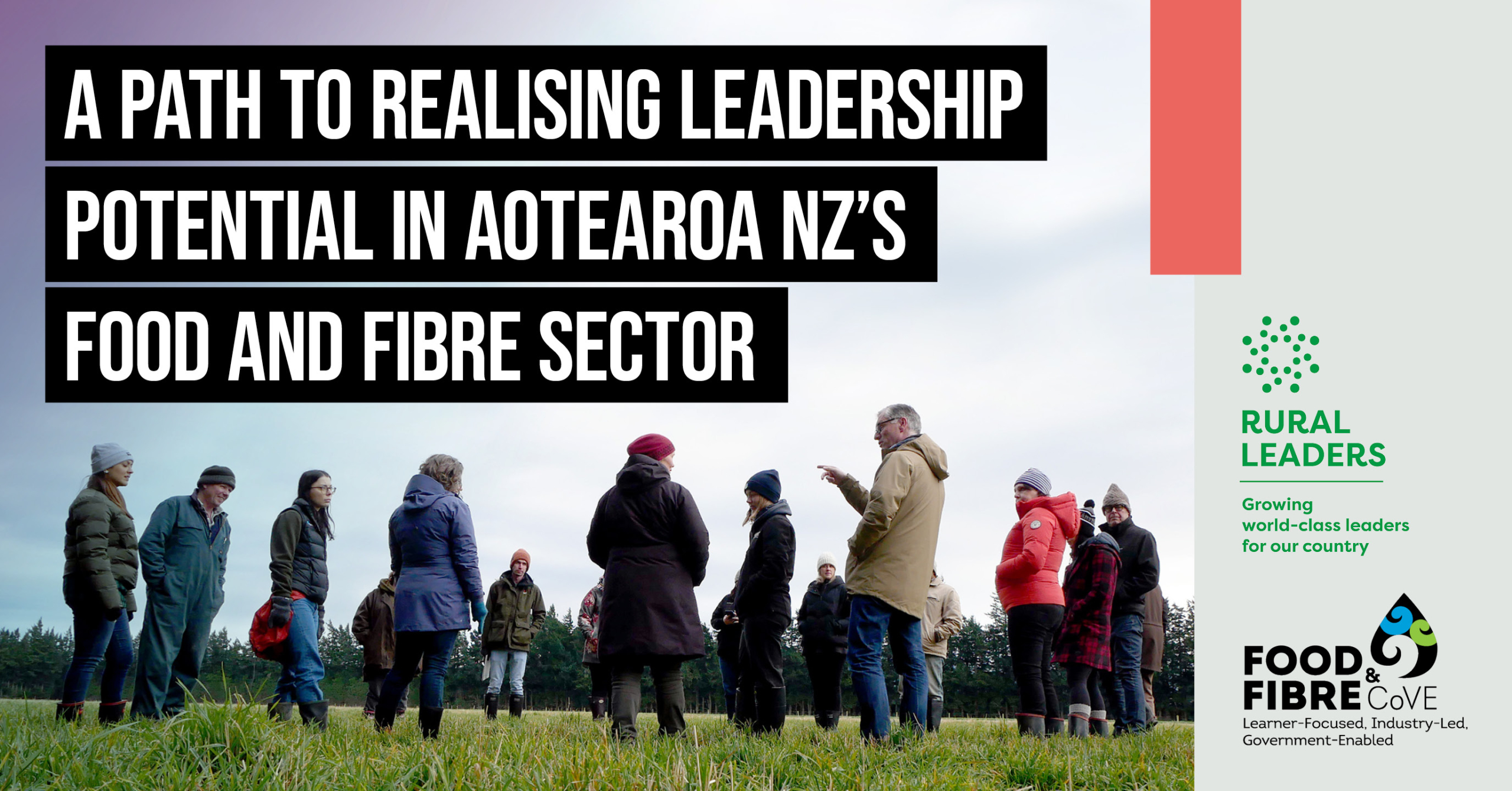
And connecting much of this work to leadership development is the Food and Fibre commissioned leadership project with Rural Leaders. The most recent report in this project, ‘A Path to Realising Leadership Potential in Aotearoa NZ’s Food and Fibre Sector’, was available to those attending.

Day Two.

Session three ‘Integrating Technology’, exploring the potential emerging technologies such as artificial intelligence has for food and fibre.

Dan Browne and Hamish Webber of Indelible – Creative Studio with CoVE’s Dr Lilla du Toit looked at how technology can advance learning and training capability, with AI researcher Dr Jace Hargis from Orlando on current possibilities.

Delegates gave new tools a go too – including an immersive experience on keeping safe when moving stock. 3 pilots to test the technology are underway with Beef + Lamb New Zealand, Te Wānanga o Aotearoa and DairyNZ.

Take a look at a report exploring the possibilities of emerging technologies for NZ food and fibre by Skills Group, here: Investing in Emerging Technologies: Gamification, VR and AI Research project and pilots.

The Scarlatti team’s Phoebe Gill and Julie Moularde spoke on two key projects including AI in assessment practices that are accessible for learners and providers.

Delegates were also introduced to Food and Fibre CoVE’s interactive Online Excellence Framework Scarlatti and Skills Group have done to bring the Rubrics and its ‘superpowers’ to life.

In Session four – a panel line-up spoke on positive disruption for the future of food and fibre VET. Grace Moscrip Josh Williams and Lisa Rogers, CoVE Board member Cheyenne Wilson and Chair, William Beetham who reflected on the learnings of the Forum’s two days – shaping a VET sector for the ever-evolving future-focussed food and fibre sectors of New Zealand.

Food and Fibre CoVE’s Chair William Beetham provided an update of Food and Fibre CoVE’s Future Directions Initiative, working with our stakeholders and PwC New Zealand on what comes next.

Have your say on what Food and Fibre CoVE’s focus should be beyond 2025. Click here: Food and Fibre CoVE Future direction

The Nuffield 2025 Contemporary Scholars Conference.

The Nuffield 2025 Contemporary Scholars Conference

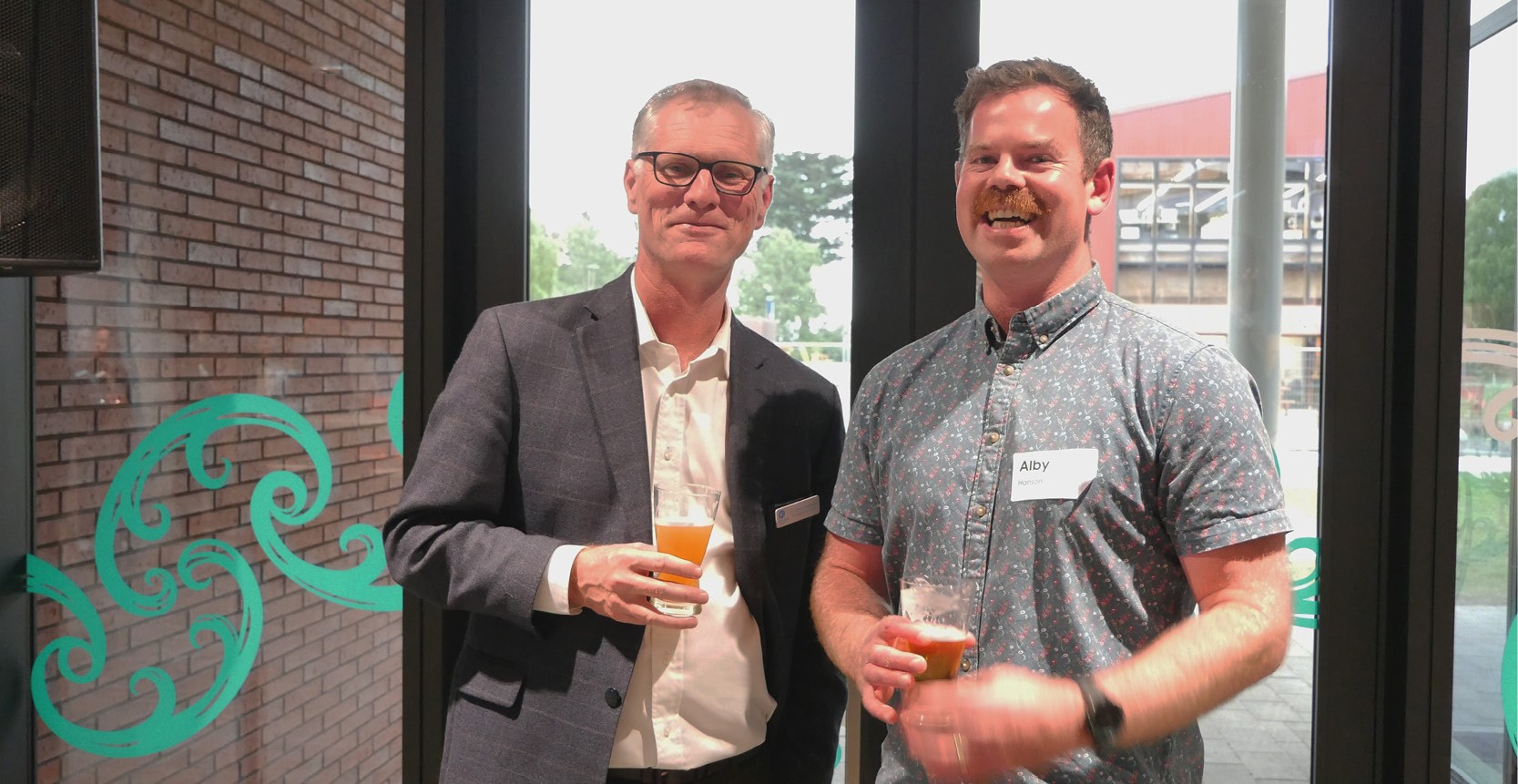
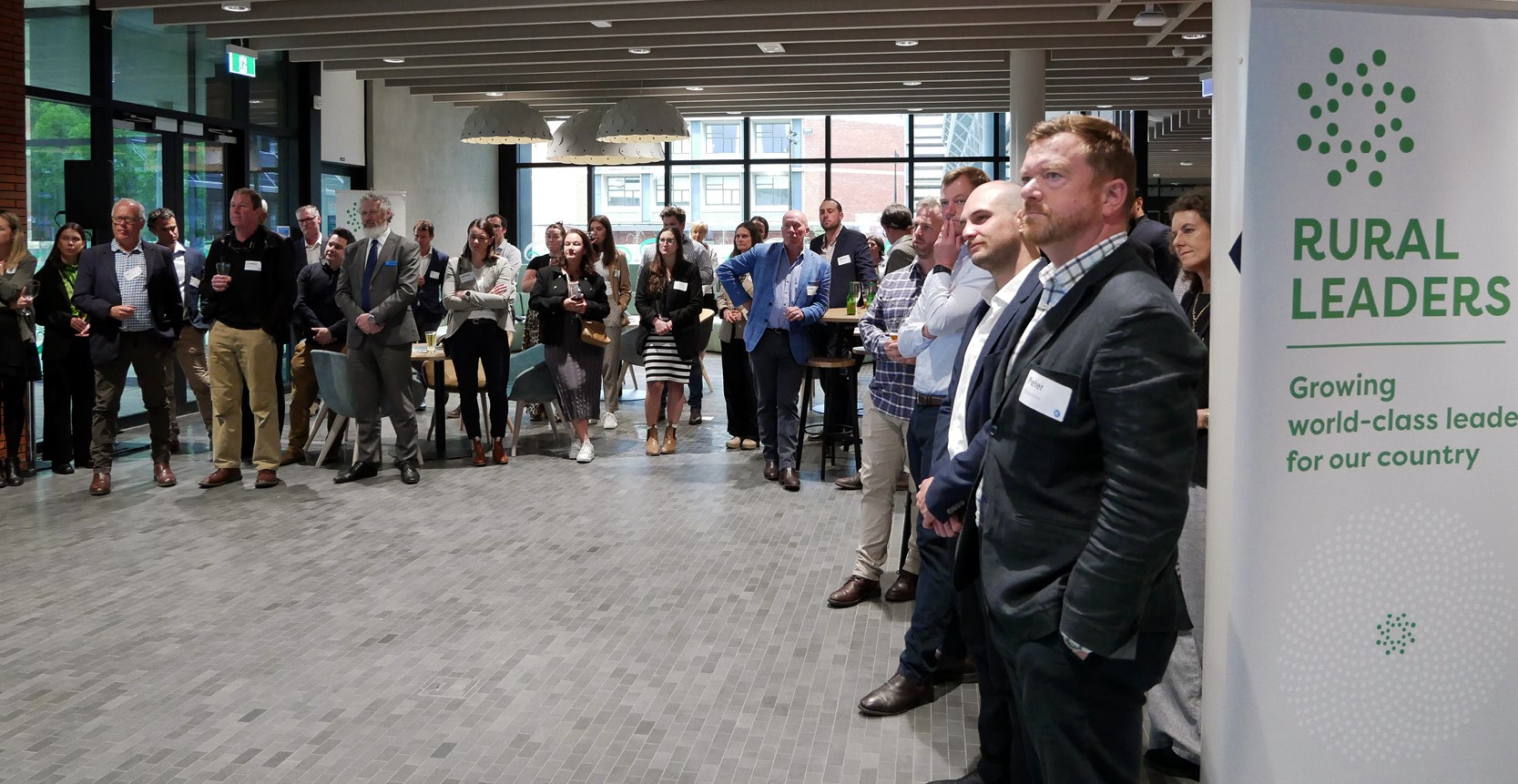
The Nuffield 2025 Contemporary Scholars Conference (CSC) wrapped up last week in Auckland, running March 8 to March 16. 

This CSC, organised by Rural Leaders and hosted by Rural Leaders and Nuffield International, brought together over 100 newly selected Nuffield Scholars from around the globe. The CSC offered scholars an immersive experience through a series of carefully curated activities, workshops and speakers.

It’s an immersive platform for new scholars to engage with thought leaders to address global agricultural challenges. The 9-day programme featured presentations, panel discussions, and field trips. This year’s conference emphasised leadership development, critical thinking, effective communication, wellbeing, Te Ao Māori and Te Tiriti o Waitangi, trade and exposure to New Zealand’s unique value chains.

For Rural Leaders, hosting this CSC provided an opportunity to showcase Aotearoa’s advancements in the food and fibre sector. Participants explored local farming systems, sustainability practices, and technological innovations, gaining insights into how New Zealand maintains its competitive edge in global agriculture. 

An important aspect of the CSC is the networking among scholars, fostering international collaboration and knowledge exchange. Many of these newly connected scholars will travel together internationally in small groups during their Global Focus Programme (GFP), another key chapter in the scholarship programme.

The GFP is a four-week tour across multiple countries, further enhancing scholars’ global perspective on agricultural practices.

CSC Programme highlights included:

Presentations: Scholars attended sessions led by global thought leaders addressing pressing agricultural challenges. These talks provided insights into innovative solutions and strategies shaping the future of agriculture.​

Speakers included: Jodie Redcliffe (Nuffield International and Australia CEO), Kate Scott (Nuffield/Rural Leaders Chair), Hon. Damien O’Connor MP, Christoph Graf Grote (Nuffield International Chair), Steve Kearney (Chief Mental Health Officer NZDF), Shannon Stallard (Lead with Virtue), Russell Pickering (The Pickering Group), Andrew Watene (Head of KPMG Propagate), Jessica Smith (Deputy Chief Executive at Te Tuapapa – Ministry for Housing and Urban Development), Marcin Markowicz,

(2023 Nuffield Scholar, Poland), Bruce Weir (GM Country Banking Rabobank), Campbell Parker (CEO DairyNZ), David Chin (CEO LIC), Tim Gibson (Director LIC), Corrigan Sowman (LIC Board Chair), Charlotte Rutherford (Dir. Of Sustainability Fonterra), Vangelis Vitalis (NZ Chief Trade Negotiator), Sally Thomson (Nuffield Executive – Brazil), Bev Flatt (Global Partnerships Manager – Agriculture Advocacy and Activiation, Bayer-Sponsor), Lisa Rogers (CEO Rural Leaders) and more. Thank you to all for giving your time and sharing your isnights.

Panel Discussions: Engaging panels allowed scholars to delve deeper into topics such as sustainable farming practices, climate change adaptation, and technological advancements in agriculture.​

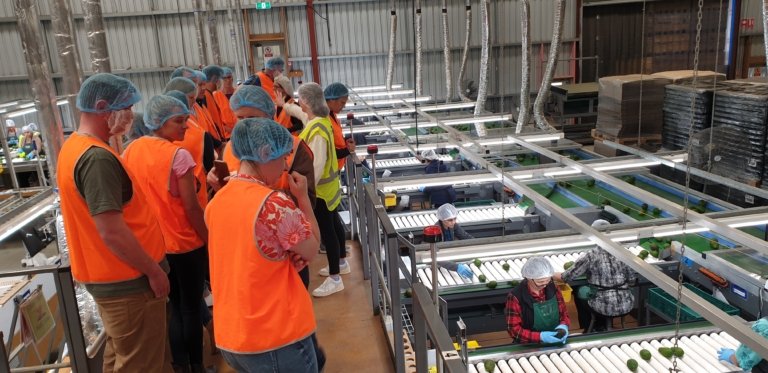
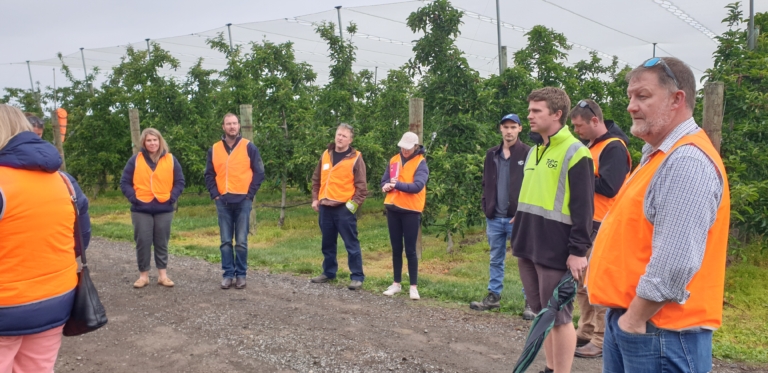
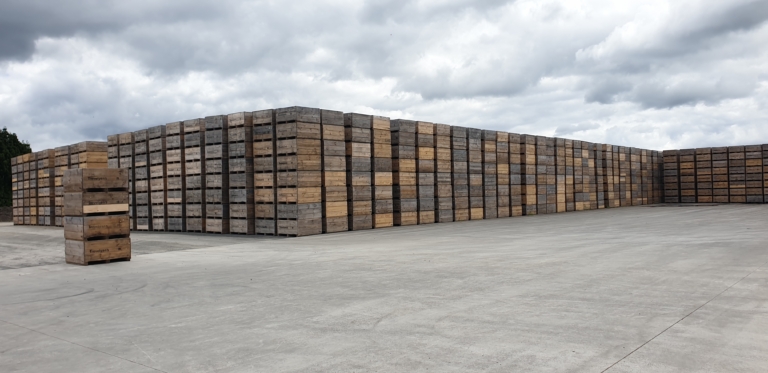
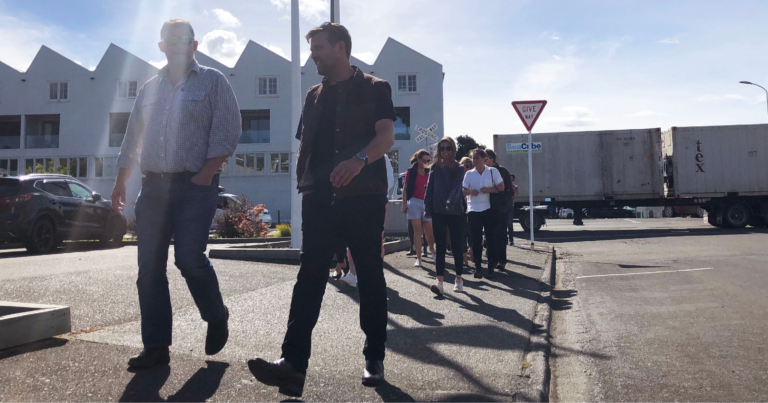
Field trips: Participants embarked on field trips to local farming operations and agri-businesses, witnessing firsthand New Zealand’s cutting-edge agricultural practices and value chain innovations.​

These included: DairyNZ, LIC, Balle Bros., Plant and Food, Leaderbrand, Punchbowl and more.

Networking: The entire conference was essentially a networking session, enabling scholars to connect, share experiences, and lay the groundwork for future collaborations.​

And, did we mention the Nuffield Games? These were held near the end of the conference and, well, there’s really nothing like it.

While the true impact of this CSC will play out over time, these activities collectively enhance the scholars’ understanding of global agricultural dynamics equipping them with the knowledge to drive positive change in their respective regions and industries. For New Zealand – it puts the country front of mind amongst a large cohort of rising global rural leaders.

Feedback has been unanimously positive. The success of this CSC is underpinned by our conference sponsors’ generosity.

Rural Leaders, Nuffield NZ and Nuffield International wish to express their thanks to: Bayer, Nuveen, LIC, PWC, Rabobank, Laguna Bay and MyFarm Investments. Thank you for making this CSC possible.

You can download this CSC’s programme here for more detail on the conference’s nine days.

A huge thanks also to Phil Morrison for binding together the CSC’s insight threads so well during the conference. Phil facilitated the event expertly and was instrumental to its success.

For the 2025 Nuffield New Zealand Scholars: Lisa Portas, Dani Darke, Alan McDermott and Jon Pemberton, their journeys are underway and their research topics are now more carefully defined. During the CSC every 2025 scholar gave a 2-minute summary of their intended research.

Take a look at the topic presentations from our four 2025 NZ Scholars below:

The 2024 NZ Scholars will submit their completed reports in the coming weeks. We’ll share those widely after our investing partners have had a first preview.

Phil Weir on Nuffield’s global perspective, sheep and beef farming, and industry good.

In this podcast, Phil Weir, 2020 Nuffield Scholar, Farmer, Director B+LNZ and Associate Director AGMARDT, talks to Bryan Gibson, Managing Editor at Farmers Weekly, about the positive value industry good brings to farming.

Phil also talks through some of the challenges and opportunities for sheep and beef farming and how his Nuffield Scholarship and research has given him a valuable global perspective.

Listen to this episode of Ideas that Grow, or click on one of the platform icons below to listen on your favourite player:

Episode Transcript

You’ve joined Rural Leaders’ Ideas That Grow podcast. In this series, we’ll be drawing on insights from innovative rural leaders to help plant ideas that grow so our regions can flourish. Ideas that Grow is presented in association with Farmers Weekly.

Bryan Gibson, Managing Editor of Farmers Weekly.
You’re with Ideas That Grow, a  Rural Leaders podcast. I’m Bryan Gibson, Managing Editor of Farmers Weekly. With me on this week’s show is Phil Weir, 2020 Nuffield Scholar. G’day Phil, how’s it going?

Phil Weir, Farmer, 2020 Nuffield Scholar, Consultant, Farmer Director B+LNZ and Associate Director AGMARDT:
Hey, Bryan. How’s it going?

BG: Pretty good thanks. Now, you’re a farmer in the Waikato, and also sit on a board or two, don’t you?

PW: Yeah, I’m, first and foremost a farmer in Te Pahu in the Waikato. We’re sheep and beef farming here, and I’ve been doing that for about seven years. Had a range of other roles in an agribusiness prior to that, and then did a Nuffield Scholarship in 2020, which we’ll probably touch on because it was an interesting time to do that.

Since then, I’ve become a farmer elected director for Beef + Lamb New Zealand, and that also involves the New Zealand Meat Board and an Associate Trustee with AGMARDT. And then do a little bit of consulting for AgFirst Waikato. So, I keep myself busy enough and a nice diversity of things going on. So nothing never gets too boring, right? That’s great.

BG: That’s where I met you the first time was when you turned up for your first Nuffield weekend, wasn’t it?


Doing a Nuffield Scholarship during COVID.

PW: Yeah, I think so. I think we were getting media training at that point, Bryan, about how to talk to journalists and then that thing. So hopefully, some of that flashes back to me, I guess, today. But yeah, we were down in Wellington at that point preparing for… That would have been 2019, and we would have been preparing for what a Nuffield Scholarship was to look like.

Ultimately, the experience I had was a wonderful one, but probably one that was a little bit different than when we were sitting when I first met you and in 2019. But I think the whole Nuffield thing, I think this year is 75 years of Nuffield, and I was really lucky to get a scholarship. As I mentioned, did it during COVID, which meant that some of the travel arrangements didn’t happen right away, but absolutely, we did at some point get to go around the world and see some fantastic agribusinesses.

I think one of the cool things was reflecting prepping for this was we did the first Value Chain Programme around New Zealand, so Rural Leaders are now running a programme which looks at how good New Zealand agribusiness and agriculture and growing is.

And we were lucky to be the forced guinea pigs for that because we couldn’t go abroad. And so we got the chance to go and have a look at the best growers and best Agribusiness is in New Zealand, and I think it’s fantastic that programme now has been created probably out of the back of that.

I think it’s so valuable to go and look at what’s in your own country because we do so many things really well. That was one of the lucky things, I guess, about a COVID disruption. Every cloud has a silver lining.

BG: That programme’s going great guns these days. As the old ad used to say, ‘don’t leave town until you’ve seen the country’. Did you grow up in a farming family? Have you always been rurally focussed?


A call back to the farm.

We grew up in a small dairy farm, so I showed Ayrshire Cows as a teenager and a child. My wife brings up some of the photos with me leading cattle around the ring.

We grew up on a small dairy farm on the outskirts of Hamilton. In. It was fantastic. It was the classic family farming upbringing. We were probably fairly poor, but we didn’t want for anything, I guess. We were lucky, we were on the outskirts of town, so we got the best of both worlds. Then after high school, I probably tried to get as far away from agriculture as I could, to be honest.

I went and did a social… I started doing engineering and found that wasn’t quite for me. And then social science. And then went and did a master of marine management in Canada. So, for someone to get seasick, it was a bit of a novel thing to go do, but it was probably just a case of seeing the world, right?

Then I ended up living in Sweden with my wife in a range of places before we made it back to New Zealand via Australia and then worked at AgResearch. In a few business roles there. Then the opportunity to come farming on my wife’s family farm presented itself in 2017. We took that opportunity. So, it was full circle, I guess. Probably I tried pretty hard to get away from it, but kept nagging away to come back and have a crack. When the opportunity presented, we took it.

BG: I get that story a lot when I talk to your alumni in the Nuffield and Kellogg Programmes. A lot of them grow up in farming, head off and pursue other things, do things in other fields, see the world. Then, I don’t know, something nags at them, and they find themselves back where it all started.

I think it’s pretty hard to get past the fundamentals of rural life. Particularly, as you become a parent, you have plenty of space, and you have fresh air, and you don’t have some of the challenges associated with having children in urban environments. I think It’s not all roses going back from a corporate or agribusiness to a farming role. Farming is quite hard work, and there’s different challenges to it.

PW: I think that’s probably one of the big drivers. I think that’s what we reflect on that we really like about it, is that life It’s still an opportunity for both us and probably our children as well.

BG: On the sheep and beef farming side of things, it’s been a pretty tough few years, hasn’t it?

Sheep and beef farming now.

PW: It has. Yeah, there’s no doubting it. It’s been tough. Everyone experienced rapid inflation, so your costs escalated significantly. At the same point, we had the global commodities really dipped. So it was tough, particularly for sheep farmers.

There hasn’t been a whole lot of love from wool for a for a long time, and some of the high pricing that existed around COVID for sheep came off at a really unfortunate time. So it has been really hard. I think it’s great now there’s a sense that most people’s budgets are able to balance.

When I hang out with other farmers, I see more confidence. It’s partly just because you know you can make the box balance, and ultimately, you’re working for a profit or to be able to have some improvements. I think, really, there’s across the country, we got smacked with weather events amongst that as well, whether it be Gabriel or Northland weather events.

I think most of the North Island anyway had an event that costs significant amounts to farming businesses. It’s been a hard couple of years with interest rates and other things. But I think it’s on the right trajectory now. One’s going down and the prices are going up. So, I think make hay while the sun shines, Bryan.

BG: Yeah, I’ve been talking to AgriHQ analysts a bit over the past few weeks, and they’re surprised but happy with the way things are looking in terms of export demand and farm gate returns. They don’t see a downside coming soon. It looks like it’s going to be pretty good throughout the season. So that’s great stuff.

The outlook is positive.

PW: I think it’s nice to know that the strong prices are projected to continue. The world’s not without a fair dose of crazy right at the moment, but things could change. But I guess the fundamentals is a bit of a deficit of protein, and the protein that we produce. It’s nice to be in that position at the moment.

BG: Just getting back to your Nuffield experience. Obviously, you investigate an idea, I guess. Your report was on the changing world in farming and diversification and resilience and that sort of thing, wasn’t it?

PW: My Nuffield report, I guess when I entered it, I’d come from a research environment. I believe there’s a whole lot of value in farmers and growers investing collectively. I looked the industry good bodies and how they might best arrange themselves.

I had a particular focus on commodity levies bodies. But I guess probably what I found through that was that there’s a whole lot of industry good activity that goes on. And ultimately, New Zealand does a really good job in doing a lot of that.

We’ve got Beef + Lamb New Zealand, DairyNZ and other organisations, but we’ve got a whole range of other industry good bodies. And to be honest, it probably worked pretty well together. I think I probably looked at it from the angle and I proposed some change that could happen.

The value of industry good to farmers.

PW: I suppose the starting point was, and I guess it’s why I’ve become a beef and land director, is that I see massive value in individual farmers contributing a small amount of money in the form of a levy or a relatively small amount of money in the form of a levy to enable certain activities to happen that we otherwise couldn’t do.

The R&D work and the helping farmers to perform better in areas where you’ve got market values, the stuff that I’ve always been interested in. I don’t know whether it was ‘Tragedy of the Commons’ reading that when I was at university or something like that, but that whole pooling of resources to get a better outcome and stuff that the market won’t fund the area I was interested in.

I was lucky to look at the New Zealand system, but also to look at the United Kingdom and some European examples, Australia and the US as well. I guess probably what the outcome of it was is that when it’s all finished, I don’t think any system’s perfect, but our one does a pretty good job.

BG: That’s really good to hear because I guess in terms of the industry good organisations, you could argue we’ve been through one of the more turbulent times in recent memory, I guess, fuelled by the emissions pricing process, which ended up with a lot of people questioning how farming side of things went through it.

We seem to have evened out on the other side of that now. Of course, this government doesn’t have such a strong hand of regulation on the sector. It’s good to hear that through your insights globally, we look pretty good compared to others.

PW: Yeah, Bryan, I think the He Waka Eka Noa and water and those big media issues are often what people think of as the work that some of this industry good stuff does. But I think probably the thing we often forget is the amount of other work that goes on.

So whether it be the benchmarking work that can enable a farmer through Beef + Lamb’s economic service or a dairy base or some other tool to work out, well, hey, if I have this property and I’m running this system, then how are my peers going economically? What are they spending their money on? How does that work? Those data sets that have been prepared on behalf of industry for many years are really powerful and really important and can help us farm better.

I think there’s also areas where industry good bodies can ultimately collect some resources and they can make determinations around where some of our investment is spent from an R&D perspective. If we look at facial eczema in our area, if it rains today, then I’ll be happy. But in another level, I’ll be worrying a wee bit about facial eczema.

The fact that there’s an industry good body, in our case, doing work on that’s great. It’s not something I can afford. I can’t afford to do that work, but it’s stuff that very much underpins my business. I think we often forget or get caught up in those couple of big political critical areas where there’s a bit of conflict that clouds our overall perspective of all the good stuff that goes on.

BG: And of course, New Zealand being so unique in the world of farming, with its geography, climate farming systems, we’ve really got to do all that stuff here. We can’t just import IP or knowledge from other places because no one does it quite like we do.

PW: We’re so unique, right? There’s not many people produce sheep meat or kiwifruit, for that matter at any real scale. We’re the leaders in that, or us in Australia, and it depends maybe on what product you’re talking about.

Ultimately, we do have a unique primary production system based on grass, and so we have some unique challenges we need to deal with. I think it’s great that for the most part, growers have, whether it be onions, or potatoes, or tomatoes, or dairy beef, sheep, whatever, pulled little bits of funds together to help out the collective. It’s probably builds a problem like cooperatives and other collective models that have been really effective and efficient to helping New Zealand Ag, I think.

Despite your Nuffield experience being curtailed or hit, I guess, with the pandemic, how did you find the whole thing?

The Nuffield experience.

It was a life-changing experience, Bryan. To that point, we were on Tangalooma Island, which is off the Coast of Brisbane, like a tropical paradise, doing this scholar conference for Nuffield when the world fell apart during COVID. I think the group this year are coming to New Zealand. And so what happens there is that 100 scholars from each year converge on one location and discuss global agriculture. So we got the start of that, and then things changed.

But I guess probably what Nuffield provides as perspective, I think. Perspective as to where New Zealand’s agricultural system fits. So the basic thing of it is you get to travel and then you do a report. But through the travel piece, I suppose from a perspective, you get to see a range of different agricultural systems. Our group visited North Carolina, we visited Argentina, we visited Chile, we visited a range of places.

So, we saw agriculture in the United Kingdom. We saw agriculture being done on a range of scales, from massive feed lot systems, to avocados and lemons being growing on areas where there was basically no soil left, and it was all irrigation and social licence issues to do with that.

Then right down to small scale producers, 20,000 sheep, milk, dairy sheds, 100,000 hams hanging up in Iberian ham factories. So, you got the range of scale and perspective. And so I think that made me think about what is the role for New Zealand agriculture. I think the other one that it does is it provides a significant amount of confidence. And I think that’s across all leadership programmes.

Gaining confidence through leadership development.

I did Kellogg a number of years ago, and I think it provided the same thing. Both programmes empower the individual to think that they are credible contributors, that they can have an opinion, that their ideas are important, and that they can discuss and work through those with a range of different people in the industry.

So you get to interact with the people that are running the big businesses, whether it be Fonterra or Zespri, or others, and you get to hear their perspectives. I think that confidence is something that I’ve definitely taken from it. I think, yeah, confidence and perspective are probably the two . I think the other one that’s probably also stuck with me is, I remember Julian Raine talking to us, who’s been heavily involved with rural leadership in New Zealand.

He’s saying that a lot of it’s about how spending as much time as you can to really understand a problem. I guess part of it is it’s a programme, and I think Kellogg as well, they really encourage you to critically think about an issue to go a bit past the social media grab or the particular part of spin or headline grabbing that might be going on and actually think, what is this? Whose perspective is this from? What does it mean for me? What does it mean for the people I might represent?

For me, that was a really powerful learning experience. I’m very grateful for the Nuffield and for the sponsors that sit behind it.

BG: So, you’d recommend it to those thinking about doing it?

Investing in yourself.

You often speak with people that are looking at doing it and there’s no great time to do it. But the reality is you’ll probably have young kids, you’ll probably have… You will have business commitments. And what it makes you do is drop all of that and invest time in yourself and understanding agribusiness or agriculture globally. They used to stick you on a ship and send you off for six months, but now it’s more like five or six weeks. But regardless, it is a circuit America.

The programmes when you’re abroad are so busy, you can’t be running your own business at home. You struggle to deal with the family affairs, and so it provides a real disconnect. That is one of the strengths of it. I think that the best time to do it is now. It’s not going to get any easier to do it. I feel scholarship-wide, very young kids. I have a very supportive wife. I was very lucky in that sense. But I think it’s something you just need to do. The immersive learning component of it is something that’s really unique. I really encourage people to have a crack at it.

BG: Thanks for listening to Ideas That Grow, a Rural Leaders podcast presented in association with Farmers Weekly.

You can read Phil’s Nuffield report here.

For more information on Rural Leaders, the Nuffield New Zealand Farming Scholarships, the Kellogg Rural Leadership Programme, the HortNZ Leadership Programme, the Engage Programme, or the Value Chain Innovation Programme, please visit ruralleaders.co.nz

NZRLT governance opportunity.

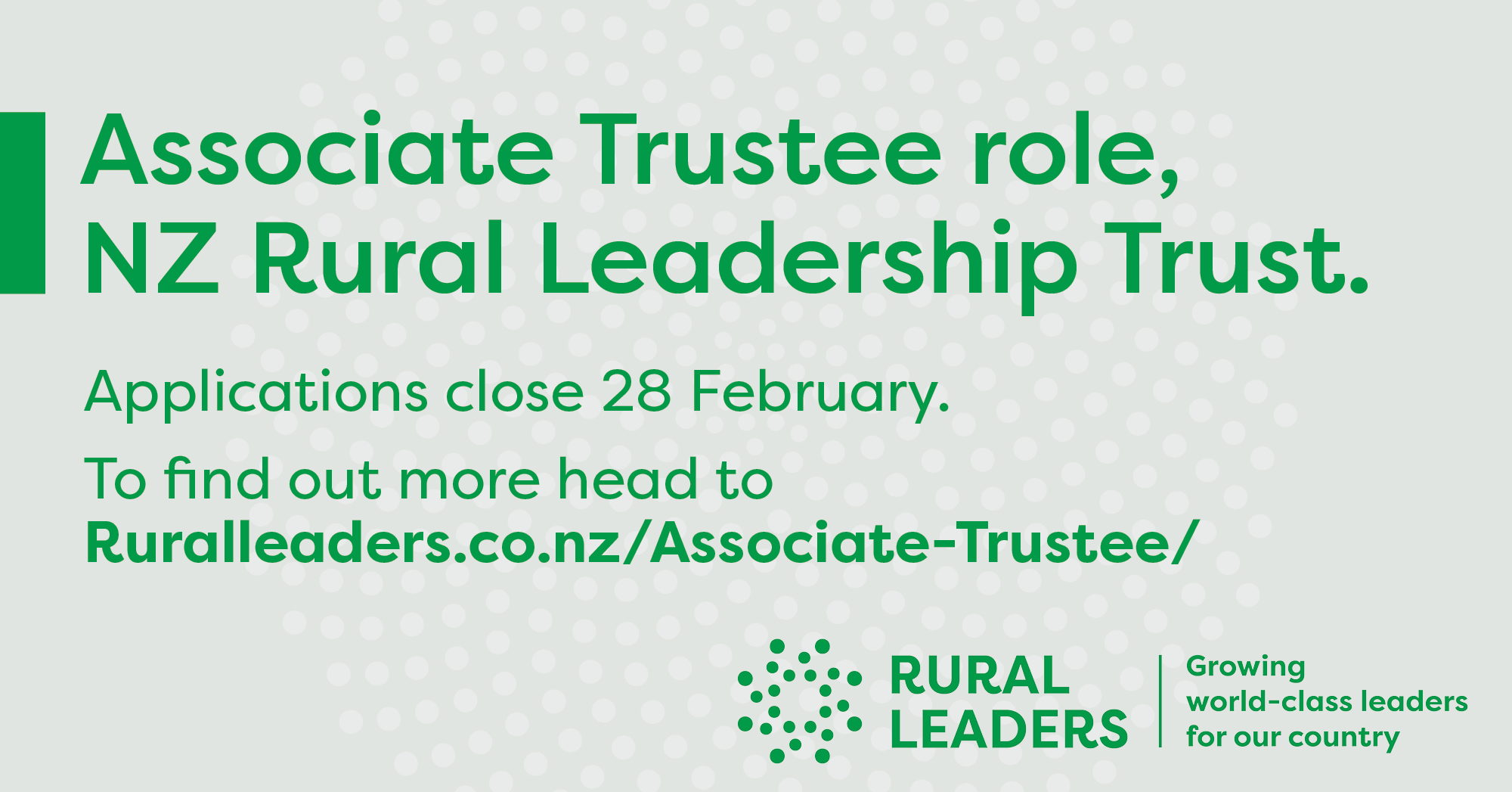
The Board of Trustees for the New Zealand Rural Leadership Trust, responsible for governing the Nuffield Scholarships, Kellogg Rural Leadership Programme, the Value Chain Innovation Programme, Engage and the HortNZ Leadership Programme, wish to appoint an Associate Trustee.

This governance development opportunity is open to all Rural Leaders Alumni.

The Associate Trustee will have the opportunity to:

  1. Sit on the Board and gain greater understanding of governance processes under an experienced Board.
  2. Provide input into the development of some of the leading rural leadership programmes in New Zealand.
  3. Provide insights and perspective as an Alumni of the programme(s).

The Role
The position is included fully in all Board activities, events and meetings.

The Associate Trustee is expected to fully contribute to all Board discussions and actions as if they were a Board member of the organisation and attend events associated with the role. However, the role has no voting rights.

Eligibility
The Associate Trustee role is open to Alumni of the New Zealand Rural Leadership Trust who completed their programme between 2019 – 2024, inclusive.

Term
The term of appointment is for a twelve-month period (May 2025 – May 2026), which provides an opportunity to cover a full year of operations.

There are seven more Board meetings this year and several events. Most events are held in Christchurch or Wellington.

Flight and accommodation costs are covered, where applicable.

The Board meeting schedule for 2025 is:

  1. May TBC (Online)
  2. July 9 (Christchurch)
  3. August TBC (Online)
  4. September 10 (Wellington)
  5. November 3 (Wellington)
  6. December TBC (Online)
  7. January/Feb 2026 (Christchurch)
  8. April 2026 (Wellington)

Remuneration 
There is no remuneration or payment, however all direct costs (such as flights and accommodation where required) relating to meeting attendance, will be met.

Confidentiality and Conduct 
On appointment the Associate Trustee will be asked to sign a confidentially agreement.

Although the position is not an appointed Trustee of the New Zealand Rural Leadership Trust, the appointee is expected to adhere to the code of conduct of a Board member.

The Associate Trustee is expected to comply with any reasonable directions of the NZRLT concerning their role.

Application
Interested scholars should forward their application by 24 March 2025 to Lisarogers@ruralleaders.co.nz

Applications should be in writing, with a CV and a covering letter with the following;

  1. The reasons for applying for the role,
  2. What you expect to gain from the opportunity, including how the opportunity would contribute to your leadership goals,
  3. How you might contribute to the Board’s skills, experience and perspectives.

Appointment process 
An appointments sub-committee (a delegated committee of the Board) and the Chief Executive will consider all applications and provide a recommendation to the full Board who will approve the appointment.

The successful Associate Trustee will be notified by 10 April and will be invited to attend the May Board meeting online and subsequent meetings and events.

For any questions please contact:
Lisa Rogers, Chief Executive
Phone: 021 139 6881
Email: lisarogers@ruralleaders.co.nz

Lisa Lunn on genetic technologies in agriculture

In this podcast, Lisa Lunn, 2024 Kellogg Scholar, talks to Bryan Gibson, Managing Editor at Farmers Weekly about her Kellogg research into the use of genetic technologies in agriculture. Lisa’s research presents a balanced view that unpacks the challenges, and the opportunities genetic technologies offer the food and fibre sector.

Listen to this episode of Ideas that Grow, or click on one of the platform icons below to listen on your favourite player:

Episode Transcript

Bryan GibsonManaging Editor of Farmers Weekly.
You’ve joined Rural Leaders’ Ideas That Grow podcast. In this series, we’ll be drawing on insights from innovative rural leaders to help plant ideas that grow so our regions can flourish. Ideas that Grow is presented in association with Farmers Weekly.

Bryan Gibson, Managing Editor of Farmers Weekly.
You’re with Ideas That Grow, the Rural Leaders podcast. I’m Bryan Gibson, Managing Editor of Farmers Weekly. With me on this week’s show is Lisa Lunn, who is a recent Kellogg scholar.

Lisa Lunn, 2024 Kellogg Scholar and Category Manager for Crop Protection at Farmlands:
LL: Hi, Bryan. Thanks for having me.

BG: Where are you speaking from?

LL: Currently in beautiful Morrinsville in the Waikato, where I’m based.

Lisa’s Journey and Passion for the Food and Fibre Sector

BG: Nice. Now, you work for Farmlands, is that right?

LL: Yes, I do. I’m the Category Manager for Crop Protection at Farmlands.

BG: That sounds like a big job.

LL: Yes, essentially, it’s looking after anything related to agrochemical with an agronomy focus across the country. Working in really close with our team of talented TFOs, our agronomists, and our supply chain team as well.

BG: What knowledge and education do you need to get that job?

LL: I went through Lincoln University and got an Agricultural Science Degree, and I spent quite a few years in the sector working in various technical sales roles. I’ve had pretty good on-the-ground experience around the industry. Then this opportunity came up to get into the merchandising team. On my side of things, I bring a bit of technical on-the-ground knowledge, in an incredibly supportive environment with a lot of resources to help on the category side of things as well.

BG: Was the food and fibre sector always going to be your career of choice?

LL: Yes, I think so. I grew up on a small farm in the North Waikato. I think I always lean towards science and agriculture. Heading down to Lincoln to get my qualification was a natural step – Just so passionate about the food and fibre sector. It’s obviously everything starts and stops the food we grow. I’m proud to be involved with a sector that puts food on people’s tables around the world every day. It’s a pretty exciting industry to be part of.

Genetic technologies and the Kellogg research report

BG: We know the food and fibre sector in general, and New Zealand has a few challenges ahead of it. One of them we’re grappling with at the moment is whether to relax the rules around genetic technologies. And your Kellogg’s scholarship report looked directly at that, didn’t it?

LL: Yes, I was part of Cohort 51 that kicked off about a year ago. At the time, it was being talked about, but obviously a lot more has happened in the past year since then. The coalition government proposed some rules, a rethink of the rules, I suppose, that govern the genetic technology space. My report looked into if a change were to happen, what do we need to understand, as a country ,to make sure that any changes implemented are sustainable and the best thing for the country and our export markets.

Kellogg research process and key findings

BG: How do you go about getting the information and putting it together?

LL: Every Kellogg report generally involves a literature review. There’s a fair bit out there on this topic. Genetic technologies are very prevalent overseas, so there’s plenty of information there, and there’s quite a bit of information as well as to how it may impact our export markets.

The other part of that was semi-structured interviews. I spoke to about 16 key stakeholders from across the industry and also environmentalist groups as well, to make sure it was balanced. I had some interviews, and analysed the data as to the main trends that came out of it.

BG: Can you tell us a little bit about what those trends were?

LL: I spoke to a number of stakeholders representing a lot of sectors throughout the primary industries, and environmental groups, to make sure it was a fair and balanced discussion. In the groups I spoke to, no one was outright against a change, but there was plenty of those that were for it, and a portion were supportive but proceed with caution.

There were definite trends there in that a lot of people did support a change, and then probably the main group was ‘proceed with caution’. It was, ‘have a look at what other countries have done, make sure there’s a very good national conversation had so that everyone’s brought up to speed and understand what it means for us as New Zealanders, what it means for our export markets’. All of these things, that if we are to do it, we’ve got to do it right. We’ve got to take our lead from other countries that have done it and who’s been successful and who hasn’t.

Legislation and Global Considerations

LL: There was a group of individuals that I spoke to that were a bit more, ‘let’s find out a bit more information before we can make a decision, and potentially, are there other areas we should be focusing on first?’

A big thing that came out of it was that there are a lot of uses of genetic technologies. One of them, that’s been heavily spoken about, is the ability to reduce our greenhouse gas emissions. The group of respondents I spoke to were very clear on saying, ‘this is not a silver bullet’.

It has to be part of a holistic approach that means that we can use other technologies and other mechanisms to help reduce our greenhouse gas emissions. This isn’t just going to be a set and forget. We’ve got to look at the bigger picture and make sure we are using everything we can to make sure we’re hitting the targets we’ve set ourselves and doing the right thing to be sustainable farmers. It’s not something that’s just going to come in and solve all our problems overnight.

BG: The legislation we’re working to now was written in the mid ’90s, wasn’t it? Considering how far the science has moved, it’s definitely time to have another look at this.

LL: Yes, scientific consensus is that basically the technologies have moved faster than our legislation has. As you said, it was written a long time ago, the HSO Act, which governs the space. Initially, when it was written, genetic technologies was a lot more cisgenesis.

There was a lot more inter-species genetic transfer. Nowadays, it’s much more specific with CRISPR-Cas9, and those technologies. There’s also some cases where certain modifications that might happen in the market that’s been exported to, might not even be considered a genetic modification because it’s something that can occur in nature anyway. It’s about having clarity on the definitions and what our export markets would consider genetic modification or genetic gene-editing. And bringing that legislation up to date with the technology we have available to us these days.

BG: That’s the big thing. I think I often find in the correspondence I get on this, that some people think we can do this, so we should, whereas there’s a bigger discussion to have around what does that mean for other things outside of science in terms of society and the way we market ourselves to the world.

The Kellogg Experience and Future Outlook

BG: You mentioned trade agreements already. There are a lot of places who have different ideas what is acceptable or not. There’s a lot to get through, isn’t there?

LL: Absolutely. A lot of the competing nations in the agriculture space do use it, and in some areas it has given them an advantage. But we tend to trade on ‘clean green’ with the NZ Inc. image.

We need to be conscious of the fact that just because we can do it, it doesn’t mean we should. That’s an absolutely fair argument. There are a lot of very valid concerns out there. To name a few, it would be what impact is it going to have on our export market? There’s concerns around the corporate regulations around it.

There’s concerns about coexistence. Can an organic farmer still do what they want to do and be nearby to a farm that’s using GE products? I think it needs to be balanced. It needs to be fact-based.

I think you have valid concerns on both sides of the coin, and they need to be heard and understood and addressed. Some of the literature I read spoke to the fact that our export markets are probably more concerned with us moving in the right direction with our greenhouse gas emissions, water quality, animal husbandry, those things, even though we’re already very good.

But there were areas that, potentially, they’d like to see improvement, whereas in some markets, genetic technologies was less of a buying decision for them. But can we coexist? Can we still have the non-genetic technologies with farms operating alongside ones that choose to take up these technologies? The government has drafted a bill that’s already available for viewing and submissions.

It’s making sure that the discussions that are had our fact base, and it is an emotional topic. Hearing both sides of the coin and looking into what’s best for us as a country, as an agricultural export nation, and as New Zealand does as well, it goes beyond agriculture. Just understanding the technologies that may be available to us – what benefits are they going to bring?

BG: I understand the bill that’s been drafted is loosely based on the Australian system that they’ve got in train. Is that correct?

LL: Yes, it is.

BG: That there is some aligning with our close neighbours, is not a bad place to start, hopefully.

LL: Yes, absolutely. Just taking a lead on some of the nations that have done it and what their learnings have been and going more risk-based assessments as opposed to reviewing the individual technology itself, what’s the end product. They’re definitely taking a lead from Australia’s legislation.

A Transformative Leadership Experience

BG: Your report is out there. What was it like doing it? What was the Kellogg experience like for you?

LL: Fantastic, I absolutely loved it. I couldn’t recommend it more. I was very fortunate to be sponsored by Farmlands to do it. Farmlands are very generous with allowing me the time to head down and do the in-person courses. It was a lot of work putting the report together and doing the interviews, but the whole experience was absolutely incredible – The people you’re able to connect with both throughout the cohort.

The speakers that came to see us, conducting themselves under Chatham House rules meant they were just able to be so free and frank, and you could ask them questions you probably could never normally ask an industry leader or a CEO or a high-powered scientist or politician. You could be very open and transparent and learn whatever you needed to for your own personal development journey.

It was just absolutely unreal. The scope of people that were in the cohort, the knowledge they had, the questions they asked, just a wonderful cross-section of people from across the industry. The main thing we all had in common was we were passionate about the industry and the future of the sector.

BG: You mentioned it is personal development. What does the future look like for you?

LL: I touched on it before: Food and Fibre is my passion. I love being part of the sector, and I will always remain a part of the sector. I’m excited to be part of it here in New Zealand. It’s such a small industry. Everyone knows everyone. It’s a great thing. Everyone’s genuinely passionate to turn up to work every day.

I’ve been with Farmlands for about two and a half years now, so I’m really happy to get stuck in there and keep building on my role and working with a fantastic team I’m lucky to be a part of. Whatever I do, it’ll be involving the sector.

BG: For those out there who might be thinking about getting to work on something like the Kellogg programme, you’d recommend it?

LL: Absolutely. Rural leaders do a fantastic job of giving you all the resources you need, all the tools you need in your toolbox to become a better leader, to be more self-aware, to understand the skills you do have and the skills you could improve on.
The networks are astounding, and it gives you really good context for both internal
New Zealand-centric trends and aspects of the sector here, and also a really good handle on geopolitics and things that are happening overseas.

It helps you understand what trends may be emerging and how they could affect us here, as well as teaching us really good soft skills, like improving your critical thinking skills and time management and all sorts of things that come out of it.
Everything I gained from that is absolutely invaluable, and I’ll continue to use it in my career.

Thanks for listening to Ideas That Grow, a Rural Leaders podcast presented in association with Farmers Weekly.

You can read Lisa’s Kellogg Report ‘Understanding a future with genetic technologies in New Zealand agriculture’ here.

For more information on Rural Leaders, the Nuffield New Zealand Farming Scholarships, the Kellogg Rural Leadership Programme, the Engage Programme, or the Value Chain Innovation Programme, please visit ruralleaders.co.nz

Alumni in the Spotlight – Robert Campbell, Bryan Guy, Grahame Webber, Carlos Bagrie and Karen Williams

Here are just a few of the media pieces covering the impact of Rural Leaders’ Programme Alumni in industries and communities across the sector. 

Robert ‘Robin’ Campbell, 1980 Kellogg Scholar, ONZM

Robert Campbell of Invercargill becomes an Officer of the New Zealand Order of Merit for services to farming and governance.

Over the last 40 years, Robin Campbell has freely given his farming and governance skills to the Southland community and to farming.

Other agencies Robin has served at include the New Zealand Sheep Council, Sheep Research Foundation, Sheep Improvement Ltd. And, at Ovita, he promoted funding for pioneering farm genetics research and genomic technologies.

Robin also served as Presbyterian Support Southland chairman for nine years and as the PSS national chairman where he earned the Extra Mile Award.

It doesn’t end there, Robin also adds Venture Southland, Presbyterian Retirement Villages Ltd, Waituna Partners Wetland Restoration Project, and the Community Trust of Southland, to his long list of service to community and industry. 

Bryan Guy, 1990 Kellogg Scholar, KSM

Bryan Guy has been awarded a King’s Service Medal for services to the community. Bryan is a retired dairy farmer who has volunteered in his community through church, farming and other organisations.

A leader in the Anglican Parish of Oroua, he holds several governance roles. He stepped in as Parish Bishop’s Warden in 2022, the primary lay parish leader for the seven churches of the Oroua Parish. He is also Chair of the Oroua Parish Trust and a Trustee of the St Johns Close Board Trust, administering church housing for the St Johns Close Trust Village.

He has been a Board member of Arohanui Hospice since 2021 and was elected as the Wellington Hawke’s Bay Board member of the Livestock Improvement Corporation (LIC) in 1986, with 20 years on the LIC National Board.

He became an Area Representative of the Manawatu-Rangitikei Rural Support Trust in 2015 and was involved with Farmstrong at its inception. He is Chairman of the Coach House Museum Board and was a Trustee of the Eastern and Central Community Trust (ECCT) from 2016 to 2020. Mr Guy previously served six years as Chair of the Taonui School Board of Trustees.

Grahame Webber, 1988 Kellogg Scholar, KSM

Grahame Webber, former Waipā District councillor, deputy mayor, and Cambridge Community Board member, has been awarded the King’s Service Medal for his outstanding contributions to local government and farming governance.

Grahame was a Waipā councillor for 21 years, to 2022, including deputy mayor from 2010 to 2019, and a member of the Cambridge Community Board from 1998 to 2022.

In an article from the Waipa District Council, he said it was an honour to be awarded the King’s Service Medal. 

In the article Grahame said, “It was overwhelming and emotional. I never dreamed someone would put my name forward. When I first received the email about the nomination, it took me a week to open it because I couldn’t quite believe it.”

While serving on the Cambridge Community Board, Grahame chaired the Sister City Committee, and started annual tours to rural communities, building connections with Le Quesnoy in France and Bihoro in Japan. These annual programmes have now been running for over 25 years.

In addition to his local government service, Grahame was a member of the Cambridge Federated Farmers from 1982 to 2020 and a director of the New Zealand Dairy Group from 1991 to 1994.

Carlos Bagrie, 2024 Nuffield Scholar, ONZM

Carlos Bagrie, 2024 Nuffield Scholar was recognised in the New Year’s honours list, along with Nadia Lim, for services to the food and rural industries.

Carlos and Nadia become Officers of the New Zealand Order of Merit (ONZM).

Carlos, co-founder with Nadia, of meal kit company My Food Bag, was recognised for regenerative, ethical farming practices at the couple’s Royalburn Station in Arrowtown, Central Otago.

Nadia commented to RNZ that “We are blown away to be receiving this recognition. And even more so because we are on the list together this year. We are stoked that farming and food production are receiving some of the spotlight.”

Carlos received a 2024 Nuffield Farming Scholarship and spent several months travelling, looking at innovative agricultural systems and exploring how New Zealand Food and Fibre exporters can position themselves for success in global markets.

Carlos, along with his fellow 2024 Scholars Rachel Baker, Jenna Smith and Peter Templeton, will submit their final Nuffield research reports in the coming months.

Carlos and Nadia spoke on The Country about the award, along with Dan Steele, 2015 Nuffield Scholar, who spoke about his work on Blue Duck Station and his father Richard’s recognition on the Honours List – awarded a King’s Service Medal for services to the rural community.

Dan provides an update on Blue Duck Station and how their conservation efforts are going.

You can listen to Rowena interview Carlos, Nadia and Dan on The Country here,

https://www.iheart.com/podcast/1049-the-country-28628176/episode/the-country-full-show-monday-january-257128853/

Or read a Press article here,

https://www.thepress.co.nz/nz-news/360534278/food-and-rural-leaders-nadia-lim-and-carlos-bagrie-recognised

Karen Williams, 2023 Value Chain Innovation Programme

Karen Williams completed the Value Chain Innovation Programme in November 2023. Karen is National Client Propositions Manager with FMG and has recently been appointed to take up the CE role for IrrigationNZ.

In an article by Farmers Weekly, IrrigationNZ chair Keri Johnston said Williams brings a wealth of experience to the role, including a background in resource management, agriculture and farming, notable awards for her achievements and wide recognition for her leadership skills.

You can read more about Karen’s appointment in the article here,

https://www.farmersweekly.co.nz/people/karen-williams-to-head-irrigationnz/

Karen was named as one of NZ’s most influential and inspiring women in food and drink in 2023.

Alumni in the Spotlight – Anna Nelson, Rosie Dowling, Kate Kellick, Reuben Carter, Sarah How and Tracy Brown.

Here are just a few of the media pieces covering the impact of Rural Leaders’ Programme Alumni in industries and communities across the sector. 

Kate Kellick, 2024 Kellogg Scholar.

Kate Kellick’s esheep, a shedding sheep breeding operation, hosted its first ram auction in Mangamahu near Wanganui recently.

The auction saw farmers from across the North Island, bid on the adaptive shedding sheep.

In a Farmers Weekly article by fellow Kellogg alum Cheyenne Wilson, Kate said: “It was quite surprising. There was a good turnout of people from all over the place. There were even a few bidding wars, with people vying for the same ram and pushing the prices right up.” 

During the auction the top ram fetched $8000, with an average price of $3500. 

“That’s apparently topped the average ram price in New Zealand,” Kellick said. 

“It definitely exceeded my expectations and makes all the hard work worthwhile.” 

Take a read of Cheyenne Wilson’s Farmers Weekly article here.

You can also read Kate’s Kellogg report here.

Reuben Carter, 2015 Kellogg Scholar and 2024 HortNZ Leadership Programme graduate.

A recent ODT Rural Life article charts Reuben’s career and life course so far – let’s just say he’s been a busy man. You can read more on Reuben’s journey here.

As a both a Kellogg Rural Leadership Programme and HortNZ Leadership Programme graduate Reuben is well equipped to deal with the challenges and opportunities the sector presents.

Reuben, is a crop manager with Oakley’s Premium Fresh Vegetables in Canterbury. Delivered by Rural Leaders, Reuben and his fellow cohort completed the HortNZ Leadership Programme in two phases over nine weeks, between August and October this year.

Take a read about Reueben’s HortNZ Leadership Programme experience here.

Tracy Brown, 2020 Nuffield Scholar.

Following up on last month’s post on Tracy Brown’s new role as Chair at DairyNZ, we share a recent DairyNZ ‘Talking Dairy’ Podcast.

In the podcast Tracy shares her inspiring journey and her vision for the future of New Zealand’s world-leading dairy industry.

You can hear how Tracy plans to steer DairyNZ to deliver greater value for farmers here.

Rosie Dowling, 2014 Kellogg Scholar.

Rural Leaders’ programme alumni appear regularly on Country Calendar.

In one of the most recent episodes, Rosie Dowling’s determination in the face of adversity features as she farms sheep and beef, raises her young kids after her husband dies, and runs a business making wool-insulated dog kennels.

This is an inspiring watch. Head here to view.

There’s also this article on Rosie, in CountryWide by Joanna Grigg.

Anna Nelson, 2016 Kellogg Scholar.

Anna Nelson has been Chair of the co-operative side of Silver Fern Farms for six months and will take over from Rob Hewett as Chair of the Shanghai Maling joint venture side of the business in May.

Anna also runs a 1450ha King Country sheep and beef farm with husband Blair.

You can read more about Anna in Farmers Weekly’s Land Champions series below.

You can read the article here.

Sarah How (Tait), 2018 Kellogg Scholar.

The Zanda McDonald Award, a prestigious trans-Tasman honour that recognises and nurtures exceptional talent in agriculture, has announced the final three New Zealand finalists for 2025. The finalists include Kellogg alum Sarah How (Tait) and Lincoln University alum Maegen Blom.

Sarah is Co-founder and General Manager of Landify Ltd, in South Canterbury.

You can read more about the Xander McDonald Awards here.

You can read the article here.

Dave Nuku on Kaitiakitanga and adopting a long term view.

In this podcast, Dave Nuku, 2024 Kellogg Scholar, talks to Bryan Gibson, Managing Editor at Farmers Weekly, on his work with Ngamanawa Incorporation and about how adopting a philosophy of Kaitiakitanga can be in alignment with a strong and profitable business.

Listen to the podcast here.

Bryan GibsonManaging Editor of Farmer’s Weekly.
You’ve joined Rural Leaders’ Ideas That Grow podcast. In this series, we’ll be drawing on insights from innovative rural leaders to help plant ideas that grow so our regions can flourish. Ideas that Grow is presented in association with Farmers Weekly.

Bryan Gibson, Managing Editor of Farmers Weekly.
You’re with Ideas That Grow, the Rural Leaders podcast. I’m Bryan Gibson, Managing Editor of Farmers Weekly. This week, I’m talking to Dave Nuku. How’s it going?

Dave Nuku, 2024 Kellogg Scholar, Ngamanawa Incorporation.
DN: Hi, good Bryan and you?

BG: Going good, thank you. You’re one of the very recent Kellogg scholars. I understand your report has only just come out.

DN: I’ve had a fantastic experience with Kellogg. Just finished my report, so glad to have had that completed. Yeah, it’s good to be here with you today.

BG: Just tell us a little bit about yourself. Where are you from?

Bringing a global perspective to New Zealand food and fibre.

DN: I’m from the Bay of Plenty, up here in Tauranga, and have some strong whakapapa connections back here. My family have been here for a long time. I’m currently working for Ngamanawa Incorporation, managing a block of Māori land of around 4,000 hectares in the lower Kaimai.

BG: Awesome. I was born in Tauranga, so I know the place pretty well. Has most of your career been in the food and fibre sector, or is that something relatively new to you?

DN: To be completely honest, it’s very new to me. I do not have a background in the food and fibre sector. I actually spent two decades overseas working through Southeast Asia, Hong Kong, Singapore, Philippines, Indonesia, Thailand, Malaysia. So I lived based in Malaysia, Hong Kong, and Singapore for several years in a completely different industry.

I was working for a multinational company over there running health clubs and resorts across Southeast Asia. So, it’s a big change from that perspective. I moved back home to Aotearoa a few years ago, just after COVID, and was fortunate enough to make a transition into the food and fibre sector with the Incorporation which our family have got long-standing connections with. It was a nice fit, but a very different industry – and all the differences that come with changing industries and countries.

BG: Yeah, that is quite a change, isn’t it? How did you find your time overseas? You’re obviously there a long time. environment.

DN: Absolutely loved being overseas, loved travel. My wife and I have got two kids as well, and so they were born overseas. So very much an international whanau. We did a lot of travel when the kids were young, and as they grew up. It was a constant part of our lives.

We were working in these different markets, so it was quite dynamic. Quite different to New Zealand. We were living in Malaysia and Singapore – so that’s closely connected to a lot of other countries, very easy to be mobile and get around. Businesses, languages, all of those things are very different, more nuanced, more complex than New Zealand in industries that we’re working at, but loved it. Absolutely loved it.

Having said all of that, it’s great to be home. I think Aotearoa, New Zealand is the best country on Earth and absolutely love living here, working here, and being home with my family.

BG: Tell me a little bit about the Incorporation you’re working for now.

Managing, leading, and stewardship.

DN: Yeah. So, Ngamanawa Incorporation has a large land block up in the lower Kaimai’s. Mainly the Incorporation has its roots in forestry. It’s around 2000 hectares of pine, radiata pine, and around 2000 hectares of native forest. In the native forest, we have a conservation team of five full-time Kaimahi or staff who are involved in our predator control efforts there.

We do everything from monitoring the waterways, the habitat for native species, whether it’s tuna/eels or kōkako, or kiwis. We have a lot of those really special native species up on the block. As well as forestry, we’re also involved in horticulture. We have a kiwifruit orchard with golden and green kiwi fruit in the Kaimai area, a little bit closer to Tauranga.

Then we also have some investments in other horticulture crops, strawberries on Matakana Island and some rocket apples in the Hawke’s Bay. So, quite a mix of different business interests across the Incorporation. It keeps you busy and it’s varied.

BG: Yeah, a lot of variation and diversity there. I guess there’s a lot of different farming techniques, business management, and you’ve got the native block as well, which is more of a conservation approach, I guess. A lot to keep on top of.

DN: I think it’s the variety and that diversity that makes it fascinating for me. I have a really strong international business background, but it’s nice to be doing something that is very, I suppose, organic and something working for an entity that we’ve got a long-standing connection to.

The block, the incorporation is made up of a number of different blocks of traditional Māori land, that has been in Māori ownership for hundreds of years. It’s nice to be taking that and really making sure that it’s productive in terms of our forestry, and then also in the indigenous forest space and the native bush, really looking at preserving the native species there.

We also have a lodge for our shareholders, so you can book the lodge and go up there and enjoy it with your family. It’s nice on a lake with lots of waterways in the middle of the bush.

It’s also about connecting people to land as well. Then the horticulture and the kiwifruit is really that’s a lot of the day-to-day operations. Long time between drinks in terms of the business model for forestry, but with Kiwifruit. They’ve got a more seasonal cash flow in business requirements and operations there.

BG: How are things tracking for you guys at the moment? Has it been a good year? Things looking pretty good?

DN: It’s been a fantastic year for kiwifruit in general across the Bay. It’s been something that the industry has really needed. We had a couple of rough years there with COVID, and there were a number of weather events.

Also, some of our growers down in the Hawke’s Bay area were really affected by cyclone Gabrielle. But overall, the industry has had a great season, a really strong crop. I think a record season, just under 200 million trays, which is around about a 25% increase on the previous highest year for Zespri overall, who sell our kiwifruit into market.

It’s been a record crop. Growers have really benefited from it. Last year’s growing conditions were excellent. Not only did we get good volume, but it also got really good fruit quality, which has held up well in the markets. We sell that through into Europe, China, and other places.

You’ve got to celebrate the wins, and we’ll take those because horticulture can be challenging. There’s always weather events, and you’re always on your toes, and no two seasons are the same. We’ll just take the win and then really focus on trying to do that again this season.

A background into how a Māori Land Incorporation works.

BG: Now, probably most of our listeners have a bit of an idea about how a Māori Incorporation functions and is structured. But could you just give us an overview of how that works?

DN: Absolutely. The Incorporation is governed by a committee of management. They function more or less like a board, I suppose, if you could think of it in that way, with some really small, subtle differences. But if you think of them as a board that are duly elected by the shareholders to represent the shareholder interests in the land block.

The Incorporation itself is an amalgamation of five different blocks in the lower Kaimai area that were all brought together just for the economies of scale that comes with a motivating all that land, which led to the 4,000 hectares that we currently have. Then what ends up happening is all of the owners in those individual land blocks more or less get shares in the Incorporation as opposed to a direct ownership in the land itself. That’s the governance structure and the ownership structure is more like a shareholding reporting into the committee of management.

The big difference between a Māori Land Incorporation versus a trust where the owners of the land still retained a slightly different ownership model. The Incorporation has been around for around 50 years and came together in the 1970s to amalgamate the land blocks to secure the land over the long term.

At that time, we were facing some challenges with the confiscation of land through the Public Works Act for the hydro scheme that’s currently up in the in the Kaimais. As I said, that was the origin story of the Incorporation. It’s come together as a result of that. We got into forestry and then have diversified over the years.

Kaitiakitanga – guardianship/stewardship. Adopting the long term view.

DN: So, generally speaking, Māori Land Incorporation, long term holders of assets in land, long term view, primary in nature, forestry, horticulture, looking to diversify. We have some other stocks and portfolio financial products. But everything we do isn’t really driven on a quarterly basis in terms of returns. It’s much more about where we want to be in 5, 10, 15, 20 years.

BG: That’s something that a lot of people are thinking about more and probably should think about more is having that longer term view of where you’re going. Because you’re right, that quarterly reporting makes you overegg the omelette in some ways.

You can drive production to meet targets and then have some issues to clean up afterwards. Whether a more measured approach with more long term targets seems to be a better way to take care of our land?

DN: I think so. That’s definitely our view on it. It’s more of the Kaitiakitanga view. Kaitiakitanga, meaning guardianship or stewardship. I’d describe it in that way – which was the subject of my report. What I wanted to do, having come back from extensive experience overseas in more international markets, where stewardship, guardianship, long term, intergenerational ownership, wasn’t really anything that I worked in overseas.

I worked for companies, many of whom were private equity owned. So, a different modus operandi, so to speak, a different timeframe, buying and selling companies, building them, selling them to the next person.

Coming back into this environment with a much more long term view, real care for land and nature, led me to study Kaitiakitanga, which is the subject of my Kellogg report. The concepts and all of the different influences, in fact, as they tie into Kaitiakitanga, I thought that would be a good way to educate myself and bring myself back up to speed so I can use that philosophy when managing the Incorporation assets and people.

Kellogg and Kaitiakitanga as a pathway to enduring prosperity.

BG: So, your report, as we said just out very recently, is called ‘Kaitiakitanga as a pathway to enduring prosperity’. I was interested that you kicked off by saying a lot of us have a simplistic view of what Kaitiakitanga is.

DN: Yeah, I think it’s most often thought about or used as a term in reference to guardianship or stewardship with regard to the natural environment. Whilst that is a part of Kaitiakitanga, that’s only a small component of Kaitiakitanga.

The broader application of Kaitiakitanga is the idea that one has a relationship not only with the environment, but also with your family members, also with everything within that environment. And with that, we call it Whanaungatanga or kinship. And with that kinship, our relationship, comes responsibilities. And the responsibilities that come from that, Whanaungatanga, or kinship, are responsibilities of care and Manaakitanga, looking after the environment, looking after others, looking after yourself, respecting the spiritual dimension that are imbued in all things.

We believe as Māori that things have a spirit, they have a Wairua, they have a Mana, they have a life force, or Mauri. Just acknowledging and respecting those things, particularly in the Taiao, but also one’s self. It’s a real all-encompassing philosophy in terms of how one can approach their life.

For me, in the way in which I think about it for the Incorporation. I see myself as a Kaitiaki of the assets that are within my responsibility, making sure that they’re not only produce good results, but they don’t do harm, whether it’s to the environment.

We look at things like forestry and our aspirations there to convert more of that into indigenous forests over time, perhaps retire parts of that. We also take the responsibility quite seriously and invest a lot into the conservation space, trapping possums, predators, to be able to restore some of the natural bird life on our block, to get the bird numbers up. To do that, you need to suppress the predators because they tend to kill all the chicks and the eggs and so on and so forth. That’s an example of Kaitiakitanga there.

Our team have rituals or practises that they use each day when they go out into the bush. They protect their Wairua or their Mauri. They’ll say special Karakia or incantations or prayers to protect themselves.

They’ll also ask for blessing and protection when they do the work in the bush. Then likewise, within the organisation itself, our philosophy is driven by Kaitiakitanga in terms of starting meetings with Karakia, with prayer, acknowledging people within the meeting or anyone who may have, for example, for us as Māori, in speaking back to that kinship and relationship connection.

We’ll also acknowledge those who may have passed on, their family connections and those within the region or the Mutu of Tauranga, the rohe of Tauranga will acknowledge them and do a Mihi to them and their family. So, all of these different practises that feed into Kaitiakitanga are all a part of the way you operate the way that you live and aspire to live.

Can you have alignment between Kaitiakitanga and propseprous business?

BG: As the title of your report suggests, Kaitiakitanga is not in opposition to having a prosperous and profitable business operation, is it? I mean, enduring prosperity, you can make a good living for all of your shareholders.

DN: Absolutely. That’s the aim. I suppose that was really what drew me to the subject  they’re not opposing forces. One can be a good steward of the land, good steward of themselves and a guardian, and still prosper and have good economic returns, whether it’s for your shareholder, whether it’s for your Whanau or your business or whatever it is. Those are not things that are opposing their nature. I think that comes back to the long term view.

Then also considering in a broader sense what the return on an investment might be. An example of that would be we most often measure return on investment in dollar terms. Whilst that’s an important metric, it’s not the only metric. For example, we have businesses we’ve invested in, and they have a really good social return for our people.

It’s about unlocking the potential of some of our Māori land, by our people, for our people and creating employment opportunities. Like growing high-value horticulture crops. The case in point is the blueberry investment we’ve made. We know that that investment is not just about a hard and fast financial return. That is also about investing in capability and building skills in high value horticulture.

We can accept that for that type of investment that may carry a higher risk, so to speak. But we think the returns are going to be social in nature as well as ultimately a sustainable, profitable business. We’re prepared to take on a bit more risk because we can see that we measure success differently, so to speak. You have the right size that for your Incorporation in your business.

We’re not going to put all your eggs in that type of investment, but we do take a number of smaller investments that allow us to be more adventurous. Then as those businesses grow and perform, then we can scale them up knowing that they have a good return for our people, for our land, and then also from a financial or Putea perspective for our shareholders.

BG: Obviously, your report looks at this quite in-depth. You’ve looked at the literature, of course, and case studies. You’ve made some recommendations about how to incorporate more of a Kaitiakitanga mindset into a food and fibre of sector business. What are some of those?

Three recommendations to include Kaitiakitana principles into business.

DN: What came out of the report that I did were a series of recommendations that I think I did expect would be the outcome. They are, first and foremost for Māori entities where there’s an opportunity to include Kaitiakitana principles. Those are things like in the culture of the organisation, having Tūkanga, what we call Tūkanga or Māori protocols around the Karakia, Mihi, acknowledgement of people, those who have passed special occasions, opening meetings with Karakia, finishing meetings with Karakia, welcoming new guests into your office with Mihi and Whakatau. That would be one example of something that the Incorporation does.

Also, there are some tools out there that one can use to exercise the Kaitiakitanga in regards to waterways. There’s a really cool tool called the Mauri compass, which allows you to measure the habitat of certain wildlife, wild species. For example, the native silverbelly tuna (or eels) that we have here. We do a lot of work in that space. So, water quality, habitat cover, abundance of life within the waterways, et cetera. Creating benchmarks using the Mauri compass across those different areas. Then setting some goals based on that.

One of the other recommendations that came out of the report was the importance of really capturing Kaitiakitanga and incorporating it into what we call our SAIPO, our strategic investment priorities and objectives document that outlines how we invest in different things and incorporating Kaitiakitanga as a guiding principle. So, that one, we’re investing in things that we’re proud of, that we want to be in, that are going to be good for the Taiao and the environment as opposed to things that aren’t.

That we are also making investments for a certain portion of our asset base. We’re looking at that as a good financial return, but also a good social return as well. And so, we have the lens of Kaitiakitanga, that’s our perspective, and we look at different investments.

Those were the three recommendations, what you can do on a daily basis in your Incorporation to make it part of what you do. Two is, tools that you can use in the natural environment. Three is, how you can weave it into your governance structures or your investment structures so that you’re getting involved with things where you can exercise your Kaitiakitanga.

BG: I talk to a lot of people and do a lot of reading in my job running Farmers Weekly. It seems to me that there’s a lot in the Incorporation’s view of how to run things that everyone could learn whether they’re a family farm in Canterbury, or wherever they are.

It gives a story to someone about the weighing up all of the externalities and the balance sheets of what you’re doing in terms of sustainability, social responsibility, social licence to operate, profitability, that sort of thing. Is that something you think?

Kaitiakitanga - universal principles for a long term view.

DN: I think the principles are universal. I really do think they’re universal. We’re talking about them in a Māori context here, but these are principles that you find in many indigenous populations across the world. I think you’ll find them in non-indigenous populations as well.

Part of the research that I looked into, you’d see new concepts emerging, for example, in the US, around steward ownership models that are really very similar to Kaitiakitanga, where entities that are in the environmental space, in the education space, or the charitable space in the US. They have come up with certain corporate structures that allow them to separate the stewardship values as a separate and enduring part of the governance structure that oversees those companies.

Irrespective of who the owners might be, they’re still held accountable to those principles of stewardship, and that’s really aimed at enshrining those principles of guardianship over these different assets, more common in the environmental space. I suppose my point is that that’s an example of the same concept halfway across the world being implemented and enshrined in legislative corporate law. Because I think it’s a lot of people are wanting to do that.

I think there are a lot of entities out there that are saying, Hey, look, these are really good principles of long term view, not just measuring the bottom line from a dollar perspective, but also from a social perspective. I think that a more holistic view and long term view is better. I mean, anything, even from an investment perspective, if you invest in it for longer, it’s generally better. I think there’s a lot of principles that could apply to any business.

BG: I was reading just the other day about something that applies to the other end of the supply chain, NZ Story, which is part of New Zealand Trade and Enterprise, did its most recent survey with Chinese consumers.

They found that after COVID, they were connecting more with their history and felt that New Zealanders, the fact that we embrace our indigenous culture and what we do more than some other colonised countries, was a point of difference for us. So, it’s an interesting thing to think about as well.

DN: I think we’ve got a great story. I think we’ve got the greatest country in the world. I really do. I think New Zealand is an incredible country. I think we do food and fibre really, really well. I hope there’s opportunities to lean into these indigenous narratives and concepts because they’re good for their environment, good for people.

That also sounds, as you’ve said, that they have a powerful resonance with other people abroad and other cultures. In typical New Zealand fashion, we’re probably too humble about it, quite modest. I think it’s okay to say, hey, look, these are things that we do really well. We do lean into it. That’s a part of our culture and our history, and we should be proud of.

The Kellogg Rural Leadership Programme.

BG:Now, how did you find the whole process of going through the Rural Leaders’ Kellogg Programme?

DN: I can absolutely say without any word of a lie or doubt that it was the best leadership programme that I’ve ever done. The most complete and thorough. The quality of the information from the presenters that you’re exposed to is really world-class.

We’ve got some of the best educators presenting content, a wide variety, too. People with military backgrounds, doctors, professors, politicians, farmers, horticulturalists, you name it. Te Ao Māori educators and specialists too. The broader array of leaders in all of these different fields and to be able to listen to them, to interact with them, to learn from them was just incredible.

It was a very, very special experience. Throughout that all, you’ve also got this report that you need to produce. You’re constantly taking in information from these presenters. You’re learning a lot from some of the best young minds, and probably I wouldn’t put myself in that, but more of a more mature vintage, shall we say myself. But they’re really, really great leaders in their own right who come in to do this course. You end up learning a lot from the people around you. That’s very motivating. Iron sharpens iron, so the whole experience has been exceptional.

If I was to say one thing to someone considering doing it, is to absolutely do it, go for it, but do not underestimate the amount of time it’s going to take you, and the focus and commitment that you’re going to need to get the most out of it. It’ll be worth it, but it’s a lot of great work.

You can read Dave’s Kellogg Report ‘Kaitiakitanga as a pathway to enduring prosperity’ here.

Thanks for listening to Ideas That Grow, a Rural Leaders podcast presented in association with Farmers Weekly.

For more information on Rural Leaders, the Nuffield New Zealand Farming Scholarships, the Kellogg Rural Leadership Programme, the Engage Programme, or the Value Chain Innovation Programme, please visit ruralleaders.co.nz