2026 Nuffield NZ Farming Scholarship. Apply by 17 August 2025. Read More...

Apply for 2026 Nuffield NZ Farming Scholarship by 17 August 2025. More details...

Kellogg Rural Scholars Series. Leadership issue.

Supported by our investing partners, the New Zealand Rural Leadership Trust is privileged to help grow many of our sector’s capable and purpose-driven leaders.

A key aspect of the Kellogg Programme (and the Nuffield Scholarship) is research based learning. The clarity of thought and confidence the research component of Kellogg promotes can be hugely transformative.

The Kellogg Rural Scholars Series booklets are distillations of this research – each focussing on a selection of reports covering one industry or topic.

Currently, there are five booklets in the series, with this latest issue being ‘Leadership Insights’.

Leadership Insights contains twelve reports spanning the last 7 years.

The reports in ‘Leadership Insights’ cover such topics as: Leadership During a Crisis, Emotional Intelligence, the Qualities and Characteristics of Good Leadership, and the Effect of Good Leadership on Staff Engagement and Retention.

These reports were written by scholars: Jack Dwyer, Jordi Hoult, Cheyenne Wilson, Louis Batley, Brian Henderson, Melisssa King, Henry MacIntosh, Jason Halford, Sophie Malone, Joanna Greaves, Hayden Dunne, Nick de Ridder.

You can view Leadership Insights here.

If you would like to grow as a leader; exploring research into a food and fibre topic of your choosing, apply for 2026 Kellogg Programme One by 19 October.

To learn more head here.

Kerry Worsnop shares Scholarship experience at Nuffield 75th.

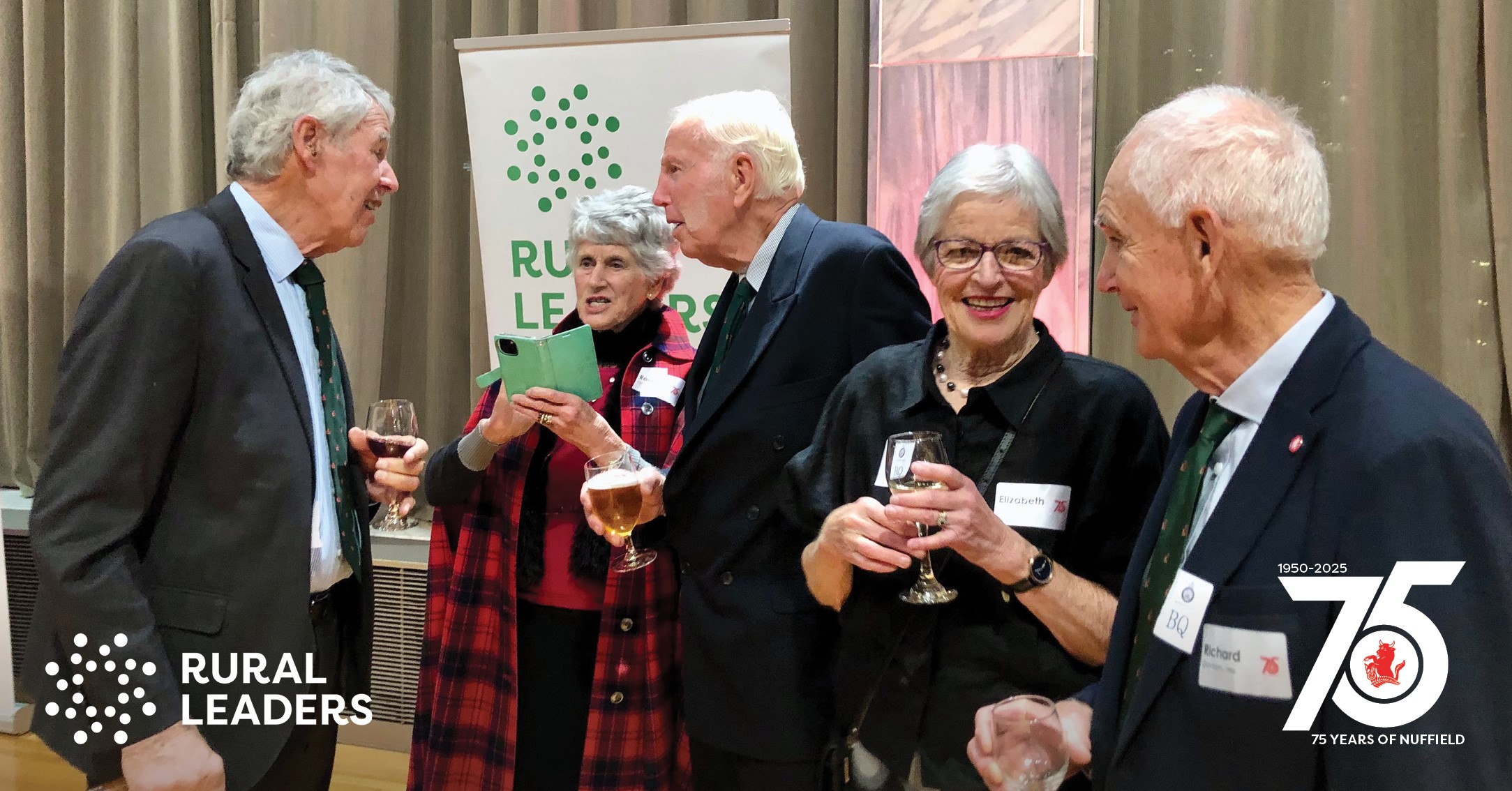
Nuffield Farming Scholarships celebrated 75 years in New Zealand last Thursday.

100+ Scholars and their partners gathered for dinner, to hear from an excellent line-up of speakers and of course, chat.

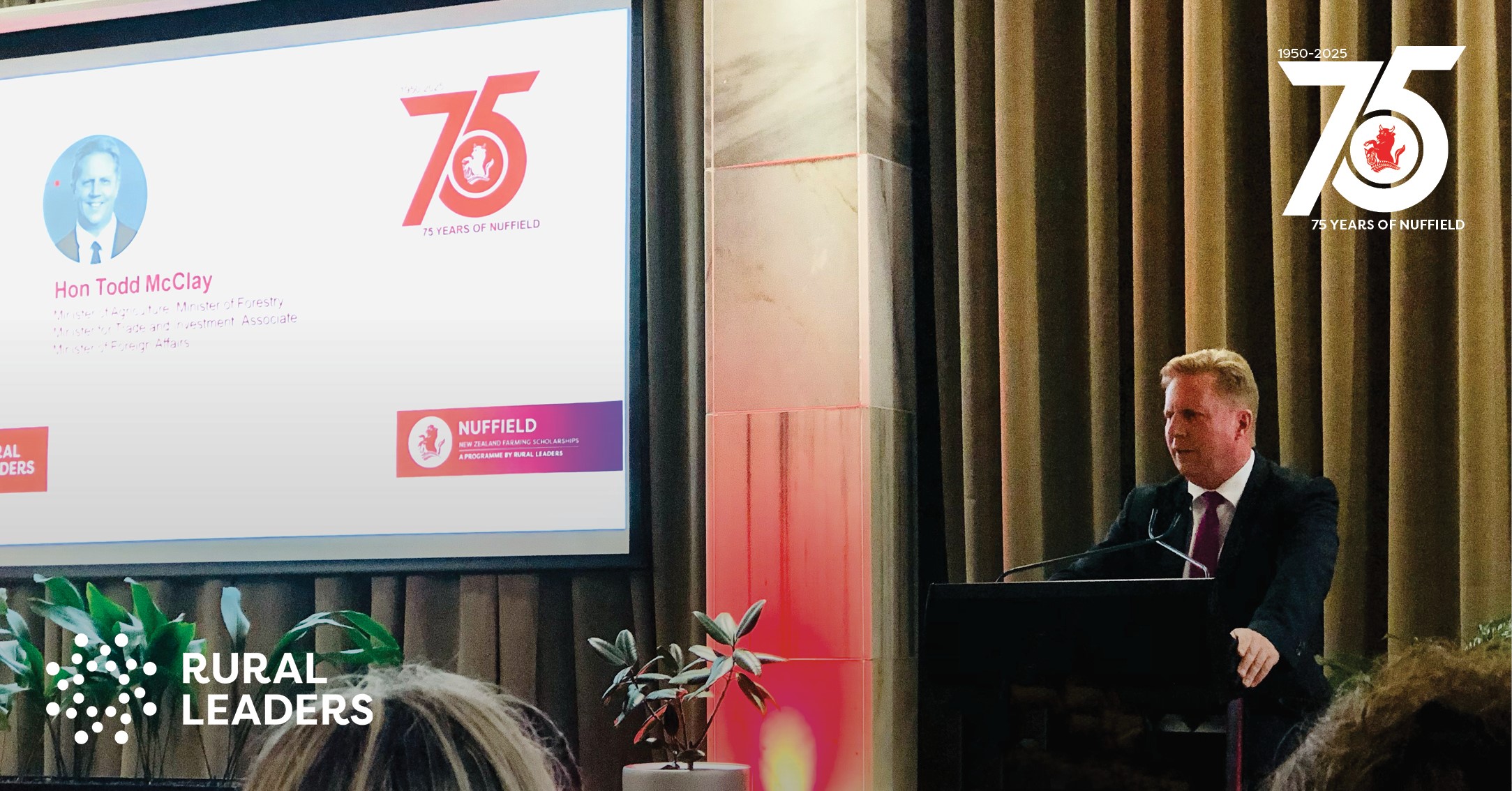
Kate Scott, NZRLT Board Chair (2018 Scholar) opened and spoke on the impact of Nuffield Scholars before introducing host Hon Todd McClay. 

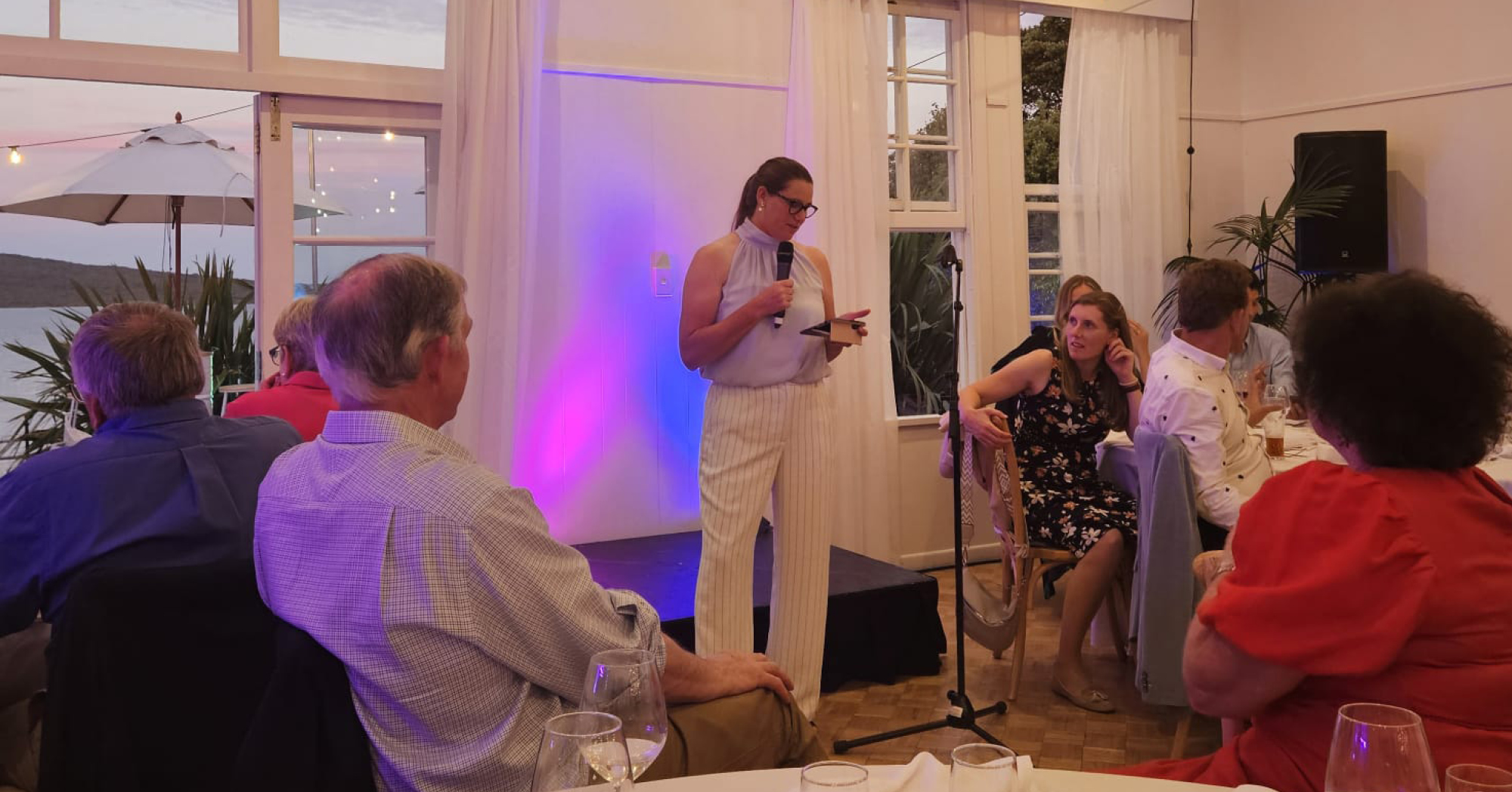
Julian Raine (1997 Scholar) and Kerry Worsnop (2023 Scholar), spoke about their Nuffield experiences including some of the challenges overcome and unique opportunities encountered.

You can read Kerry’s speech below.

One of the most important moments of the night was an announcement by the Hopkins family.

John Hopkins,1979 Nuffield Scholar, passed in 2022. John and wife Elaine, gave generously to the Nuffield Programme over the years. This generosity included providing a Scholarship for Ben Anderson, 2021 Nuffield Scholar.

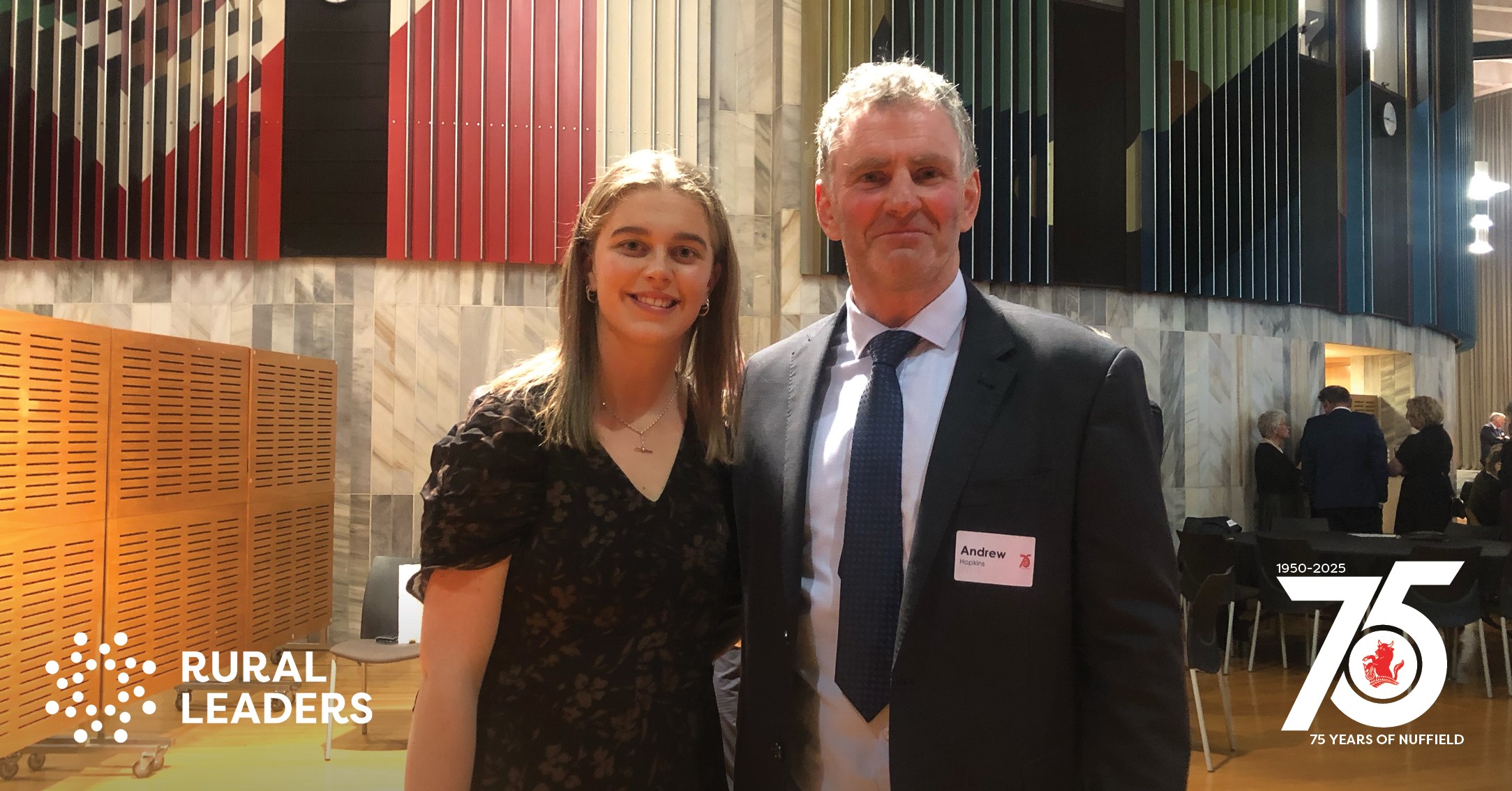
John and Elaine’s son and granddaughter, Andrew and Chelsea Hopkins, attended the dinner. Chelsea announced they would again support a Scholar onto Nuffield.

Here’s an excerpt from Chelsea’s LinkedIn post that echoes her excellent speech on the night:

“… My grandfather, John Hopkins was a 1979 Nuffield Scholar. I have fond memories of him telling me how the scholarship transformed him and the lasting impact it had on his life. I was lucky enough to share his story with the attendees last night and for this I am truly grateful.

To give back to the programme that gave us so much, we are providing a scholarship for 2026 Nuffield Scholars to support the next generation of agricultural leaders.

Being a part of last night’s celebration was super special for Dad and I. It was a reminder that life’s moments, although sometimes small, can have big impacts. This is a night I won’t forget.

A big thank you to Lisa Rogers, Rural Leaders and Kate Scott for the invite and making us feel so welcome.”

Andrew and Chelsea Hopkins are pictured below (image 4).

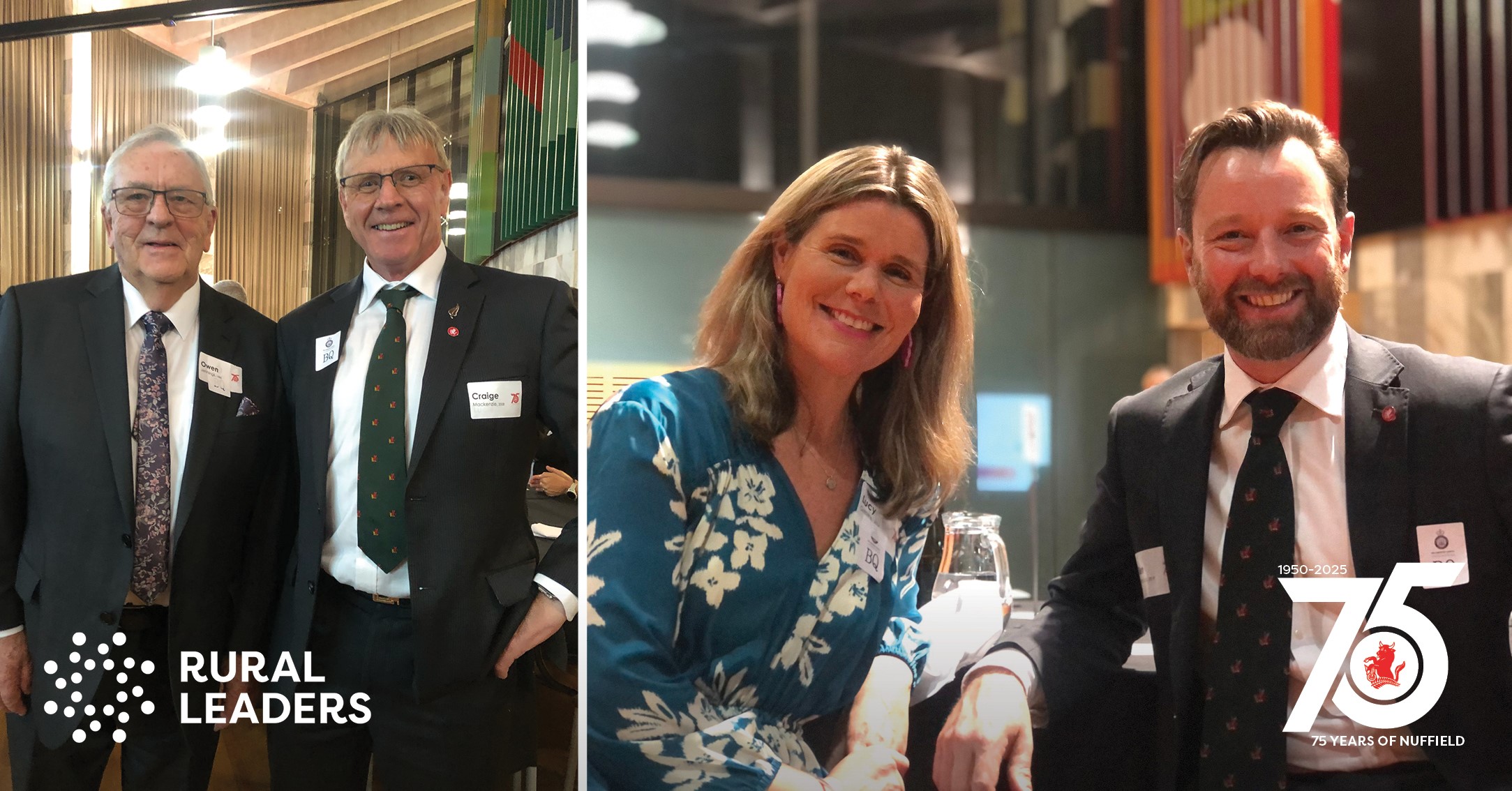
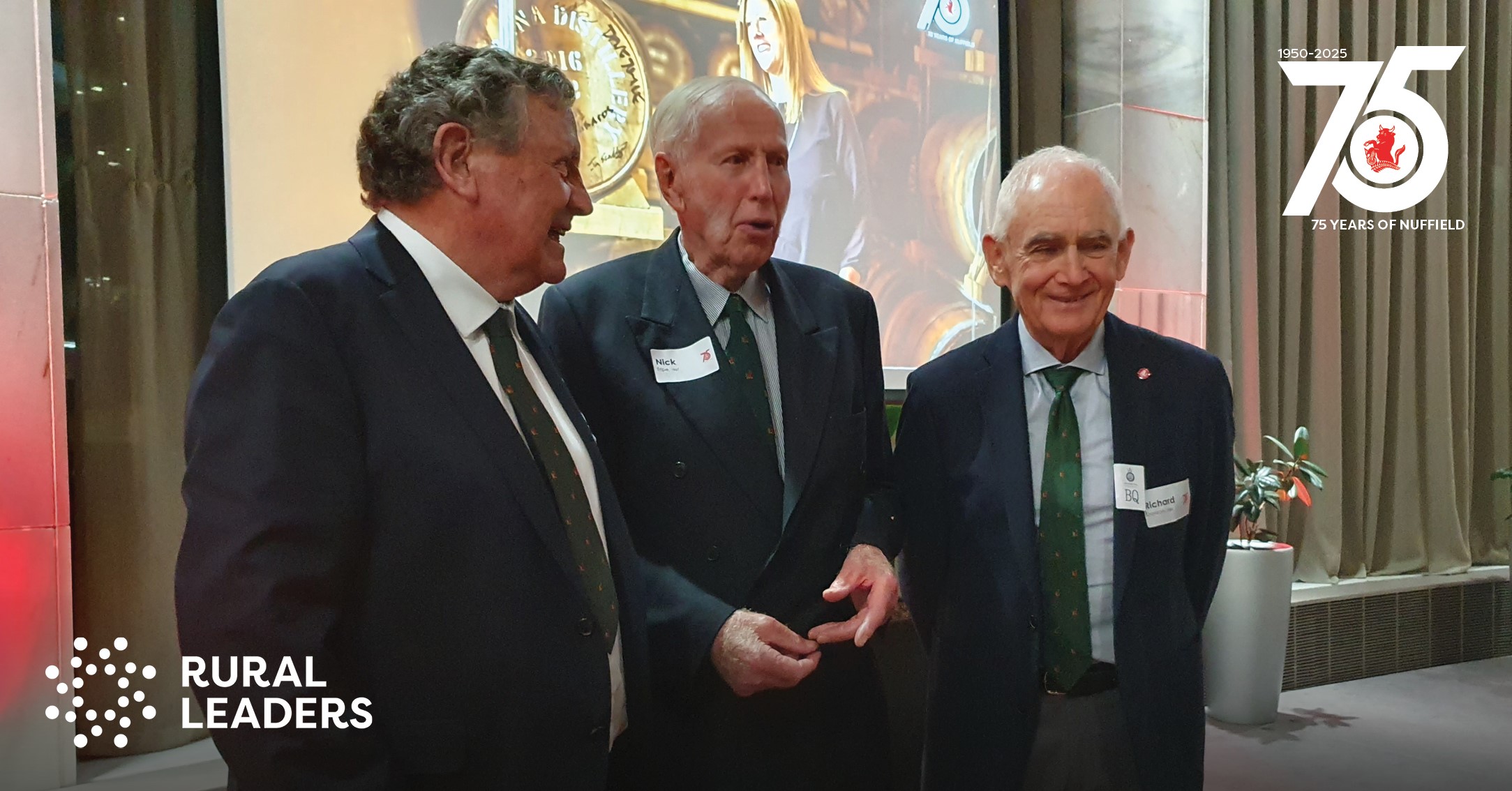
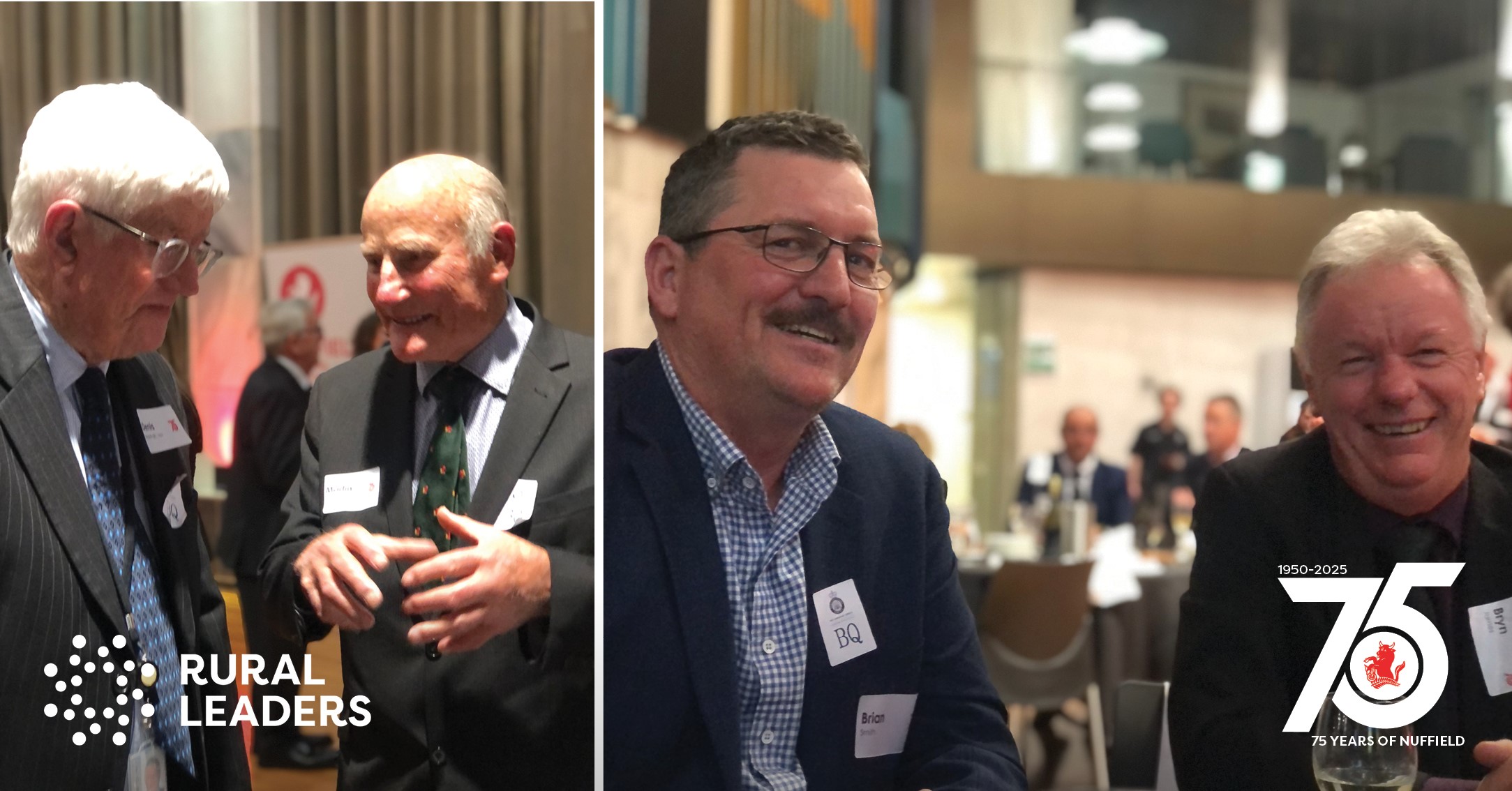
Images are: 1 – Hon Todd McClay. 2 – Owen Jennings (1980), Craige Mackenzie (2008). Lucy Griffiths (2014) Ben Hancock (2019). 3 – Gavan Herlihy (1985), Nick Tripe (1967), Richard Davison (1986). 4. Andrew and Chelsea Hopkins. 5 – Ian Mackenzie (1993). 6 – Marise James (1998), Don McFarlane (1981). 7 – Hon Damien O’Connor, Allan Richardson (1998). 8 – Don McFarlane, Ronny Percy, Nick Tripe, Elizabeth Davison, Richard Davison. 9 – Hon Denis Marshall (1983), Martin Nelson (1983). Bryn James, Brian Smith.

You can read Kerry Worsnop’s speech from the 75th Dinner below. It was an excellent speech that may be useful for those considering a Nuffield NZ farming Scholarship in 2026.

Take a read, it gives some great insight into what to expect.

Scholarships are open until 17 August.

Kerry Worsnop, 75th Nuffield dinner speech, Parliament.

I applied for a Nuffield scholarship at one minute to midnight on the night that applications closed in 2022, having pitched it to my husband at about 9.30 that night.

Now because he’s used to me doing random things, Marcus just rolled his eyes, sort of shrugged, told me to do what I wanted and said he was going to bed.

On reflection, had my application not been so last minute, I would likely never have submitted it. The fact that I did set in chain a sequence of events that will forever make 2023 a pivotal year in my life. And that is without accounting for the two cyclones.

That’s another story.

Now for you poor souls who have had two- or maybe five doses of my research, you’ll be pleased to know that I’m not going to ram it down your throats again. But what I am going to do, is give you a little bit of my journey and in it, hopefully you recall some of your own.

I left New Zealand like many of you will have, wondering what in the hell I was doing, feeling overwhelmed with the magnitude of what I was attempting, and amazing that anyone was crazy enough to fund it.

I had no idea how to hustle meetings with foreign dignitaries, executives, scholars and all the others whose knowledge I would need to augment my own.

But like all of you – I would learn.

I learned that every no, was one step closer to a yes. That every connection can yield three more and most remarkably, that my own knowledge would become a form of currency, the medium of exchange valued by those whose own curiosity would draw them into a room with me.

I learned the value of being able to trade in ideas, to appreciate something I can only describe as intellectual alchemy.

My questions took me to Washington, Pennsylvania, Canada, the UK, the Netherlands and others. 11 countries in all.

I stayed in basements, slept in hostels – had one very dodgy experienced accidentally being the only female in a sardine can room with 7 men from all corners of the world.

I missed flights, misplaced luggage and got lost on numerous occasions – but only once did I end up in the wrong city attempting to board the wrong ferry. Naturally – another Nuffielder put me up for night on half-an-hours’ notice, and on I went.

I met people like Guy Peters, the godfather of public policy research who himself had no real reason to meet me – beyond the fact that New Zealand was fascinating to him.

I found myself in incredible situations, an exclusive cocktail party with US senators, meeting the UK’s agriculture minister, in rooms with countless officials, public servants and farmer organisations and farmers themselves.

I marvelled at how many people made time for me and the generosity of spirit that every Nuffielder I met seemed to share.

For the rest of my life I will never forget the two days I spent with Dorothy Fairburn in Yorkshire, or the lengths that Katlyn Cruiskburg went to, to host me in Canada.

Of course no Nuffield would be complete without someone being sick in a suitcase after too many vodka shots (it wasn’t me) and the painful test of everyone’s social endurance that is the GFP program.

It doesn’t matter if you visited Argentina, Ireland, Poland and France as I did, or India, China and Zimbabwe as others have, the universal truth is that our humanity and the land itself connects us.

I applaud Nuffield NZ for ensuring the GFP’s are an integral part of the journey and I maintain the ultimate test of your capacity – is can you still be talking some kind of sense at midnight when your host is still in fine form but you’re on day 26 of your GFP and it’s your turn to be leader, so you can’t go to bed.

And this is where the rubber hits the road. As New Zealand scholars, we have a clear expectation set for us and we understand our role as ambassadors for our country and for this organisation.

I expect that of all the scholars world wide, New Zealanders are the least likely to go to bed when the host still wants to talk, and we are the most likely to ask questions when someone needs to show an interest, even if it’s the 500th dairy farm visit.

New Zealand Rural Leaders Trust sets the standard and it’s Nuffield program stands alone in offering a truly life changing experience. Much like the Greek myth of Odysseus, once we have wondered the word in search of answers we can not help but return changed.

In accepting a New Zealand Nuffield scholarship you agree to explore parts of the word, and parts of yourself that you may never have reached alone.

In return Nuffield in this country defends the space for your conclusions. They did this for me, and likely, for most of you.

I can not emphasise enough the value in this.

Not every country offers this. I spent time with scholars agonising over the fact that their conclusion were increasingly at odds with the business model of their sponsor, I spent time with others for whom getting the sponsorship itself predetermined their research topic.

In New Zealand our most curious minds are entirely free to search the world for answers and when they return, they are free to speak whatever truth they find.

This is exceptionally rare in a world where research funding is thin and increasingly political and where commercial interests often guard the doors.

Our sponsors deserve great recognition and immense gratitude for their willingness to support such impartiality, which no doubt at times may have been at odds their own interests.

So my message to all those who deliver this program and to those who support it, you have created something precious and rare, and this country is ultimately the better for it.

Thank you.


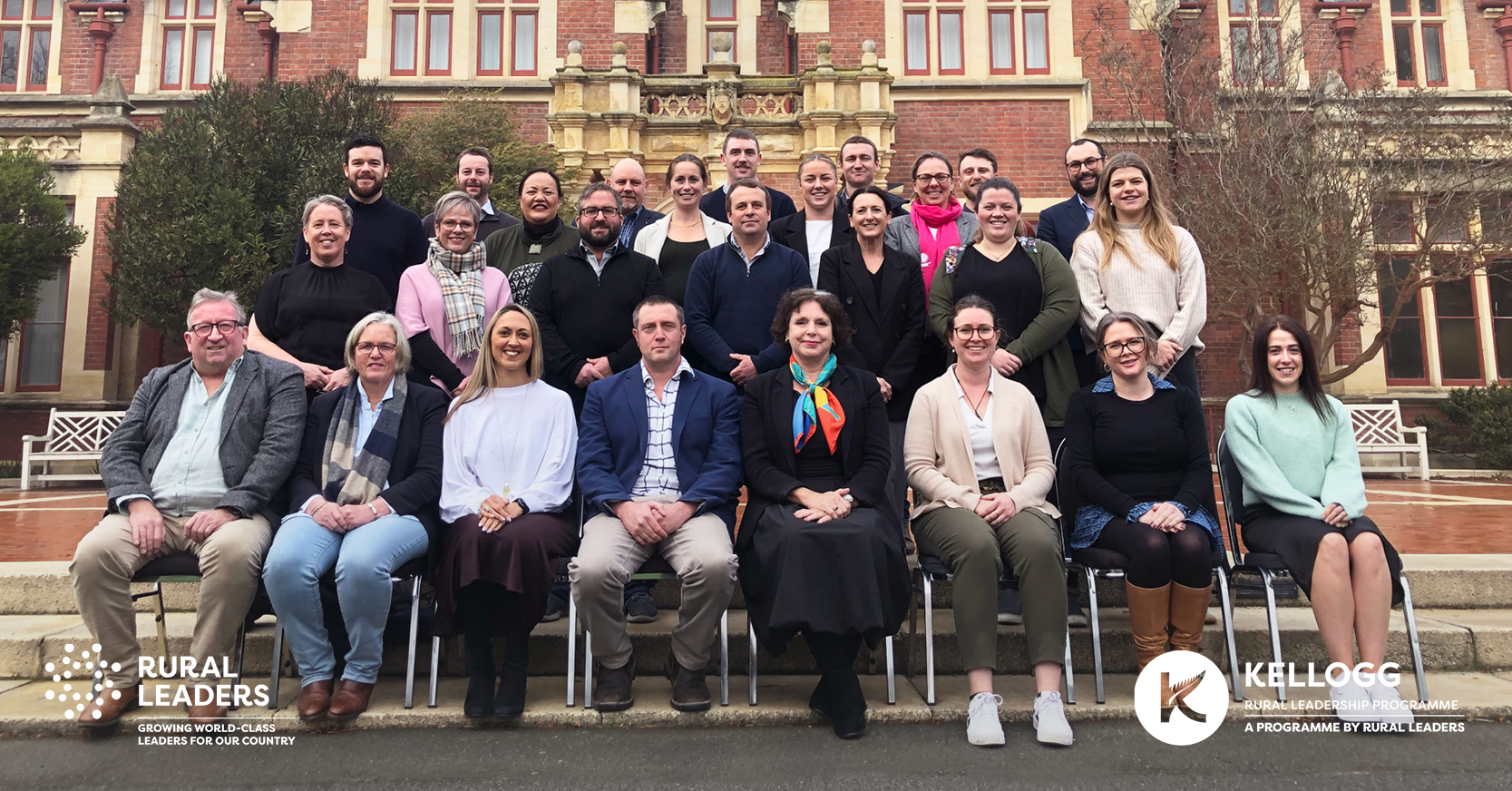
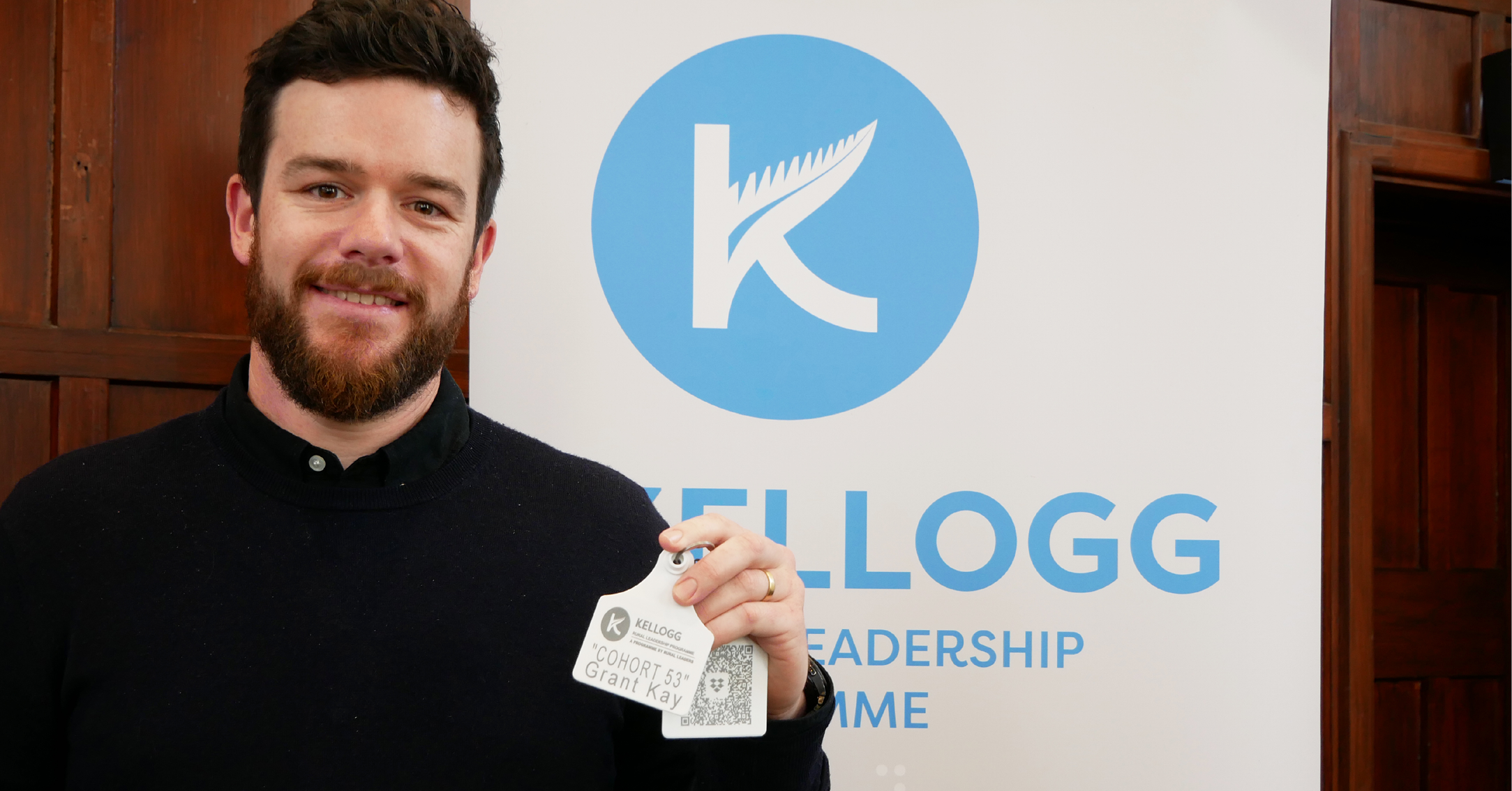
Kellogg Programme One 2025 (K53) graduate.

Congratulations Programme One 2025. 18-inperson days in Lincoln and in Wellington, one research report, one presentation of said research report, tens of insights sessions from industry leaders, workshops, reflections, at least 22 new friendships, and much more.

This graduation marked the completion of the research component of Kellogg. Scholars presented their work to the cohort throughout their phase three. Their reports will be made available on the Rural Leaders’ site in the next two weeks.

The graduation ceremony was held in Lincoln University’s Memorial Hall. Thank you to Lincoln University (NZ) for the use of this incredible space.

Lisa Rogers, Rural Leaders CEO got the graduation ceremony started, introducing new Rural Leaders Associate Trustee, Katie Rodwell (2019 Scholar).

Katie spoke to the graduates about the transformation the programme had created for her. Katie discussed the critical thinking skills, networks and connection that are developed on Kellogg, and encouraged the group to stay connected and to lean into any opportunities for growth.

This cohort’s reports will be shared with investing partners for a first preview, then more widely soon after.

As a heads-up, scholars and their report topics (under broad theme headings) are as follows:

Environmental management in agriculture.

Adam Williamson
Water quality in the Amuri basin – where are we at?

Jodie Goudswaard
Balancing profit and environment: Insights from New Zealand’s leading dairy farms.

Cameron Walker
Enhancing on-farm carbon stocks.

Jess Ross
Softer Crop Protection, The Way of The Future?

The business of agriculture and horticulture.

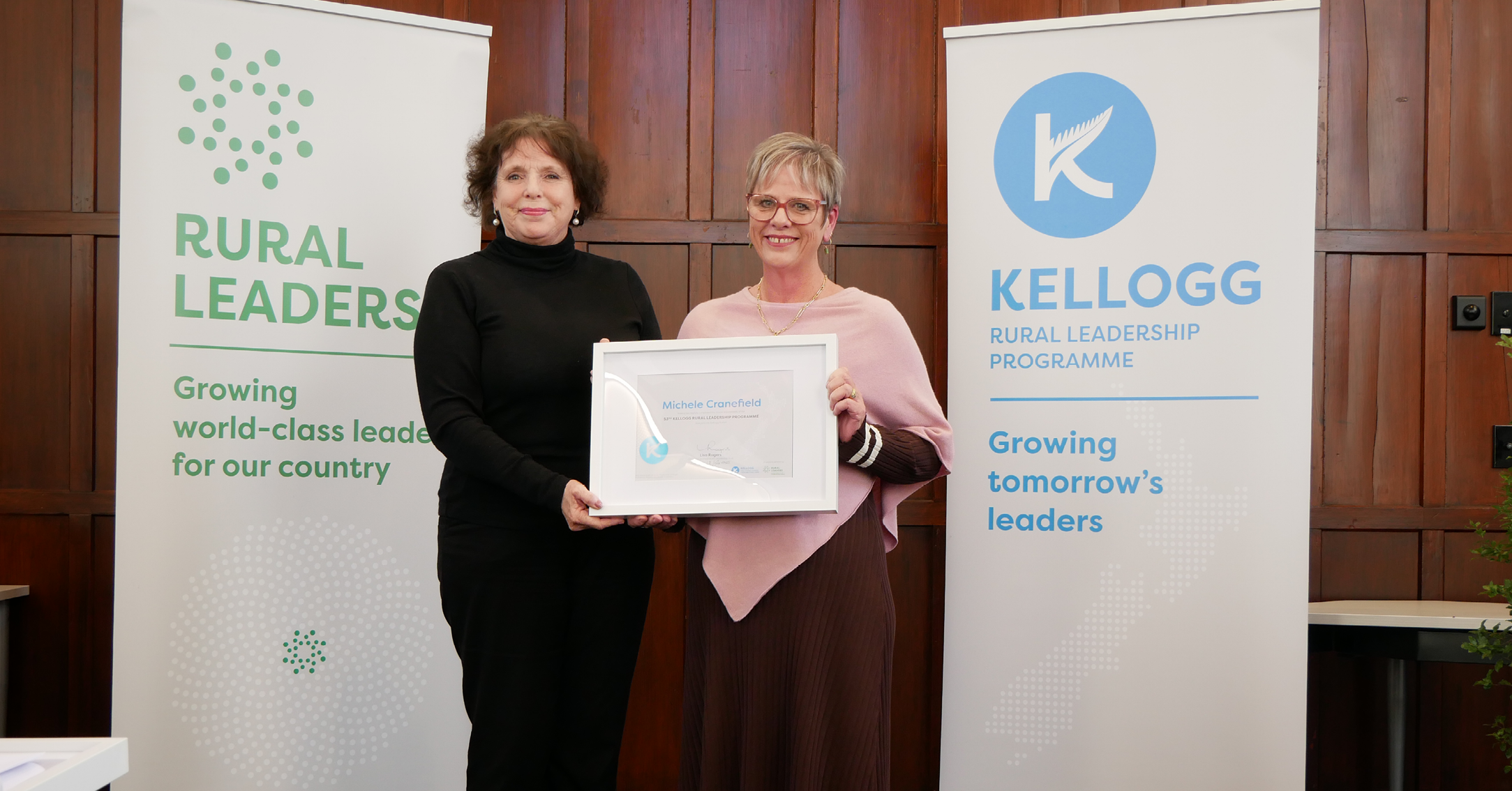
Michele Cranefield
From Seed to Success – Transitioning Farm Ownership in New Zealand – The Ownership Equation: Exiting with Value, Entering with Vision.

Emma Harvey
Opportunities within New Zealand agri-tourism.

Kurt Harmer
Dairy diversification into raw and pasteurised milk sales.

Pare Taikato
The opportunity cost to New Zealand of under-developed whenua Māori.

Malinda Wynyard
Building diversity in New Zealand dairy export markets for independent manufacturers.

Grant Kay
Dairy farmers love sharing data…but there is a ‘but’.

Sam Connor
Partnerships within the food and fibre sector: do they return value to the farm gate?

Kaitlin Bates
Smart Nutrition, Stronger Herds: A Holistic Approach to NZ Dairy Excellence.

Matt Ward
How can we maximise profitability in our decreasing ewe flock?

Daniel Judd
The soils gap: Interactions between culture, research and fertiliser.

Developing our people and communities.

Emma Weston
Career satisfaction and job retention for front line vets in government roles.

Katrina Roberts
Dairy farmer-female veterinary advisor relationships in New Zealand: Identifying the key attributes of a flourishing partnership.

Morgan Jones
How do we develop financial literacy in rural New Zealand?

Michele Findaly
What factors enable trusted, high value relationships between rural managers and clients in New Zealand’s food and fibre sector?

Jack Dwyer
Leadership qualities needed for first time managers.

Richie Cameron
How can the sheep and beef industry retain farm managers without ownership opportunities?

Anthea Yule
Does the decline in school bus services highlight more significant issues affecting rural primary education?

Phil Holland
Guardians or executioners: Navigating the ethics of deer control.

The 2025 Food and Fibre CoVE Research and Insights Forum.

Food and Fibre CoVE Forum

The 2025 Food and Fibre CoVE Research and Insights Forum.

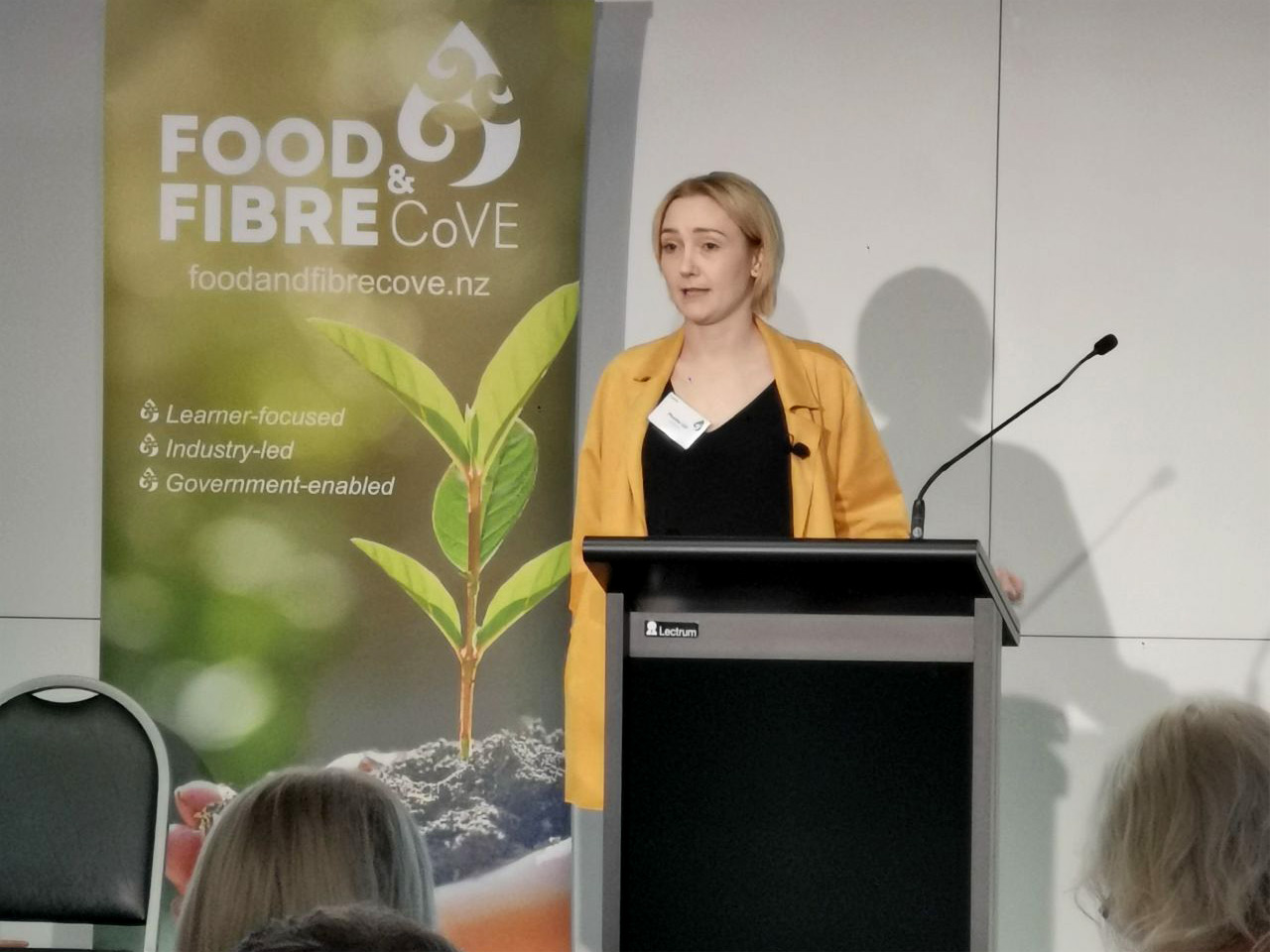
The 2025 Food and Fibre CoVE Research and Insights Forum showcased crucial projects delivered throughout the last year, that have helped address the challenges our sector faces, specifically around workforce talent, the pace of change in technology and uncertainty.

The two-day Forum got underway at Wharewaka in Wellington yesterday, with Rural Leaders’ CEO Lisa Rogers in attendance.

The following is a summary of the excellent posts (and photos) from Food and Fibre CoVE.

Day One.

The Honourable Andrew Hoggard opened and shared his vision for advancing a thriving skilled food and fibre workforce while Shamubeel Eaqub gave the economic realities and implications for NZ as a trading nation – a lot of it good news.

A session ‘Talent for our Future’ followed and brought the Skills Framework to life. This was conducted by Kathryn Koopmanschap, Nicky Murray and HTK Group’s Neala Rosandich.

The Skills Framework focuses on a skills-first approach encompassing: mōhio (understanding). mātau (expertise) and mārama (enlightenment).

Alongside this, a Te Ao Māori Skills Toolkit has been developed as a guide and support for learners, employers and providers.

View the Skills Framework toolkits here: Food and Fibre Skills Framework.

Forum goers also heard about the Secondary School Transitions and Pathways to Vocational Education, Training, and Employment project from Josh Williams of Skills Group.

To view the policy review by Josh Williams and Arthur Graves, or for more on the project, click here: Secondary School Transitions and Pathways to VET and Employment.

The second session captured a key range of projects focussed on workforce retention. Adam Barker of Scarlatti on insights looking into the possibility of coordinating New Zealand’s seasonal workforces between sectors and regions.

The final report is due to be published shortly.

Emma Boase of PwC New Zealand profiled the Employer Toolkit that has been developed for the ‘Retaining our People – Food and Fibre Retention Pilots’ project.

This toolkit for supervisors, managers and employers developed alongside industry provides free online information for better workplace wellbeing and culture, Māori cultural confidence, mentoring and more.

Head to www.employertoolkitnz.org to see this valuable work.

Sector snapshots from Dr Lesley Petersen included a sneak peek into the Aquaculture New Zealand mentoring and coaching pilot programme and the results from an impact evaluation of Mr Apple New Zealand Ltd’s internship, called Growing Future Horticulturalists. Both these pilots provide learning and guidance to take programmes like this to other food and fibre sectors.

Moerangi Vercoe and Daniel Wallwork of Muka Tangata Workforce Development Council shared the Te Haumako – Māori Workforce Development Plan recognising the significance of Māori agribusiness and growing demographic within food and fibre, with the opportunity to enhance qualifications and training that work for Māori.

You can read more on Te Haumako here: mukatangata.nz/te-haumako/

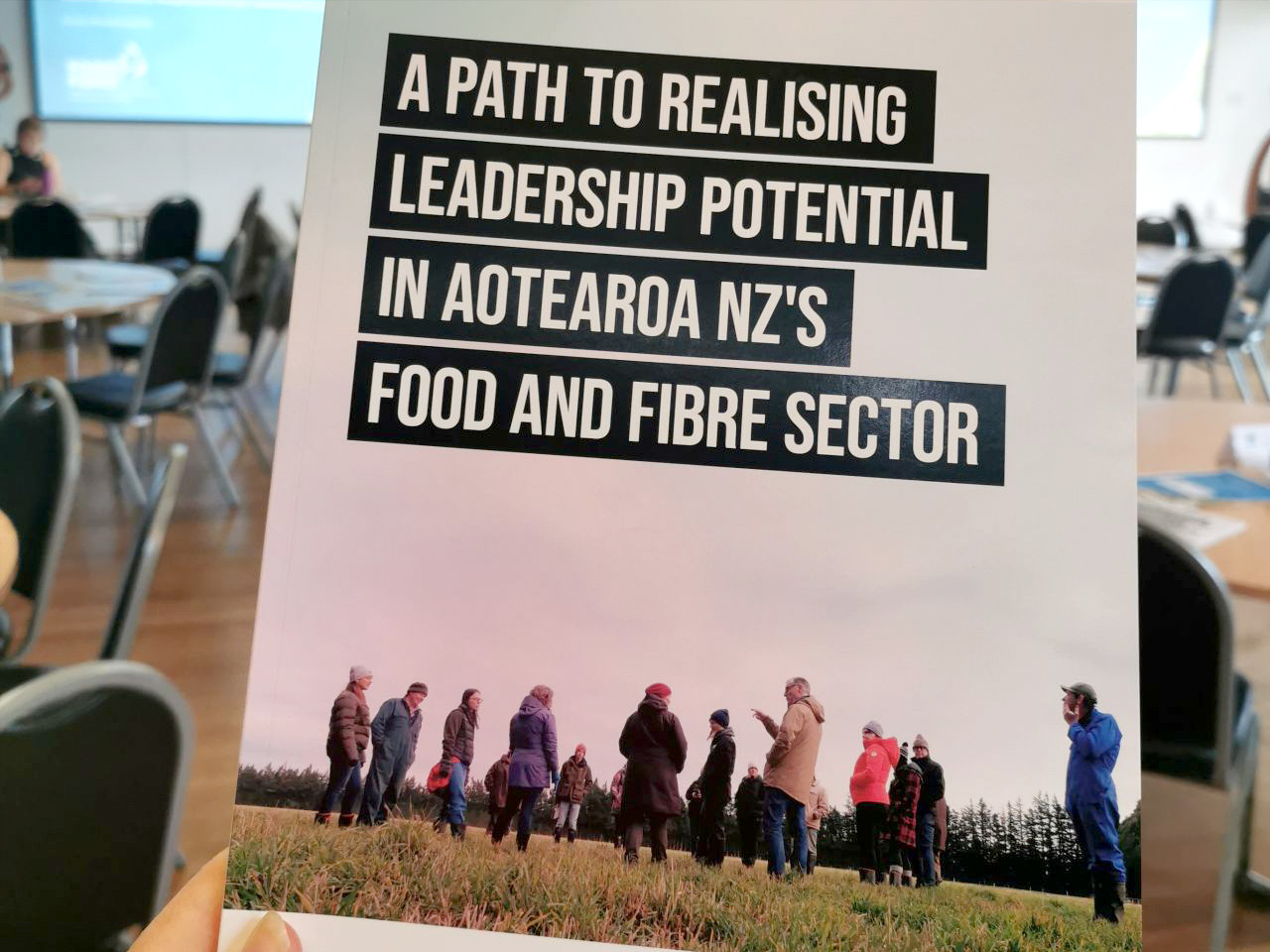
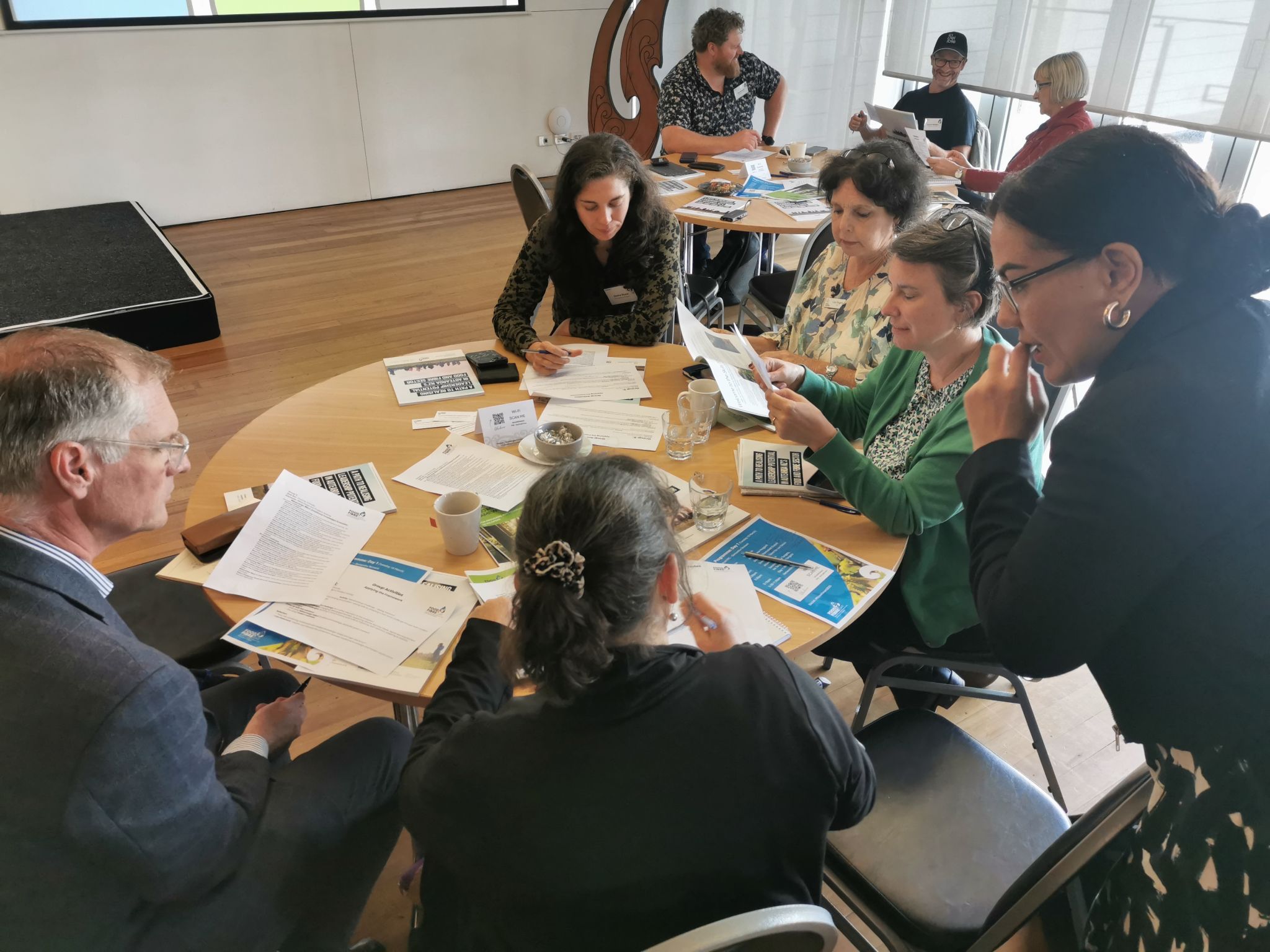
And connecting much of this work to leadership development is the Food and Fibre commissioned leadership project with Rural Leaders. The most recent report in this project, ‘A Path to Realising Leadership Potential in Aotearoa NZ’s Food and Fibre Sector’, was available to those attending.

Day Two.

Session three ‘Integrating Technology’, exploring the potential emerging technologies such as artificial intelligence has for food and fibre.

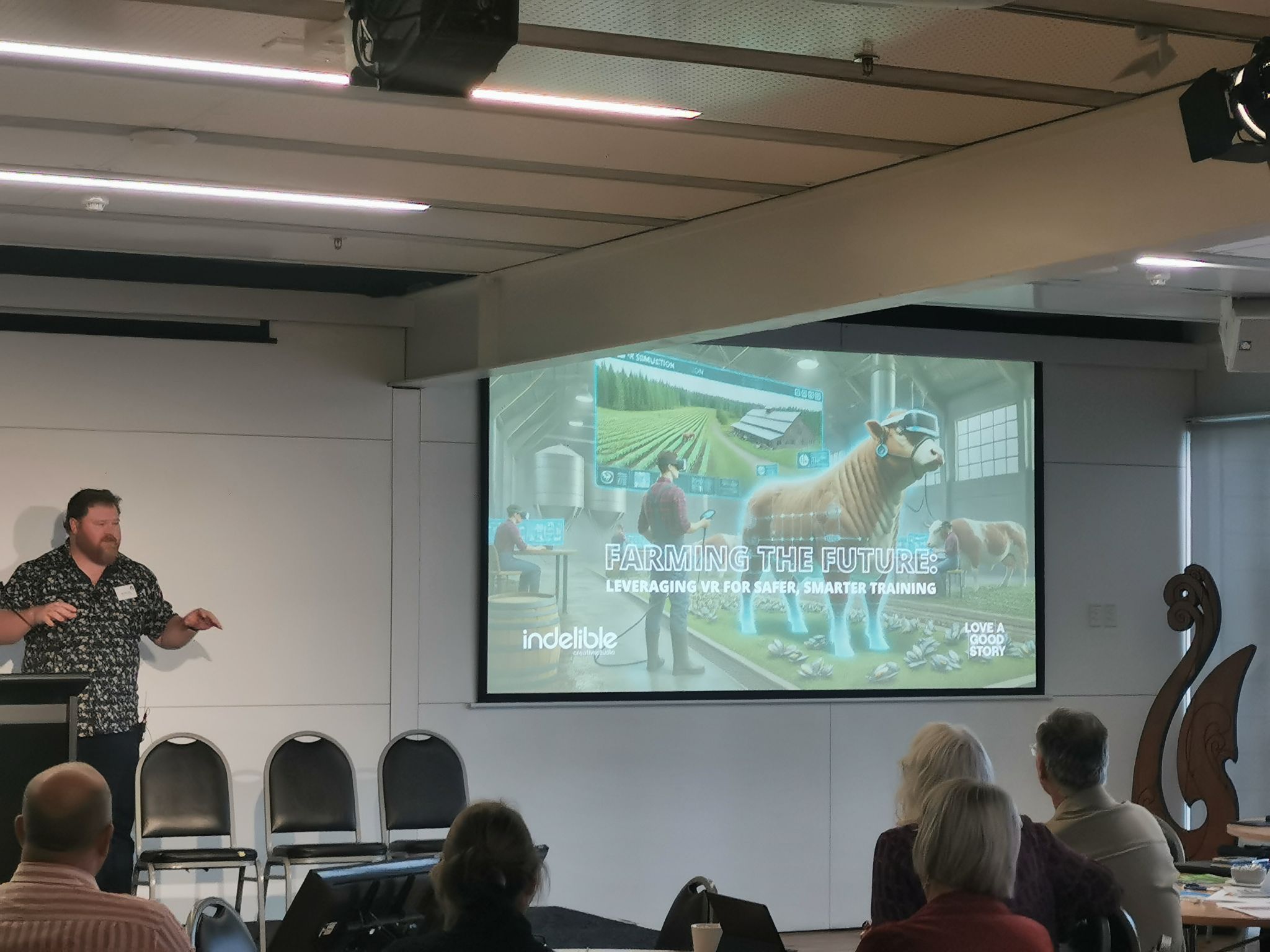
Dan Browne and Hamish Webber of Indelible – Creative Studio with CoVE’s Dr Lilla du Toit looked at how technology can advance learning and training capability, with AI researcher Dr Jace Hargis from Orlando on current possibilities.

Delegates gave new tools a go too – including an immersive experience on keeping safe when moving stock. 3 pilots to test the technology are underway with Beef + Lamb New Zealand, Te Wānanga o Aotearoa and DairyNZ.

Take a look at a report exploring the possibilities of emerging technologies for NZ food and fibre by Skills Group, here: Investing in Emerging Technologies: Gamification, VR and AI Research project and pilots.

The Scarlatti team’s Phoebe Gill and Julie Moularde spoke on two key projects including AI in assessment practices that are accessible for learners and providers.

Delegates were also introduced to Food and Fibre CoVE’s interactive Online Excellence Framework Scarlatti and Skills Group have done to bring the Rubrics and its ‘superpowers’ to life.

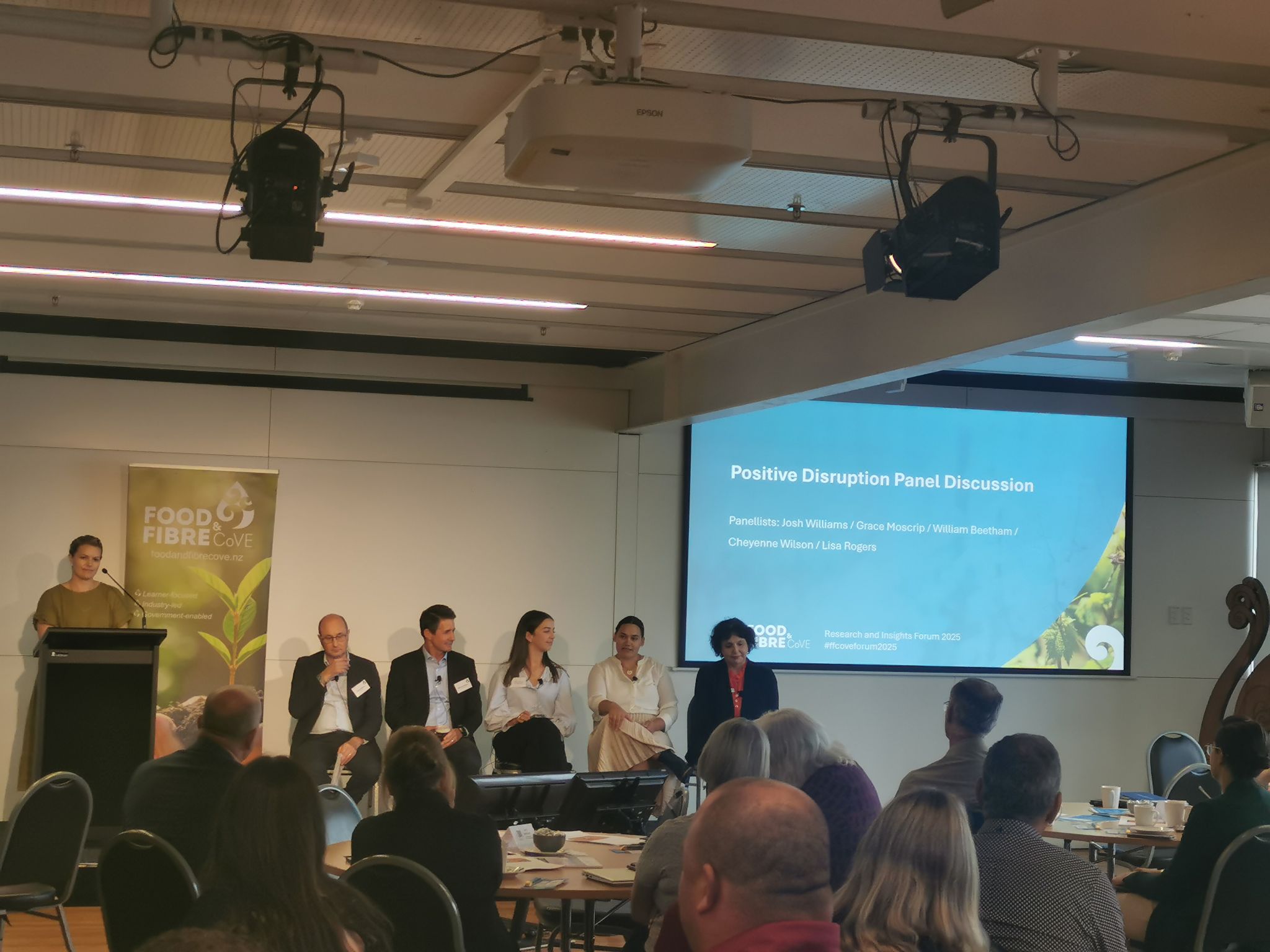
In Session four – a panel line-up spoke on positive disruption for the future of food and fibre VET. Grace Moscrip Josh Williams and Lisa Rogers, CoVE Board member Cheyenne Wilson and Chair, William Beetham who reflected on the learnings of the Forum’s two days – shaping a VET sector for the ever-evolving future-focussed food and fibre sectors of New Zealand.

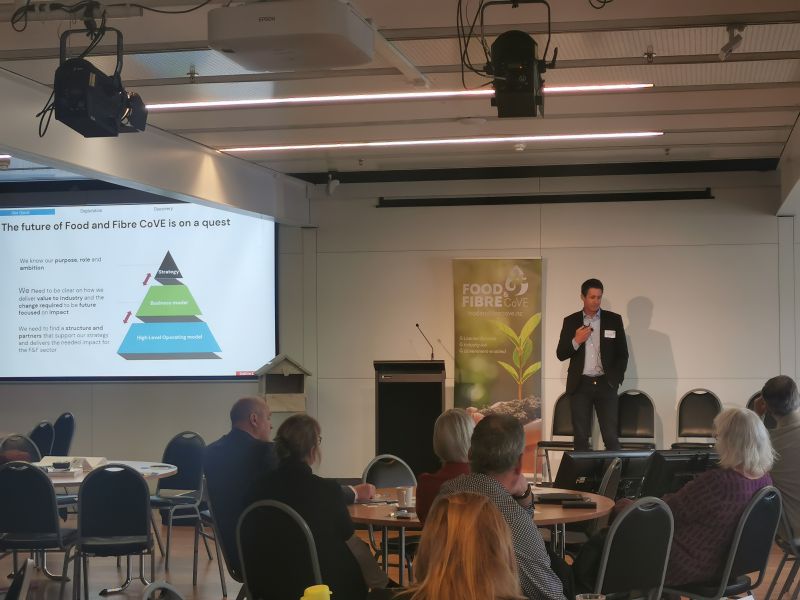
Food and Fibre CoVE’s Chair William Beetham provided an update of Food and Fibre CoVE’s Future Directions Initiative, working with our stakeholders and PwC New Zealand on what comes next.

Have your say on what Food and Fibre CoVE’s focus should be beyond 2025. Click here: Food and Fibre CoVE Future direction

The Nuffield 2025 Contemporary Scholars Conference.

The Nuffield 2025 Contemporary Scholars Conference

The Nuffield 2025 Contemporary Scholars Conference (CSC) wrapped up last week in Auckland, running March 8 to March 16. 

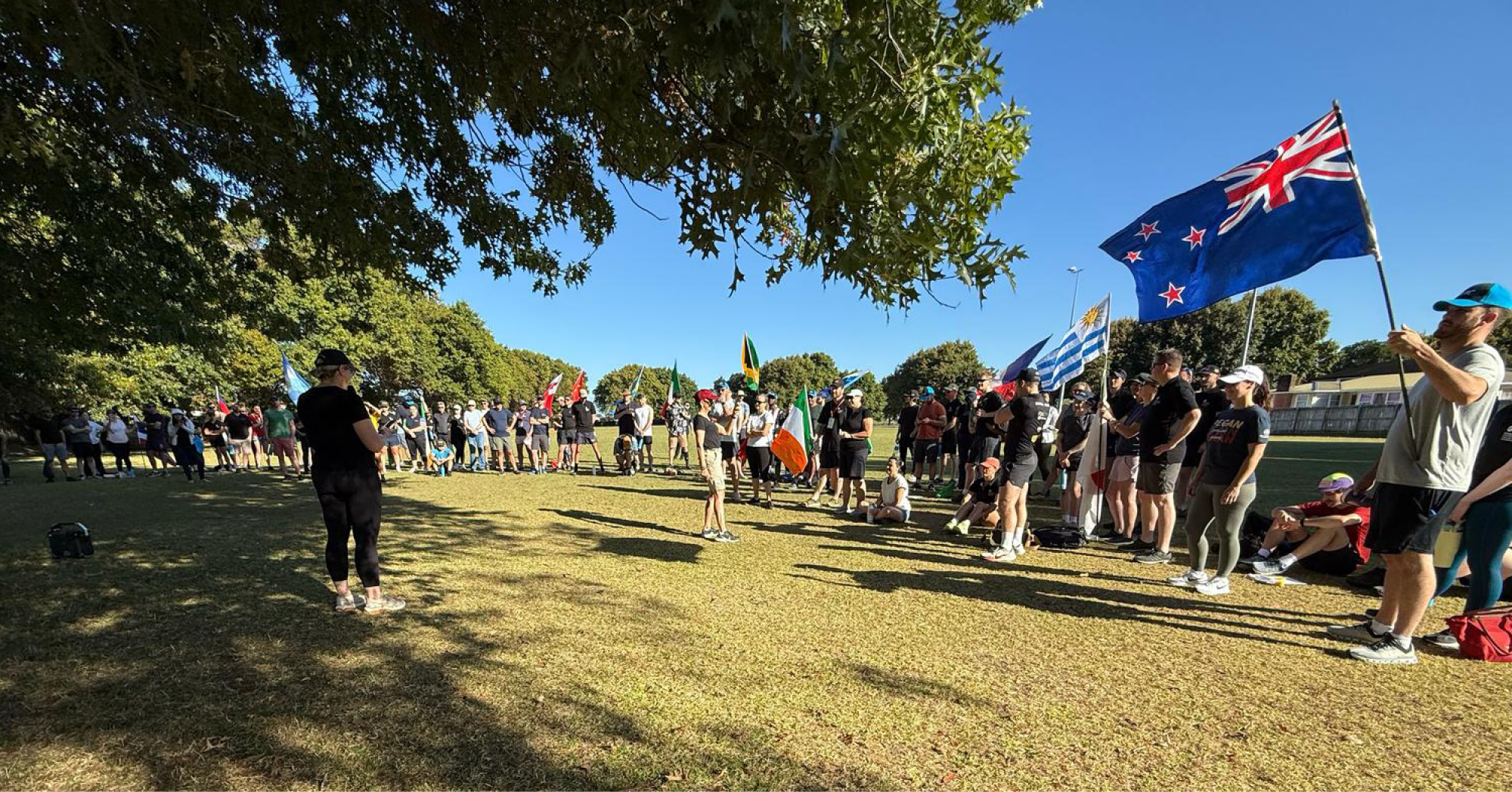
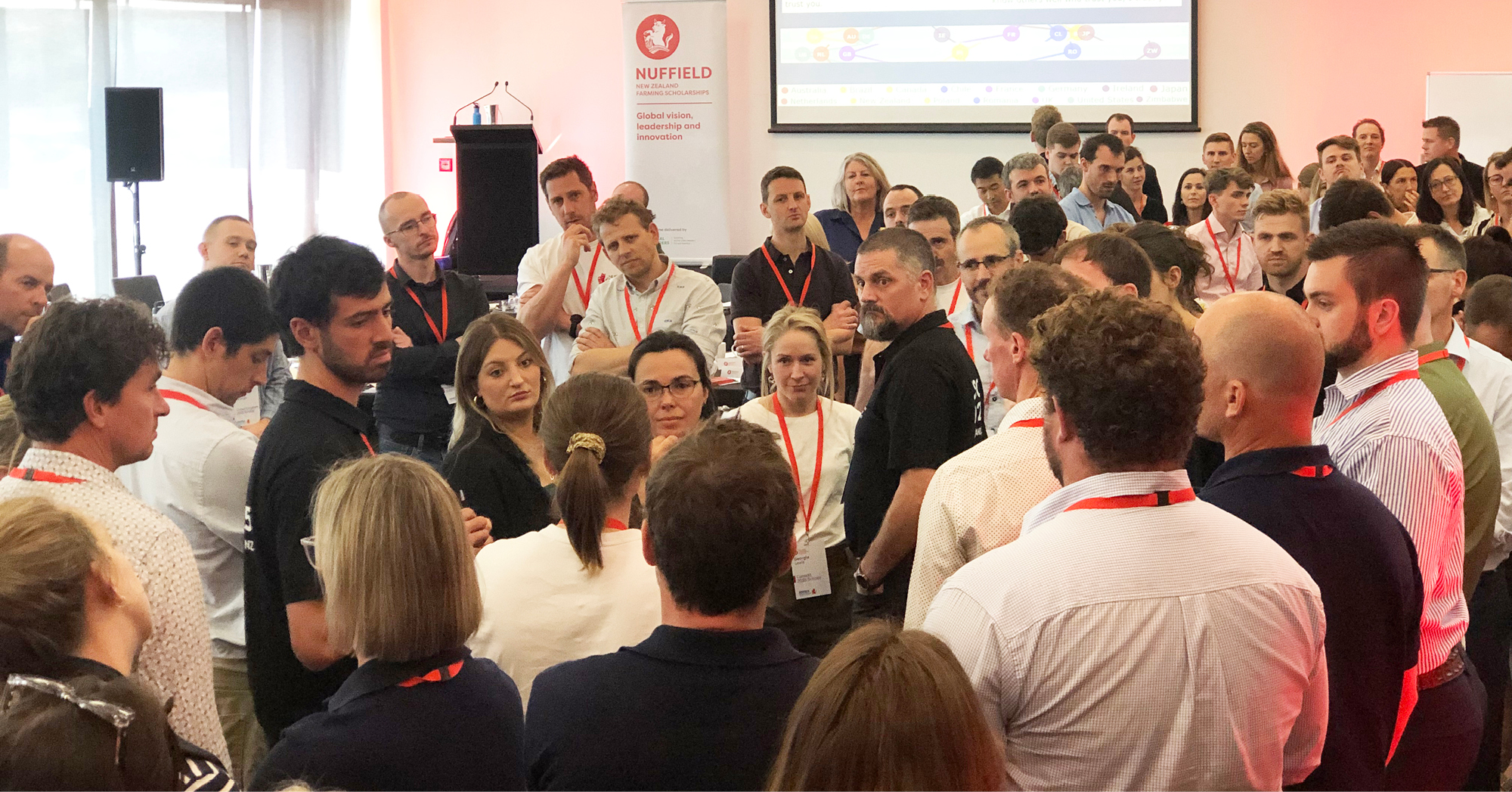
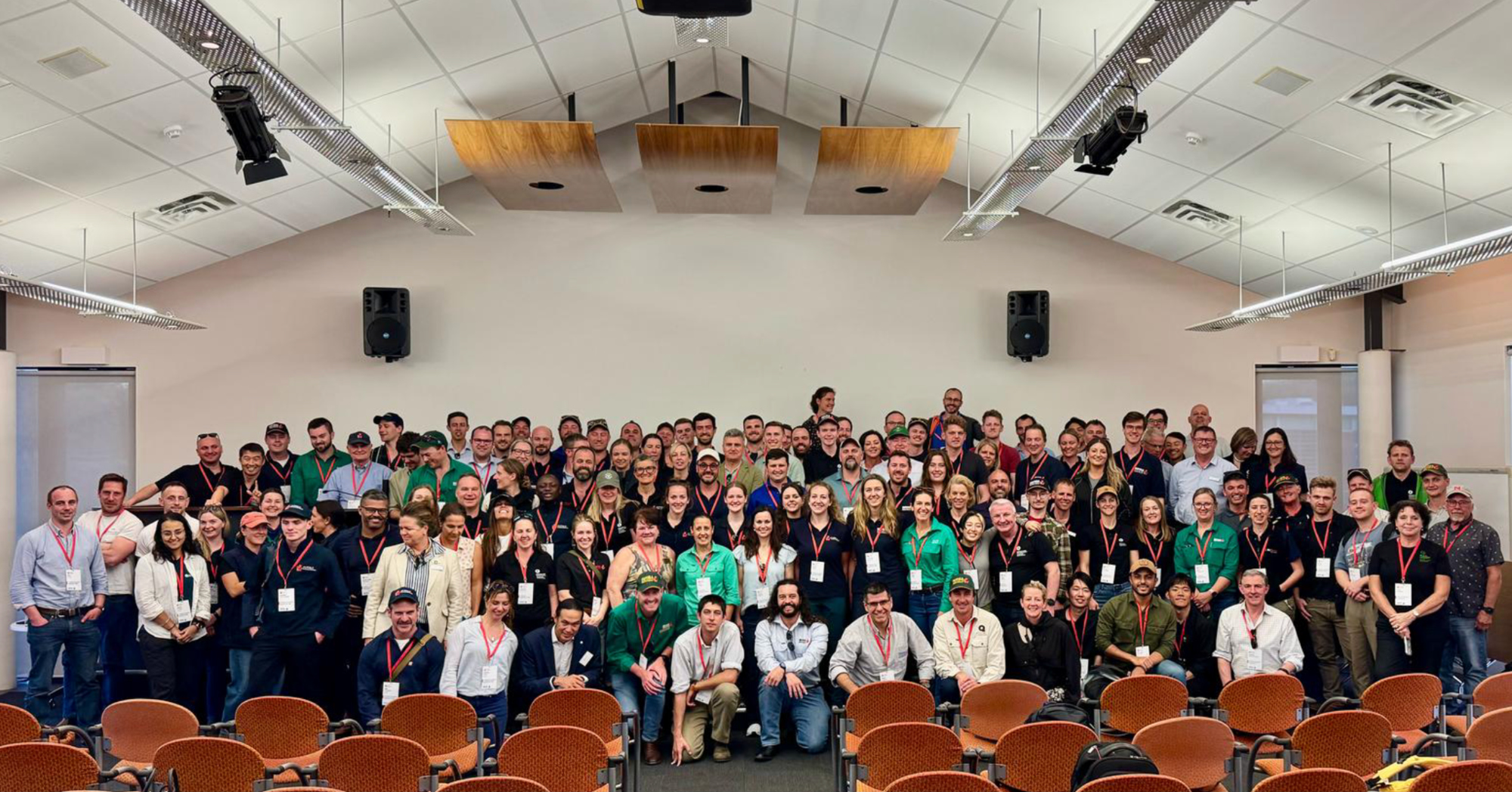
This CSC, organised by Rural Leaders and hosted by Rural Leaders and Nuffield International, brought together over 100 newly selected Nuffield Scholars from around the globe. The CSC offered scholars an immersive experience through a series of carefully curated activities, workshops and speakers.

It’s an immersive platform for new scholars to engage with thought leaders to address global agricultural challenges. The 9-day programme featured presentations, panel discussions, and field trips. This year’s conference emphasised leadership development, critical thinking, effective communication, wellbeing, Te Ao Māori and Te Tiriti o Waitangi, trade and exposure to New Zealand’s unique value chains.

For Rural Leaders, hosting this CSC provided an opportunity to showcase Aotearoa’s advancements in the food and fibre sector. Participants explored local farming systems, sustainability practices, and technological innovations, gaining insights into how New Zealand maintains its competitive edge in global agriculture. 

An important aspect of the CSC is the networking among scholars, fostering international collaboration and knowledge exchange. Many of these newly connected scholars will travel together internationally in small groups during their Global Focus Programme (GFP), another key chapter in the scholarship programme.

The GFP is a four-week tour across multiple countries, further enhancing scholars’ global perspective on agricultural practices.

CSC Programme highlights included:

Presentations: Scholars attended sessions led by global thought leaders addressing pressing agricultural challenges. These talks provided insights into innovative solutions and strategies shaping the future of agriculture.​

Speakers included: Jodie Redcliffe (Nuffield International and Australia CEO), Kate Scott (Nuffield/Rural Leaders Chair), Hon. Damien O’Connor MP, Christoph Graf Grote (Nuffield International Chair), Steve Kearney (Chief Mental Health Officer NZDF), Shannon Stallard (Lead with Virtue), Russell Pickering (The Pickering Group), Andrew Watene (Head of KPMG Propagate), Jessica Smith (Deputy Chief Executive at Te Tuapapa – Ministry for Housing and Urban Development), Marcin Markowicz,

(2023 Nuffield Scholar, Poland), Bruce Weir (GM Country Banking Rabobank), Campbell Parker (CEO DairyNZ), David Chin (CEO LIC), Tim Gibson (Director LIC), Corrigan Sowman (LIC Board Chair), Charlotte Rutherford (Dir. Of Sustainability Fonterra), Vangelis Vitalis (NZ Chief Trade Negotiator), Sally Thomson (Nuffield Executive – Brazil), Bev Flatt (Global Partnerships Manager – Agriculture Advocacy and Activiation, Bayer-Sponsor), Lisa Rogers (CEO Rural Leaders) and more. Thank you to all for giving your time and sharing your isnights.

Panel Discussions: Engaging panels allowed scholars to delve deeper into topics such as sustainable farming practices, climate change adaptation, and technological advancements in agriculture.​

Field trips: Participants embarked on field trips to local farming operations and agri-businesses, witnessing firsthand New Zealand’s cutting-edge agricultural practices and value chain innovations.​

These included: DairyNZ, LIC, Balle Bros., Plant and Food, Leaderbrand, Punchbowl and more.

Networking: The entire conference was essentially a networking session, enabling scholars to connect, share experiences, and lay the groundwork for future collaborations.​

And, did we mention the Nuffield Games? These were held near the end of the conference and, well, there’s really nothing like it.

While the true impact of this CSC will play out over time, these activities collectively enhance the scholars’ understanding of global agricultural dynamics equipping them with the knowledge to drive positive change in their respective regions and industries. For New Zealand – it puts the country front of mind amongst a large cohort of rising global rural leaders.

Feedback has been unanimously positive. The success of this CSC is underpinned by our conference sponsors’ generosity.

Rural Leaders, Nuffield NZ and Nuffield International wish to express their thanks to: Bayer, Nuveen, LIC, PWC, Rabobank, Laguna Bay and MyFarm Investments. Thank you for making this CSC possible.

You can download this CSC’s programme here for more detail on the conference’s nine days.

A huge thanks also to Phil Morrison for binding together the CSC’s insight threads so well during the conference. Phil facilitated the event expertly and was instrumental to its success.

For the 2025 Nuffield New Zealand Scholars: Lisa Portas, Dani Darke, Alan McDermott and Jon Pemberton, their journeys are underway and their research topics are now more carefully defined. During the CSC every 2025 scholar gave a 2-minute summary of their intended research.

Take a look at the topic presentations from our four 2025 NZ Scholars below:

The 2024 NZ Scholars will submit their completed reports in the coming weeks. We’ll share those widely after our investing partners have had a first preview.

NZRLT governance opportunity.

The Board of Trustees for the New Zealand Rural Leadership Trust, responsible for governing the Nuffield Scholarships, Kellogg Rural Leadership Programme, the Value Chain Innovation Programme, Engage and the HortNZ Leadership Programme, wish to appoint an Associate Trustee.

This governance development opportunity is open to all Rural Leaders Alumni.

The Associate Trustee will have the opportunity to:

  1. Sit on the Board and gain greater understanding of governance processes under an experienced Board.
  2. Provide input into the development of some of the leading rural leadership programmes in New Zealand.
  3. Provide insights and perspective as an Alumni of the programme(s).

The Role
The position is included fully in all Board activities, events and meetings.

The Associate Trustee is expected to fully contribute to all Board discussions and actions as if they were a Board member of the organisation and attend events associated with the role. However, the role has no voting rights.

Eligibility
The Associate Trustee role is open to Alumni of the New Zealand Rural Leadership Trust who completed their programme between 2019 – 2024, inclusive.

Term
The term of appointment is for a twelve-month period (May 2025 – May 2026), which provides an opportunity to cover a full year of operations.

There are seven more Board meetings this year and several events. Most events are held in Christchurch or Wellington.

Flight and accommodation costs are covered, where applicable.

The Board meeting schedule for 2025 is:

  1. May TBC (Online)
  2. July 9 (Christchurch)
  3. August TBC (Online)
  4. September 10 (Wellington)
  5. November 3 (Wellington)
  6. December TBC (Online)
  7. January/Feb 2026 (Christchurch)
  8. April 2026 (Wellington)

Remuneration 
There is no remuneration or payment, however all direct costs (such as flights and accommodation where required) relating to meeting attendance, will be met.

Confidentiality and Conduct 
On appointment the Associate Trustee will be asked to sign a confidentially agreement.

Although the position is not an appointed Trustee of the New Zealand Rural Leadership Trust, the appointee is expected to adhere to the code of conduct of a Board member.

The Associate Trustee is expected to comply with any reasonable directions of the NZRLT concerning their role.

Application
Interested scholars should forward their application by 24 March 2025 to Lisarogers@ruralleaders.co.nz

Applications should be in writing, with a CV and a covering letter with the following;

  1. The reasons for applying for the role,
  2. What you expect to gain from the opportunity, including how the opportunity would contribute to your leadership goals,
  3. How you might contribute to the Board’s skills, experience and perspectives.

Appointment process 
An appointments sub-committee (a delegated committee of the Board) and the Chief Executive will consider all applications and provide a recommendation to the full Board who will approve the appointment.

The successful Associate Trustee will be notified by 10 April and will be invited to attend the May Board meeting online and subsequent meetings and events.

For any questions please contact:
Lisa Rogers, Chief Executive
Phone: 021 139 6881
Email: lisarogers@ruralleaders.co.nz

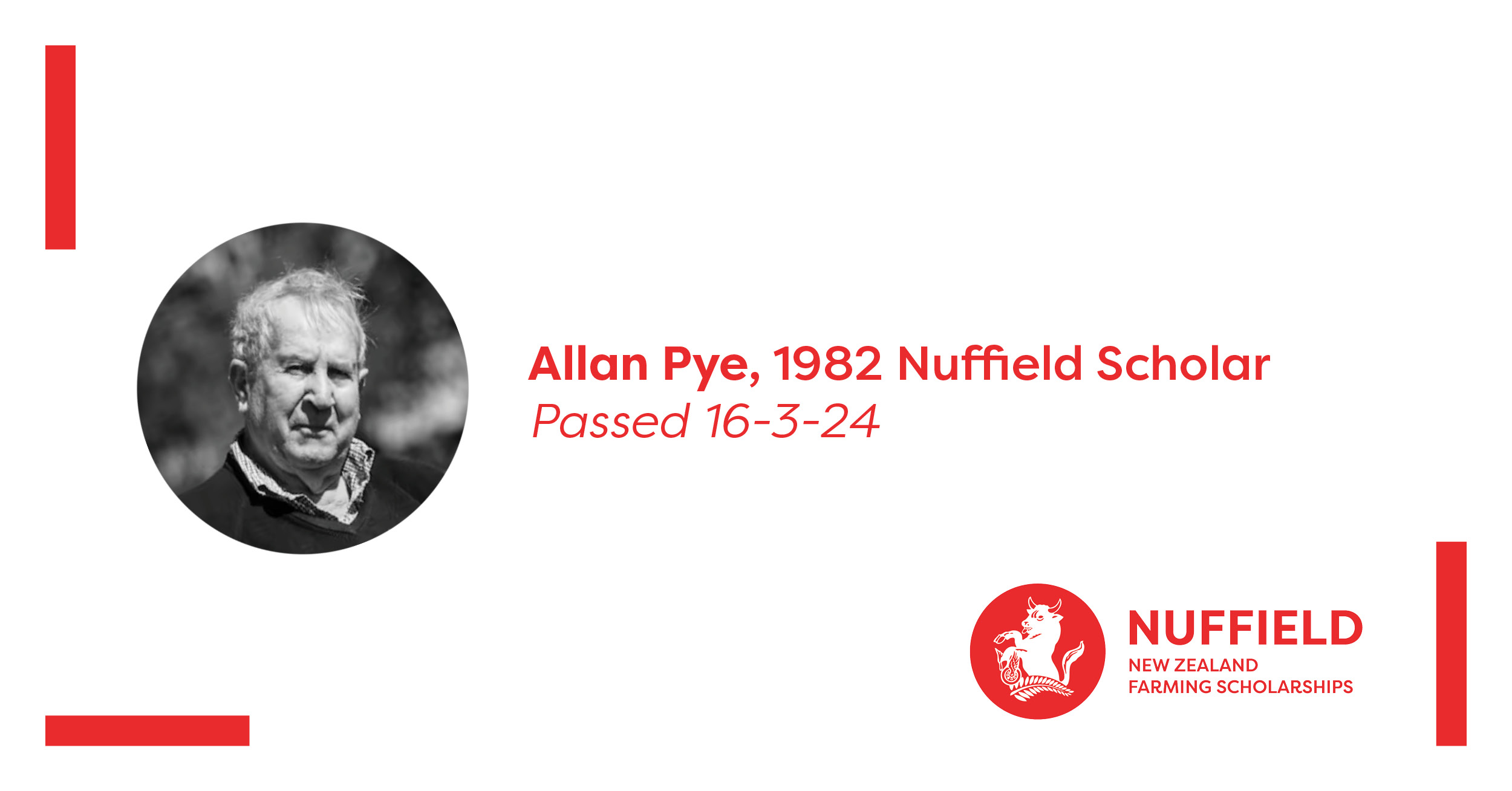
Allan Pye, 1982 Nuffield Scholar, passes.

Rural Leaders, The Board of Trustees, and Nuffield New Zealand were saddened to learn of the recent passing of Allan Pye (1982 Nuffield Scholar). We offer our deepest condolences to Allan’s family.

Many will have known, or known of, Allan, who passed away peacefully at Burwood Hospital on Saturday at the age of 83.

Allan’s funeral service is to be held on the farm at 276 Rise Road, Winchester on Friday, March 22, at 2.00pm. Messages to The Pye Family, 251 Rise Road, R D 26, Temuka, 7986.

Allan was affectionately known as ‘The Spud King’ after spending a lifetime building a large potato business on both sides of the Tasman.

Alan was always happiest working on the farm. In a recent Herald interview, he was quoted as saying, “I love sitting on a header. There’s nothing more satisfying than sitting on a header and harvesting 10 to 12 tonne per hectare crop of wheat. It’s better than anything.”

If you would like to leave a message for Allan’s family, you can leave condolences here https://deaths.press.co.nz/nz/obituaries/the-press-nz/name/allan-pye-obituary?id=54652220


Seeking applications for a 2024 Associate Trustee role.

The Board of Trustees for the New Zealand Rural Leadership Trust, responsible for governing the Nuffield Scholarships, Kellogg Rural Leadership Programme and the Value Chain Innovation Programme, wish to appoint an Associate Trustee.

This governance development opportunity is open to Nuffield, Kellogg and Value Chain Alumni.

The Associate Trustee will have the opportunity to:

  1. Sit on the Board and gain greater understanding of governance processes under an experienced Board.
  2. Provide input into the development of two of the leading rural leadership programmes in New Zealand.
  3. Provide insights and perspective as a graduate of the programme(s).

The Role
The position is included fully in all Board activities, events and meetings.

The Associate Trustee is expected to fully contribute to all Board discussions and actions as if they were a Board member of the organisation and attend events associated with the role. However, the role has no voting rights.

Eligibility
The Associate Trustee role is open to Alumni of the New Zealand Rural Leadership Trust who completed their programme between 2018 – 2023, inclusive.

Term
The term of appointment is for a twelve-month calendar year (January – December), which provides an opportunity to cover a full year of operations.

There are seven more Board meetings this year and several events. Most events are held in Christchurch or Wellington.

Flight and accommodation costs are covered, where applicable.

The Board meeting schedule is:

  1. April 10 (Wellington)
  2. May 22 (Online)
  3. July 3 (Christchurch)
  4. August 21 (Online)
  5. September 11 (Wellington)
  6. November 4 (Wellington)
  7. December 18 (Online)

Remuneration
There is no remuneration or payment, however all direct costs (such as flights and accommodation where required) relating to meeting attendance, will be met.

Confidentiality and Conduct
On appointment the Associate Trustee will be asked to sign a confidentially agreement.

Although the position is not an appointed Trustee of the New Zealand Rural Leadership Trust, the appointee is expected to adhere to the code of conduct of a Board member.

The Associate Director is expected to comply with any reasonable directions of the NZRLT concerning their role.

Application
Interested scholars should forward their application by 28 February 2024 to Lisarogers@ruralleaders.co.nz

Applications should be in writing, with a CV and a covering letter with the following;

  1. The reasons for applying for the role,
  2. What you expect to gain from the opportunity, including how the opportunity would contribute to your leadership goals,
  3. How you might contribute to the Board’s skills, experience and perspectives.

Appointment process
An appointments sub-committee (a delegated committee of the Board) and the Chief Executive will consider all applications and provide a recommendation to the full Board who will approve the appointment.

The successful Associate Trustee will be notified by Mid-March and will be invited to attend the 10 April Board meeting in Wellington and subsequent meetings and events.

For any questions please contact:
Lisa Rogers, Chief Executive
Phone: 021 139 6881
Email: lisarogers@ruralleaders.co.nz

Field notes from the 2023 Value Chain Innovation Programme.

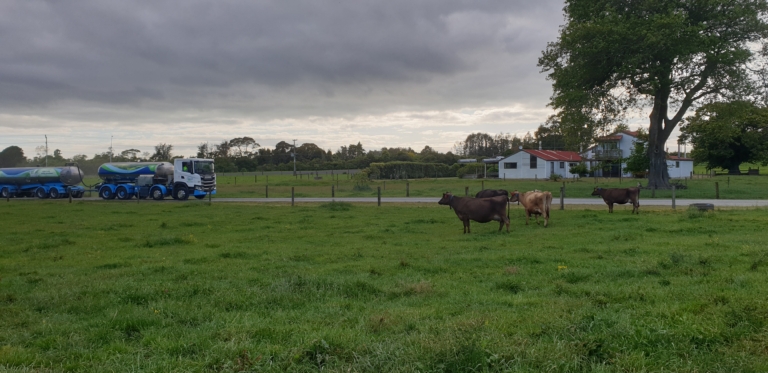
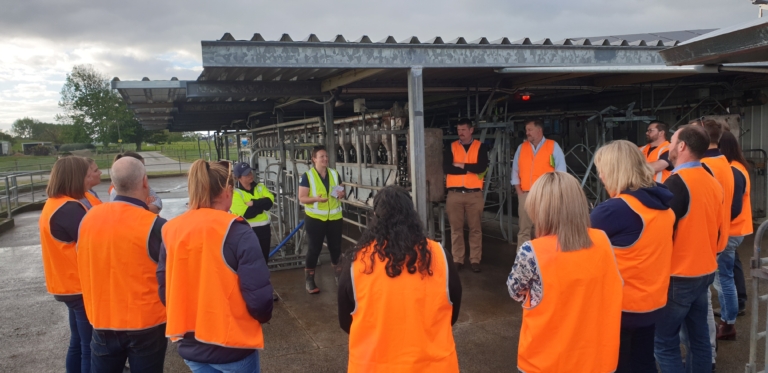
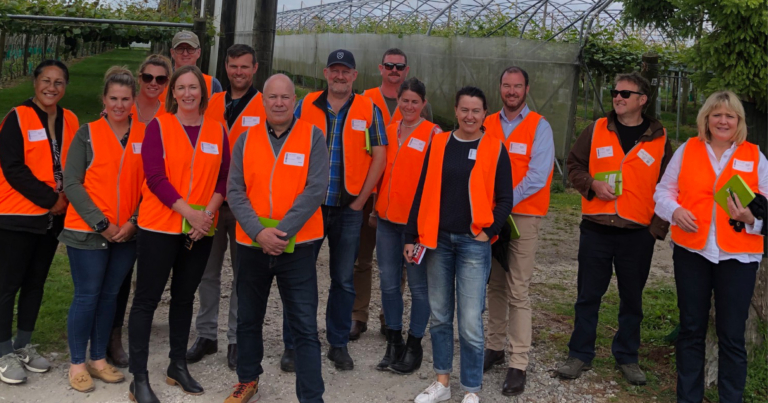
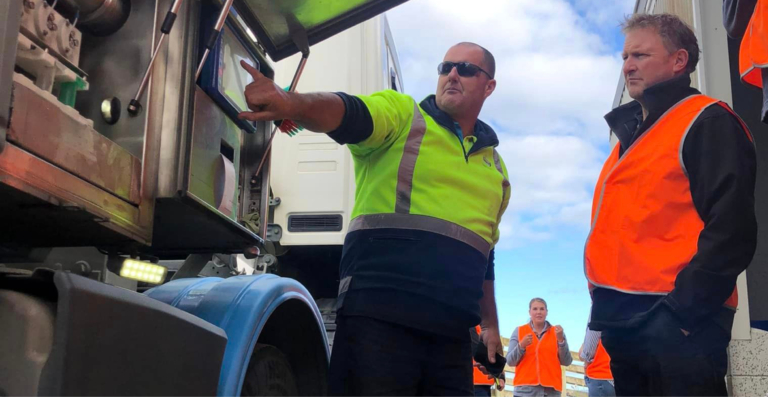
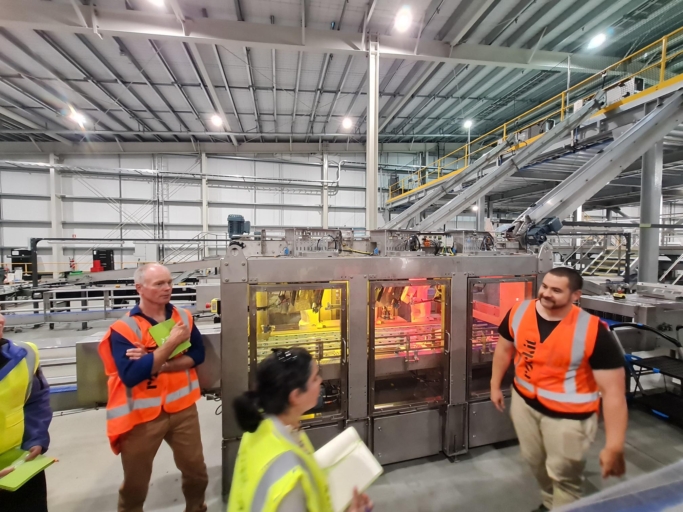
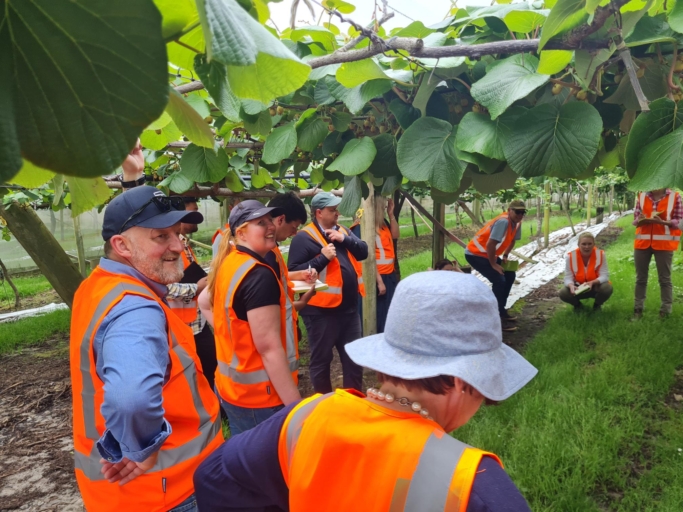
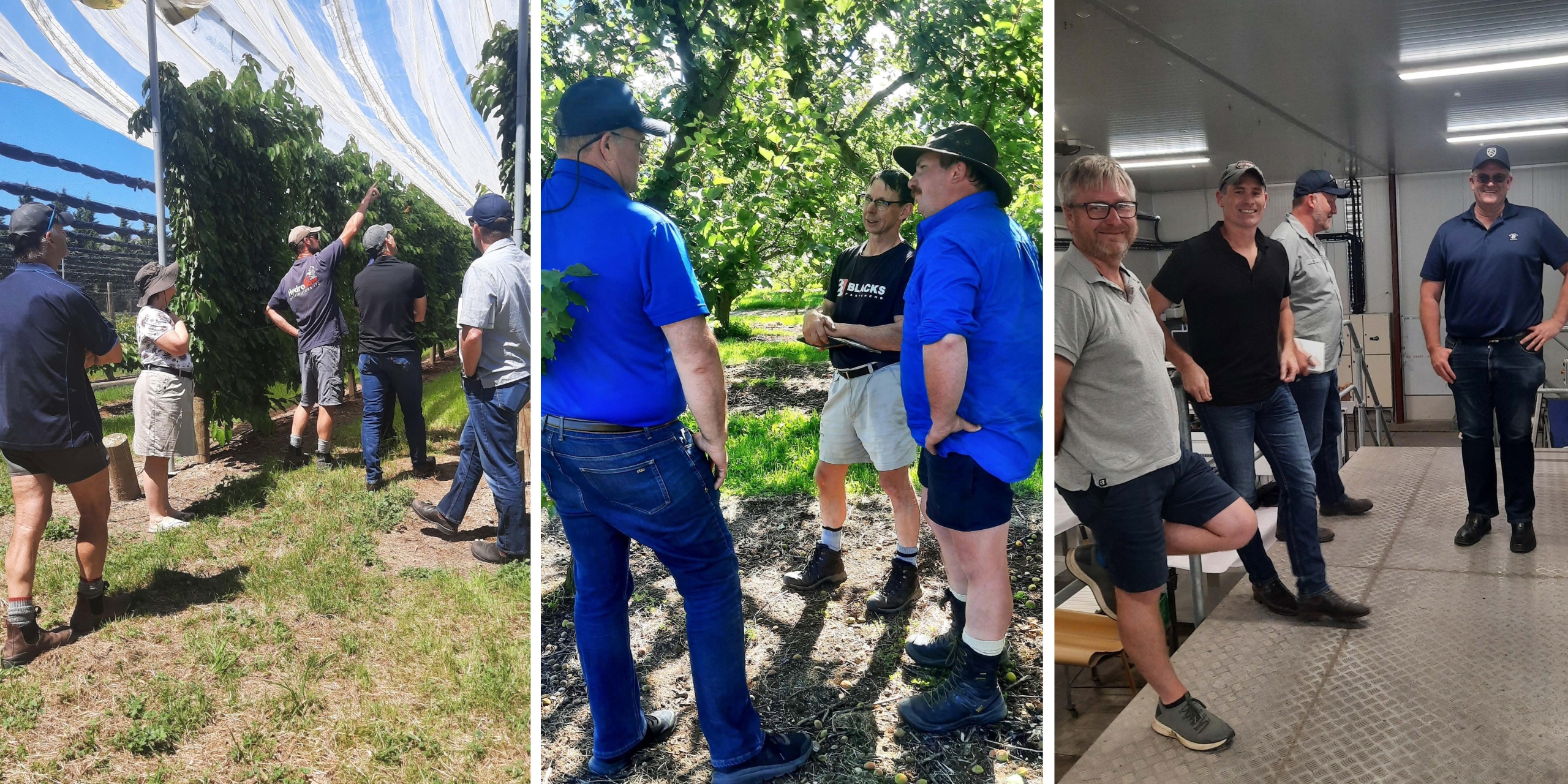
Just over two weeks ago a group of people from across New Zealand came together in Auckland for a week of visits to operations within four key value chains – Dairy, Red Meat, Apple and Kiwifruit.

Any one of the twenty-two Value Chain Innovation Programme visits seen in isolation, would generate plenty of ‘aha moments’. To run four value chains in their entirety was quite something else. It’s what makes this programme work so remarkably well.

The level of access to the leaders, founders, operators met on the Programme created the feeling you were often being ‘let in’ on some extraordinary insights. This made possible by the understanding that Chatham House Rules apply.

In this article we share ‘field notes’ from the perspective of the people who were there.

Jesamine Wanoa, also wrote a post a day while on the Programme and offers her unique perspective as a specialist grower of native NZ plants and owner-operator of Tangikaroro Native Nursery.

Rachel Baker, was one of the four 2024 Nuffield Scholars on the Programme. We share her post-programme post. Rachel is a Farmer and Portfolio Manager of MyFarm Investments’ Hawke’s Bay apple syndicates.

Jesamine

12.11.23
Day 1 – Jesamine Wanoa:

Good first day, departing at 1pm from Auckland Airport to Hamilton.

Instantly connected with two Ngāi Tahu women, and enjoyed deepening my understanding of the three disciplines of value chain models, and seeing the potential for where Ngāti Porou might adapt a model to suit our purposes. A good overall general structural framework for navigating this journey with.

Thank you Hamish and Phil for both leading and Co-facilitating, and Matt and all my colleagues on this journey with me. What a talented bunch!

I’m so excited to finally be here growing our network and understanding together. Thank you my whanau back in Te Araroa and in Tuwakamana for this opportunity.

13.11.23
Day 2 – Jesamine:

Visited Te Rapa Farm (Fonterra Farm Source) and witnessed milk testing technology at Fonterra today, as well as cheese and dry milk powder production. Then visited the cold store facility prior to export. Every truck bringing in product must meet a standard of cleanliness! Amazing 40 ton forklifts that lift 28 ton crates.

Additional field notes:
First stop was a Fonterra Farm Source working dairy unit, where new on-farm technologies and innovation are trialled for wider rollout.

We explored MilkTestNZ, where milk samples from 10,000 dairy farms are tested every day in a remarkable feat of logistics and efficiency.

Then we moved to Fonterra’s impressive distribution centre, to LIC and DairyNZ where senior leaders spoke with us directly. And the NZ cream on top – a visit to Zenders Cafe, run by three sisters who grew up on a Dutch dairy farm.

14.11.23
Day 3 – Jesamine:

I was very impressed with our host Hayden’s approach. Hayden works with Robotics Plus. The ability of Robotics Plus to recognise where their strengths lie in solving problems, helps them then play between the flags of those strengths, to produce customer-focused solutions.

Their model allows for collaboration with other partners, who hold expertise in other areas of the value chain outside these flags, to create a solution fit for purpose to meet the client’s needs. Ka mau te wehi!

My take-away from this visit, is that it’s critical to customer trust and confidence to be transparent about what you’re skilled in, and then decide what components for the solution should be out-sourced to business partners who are better positioned to meet those requirements.

This collaborative approach towards knowledge sharing to solve the customer’s problem, allows business partners to use their unique skillsets to support you and your customer’s business, and vice-versa.

This model is so efficient and utilises a strong collaborative network approach that puts the customer at the centre – and is future focused. Everyone on the workshop floor understands that culture from apprentice to Manager. Everyone has genuinely taken ownership of their part in the value chain, creating an incredibly innovative and creative work environment that’s a safe space for developing their talent.

After Robotics Plus, the Ports of Tauranga. The volume and variety of export that goes through this space is mind boggling! It requires every individual on-site to be committed to best practice in terms of biosecurity and health and safety.

There are layer upon layer of control measures needed, not just to keep you safe on this extremely busy port, but to keep you alive! We saw here the forestry logs, and the automated Robotic Plus technology used, to measure each log’s length, diameter and therefore weight.

The next visit was at Zespri, who have shifted over time from being supported by government entities, to now leading and supporting our government on the international stage. Such is the success of their approach, which is thorough but future focused, with the consumer always front of mind.

Also invited to speak were KVH (Kiwifruit Vine Health), who focus on NZ’s biosecurity response. KVH anticipates future threats before they hit NZ, to mitigate and minimise their impact. Again, another visionary entity, who like Zespri and NZKGI (NZ Kiwifruit Grower’s Incorporated), were willing to share material in their presentations today, and made the process of choosing the kind of model that would be a good fit for Te Tairāwhiti easy.

I express my sincere gratitude to all the above businesses for their kindness in opening themselves up to our questions, and for their generosity in sharing their answers. I have found today absolutely invaluable. Kei te mihi tino nui ki a koutou.

Additional field notes:
Port of Tauranga Ltd, the largest of NZ’s 13 ports. An impressive operation to see firsthand – 80% of NZ kiwifruit exports, 70% meat exports, and a total of 24.7 million tonnes moved through the Port last year.

Next stop, hearing from senior leaders at Zespri, KVH and NZKGI in Mt Maunganui – a collaborative model combining single point of entry via Zespri, strong advocacy via NZKGI and world-class biosecurity from KVH.

15.11.23
Day 4 – Jesamine:

We started the day with Plant and food research, who perform a critical service in protecting our horticultural industries like Zespri. They have a pioneer research team working on taonga foods. I’ll share about this at a future date. So exciting!

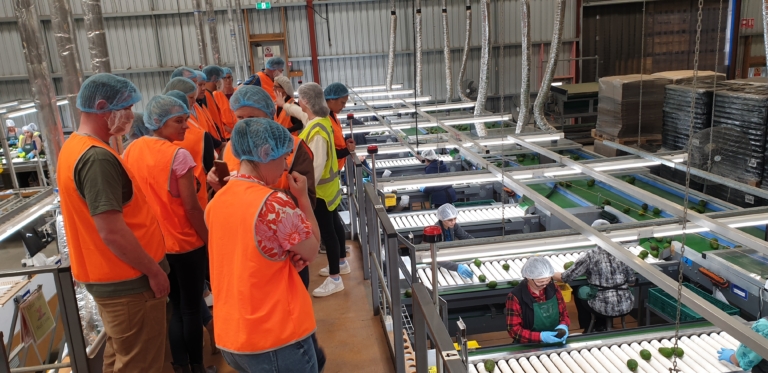
We then left for Trevelyan, who are a legacy NZ company that’s been around for eons. Time critical performance schedules for grading, sorting and packing, to get produce exported to their international market.

Then we had the pleasure of a walk through an A Class nursery, Southern Cross Horticulture. An awesome set up that’s got so much to offer in specialist knowledge for growing Kiwifruit.

Additional field notes:
Day four, continued the kiwifruit value chain. First stop – the Kiwifruit Breeding Centre, a collaboration between Plant and Food Research and Zespri. KBC finds out what growers need in a cultivar and then deliver through accelerated research.

Then onto the Te Puke based Trevelyan’s, an independent, family-run, single-site kiwifruit and avocado packhouse – and NZ’s largest. It has a 50+ year history and has family values woven through all facets of the operation.

Southern Cross Horticulture – orchard developers, cropping and orchard management. We saw a perfectly constructed system, consistently delivering the perfect plant.

Finally to Pāmu’s Wairakei Estate to complete the dairy value chain. We heard from senior leadership on Pāmu’s dairy beef, organic dairy, winter milking, A2 and deer milk, and pastoral business mix, as well as an extensive sustainability strategy on all 112 Pamu farms.

16.11.23
Day 5 – Jesamine:

Today I broke my ‘beer drinker virginity’ with a tall glass of Gizzy Gold! Thank you Gerard and Jason from First Light for treating the local pub as your classroom 😀. By embracing a real world approach, (the course) allows us as participants to get up close and personal with export industry leaders, in their mix and mingle comfort zones, which in NZ is the local pub.

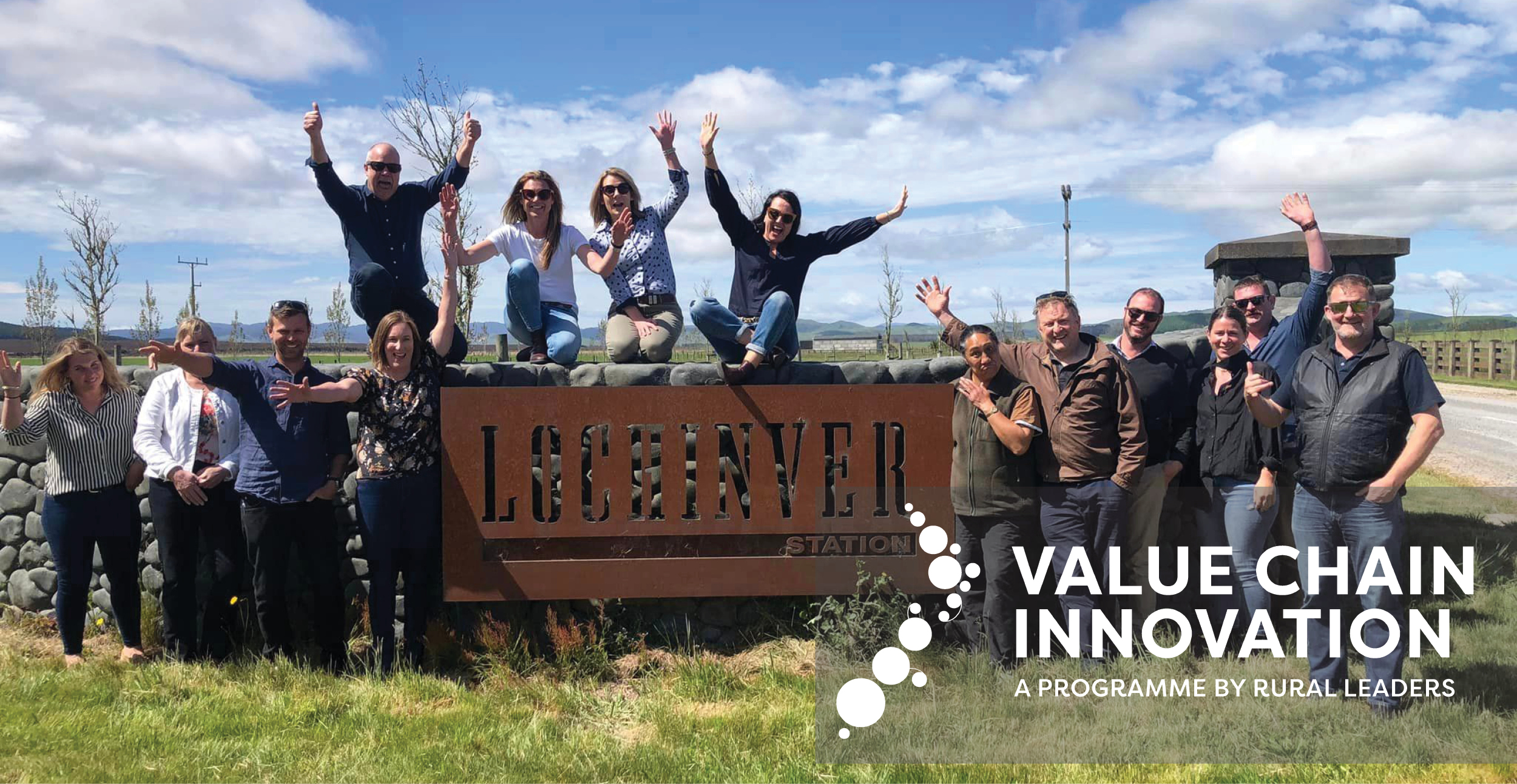
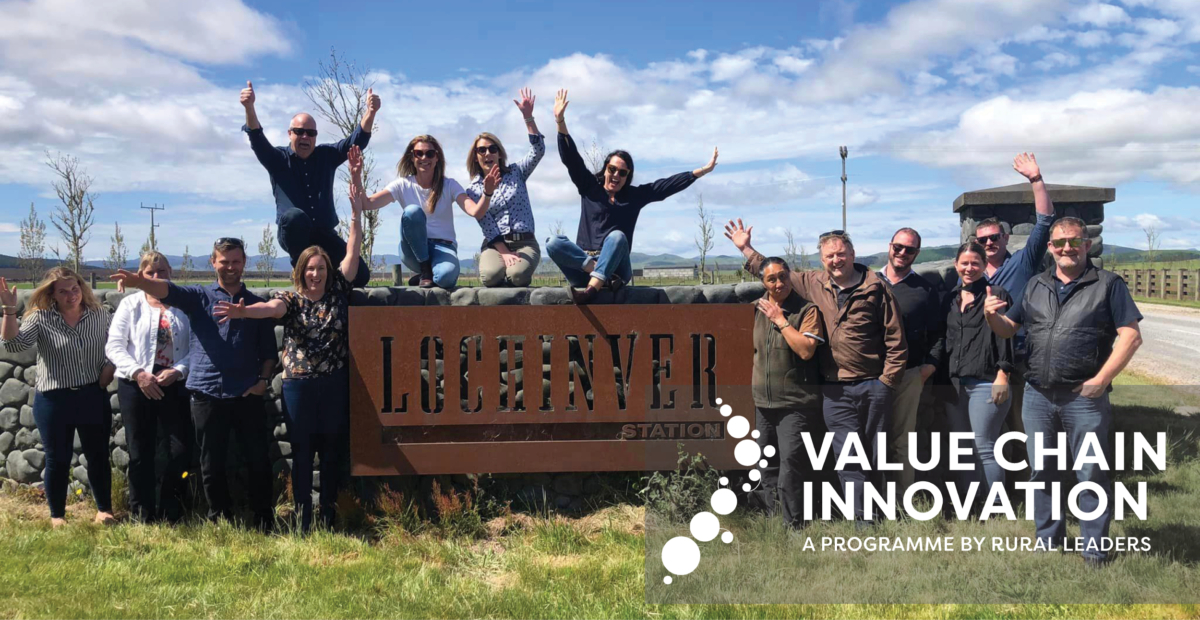
However, before we got to the pub, we visited Lochinver, a huge farm with huge stock numbers. The value chain here is commodity based, which is very different from that of First Light.

Aside from livestock, I can see huge potential in the land itself here, and the still untapped natural resources of native plant seed harvesting and propagation, and gourmet food developed from wild Canadian Geese. The geese are a pest here, that could add economic value as meat. However, that would require a shift in mindset which may not suit their current customer focus.

So what I learned from First Light is that different value chains will have a different focus depending on who they identify as their customers, which can be at different ratios for customer groups, with strategies to cater to each of those customer groups.

Additional field notes:
“We’re driven by growth, but by growth in value.” Jason, First Light Foods.

Jesamine:
Being able to forecast how the dynamics in the make-up of that customer group will change over time is key to longevity. Looking after every step of your product’s journey from farm gate (nursery) to the customer, while never losing your “story” and point of difference, is also a skillset NZ is leading in, but can always improve on.

Additional field notes:
“I’d rather stab myself in the stomach than lose a point of difference.” Jason, First Light Foods.

Jesamine:
The journey from Lochniver to Napier took our team through Eskdale Valley, where a colleague walked us through the disaster as she experienced it. What we saw, the impact on the land, the homes and the lives of locals was incredibly sobering. To say that the people here are resilient is an understatement.

Upon reaching Napier, prior to meeting the owner operators of First Light, we had the privilege of meeting Gourmet Direct, who BBQ cooked delicious samples of Rose Veal for us, and believe me, it’s to die for! It’s the one thing that both Gourmet Direct and Zespri got right. They both show-cased their product for us to taste test. That’s a mark of confidence that’s earned each of them a 10/10 in my book.

I loved Kate and Perry’s “who and why” story for their value chain. The success of it will be significantly influenced by how well that story is communicated both locally and internationally. (I shared an idea. I hope they use it).

Additional field notes:
Lochinver Station kicked off day five on the Value Chain Innovation Programme. 13,000ha’s of mostly sheep and beef finishing.

Next stop was one of New Zealand’s first direct to consumer online perishables retailers, Gourmet Direct. Owned line, Rose Veal, sees animals raised in pasture to 8 Months. No hormones, antibiotics or palm kernel are fed.

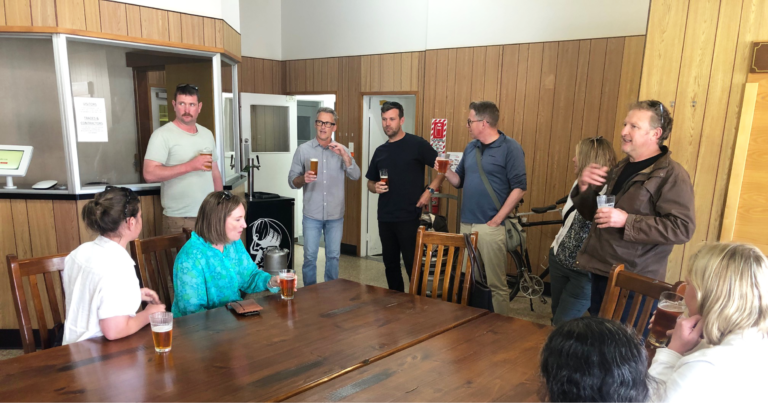
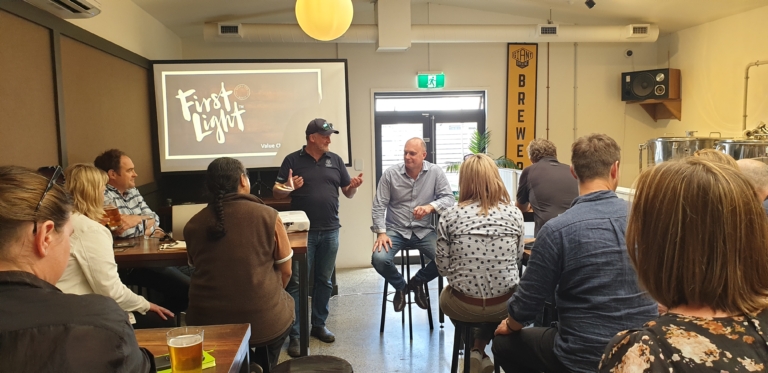
First Light Foods’ founders hosted an inspiring discussion at Havelock North’s Giant Brewery. First Light continues to show how to produce the highest quality grass-fed wagyu and farm-raised venison.


17.11.23
Day 6 – Jesamine.

Today we visited Turners & Growers, Rockit and Mr. Apple. So in a nutshell, apples were the food of choice for the day. We also were introduced to a newly created beer, one of my course colleagues produced. I’ll wait until he launches it first though, before I mention the name. My Dad would absolutely love it.

We saw the differences in the value chain models employed by each of NZ’s top apple growing companies. We also touched on the impact of Climate-change, Covid, Delta, War, Government, and building human capacity, and how that looks for each group.

I met people today, who are not just international superstars in the horticultural and agricultural space, I also witnessed trail blazers passing on the torch to a group of passionate, driven and motivated visionaries – my colleagues. It’s humbling to meet local NZ giants, who understand the international market place so well, they can put you at ease, while describing their story in a way that makes it easy to digest.

There were times I could enjoy bite-size pieces, and there were times I knew I just had to live in the moment and absorb whatever I could. The thing I felt grateful for, was that the way they told their story allowed me to feel I was sharing in it. The quality and callibre of leadership in the room amongst my colleagues, meant that I was learning from the questions they asked and the answers we all received as a result.

I hope they in turn, were able to take away something from the answers to my questions. I’m really proud of all our NZ apple exporters. Thank you for your commitment to lifting our country’s economic future up to where it needs to be on the world stage. Tautoko!

My last point, is that the style of teaching in this course, requires you to have an appetite for the market place, regardless of what your focus is in your given industry. You can’t wait to be spoon fed. You have to be proactive, to stretch yourself – at times painfully – outside your comfort zone. That in itself, is a very important characteristic in the market place, which changes shape often. Adapt or die is a loud enough message here.

Fortune favours future-focused visionaries, who appreciate the value of our own authentic story, to share in a new way on the world stage for everyone to enjoy. It’s our point of difference, that makes us the premium product, and therefore the premium price point.

Additional field notes:
Day six, T&G Innovation Orchard. This vertically integrated continuous improvement model covers research, growing, sales and marketing.

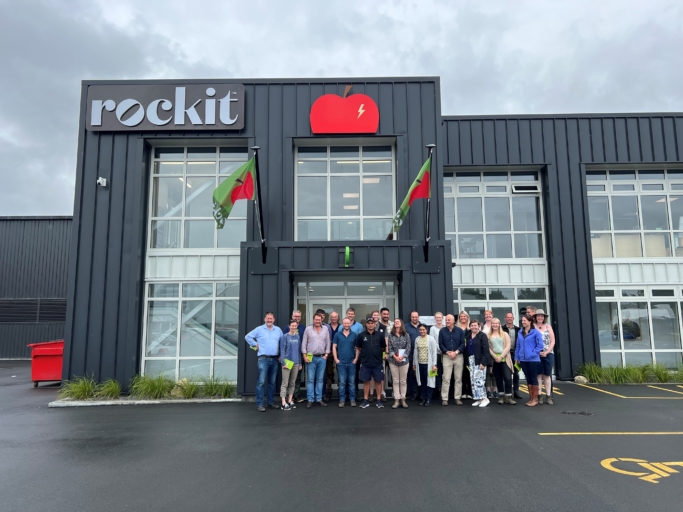
Next was Rockit Global, where we spoke with one of New Zealand’s most experienced, accomplished, and humble sector leaders.

Rockit was a clever apple waiting for an idea to fall on it. And, the idea that landed turned out to be rather big; apples in a tube, sold at service stations – and a huge export earner too. It’s a story that “…neatly blends FMCG requirements with fruit realities.”

The final visit Mr Apple, export 25% of the New Zealand’s apple crop around the world and follow a philosophy of “…discipline not control…”

To end the day, programme participant Carlos Bagrie kindly shared the first pull of his fantastic new beer in the hi-tech brewery it was made in.

18.11.23
Day 7 – Jesamine.

The opportunity to see Craigmore Orchards today, was an experience that will stay with me for a long time. Simply because of the sheer size and scale of the operation. There are literally tons of apples taken from here to international markets, with most being IP branded to specific companies.

The fascinating thing about the apple industry, is the collaboration between growers supplying the market. Growers are both transparent and supportive of one another. Working together lifts the standard on both the domestic and international front, because best practice outcomes add value to the market’s perception of NZ apples as a “trusted source”. This perception of us as a trusted source, is what allows us to trade our NZ apples (in competition with other international growers like Chile 🇨🇱, USA 🇺🇸, etc.) at a premium price.

Our country’s leadership in the apple industry, regard people as a valuable asset to be invested in, developed, and up-skilled. The apple capital of NZ is Hawkes Bay, where staff retention can be a challenge. So this approach is pivotal to this industry’s survival and success. There are good success stories with migrant workers, which has benefitted our local retail in Hawkes Bay, and the families of these workers in the Pacific.

Out of all the apple brands out there, Rockit, Mr Apple and Turners & Growers lead in this space. Thank you everyone for your enormous generosity towards our group, who will one day be your future industry leaders.

Additional field notes:
The last day of the Programme – Craigmore Orchard, producing 2500 tonnes a year. The Orchard’s leader has a passion for people, “…along with locking up great IP … good social practices will be something that differentiates NZ Horticulture.”

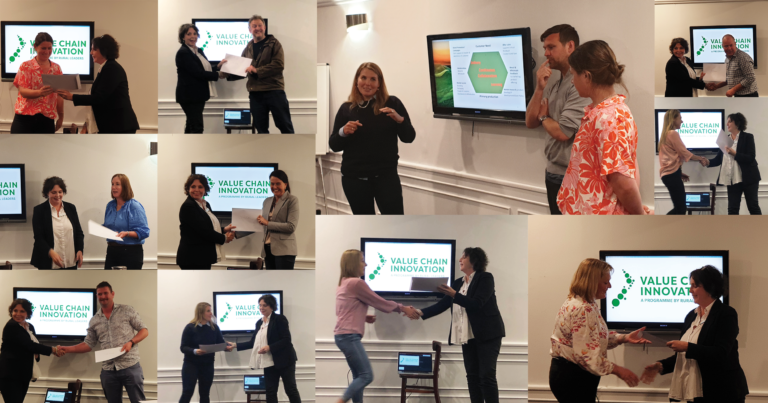
The day ended with Lisa Rogers, Rural Leader’s CEO, and facilitators Hamish Gow and Phil Morrison chairing participant preso’s before a final dinner together.

A truly inspiring and informative value chain experience, where sharp ideas, insights, new connections and friendships have been made.

Good things.

Summary – Jesamine.

The Rural Leaders Value Chain Innovation Programme: If there is one word that springs to mind to describe this course, it would be “access”. Access to a wider vision for understanding the same landscape. Access to business models that can shift you from a business transaction to a business relationship with other entities. Access to incredible industry giants who I believe genuinely care about “our country”.

The second word is “relationships”. The wealth of “industry know how” across the horticultural and agricultural sectors became available to other course participants and I, because of the relationship “Rural Leaders” has with industry gurus in their field of expertise.

So then after having found access to these relationships, the question is now, “Where to from here?”

My experiences have re-shaped my vision. I arrived in this space believing I would discover a value model that I could take home, adapt and bend into a Maori framework to create a “Maori Rural Leaders Value Chain Programme” for Ngati Porou. What I realised by day 1, is that this approach would rob my own people of the huge value that is found in the interactions between Pakeha, Maori and Tauiwi course participants in this space.

The learning in these interactions is just as valuable as the knowledge gleaned from sitting face to face at the table with industry experts, and the mentoring by course leaders.

Although my Koro, Ben Wanoa was a farmer, as was his father Rev. Matauru Wanoa, I myself had no experience of farming other than to feed Papa’s chooks as an 8 year old from the wool-shed platform. Listening to the calibre of questions issued by my Pakeha colleagues working in dairy and beef, to CEOs, Chairpersons, Managers and the like, gave me a greater appreciation of their huge concern for the horticultural and agricultural industries in Aotearoa-NZ.

There were also Ngai Tahu women leaders present as course participants, whose skill and expertise were wonderful to witness. I believe my own questions and answers had some impact, even if I hadn’t intended to challenge the CEO of Rural Leaders.

When I was asked, “What do you think is the biggest impediment to Maori accessing this course?” I plainly answered, “Money. I have heard my Pakeha colleagues share about the very real hardships they have faced with Covid, weather events, government and industry bodies. If they’re operating at 60% with all they have access to, then my people who have no access, are operating at 40% or less.

We can’t say NZ’s the best in the world if we’re operating at 40/60. We’re only the best when we’re all operating at 100% in total. To get there we can’t operate as ‘them’ and ‘us’ on the world stage. There has to be just ‘us’ if we’re going to compete as a country against international competitors. The 100% lift we’re looking for with resource allocation, must be right across the sector to get prime product status for all of NZ. Rural Leaders are acting on this.

Rachel-B

Rachel Baker – via LinkedIn.

Last week I toured the North Island exploring NZ food sectors on the Value Chain Innovation Programme delivered by Rural Leaders and facilitated by Hamish Gow from Lincoln University.

This is a truly outstanding programme. Learning as a group from each other, while being connected with the leaders, innovators and rockstars of businesses in dairy, red meat, kiwifruit, apple and logistics, and doing a deep dive into each.

It continually struck me over the week that as a food producing nation, we trade on trust. Trust in relationships (many buyers were customers of 20+ years), the quality of product (rigorous grade standards, consistency), how it is produced (sustainability, transparency) and who produces it (farmers and growers behind the product). Trust must ultimately reach and deliver to what our customer wants. Customer-led value chains knew their customer profile intimately.
Taste was talked about a lot. “People buy with their eyes. Marketing will get you the first sale, but taste will ensure you get the repeat customer.” We put this to the test with Zespri SunGold, Rockit apples, Rose veal and a soon-to-be released craft beer.
Other observations were that while NZ’s seasonality plays to our farmer/grower strengths, on the flipside it has the potential to erode value with uncontrolled volumes and inconsistency of product.

Capitalisation of some value chains is needed to manage future planned volume increases, and to fund innovation and technology advancement – in a capital constrained environment, where will this come from, and how will it be prioritised?

Every value chain required more highly skilled and trainable people. Those with seasonal staff celebrated and individualised them, which is not often highlighted when politicised. Our education system needs to be geared to advance our primary sector, yet some tertiaries are reducing their focus on ag/hort, science and food…

Much “thought for food” and “food for thought”…!

Thank you to all who generously hosted our tour group and to Nuffield NZ for giving me a thought provoking and inspiring opportunity.

Follow Jesamine Wanoa on LinkedIn here.

Follow Rachel Baker on LinkedIn here.

Register your interest in the next Value Chain Innovation Programme here.

The search for 2024’s Nuffielders is nearly over.

The magnitude of the decision to apply, to commit to a year or more of study, travel, and growth is significant. Most applicants are on farms, working in agribusiness – sometimes both. They are busy people, even without a Nuffield Scholarship.

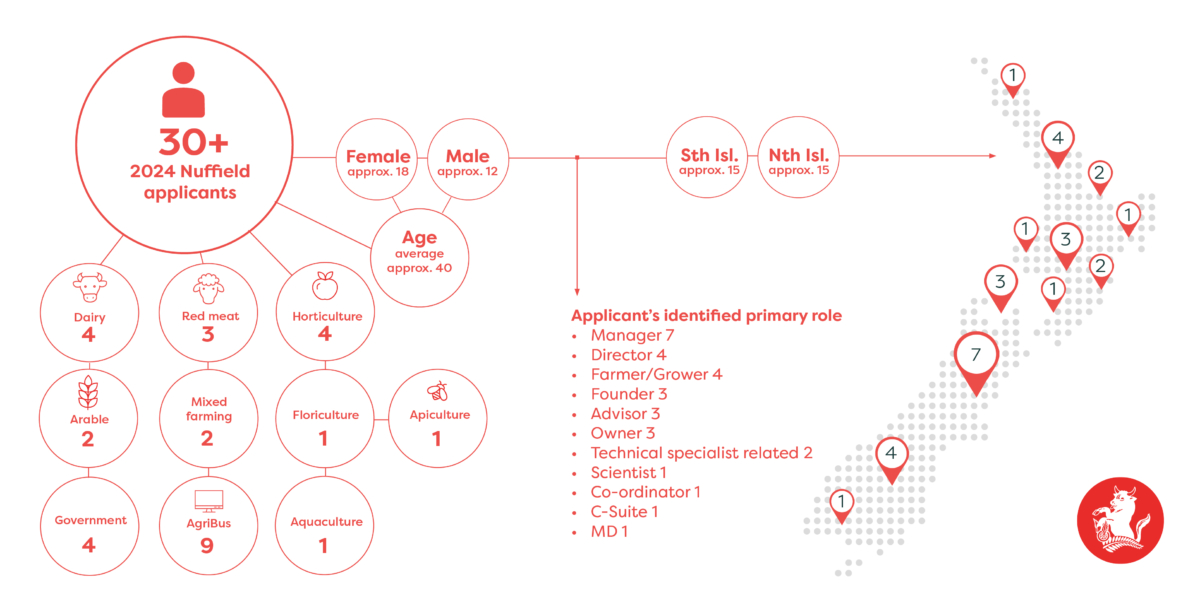
In the search for 2024’s Nuffield Scholars Rural Leaders received approximately 30 applications. Here’s an approximate breakdown of this latest applicant group.

The search for the next Nuffield Scholars: the path to receiving an application.

Here’s a brief summary of what is involved in the search for our Nuffield Scholars.

Our Nuffield alumni critical in helping prospective scholarship applicants get to grips with the process of applying and the Nuffield Programme itself. Alumni are also active in referring those in the sector they feel would benefit personally and professionally from a Scholarship. Rural Leaders follow referrals up with personal emails and phone calls.

Alongside the referral activity, Rural Leaders run a modest, traditional paid media campaign, both paid and unpaid social media, as well as some digital placements. All activity here asks for registrations of interest. This activity is rounded out with help from partners and networks.

The registrations of interest build over time and these are nurtured with a 3-4 month email campaign featuring podcasts, testimonials, links to articles and details on the Scholarship.

It’s a rewarding experience for all involved. To see the first indications of interest develop into an application. Some have applied before, some are not well known to us, and some may have had Nuffield on their minds for many years.

The applicant demographic profiles shift and change over time, while such leadership traits as: pragmatism, passion, courage, and self-awareness remain constant.

In early November we’ll be in a position share who our 2024 Scholars are. For now, we’d like to thank all the incredible, dedicated people who applied. We know it was a decision that likely involved partners, family, work colleagues and friends.

The final submitting of an application is just the start of the story. It’s also the end of this one.