The government has introduced a Research and Development (“R&D”) Tax Incentive, to support and further promote R&D in NZ businesses.
The R&D Bill has passed its first reading in Parliament and we expect legislation to be enacted in May/June this year, allowing businesses to access, and make the most of the incentive from the start of the current tax year (typically 1 April 2019).
The incentive is a great opportunity for businesses to access support for R&D – It’s expected that over 2000 New Zealand businesses will be eligible to claim the incentive.
KPMG invite you to join one of their sessions where R&D experts will present – alongside officials from Inland Revenue, and Callaghan Innovation – on the R&D Tax Incentive, providing insight into how the incentive will provide broader access to R&D funding for New Zealand businesses.
The seminar will also cover what is, and what isn’t R&D, and how to start planning early to be ready to make a claim for this year’s R&D activities.
As well as KPMG, officials from Inland Revenue and Callaghan Innovation will be on hand to answer any of your questions on the new incentive in the Q&A section of the seminar.
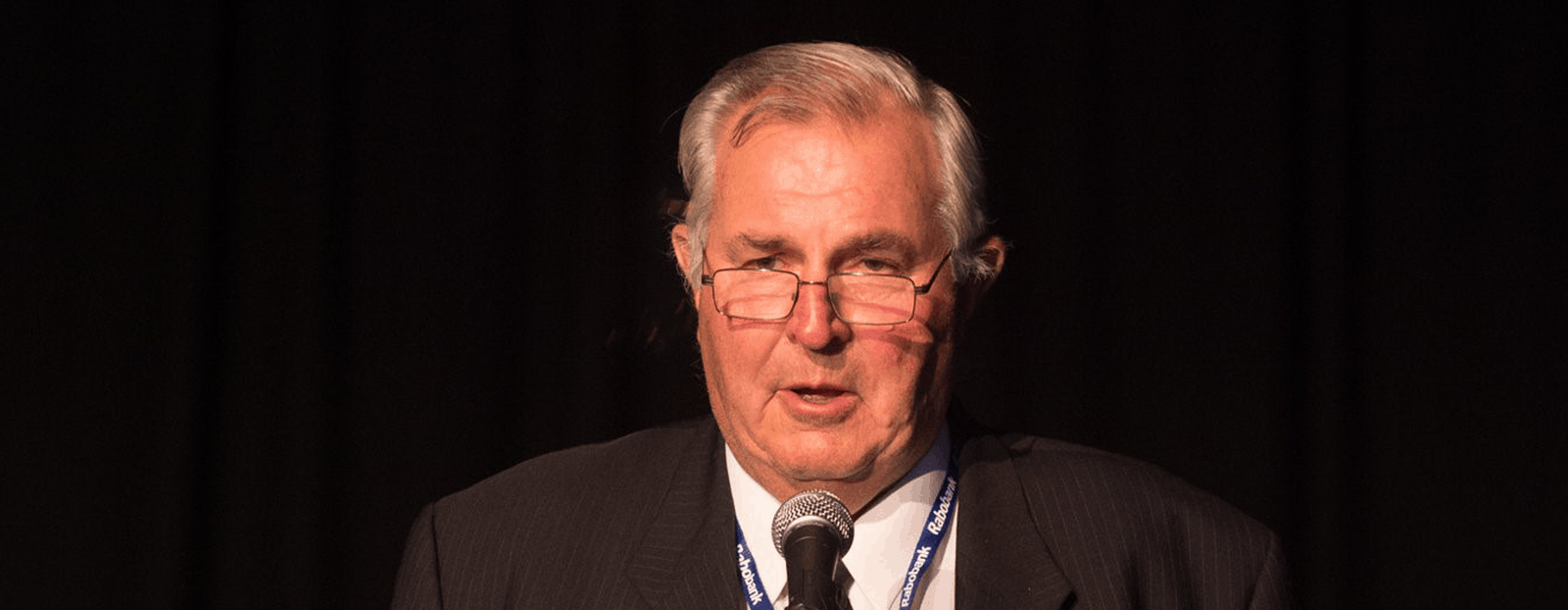
It is with great sadness that I share the news that 2000 Nuffield Scholar and former Chairman of Fonterra, John Wilson passed away aged only 54yrs. He is survived by his wife Belinda and four daughters, Sophie, Victoria and twins Tessa and Libby.
In July last year, John made the difficult decision to step down from the role of Fonterra Chairman to focus on his health. He then retired from the Board at the Fonterra Annual Meeting last November.
John was a man whose dedication and commitment to our Co-op ran deep. Outside of his family life, he dedicated most of his time to farmers, Fonterra and farming.
We owe John and his family a debt of gratitude for all the time, energy and sheer hard graft he gave us as a farmer-owner, inaugural Chairman of the Fonterra Shareholder’s Council on merger, as a Farmer Elected Director from 2003, and as Chairman from 2012.
John always brought dedication, commitment and deep dairy knowledge to each of the representation and governance roles in which he served. On behalf of his fellow farmers he was the ultimate advocate for what we stand for. He’d never back down from going at something head on if he believed it was important.
John was one of us – a dairy farmer through and through. He always looked ahead and focused on finding a way through the tough times that would protect Fonterra’s farmers, sharemilkers and their families. Bringing farmers solutions, not problems was always his mindset.
We have lost a friend, colleague, leader and champion for our industry much too soon. Nuffield NZ has lost an amazing leader who has demonstrated the commitment of Nuffield. John has always made every attempt to attend the Nuffield NZ Conference
and has been a contributor as a presenter to both the Nuffield and Kellogg programmes
Our thoughts and deep gratitude for all that he contributed go to his family and friends.
Geoff Mathis a Nuffield Scholar has focused his energies into an amazing project in Tanzania – East Africa. With the support of many individuals (including Nuffielders) MFAT, Rotary NZ World Community Service, The Rotary Foundation and numerous other people, this NZD1.1m project is changing lives.
The goal: Moving farmers and the community off the poverty line in Mwika, Tanzania.
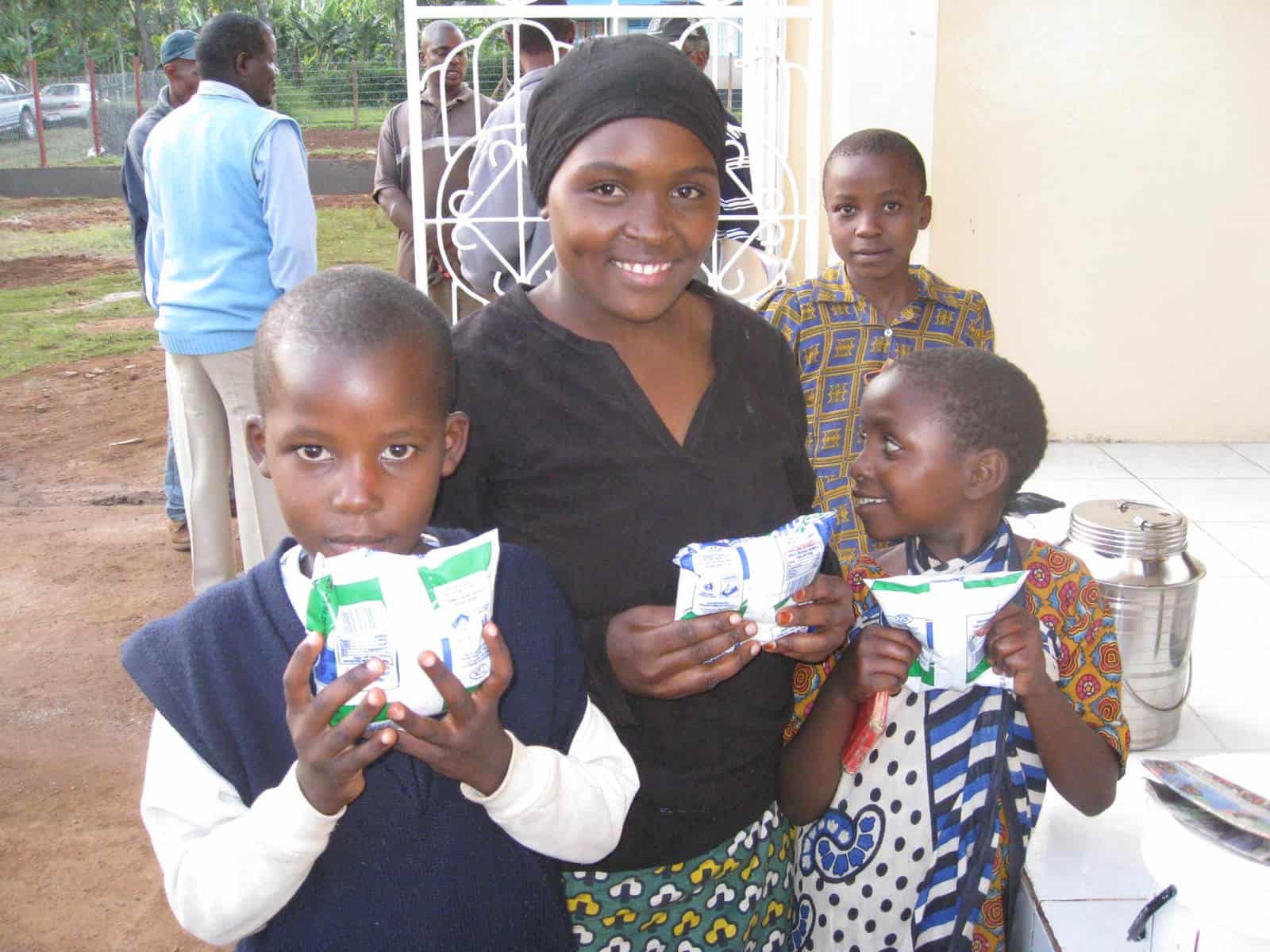
In 2008, I started helping the village of Mwika on the foothills of Mt Kilimanjaro with sufficient funding for 36 biogas digesters (converting cow manure to methane gas)?.
We have funded over 90 on-farm biogas digesters, 200 stainless milk cans, 1,000 good farming booklets – very basic, a 600 ltr per hour processing milk plant replacing the old copper boiler, 150 rising 2yr old milking cows and a lot of other equipment to support the community. Most were made available on a shared basis – the locals had to take ownership of the assistance – in most cases (but not all) the farmer made a 25% contribution to each part of the project – ownership!
It has grown considerably from that point to where we are at now – the final stage of that project.The Kondiki Dairy Co-op is very similar to where the first NZ Co-op was born in Otago in the 1880’s, a fledgling company growing with plenty of constraints …It is in desperate need for a second reliable small truck (ute) to assist in collection and distribution of dairy product. I have undertaken to do our best to fund the NZD$30,000 required.
I have setup a Charitable Trust with Rotary New Zealand (all donations receipted) – my hope is that this will be shared with your family, friends and colleagues.If you are willing to forward this domain page onto 20 persons I am sure we will achieve our goal.
We heard repeatedly about the growing world population and the related demand for food driving the need for bigger, better yields of commodity products (sound familiar?!).
America has always been known of the land where bigger is better. We saw that on show in Ames, Iowa for the 2019 Nuffield Contemporary Scholars Conference. The week served as a celebration of US agriculture and the role corn and soybean production has in feeding the world. We heard repeatedly about the growing world population and the related demand for food driving the need for bigger, better yields of commodity products (sound familiar?!). This is a message from policy makers, researchers and farmers alike. Throw in a question about the current trade disagreements and their effect on ag exports and the response is surprisingly positive. Trade needs to be fair so, despite the current blip, it will be better in the long run – rural support for the current administration is strong.
Research and Technology
Iowa State University hosted the conference. It has one of the best agri-colleges in the country with some impressive projects such as individual plant level crop management, animal vaccination by drone and genetic products. They collaborate with industry to bring products to market quickly and have a well organised extension service that ensures research reaches farmers at pace.
Iowa is also the home of John Deere who showed us a vision of the farming future with automated cropping, sensing and decision making.
Innovative Farmers
Joe Sweeny of Eagle’s Catch, a 27 year old entrepreneur, has built a $16 million glass house to farm Tilapia, a tropical fish often served whole in Hispanic cuisine. A brave move considering his glass houses are often under two feet of snow in a tornado prone area. But with a well constructed business plan and local backing, it demonstrates the willingness to ‘just do it’ here.
Ben Riensche of Blue Diamond Farming saw the inefficiency in his fleet of cropping machinery sitting in the shed for most of the year so bought a farm in a state further south growing different crops and ships his gear backwards and forwards.
Environmental Standards
The few farms we visited were very proud of their environmental work. There is a growing recognition of farming’s impact on the environment however the policy and mitigations still lag that in New Zealand. Climate change is often seen as an opportunity to grow higher yields but a threat long term.
Learning from Other Scholars
The other scholars added the most value during the week, sharing their stories, insights and many laughs. We are all struggling with similar issues of labour, public perception, succession and the environment – an insight that is both a relief and a worry. Our new global network of friends will help as we continue on the Nuffield journey. Next stop – Washington DC.
Finally – a big thankyou to all the organisers and sponsors in NZ for your support and Kia Kaha Christchurch.
A look into the Land Grant University system and their education, research and extension work reminded me of the importance of strong institutions in our agriculture sector.
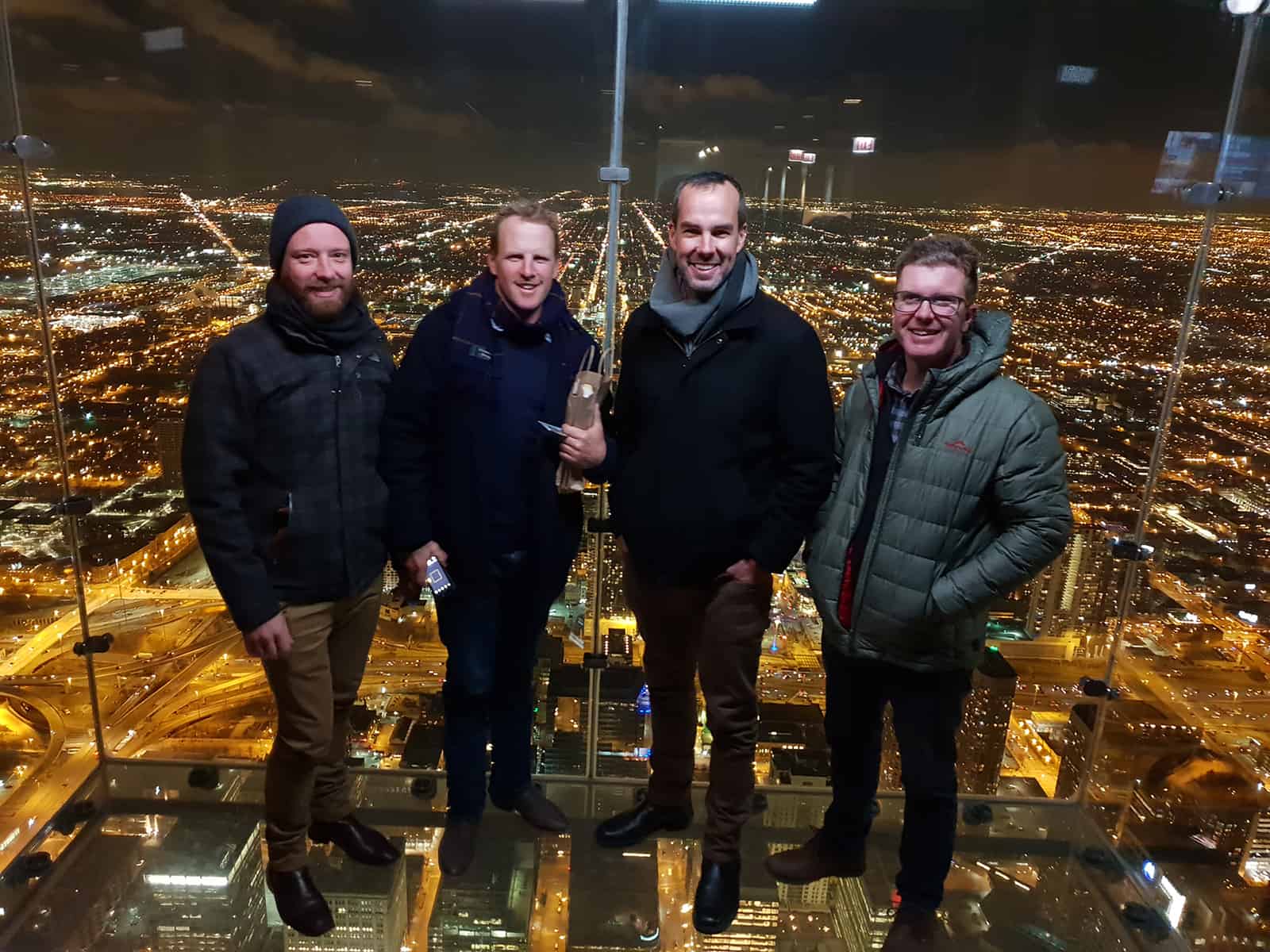
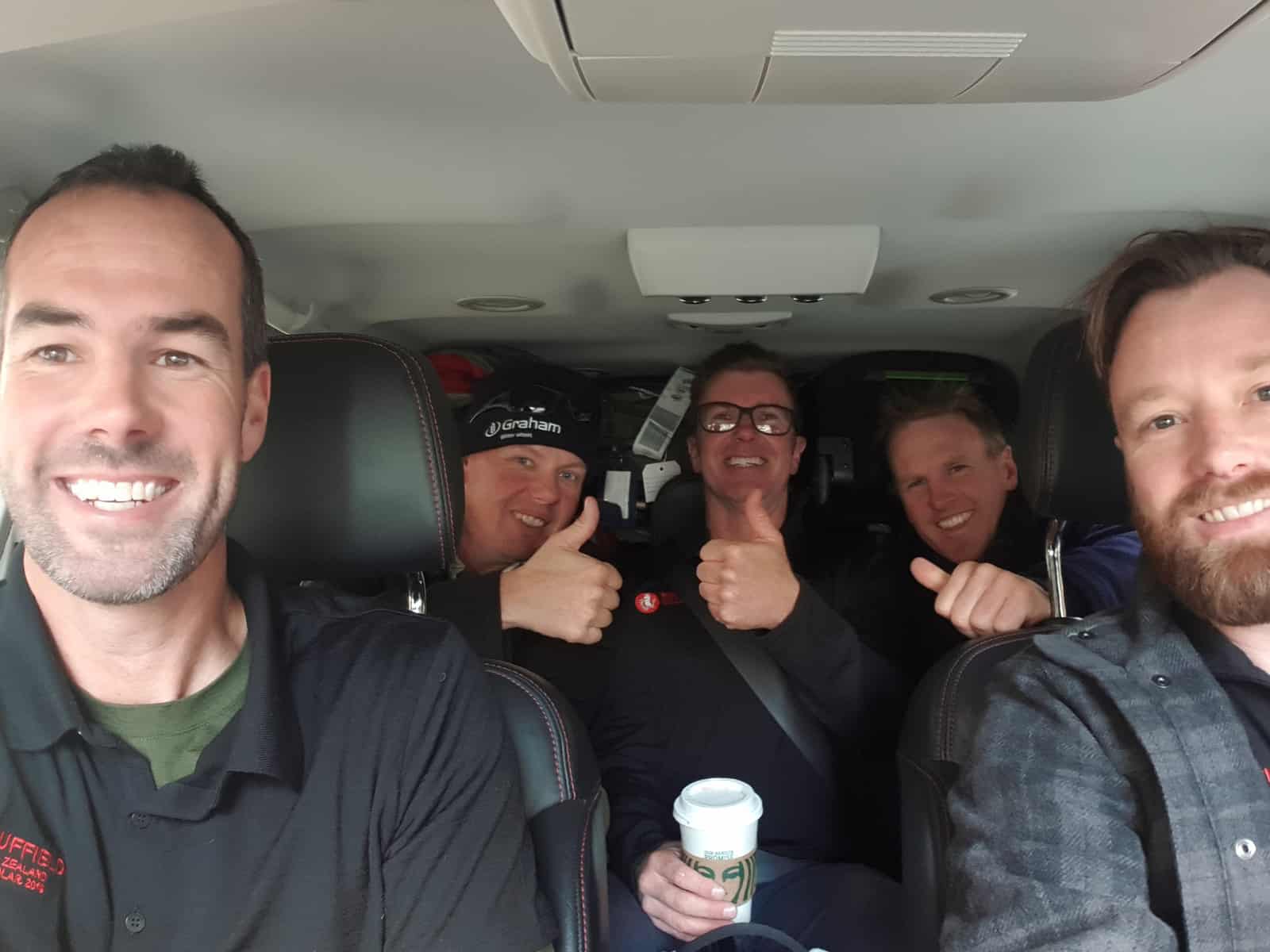
Travelling to the American mid-west in the middle of winter was a shock to the system. Stepping out after 6 weeks of 25-30 degrees into -5 was only the first, there were many more surprises instore as we explored the States of Illinoi and Iowa, the corn and soybean capital of the world for a week before joining the Nuffield 2019 Contemporary Scholars Conference in Ames.
A week together allowed the five kiwis to quickly acclimatise and the chance to use some of the work done in preparation for the year ahead. A meeting with the Chicago IDEO office in the first days of our visit, quickly challenged our thinking as it provided new insights in to the processes and insights from a professional Design Thinking Team. The idea of a broader design brief, multi-functional teams and the testing a small protypes with ever present feedback loops quickly became a theme for the week.
We went to the Fonterra head office in Chicago for a quick overview of their US operations, before heading to an Agritech Summit at the University of Illinoi. A look into the Land Grant University system and their education, research and extension work reminded me of the importance of strong institutions in our agriculture sector. The Summit illustrated both their role in innovation of ideas and the verification of data providing confidence in research. The public private partnerships were providing benefits to the all involved.
Students gaining real world experience, and reward for work rather than ever increasing student loans
Tech talent paired with innovated companies at a lower cost than Silicon Valley competition
A beach head for tech, engineering and biotech students into Ag which would previously not have been considered
Real world experience and innovation without the downside risk, providing a pipeline of ideas
Sharing data and ideas in collaborative ways between seemingly competing companies
Real importance of discovery teams for addressing the real need (ICOR teams)
De Moine, the global head office of John Deere and combine factory was a highlight, not only because like little boys in a toyshop we were excited to see the big gear, but for me it illustrated how the culture of a company flows right through from top to bottom. The guy on the factory floor had as much pride in his work as the tour guide showed and allowed us access to sit at the table in the board room. Examples of how they have instilled that culture and have been able to maintain it over 180 years were evident throughout and a good reason why they are one of only and handful of companies to sit within the Fortune 500 for over 50 years.
The five kiwi scholars hit the ground running as we joined 70 other International Scholars in Ames, however at this point it stepped up a gear again and we got a further shock to our already overloaded systems. We had built a tight group and some confidence amongst each other, but even as I sit and write this report on the plane home it is hard to explain what just happened. The intensity of the CSC, meeting so many other scholars, a packed programme of speakers and panels, field trips and social events kept pushing me to the edge all week. On reflection it is an incredible exercise in human capacity building, and I am excited for the next step in this year as I travel for GFP in June.
Three further brief points of interest – gleaned from the CSC and travels
America an example of big Ag – bigger, faster, stronger however this is slowing and beginning to shift more to thinking about smarter more efficient and lower impact.
Heard a lot about feeding the world – but it is no longer about growing more when 40% of the food grown is wasted. Consideration is shifting to the importance of providing the right nutrition to underfed and those overfed as everything in this later area is reducing our ability to tackle the 1st problem
Food trends breaking into three sectors – convenience now, convenience delivery and bulk buying of quality, natural and almost unlabelled product.
I would like to acknowledge the investment that the New Zealand Scholars received prior to leaving for the Contemporary Scholars Conference (CSC). While the preparation covered a range of skills, personality assesments, and sessions with industry leaders and government officials, I would like to highlight two skills that have helped us hit the ground running at the CSC.
In particular, the reflective techniques got us off to a strong start. During our second meeting in Wellington, Hamish Gow went over some reflective strategies and gave us some material. With a little practice before we left New Zealand and our pre-CSC, we were well prepped before by the time we arrived in Ames, Iowa – though it will continue to be developed.
A noticeable example of this was during the CSC was after a fieldtrip where many scholars were focused on some of the negative aspects of the operation that wouldn’t apply in their own country. However, the conversation amongst the kiwi scholars had different tone that centred around the context and why he was farming in this manner, and why the CSC went there. My observations and reflection from this conversation helped me develop the background and why my research project area is directly relevant to primary producers.
My Global Focus Programme (GFP) group met during the CSC to plan our team rules and roles. The techniques that the New Zealanders were developing were noticed by other scholars and I’ve taken an lead in the initial reflective sessions and the format of these.
The second skill was the open questioning that Corene Walker and Hamish Gow coached us on. On our pre-CSC trip we practiced this technique often, whether expanding on the observations made in our reflection sessions, discussing how ideas could apply to our own systems, or developing our own research projects.
The coaching and practice prior to the CSC helped to internalise this skill, helping myself to think through presentations and visits, which feeds back into more concise reflective skills. I have been able to use open questioning in my own personal life outside of the Nuffield Scholarship and believe it will be helpful in farm succession discussions when I return to the Wairarapa.
Towards the end of the CSC, we had a session when we were paired up to practice open questioning. My partner had not used this structured technique before, so I was to help coach him because of our earlier introduction and previous practice. In helping my partner, it made helped myself to view the process from another aspect and be more conscious of straying from the process.
An instance where these two techniques combined was a chance meeting with the owner of restaurant that employs recovering opioid addicts. While this business was not directly involved with primary production, the discussion provided aspects of this operation I was able to consider for my own research. For instance, a field of research used to engage individuals removed marginalised from society by addiction back into the community, which reduces relapses, that could possibly be applied to engage those removed from how their food is produced.
The investment in the scholars prior to leaving New Zealand enhanced my ability to get more out of the CSC and the week prior. Furthermore, these are skills that can be applied in my personal life and will be valuable going forward.
If you asked any of the five scholars from this year they will all say the same I’m sure, our preparation was the key to our success not only in our pre CSC travel together but also at the CSC in Des Moines. We must thank the board for three key pieces of personal training they allowed us to undertake. Juliet Maclean, Hamish Gow and Corene Walker all spoke to us at length and we gained a lot from them.
Juliet Maclean, past chairperson of Nuffield New Zealand and Nuffield Scholar was able to not only impart a lot of her knowledge from her own experience but strategies we could use when dealing with other people in situations that always arise in groups. Juliet also spoke with our partners about their expectations and what the 12 – 18 months was probably going to be like and walked us through some of those.
Hamish Gow’s insights into what is in store for us in the year ahead have been invaluable and reassuring. The explanation and classification of the stages of our journey being initially a divergent phase as we explore the world of many agricultural businesses, practices and views on the world. The concept that you can’t solve the issue on day one until you have fully understood and defined the actual problem. The idea and encouragement to keep our topics broad and the skills imparted around reflective thinking really set us apart in keeping an open-minded approach. Often the Kiwi scholars were leading those reflective practices with small groups after various discussions or field trips. “What did you see, what did you hear, what didn’t you see, what weren’t you told?” These skills were touched upon in the CSC but nowhere to the extent that we had from Hamish. New Zealand really cemented those skills prior to the CSC which allowed us to get a lot more out of it than some other countries. This fact we know from the feedback throughout the CSC. As an example we visited a beef farm during the CSC, it was the middle of winter, snow on the ground, muddy and very cold. It wasn’t the best advertisement for feedlotting cattle but it was where we went on the day. A large number of scholars were less than impressed and could see no benefit in the visit. However, the New Zealand contingent saw the potential in simple management decisions such as EID’s for weighing and feeding, regular marketing channels both in and out. Some take homes, cattle can obviously survive outdoors in -25 deg C and its not wrong, just different. Hamish’s advice was always in the back of our minds, “what is the one take home from every visit you go on?”
Corene Walker spent a day with us detailing the science of getting along with people. The first phase being you must know yourself, your strengths, your weaknesses and how you deal with these things. The second phase involves knowing and dealing with other people’s personality traits and the strategies to use these to everyone’s advantage. These soft and yet subtle skills certainly came to the fore at the CSC when faced with 80 strangers. It gave us the confidence not only in self-regulating our own feelings but also recognising the signs within the others in the group.
We also had a range of trade and government briefings prior to departure from New Zealand which helped us greatly. Even in such a short space of time, it is incredible how often people are interested in what goes on within New Zealand and how it is managed politically. Briefings from KPMG, Wakatu Farming, NZTE, MFAT, MPI, Wine NZ, Fonterra, Kiwifruit NZ, Hort NZ, FAR and Beef and Lamb NZ all helped to paint a picture of where New Zealand sits in the world.
The outcome of these meetings was that we left New Zealand as a very tight unit and we were set up well for what we encountered and what we will encounter throughout the year.
As a group, we must acknowledge and thank the Nuffield Board and also the tireless work of Anne Hindson and Lisa Rogers. Our pre-work and our travelling to date have exceeded our expectations and I know we are all very much looking forward to what happens next.
The Trustees held our second Board meeting of the year last week (early April) to address ‘business as usual’ matters focused on running two high quality leadership development programmes as well as the strategic development of the organisation.
The New Zealand Rural Leadership Trust (NZRLT) is the operational entity with the Nuffield New Zealand Farming Scholarship Trust (NFST) now operating as a capital fund for the future reinvestment in Nuffield Farming Scholarships.
Nuffield Scholars at our biennial meetings can elect two (existing or new) trustees to make a total of four Nuffield appointed Trustees, with two independent appointees appointed by our National Advisory Committee made up from our investor partners. We also have an associate Trustee appointed from recent Nuffield scholars.
I reference this because under the Charities Act we must hold our ‘annual’ meeting every year, with the proposed date for the 2018 financial year being Friday 10 May 2019. We will conduct the meeting by a zoom video-conference invite. During the meeting we will cover off the normal requirements, including the 2018 year-end financial position with the NFST. As requested at last year’s AGM we will provide you with an update on the financial situation with the RLT and we will also provide updates on Nuffield International, the 2020 Triennial, and our Rural Communities project.
As part of the AGM we will provide some feedback on the ‘one kitchen two restaurants’ concept developed five years ago – that saw the NZRLT be formed and take over the operations of both the Kellogg and Nuffield programmes in June 2017. The analysis shows that Kelloggs has been a great contributor to the financial performance of the NZRLT, which in turn has enabled us to improve and extend the Nuffield Scholarship programme.
As a reminder, our two programs are as follows:
Nuffield:
Develop emerging producer (farming) leaders by fast tracking their leadership pathway through GLOBAL exposure & learning
Equip scholars to analyse and untangle wicked /complex problems, thereby enabling effective provide producer input into decision making
Experiential learning with the tools to maximise opportunities available
High quality research project and global insights delivered to partners, farmers /growers and industry
Kellogg:
Providing the ideas, capability, motivation and skills to “enable” and empower leaders who can collaborate across sectors and geographically.
Providing the tools, skills, and pan sector understanding of NZ AGRIFOOD sector
Creating networks/friendships across sectors and country
Transferable skills being Collaboration, Creativity and Communication
Kelloggs is an ideal pathway development programme into the Nuffield scholarship although candidates can successfully enter the Nuffield program directly.
As the NZRLT our unique proposition as an organisation is:
Experiential learning focus and global exposure (Nuffield)
The combined Kellogg and Nuffield alumni
Our proud and successful history with a positive view of change
Our insightful reports
Our pan sector representation and national reach
Craige Mackenzie and Anne Hindson attended the recent CSC programme in Iowa in the US. It is pleasing to see our five scholars standing out as a group with their enthusiasm, team work and work ethic. They were well prepared and showed their capability and potential.
Craige represents New Zealand on the international board with the current focus on the financial sustainability of the organisation and delivering on current international scholar commitments. Nuffield International has important goals to extend Nuffield beyond the Commonwealth countries but is still in start-up mode.
Michael Tayler and his able team are making excellent progress on planning for the 2020 Triennial. The combination of the Nuffield New Zealand conference, the Agri-business Summit and the Nuffield 2020 Triennial (10 days from 20 March to 29 March, plus technical tours) makes this job a massive feat to organise with the resources of one contractor, volunteers and some support from NZRLT. We hope all our alumni will take on the host role and be part of the full programme.
Whilst we plan to update you on strategic matters at the AGM, our short-term focus is on building our potential pipeline of people (with an emphasis on farmers and growers) considering our two programmes. To that end we are to repeat our successful regional meeting initiative from 2017 to attract new potential applicants. This time the meetings will be open to both Kellogg and Nuffield applicants; we intend to utilise the meetings, to showcase our best scholars and to discuss the potential Rural Communities project. Our initial focus for meetings is Northland, Bay of Plenty, Hawkes Bay, top of the South, Central Otago and Southland. The NZRLT team may be in touch for suggestions and ideas for these meetings.
We look forward to a good discussion at the AGM on May 10th at 12.00pm!
The last six months has been a very busy time for our Triennial Nuffield 2020 committee. With now only around 15 months until we have delegates arriving for our conference, we are very aware we still have a lot to do.
Our aim is to produce a world-class conference that will showcase New Zealand’s innovative and leading edge agri-food sector. Highlighting Maori agriculture and demonstrating innovation and sustainability in our businesses.
Some of the things we have been focusing on are;
Communication/Marketing
We have created a promotional video to be played at the individual countries conferences and will be putting another video out before registrations open
We have created a basic website that we will continually add to www.nuffield2020.com
We have set up social media accounts on Facebook and Twitter @Nuffield2020 and #Nuffield2020.
NZ Alumni have been emailed a ‘save the date’ announcement including ways they can help
International Alumni have been emailed a ‘save the date’ announcement with a program overview
We have selected approximately 20 ‘Triennial Ambassadors’ from different year groups to help us promote the Triennial in their countries
Biennial & Triennial Program
Confirmed dates are:
– Biennial 20th– 21st March 2020 – Triennial 22nd-29th March 2020 – Technical tours 30th March – 1st April 2020
We have selected catering and accommodation options
We have spent time researching in the Central Otago and Canterbury regions looking at potential field trip options
We have created a sponsorship prospectus document with insets for different levels of sponsorship
Have been approaching targeted companies to become a partner of Nuffield 2020
There is no doubt though that raising a sufficient level of sponsorship will have a key impact on our ability to put together a world-class conference so if any of the alumni have some suggestions, contacts or ideas regarding sponsorship we would welcome them.
Finally, for our conference to be successful, we will need the help and support of our New Zealand alumni. This is a unique opportunity to show the rest of the world New Zealand agriculture at its best and we would love you to be a part of it.
So please put 20th March – 1st April 2020 into your diaries now. We look forward to seeing you all in March 2020!
My interest in biosecurity started with the harsh lessons of the PSA incursion into kiwifruit in New Zealand. My small orchard was only 500m away from ground zero and like all growers, I got a crash course in the importance of basic biosecurity and hygiene practices.
I started my Nuffield travels around the world hoping to look at examples of on farm biosecurity practices. It was disappointing to see a total lack of preparedness worldwide, and the only farmers engaging in biosecurity had done so after an incursion had already established.
The worst example of this was, after visiting farms in Qatar which is known to have foot and mouth, we could fly directly to France and head straight from the airport onto a dairy farm with no questions asked. Its little wonder that worldwide we are seeing an increase in exotic pest incursions taking their toll on agricultural production.
Even with world class biosecurity protecting our border, we cannot stop everything. Once we accept that, then it becomes critical what happens inside the border and how we as individuals protect our own border – the farm gate.
After 20 weeks and as many countries it was great to finally meet a farmer that got Biosecurity. He was a banana farmer from Queensland facing the threat of TR4 – a devastating banana disease. One of his comments that really struck me was biosecurity wasn’t about the things you do – the procedures the footbaths. Biosecurity is about culture. It’s about creating a culture that encourages everyone to accept responsibility for their own biosecurity.
The challenge is where will the drive to change this culture come from. Farmers in Britain have forgotten the lessons of foot and mouth and in the kiwifruit industry after only 7 years we are already losing the lessons we learnt. The only way to overcome this is to create a culture where biosecurity is just a part of everyday life – it becomes business as usual.
It’s pleasing to see the launch in New Zealand of Biosecurity 2025’s campaign Ko Tatou – this is us which is about trying to start a national culture of biosecurity awareness. The key is how do we build on this and how do we create this culture within the primary industries.
Kate Scott 2018 Nuffield Scholar - Global Insights.
I have come to the view so far during my travels that globally New Zealand Agriculture is punching well above its weight in terms of both its understanding of the impacts of its activities on the environment, but also in its recognition of the need to change.
This is not to say that we have achieved all that is needed, in fact we are still some way from this. However I believe that we have at least started along the path towards finding solutions to reduce the environmental footprint of agriculture, and to achieve this we need to overcome the following challenges.
The first challenge is goal setting. As I see it there is broad consensus on the need to change, however we need a game plan to guide us on our journey, otherwise how do we go about making this change if we don’t know where we are going? This plan must set out long term, ambitious goals that define what agriculture in New Zealand will look like in the future. Until we have done this any change to our approach remains piecemeal and is unlikely to reduce the footprint of agriculture.
The second challenge is about taking a holistic approach. The path we take must encompass holistic management that is outward looking. We can no longer continue to look at the challenges of agriculture as isolated component parts, and we cannot define our road map without bold leadership at all levels.
We must encompass holistic, community centric, collaborative decision making.
Engaging all of New Zealand will be critical to solving the challenges that we face.
The third challenge is enabling evidenced based decision making. This must play a lead role in shaping our road map.
The fourth challenge is enabling technology. We must continue to encourage innovation and find new tools that help guide our decision making and enable better environmental outcomes.
Information and data are the currency that will bring agriculture from reactive to revolutionary, and we must adopt these now at speed and at scale.
The final challenge is driving a shift to outwards looking policy. I think the answer lies in redefining our approach to policy. This requires a shift from a reactive regulatory approach to a proactive regulatory approach, where regulation and policy is the backstop rather than the front door.
We need to move towards capturing and monetising our sustainability, and to do this we need to address the five challenges:
Clear vision vs. Vague plan
Holistic Working Approach vs. Silos Working Approach
Evidence Based Decision Making vs. Thought Based Decision Making
Technology Uptake vs. Status Quo
Policy Incentives vs. Policy Punishment by Rules.
I encourage you all to get on board with making bold changes for the future of New Zealand, and New Zealand Agriculture.
Right now, farmers throughout New Zealand are confronted by a need to implement change to improve multiple environmental outcomes while still returning a profit.
Supporting them on this journey industry groups, regional councils and central government have developed the Good Farming Practice Action Plan for Water Quality, which acknowledges a range of Industry Agreed Good Management Practices. This has been useful in providing clarity and collaborative industry support for farmers around agreed standards. But I’ve found myself asking the question, “what happens when good practiceis not good enough’? By that I mean, what happens when farmers who in good faith have invested in changes to improve the environment to be considered operating at Good Farming Practice, still exceed community agreed limits? My Nuffield research seeks to explore this issue, considering farm and land use optimisation at both farm and catchment scale.
Farm Environment Plans (FEPs) are often hailed as a primary means to help farmers improve environmental outcomes – and I agree, they have a huge role to play in this space. A tool which farmers can take ownership of to drive tailored and farm specific actions targeting specific management objectives.
However, I really think that we need to utilize FEPs better, and I fear that as they are linked to compliance with an increasingly dominant pass/fail focus around Good Management Practice, FEPs are losing more of the aspiration of a living document and becoming more a tick box for minimum standards.
In the early stages of my individual travels I have been pulling apart different examples of Farm Environmental Planning in Canada, Australia and the UK, leaving me with several key insights – a few of which I’ve highlighted below:
We need to be encouraging farmer innovation with FEPs and provide real market linked incentives for their success.
FEPs should reflect a holistic farm assessment which considers environmental, financial, social, and cultural priorities.
Environmental considerations should have a broad focus, more effectively incorporating aspects around native biodiversity, climate, and greenhouse gas emissions.
We need to be able to more effectively recognise cultural aspects and functions to our landscapes such as mahinga kai.
We should better inform FEPs with non-regulatory decision support tools considering the role and function of ecosystem services and land use optimisation at farm and catchment scale.
To help set farmers up to succeed in the long term, we need to enable effective Farm Environment Planning – linked to market and informed by non-regulatory decision support tools and farm systems modelling.
The impact on our primary production systems of our transition to a low carbon economy
Leader
Economic projections for our low emissions economy miss a fundamental physical challenge in our transition. Biophysical analysis and our primary food systems can address this. Here’s how.
Background
The transition from energy dense fossil fuels to far less dense renewable alternatives is the story of our time. We need a huge transition to low emission energy systems.
Urgency is growing so fast it’s now being hailed a war-scale mobilization of change.
New Zealand’s transition is outlined in our proposed Zero Carbon Act. An outstanding and enormous step forward, this document puts us on the front foot internationally.
But see it in context. Itsunderlying modelling is rooted solely in economics.
The problem
Economics does not reflect the physical impact of our transition, especially on energy.
Taxes, tariffs, interest rates, discounts, exchange rates, bonuses, deficits, etc etc. Strip them away to look purely and simply at the energy aspects of transition.
As a key part of my Nuffield study I did this for the data behind the Carbon Zero Act. I used a method from biophysical economics known as Energy Return On Energy Investment.
This method makes a ratio of the amount of energy our society uses (in coal, petrol, diesel, PV, wind etc) relative to the amount we invest in obtaining that energy (mining, refining, building wind turbines, and shipping fossil fuels etc). Simply put: a ratio of outputs to inputs on an energy scale.
Today, this ratio for our national energy mix is 20:1. Under our ambitious transition scenario for 2050, this ratio is 9:1. A drop of over 50%.
The impact on our economy and especially our primary food systems is unknown, completely unanticipated and probably substantial. Think of it like an alcoholic transitioning from vodka and whiskey to beer and wine. Surely there must be withdrawal symptoms. Where will they bite hardest?
We cannot afford to pursue a transition path on economic merits for several years to have it crash into physical constraints. Reversing back and changing tack would be a massive failure. A loss of resources, loss of trust, loss of direction, loss of time.
The solution
We need a ‘Transition Institute’ within the Independent Climate Body. It does these energy analyses and tackles other biophysical issues. We pioneer integration of its outcomes in our primary food chain, because these people have an immensely practical and innovative grasp of this very physical approach to system optimization. Besides the fact that they drive export revenue. Just the nuts and bolts of transition. No silicon valley. No virtual reality. No exotic financial instrumentation.
Linking our physical knowledge and our economic knowledge, we map out a transition that fits both our financial aspirations and our biophysical boundaries. We’ll lead the world by a good margin in achieving this.
My journey started with a quest to explore what a move to focus more on nutrition would mean for our Primary Industries.
If we diversified and invested into ingredients, extractable compounds and functional claims from our existing production could we increase value for export and develop new market opportunities?
In Canada I had an epiphany. There I met companies who were commodity producers of legumes and grains, within three years they have transitioned to different varieties to become ingredient companies and are now growing specialised crops for customers. These companies are now investing in their own breeding programmes and product formulation businesses, because their produce is no longer grown for visual consumer preferences, it’s grown for its nutrition or extractable value as ingredients.
This was a catalyst for me to think about how NZ could develop secondary income streams that focus on nutrition, micro-nutrients and dietary minimums, and develop a BACK STORY to our food, the environment, our waste, a more diverse, integrated food system.
Premium food should ultimately boost health, our mental health and our wellbeing…… as Industry we need to take a greater lead in developing this strategy around our food.
I believe it’s becoming too risky and expensive for us all to solely focus on end consumer.
Food fashion is far more unpredictable than nutrition, so why do we focus on trying to understand food fashion over nutrition.
If we chose to work with strategic customers already in market, customers who develop products such as formulated foods, nutraceuticals, vitamins, dietary supplements, pharmaceuticals.
If we co-design solutions and products for their existing customer base, we would be opening a new business model and opportunity for growth and export from our existing base.
By working with companies in market, we can utilise their science capability, their consumer research and knowledge, their technology, their Govts funding and their investment $$. We can double up. Our new customer in this space is a customer who already has customers.
We do not have to do everything in NZ anymore or own all the IP. It’s making us too slow and too unresponsive to market opportunities.
We have science and tech capability, but we need strategies that offer both value creation and solutions to environmental and health problems.
More engagement internationally would position us competitively with other countries who have a head start in Industries and market offerings we are just developing. With strong leadership we accelerate adoption of resilient agriculture models and build a more expansive Industry vision.
The opportunity that NZ’s Primary Industry has is an opportunity to create a new pathway.
A story around nutrition, transparency and the environment.
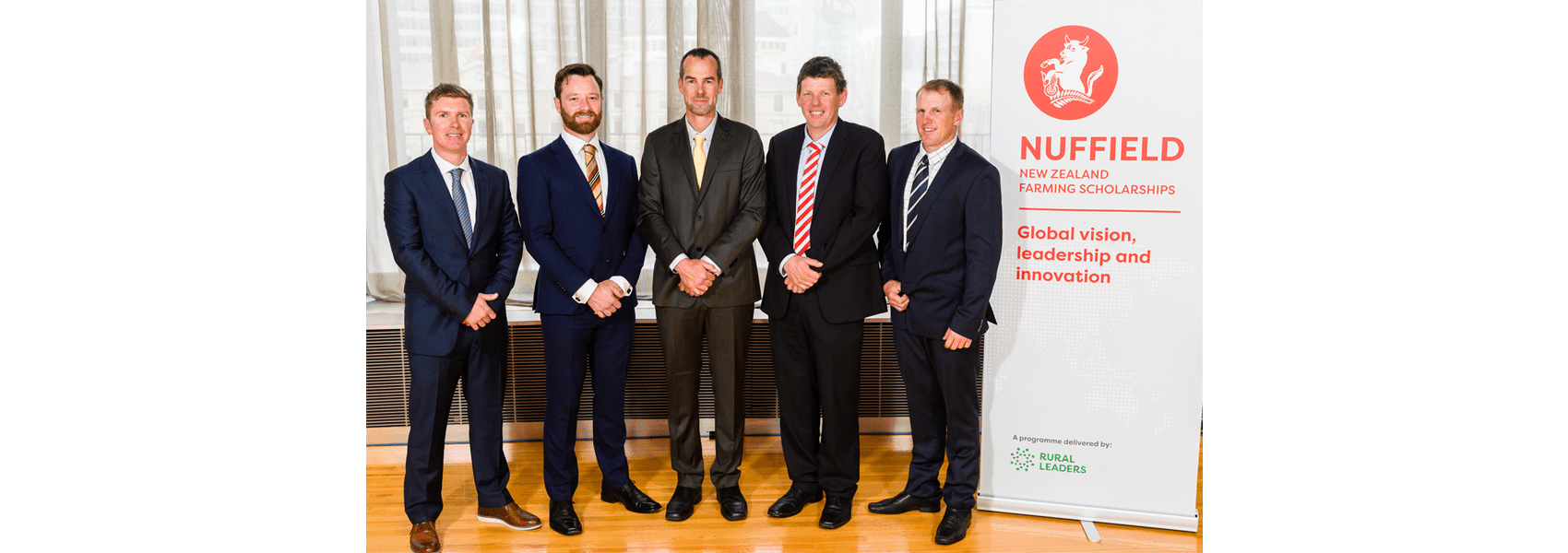
The 2019 Nuffield scholars were announced on Tuesday 6th November at parliament by Hon Damien O’Connor Minister of Agriculture and Minister for Biosecurity, Food Safety, and Rural Communities. They are:
Ben Hancock
Ben was raised on his family’s Wairarapa hill country sheep and beef cattle farm. He is now based in Wellington working for Beef + Lamb New Zealand as a senior analyst, still near the farm and often back home to work.
After working in research and conservation roles in New Zealand, USA and Panama, Ben completed his PhD investigating eco-system services. Ben worked for the Ministry for Primary Industries in biosecurity policy before joining Beef + Lamb New Zealand.
With New Zealand’s agriculture export-focused, improving the diversity of markets can help to minimise volatility and maximise highest value outcomes. There are markets that have traditionally used sheep products that maybe under-utilised by New Zealand. Ben is interested in researching this during his scholarship.
Cam Henderson
Cam owns and operates a 750 cow dairy farm near Oxford, North Canterbury. With degrees in engineering and finance, he has worked in a range of dairy industry roles including time with Fonterra and DairyNZ.
Alongside overseeing farming operations, Cameron currently commits much of his time to the Waimakariri Zone Committee in setting local environmental limits and to representing farmers as North Canterbury Federated Farmers Provincial President.
“All farmers will benefit from adopting the latest innovative practices on the farm and encouraging others to do the same. The faster we can encourage farming to evolve, the less regulatory and public pressure we will have to endure”. Finding the factors that increase the speed of innovation adoption among farmers is a key interest for Cameron.
A trainee in music, golf, snowboarding, flying and Te Reo, Cameron enjoys learning and giving anything a go.
Corrigan Sowman
Corrigan lives in the small rural community of Golden Bay with his wife Ruth Guthrie and their two sons Wylie (7) and Tim (5). He is a partner and manager of the family’s dairy farming business alongside his parents and brother Sam. Corrigan is a graduate of Massey University with a Bachelor of Applied Science, was a former Consulting Officer with DairyNZ and Farm Consultant with FarmRight in Canterbury.
Alongside managing their 400ha dairy farming business, Corrigan has several off-farm roles. He is Chair and Independent Director of the South Island Dairy Development Centre (SIDDC) which operates the Lincoln University Dairy Farm. He is also Deputy Chair of the DairyNZ Dairy Environmental Leaders Forum, an initiative to foster and strengthen environmental stewardship and community leadership amongst New Zealand Dairy Farmers.
Farming practices that strengthen the integrity of the food produced is something Corrigan wants to better understand. “How can we give our farmers better market signals about the value they are creating in their production systems, especially inside a large cooperative?”
Hamish Marr
Hamish is a 41-year-old, 5th generation, an intensive arable farmer from Methven in the South Island. Hamish is married to Melanie and they have three daughters aged 8,5 and 3. Prior to a farming career, Hamish graduated Lincoln University with B COM Ag in 2000 and then spent 4 years with Ravensdown Fertiliser as a field officer based in Ashburton. With his brother and parents, they farm 500ha of arable crops specialising in small seeds.
Outside of farming and family, Hamish is involved in several industry organisations. He is also active within Federated farmers and represents the Herbage seed growers section in Mid Canterbury and within that on the management committee for the Seed Quality Merchants Association, a board that oversees the seed certification scheme on behalf of MPI. Hamish is also involved with the Foundation for Arable Research on the Mid Canterbury Arable Research Group and the Research and Development Advisory Committee. Outside of work he has become a council member on the Ashburton Scottish society representing the Ashburton Pipe Band.
Farmers over the years have become dependent on a vast array of synthetic agrichemicals as a means of controlling weeds, pests and diseases and as a result, increasing yields across the board but this is being challenged and Hamish hopes to study the regulation that is being introduced in Europe and the implications for NZ.
Hamish Murray
Hamish, wife Jessica, three children, Lucy (5) Margot (3) and Jonty (1) farm Bluff Station a 13000 ha High Country property in Marlborough. South Island NZ. He completed an agricultural degree at Lincoln University NZ, economics at Cambridge University (UK), and worked with the New Zealand Merino Company, before returning home to farm in 2008.
Hamish has been managing the farming operation including sheep, cattle and a recent diversification into beekeeping and honey production. He is also on the governance board for the Post Quake farming group helping with recovery from the November 16 Kaikoura Earthquake and a production science group for the New Zealand Merino Company.
Hamish has a real focus on people and relationships and is planning to investigate how the differences in environment, education and culture have shaped the values of our consumers and employees. Recognizing and understanding how these values have been formed and vary between culture and generations is key the success of our marketing efforts being a small export-led country. He aims to search out those organisations in our key export markets for wool, meat and honey which are engaging consumers and understand what is making them successful.
We are reaching the end of a busy year for Rural Leaders and our two programmes – the Nuffield Scholarships & the Kellogg Rural Leadership Programme. While we have tried to make this a year a time of some consolidation after the launch of the new organisation and branding and the increased responsibilities, the projects and opportunities keep arising and enthusiasm from a busy management and governance team keeps emerging!
For this last E Nuff of 2018, I would like to give an overview of the highlights and achievements of the organisation and the programmes for the year which has involved the contribution of a larger team as highlighted below.
2018 Highlights/Achievements
Marketing
Launched new branding (logo & applications) for Rural Leaders and Kellogg programmes & Refreshed the Nuffield brand to modernise and be consistent with the branding of Rural Leaders as the organisation
Launched a new website hosting both programmes and Rural Leaders with multiple entry points
Appointed a part-time marketer – Clara Sweetman to drive our marketing activities
Increased significantly the media coverage and exposure of Kellogg & Nuffield projects supported by our media partnerships
Had at least 5 alumni featured in On Farm Story with David Kidd starring on a Country Calendar episode.
Financial & Sponsorship
Re-signed four of our programme partners for a further period – thank you for your support Farmlands, Zespri, Hort NZ, FAR
Bought onboard new Service & Media partners with KPMG, NZ Farming Life (Dairy Exporter & Country Wide) and Global HQ (Farmers Weekly & Dairy Farmer)
Introduced new accounting and reporting systems as required under the Charities Act, with the support of our KPMG partner.
Governance
Farewelled and thanked Chair Juliet Maclean for her exceptional leadership and contribution to the big changes introduced, particularly the new branding.
Welcomed James Parsons on to the board as Nuffield appointed Trustee
Recruited, after a robust selection process, a new independent Board member, Louise Webster who will start the role in January (click here for more info on Louise)
Programmes
Nuffield
Hosted a Nuffield International GFP New Zealand leg in Hawkes Bay and Bay of Plenty in April
Delivered a fantastic, well supported Nuffield NZ Biennial Conference in Tauranga in May, thanks to Dave Hurst and his team
Discussed and debated high quality presentations from the 2016 & 2017 Scholars.
Selected five high quality 2019 scholars (see their profiles in this E Nuff)
2018 Scholars presented insights and debated implications for NZ to an audience of our investing partners
Hosted the 2019 Nuffield Awards with over 75 industry guests & alumni attending
Launched Nuffield 2020 Triennial event globally with a great video resource
Appointed a project manager for the Triennial – Deb Gee from Higher Perspectives Consulting
Kellogg
Ran two 6 x month Kellogg programmes coordinating the involvement of over 40 industry leaders
Graduated 48 new leaders within a broad diversity of sectors, geographical location, gender, age, ethnicity.
Published 48 new pieces of rural research for industry & public use.
Our vision of “Growing NZ Through Thriving Rural Communities” and the achievement of the steps toward this could not be achieved without the ongoing contribution and time of the following;
Rural Leaders Team: Programme Coordinator Lisa Rogers, Marketing & Comms Clara Sweetman, our Kellogg programme leader Scott Champion and Project Support Patrick Aldwell & Nuffield Advisor, Hamish Gow.
The Trustees: Andrew Watters (Chair), Hamish Fraser, Michael Tayler, James Parsons, Craige Mackenzie, Associate Matt Hocken and Juliet Maclean (chair prior to June)
Join us at Nuffield2020, the key forum for Nuffield alumni globally to get together for networking, ongoing learning and development. We have a programme that will focus on successful innovation and business models as we innovate for the future. Nuffield2020 coincides with our bi-annual Nuffield New Zealand conference and an important milestone of 70 years of the Nuffield New Zealand organisation and scholarships.
See the program of events and more information on our website www.nuffield2020.com
This time of the year is a busy period for trustees, selecting and presenting our 2019 Nuffield scholars. The process is robust and involves shortlisting, referee checks and of course the interview process. It all culminates with the announcement in the Banquet Hall of Parliament in early November.
You will see from the profiles that we have very good hands-on farmers in this year’s selection with representation in dairy, sheep & beef, fibre, arable sectors. It is also notable that the topics initially selected (which can change) are very outward/ market/ customer focused in recognition that the challenges and opportunities facing many sectors are more about the how and why of what we are doing on-farm than the what.
We obtained excellent feedback from this year’s scholar announcement event. Prior to the Awards, we had a highly valuable two-hour session engaging returning scholars and programme partners on topics and perspectives facing NZ and global agriculture. And at the formal announcement at Parliament more than 75 people enjoyed hearing perspectives on the 2018 Scholar’s preliminary insights on their research topic which included challenges of setting environmental policy, the physical limitations of moving to low carbon energy systems, the need to optimise farm systems within environmental limits, the need for NZ agriculture to up its game on biosecurity and the opportunities for high value nutritional ingredients.
One notable fact that we will be addressing in future selections is the lack of diversity amongst our scholar group. We are under-represented this year in horticulture, in Maori agribusiness and in women scholars. This isn’t an issue of selection, it is an issue of ensuring that we get a sufficiently diverse group of applicants. We will be developing some plans to address this for the new year. The answer is probably a mix of better engagement with our business partners and sponsors around candidate nomination and some more activity in the regions.
Since our last Enuff, I am pleased to confirm the appointment of Louise Webster as an independent trustee. As noted on our website, Louise brings a different skill set based around technology, innovation and leadership development. Louise will join the Trust Board in January following a six-month sabbatical in Europe looking at the agri-food and other sectors. We look forward to her contribution helping us ensure we remain relevant in a fast-changing world.
I can also report on progress on the Thought Leadership or Rural Communities project. Utilising the ‘Good to Great’ hedgehog as an organising concept, we have confirmed as a Trust that we are passionate about “Growing New Zealand through thriving rural communities”. We are working on the other two components of the hedgehog but believe we can be world’s best at “Developing rural leaders that can solve (or untangle) wicked problems”. And finally, we think that our real economic engine (how we secure ongoing funding) is “delivering leaders, and cost-effective solutions, that can address wicked problems” for our programme partners and sponsors.
A wicked problem is defined as a problem that is difficult or impossible to solve because of incomplete, contradictory and changing requirements that may be difficult to recognise. An effort to solve one aspect of a wicked problem may create other problems.
The trend towards commoditisation, the need to meet environmental standards, climate change, the role of genetic engineering, attracting young kiwis to work on farms are all examples of wicked problems. Often these problems are across industry rather than within industry silos.
As an organisation, we have limited resources so we need to crawl before we walk. What we can do in the near term is ensure that our new scholars (Nuffield and Kelloggs) understand the wicked problem concept and can develop their topic area into an aspect that we need to solve for the future of NZ agriculture. We then need to better leverage the post scholarship period to ensure scholars can engage with our partners and the alumni to transfer their knowledge into positive action.
Finally, as we near the Christmas period it is important to acknowledge the work of Anne Hindson and her very small team. They are currently fully engaged in running the Nuffield (working with 2018 and 2019 scholar groups) and Kellogg programs (class 38 just completed last week) & planning for the 2019 courses starting in mid-January and supporting the Nuffield Triennial work being done by Michael Taylor and his group. As we move forward it will be important that we match our desire for impact with resourcing and this in-between time can be difficult to traverse.
John Clarke was awarded a Nuffield Scholarship in 1963.
One of New Zealand’s great leaders in the N. Z. agricultural business, in particular the New Zealand wool industry, John Clarke passed away on 12 May 2018 in Dunedin.
John was involved in the sheep, beef, dairy, cropping and pig farming industries. He was a member of the Producer Board’s Electoral Committee; became Chairman of the New Zealand Wool Board between 1072-1980; served as a Director of the Otago Dairy Co-Operative; the Kiwi Dairy Co-Operative; a Director of The National Bank; and served as a Governor on the Board of Columba College, Dunedin.
His involvement in his local community as a leader both nationally and internationally within the wool industry John was formally recognised for these services. In 1981, he was honoured with the CMG (Companion of the Order of St Michael and St George) and received the NZ 1990 Medal for services to his community.
Anyone wishing to make contact with John’s wife, Margaret, and his family can do so by sending a message to 113 Quatermain Rd, Clinton South Otago 9584.
Peter Jensen encouraged alumni to pay it back at the 2019 Nuffield NZ AGM announcing that he and his wife Anne were donating $40k, the equivalent of one scholarship, to the Nuffield Capital Fund.
He challenged every scholar for whom the scholarship had been a life changing event, either in their business or personal life, or both to donate over their lifetime the equivalent of a current scholarship ($40k) in recognition of the opportunities that it provided each person in their business and personal life.
“I am showing that I believe that in donating back the equivalent of a scholarship I can ensure this amazing opportunity continues well into the future and Nuffield NZ is in a strong position to continue to spearhead rural leadership development into the future” says Peter.
He follows another generous contribution of $10k by Derek Daniels earlier and contributions some years ago by other alumni and events.
The fund is currently sitting at just over $810k so our target is not unrealistic!
The Nuffield Capital Fund was set up a number of years ago to build a fund of $1million to ensure that the Nuffield legacy would continue in times of ‘shocks and challenges’ such as the loss of a major sponsor or a rural/country recession. The interest from this fund would support at least two scholarships each year and enable ongoing leadership development opportunities for alumni i.e. attendance at courses, development opportunities.
The fund will ensure Nuffield continues to be the pinnacle of rural and agri food leadership development in New Zealand into the future.
Hugh was a highly active member of the Nuffield Alumni and at the 2015 Nuffield Australia National Conference in Albury, was acknowledged for a 40-year reign as a Nuffield Scholar.
Hugh was a well-known grains industry advocate, former agri-politician who had a long association with the NSW Farmers Association and other industry bodies. He was also a strong advocate for genetically modified (GM) crops.
Until recently, Hugh and his wife Jenny lived at “Birralee”, a 485 hectare property which became widely known as the base of a successful registered seed business, specialising in triticale and legume varieties.
Hugh was awarded a Nuffield Scholarship in 1977 to study British agriculture, and the British seed industry in particular. You can read Hugh’s final report here.
He has represented the agricultural industry in many roles, including with NSW Farmers Association, Grains Council of Australia and Bio Technology Australia Advisory Council, Australian Seeds Authority and the Australian Crop Accreditation System.
Andrew in his Chair update, focuses on Nuffield strategic initiatives and NZRLT board activities, while this update covers management activities of the NZRLT Trust (incorporating both Nuffield and Kellogg programmes) as well as Nuffield programme activities and reflections.
The launch of our new branding, in late June,has occupied a large amount of my time. Juliet Maclean led the project which began in January, through the brand development including the research, strategy, creative, story, and identity to get it to the brand kit and roll out stage. Juliet’s commitment to making sure the Nuffield and Kellogg programmes are relevant for our future markets is invaluable in setting us up for the future.
We started with the development of a new brand for our new organisation – the New Zealand Rural Leadership Trust (referred to as Rural Leaders) accompanied by a new fresh logo for the Kellogg programme and a refreshed modernised logo for the Nuffield Scholarships. If you missed our email with the story behind the branding, click here for a detailed explanation and video.
We created a single website which now hosts Rural Leaders and the two programmes, but have ensured that all Nuffield (and upcoming Kellogg) marketing drives people directly to the Nuffield page on the new site. Over time, we hope to position Rural Leaders as the recognised organisation delivering both programmes with marketing going to just that site.
The single website also provides one platform for our joint alumni to interact with both programmes and alumni activities. It is the first step in bringing our alumni groups together also under one umbrella organisation for thought leadership activities. The final step in this project is the transfer across of several hundred reports from both sites which will take some time.
The new branding is now fully adopted in all communications; the response has been very positive from internal and external audiences.
The appointment of Clara Sweetman as a part time marketing contractor in late June has already bought results with a raised social media profile and some fresh ideas. This is a resource which has been needed for a while but was delayed until the rebranding process had occurred. Clara joins us after contracting for Farmlands, before having her first child.
Our 2019 Nuffield Scholarships close on 19 August and at the time of writing this newsletter we are waiting anxiously to see the calibre of applicants who apply. It is getting harder to market the Scholarships with the clutter of advertising and messaging, so the marketing strategies are continually being reviewed. 5 years ago, most of our marketing was focused on the rural print publications and alumni networks while now our vehicles are social media, testimonials and alumni shoulder tapping. We are also trying to work more closely with each industry sector to get them identifying their emerging leaders and encouraging this as part of their pathway.
While I appreciate that it has always been a big commitment and investment to undertake a scholarship, we are seeing and hearing some of the following challenges /barriers for the next generation of potential scholars;
Young family commitments – many in the 30 – 40 age group are just starting families or have very young children
Working partners – ability to cover family/business is reduced
Diversity of investment often across several farm types or production systems so no natural breaks in workload
More sole operators with no backup from family or others and no fulltime managers to take workload
Greater opportunities to travel overseas, attend international forums
Competing programmes and options to develop leadership skills
While there is greater flexibility for doing the individual research travel there is still a requirement to be overseas at least 4 months in a 10-month period and complete the full scholarship in a year, which is tighter than other Nuffield countries with timelines of 18 – 24 months. Of course, we do note to scholars that learning how to reorganise ‘life’ to take on new challenges is part of the benefits of undertaking a scholarship.
As alumni numbers grow we also need to connect our recent scholars into the support network where alumni provide the opportunities and support their development post the scholarship. The Biennial Conference provided a great launchpad with this year’s 2016 and 2017 presenting scholars and it is pleasing that their topics are attracting industry interest with all of them having presented at conferences and industry forums before and after the Conference.
Their 15min video presentations on the website and You Tube is proving to be a popular vehicle for those wanting to get an overview of their reports. If you haven’t checked them out, click here https://ruralleaders.co.nz/nuffield-presentations/
Planning for the 2020 Nuffield Triennial Conference is well under way with an organising committee meeting this week to sign off some key dates, branding, components. This will allow us to release the first marketing for the event to Nuffield alumni globally through country conferences, direct mail and using alumni contacts
This is a very big commitment for the organisation in terms of resource, time and financial resources, and the full support of all alumni, which I am sure will be forthcoming.
Upcoming Events
Kellogg Course 38 delivery: June – November
Kellogg Course 39 2019 Applications close:19 October
Andrew Watters, Chair, Board of Trustees August 2018
I hope you agree with me that the Tauranga Biennial Nuffield conference was a great event. It had a nice mix of local content, thought leadership and catching up with old friends.
I thought our new scholars did a very good job of presenting their project findings and their views on the issues and opportunities facing New Zealand and global agriculture. And for them, it is a perfect introduction to the Nuffield fold. The mix of youthful enthusiasm and wise perspectives from our range of generations is a strength of our Nuffield body.
Thank you’s have been extended to the local organising committee led by Dave Hurst; the conference was well organised and operated with a $15,000 surplus assisted by securing valuable local sponsorship – this surplus has been transferred into the Nuffield Capital Fund.
At the AGM, James Parsons was elected to fill the vacancy left by Juliet Maclean and I was re-elected. Following the meeting the board elected me as your new Chair. Thanks to Lucy Griffiths and Steve Wilkins for also being prepared to put their names forward for election.
I would like to acknowledge the service of Juliet Maclean with her contribution of six years as a trustee including the past two as chair. Juliet was instrumental in setting up the original consortium between Lincoln University and Nuffield New Zealand which provided both a potential leadership pathway for people in agriculture but also enabled the organisation to take on professional management. Her work culminated in forming the New Zealand Rural Leadership Trust (NZRLT) with full operational control of the Kellogg scholarship programme.
The outcome is to be appreciated but the behind-the-scenes work from Juliet along with our GM, Anne, was critical to the outcome. Juliet also led our 2017 strategy review process which resulted in the rebranding of our programmes and the branding of the Trust, and the consideration of the Rural Thought Leadership and Advocacy Project. Juliet has left Rural Leaders and the Nuffield program in exceptionally good heart and she has set a high mark for us all to perform to.
The constitution of NZRLT requires four scholars elected by the Nuffield Alumni and two independents who are approved by our strategic partners. Hamish Fraser has and continues to fill one of these roles, and we have had a vacancy that we are close to filling. We have run a very successful recruitment process with 26 high quality applicants, quite astounding given this is a voluntary role. At the time of writing we are completing referee checks on our preferred candidate. A key element for us is seeking diversity in skills, experience and thought. We look forward to announcing the appointment in coming days.
Two related matters raised at the AGM was the fact that we have been holding AGMs only at our biennial conference (the constitution requires an AGM to be held annually), and that the Nuffield NZ financial reports are less meaningful now given all operations are under the Rural Leadership Trust. The board have considered both these matters, we intend to hold an AGM via webinar in off-conference years and we will report the financial results of the NZRLT to the Nuffield alumni, noting that this is a separately constituted Trust and reporting structure.
One general comment from past scholars and our strategic partners is the need to ensure that we get sufficient representation from grass-root scholars in our Nuffield programme. This will be a continued work-on for the board including our processes for attracting applicants and how we assess applicants. Although our agricultural economy is seeing the traditional within and outside farmgate boundaries blurring, we do need to get the balance right between selecting scholars who can shape the future of NZ agriculture and equipping our grass roots to work in a more complex world, including as farmer elected members on co-operative and industry boards.
The thought leadership programme is progressing, albeit with small steps. Work with other rural leaders and in particular our strategic partners suggests strong support for mobilising our Nuffield and Kellogg alumni to ensure that we win the debates on matters important to the future of rural communities. We have decided to trial our first initiatives on a couple of regions to ensure that we learn ‘how’ we can be effective. We expect to be in touch with scholars in those regions this spring.
Michael Tayler and his team continue to work on the 2020 triennial conference which of course is a combination of our NZ biennial and the international triennial. There is some consideration at Nuffield International that this may be the last triennial (perhaps replaced by annual travel opportunities flowing from the annual CSC conferences) although we need to see more debate on the proposed changes. It is important that our NZ alumni support this event in all ways and we will come back to you soon to help market the event with your cohorts.
Finally, it is pleasing to report the on-going growth of the NZ Nuffield Farming Scholarship Trust’s fund performance. As at the end of June the fund’s balance was $811,000 with an 11.74% return in the last 12 months and a time weighted return of 12.83% since inception (May 2010). The fund has been supported by donations from scholars and business partners, but the growth strategy implemented ably by Craigs Investment Partners has been a significant help. You will read separately about Peter Jensen’s generous ‘giving back’ which has been an important contribution to the fund.
I wish you the best for the spring ahead; we have rarely seen agricultural prices so firm (other than wool) right across our industry and although there may be trade headwinds ahead there is at least some NZD relief being bought to bear.