2026 Nuffield NZ Farming Scholarship. Apply by 17 August 2025. Read More...

Apply for 2026 Nuffield NZ Farming Scholarship by 17 August 2025. More details...

The Home Paddock

Daniel Eb Nuffield report image

A fracturing social licence to farm.
Recruitment.
An authentic provenance story.


These are our sector’s most entrenched challenges.

At their roots, they are about culture, values and perception.

They are homegrown, non-market problems confronting a sector that has optimised to win in the global marketplace. We can’t rely on our traditional strengths to produce, R&D or market our way out of them.

There is a tacit acceptance that the way forward is to shift from designing for volume and market value, to systems that also include social and environmental values.

To support that transition, this report imagines what a values-led food & farming system in Aotearoa New Zealand might look like. It’s built around an analogy, what if food & farming was more like healthcare and education – a public good. The analogy helps us to compare systems designed to sell to consumers, with those designed to more fully meet the needs of people. It helps us to see the challenges in values-led systems (like complexity, stakeholder collaboration and empathetic design) and their benefits (like trust, engagement and local prosperity).

In addition to the public good analogy, this report looks to examples in Kaupapa Māori, proposes a ‘cheat sheet’ for values-led innovation and explores five forms of values-led food & farming operating at the
edges of the sector.

It concludes with something concrete. A strategy for values-led redesign of the domestic market focussed on scaling local food & farming economies.
It’s a strategy to realise the untapped value in our domestic food system – our home paddock. It calls for enabling some farmers to look inwards and participate directly in their town’s local food economy.


It’s about designing around our values and practices that Kiwis increasingly want to engage with – like connecting to nature, learning & healing on farms or farming-based sustainability solutions. It proposes a
framework for action on food insecurity and health, two fundamental barriers to developing the ‘food & farming culture’ we need to rebuild social licence, recruit Kiwis and tell a provenance story to the world.
At its core, this is a strategy for building meaningful, everyday touchpoints with urban New Zealanders.

Because values matter across every kitchen table, community hall and boardroom – this report concludes by covering the potential roles of each sector player in a values-led domestic system.

We’re a trading nation, and we’re good at it. But we need to front-up to the fact that under the current export-dominated model, Kiwis feel increasingly disconnected from food & farming.

To meet these entrenched social challenges, we need to have the courage to do things differently – to lean into our values and redesign our home paddock, for local food & farming economies to thrive.

Here’s how.

Keywords for Search: Daniel Eb

The Green and the Black of It

This paper initially set out to determine whether it was possible to better monetise sustainability with the New Zealand Deer Industry. In addition to this, I wanted to understand why NZ deer farmers seemed to achieve such poor returns in comparison to both the end value of their products, and the level of risk they accepted in producing them. And lastly, I wanted to know whether our conventional industry supply chains were going to be fit for purpose in a rapidly changing world.

To achieve this, I undertook a review of existing literature, spoke to industry leaders, academics, public servants, and business owners. Most of these were connected to the primary sector, however perspectives and experience from outside the sector were also sought for insight and comparative purposes.

In doing so I found the following:

  • NZ deer farmers, similar to the wider drystock sector, are not profitable in the context of other industries and what are considered average Returns on Capital Employed (ROCE) within NZ. On average, NZ deer farmers achieve approximately 3.4% return on their capital. In comparison, the NZ share market has achieved an average return of 6.5% since 1900. Additionally, our true capital gains are virtually zero once inflation is considered.

  • There are a number of macro level risks and trends in existence that are affecting the NZ deer industry now or will do so in the future. It is also likely that we are underestimating them. The risks posed by factors such a climate change, environmental degradation, geopolitical risk, and the rapid emergence of alternative proteins are significant. Each of these has the ability to significantly disrupt our industry, one that is plagued by poor returns and an increasingly unsympathetic public. Our current approach to these trends is largely one of defense and maintaining the course. This must be replaced by a strategy of active risk management and opportunity realisation.

  • Our current industry supply chains do indeed place the majority of the risk onto the farmer, noting our conventional position as sellers of raw undifferentiated commodity products into global markets. This ongoing situation forces the industry to accept all production risks and the prevailing market price, while allowing multiple other members of the supply chain to add their margin. This results in farmers receiving as little as 3% of the end value of their velvet. As the range and severity of the risk’s deer farmers face increase, it is clear that we can no longer afford the status quo.

  • Environmental outcomes and profit are not mutually exclusive. There are currently working examples within NZ of primary sector organisations and businesses that are achieving above average returns and positive environmental outcomes. An example of this is Lake Hawea Station that is achieving a 40% premium over the current industry average for its fine wool on the basis of its carbon zero certification.  

  • Whilst environmental attributes can be successfully monetized, it is unlikely to be done successfully through our conventional supply value chains. These systems are set up to supply undifferentiated commodities onto the open market and are therefore unlikely to achieve and/or maintain a premium for those attributes, particularly when other agriculture countries are doing the same. Additionally, not all of our end customers place the same value on environmental attributes. To fully leverage positive environmental attributes, it is necessary to fundamentally change the way we take our products to market. It is also recognised that developing new business models can carry a significant degree of risk and requires a range of competencies outside of those required to run a traditional farming business.

To achieve this, it is recommended that the NZ Deer Farmers Association (DFA) establish a programme of work in coordination with Deer Industry NZ (DINZ) and Central Government, with the purpose of transitioning the industry away from the sale of its products as raw/undifferentiated commodities via conventional supply chains, and towards the establishment of short value chains that are effective in matching value creation with economic return. It is proposed that the programme contain the following key objectives:

(a) Identify and support the establishment of business models and/or industry structures that have the potential to achieve the intent of the project. This work would be initially informed by those models utilised by Spring Sheep, NZ Merino and Zespri.

(b) Identify and promote the utilization of technology and web-based platforms that allow for the identification of consumers and the sale of finished products directly to them.

(c) Identify what environmental attributes can be leveraged by these business models for commercial advantage, noting that the delivery and communication of on-farm environmental outcomes will also be beneficial to the deer industries social licence.  The key focus of this objective is turning environmental compliance into economic opportunity.

It is further proposed that financial support for this project by sought from Government, based on its alignment with current political priorities, including addressing climate change through the reduction of on-farm emissions.

It is well understood by the author that many of findings contained within this report are not new, and that attempting to both capture and create more value from NZ’s agriculture products has long been an area of focus. However, our environment today is different from yesterday. We now have the knowledge, the examples, and the tools necessary to take our products to market more profitably and achieve better environmental outcomes. We as farmers, should no longer let existing structures, interests and thinking continue to dictate what we are paid and how much risk we accept in turn.

Keywords for Search: Ben Anderson, Benjamin, Andersen

Super heroes, not super humans

Agriculture is the most dangerous occupation in New Zealand, the UK and Australia.

Despite the introduction of the Health and Safety at Work Act 2015 and a focus on improving health and safety, the rates of fatality and harm in NZ agriculture remain stubbornly high. This has negative impacts on the sector’s productivity, profitability and sustainability. The consequences for farming families and communities are tragic.

This report explores the paradox:

Farmers care about people and each other and Their workplaces kill, hurt or harm too many people.

The report draws on semi structured interviews with nearly 50 stakeholders complimented by conversations with countless farmers, their team and family members. A review of research exploring the current state of health and safety on farm and how farmers think identifies possible root causes of the current state (what’s happening now).

Although largely invisible, assumptions and beliefs powerfully influence farmer behaviour including:

  • Lack of perceived susceptibility (they don’t think they personally will get hurt)
  • Risk is normalised by family and peers (everyone’s doing it)
  • Risk is assumed to be a part of farm work that can’t be managed or controlled (when accidents happen they are explained as “freak” events or unpreventable)
  • Risks are perceived to be common sense and people are expected to take care of their own health and safety, with some being perceived to be ‘just accident prone’.

Farmers expect themselves and their people to be super human!

The report uses the Conscious Leadership’s Fact vs Story model to explore common farmer beliefs and compare these with facts and data to identify the “stories” that prevent positive change.

Given unhelpful stories are a strong influence on behaviour it is critical that interventions address these beliefs and farmers’ “mindset”.

However, interventions have traditionally focused on “education only”. Health and safety has been pigeon holed as a compliance issue of little value to individuals or their businesses.

Establishing the “why” or “what’s in it for me” and the compelling benefits of good work design, is critical. The mindset/practices model shared by Fiona Ewing at the Forestry Industry Safety Council identifies the importance of establishing both the mindset and capability to support the design of good work.

There are examples of farmers in quadrant 4 (get it, do it) which demonstrate what is possible for the sector if the correct mindset and practices (capability) are established.

There are many measurable benefits of good work design which will help establish the “why” for individual farmers including:

  • Higher engagement
  • Lower absenteeism
  • Enhanced social licence
  • Better attraction and retention
  • Positive return on investment
  • Lower costs
  • Increased productivity

Articulating these benefits may provide farmers with something they really want (better work and work environments which address some of their existing challenges).

Good work results in win:win:win outcomes: better work quality, more productive and enjoyable work environments and healthy and safe people.

Challenging pervasive stories and unhelpful beliefs requires relationships built on trust. It is important that the sector values those who bring diverse thinking and non-technical skills. Non-technical skills are identified as critical to better health and safety outcomes. Supporting farmers to develop non-technical skills will improve health and safety outcomes but also have a range of other benefits at business and sector level.

Credible, trusted “connectors” need to be available to support farmers to make change – the messenger makes a difference. To be effective these connectors need trusting relationships with those they seek to influence. Building these takes time and requires proper resourcing. It is important to take a holistic approach to the farm system that acknowledges good work design is fundamental to success and influences all aspects of the enterprise; health and safety can’t be put in a box.

Once the benefits of good work are articulated and farmers “get it” or connect emotionally with the “why”, the what and how become easier.

With the right mindset, the focus becomes lifting capability by setting up farmers up for “can do”. They need:

  • The knowledge (an understanding of why, how and what to do)
  • The skill (the research shows this must encompass both the technical and non-technical skills required for success). Developing skill requires practice and it is important that support is provided during this stage.
  • The method – The correct method for “good” work design, specific to the farm context and focused on practical and effective outcomes. This requires an understanding of the hierarchy of controls and an emphasis on higher level (more effective) controls like elimination or minimisation, rather than the current sector wide focus on lower level and less effective controls (administrative controls or Personal Protective Equipment). It also requires collaboration and leadership to agree “what good looks like” for the sector.
  • The tools – Support from up-stream duty holders (those who share responsibility for controlling workplace risks) is required to ensure farmers have access to the tools required to manage risk in their workplaces and set up for “good work” in a practical and effective way
  • The resources – the money, materials and people to be successful. The closed border and current immigration settings are currently a limiting factor due to the severe people shortages in the sector.

Only if all five components of “can do” are present can farmers be expected to successfully manage work design and ensure healthy and safe outcomes for their people.

Increasing awareness of “what good looks like” is also critical to changing behaviour and social norms. This requires a cohesive sector communication strategy. All sector stakeholders need to collaborate to support the messaging which should focus on 2-3 key components.

The Health and Safety at Work Act provides significant fines and other consequences for farmers who fail to provide safe and healthy work. However, the fragmented, low surveillance farming context reduces the likelihood that these consequences will result in change. Farmers are more likely to die than be prosecuted.

Raising awareness about why, how and what should be done and increasing accountability may be more effective. Leveraging “belonging” to change social norms and make good work design an attribute of great farmers may be more successful. Farmers want to know: are my neighbours doing it?

Changing social norms requires a compelling vision for the sector. This is more likely to be successful if it addresses health and safety by stealth, given many farmers have totally disengaged with the tainted health and safety brand. Motivating farmers with a vision which connects with them on an emotional level is more likely to be successful.

Supporting change by communicating:

  • through multiple channels and mediums
  • using visuals and graphics (rather than text)
  • through story telling to share stories of positive change and develop self efficacy (a belief that farmers have the ability required to design good work and prevent harm)
  • examples of the journey taken by farmers at all stages (beginning, developing and excellence) focused on small, low/no cost changes and safe change at a pace and scale suited to individual capacity and resources
  • realistic examples of positive change aligned with something farmers really want (more enjoyable, productive workplaces with fewer people headaches) is the recommended approach.

Ensuring intervention before risks become habituated or “normal” is critical and leveraging children and young people before they embed unhelpful beliefs is key. The next generation of farmers and young people are at the heart of this cultural and behavioural change. Significant change may take a generation and resourcing needs to reflect this and be independent of political cycles.

Keywords for Search: Lynsey Stratford, Lyndsey, Linsey, Lindsay, Lynsay

Science and Innovation in New Zealand Agriculture

The era of trade liberalisation and reform in the 1980’s and 1990’s left New Zealand (NZ) focusing on what it was good at – being efficient commodity producers, and NZ exploited its comparative advantages. This drive for efficiencies created the domestic agenda for science and innovation. For agriculture, to drive productivity gains, the focus was inside the farm gate. It is something of a paradox that, as the world was globalising and NZ was opening up its economy to competition, we became more localised in the things that created immense value for NZ. The world is changing, and to keep up, NZ needs to be world-class at research and value creation – Innovation is the common denominator. We need to re-imagine our science and innovation models to give agriculture the best opportunity to contribute to a more prosperous NZ.

This report makes a case for change in the way research and development is conducted in this country. What we have today was the result of a massive reform agenda in the 1980’s and 1990’s, when market forces were introduced into areas of the economy that had traditionally been protected. In the 30 years since, there has been a series of policies attempting to ‘fix’ our science system; to roll back the unintended consequences of the reforms. These efforts have largely been ‘small’ and often on the edges of the big problems. It is almost as if the courage of government for reform has evaporated; the upheavals of the earlier era has left little appetite for fundamental change. So, we have a science system that is fragmented, siloed, and characterised by competing agendas and organisations. The structures and funding models drive perverse incentives such as, doing science to get published, to be able to get funding, and to get funding, in order to get published….

The government’s role in science is complex. As a major funder it has an obligation to ensure the output is both world class, and benefits NZ. It must balance funding of the science sector with all the other demands on the treasury. The political reality of science is that there is little be gained from solving the sector’s problems. The issues are complex, difficult to define, and changes hard to implement. Over the decades there has been a decline in expert capability inside government (Cook, 2004) – people who have depth and breadth of experience in their roles. Cost efficiencies and productivity became guiding principles (Cook, 2004) and a ‘slimmed’ down state sector still resonates with the electorate. This in turn, has lowered the ambition of governments and reduced the experience held internally (Mazzucato, 2021).

Policy change at any level becomes difficult, making substantial reorganisation or visionary change to the status quo, very complex. When we try and ‘fix’ the issues we enter into what is known as the complexity paradox (Mazzucato, 2021), where layers of policies drive the creation of silos that begin competing with each other. Thus, rather than ‘fixing’ the problems they are further entrenched. We need to do much better. Whilst it’s broadly true that innovation happens close to consumers, in value chains, in science institutions, private enterprises and on farms – all across the economy, governments do have an important role in creating the framework and policies, that encourage innovation.

The crux of the problem for NZ’s science sector is that everything is viewed in the short term. Everything, almost everywhere, has been reduced to time periods, – governments can’t wait, the Performance Based Research Fund can’t wait, the science can’t wait, the funds are annually contestable, and businesses want quick wins for reporting purposes. The system doesn’t allow science enough time to figure things out. Election cycles influence funding horizons that determine project lengths, and scientists’ time horizons are limited to the length of the project they are working on, and their careers are limited to the project duration.

Everyone needs quick wins to survive. Incentives are misaligned and fragmented, all players are responding to ‘their’ incentives and few groups share the same ones. Long term strategies underpinned by investment in R&D have created some of our most successful businesses. The long-time horizons associated with Māori business is a compelling reason to build relationships with Māori and may be the catalyst for our science sector to recapture its long term view.

Keywords for Search: John Foley, Jon Foly

Resign or Redesign

David Eade report image

Commodity prices received by New Zealand farmers are close to all-time highs, yet we are protesting in the streets for the first time in decades. Our resistance to environmental regulation has exposed a vulnerability – we, farmers, are struggling to hold our place in the power hierarchy.

We took our place atop the power structure when the SS Dunedin set sail for the United Kingdom with the first shipment of refrigerated produce in 1882. We have maintained our place in society with strong representation for the best part of 140 years. This is starting to change.

Our economic model is no longer fit for purpose as we approach an environmental point of no return. We are transitioning from a model optimised for human capital to one focused on maximising natural capital. The negative externalities associated with the farming models we have used for over a century are coming home to roost.

To maintain our place in the power hierarchy, we are defaulting to old tools such as protest and advocacy groups. We do not currently have the right mix of tools needed to drive and support change in a modern world.

Biodiversity loss, net zero commitments, the rise of alternative proteins and climate change are some of the many signals on the horizon that threaten our current system. We can either view these as threats, or as opportunities. Some of the most effective ways of reaching net zero commitments come through effective land use. Through the correct stewardship of land, farmers can make a disproportionate positive impact on the environment. What’s more, a burgeoning market of investors is looking to get behind this exact cause.

Individually, farmers in New Zealand are projected to spend $150,000 over the next 10 years to meet the latest round of environmental regulation. Collectively, the New Zealand Dairy industry alone is projecting $6 billion dollars in annual losses attributable to environmental
regulation. Yet, at the same time financial markets across the world are experiencing the largest amount of investment backing net zero commitments from both large institutions and through the rise of citizen finance.

We have a model that is no longer fit for purpose. It does not serve the environment or farmers. We also have a disconnect between farmers looking to make positive environmental change and investors looking to fund these exact pursuits.

What do we do when something is no longer serving us? We redesign it.

A design process was kicked off. The first step was to empathise with the challenges faced by New Zealand livestock farmers. Over the course of 50+ hours of interviews and 100+ survey results, challenges started to emerge. Many livestock farmers currently face a negative spiral with each challenge compounding upon the last:

  • margins are being squeezed and profits are variable
  • farming businesses struggle to pay what is needed to attract good talent
  • many farming businesses remain understaffed
  • understaffed businesses lead to farmers spend more time in an operational capacity
  • after operational tasks are taken care of plus the day to day complexities of farming, there is no time left to understand ambiguous environmental regulation
  • tired farmers carry the mental tax of having to defend a negative public image.


When summarised – New Zealand livestock farmers are scared that environmental regulation will cripple their low margin business.

We are not fundamentally bad people, and we are certainly not environmental villains. The negative spiral faced by farming businesses needs to be broken. What breaks this may be an unlikely source. The environment itself.

A series of complex and simple nature-based solutions emerged during the ideation phase of the design process. These potential solutions were viewed against the criteria idefined by farmers during the empathize stage – the ability to help farmers; get paid, reduce complexity, get time back and feel valued in society. Most importantly an ideal solution had to provide the first tangible step New Zealand livestock farmers could take to make positive, profitable environmental change. The final prototype leverages many existing tools to create an outcome that will break the negative spiral faced by New Zealand livestock farmers. Of the 19 farmers pitched the idea, 75% said that they would pay to use the product.

By no means is this a silver bullet, but it is an example of what happens when we become deeply curious about a problem we are facing. Assumptions are left behind and problems are reframed. We are going to need many solutions that enable and empower New Zealand livestock farmers. This is but one tool in what will be a large toolbox. The findings in this report could be the ingredients of a future cake. A diverse range of people are needed to bake this cake and ensure that farmers can adapt to market lead signals.

Keywords for Search: David Eade, Ede

Mel Poulton: Insights from a Special Agricultural Trade Envoy.

Mel Poulton

Mel Poulton: Insights from a Special Agricultural Trade Envoy.

2014 Nuffield Scholar Mel Poulton is someone with a unique perspective. Well, two really. As both a food producing farmer and New Zealand’s Special Agricultural Trade Envoy, we asked Mel to share her perspectives on trade, Nuffield, Brexit, and an industry grappling with significant global challenges.

Question: What do you do in your various roles?

Mel Poulton: In and on my farm business, I’m on both sides of the farm gate. I do anything from stockwork to bulldozing, to making all the decisions required to run a business. 

In the Special Agricultural Trade Envoy (SATE) role, following my appointment, border closures and a vastly different global operating context, have meant changing how the role is delivered. It’s a two-pronged approach with an international and a domestic focus, mixed with face to face and virtual engagement.  

I’ve been more purposeful working with the world here in NZ, by way of direct engagement with the International Diplomatic Corps here (they are the eyes, ears, and influencers of their nations in NZ). This engagement includes taking Ambassadors on x-sector farm tours, hosting Diplomatic Corps meetings, and meeting with them one-to-one, or with industry groups. I am also working internationally on virtual platforms, speaking on panels, webinars, or virtual meetings with farmers, and private and public sector organisations.  

Covid has provided opportunity for me to invest more time and effort with NZ sectors (all food and fibre – except Forestry and Fisheries). My background is the sheep and beef sector, but I put a high priority on building a greater understanding of the other sectors I represent as well. I use these insights when engaging with each of the sectors, government, and the world.  

Helping NZ food and fibre producers broaden their understanding of the global and domestic context is a priority too. Both behind and beyond our farm gates.  

Q: What changes have you seen since being in your SATE role?

MP: Quite a few things.

Trade negotiations. 
Trade negotiations, particularly the New Zealand-UK Free Trade Agreement (FTA), have been the fastest progressed trade negotiations in New Zealand history to get to Agreement in Principle – so I’ve been told. Much of this negotiation has been done virtually, also a first. This will change the way trade negotiations occur in the future. A lot less travel overall.

Farm subsidies. 
Direct and indirect farm subsidies in large economies, such as the USA, have increased exponentially. People may argue they have already exceeded agreed WTO thresholds.

Growing distrust. 
There’s a growing distrust of governments in the democratic world. Governments need to work on their social licence to operate. Social licence is not just a thing for food producers.

Supply chain vulnerability. 
Just In Time (JIT) delivery has been exposed for its supply chain vulnerability in this global pandemic. Economies and businesses will now be building more capacity in their value chain system. This will mean a more conservative approach to exports and imports, to withstand the volatility, uncertainty, complexity, and ambiguity (VUCA) in the world of trade, market access and freight.

Nevertheless, nothing beats high trust and long-term government to government, business to business, and people to people relationships across the world. New Zealand has optimised these relationships throughout the pandemic to utilise market diversity for navigating trade, market, and supply chain disruption.

For example, Covid19 related trade agreements to secure medical imports and food exports. As well as digital certification for export products, through to relationships that our major exporters have with freight companies, importers, and international customers. The last 18 months haven’t been easy, but these strong relationships, and diversity of markets, have shown their worth to New Zealand.

Food security. 
Economies are moving from thinking about food security, to actively putting mechanisms in place to secure their food supply in a pandemic disrupted system, e.g., green lanes in Europe. There’s also a slow nuanced shift from food security to nutritional security taking place.

Regulatory pressure. 
Farmers and food producers in New Zealand and around the world are wrestling with the multi-layered challenges of regulatory pressure (particularly on the environmental and climate change fronts), as well as market volatility, and Covid 19 induced uncertainty. This is increasing farm input costs and diminishing the tools available for farmers to use to produce food.

As an example, farmers in Europe have real fears about their ability to produce the volume of food required to stay viable and maintain food security. The new farm to fork strategy in the EU is deliberately shifting organic food production up to 25%, with rules to reduce synthetic fertiliser by 50%. Glyphosate use is under threat too. In some places farmers can’t use it (I note in New Zealand, the EPA is currently undertaking a review of Glyphosate use). There’s major transformational change happening in Europe.

The rush of multi-layered change gives a sense of exponential pressure. Farmers all over the world are feeling exasperated, frustrated, misunderstood and under siege. All the same, if there is anywhere in the world I would rather be farming right now, it is here in New Zealand.

We’ve navigated major challenges in the past, and when farmers look at the change they’ve implemented on their farms over the course of their careers, or in the intergenerational businesses they are running, we can take confidence in the fact we are already change agents.

A uniquely positioned New Zealand. 
From a New Zealand food producer’s perspective, farmers here are uniquely positioned. Without subsidies, we aren’t dancing to someone else’s tune in quite the same ways as farmers receiving subsidies elsewhere. There are two sides to this. On one hand we’re not being bailed out at the next threat, but we also get to take full responsibility to master the destiny of our businesses. So, we have an ability to create workable solutions in a way that keeps our businesses competitive globally.

With an innovative, integrated systems approach, we can create solutions to challenges like reducing our global warming impact, improving native biodiversity and water quality, while producing high quality, safe, nutritious food – delivered with integrity.

In New Zealand we have an industry ecosystem focussed on helping farmers create and implement solutions. Our research centres and academic institutions, both provide science and knowledge, and help support farmers crack real challenges. There are the easily accessible service providers, and the folk in Government ministries – who are in the teams working hard on trade negotiation to ensure the best possible outcomes for access to markets, and on removal of tariffs and non-tariff barriers to create a level playing field for New Zealand. Let’s keep it that way.

This ecosystem enabling success is our major competitive advantage in the world. We’ve really got to leverage this and remember we’re all on the same team.

We must not be paralysed by fear, but instead celebrate what we’ve already achieved throughout our farming careers and take confidence that we can use our whole systems thinking to improve what we do for our natural resources, our people, businesses, and our nation.

Q: What links between International Trade and International Policy have you seen, with direct and indirect implications behind your farm gate?

MP: Let’s summarise how it works first. There are recognised global challenges. Then international forums are established to address these challenges, leading to international commitments made by member states (different nations).  

Examples of this include United Nations Sustainable Development Goals (SDG) and the Paris Accord on Climate Change. Some international commitments are legally non-binding. But where it applies to the WTO (World Trade Organisation) they are often legally binding.  

Once those international commitments are made, each economy, member state, or nation must determine its own policy and regulation to deliver on its commitments. That gets shaped up (with some consultation in the process) and is rolled out by the government of the day, and folks like us everyday people have to make it work on the ground. The Government then reports back to those international forums, or institutions, on what our progress has been against the commitments the Government made. COP26 is an example of this. 

Given New Zealand’s economy is so internationally exposed and dependent, we need to be at the international table to maintain influence.  

But to have influence we need to have integrity and demonstrate action. So, these international commitments have been drivers for shaping NZ Government policy on Sustainability and Climate Change. Examples here are the New Zealand freshwater regulations and climate change targets. Both resulted in changes on my farm, and on farms all over New Zealand, which is increasing costs and could reduce revenue for some.  

If we do it right, there could also be opportunity to reduce costs and increase profitability. It will be different for every business. The bottom line is that financially there’ll be change, so we need to reconfigure the financials for a new shape to our businesses. Easier for some than others, and not all will be the same. 

The environmental, social, and economic outcomes are significant across NZ, and underestimated. In some cases, we might secure a market premium for this work, though there is no guarantee what we’re doing delivers a premium to food producers in New Zealand for all products in all markets. I have more confidence this work will enable us to obtain and maintain market access to customers.  

This is where the work of our trade negotiators, ensuring a level playing field in market, is so critical for ensuring the changes we’re making here in NZ don’t make us uncompetitive on the international market. I’ve seen their tireless, relentless work, day, and night, to get the best possible outcomes for New Zealand. Many of these negotiators are the hidden superstars of our food and fibre ecosystem.  

What is going on in New Zealand around environment and climate change is often a focus of interest from others in my international engagements. I talk about what these regulations and targets mean for me, and what I am investing in to address the challenges in my farm business, alongside promoting what other farmers from the different sectors are doing in New Zealand. I also give a clear message that much of this cannot be done quickly when taking a whole systems approach. Effective change takes time. Farmers the world over get this.

Q: How do you think Brexit will play out for New Zealand trade? The obvious and not so obvious.

MP: The choice of the UK people and UK parliament to pursue Brexit is forging transformational change for the UK food and fibre sector. The transition period will take 15 to 20, even 30 years to find a new equilibrium. Like the 30 years it took New Zealand to find equilibrium when agriculture subsidies were removed here.  
 
This change requires a culture shift in thinking about UK farm business structures, their subsidy system, domestic policies, and rebalancing their trade and export portfolio beyond the common market, to a global market. Add major geostrategic inflection points in trade and security, affecting us all, and you have a UK trying to position itself as a global strategic leader.

Its focus in the Asia-Pacific region, particularly regarding the FTA’s it is currently negotiating with Australia and New Zealand, along with its formal request to join the Comprehensive and Progressive Trans-Pacific Partnership (CPTPP), all highlight the trade and security opportunities and challenges it perceives.  
 
So, building more structure into the relationships of allies like New Zealand and Australia by way of FTA’s is an important part of their process to find their new place in the world. This is providing new trade opportunities for New Zealand, subject to the NZ-UK FTA and their accession to the CPTPP. 
 
In the future it may create more competition in our export markets too. It will also create opportunities for more collaboration on the global stage, especially where we align with the values and perspectives that matter to both economies.

Q: What does New Zealand need to do more, and less of, now and in the future?

MP: Because our food and fibre sector is orientated to international markets, we need to continue to pursue being the best we can be. This means achieving optimal standards, positioning ourselves to have the best integrity, facts, processes, and story for all the concerns that governments, markets, customers, and consumers may direct at us.  

Whether these be from the position of protectionism or not, we still have to give ourselves the best chance of capturing opportunity. So, concerns about animal welfare, food safety, or environmental stewardship, e.g., water, soil, biodiversity, chemical and fertiliser usage, climate change, labour, the list goes on. These are the things we need to keep improving to position ourselves to open as many doors as possible, and to keep flexibility, adaptability, agility, and economic viability open to us.  

We have already demonstrated plasticity through this pandemic, and we need to fully embrace a plasticity approach in our lives, our businesses, and how we engage with the world.  

We need to be able to maintain our essence and values, while changing and reshaping the way we live, do business, trade, and collaborate with others, as we all grapple with significant global challenges.     

Q: How has doing a Nuffield Scholarship helped you?

MP:   The Nuffield Scholarship has been an important part of my personal and professional development. It’s been a stepping-stone for doing what I do now, on and off farm. The international networks, the doors of opportunity opened, the domestic and international insights as well as the ‘aha’ moments. These all contribute to my thinking, conversations, and ideas on the farm and in the world of trade.  

That said, and without taking away from Nuffield, the older I get and the more I learn, it seems the more questions I have and the more I need to learn. 
I’d like to encourage all readers to keep that hunger to learn, take some confidence from the change we’ve already made on our farms, in our businesses and our whole industry with our systems thinking.  

Let’s keep doing what we do best – producing top quality food and fibre to the best of our abilities.  

Optimising all we do with high standards, care and integrity for our environment and natural resources, our people, communities, and for the economic viability of our businesses and nation. 

Balanced with humility, we need to be able to hold our heads high and have pride in who we are and what we do. Keep being the best you can be. 
Download report
Read Mel Poulton 2014 Nuffield report “Capturing value.”

The nowhere-near complete guide to writing your Nuffield Scholarship application.

So, you’re looking to craft a cut-through Nuffield Scholarship application. If you’re like most people, the real struggle is getting started. There is something you can do while you stare blankly at the blinking cursor – ask yourself why?

Why are you applying for a Nuffield Scholarship? Your motivation is important. It will help you form a plan. A plan almost always leads to a better crafted anything really.  

Let a strong, singular motivation shine through, in not only the way your writing sounds, but how it feels too. For the reader, it’s the difference between wanting to read something compelling, and words on a page. 

Now, we can’t give you tips on what your motivation might be, but let’s just say anything along the lines of ‘I want to give back to the food and fibre sector’, is a good place to start. Remember you are submitting to a panel of smart, motivated people like yourself, who are determined to see New Zealand leading the future of food and fibre on the global stage.

Here are some tips from those who have read a few applications, to make the answering-questions-brilliantly-bit easier.  

1. Be clear and concise as to why you want a Nuffield Scholarship. 
Choose your words well and be economical. A good answer does not have to be a long-winded one. The more concise you are, the more the reader will gain a sense of your single-mindedness. That your motivation is clear.  
 
2. You’re likely to be clear about what a Nuffield Scholarship can do for you.
Make sure the reader is clear about what you will do for Nuffield. The reader, also known as ‘The Selection Panel ’, will want to know about your propensity for giving back. That’s a big part of Nuffield. Bringing back the thinking and ideas that might advance New Zealand’s food and fibre sector. 

A good application will show an understanding of how a Nuffield Scholarship will enable you to develop and implement strategic ideas and opportunities. Put simply, show you understand what a Nuffield Scholarship is.  

3. Sell yourself, but don’t overcook it. 
A critical piece of your sell is including examples of community leadership involvement, and ideally sector leadership experience as well. Recent is best. Play any ace cards up front, don’t bury them. 

Before you submit your application. 

Have you read it out loud? 
Does it sound the way you imagined it would when you wrote it? Try reading it out loud, it will help you find the things that aren’t quite working. 

Can you make it shorter? 
Less is more. There will always be a few words you don’t need. 

Have you asked someone else to read it? 
As great at writing as you may be, a second pair of eyes helps proof and sense check. When you’re the one writing, you’re often too close to see the obvious, like, glaring errors the spellcheck missed. 

Any big words you can replace with simpler ones? 
Enough said. 

Did you enjoy writing it? 
Are you pleased with what you’ve written? If so, chances are your reader will enjoy reading it too. 

Tracy Brown on Country Life on Radio New Zealand

Tracy Brown

On 4 June, our Tracy Brown, one of our 2020 Nuffiled Scholars, was a guest in the Radio New Zealand’s Country Life programme.

In this interview, Tracy talks about her recent experience as a Nuffield Scholar on the National Focus Programme.

Interested in the process of change in Dairy Farming, Tracy is focused on getting dairy farmers onboard with doing the right thing – through improved actions for the environment and better connections with community. A big part of this is improving dairy farming’s social licence to operate, or right to farm – that is, helping the public understand why dairy farmers do what they do.


Listen to the full interview here.

Tracy Brown is 2020 Nuffiled New Zealand Farming Scholar, Chair of the DairyNZ Dairy Environment Leaders Programme, Chair of the Ballance Farm Environment Awards Alumni, and is a farmer representative on the Dairy Environment Leadership Group.

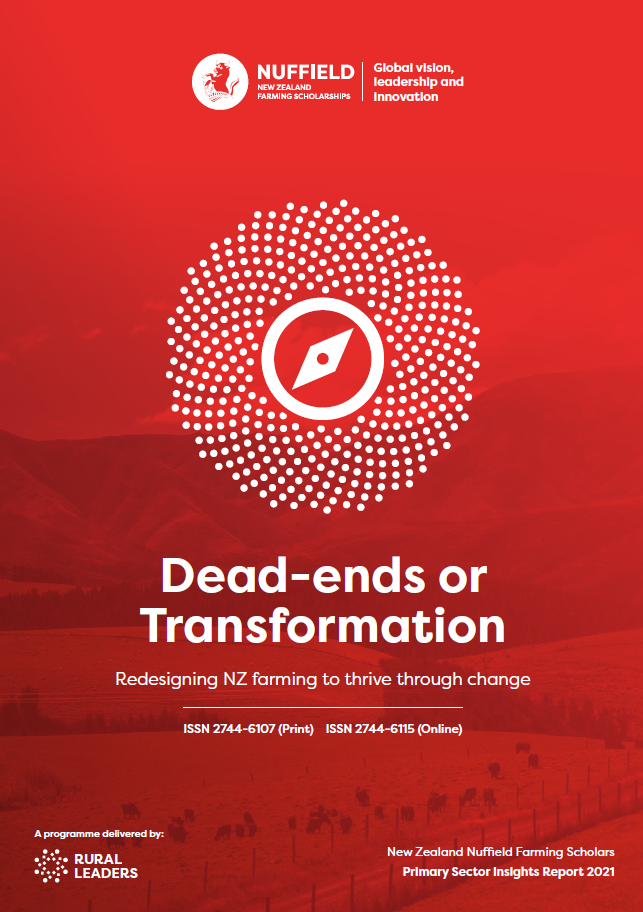
2021 Food and Fibre Sector Insights Report

2021 Nuffiled New Zealand Farming Scholars Insights Report

Dead-ends or transformation - Redesigning NZ farming to thrive through change.

The environmental, social and economic contexts in which we farm and grow are changing rapidly. The pressure many primary sector New Zealanders feel is the collision of ‘business as usual’ with accelerating forces of change. Under these new conditions, protecting long-held structures and models becomes untenable. To thrive in a challenging new world, we must choose to self-disrupt and transform fundamental parts of our sector: however difficult that process may be.

This is the core insight of the Nuffield 2021 ‘World Tour of New Zealand’ – a redesigned Nuffield Farming Scholarship experience that saw 10 emerging primary sector leaders travel the length of the country to gather insights into the challenges and opportunities ahead.

This report is a culmination of those insights, as viewed through five pillars fundamental to a thriving NZ food and fibre sector:

Incentives – How the end of the ’farming for capital gain’ model is forcing us to redefine value, and restructure our organisations to capture it.

David Eade and Ben Anderson

Innovation – Mapping innovation potential across the sector to find what separates the status quo from the game-changers.

Shannon Harnett and Ben Mclauchlan

People – How leading organisations put people at the centre of what they do.

Lynsey Stratford and Edward Pinckney

Silos – How systemic silos across leadership, research and data management are restricting the potential of the sector.

Philip Weir and John Foley

Leadership – Why transformation must be led by values and purpose-driven leaders.

Tracy Brown and Daniel Eb

This report builds on the 2020 Nuffield Scholars Insights and represents the start of our individual study in chosen areas. We encourage those who wish to support our research to get in touch – our contact details are included throughout.

Finally, our sincere thanks to the many hundreds of primary sector New Zealanders who shared time and insights with us along the way. While there is a need for great transformation ahead, your pride, passion and talent are a reminder that we can and will get there.

Ngā mihi nui

The 2020 and 2021 New Zealand Nuffield Farming Scholars

Download your copy here


Sophie Stanley on agri-tech, AI and art classes

Sophie has been busy. Passionate about creating meaningful changes to the way we eat, and how that connects back to our planet – each step on her career path seems well placed to help make that happen.

Sophie’s Nuffield research paper, ‘Harnessing Social Media in Agriculture’, was followed by joining agri-tech start-up Figured, moving to Nebraska to launch it in the United States.

She returned to New Zealand in 2019 to join Autogrow and later WayBeyond, providers of artificial intelligence solutions for controlled environment farms. Sophie joined the board of the Dairy Women’s Network not long after.

Now standing at the intersection of agriculture, digital technology and innovation, we asked how the Nuffield Scholarship has helped expand her thinking.

“Before I received a Nuffield Scholarship, I was focused on the pastoral farming sector. But then [on the Global Focus Programme] you’re thrown into everything from row cropping to aquaculture. You get to see so many things. I met lots of interesting people in the agri-tech space too, from all over the world. I was exposed to a lot of diverse thinking, ways to solve problems, and to technology being used in different contexts. So yeah, the interest in agri-tech was sparked.”

On the potential of technology.

“When I came back to New Zealand, I noticed huge gaps, particularly with growers. Some hadn’t innovated for twenty years. And so, they were struggling to satisfactorily address challenges like consumer dietary preferences, traceability demands and sustainability evidence. New technology is the perfect solution to help address those things.

We can have a thriving, efficient agriculture sector using technology and at the same time achieve the sustainability and climate change goals we might have as a nation.

This is where social media is beneficial. There are always trends or signals that appear, often first on social media – signposts of the future. We need to start proactively picking up on those signals. One of my personal beliefs is to have a bias towards action – just make decisions and course correct later.

In the tech industry we have this concept of MVP, or Minimum Viable Product. It’s the quickest time you can get something of value out to a customer, so that they can try it, then you improve it.

We’re seeing the same thing across agriculture. People are asking, why don’t we just try something and see how it goes? And it doesn’t have to be solving climate change. Because that’s a big problem. It’s a very complex problem.”

We should instead ask, what is the smallest piece that we can carve off and solve? We need lots of players solving little pieces of that bigger problem. And eventually, we’ll all solve it.

On thinking differently.

“I started going to art classes recently – learning to look at problems in new and creative ways. It’s interesting to see people’s differing approaches to the same task – like painting a chair in the middle of a room. We all saw it from different perspectives – but from those perspectives you build a new picture. I like thinking about how we can apply that to the way we look at things in our industry – even just allowing me to approach my job differently.

I attended BOMA, E Tipu recently. One common thread running through many of the speakers was this idea of reframing challenges so that we tackle them from the opportunity rather than the problem.

What really stood out for me was hearing from Geoff Ross. He studied agriculture, but then he focused on creating great consumer brands like 42 Below Vodka.

He presented an aspirational and inspirational idea, something that could galvanise the primary sector. This idea was, could New Zealand be the world’s first climate positive farm? That’s an idea worth exploring. With that idea we know consumers would want to buy from us.

This ties back to my Nuffield social media research as well. Three years ago, you probably wouldn’t have heard about regenerative agriculture for example. Now, because of stories shared on social media, consumers have started to ask – is this produce from a regenerative agriculture ecosystem? Supermarkets like Whole Foods in the United States recognise this too, awarding New Zealand lamb company Atkins Ranch with their Supplier Award for Regenerative Agriculture Commitment.”

I’m interested in how we might catch the tailwind of these signals and ideas to get ahead of the curve too. I think telling better work stories can make that happen.

On Artificial Intelligence in agriculture.

“AI, the version without the gloves, is well and truly here – even still, people get scared of those two letters, AI. That it’s going to take everyone’s jobs and make us all irrelevant. For a different viewpoint, I went to TEDx Auckland recently.

There, Will Hewitt spoke about how medicine is using AI. He quoted Eric Topol who said, “AI won’t replace doctors, but doctors that use it will replace doctors that don’t”. And I think in turn you can replace ‘doctors’ with growers or farmers.

…AI won't replace doctors, but doctors that use it will replace doctors that don't. And I think in turn you can replace that word with growers or farmers.

At WayBeyond we find AI is most useful to growers for modelling six weeks ahead, to predict how many tomatoes they’ll have to meet their commitments to supermarkets. They’ve got thousands of data points, from temperature, from plant growth measurements, from colour change, so many things. That’s a lot of complex data for a human to process. They might get to 80% accuracy in a model.

Now, if you can use AI, you can continuously look at these data points and at the correlations between them. You go from 80% to 90% pretty quickly. The impact of that could be millions of dollars to the bottom line for large scale growers – and hugely reduced food waste.

There’s plenty happening within an operation that a computer just isn’t going to see though. You still need to walk the greenhouse. There are tweaks the grower needs to backfill with their experience.”

So, AI is a support tool for people to make better decisions, not the end of all our jobs.

On the next big leaps in agri-tech.

“They’ll be around solutions that are focused on sustainability. Because it’s something that consumers are driving and it’s important in terms of our shared planetary goals.

We’re going to see more around planetary accounting and carbon, things like that. Consumers want produce they can feel good about, produce that contributes to their morals and ethics.

We’re starting to think about how we can be more sustainable in aquaculture and commercial fisheries. We heard a bit about that at BOMA as well.

We’re in the very early stages of where we could be with artificial intelligence and neural networks. There’s likely to be many more technology applications here.”

…creating a digital twin of a plant or even a cow, would mean we can model and predict so many possible outcomes.

“Things like creating digital twins* of biological systems, and plants too. Digital twins have already been used with aircraft engines and other complex machines. Bringing it into a biological space and creating a digital twin of a plant or even a cow, would mean we can model and predict so many possible outcomes
– like the impact of disease. It’s something we’re looking at within controlled environment growing.”

On making good things happen.

“We’re really focused on return on investment for our grower customers – being able to show the benefits of an innovative change. The innovation must provide value back to them. So, whenever we’re doing a proposal, we’re always showing what the return on investment will be – to the bottom line and to the environment too.

Real industry-wide change will only happen if we hear those stories. Stories about the leaders breaking new ground for the rest of us to follow. And again, social media is key here.

At the end of the day, our customer is that person on the other end of the tweet, or the Instagram post. They’re buying our products, especially when we’re using all the technology at our disposal to do things better, not just by the environment but by future generations too.

I want to help make meaningful change in the way we eat, and the way that connects back to the planet. I’d like to be part of telling the stories that help connect and create solutions for change.”

I think by tackling little parts of big problems, using technology and sharing the stories that inspire others to act, we’ll get there together.

*A Digital Twin is a virtual representation of a physical object or process. It enables the testing of scenarios under varying conditions.