This report, released today, covers the banking side of NZ Dairy Farming and makes for an interesting read. Recent Kellogg graduate Zach Mounsey alongside others, has helped analyse the findings, create and publish the report….


This report, released today, covers the banking side of NZ Dairy Farming and makes for an interesting read. Recent Kellogg graduate Zach Mounsey alongside others, has helped analyse the findings, create and publish the report….
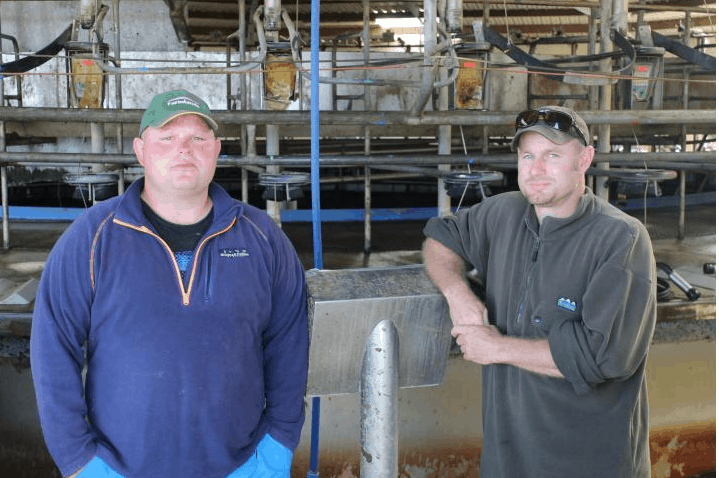
The record-setting exercise is the brain-child of healthy farming campaigner Ian Handcock who was responsible for the Farmstrong initiative, aimed to improve farmers’ mental and physical health. In 2013 Handcock’s Kellogg rural…
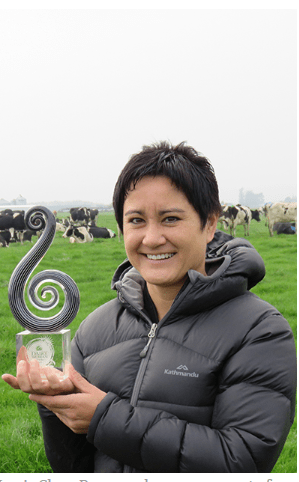
Jessie Chan-Dorman is a Kellogg Rural Leadership scholar, has completed a Fonterra governance programme and was the recipient of Canterbury’s Institute of Directors aspiring director award in 2014. And she was named 2017 Fonterra…

NZ Young Farmers chairman and recent Kellogg alumni Jason Te Brake will attend the Te Hono Movement Stanford Bootcamp in the United States after receiving the Emerging Primary Industries Scholarship.
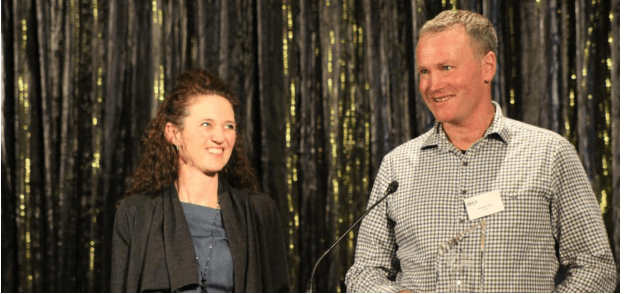
Excellence in New Zealand’s sheep industry was celebrated in Southland with the annual Beef and Lamb New Zealand Sheep Industry Awards.
By Turi McFarlane, 2018 Nuffield New Zealand Scholars
With a much-touted reputation as the tiny country which feeds the world, The Netherlands is the world’s second largest exporter of agricultural products after the USA. The Dutch agricultural sector is diverse and supplies a quarter of the vegetables that are exported from Europe amongst a range of other produce.
During the CSC, we were privileged to hear and visit a wide range of farmers, researchers and rural professionals who emphasised several key themes over the week:
Farming land and succession
Three farmers a day leave farming in The Netherlands and with agricultural land selling for € 60-100,000 per hectare there are massive challenges for the next generation of farmers looking to own their own farm.
Feeding the world versus niche markets
With the world population expected to grow to almost 10 billion by the year 2050, we are regularly presented with the challenge of “feeding the world”. However, how does this align with obvious opportunities for us as a nation to focus on creating high value products which command a premium price in niche markets? Food security, particularly in Africa which is expected to see the most growth over this period is critical to us all, yet perhaps our greatest opportunity as a nation is to provide technical advice and assistance to improve the food self-sufficiency in developing countries?
New technologies
A number of new technologies were mentioned throughout the week as potential game changers. CRISPR-Cas9 genome editing is definitely seen as having great potential, offering dramatic advances in speed, scope and scale of genetic improvement. However, the debate around GM and gene editing policy is obviously alive and well – “The CRISPR conundrum”.
We also heard about research at Waginengen University in The Netherlands which has highlighted a natural variation for photosynthesis in plants. With this knowledge they are hoping to breed crops in the future which make better use of photosynthesis – opening the possibility for much higher yields and capture of carbon dioxide.
To finish – a few interesting quotes from speakers over the week included:
“Every 20 years, the number of people depending on one farmer doubles in developed countries”.
“Climate change is here”.
“Agricultural land per capita has halved since the 1960s (worldwide)”.
“1/3 of globally produced food is wasted”.
“Lactose intolerance is more popular than skinny jeans”.
The Nuffield Contemporary Scholars Conference mixed some 100 plus forward thinking rural professionals from around the world for a week in an intense learning environment. The group was primed by top level speakers, who outlined current and projected issues for global primary food production. They then burst onwards into networking, brainstorming, and debates on the path ahead in the coming decades.
The diversity and intensity of discussion held all day and long into the night is hard to describe. The broad spectrum of professional experience and opinion, in a positive and engaging environment created conversations that became quite literally storms of ideas across the agricultural landscape.
A while later in the relative calm of the long haul flight to Washington I picked around in the debris for a conclusion and what I found was this.
Yes, there are global reports describe how food production and the human population will look in 2050. Roughly double the food and nine billion people being a widely held consensus. But these reports should be closely accompanied by two critical points. The first; they are based only on what has happened in the past. The second; they represent the distillation of many expert opinions, which on an individual level often diverge extensively. Don’t be thinking for a moment that they are all in agreement, or that the path to 2050 is even remotely clear.
Africa is a good example. On the one hand, there is concern at population growth rates there, the low level of agricultural development, and the questionable ability of developed nations to supplement its food production in future. On the other hand the potential to increase food production there is great, the average age is low, and their level of connectivity to the internet is growing rapidly. Relative to the over exploited systems of developed countries, the aged farming population, and great burdens of debt, Africa is a resource, and as likely to be exporting food in 2050 as importing it.
Despite the ‘ifs’ and ‘buts’ in combining the political, social, economic, cultural, and environmental dimensions of global food production there are some big pictures worth noting.
One is rapidly growing concern at increasing protectionism and populism and their impact on trade. Where this ends up is anyone’s guess which makes it even more alarming.
Another is how to repair the growing disconnection between the producer and consumer. The comparatively low cost and abundance of food that was such a wonderful achievement following the second world war is now working directly against farmers as consumers lose appreciation for it. This model needs to be fixed.
A third is the ‘race to the bottom’ for lowest cost food production. Often perceived to be achievable through intensification and technological advancement it goes hand in hand with debt. This model needs fixing too and is a particular risk for farmers in New Zealand. There was a surprisingly strong consensus that the more intense systems we saw on farm visits during the conference were well beyond reasonable ethical and environmental limitations. We saw first-hand the growing tension between sustainability and profit.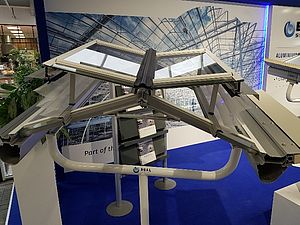
Another is shifting climate. Farmers from every corner of the planet spoke of sensing changes in their local climatic conditions. This came with no small amount of apprehension.
And of course the old dogs of commodity versus value add production, subsidies, a shortage of good labour, and the price of land were all in the mix too.
There was virtually no mention of the role of energy in agriculture. Nor discussion of the risk or impact of restrictions on production and trade resulting from emissions regulations or high energy costs. I found this deeply alarming.
In short, the Contemporary Scholars Conference contrasted the very diverse opinions on our path to 2050. This was both daunting and exciting. The perennial issues in agriculture are alive and well, particularly protectionism, consumer perception, and sustainability along with climate. I came away feeling that there is room to manoeuvre to meet the challenges ahead. But proactive and genuine change will be essential to our success.
By Andy Elliot, 2018 Nuffield New Zealand Scholar
It’s been a whirl wind week here in the Netherlands, I wasn’t too sure what to expect in terms of the whole experience and I honestly believe that it will take a while for it to all sink in. The first challenge was the meeting and working together with another 75 other future leaders from around the world. It was incredible, stimulating, challenging and empowering. It really pushed me and forced me to look critically at myself and my perceptions.
Sitting here now reflecting on the week, I realise that there were a few themes emerge that have been interesting to dive deeper into, some issues have been specific to the Netherlands, but many relate to New Zealand.
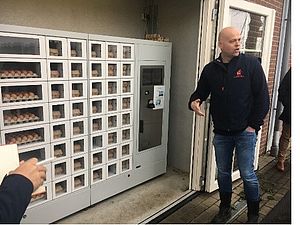
One of these is the obvious pressures farmers are feeling to become more demand, rather than supply driven. It’s very difficult under a backdrop of subsidy, but we met a few of small operators who are achieving this transition successfully by moving to a direct to customer, or value add proposition within their business model. These farmers are the innovators, the first movers who will always find a gap and are prepared to tread a different path. In the Netherlands, these innovators are supplying a very concentrated local market with quality products. But what about the rest of the farmers?
We learnt that the Netherlands has approximately three (3) small farmers leaving their land every day. They are walking off for several reasons; some of these include the income not being there, there are increasing legislative and regulatory layers and cost and the average farmer is becoming older without a younger generation succeeding them. For every farmer in Europe under twenty five there are seven over seventy five years. The average land price is close to €60000/H and these issues are not unfamiliar for us in NZ.
The Dutch cannot afford to continue to lower the cost of their production and rage battle over commodity prices, as like New Zealand, production costs are too high. Exports need a clear identity, a story, a differentiation from others, which will attract and appeal to the consumers purchasing choice. The other driver in loss of value would be volume, but that’s a bit more challenging to manage.
Can everyone innovate and become a supplier direct to consumer? Is everybody capable of becoming an entrepreneur? I’d suggest not, but we can all change what we do, and we can all prepare ourselves to be in a better position, when such disruption is being forced upon us.
Photo on the leftt: Egg vending machine – Tomesen Pluimveehouderij. A good example of a farmer transitioning from wholesale to direct to customer.
I think, like the Dutch we need to improve our ability to collaborate and work together. There are many ways of diversifying or differentiating. It may be through supply chain or through the way we value and treat our environment or using technology within our business.
It could be through diversifying the products we produce or even through the capture and use of data within our farms. What we do not want to do is put our whole business at risk by hoping it will fix itself.
We can strengthen our adaptability by developing collaborative models or through the investment in doing things differently; research and development, transfer of technology and most importantly regular engagement with the customer and consumer to maintain awareness of their changing needs. This will all help decrease our risk, while enabling us to be more resilient to a changing export market.
Traditional farmers in the Netherlands are currently struggling to adapt to their new environment, even though the world may see the Netherlands as the innovators and technology creators. The challenge is real and often daunting, but I believe NZ is already very well positioned to adapt faster.
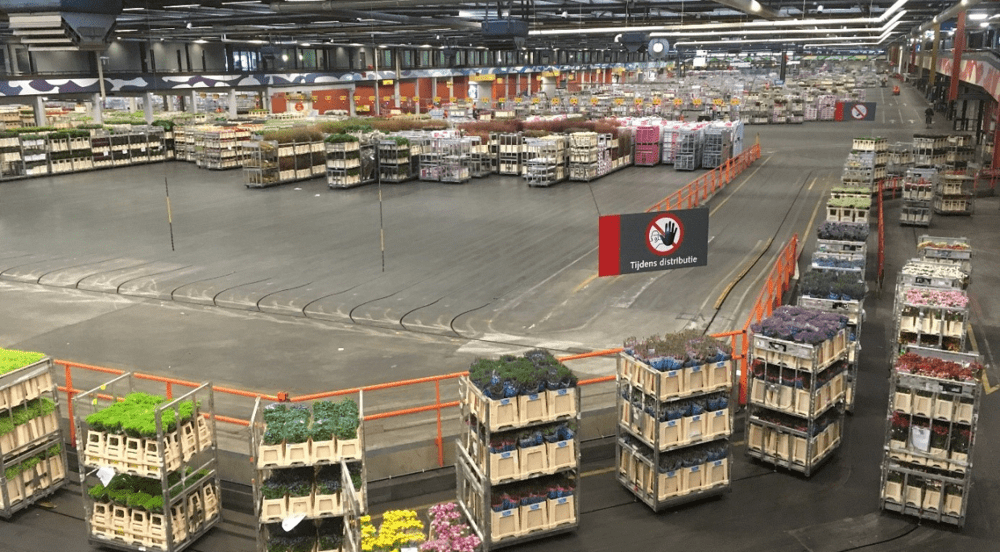
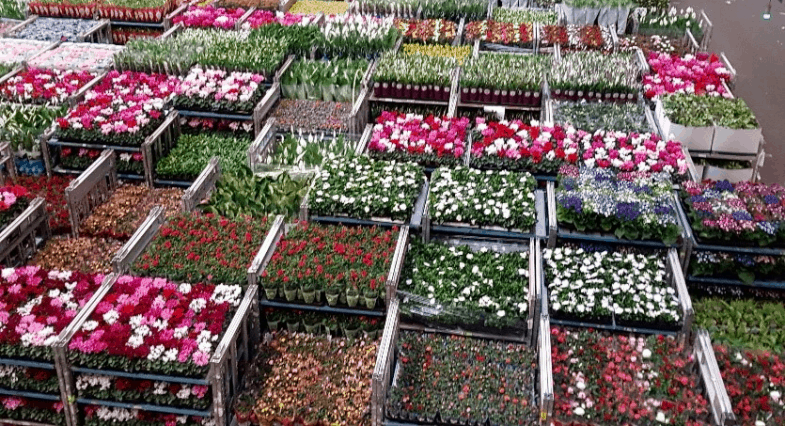
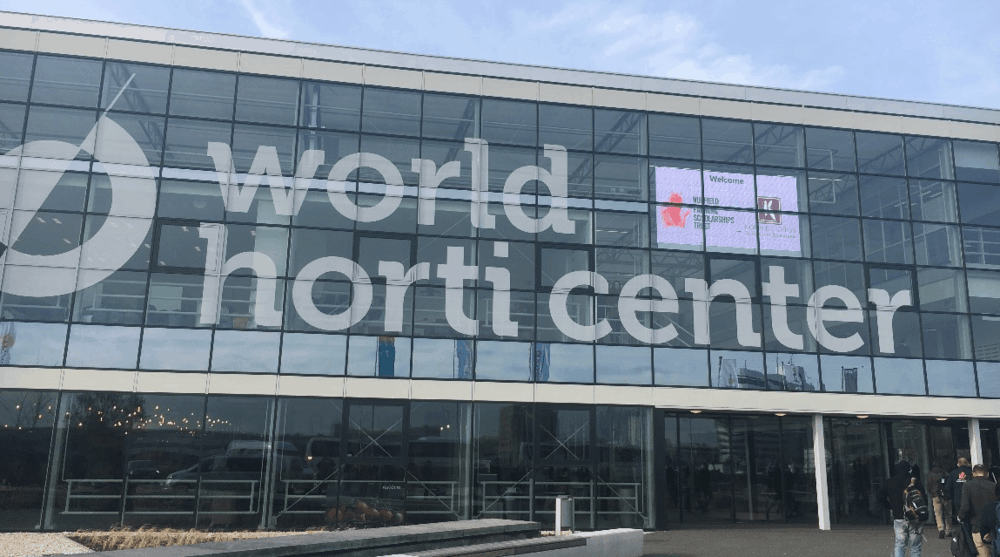
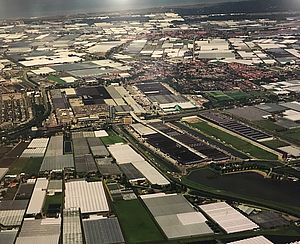
Image on the right: The kilometres of glasshouses around Rotterdam and the Royal Dutch Flower Market
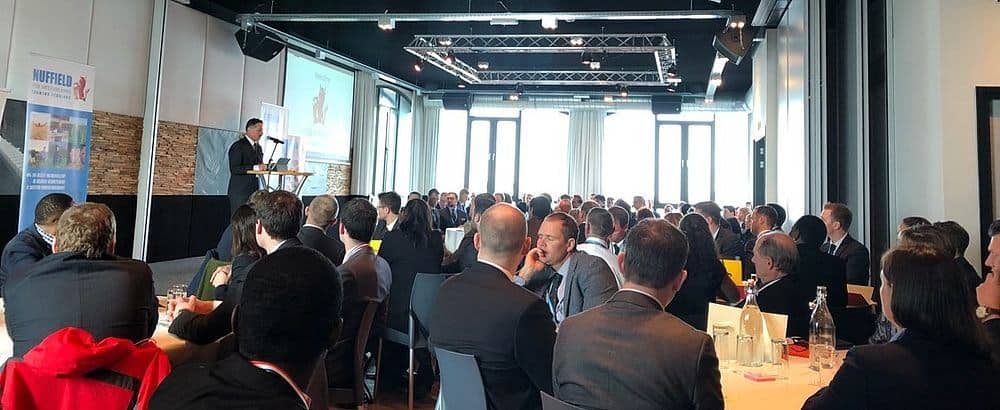
By Simon Cook, 2018 Nuffield New Zealand Scholar
The theme of this year’s CSC in the Netherlands was very much about learning and understanding the history of Dutch agriculture and how and why they have got to where they are now. As a New Zealand farmer, we often hear about the long term subsidies paid to farmers in the EU, without ever understanding why these subsidies were introduced in the first place. During our Nuffield conference in the Netherlands we had a number of speakers fill that gap in our knowledge with the story behind the introduction of subsidies.
After a day of beginning to meet each other and an afternoon farm visit, the second day of our CSC got off to an interesting start, with a presentation being given to the scholars while they sat in the pool in their togs – an introduction to business models.
Once back in the conference room we had some moving presentations focused around WW2 and the famine bought on as the war drew to a close. We had a presentation by Mr Jaques Von Trammel who was a young Jewish boy forced to grow up quickly as he lived in constant fear of being caught by German forces. We were then given the story of Leny Adelaar-Polak, a survivor of the medical experiments in Auschwitz. Leny was the only member of her extended family to survive the war.
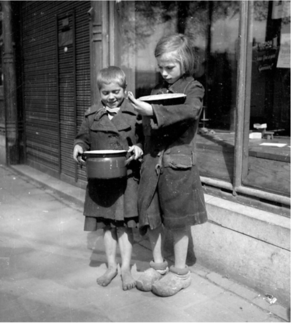 We also had a presentation by Ingrid de Zwarte who completed a PhD thesis titled “The Hunger Winter” which focused on the famine that struck the Netherlands as WW2 drew to a close. In the winter of 1945 the population of the Netherlands were struck by food shortages. Bought on by a shortage of local produce and failing supply lines from Germany, the population of Netherlands suffered a severe famine. During April 1945, the average daily calorie intake dropped below 500 kcal, less than a quarter of the daily average an adult consumes today.
This mass starvation and resulting deaths galvanised the population to ensure that farms completely de-stocked and devastated by the war would be given whatever support was needed to get back up and running, to ensure this situation would never happen again. Food security became the utmost priority in the Netherlands and across Europe.
It was interesting to reflect on the low status farming holds in countries like New Zealand and Australia, where there has never been a food shortage, and compare it to countries like the Netherlands and Japan who have known critical food shortages and truly understand the importance of agriculture as a necessity of life along with fresh water and clean air.
One of the major steps towards ensuring not only food security but also political stability in Europe came in 1958 with the formation of the EU. The initial trade agreements, signed up by the six founding nations, that were to form the basis of the EU, were designed to control the supply of steel and coal, the two raw ingredients required to manufacture canons and therefore wage war. By the late 70’s most European countries and the UK had also joined the EU.
Now that I have a better understanding of the environment and pressures that lead to the formation of the subsidies I have a more open mind towards their purpose and introduction.
The question is whether they are still valid in today’s society and it will be interesting to follow the outcome of Brexit which will remove the direct payment subsidies to farmers in the UK, and may also challenge the future of farming subsidies across Europe.
November and the last E Nuff seem a long time ago, but Lisa, myself and the Board have been very busy since then with programmes, events and projects.
It is a good time to acknowledge, as we head into the two yearly AGM, the workload and contribution of the Trustees. The Nuffield Trustees (along with the two independent Trustee), have the responsibility of overseeing both leadership programmes (Kellogg Rural Leadership Programme and the Nuffield Scholarships) which have increased in size and complexity.
While I respect the decision by Juliet to stand down after 6 years as a Trustee and 2 years as Chair, the leadership and the support, time and effort she has given to the organisation and myself as GM has been enormous, particularly given the significant strategic changes and developments in the last two years.
The establishment of the NZ Rural Leadership Trust has required us to review our vision, strategic goals and external brand and the positioning of the programme. I am excited about the branding work that has been done, which will be shared at the Conference.
The Nuffield programme is still a flagship programme for the agribusiness sector and in discussions recently with the Forestry sector, it is clear the status extends wider than the traditional sectors we have operated in. The exposure of our scholars is also expanding and they are increasingly active in industry events and media broader than their sector.
I have been impressed by the number of presentations already completed by the 2017 Scholars and the quality of their reports ‘hot off the press’ and now live on the website for reading (see the enclosed box for the latest reports).
The encouragement to look at issues facing NZ Agribusiness rather than more technical topics has resulted in greater interest from the wider sector. The 2017 group were invited in March to present their insights and report recommendations at a) a workshop with MPI staff, and b) an Agmardt Board lunch with both providing some robust discussions and challenges.
Individually, they have already presented at a number of forums including Irrigation NZ & Landcorp’s Pamu Conferences and have a number of scheduled presentations coming up.
Both the 2016 and 2017 scholars are looking forward to some challenging discussions with alumni following their presentations at conference!
HOW CAN PASTORAL DAIRY FARMING REMAIN COMPETITIVE?
Ryan O’Sullivan
EFFECTIVE INDUSTRY COLLABORATION FOR ENVIRONMENTAL GAINS
Rebecca Hyde
THE INNOVATIVE FARMER
Mathew Hocken
DEVELOPING AN ONLINE SALES STRATEGY FOR NEW ZEALAND FOOD
Jason Rolfe
GROWING VALUE FOR NEW ZEALAND’S RED MEAT INDUSTRY
David Kidd
BROKEN FOOD SYSTEMS – DEVELOPING A CITIZEN CENTRIC NEW ZEALAND FOOD STRATEGY
Nadine Porter
Our 2018 scholars who we announced in the last newsletter, are well into their programme. The group attended a two day briefing in December, with government and industry representatives ensuring that their knowledge of New Zealand and its positioning and activities globally were well understood.
This year the scholars were also offered the opportunity to attend a leadership skills workshop in January, in conjunction with the Kellogg group, run by Coach Approach in January. This proved to be really beneficial for them in gaining greater insights into their personal leadership profile and developing higher level skills in question formulation.
The five scholars (Simon Cook, Andy Eliot, Turi Mcfarlane, Solis Norton and Kate Scott) commenced their first international component with the Contemporary Scholars Conference (CSC) in the Netherlands from 10 – 17 March along with 80 plus other international scholars. They share their reflections, insights and questions to explore further in their travels in this E Nuff.
The CSC is always a big week with the Dutch organsers, Djûke van der Maat and Henk Smith and their team, putting on an excellent programme of fieldtrips, speakers and panels presentations. Many of the recent Dutch scholars were involved in assisting with the conference and hosted field visits and provided food products for the self-contained apartments that the conference enjoyed.
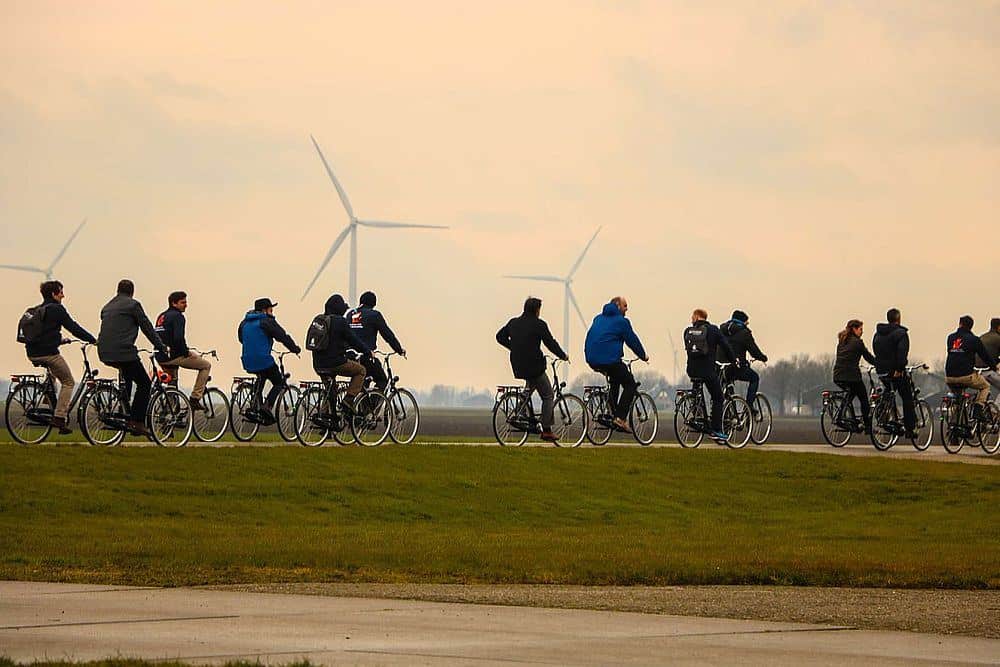
One memorable experience of Dutch life, was a 20k round trip cycle into the countryside (see header photo) visiting the very successful farm and production enterprise of one of the 2015 Dutch scholars and his business partners.
However, the “Beast of the East” temperatures with -2 chill factor and snow which hit during the CSC, was in stark contrast to the outdoor activities enjoyed in Brazil, the previous year!
Alongside the CSC, the Nuffield International meetings of Board and Country Executives were scheduled. This is a particularly important time for strategy development, sharing of information, planning of events, and alignment of programmes. The NI Board (with Andrew Watters as the NZ representative) spent many hours on reviewing the strategy and financial business plan. Andrew will share the key points at the Nuffield NZ AGM.
Upcoming Events
As this Enuff arrives, a group of 10 Nuffielders from around the world, including NZer Kate Scott, will be completing their Brazil GFP – NZ Leg with a programme in the Hawkes Bay organised by Tom Skerman and Sam Lang (with support from other alumni). This is the final week of their 6week programme which started on 18 March with visits to the Netherlands, Ireland, USA, Mexico and Brazil & NZ before concluding on 26 April.
Registrations close in a few days for the 2018 Nuffield NZ Biennial Conference & it is only a few weeks until we get together in Tauranga. Dave Hurst and his team have put together a great programme, and put in a lot of hard work with support from management. Dave and his team have successfully secured a family of local sponsors, who along with our strategic and programme partners we look forward to engaging with at the conference.
Work is building for the 2020 Nuffield Triennial Conference which will be held in March 2020. We hope that alumni will use the opportunity to invite their Nuffield cohort for a reunion in NZ. We will release more details in the next E Nuff as promotion of the conference will be launched. Confirmation of hosting the 2020 Nuffield NZ Biennial Conference in conjunction with the Triennial will be made after discussion with alumni in Tauranga.
Finally, on a sad note, Nuffield NZ lost one of our oldest and respected scholars with the passing of John O’Connor. Condolences were sent on behalf of the alumni and Board to Del, Damien and Bede and thankyou to Julian Raine who represented the alumni at the funeral. Many will remember John & Dell attending part of the last conference in 2016 in Blenheim and he desperately wanted to be in Tauranga to see Bede present and Damien as Minister open the conference, but unfortunately it was not to be.
I look forward to seeing most of you in Tauranga on 10th May.
Anne Hindson