2026 Nuffield NZ Farming Scholarship. Apply by 17 August 2025. Read More...

Apply for 2026 Nuffield NZ Farming Scholarship by 17 August 2025. More details...

How can pastoral Dairy Farming remain competitive.

The NZ dairy industry has always historically enjoyed the advantage of being the world’s lowest cost producer of milk with our cheap pasture feed resource being the envy of the dairy industry globally.

Despite this, farmers in the Europe and the US, the worlds 2nd and third largest exporters are eyeing opportunities for growth to compete with NZ in the global milk market. They are using a containment (housed) dairy model to achieve this and becoming increasingly competitive on many production and cost metrics through the application of efficiency, scale and productivity gains. These same techniques are being applied to world grain production with resultant excess of supply over demand suppressing prices, a key driver for profitability in containment livestock industries.

The question for the NZ dairy industry in light of this is ‘How can pastoral dairy remain competitive?’

The aim and purpose of this paper is to explore and evaluate the comparisons between pastoral based and containment-based production systems and determine where the advantage for NZ will lie in the future i.e. how we can compete and stay relevant.

This is an important discussion, the NZ dairy industry is a key part of the NZ economy and its prosperity is important on many levels. Over the past decade, the NZ dairy industry has pursued a volume (growth) model but due to emerging environmental constraints, this has evidently run its course and a value model is the next opportunity.

Information gathered on the topic followed two main themes: production systems and consumer insights. Dairy farming businesses, particularly scale or expanding operations were consulted in the US and Europe with a view to establishing resilience of their business models, future prospects and intentions. Consumer market insights were observed, mainly in Asia and the US, to establish what trends are currently occurring in dairy consumption and consumer preferences.

The key findings suggest that cost competitive marginal milk will be delivered onto world markets from the US, Europe and others, but there are opportunities for NZ to differentiate and pursue a value proposition around ‘grass-fed’. Our free-range pastoral model is unique in a global volume context and difficult for most dairying nations to replicate. Many consumers are actively seeking out food produced from sustainable, high animal welfare production models and this is an important opportunity for NZ.

The recommendations from this research contain a key message around the NZ dairy industry continuing to do what it does best on-farm. Beyond the farm, we need to look at ways to tell our story and leverage the differentiation that already exists in our national milk supply.

There are of course a number of challenges along the way and some of these will be discussed. This report endeavours to provide only a perspective based on observations offshore. It is up to the industry to evaluate the merits of the discussion and find a way forward.

Keywords for Search: Ryan O’Sullivan
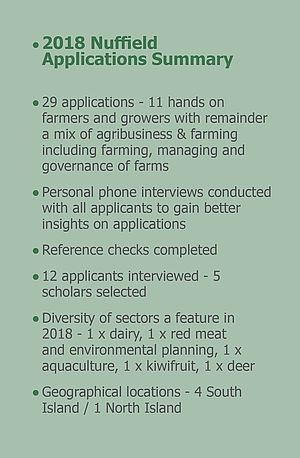
2018 Nuffield Scholars Announced

Simon Cook is a kiwifruit grower from Te Puke, owns an orchard a contracting business. 

Andy Elliot, working for Wakat? Incorporation in Nelson, has 20 years’ experience in New Zealand’s aquaculture industry.

From Banks Peninsula, Canterbury, Turi McFarlane works for Ravensdown Environmental utilizing his experience in agricultural systems and sustainable land management. 

Solis Norton from near Port Chalmers, Dunedin manages the industry funded national animal health and productivity  programme for the New Zealand Deer Industry.

With a background in dairy farming, Kate Scott, from Central Otago, owns her own environmental planning and surveying business which services a broad range of agri sector businesses.

The five new 2018 scholars join more than 140 New Zealand agricultural leaders, over more than 60 years, to have been awarded a Nuffield Scholarship – a highly respected and prestigious award in the primary sector.

The 12 month scholarship programme with up to 20 weeks spent overseas, allows participants to spend time away from their business and to travel to observe, immerse, reflect and learn about global agricultural practices and the contexts they are operating in. A research topic, which focuses on an issue /challenge for the New Zealand primary sector, will be a focus of individual travel and investigation.

Nuffield and Kelloggs combine resources

Media release

24 September 2013

Kellogg and Nuffield combine resources

The Nuffield Farming Scholarship Trust and Lincoln University are combining their efforts to improve leadership capability within the rural and primary sectors in New Zealand. The two organisations have agreed to establish a rural leadership consortium to manage two prestigious leadership programmes that have operated in New Zealand since the late 1970s.

The two programmes will continue to operate distinctly and maintain their strong existing brands and alumni networks, but will be managed by a shared full-time General Manager. This position will be advertised shortly.

The Kellogg Rural Leaders Programme (Kellogg) is owned and administered by Lincoln University and the Nuffield Farming Scholarship Trust (Nuffield) is owned and administered by the Nuffield Farming Scholarship Trust. Over 650 New Zealand alumni have completed the Kellogg programme and there are around 150 Nuffield New Zealand alumni. 

“There is a natural synergy between the two programmes and they combine logically to form a leadership pathway within the rural and agribusiness sectors”, says Nuffield Trustee Juliet Maclean.

Chancellor of Lincoln University, Tom Lambie adds “By combining our resources, the University and the Nuffield Trust will be able to strengthen both of these programmes, and ensure the essential leadership capabilities are maintained and enhanced within rural New Zealand”.

Both the Nuffield Trust and Lincoln University expect that the combined resources of the rural leadership consortium, with the support of both programmes’ industry partners and sponsors, will enable the Kellogg and Nuffield programmes to better meet the leadership development needs of the wider rural and primary sector.

Background information

Lincoln University and the Kellogg Rural Leaders Programme

Lincoln University is New Zealand’s specialist land-based university delivering research informed education and training, along with research and commercial activities to support growth in the land based industries. Land based industries are referred to in the widest sense of the word including land, land resources and waterways.  

Lincoln University has administered the Kellogg Rural Leaders Programme since 1979 when it was launched with a grant from the Kellogg Foundation, USA. The programme provides an opportunity for twenty men and women who live and work in rural New Zealand to participate in residential workshops, seminars and personal study over an 11 month period.  The objectives of the Kellogg programme are to:

  • Develop solid leadership skills
  • Build the confidence to take the next big step in business, professional development, politics, industry governance or community service
  • Learn how political, cultural, social, economic and physical forces impact on New Zealand agribusiness
  • Establish networks with leaders from New Zealand and beyond.

The Kellogg programme is generously supported by DairyNZ, Beef+Lamb NZ, Zespri, Pipfruit NZ, and Deer Industry NZ.

The Nuffield Trust and Nuffield Scholarships

The Nuffield Trust is a charitable New Zealand Trust set up in 1978 and is part of an international network of Nuffield Trusts that provides scholarships to emerging leaders in the agricultural industry.

The Nuffield Trust is governed by four Trustees and managed through a part-time director and secretariat, with around 150 active alumni members (all the alumni are Nuffield scholars).

The Nuffield Trust’s mission is to develop leadership and excellence in all aspects of New Zealand agriculture through its function of providing scholarships to around five scholars.

The objectives of the Nuffield programme are to:

  • Select scholars with high personal integrity, a close connection to farming or a practical hands on farming background, who are self-disciplined but flexible, focused on innovation and high achievement and who are likely to “give back” to the agricultural industry over their life time
  • Increase thought leadership
  • Create a full international immersion experience for scholars
  • Develop global networks

Nuffield scholarships are provided to future leaders chosen because of the positive difference they will make to their relevant primary sector, and for the life-time contribution they make to New Zealand agriculture. 

Scholars are linked into the Nuffield international network and supported to undertake projects or research that will fuel intellectual debate within their communities and industries.   Nuffield New Zealand also provides an alumni network through circulating newsletters, publishing information on the Trust’s website and running conferences. 

The Nuffield programme is generously supported by DairyNZ, Beef+Lamb NZ, FMG, AGMARDT, FAR, the Mackenzie Charitable Foundation, and Landcorp.

Triennale Nuffield Conference 2017: United Kingdom

David Kiss and Jason Rolfe, 2017 Nuffield Scholars

England – The Triennial

The Triennial was an amazing opportunity to catch-up with not only the other groups who were also travelling on their GFPs, but also to meet and interact with a range of scholars from all countries and years.  They provided a fascinating insight into the Nuffield Scholarship and the opportunities and discussions that have resulted following completion of their scholarship programmes.

Although several impressive businesses were viewed, many of which were using new technology to improve their profitability, sustainability and environmental impact, discussion was very much influenced by the upcoming BREXIT and what this will potentially mean for these businesses.  Some appear to be embracing the opportunity, while others were quite apprehensive about the challenge of competing against lower cost or more efficient operators from other parts of the world (NZ very much included). 

There was considerable discussion regarding the potential for subsidies in farming to be reduced or removed, and NZ was discussed at length as a model as to how this could work.  Many of the businesses that we were shown relied heavily upon manual labour which invariably came from Eastern Europe, a challenge that the UK government will face as they work through discussions with the EU.

Some of the businesses that we were fortunate enough to visit really focused on two key points of interest, the first being the provenance of the food they were selling and ensuring the quality of that produce.

Consumers are becoming increasingly focussed on the ‘story’ of their food.  They want to know how it has been made, where it comes from and what makes it unique. 

We cannot underestimate the importance of this, however any ‘story’ must be supported by a strong and secure supply chain that backs the integrity of claims on the packaging.  I was also struck by the high importance of consistent quality and the impact of this quality on the price that is received.

At Hall Hunter Partnership, the managing director Harry Hall was only interested in supplying berries of ‘A’ quality.  Berries that did not meet ‘A’ quality standards were discarded regardless of any income that could be received from them. 

Together with his level of supply, this meant he had the ability to engage in meaningful discussions with his in-market partners (Waitrose and Marks & Spencer) when it came to marketing his products and achieving the highest possible price (and therefore the best return on his assets).

David Kidd

*****


United Kingdom – “Attitude towards Agriculture and Subsidies”

In the UK, we were lucky enough to attend the Nuffield Triennial Conference, where we got to mix and mingle with many previous Nuffield scholars from around the world. This was a valuable opportunity to make some contacts for further travel and research later in the year.

The common topic of the conference was around ‘Brexit’ and what the future looked like for British Agriculture as they transitioned out of the European Union (EU).

The debate naturally centred around farm subsidies currently received by farmers and whether these would continue and for what. Interesting for me was the large number of farmers, including UK Nuffielders, whose attitude was that they would not survive without subsidies and were very resistant to change.

Delegates at the conference were in agreement that due to Agricultures relatively small contribution to GDP that subsidies were going to be greatly reduced if not removed.


This potentially would create opportunities for the younger generation if older farmers chose to exit the industry. It was clear that the process of leaving the EU was going to be very long and drawn out.

Due to this and the inward focus it brings, they may miss global market access opportunities.

Jason Rolfe

Toxicology and the New Zealand Farmer.

Executive summary

This work is designed as a short introduction to common poisons found around New Zealand farms. It has been prepared to fulfill, in part, the requirement of the Kellogg Rural Leadership Programme. 

Toxicology is the study of poisons. You may have heard the old saying “the dose makes the poison”. This means that actually, everything is toxic at some level which makes the study of toxicology relevant to a number of areas including human health, the environment, public policy, drug development and human safety.

This booklet covers some of the chemicals found around the common New Zealand farming environment. The information on what to include has been based on analysis of statistics from the New Zealand National Poisons Center.

Belinda Cridge

Comparing and contrasting adoption of technologies used overseas to New Zealand for managing variability on farm.

Executive summary

The growing trend in precision farming (PF) comprises technologies that combine sensors, information systems, enhanced machinery, and informed management to optimise production by accounting for variability and uncertainties within agricultural systems. Adapting production inputs site-specifically within paddocks and individually for each animal enabling better use of resources to maintain and improve the quality of the environment while improving the sustainability of food supply and security.

Precision farming is now providing a means to monitor the food production chain and manage both the quality and quantity of agricultural produce. A key area of growth in terms of scientific development and validation is in the area of sensors and precision application to manage the increased level of information. Although the benefits from PF appear to be endless, in New Zealand there is a lack of understanding and insight into adoption of precision farming technologies. 

The purpose of this report is to provide insight into extension strategies for PF technology adoption to improve New Zealand’s ability to aid the adoption process through a more considered extension approach including details of:

  1. Trends in precision farming overseas and in New Zealand
  2. Diffusion and adoption overview
  3. Currently recognised rural extension strategies
  4. Overview of two PF technologies available overseas and in New Zealand.

Data accessible online and through Ballance Agri-Nutrients network identified two technologies, the N-Sensor® and global position systems (GPS) as case studies. The information available on these technologies was used to identify how they have been adopted overseas compared to New Zealand, and if any extension approaches were developed to aid their adoption. The extension approaches for each of the technologies have been compared and contrasted to industry recognised extension approaches, to provide improvements for future PF technologies released to the rural sector.

Although a comparison was made between countries, regarding adoption of the case study technologies there was little insight gained due to the lack of data available for a robust comparison. Further to this, the relevance of a country when reviewing extension approaches was found to have little to no influence on the adoption rate. Beyond this exception, there were some similarities and differences between how the case study technologies were released to market and aided or in the instance of the case studies, were unsupported by deliberated extension approaches, but the major consistencies were:

  1. Lack of deliberate extension strategy.
  2. Improvised linear ‘top-down’ transfer of technology.
  3. Dependant on highly technologically perceptive farmers.
  4. Technology developed by researches or in another field, which “found” a solution in the agricultural sector.
  5. Hugely dependant on external drivers to get adoption over the ‘chasm’ – greater than 15% adoption in the market place.
  6. Lack of consolidated data to assess rates of adoption and impacts of extension approaches.

As the adoption of PF technologies in New Zealand is perceived to accelerate with the expectation that the majority of innovations for PF will become industry standard. This report recommends that through utilising current and future case studies and leveraging the knowledge and skills of extension process and practices greater adoption of PF innovations can be achieved by:

  1. Greater attention and emphasis should be placed on developing extension approaches through the development of an innovation.
  2. Identifying target markets and involving the potential adopters through the development of the innovation is reported to have a great improve on rate and success of adoption.
  3. Data of technology adoption should be captured on a national level to provide insight into rates of adoption and technology transfer within the agricultural industry.
  4. Identified through the literature review, the lack of knowledge around the level of education attained by New Zealand farmers was revealed. This should be reviewed as it may influence their ability to critically analyse the farm system and be able to identify issues and work through solutions.
  5. As this is a review with case studies applied to a theoretical construct, further research should be conducted into understanding the potential of planned extension strategies with precision farming innovations.

Precision farming presents a great opportunity in managing variability on farm to an every declining scale. There are currently innovations that are well down the track of the innovation categories while others have yet to become commercially available. Although precision farming has been around for a number of decades, it is still in its infancy here is New Zealand but this will be overcome by time. With a greater focus on extension practices and processes in the rural sector, the impact of PF on the wider industry and society as a whole will be realised.

Oliver Knowles

Maximising your asset.

Executive summary

50/50 Sharemilking as a path to farm ownership is a tried and true journey in the NZ Dairy Industry. Often, sharemilkers have to grow their herds quickly over a short period of time. For example, moving from a 270 cow farm up to a 500 cow farm. A sharemilker’s herd is their biggest and most valuable asset. My Kellogg Rural Leadership Project explores strategies and attempts to quantify several strategies for sustainable herd growth. 

Herd value in New Zealand is usually determined by a few factors. Breeding Worth, Production and Cow Age. Herd growth must fall within these boundaries and be cost effective and sustainable.

This case study focused on a 77ha 270 cow dairy farm in the Matamata/Piako district. Several scenarios were analysed that were applicable to this herd and interviews and a survey conducted which explored other farmers herd growth stories and strategies, with special focus on people who had undertaken these strategies themselves and their experiences.

After comparing several scenarios, it was decided that to “maximise” the herd owner’s asset; herd growth will have to come from within. This will be achieved by breeding the herd to high BW proven bulls, attempting to increase 6 week in calf rate and breeding the bottom 10-15% of animals to easy calving beef sires.

Increased value from cull cows will be achieved by preventing udder damage.

Advice was also sought from farm consultants, one herd growth expert and one reproductive expert.

Sophia Clark

Once Upon a Time Down on the Farm…

Executive summary

Dairy farmers are being encouraged to tell their story by leaders in the New Zealand dairy industry. This study surveyed opinions from fifteen New Zealand dairy industry and media leaders and discovered a need to share good stories with other farmers to improve uptake of on farm practice, with the general public to improve the social licence to operate and with international markets to create value for dairy products. The science as to why storytelling as a communication tool is so effective in these circumstances points towards creating an emotional connection with the target audience that fuels a hormone induced bond and aids in persuading the audience towards a specific idea or outcome. 

Building a story to create that connection is an art. International experts talk of the story structure, plot, characters, conflict and resolution but the surveyed leaders indicate sharing small snapshots of the farmers’ story is adequate in building the larger New Zealand farming story. Leaders and experts agree storytelling requires the careful consideration of who the target audience is, the formation of a clear, simple message, selective use of emotive language and a creative form of delivery to have the desired effect. In the context of farmers telling their story, it is suggested that farmers use online multimedia through social networks to tell the story that they care about their farm, their families, their animals and their environment.

Cam Henderson, Cameron

Emotional intelligence: Seismic shifts in the primary industry compel whole brain leadership

Executive summary

Enthusiasm and passion for the Primary Industry, and it’s people, ignited an aspiration to understand how the Primary Sector is going to boost human capability to achieve it’s ambitions of doubling export earnings by 2025. Seismic market movements, international politics, technological advances and climate change all contribute to an unsettled and fickle business environment. Increasing complexity requires resilient leaders, and businesses, to be economically sustainable to withstand the challenges we face in the future. Involvement in the Dairy Sector fostered an awareness of the challenges business leaders are facing, particularly in terms of leading a team. Curious to learn more, the purpose of this report is to understand how Emotional Intelligence could influence leadership capability in the Primary Sector.

The capability to manage this level of disruption, presents a management challenge to those who operate in the Primary Sector. The same drivers that have delivered performance are no longer adequate to lead success in the future. Although leadership success starts with a vision, a leader’s performance is dependent on their ability to influence the behaviour of their team. It is about the ability to influence beyond positional power, influencing people to work towards a common goal with enthusiasm. Leaders are challenged to cultivate an environment to build capability, inspire the right behaviour and unlock potential; all characteristics underpinning high performing teams.

Parallels were significant between the literature review and the interview process, undoubtedly supporting my anecdotal views that emotional intelligence is a crucial precursor to exemplary leadership. Fifteen dairy business leaders were interviewed and results were analysed, identifying five key themes. Leaders demonstrating higher levels of self-awareness tended to be people focused, they knew themselves, their capabilities, and limitations. Energised to execute with integrity, they were motivated to build relationships and foster an environment for growing others. In times of disruption, they appeared to be adaptive, resilient, and embraced learning opportunities for themselves and their teams. The five themes identified were as follows:

  1. Prevalent left wired brain approaches are managing the journey with less awareness of the influence that EQ competencies are contributing to business performance.
  2. A disrupted intrinsic compass is inhibiting the growth of our sector. The New Zealand Primary Industry is characterised by industry uncertainty and a lack of emotional and adaptive resilience is influencing the ability to deal with disruption.
  3. Disruption is hindering leaders’ capability to energise and execute effectively. Farmers’ coping mechanism is to dig deep, working longer and harder, losing sight of the rituals that energise, tending to be reactive in their behaviour.
  4. Task focused leadership methods are skewing the ability to build high trust team relationships. Farmers acknowledged difficulty with understanding the diversity of our finger print on the world, the way you see the world is different to the way another person views the world.
  5. Leveraging positional power is impeding the capability to unleash potential and build high performing teams. Conversations with farmers indicated the ‘do as I say and not do as I do” leadership styles are prevalent.

Farmers are passionate about their stock and their pastures. Harvesting the best grass, requires cultivating the best soil for the grass to grow. Breeding the best young stock, cultivating the best pastures, seeking nutrient management advice, and purchasing a big green tractor. These investments all appear to be easily justified. Investment in people, appears to be less of a focus.

People management is indifferent; it is about nurturing the right environment to promote growth. This sets the beat of an organisation. Igniting this type of environment strengthens responsibility and accountability, the potential to increase both productivity and performance. Farmers are proud, and so they should be. It is however this pride and the ‘tall poppy syndrome’ that has been nurtured so well in New Zealand that is inhibiting our ability to lead effectively. Increasing complexity and the rise of the millennial generation will continue to challenge. The best leaders are learners, they are humble when they do not know something and are open to seeking new ideas and processes. Gone are the days where it was thought to be a weakness to acknowledge your shortcomings and seek help.

The pivotal element to drive this change is embracing a whole brain leadership strategy. Building emotional intelligence competencies will aid to engage this holistic attitude.

  1. Lead from the inside out by tuning into the intrinsic compass. To lead others, we must first lead ourselves, to lead ourselves, we must know ourselves.
  2. Energise to execute. Prioritise Personal Power. The ability to ignite enthusiasm, influence and motivate teams will be driven by leaders with significant personal energy, actively valuing themselves, to be the best person possible.
  3. Activate with Purpose. Know your why. A sense of purpose drives feet on the floor every single day. Attract your tribe through a shared value based mindset, igniting the power to shape behaviour.
  4. Pilot the focus. Shift to the blue head. Steering your focus is underpinned by the ability to anchor in disruptive environments, acting with edge to make the tough decisions. Focus is either diverted or on track.
  5. Flex the social filter to tune into the emotional and social atmosphere of your teams. Connect. One size fits all rules do not apply. A distinguishing factor between those who will thrive will be dependent on the ability to understand what makes your team tick, build relationships and care about people. This does not run through the left brain.
  6. Foster a learning climate to unleash potential. Create the right environment for the right behaviours to occur. Fuel the communication through rituals and beliefs that set the beat for the business, the team language shapes the values, values shape behaviour.

New Zealand has the best rugby team. Why? The All Blacks have the best coaches and the best culture. Why? Their actions are underpinned by the belief that leadership is an inside job, it starts with knowing yourself. The Primary Sector can learn from this attitude. The capability to meet the intricacies of an ever-changing business arena and the vision of the Primary Industry for 2025 hinges on fostering a world class learning environment. Learning environments should not only be challenging the intellectual capability but emotional parameters as well if it is to have the opportunity to build a great leader. The obvious barrier is the ability to build on this momentum. Building one’s emotional intelligence will not occur without commitment and effort. A how-to manual will not suffice, this is not for the faint hearted.

I hope this report will stimulate further discussion, both by individual farmers and industry bodies, on the importance of equipping our Primary Sector with the skills to lead from the inside out, adopting a whole brain leadership approach. A determining element is the courage and determination to change. They must want to change. Seismic disruption is an opportunity to lead from the front, high emotional and social intelligence will alter the game. Understanding the intrinsic compass, knowing oneself, is the jumping off point, the key determinant in achieving real change.

Change is unkind to those inflexible in mind. The first to develop a whole brain approach, will do well. The choice is yours.

Update from the General Manager

Anne Hindson, November 2017

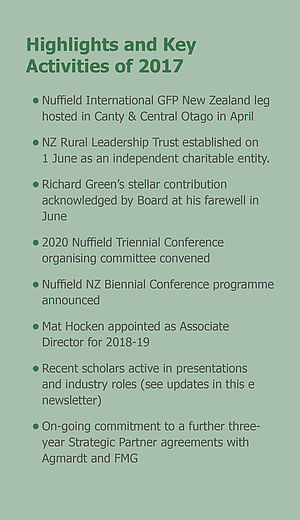
There has been lots going on since I last updated you in August. This is my summary of the key activities and the highlights of the year.Earlier this month we announced our 2018 Scholars. This edition follows up on our brief, pre-media announcement to you with photos and bios of the scholars. I hope that many of you will get to meet the scholars during their scholarship year.

The 2018 Awards Ceremony was hosted in Parliament by the new Minister of Agriculture, Damian O’Connor in his first few days in office. Having the Minister able to present the awards had special significance given both his father and brother are Nuffield alumni.
 
A second highlight of the Awards evening was hearing the progress of the current scholars. Each shared their preliminary insights on their research topic. With greater emphasis on scholars studying topics that will add value and offer solutions to some of the challenges facing the primary sector, there was strong interest from those attending. The value of this has been reinforced with MPI Director General, Martyn Dunne requesting a presentation from the scholars to MPI staff in the new year.

Having shared information and experiences with the 2017 scholars, the 2018 scholars will have a two-day New Zealand and Industry sector briefing in Wellington on 7/8th December. This is to ensure they understand the global positioning, strategy and key markets of our primary sectors, as well-informed ambassadors of NZ and Nuffield.

New Entity

The New Zealand Rural Leadership Trust has now been operating for 6 months, managing the Nuffield Scholarships and the Kellogg Rural Leadership Programme.

The transition to a standalone entity has taken time, but the organisation is now well set up to meet opportunities and challenges for the future. The legal and accountancy advice required has been significant and I wish to acknowledge the generous support of Mark Tavendale of Tavendale & Partners (legal) and Andrew Hawkes & team at KPMG Christchurch office (accounting) and encourage alumni to support them for any future needs.

The office at Lincoln University has been retained with myself and Lisa Rogers, our Programme Coordinator based there. The Kellogg Rural Leadership Programme is still delivered using Lincoln University venues and facilities.

Investing Partners

Our Strategic Partners are now contributing to leadership pathways by supporting both programmes and are actively involved in the development of leaders for the sector.

During the year, FMG and Agmardt have recommitted to a three-year partnership with the Trust, while Dairy NZ and Beef+Lamb NZ have continued their support.

For our organisation, the value of these industry partners comes in many ways with the National Advisory Group (representatives of the four organisations) providing regular industry insights, developments and views on future leadership needs to help us better shape the programmes. In addition, they have provided meeting space, special project support & Nuffield selection specialist HR support.

Our Programme Partners have grown in number, and their support is equally valuable providing marketing and speaker support to the programme.

Associate Director appointment

The Board recently invited alumni from the last 5 years to expression interest in the Associate Director role being vacated by Dan Shand in November. After considering the five applications, Mat Hocken was selected and will take on the position in January 2018 for 18 months. This is part of our commitment to provide ongoing leadership development opportunities to scholars, with governance a key goal for some.

Upcoming Events

Dave Hurst and his team have finalised the exciting programme for the 2018 Nuffield NZ Biennial Conference in May 2018 in Tauranga and surrounds. They are confidently anticipating a great turnout! You will be receiving information and regular updates over the next few months.

The programme will begin at 2pm on Thursday 10th May to accommodate presentations from the eleven scholars, including the six 2017 scholars with their reports “hot off the press”! The programme features some interesting field visits reflecting the agri-food and business strengths of the Bay of Plenty region.

The 2020 Nuffield Triennial Conference organising committee has been convened under the chairmanship of Michael Tayler with Murray King, Jane Mitchell, Steve Wilkins, Desiree Whittaker (Reid), John Wright, Rebecca Hyde, Anne Hindson and Lisa Rogers on the planning committee. Other alumni will be brought in to assist with specific activities as required.

This event will be a major undertaking so thanks to the team that have taken on the challenge.

We plan to hold the 2020 Nuffield NZ Biennial Conference in conjunction with the Triennial but with a separate programme.
Thank you for your support during the year.

We particularly value the role you play in identifying and encouraging applications from potential and successful new Nuffielders. You are our most powerful and respected advocates.

I look forward to seeing you all in May, in Tauranga for the conference.

Anne Hindson