2026 Nuffield NZ Farming Scholarship. Apply by 17 August 2025. Read More...

Apply for 2026 Nuffield NZ Farming Scholarship by 17 August 2025. More details...

Financial rewards within a sustainable kiwifruit business.

Executive Summary

This report was written with the aim of exploring how other successful businesses within the Primary Industry can gain a higher premium on their products to give a competitive advantage and exclusive brand positioning. I wanted to see if there are any lessons that can be learnt and adopted by Zespri and Growers to gain an even higher premium on their produce for being a Sustainable supplier.

The research methods included:

  1.  A literature review
  2. An interview with three Primary Industry based operations
  3. A case study review of three Primary Industry based operations
  4. An online survey of Growers and Post-Harvest Kiwifruit entities

Key findings included:

  • Many New Zealand businesses are taking tentative steps into the world of sustainability
  • Businesses see competitive benefits from acting sustainably
  • Many leaders are aiming to seize sustainability leadership within their sectors over the medium term

This report was compiled with the help of many different people within the Primary Industries within New Zealand.

The potential role of trading systems in the allocation of nutrient discharge allowances.

Executive Summary

Trading systems, as a tool to reallocate nutrient emissions are currently underutilised in New Zealand. This is primarily due to the under development of the underlying water management policies and regulations required for a trading system to operate effectively.

Water quality must be more proactively managed if we are to reach the goal of having 90% of New Zealand’s rivers and lakes swimmable by 2040.

As water management policies are developed the use of trading systems to manage discharge allowances is expected to become more prevalent. But a trading system alone is not a viable solution. A trading system can be used as part of a wider structure for managing water quality. It is also not the only solution available to councils, but it is one that is favoured by economist due to its ability to efficient price and allocate scarce resources.

For a trading system to operate efficiently it must be designed in a way that it is fit-for-purpose and is embraced by potential users. Education plays a huge part in the success of any trading system. This education needs to encompass the underlying purpose or problem which the system is attempting to mitigate, as well as the practicalities of how the system itself operates.

A note from the Chair

Juliet Maclean, November 2017

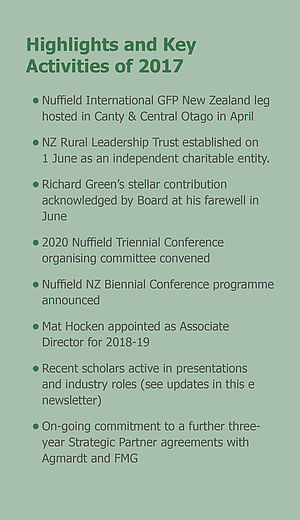
Since my last note, not only do we have a new government, we also have five new Nuffield scholars.

The businesses of farming and growing have changed dramatically over the past decade. Historically, it was adequate for farmers to express a personal desire to care for their livestock and land and to ‘do the right thing’ when undertaking development projects. There was little scrutiny and our freedom to operate was largely unlimited. This is no longer the case, with a complicated landscape of approvals, monitoring and reporting, compliance and restrictions now changing the way rural businesses are operated. Both the general public and the regulators are lifting the bar on how farmers and growers produce food.

Many a rigorous debate has navigated the pros and cons of changing nutrient management regimes, protecting our waterways, reducing waste, keeping our people safe from harm, sourcing adequate capital to ensure financially robust businesses, biosecurity, customer centric marketing,  succession and the place for exponential technology. I believe that sustainable and successful rural businesses will be led by those who stay abreast  of these and many more topical issues, develop an ability to  critically analyse the options, then execute with excellence.

With this backdrop and the Nuffield objective of encouraging global vision, leadership and innovation, your board of Trustees agonises over their decisions to select the most appropriate scholars from those who apply. We seek diversity, the potential to demonstrate thought leadership, to gather and share knowledge, to understand different aspects of our production to plate supply chain,  to influence positive future outcomes for New Zealand and to ‘fit’ with our proud Nuffield culture.

Our agri business ownership structures are evolving and not all farmers own land, not all growers work full time within the farm gate. The future of work is such that technology will play a bigger part and a first chosen career is likely to be followed by many iterations of learning and doing as our future work-force reinvents themselves to stay relevant and engaged.

Our system for short listing, reference checking and interviewing scholar applicants for one of five available scholarships is now a very thorough one and a demonstration of Nuffield New Zealand focusing on professional management processes with outcomes which have relevance for the future.

Over recent years, the selection panel has balanced all these factors to select scholars whom we believe are ‘fit for the future. Some are hands on farmers and growers and others work alongside them to provide information and advice which is required to operate rural businesses. What these scholars all have in common is a sense of self responsibility to learn and lead and a strong desire to influence positive future outcomes for our rural ecosystem – communities, people, the environment and business. I believe a diverse and  well networked Nuffield New Zealand will continue to be a national asset.

I look forward to seeing you all at the conference in Tauranga in May and I trust you’ve saved the date already. Our recent scholars are excited about presenting to you and are ready for your feedback and searching questions. They know this is the ‘Nuffield Way’.

Enjoy a safe and fulfilling summer, fun across the festive season and look forward to 2018 with excitement and anticipation; we are all privileged to have the opportunity to enjoy another year!

Kind regards

Juliet Maclean

Finding our place in the market and our future food strategy

David Kidd, 2017 Nuffield Scholar


As the world population continues to increase, there is a corresponding need to further develop innovation within the food production model in order to sustain this increase.

However, we need to be very aware of what our place in the model is, and the number of people that we can feed.

There is huge potential for increased production from the likes of South America, who with a tweak in the way in which they farm and the inevitable gains from the use of technology could increase their output significantly.

I expect to see a drive from food as sustenance toward food as a source of enjoyment in many countries, leading to a desire for higher quality produce that may or may not be grown locally.  If our product is positioned correctly, there is an opportunity for increasing its demand and value.

New Zealand has built a strong reputation as a supplier of safe, quality product that will meet the specifications desired by the buyer. Over time, the processors of New Zealand meat have diversified the way in which the product is sold to ensure that maximum value is gained in the current state.  One of the challenges here is ensuring that the provenance of the product provided is communicated to the consumer.

Is there an opportunity to differentiate ourselves now on the quality and provenance of the product to safeguard our position into the future.

As “local” food becomes a more topical issue, we need to decide whether to invest the significant sums required to design and promote consumer brands in the marketplace, or to invest in creating long-term supply relationships within the service industry.  With the mix of product that we currently provide, this may allow for more New Zealand provenance in the finished article, whilst not changing the product that New Zealand currently supplies.

We also need to decide which countries we wish to focus upon.  Discussions I had indicated that New Zealand has at times sought short term gains in price at the expense of longer term growth plans.  This can lead to markets being unable to consistently rely on New Zealand product, thereby attributing a lower price to it than if we have built the supply relationship.

Many countries continue to focus on food security from their farming systems.  As global trade attempts to break down some of these barriers, a shift in the types of farming systems to better accommodate the climatic conditions in each country will likely occur.  This may provide additional opportunities as countries realise that they are not cost competitive when producing certain products.  There is also the role of technology in food production, with examples such as vertical farming, plant based protein and synthetic protein all changing the face of food as we know it.

We need to adapt to changing production systems faster than ever, especially those that can produce consistent quality and experience every time.

The challenge for NZ is to decide how we fit into the world supply chain.  For a long period we have focused on producing the products we know we can grow, and expecting others to find a market for us.  High production and low cost have been the mantra that we have lived by.

Is there an opportunity to differentiate ourselves now on the quality and the provenance of the product to safeguard our position into the future?

Based on my travels, I think there is.

David Kidd, 2017 Scholar


Opportunity to lift our game: leadership in employment standards

Jason Rolfe, 2017 Nuffield Scholar


Travelling around the world as part of my Nuffield experience it was clear that the other dairy producing countries hold New Zealand as world leaders in pasture fed milk production which is something we pride ourselves on. However, we can’t become complacent and as I have identified there are areas that we need to improve. One of these areas for is our on-farm leadership, particularly when it concerns our interactions with employees and how we motivate and keep them engaged.

A large number of New Zealand on-farm leaders have got to their position of leadership through long hours working on farms or up through the sharemilking system then, purchasing a farm or taking over the family farm. Often they have had no formal training around leadership styles that get the best results out of their staff or any experience managing a team prior to this.

There is also an expectation that staff will work as many hours as they did, despite not having a financial interest in the business or the same goal of one day owning a farm. Many of the next generation have a lot more opportunities as careers available to them and don’t see the current structure as a worthy career.

Research has shown that many New Zealand farm workers average between 60-80 hours a week and the most common roster is having 12 days’ work before two days off. It is no wonder that nearly 1 in 3 employees is leaving their jobs each year in the sector compared to 1 in 7 employees across most other industries (source: Statistics NZ).

Many of the farms I visited overseas had more employees per number of cows, each working on average 40-45 hours per week. Some of this was driven by legislation. This had not always led to increased wage cost as staff were paid for the time they were working and the overall number of hours worked by the entire team in a week was similar to a NZ system during the calving period.

“I found also that staff were more productive as they were rested, more engaged in their job, and had a work-life balance. With larger teams also came a fantastic culture within the business, morale seemed high and they had very low to average staff turnover. “

There were also businesses that were using their employment record and practices as branding on their products with slogans like ‘employer of choice’ and ‘great employer certified’ attracting a premium locally.

Dairy NZ’s recently launched strategy includes building a great workplace for our talented workforce. The goals relate to attracting talent and getting employment best practice standards across the industry. This is a great start and having goals in place will make this measurable.

However, we need to take this further and really focus on providing leadership training on farm for managers and owners. This training shouldn’t be aimed at meeting legislation minimum standards but more at the individuals own leadership styles, so they can make changes to their own behaviour. Research shows that higher engaged work forces are more productive and create more value making fewer mistakes, which at the end of the day is most producers’ goal.

Much emphasis gets put onto the environmental issues or animal welfare concerns when it comes to the dairy industry as it directly relates to our social licence to farm in New Zealand and the perceived value in our products globally.

However, many global brands have their reputation as a good employer ranked just as high a priority, as getting this wrong often does more brand damage as consumers can relate more directly to the human element. Recent examples of this are big brands like Adidas and their customer fight back around illegal and underage labour.

We don’t want to just be an industry that is proud to be meeting employment legislation standards with good on farm conditions. Let’s be leading employment standards globally and be the recognised employer of choice for someone looking for a new career.

Obtaining Premium Prices with Business-to-Business Model

Ryan O’Sullivan, 2017 Scholar

Somewhat unsurprisingly, common themes have definitely emerged during the past year of travelling the globe and discussing agriculture with our fellow Scholars.

The pastoral New Zealand agriculture sector has long been criticized for operating at the bulk commodity end of the market, be it frozen carcasses or brown bags of milk powder. The solution it is said, is a business-direct to-consumer-sales model- value add, fast moving goods with a high volume, high value and greater export returns and more on-shore jobs.

The reality of this is strategy is somewhat different.  In the consumer goods dairy category for example, a company operating in this space will release on average 8 products, with just one surviving more than three weeks on a supermarket shelf.  The other seven are a sunk cost in terms of research, innovation, manufacture, packaging and promotion.  The one champion product may provide a great return, but is needs to in order to offset the sunk cost of the other seven.  In the fullness of time, the champion product then becomes crowded by ‘me too’ products seeking to emulate the lucrative position in the particular category.

This strategy, while successfully executed by the Nestles of the world, requires massive scale of investment and significant brand equity, neither of which is strong in New Zealand, downstream of the farmgate.

The other challenge is year round supply of the raw product. Our pastoral industries have been developed to follow the growth curve for good reason but it does present some challenges for year round supply of consistent fresh product.

It is for these reasons the pastoral industries in the New Zealand agriculture sector have tended to evolve selling business-to-business: commodities, ingredients, food service. Given the challenges mentioned above and the fact New Zealand pastoral farmers have enjoyed the comparative advantage of lowest cost producer, this has worked reasonably well…we are quite good at it.

We cannot however not sit in this space forever as consumer demands change, competition is arriving and our low production cost base is being challenged by others.  It is not a case a major shift away from business-to-business, it’s just doing it better, higher value opportunities within the segment and competing on quality, leveraging the different functionality of grass fed and telling the story behind the product.

Livestock in New Zealand, in a pastoral system, lead a charmed life relative to most other places in the world so this is one example where we can leverage a comparative advantage with our customers.

Some of our challenges as an industry therefore going forward would be:

  • Coming up with a unique brand proposition around grass fed/free range/happy lifestyle livestock

  • Look to initiate a standard for grass or pasture fed similar to that of organic standards. Can we defend it and set it aside from other label claims around the world?

  • Can we ensure our environmental footprint from farming livestock outdoors is sustainable and aligned with consumer expectations?


The Nuffield journey so far has highlighted that we do have a unique point of difference in our livestock industries that is sought by today’s consumers. Our challenge is to deliver that story and create the premium.


2017 Nuffield Scholars Announced

The latest crop of primary sector emerging leaders have been revealed with six 2017 Nuffield Scholars announced by Primary Industries Minister Nathan Guy at Parliament.

They are Mid-Canterbury rural journalist and artisan food producer Nadine Porter, Manawatu dairy farmer and farming advocate Mat Hocken and Oxford-based Rebecca Hyde, who works for Ballance Agri-Nutrients and has strong skills in environmental management and sustainable farming.

Joining them are Taranaki’s Jason Rolfe, who is an area manager for FMG, farmer and former winner of the Young Farmer of the Year contest David Kidd and South Canterbury dairy farmer Ryan O’Sullivan.

The six new scholars join more than 140 of New Zealand’s emerging agricultural leaders to have been awarded Nuffield Scholarships over more than 60 years.

The scholarships are one of the most respected and prestigious awards available in the primary sector and offer a life-changing opportunity for overseas travel, study of the latest developments in a number of leading agricultural countries and an introduction to leaders and decision-makers not accessible to ordinary travellers.

Nuffield Scholars travel internationally for at least four months in their scholarship year (not necessarily consecutively) and participate in a Contemporary Scholars Conference with 60 Nuffield Scholars from around the world.

They will also attend a six-week Global Focus Programme with an organised itinerary through several countries with other scholars.

Finally, they will have their own individual study programme with a research report due at the end of their travels.

Topics this year are likely to include how we innovate in this country and how we can improve our innovation in the agriculture sector, how improved collaboration between industry and sectors can help achieve better environmental outcomes, improving/stabilising onfarm returns to attract more talent and reduce turnover in the primary industries, exploring how other countries are turning the protection of the environment into a value-added revenue stream and how irrigation schemes can deliver water, not just for agriculture or economic benefit, but for achieving environmental and social outcomes as well.

Nadine Porter

New Nuffield scholar Nadine Porter is a committed primary industry advocate and believes the agriculture sector is at an exciting crossroads. With a long career in agricultural journalism and artisan food ventures, Nadine is now working as communications manager for NZ Young Farmers.

Mathew Hocken

New Nuffield scholar Mathew Hocken is carrying on the family legacy, farming the Manawatu property that has been in his family for over 125 years and acting as an advocate for farmers through his roles with Federated Farmers. He returned to the family property, Grassmere, in 2013 after a successful career studying law and politics and working overseas in consultancy roles covering areas like climate change and energy.

Rebecca Hyde

New Nuffield scholar Rebecca Hyde believes improved collaboration between sectors and industry can help achieve better environmental outcomes and she plans to research this topic further as part of her scholarship. Oxford-based Rebecca’s passion for the environment extends to her work with Ballance Agri-Nutrients, where she is South Island team leader of farm sustainability services.

Jason Rolfe

Improving employment conditions and promoting the primary industries as an attractive career option are key to securing talented young people in the industry, new Nuffield scholar Jason Rolfe believes. Living in New Plymouth with his new wife Christina, Jason is the Taranaki area manager for FMG Insurance, a role he has held for the last year.

David Kidd

Third-generation farmer David Kidd, who won the Young Farmer of the Year contest in 2014 and has a strong background in the finance industry, is one of six new Nuffield scholars for 2017. David manages a 550ha beef finishing property at Shelly Beach, South Kaipara Head Peninsula.  He and his wife Janine have spent the past four and a half years developing the property, gradually improving its carrying capacity and productivity. Before becoming a farmer, David spent six years working in the finance industry in New Zealand and Australia.

Ryan O’Sullivan

South Canterbury dairy farmer Ryan O’Sullivan has been named as a Nuffield scholar for 2017. Ryan is married to Tina and the couple have three children, aged from five to nine. The O’Sullivans are equity managers of a large-scale farming operation near Fairlie, South Canterbury, comprising a 1200-cow, irrigated dairy unit run in conjunction with 550ha of dairy support. Previously, Ryan attended Lincoln University then began a 10-year career in rural banking.

***

For further information and photographs please contact: Anne Hindson on 027 431 7575

Detailed news releases on each scholar are available on request.


Taranaki Nuffield Evening

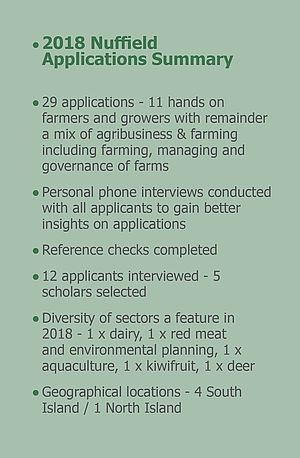
This is an opportunity for potential applicants to learn more about the Nuffield scholarship experience and have an informal face-to-face discussion with some of those who have already undertaken the programme.
 
We are keen to broaden the pipeline of Nuffield scholarship applicants (particularly farmers/growers/producers) and to have a strong pool of candidates from the region.
 
We hope that through this meeting we will provide new applicants with more information about the nature of the programme and the commitment, so they are well prepared to put a strong application in front of our panel.
 
Please RSVP at your earliest convenience, by emailing us at  nuffield@nuffield.org.nz along with your contact information and the names of the people attending. 2018 Scholarship applications close on Sunday, 13 August.

No bull behind record milking attempt

“The record-setting exercise is the brain-child of healthy farming campaigner Ian Handcock who was responsible for the Farmstrong initiative, aimed to improve farmers’ mental and physical health.

In 2013 Handcock’s Kellogg rural leadership project on dairy farmer health highlighted how sedentary the job had become, and its effect on farmers’ fitness.”

https://farmersweekly.co.nz/section/dairy/view/no-bull-behind-record-milking-attempt

Kellogg looks forward and back

“The first ever gathering of Kellogg Alumni is being organised for May but it also notes the retirement of programme leader Dr Patrick Aldwell who has been involved in 21 courses since 1999.
The former Dean of Commerce at Lincoln University, Aldwell has been replaced by former Beef and Lamb NZ chief executive Scott Champion.”

https://farmersweekly.co.nz/section/other/view/kellogg-looks-forward-and-back