2026 Nuffield NZ Farming Scholarship. Apply by 17 August 2025. Read More...

Apply for 2026 Nuffield NZ Farming Scholarship by 17 August 2025. More details...

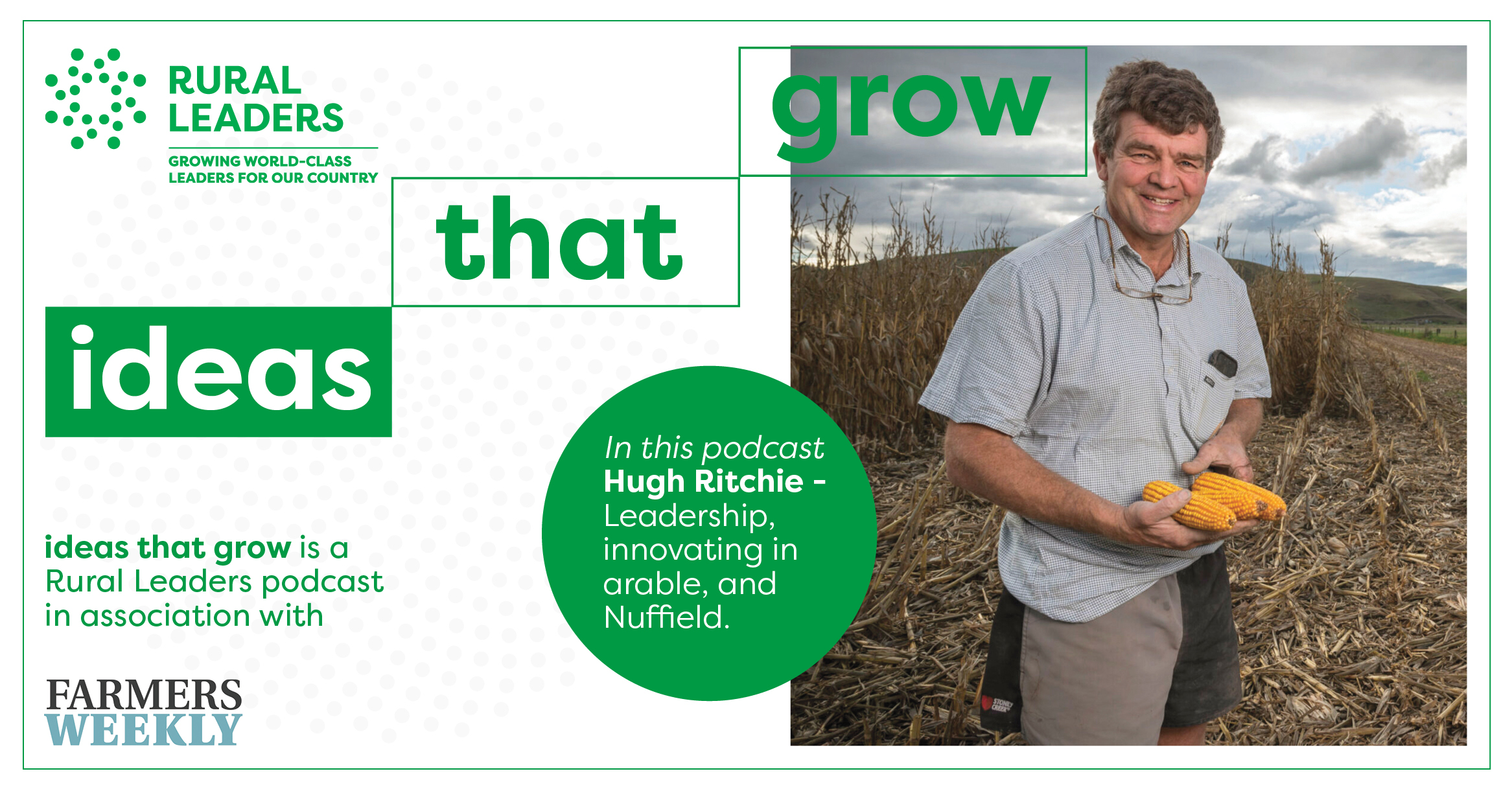
Hugh Ritchie – Leadership, innovating in arable, and Nuffield.

In this podcast, Hugh Ritchie, 2000 Nuffield Scholar and Hawke’s Bay farmer, shares his leadership journey and insights with Bryan Gibson, Farmers Weekly Managing Editor.

Hugh discusses growing Drumpeel Farms into a diverse 2000-hectare operation, the impact of his Nuffield experience on his personal growth, on innovation in irrigation and strip tillage, and on the need for better water access and infrastructure.

Hugh emphasises collaboration, global learning, and the importance of leadership development as vital to strengthening NZ’s food and fibre future.

Listen to this episode of Ideas that Grow, or click on one of the platform icons below to listen on your favourite player:


Episode Transcript

You’ve joined the Ideas That Grow podcast, brought to you by Rural Leaders. In this series, we’ll be drawing on insights from innovative rural leaders to help plant ideas that grow so our regions can flourish. Ideas That Grow is presented in Association with Farmers Weekly.

Bryan Gibson, Managing Editor of Farmers Weekly.
You’re with Ideas That Grow, the Rural Leaders podcast. I’m Farmers Weekly Managing Editor, Bryan Gibson. This week on the show, we have Hugh Ritchie from Drumpeel Farms. Gidday Hugh, how’s it going?

Hugh Ritchie, Farmer, 2000 Nuffield Scholar:
Good thanks, Bryan. And yourself?

BG: Yeah, pretty good. How are things over in Hawke’s Bay?

HR: We’ve got a very nice day. Had pretty big winds last night, which was good. I know we’re just finishing off the carrot washing harvest, and then we’ll get back into maize again. But no, it was a pretty good wind last night. But other than that, we’re good. Been a good summer for growing grass, so can’t complain.

BG: Very good. You operate a pretty diverse farming system over there.

A little about Hugh and Drumpeel Farms.

HR: Yeah, we’re just over 2000 hectares in total. We do about 800 hectares of annual cropping. So half of that’s processed vegetables. The other half is seeds and cereals with a little bit of vegetable seed production as well. And then we have 1500 bull beef on a pastoral block.

We normally finish between 8500 and 10,000 lambs – winter lamb trade as well. So that keeps the business going on many fronts. We haven’t got dairy, and we had deer, but haven’t got deer anymore. So, we do most things.

BG: Has running that operation been the bulk of your farming career?

HR: It has, yes. I left school and did a Bachelor of Ag at Massey. Production and Management was more my side. Then I came home to run the block. In those days, it was 300 hectares. We’ve grown the business quite significantly in that time as a family business. We’re reasonably proud of the fact that it’s up over 2000 hectares, and it’s quite diverse and quite intense.

We have great staff helping. I have a very good stock manager who runs the livestock site, and I tend to stick to the overall management in the cropping. It gives me a wee bit of flexibility and scale to go and do other things.

I’ve been on the Federated Farmers Board. I’ve spent some time on the Nuffield Trust, and recently on the FAR board and HortNZ board as well. So yes, I have done quite a lot of off-farm stuff as well as farming. Currently trying to get water storage across the line in Hawke’s Bay, which is proving rather tricky.

BG: Yeah, that’s been years in the making, hasn’t it?

HR: Yeah, it has.

BG: You were a Nuffield scholar in 2000?

2001: A Nuffield Odyssey.

HR: Adrian (Gault) and I travelled in 2001. I looked at irrigation efficiency and direct drilling till type systems. From there, we brought back the basis of the irrigation New Zealand design and monitoring system. I came back from a course I did at Cal Poly/University with Charles Burt, the director there, on how to evaluate irrigation systems for distribution uniformity.

Went through the Midwest and strip tillage was a big thing happening there in min till. So I brought back a strip till and worked a lot with landwise, which was a sustainable cropping programme here in Hawke’s Bay, where we developed strip till to run in New Zealand.

So, the trip itself had big impact on bringing knowledge back, which I’m pretty proud about. But equally, the trip itself, in terms of forcing you to be off-farm and allow people to run the business and do it for you also created, I suppose, opportunity within to make sure that you didn’t just then beaver away with your head down and not really looking at the bigger picture. So it was a very useful journey to go on.

BG: It sounds like it was useful not only personally for you, but in terms of the way New Zealand Food and Fibre has progressed since then.

Giving back to New Zealand food and fibre.

HR: I’d like to think that that is the core of Nuffield. It’s a personal development journey in leadership, but it’s also because it is funded by people (Rural Leaders’ investing partners), I think there’s a responsibility to bring things back that can be useful. That was the whole concept of it, to my mind, was to go and learn and explore things and bring ideas back that we could utilise in New Zealand.

I know everybody says that we lead the world in agriculture, but there’s some really clever people overseas that are more than willing to share their ideas and learning. You don’t have to re-invent the wheel. You can go and learn from people. That’s a pretty good thing.

BG: And was getting out and seeing the way farming is done in other parts of the world at that young age, good for you in terms of your way of looking at things back home?

HR: It certainly got me out of my shell. I remember driving down the interstate in the US, and 2000 was when the UK had foot and mouth. So, I moved to the US pretty quickly. And again, obviously, irrigation and direct drilling was probably their forte.

Nuffield and getting out of your comfort zone.

HR: But It was quite interesting driving in the States and I’d just see something that was interesting or something going on, and I pull over to the side of the road and jump the fence. And you could see these guys looking at you a bit sideways for a while, and eventually they’d stop and you’d go and have a chat. I wouldn’t do that in New Zealand necessarily, but over there, they probably are never going to see you again. If it went badly, you could just walk away.

But it was an incredible journey to see people, they really explained what they were trying to achieve. I visited the conservation information centre, again, because timings were out with the universities, And Dan Tauri, who was running that centre, and he just rang people up and said, hey, I’ve got this New Zealander looking at these things.

I think it’ll be interesting if we talk to you and just set up a whole lot of visits. So it was very spontaneous. Which is something we probably don’t always do a lot of – and just taking the opportunities and meeting people, and then they would send you on to somebody else. I was probably not that outgoing at that stage. And so you had to get over not wanting to push people or ask for things.

It was quite a learning journey there, but it was just amazing how willing people were to give their time and information to help. I think New Zealand reflects that and does that too. It’s a two-way street, but certainly that was eye-opening to me, just how open people were to share.

BG: You’ve gone on to take on some pretty big leadership roles in the farming sector. Obviously, Nuffield might have been a good base for that, good grounding.

Nuffield and the global perspective.

HR: Certainly, I think, as I said, Nuffield gave you that broader picture of what was happening in the world. We could sit back here and moan about things or moan about pricing. You really had to understand that we are a small part of a very big system, especially within the cropping scene in terms of direct import and things like that.

There was no point moaning about price because if someone could import it cheaper, that’s what was going to happen. We had to really get on side with how do we make our systems better, more efficient, more cost-effective, and grow that way. That was very useful.

I think coming back and sitting in Fed Farmers meetings when people were trying to give the millers or the bakers a hard time about not paying enough for wheat, and you just had to say, well, occasionally it is what it is. And so we can either agree to grow or not. But there’s no point beating the guys that are going to buy your crop, because it’s probably not going to do anything for your relationship.

BG: It’s funny. I was in a conference last week talking to someone, and they thought the goal should be that all of New Zealand’s agricultural sector should be like our arable sector, which has always been small and nimble and knows its place in the world and has innovated to make sure it’s sustainable. That’s a good model.

Innovating in the arable sector.

HR: It is. But again, I’ll be the first to admit at the moment, it’s really hard work making arable pay and sitting on the HortNZ board and looking at what IP good varieties of apples can make in the market. Or you look at kiwifruit and how well that’s going with dedicated export and serious funding around marketing and driving the supply. I mean, a really good example to follow.

I am really proud that we set up the Cultivate Ventures thing and during my time with FAR to try and create that work stream to find ideas and innovation that we can be nimble about and follow. But Certainly, we do have to, I think, do things differently going forward within the arable sector because things haven’t really changed. There’s big players out there that can produce volume commodity crops.

We’ve really got to look to what is the alternative? Where’s our niche play and where can we really drive value? If there’s a frustration I have, it’s probably the fact that just in the recent times, we see the influence of the primary sector pulling New Zealand’s economy around and making trade surplus. And yet, where is the science, technology, or the resource running?

Water is the key.

HR: We’re getting better, but trying to get water on the side to provide reliable supply should be easy, especially when it’s going to backstop a primary sector that can then grow and do things. And where’s market or trade and industry helping? I just think we don’t really get a strategy that lines all the things we can do up to really make the most of it. We leave it to the individual, and sometimes that becomes a very hard push.

BG: Yeah, the water piece is really interesting. You brought back some innovative ideas in 2000, but we’re still having the same conversations about how, where, and why when it comes to water storage and that sort of thing.

HR: What I brought back was efficiency and distribution uniformity and how do we make what we’ve got go as far as it possibly can? Because as we all know, it’s not cheap to pump water and put it through irrigators. So, you have to make sure you get the best bang for your buck from that. 

So that was the efficiency side. And that, I think, goes without saying, we should be striving for that when it comes to water. But when it then comes back to at the moment, this mentality, I think, is almost how do we cut the pie up, the current pie up smaller and smaller and make all those things happen. Whereas we actually aren’t water short in New Zealand.

We’ve got a huge primary resource there. I’m not saying we waste it, but I think we shouldn’t be afraid to utilise it to the best extent. I just look across the ditch at Australia, Murray, Darling Basins somewhere like 115 % allocated. Canterbury and here in Hawke’s Bay, probably the max out at about 7% and 3% respectively. We’re not even getting close to pushing the boundaries of the available water, but absolutely, we have to do it as efficiently as we possibly can and be mindful of the environment.

I just think we shouldn’t be afraid to look at how do we grow that pie because that’s what we can then grow value and further productivity gains on.

The trickle-down effect.

BG
: Yeah, and with the climate getting a bit more unpredictable, it’s a great opportunity to build resilience into communities as well, like people who are not part of food and fibre or maybe are supported through their work.

HR: Absolutely. If you look at the Opuha Dam when that was put in, it’s about the only study that’s being done. I think that showed on a MAF report, it was about $6.50 further value created from every dollar spent on farm, on water. And a lot of that went into the businesses, the support businesses in the town.

I think Temuka Transport before Opuha was 20 odd trucks, and now it’s 100 and something. Businesses support businesses, and hence the communities that support those businesses really do grow off the back of getting good water. So to my mind, it’s the enabler. We can talk about everything we like, but it’s the first stage in the process. We’ve got great soils and good climate. We just have to manage the water.

On Nuffield and leadership.

BG
: You mentioned earlier, you’ve been part of the governance group for Rural Leaders. It’s obviously something you believe in, something you’d recommend to someone looking to get a good grounding in leadership.

HR: Look, absolutely. I mean, leadership does have to come from within, but the Nuffield Programme has developed so much from when I went through.

I remember going into my interview and there were nine primary sector leaders sitting in a semicircle, and I was sitting in the middle, and they each had a question to fire at me, and you went home.

Now, there’s still the interview process, but we’ve got the global tours that get the scholars together and look at different areas. There’s different focus tours around the world. We do a lot of training with getting the scholars ready to go on their journey. And it is a journey, and it’s a lifelong journey, and the network that you become part of and that you can link into.

It is a very big network that I think if it came together, it would be great. So absolutely I believe in it. And obviously there’s coupling it in now with some of the other programmes, like Kellogg and things, almost a progression, but it doesn’t have to be.

I think the opportunity of creating leaders or supporting leaders is more the thing. As I said, it’s time out of your life, it’s a commitment you have to make, and it’s an ongoing commitment. I’d like to think that part of the nature of the Nuffield Scholar is how to give back to the industry or the bigger picture. Certainly an opportunity not to be missed.

I know it’s difficult with a lot of people with young families and things like that. How do they make the time? And so you have to think carefully about that. But I really encourage partners to be involved because it is quite a liberating experience to go and see and visit and get your mind open to the opportunities and the scale.

You can come back quite a different thinking person. So Again, having partners involved to explore and understand that, I think, is quite critical to success.

BG: For more information on Rural Leaders, visit the pages for Nuffield New Zealand Farming Scholarships, the Kellogg Rural Leadership Programme, the HortNZ Leadership Programme, the Engage Programme, or the Value Chain Innovation Programme.
Emma Crutchley. Finding the sheep and beef value-add.

Emma Crutchley, 2018 Kellogg Scholar, talks to Bryan Gibson, Farmers Weekly managing editor about some of the challenges sheep and beef farming faces in a water-short region.

Emma discusses her Kellogg research, the Value Chain Innovation Programme, and the work being done on ‘Puketoi’ to find value-add.

Listen to Emma’s podcast here or read the transcript below.

Bryan GibsonManaging Editor of Farmer’s Weekly.

Kia Ora, you’ve joined the Ideas That Grow podcast, brought to you by Rural Leaders. In this series, we’ll be drawing on insights from innovative rural leaders to help plant ideas that grow so our regions can flourish. Ideas that Grow is presented in association with Farmers Weekly.

My name is Bryan Gibson, Managing Editor of Farmers Weekly and this week, we are talking to Otago sheep and beef farmer, Emma Crutchley.

Bryan Gibson:
G’day, Emma. How’s it going?

Emma Crutchley, 2018 Kellogg Scholar, sheep, beef and arable farmer.
Good, thank you Bryan. How are you?

BG: Yeah, I’m really good. Yeah, so whereabouts in Otago are you?

EC: My husband, and I and two children live in a little inland basin called the Maniototo in Central Otago on a sheep, beef, and arable farm here called Puketoi.

BG: Sounds like a lot of work.

Maniototo sheep, beef and arable farming.

EC: Yep. So, I grew up here. My grandfather bought the farm in 1939, and we go a couple of more generations back here in the Maniototo. He’s one of the youngest sons, and he moved over from Kyeburn to Puketoi then.

I am an ’80s child, so I remember little bits of farming growing up through there. And I’m the youngest daughter out of…I’ve got an older brother. When I was younger, I had a love for animals and the farm and I could literally be found in any lamb pen, in any dog kennel, any filthy, smelly, or challenging job.

Growing up, I would be neck-deep in it. Mum and dad never really had a chance to get me out of it, and not that they ever thought that was a thing. They were very supportive of all their children, regardless of gender, being involved in the farm. I guess growing up here, I went away to boarding school and continued my love for the farm straight to Lincoln, and I never really looked anywhere else. From there, I moved on to work as a rural professional, as an agronomist, working in Christchurch for PGG Wrightson, and then later working for Pamu out of Wellington.

I knew I’d return home to the farm, but I was always a little bit hesitant because I love being around people and I love my networks and the social life side of it. I knew if I moved home, I was moving to a relatively isolated place away from a lot of the people that I really enjoyed being around.

I knew that it was the best opportunity I had and always something I really wanted to do. So I moved home in 2009, and imported a husband to the Maniototo, because it won’t come as a surprise, but being a small, rural community, everyone’s relatively related. I knew I had to find a husband before I moved home. So, yeah, he came home, and he moved here in 2010. And yeah, so we’ve worked to take over the family farm from my parents.

We’ve got just under 500 hectares of irrigation. The rainfall here is often what ‘wows’ people, it’s a 350ml rainfall. So irrigation creates the resilience we need to do what we do. We’re arable, so we grow about 100 hectares of arable crops: wheat, barley, peas, linseed, clover, rye for seed, and a few other bits-and-bobs as they come along.

We’ve got an angus stud as well. So we sell about 25 stud bulls each year. The main thing we do here, that is our main point of production, is our lambs. We have about six and a half thousand ewes. And apart from replacements, we finish all lambs born on the farm and also purchase more store lambs in January and carry them through as well to meet the demands of what we can produce and who we supply.

I do a lot in the advocacy space with Federated Farmers in Otago and also as a director for Irrigation New Zealand. My husband is very involved and he leads a lot of the rural fire stuff in this area. Being in a dry climate, it’s one of our challenges, I suppose.

BG: That sounds like a massive and diverse life you’ve got.

EC: Yeah, there’s a wee bit going on. They’ve got two kids of the mix, two, eight, and 10, so they keep us on our toes.

BG: Now, you mentioned the engagement with the Rural Leaders Programme was a Kellogg report, I think it was in 2018, that was on how to manage water efficiently and what that might mean. I guess it’s an issue that’s close to your home – and your heart. That’s why you took it on?

Kellogg research into water sharing in a water-short catchment.

EC: Well, as you know in 2017, one of the top election issues was around freshwater and how it’s managed in New Zealand. There was a lot of pressure around irrigation and the association with water quality and quantity. At that time, I was a director on our local irrigation company.

Being in this extreme climate where we are short growing season – long winters, and the value that irrigation is to our business in terms of the resilience and our adaption to climate change, I knew when I applied for the Kellogg Programme, exactly what I wanted to study in terms of a research project.

I’d been looking at it for a while, because the kids were, at the time, I think they were two and four, and at that time they’re starting to get a little bit more…I don’t know…I just went and did it!

So, my project was on water sharing in a water-short catchment, which was basically focusing in around, freshwater governance, or even crossing into environmental governance. I looked at different models from around the world and different examples of how water was managed, ownership rights, community management, and then investigated some of the policy settings we have. Also some of the solutions that might work in that space.

I think one of the learnings I got out of that was, as farmers in New Zealand we’re incredibly individualistic in how we run our businesses and that is a reflection of the challenges. The challenges we faced in the ’80s, we found ourselves then in that time of high interest rates and challenging Rogernomics type stuff. As individual farmers we had to farm our way out of it. We did that really, really well. But then that’s led us to being really innovative.

We need to understand the ‘why’ as to why the change is happening. I’m probably going a little bit off track here, but that project set the scene for me, for doing a lot of work over the last six years in the advocacy space and advocating for not only enabling farmers room to understand the ‘why’, but also those connections with stakeholders and the importance of that.

At the end of the day, the government calls the shots on policy, but the people that are voting for the government are our stakeholders, our New Zealand public, and the importance of understanding that dynamic for long-term goals rather than focusing on short-term advocacy outcomes.

BG: Yeah, I know you’ve done a lot of work. We had some stories in the newspaper this year on some of the work you’ve done to advocate for some changes to some of the water plans down your way?

Farming and the environment.

EC: I guess the thing that in Otago, we’ve worked first off the bat with land and water plans and regional policy statement, and I guess we’re also one of the most diverse regions in a Otago. For me, or for everyone really, farming systems in New Zealand are heavily intertwined with the environment. There’s always going to be public interest in farming because of our association with the environment that we farm in.

Everyone’s always looking over our fence. From that, it’s like, how do we set it up, so we enable farmers who are very good at change. So for that example, multiple challenges can be solved with one solution, and one challenge can be solved with multiple solutions. And what I mean by that is, how do you enable policy settings that enable this diverse, incredibly stunning region to actually find the scope within those policy settings to innovate around the challenge and to solve the different water quality, biodiversity, climate change challenges that we have faced.

I think advocacy is probably…I think it’s changing. We need to start learning. But it’s like communicating in a way which enables you to be understood. And my thoughts around that is we had in the Upper Taieri, one of our biggest challenges was the Upper Taieri plain and the diverse hydrology landscape that was tied up in the national wetland regulations. Then what that was the unintended consequence that that was going to create.

So, we had our big jobs for a nature project set up at that time, which involved the relationships with multiple stakeholders. I guess we always knew that if we were going to be successful in changing the settings around the wetland regulations that we needed to have a common ground with our stakeholders and what we were trying to achieve.

I know there’s a lot of narrative around, for example, the stock exclusion regulations and the huge cost they create on farmers. If you can flip that into, we need the tools in the toolbox to manage our environment, in a way that is best for the environment and best for our rural communities. We need to recognise the role that livestock can play within those systems to control our weeds and help with pest control. That was a common ground that we found.

So when we went to MFE with that case to Minister Parker, it was probably a more resonating message than just saying, ‘Oh, it’s a huge cost of fencing, and we’re going to lose all this land that we can graze’, which doesn’t resonate with everyone. They actually don’t care. They just want fresh water and they want a pristine environment. It’s explaining it in a way that actually identifies the unintended consequence of that.

So off the back of that, we managed to get that cut out of the stock exclusion rules, but it’s still a work in progress. We’ve still got to continue that conversation with our regional council as part of our water plan.

The art of making the tough conversations easier.

BG: Sounds like you’re at the forefront of a type of evolution that’s been talked quite a lot in terms of managing our natural assets – has many stakeholders who mostly want to do the same thing. It’s not an us and them farmers versus, say, fishermen or environmentalists or anything like that. And if you can in advance find those shared values, then it’s much more easy to overcome the challenge.

EC: Yeah, and I think I was talking to Julia Jones a couple of months ago and we’re brainstorming. I think she said something, and it was ‘we have a responsibility to seek to understand diverse perspectives’, then I added on the end, ‘we also need to give ourselves the personal freedom to change our minds’. I guess for me, that crosses into the fact that we are a small part of the population in New Zealand.

Like a lot of people like those in Auckland don’t really care about farming. They might want a pristine environment, but they don’t care about farmers as such. So the best way to get people to understand your perspectives is to actually listen to them and when you can create an environment which lets people feel like they’re understood – it takes away the defensiveness and the silos, and it creates more of a safe space to continue that conversation.

So when you’re really passionate, I think, and I have to be aware of this, because I’m really passionate about Ag and what we do, but passion can show up in many different ways. And when you’re passionate about a topic like farming or the environment and both, probably, most of the farmers fit into both those camps, but it’s like, how do you talk to someone and create that curiosity to let them feel like they’re heard? And then you create that connection and then that’s progress.

The Value Chain Innovation Programme and finding the value-add.

BG: Now, you’ve had a more recent Rural Leaders experience. You were on the Value Chain Innovation Programme this year. What was that all about?

EC: Yeah. So my lane, probably, in the past year has been a lot around the environmental stuff – freshwater, irrigation. But as a sheep and beef farmer, we are doing so much behind the farm gate in terms of how we farm and environmental gains on-farm. For us, because we are main point of production is lamb and finishing lambs, we’ve seen a lot of disruption within the supply chain over the past few years, especially since COVID.

Then we had another one more recently this year, where some of the guys we’ve worked really closely with over the past few years to develop our lamb supply programme. We went to them eight years ago, probably a little bit frustrated at the time, we wanted to supply a product that worked with our lamb, our supply chain, and what was actually needed within that, so we could add more value.

So they came back to us. We said to them, ‘how can we better support what you’re trying to do so we can add value to what we’re trying to do?’ They came back and they said, we need to know when your lambs are coming three to four months ahead. We need all year-round supply, and we need to have a consistent hook weight. And we went ‘righto’ and took that away. Then over the next few years, we worked really hard to actually schedule three to four months out and supply 11 to 12 months of the year and build a system around that, but then also target those specific hook rates and get it right. So, it worked really well.

Then when we had a bit of disruption within our meat company, probably three or four months ago, it blew a bit of that away. It blew away those trusted relationships, and it’s a bit of an ‘aha’ moment for me, and I realised how vulnerable we are to what happens in that supply chain and what we do. Because when your main part of your business is producing lambs and something happens in the supply chain, that’s a big issue.

I’d looked at the Value Chain Innovation Programme last year and I thought it was probably not really in my lane. And then I was like, well, actually, it really is in my lane, because if we’re doing all this other environmental stuff and trying to add value on-farm, we need a supply chain that actually supports what we’re trying to do.

So we, as farmers with our increasing costs, our sheep and beef farmers, especially the catchment limits that you’re trying to farm within, you can’t just produce your way out of it anymore. So, the real important thing that I’m seeing is, how can we value-add?

I applied for the Value Chain Innovation Programme with Hamish (Gow) and Phil (Morrison) to look at all the different value chain examples through the North Island. We got on a bus in Auckland and went down to Hamilton, explored the Fonterra markets with the Fonterra value chain around there, going to a dairy farm and then into the Fonterra factory, and also looking at LIC and DairyNZ and how those operations also support the dairy industry.

Then we investigated kiwifruit, and we also went to Robotics Plus in Tauranga. That was pretty amazing, seeing some of the tech that and the robots that they can pull in to support different production systems.

From there, we went down to Taupo and went to Pamu, and also sheep and beef there. I’m probably missing one, but over to Hawkes Bay to look at the apples as well, and also First Light Foods and a couple of others in there, just investigating what all these systems are trying to target. From there, I figured out that we are…yeah, I feel like we are lacking a little bit in leadership to support innovating the value chain to create value for what we do.

A lot of us are also limited in the land use change that we can actually do to add value. So it’s really important to me to start thinking about how we do add value through the supply chain.

BG: It seems to be like the Holy Grail. A lot of the feedback I get at the newspaper about various regulations and environmental and sustainable goals, people just go, well, we were promised it was value-add, and we’re not seeing it. We’re still slave to the schedule, that sort of thing. And so that’s a real hard nut to crack.

EC: And it’s never going to be easy. People will probably listen and say, she’s crazy. You can’t do that. But what options do we actually have in some cases? It’s like saying, well, okay, it’s hard, but what else are we going to do? Because in New Zealand, we’re actually not… I don’t know, we’re passionate about what we do, we have an amazing industry in sheep and beef.

I guess the other thing is we’ve also…when I think about, I’m very much Ag right through my life. Everything that I see as sheep and beef farmer supports what I can do behind the farm gate and creating efficiencies within the farm gate. There’s not a lot that actually looks at how we create value through the supply chain.

So I think that was probably a bit of an ‘aha’ for me throughout the (Value Chain Programme) trip, is actually realising that, yeah, we are actually stuck. There’s been amazing work done, but it’s like, how do we realise that, yes, a lot of what we do, even with our industry bodies, is focused on production, and behind the farm gate, but there’s not a lot on added value.

BG: Well, the cool thing is, I guess, that the product is amazing already, so it’s a good launching pad.

EC: Yeah, 100 %

BG: It sounds like your experience with Rural Leaders has been pretty rewarding. Is that something you’d recommend to others.

EC: Yeah, absolutely. I don’t know where we would be in New Zealand’s primary sector without Rural Leaders – there’s some great options of different programmes you can get involved with, and there’s always stuff to learn. I think even if I went back and did either of those courses again, you’d still pick up something new.

The people you meet along the way as well and I guess the networks. And I guess when I’m thinking about something and I know I don’t know the answer from those networks, I have a fairly good idea that I will know someone that will. And if they don’t, they’ll know someone that will. It’s a small, small place, the New Zealand primary sector, and there’s a lot of power and networks as well.

BG: Thanks for listening to Ideas that Grow, a Rural Leaders podcast in partnership with Massey and Lincoln Universities, AGMARDT, and FoodHQ. This podcast was presented by Farmers Weekly. 

For more information on Rural Leaders, the Nuffield New Zealand Farming Scholarships, the Kellogg Rural Leadership Programme, or the Value Chain Innovation Programme, please visit ruralleaders.co.nz