2026 Nuffield NZ Farming Scholarship. Apply by 17 August 2025. Read More...

Apply for 2026 Nuffield NZ Farming Scholarship by 17 August 2025. More details...

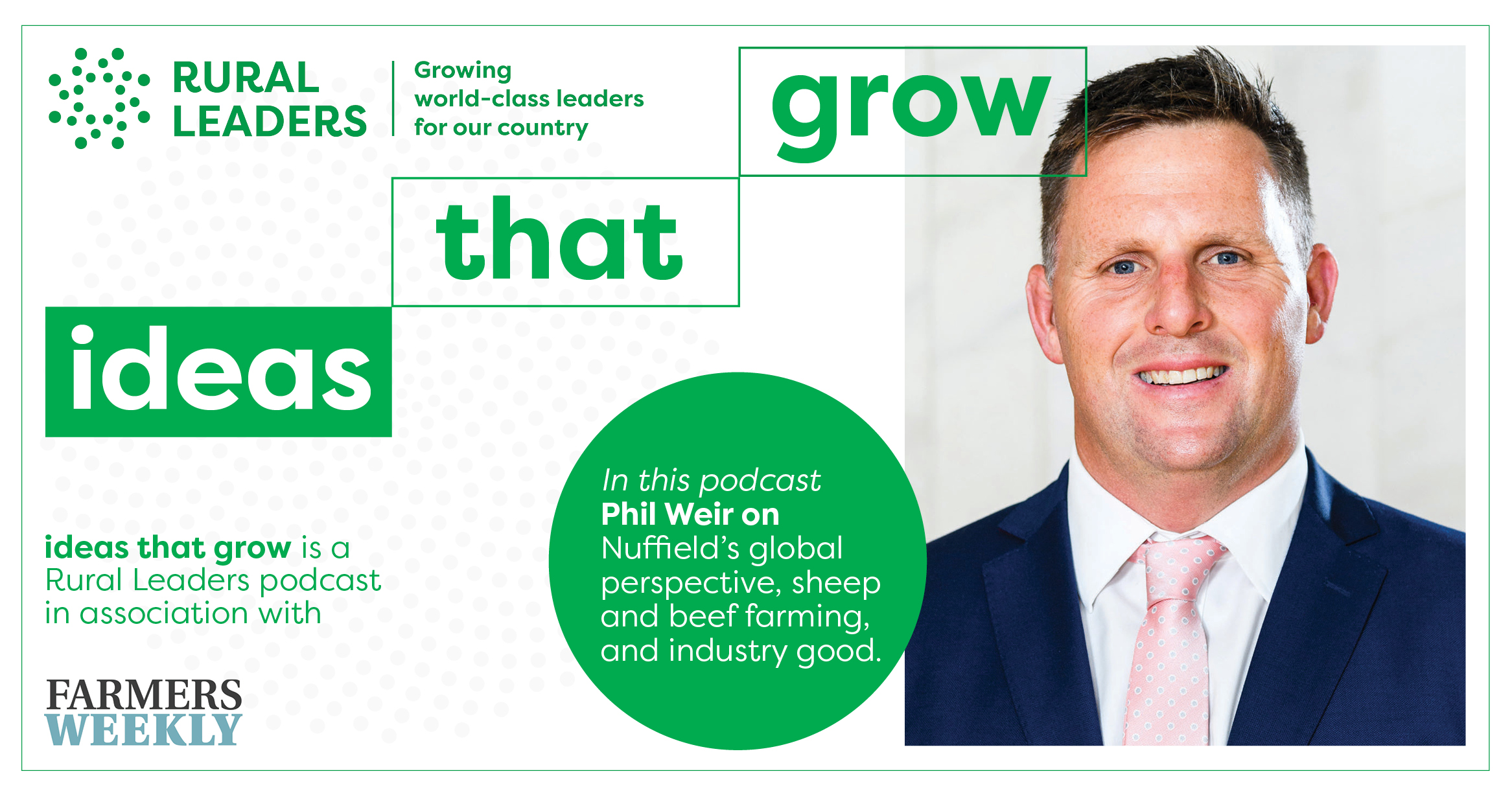
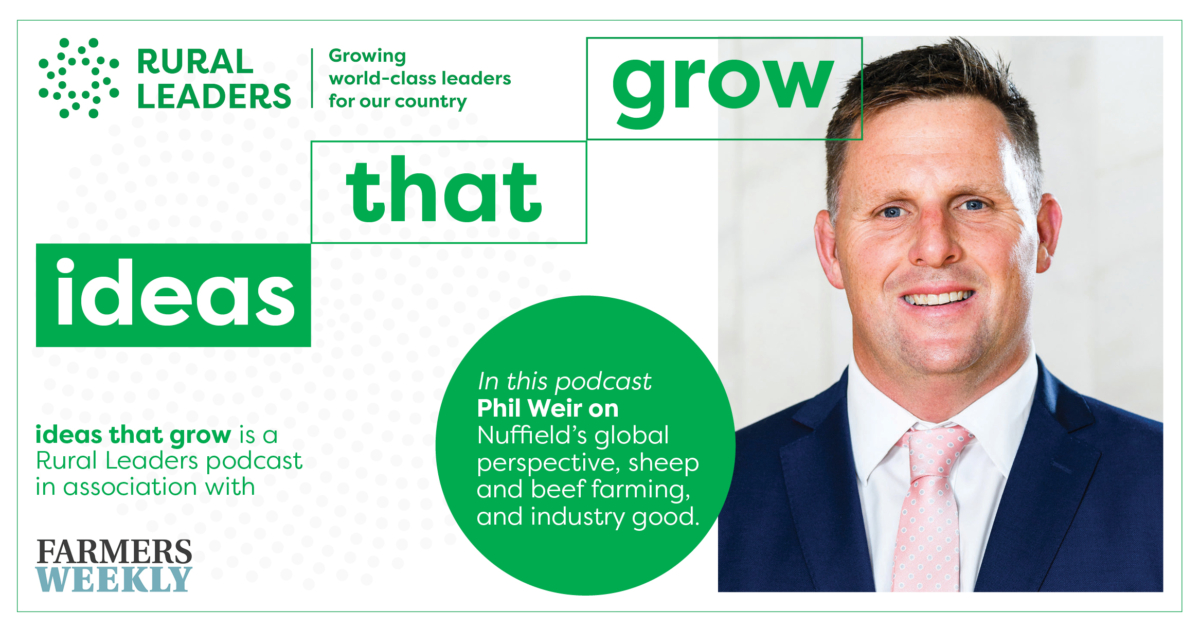
Phil Weir on Nuffield’s global perspective, sheep and beef farming, and industry good.

In this podcast, Phil Weir, 2020 Nuffield Scholar, Farmer, Director B+LNZ and Associate Director AGMARDT, talks to Bryan Gibson, Managing Editor at Farmers Weekly, about the positive value industry good brings to farming.

Phil also talks through some of the challenges and opportunities for sheep and beef farming and how his Nuffield Scholarship and research has given him a valuable global perspective.

Listen to this episode of Ideas that Grow, or click on one of the platform icons below to listen on your favourite player:


Episode Transcript

You’ve joined Rural Leaders’ Ideas That Grow podcast. In this series, we’ll be drawing on insights from innovative rural leaders to help plant ideas that grow so our regions can flourish. Ideas that Grow is presented in association with Farmers Weekly.

Bryan Gibson, Managing Editor of Farmers Weekly.
You’re with Ideas That Grow, a  Rural Leaders podcast. I’m Bryan Gibson, Managing Editor of Farmers Weekly. With me on this week’s show is Phil Weir, 2020 Nuffield Scholar. G’day Phil, how’s it going?

Phil Weir, Farmer, 2020 Nuffield Scholar, Consultant, Farmer Director B+LNZ and Associate Director AGMARDT:
Hey, Bryan. How’s it going?

BG: Pretty good thanks. Now, you’re a farmer in the Waikato, and also sit on a board or two, don’t you?

PW: Yeah, I’m, first and foremost a farmer in Te Pahu in the Waikato. We’re sheep and beef farming here, and I’ve been doing that for about seven years. Had a range of other roles in an agribusiness prior to that, and then did a Nuffield Scholarship in 2020, which we’ll probably touch on because it was an interesting time to do that.

Since then, I’ve become a farmer elected director for Beef + Lamb New Zealand, and that also involves the New Zealand Meat Board and an Associate Trustee with AGMARDT. And then do a little bit of consulting for AgFirst Waikato. So, I keep myself busy enough and a nice diversity of things going on. So nothing never gets too boring, right? That’s great.

BG: That’s where I met you the first time was when you turned up for your first Nuffield weekend, wasn’t it?


Doing a Nuffield Scholarship during COVID.

PW: Yeah, I think so. I think we were getting media training at that point, Bryan, about how to talk to journalists and then that thing. So hopefully, some of that flashes back to me, I guess, today. But yeah, we were down in Wellington at that point preparing for… That would have been 2019, and we would have been preparing for what a Nuffield Scholarship was to look like.

Ultimately, the experience I had was a wonderful one, but probably one that was a little bit different than when we were sitting when I first met you and in 2019. But I think the whole Nuffield thing, I think this year is 75 years of Nuffield, and I was really lucky to get a scholarship. As I mentioned, did it during COVID, which meant that some of the travel arrangements didn’t happen right away, but absolutely, we did at some point get to go around the world and see some fantastic agribusinesses.

I think one of the cool things was reflecting prepping for this was we did the first Value Chain Programme around New Zealand, so Rural Leaders are now running a programme which looks at how good New Zealand agribusiness and agriculture and growing is.

And we were lucky to be the forced guinea pigs for that because we couldn’t go abroad. And so we got the chance to go and have a look at the best growers and best Agribusiness is in New Zealand, and I think it’s fantastic that programme now has been created probably out of the back of that.

I think it’s so valuable to go and look at what’s in your own country because we do so many things really well. That was one of the lucky things, I guess, about a COVID disruption. Every cloud has a silver lining.

BG: That programme’s going great guns these days. As the old ad used to say, ‘don’t leave town until you’ve seen the country’. Did you grow up in a farming family? Have you always been rurally focussed?


A call back to the farm.

We grew up in a small dairy farm, so I showed Ayrshire Cows as a teenager and a child. My wife brings up some of the photos with me leading cattle around the ring.

We grew up on a small dairy farm on the outskirts of Hamilton. In. It was fantastic. It was the classic family farming upbringing. We were probably fairly poor, but we didn’t want for anything, I guess. We were lucky, we were on the outskirts of town, so we got the best of both worlds. Then after high school, I probably tried to get as far away from agriculture as I could, to be honest.

I went and did a social… I started doing engineering and found that wasn’t quite for me. And then social science. And then went and did a master of marine management in Canada. So, for someone to get seasick, it was a bit of a novel thing to go do, but it was probably just a case of seeing the world, right?

Then I ended up living in Sweden with my wife in a range of places before we made it back to New Zealand via Australia and then worked at AgResearch. In a few business roles there. Then the opportunity to come farming on my wife’s family farm presented itself in 2017. We took that opportunity. So, it was full circle, I guess. Probably I tried pretty hard to get away from it, but kept nagging away to come back and have a crack. When the opportunity presented, we took it.

BG: I get that story a lot when I talk to your alumni in the Nuffield and Kellogg Programmes. A lot of them grow up in farming, head off and pursue other things, do things in other fields, see the world. Then, I don’t know, something nags at them, and they find themselves back where it all started.

I think it’s pretty hard to get past the fundamentals of rural life. Particularly, as you become a parent, you have plenty of space, and you have fresh air, and you don’t have some of the challenges associated with having children in urban environments. I think It’s not all roses going back from a corporate or agribusiness to a farming role. Farming is quite hard work, and there’s different challenges to it.

PW: I think that’s probably one of the big drivers. I think that’s what we reflect on that we really like about it, is that life It’s still an opportunity for both us and probably our children as well.

BG: On the sheep and beef farming side of things, it’s been a pretty tough few years, hasn’t it?

Sheep and beef farming now.

PW: It has. Yeah, there’s no doubting it. It’s been tough. Everyone experienced rapid inflation, so your costs escalated significantly. At the same point, we had the global commodities really dipped. So it was tough, particularly for sheep farmers.

There hasn’t been a whole lot of love from wool for a for a long time, and some of the high pricing that existed around COVID for sheep came off at a really unfortunate time. So it has been really hard. I think it’s great now there’s a sense that most people’s budgets are able to balance.

When I hang out with other farmers, I see more confidence. It’s partly just because you know you can make the box balance, and ultimately, you’re working for a profit or to be able to have some improvements. I think, really, there’s across the country, we got smacked with weather events amongst that as well, whether it be Gabriel or Northland weather events.

I think most of the North Island anyway had an event that costs significant amounts to farming businesses. It’s been a hard couple of years with interest rates and other things. But I think it’s on the right trajectory now. One’s going down and the prices are going up. So, I think make hay while the sun shines, Bryan.

BG: Yeah, I’ve been talking to AgriHQ analysts a bit over the past few weeks, and they’re surprised but happy with the way things are looking in terms of export demand and farm gate returns. They don’t see a downside coming soon. It looks like it’s going to be pretty good throughout the season. So that’s great stuff.

The outlook is positive.

PW: I think it’s nice to know that the strong prices are projected to continue. The world’s not without a fair dose of crazy right at the moment, but things could change. But I guess the fundamentals is a bit of a deficit of protein, and the protein that we produce. It’s nice to be in that position at the moment.

BG: Just getting back to your Nuffield experience. Obviously, you investigate an idea, I guess. Your report was on the changing world in farming and diversification and resilience and that sort of thing, wasn’t it?

PW: My Nuffield report, I guess when I entered it, I’d come from a research environment. I believe there’s a whole lot of value in farmers and growers investing collectively. I looked the industry good bodies and how they might best arrange themselves.

I had a particular focus on commodity levies bodies. But I guess probably what I found through that was that there’s a whole lot of industry good activity that goes on. And ultimately, New Zealand does a really good job in doing a lot of that.

We’ve got Beef + Lamb New Zealand, DairyNZ and other organisations, but we’ve got a whole range of other industry good bodies. And to be honest, it probably worked pretty well together. I think I probably looked at it from the angle and I proposed some change that could happen.

The value of industry good to farmers.

PW: I suppose the starting point was, and I guess it’s why I’ve become a beef and land director, is that I see massive value in individual farmers contributing a small amount of money in the form of a levy or a relatively small amount of money in the form of a levy to enable certain activities to happen that we otherwise couldn’t do.

The R&D work and the helping farmers to perform better in areas where you’ve got market values, the stuff that I’ve always been interested in. I don’t know whether it was ‘Tragedy of the Commons’ reading that when I was at university or something like that, but that whole pooling of resources to get a better outcome and stuff that the market won’t fund the area I was interested in.

I was lucky to look at the New Zealand system, but also to look at the United Kingdom and some European examples, Australia and the US as well. I guess probably what the outcome of it was is that when it’s all finished, I don’t think any system’s perfect, but our one does a pretty good job.

BG: That’s really good to hear because I guess in terms of the industry good organisations, you could argue we’ve been through one of the more turbulent times in recent memory, I guess, fuelled by the emissions pricing process, which ended up with a lot of people questioning how farming side of things went through it.

We seem to have evened out on the other side of that now. Of course, this government doesn’t have such a strong hand of regulation on the sector. It’s good to hear that through your insights globally, we look pretty good compared to others.

PW: Yeah, Bryan, I think the He Waka Eka Noa and water and those big media issues are often what people think of as the work that some of this industry good stuff does. But I think probably the thing we often forget is the amount of other work that goes on.

So whether it be the benchmarking work that can enable a farmer through Beef + Lamb’s economic service or a dairy base or some other tool to work out, well, hey, if I have this property and I’m running this system, then how are my peers going economically? What are they spending their money on? How does that work? Those data sets that have been prepared on behalf of industry for many years are really powerful and really important and can help us farm better.

I think there’s also areas where industry good bodies can ultimately collect some resources and they can make determinations around where some of our investment is spent from an R&D perspective. If we look at facial eczema in our area, if it rains today, then I’ll be happy. But in another level, I’ll be worrying a wee bit about facial eczema.

The fact that there’s an industry good body, in our case, doing work on that’s great. It’s not something I can afford. I can’t afford to do that work, but it’s stuff that very much underpins my business. I think we often forget or get caught up in those couple of big political critical areas where there’s a bit of conflict that clouds our overall perspective of all the good stuff that goes on.

BG: And of course, New Zealand being so unique in the world of farming, with its geography, climate farming systems, we’ve really got to do all that stuff here. We can’t just import IP or knowledge from other places because no one does it quite like we do.

PW: We’re so unique, right? There’s not many people produce sheep meat or kiwifruit, for that matter at any real scale. We’re the leaders in that, or us in Australia, and it depends maybe on what product you’re talking about.

Ultimately, we do have a unique primary production system based on grass, and so we have some unique challenges we need to deal with. I think it’s great that for the most part, growers have, whether it be onions, or potatoes, or tomatoes, or dairy beef, sheep, whatever, pulled little bits of funds together to help out the collective. It’s probably builds a problem like cooperatives and other collective models that have been really effective and efficient to helping New Zealand Ag, I think.

Despite your Nuffield experience being curtailed or hit, I guess, with the pandemic, how did you find the whole thing?

The Nuffield experience.

It was a life-changing experience, Bryan. To that point, we were on Tangalooma Island, which is off the Coast of Brisbane, like a tropical paradise, doing this scholar conference for Nuffield when the world fell apart during COVID. I think the group this year are coming to New Zealand. And so what happens there is that 100 scholars from each year converge on one location and discuss global agriculture. So we got the start of that, and then things changed.

But I guess probably what Nuffield provides as perspective, I think. Perspective as to where New Zealand’s agricultural system fits. So the basic thing of it is you get to travel and then you do a report. But through the travel piece, I suppose from a perspective, you get to see a range of different agricultural systems. Our group visited North Carolina, we visited Argentina, we visited Chile, we visited a range of places.

So, we saw agriculture in the United Kingdom. We saw agriculture being done on a range of scales, from massive feed lot systems, to avocados and lemons being growing on areas where there was basically no soil left, and it was all irrigation and social licence issues to do with that.

Then right down to small scale producers, 20,000 sheep, milk, dairy sheds, 100,000 hams hanging up in Iberian ham factories. So, you got the range of scale and perspective. And so I think that made me think about what is the role for New Zealand agriculture. I think the other one that it does is it provides a significant amount of confidence. And I think that’s across all leadership programmes.

Gaining confidence through leadership development.

I did Kellogg a number of years ago, and I think it provided the same thing. Both programmes empower the individual to think that they are credible contributors, that they can have an opinion, that their ideas are important, and that they can discuss and work through those with a range of different people in the industry.

So you get to interact with the people that are running the big businesses, whether it be Fonterra or Zespri, or others, and you get to hear their perspectives. I think that confidence is something that I’ve definitely taken from it. I think, yeah, confidence and perspective are probably the two . I think the other one that’s probably also stuck with me is, I remember Julian Raine talking to us, who’s been heavily involved with rural leadership in New Zealand.

He’s saying that a lot of it’s about how spending as much time as you can to really understand a problem. I guess part of it is it’s a programme, and I think Kellogg as well, they really encourage you to critically think about an issue to go a bit past the social media grab or the particular part of spin or headline grabbing that might be going on and actually think, what is this? Whose perspective is this from? What does it mean for me? What does it mean for the people I might represent?

For me, that was a really powerful learning experience. I’m very grateful for the Nuffield and for the sponsors that sit behind it.

BG: So, you’d recommend it to those thinking about doing it?

Investing in yourself.

You often speak with people that are looking at doing it and there’s no great time to do it. But the reality is you’ll probably have young kids, you’ll probably have… You will have business commitments. And what it makes you do is drop all of that and invest time in yourself and understanding agribusiness or agriculture globally. They used to stick you on a ship and send you off for six months, but now it’s more like five or six weeks. But regardless, it is a circuit America.

The programmes when you’re abroad are so busy, you can’t be running your own business at home. You struggle to deal with the family affairs, and so it provides a real disconnect. That is one of the strengths of it. I think that the best time to do it is now. It’s not going to get any easier to do it. I feel scholarship-wide, very young kids. I have a very supportive wife. I was very lucky in that sense. But I think it’s something you just need to do. The immersive learning component of it is something that’s really unique. I really encourage people to have a crack at it.

BG: Thanks for listening to Ideas That Grow, a Rural Leaders podcast presented in association with Farmers Weekly.

You can read Phil’s Nuffield report here.

For more information on Rural Leaders, the Nuffield New Zealand Farming Scholarships, the Kellogg Rural Leadership Programme, the HortNZ Leadership Programme, the Engage Programme, or the Value Chain Innovation Programme, please visit ruralleaders.co.nz

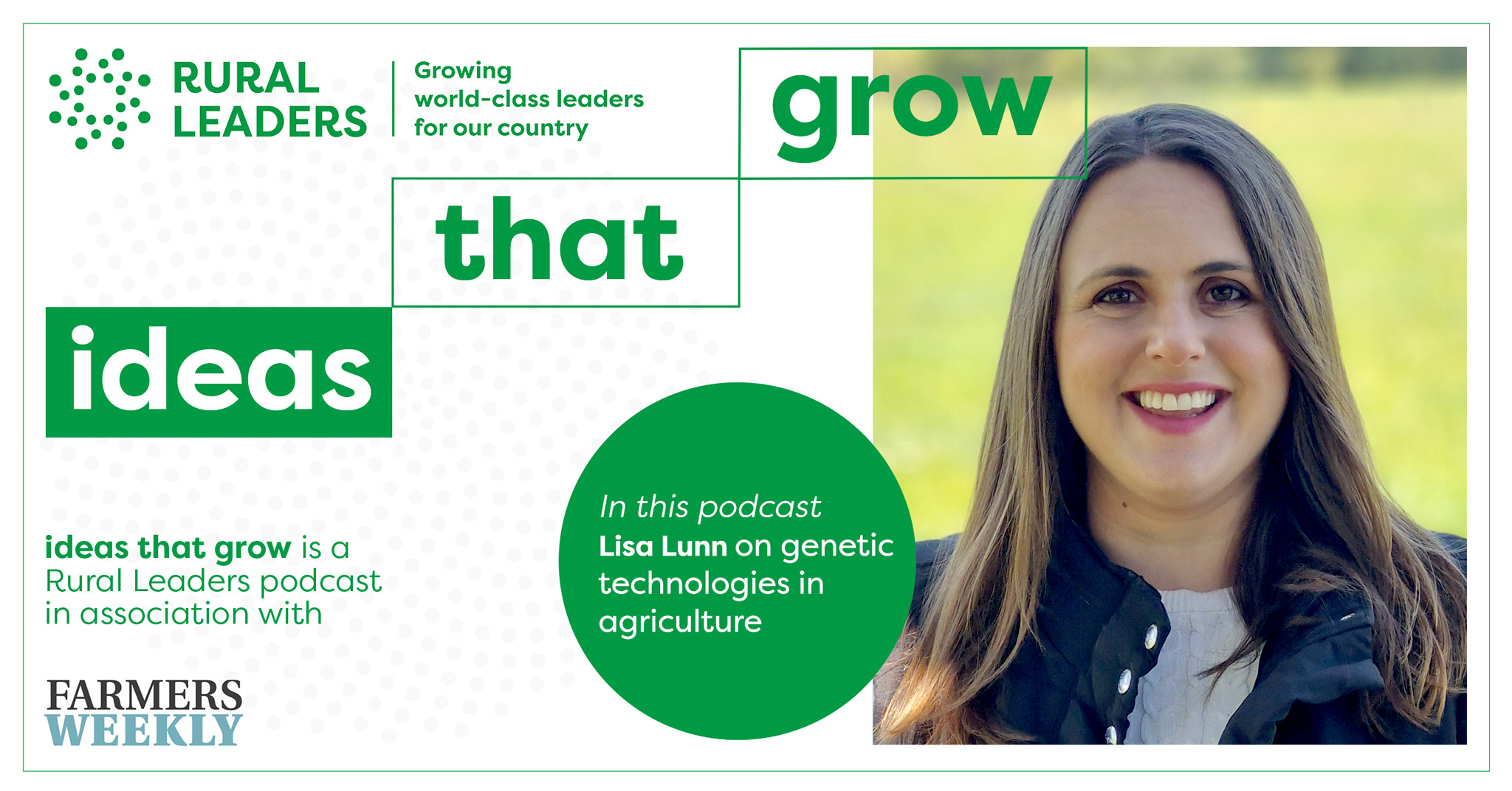
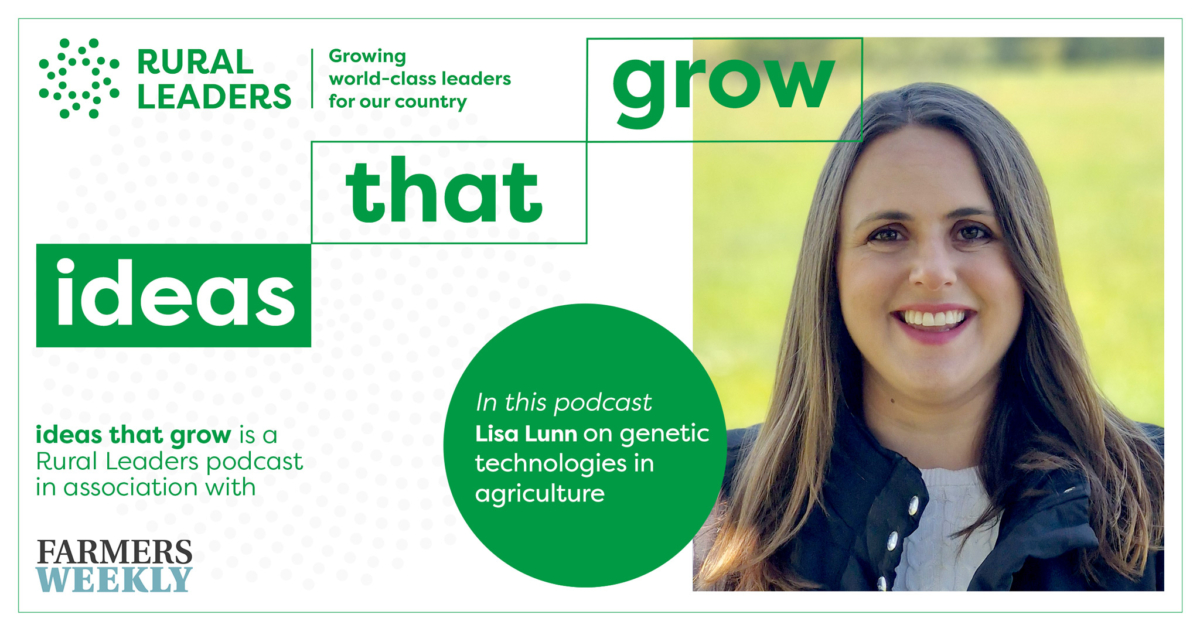
Lisa Lunn on genetic technologies in agriculture

In this podcast, Lisa Lunn, 2024 Kellogg Scholar, talks to Bryan Gibson, Managing Editor at Farmers Weekly about her Kellogg research into the use of genetic technologies in agriculture. Lisa’s research presents a balanced view that unpacks the challenges, and the opportunities genetic technologies offer the food and fibre sector.

Listen to this episode of Ideas that Grow, or click on one of the platform icons below to listen on your favourite player:

Episode Transcript

Bryan GibsonManaging Editor of Farmers Weekly.
You’ve joined Rural Leaders’ Ideas That Grow podcast. In this series, we’ll be drawing on insights from innovative rural leaders to help plant ideas that grow so our regions can flourish. Ideas that Grow is presented in association with Farmers Weekly.

Bryan Gibson, Managing Editor of Farmers Weekly.
You’re with Ideas That Grow, the Rural Leaders podcast. I’m Bryan Gibson, Managing Editor of Farmers Weekly. With me on this week’s show is Lisa Lunn, who is a recent Kellogg scholar.

Lisa Lunn, 2024 Kellogg Scholar and Category Manager for Crop Protection at Farmlands:
LL: Hi, Bryan. Thanks for having me.

BG: Where are you speaking from?

LL: Currently in beautiful Morrinsville in the Waikato, where I’m based.

Lisa’s Journey and Passion for the Food and Fibre Sector

BG: Nice. Now, you work for Farmlands, is that right?

LL: Yes, I do. I’m the Category Manager for Crop Protection at Farmlands.

BG: That sounds like a big job.

LL: Yes, essentially, it’s looking after anything related to agrochemical with an agronomy focus across the country. Working in really close with our team of talented TFOs, our agronomists, and our supply chain team as well.

BG: What knowledge and education do you need to get that job?

LL: I went through Lincoln University and got an Agricultural Science Degree, and I spent quite a few years in the sector working in various technical sales roles. I’ve had pretty good on-the-ground experience around the industry. Then this opportunity came up to get into the merchandising team. On my side of things, I bring a bit of technical on-the-ground knowledge, in an incredibly supportive environment with a lot of resources to help on the category side of things as well.

BG: Was the food and fibre sector always going to be your career of choice?

LL: Yes, I think so. I grew up on a small farm in the North Waikato. I think I always lean towards science and agriculture. Heading down to Lincoln to get my qualification was a natural step – Just so passionate about the food and fibre sector. It’s obviously everything starts and stops the food we grow. I’m proud to be involved with a sector that puts food on people’s tables around the world every day. It’s a pretty exciting industry to be part of.

Genetic technologies and the Kellogg research report

BG: We know the food and fibre sector in general, and New Zealand has a few challenges ahead of it. One of them we’re grappling with at the moment is whether to relax the rules around genetic technologies. And your Kellogg’s scholarship report looked directly at that, didn’t it?

LL: Yes, I was part of Cohort 51 that kicked off about a year ago. At the time, it was being talked about, but obviously a lot more has happened in the past year since then. The coalition government proposed some rules, a rethink of the rules, I suppose, that govern the genetic technology space. My report looked into if a change were to happen, what do we need to understand, as a country ,to make sure that any changes implemented are sustainable and the best thing for the country and our export markets.

Kellogg research process and key findings

BG: How do you go about getting the information and putting it together?

LL: Every Kellogg report generally involves a literature review. There’s a fair bit out there on this topic. Genetic technologies are very prevalent overseas, so there’s plenty of information there, and there’s quite a bit of information as well as to how it may impact our export markets.

The other part of that was semi-structured interviews. I spoke to about 16 key stakeholders from across the industry and also environmentalist groups as well, to make sure it was balanced. I had some interviews, and analysed the data as to the main trends that came out of it.

BG: Can you tell us a little bit about what those trends were?

LL: I spoke to a number of stakeholders representing a lot of sectors throughout the primary industries, and environmental groups, to make sure it was a fair and balanced discussion. In the groups I spoke to, no one was outright against a change, but there was plenty of those that were for it, and a portion were supportive but proceed with caution.

There were definite trends there in that a lot of people did support a change, and then probably the main group was ‘proceed with caution’. It was, ‘have a look at what other countries have done, make sure there’s a very good national conversation had so that everyone’s brought up to speed and understand what it means for us as New Zealanders, what it means for our export markets’. All of these things, that if we are to do it, we’ve got to do it right. We’ve got to take our lead from other countries that have done it and who’s been successful and who hasn’t.

Legislation and Global Considerations

LL: There was a group of individuals that I spoke to that were a bit more, ‘let’s find out a bit more information before we can make a decision, and potentially, are there other areas we should be focusing on first?’

A big thing that came out of it was that there are a lot of uses of genetic technologies. One of them, that’s been heavily spoken about, is the ability to reduce our greenhouse gas emissions. The group of respondents I spoke to were very clear on saying, ‘this is not a silver bullet’.

It has to be part of a holistic approach that means that we can use other technologies and other mechanisms to help reduce our greenhouse gas emissions. This isn’t just going to be a set and forget. We’ve got to look at the bigger picture and make sure we are using everything we can to make sure we’re hitting the targets we’ve set ourselves and doing the right thing to be sustainable farmers. It’s not something that’s just going to come in and solve all our problems overnight.

BG: The legislation we’re working to now was written in the mid ’90s, wasn’t it? Considering how far the science has moved, it’s definitely time to have another look at this.

LL: Yes, scientific consensus is that basically the technologies have moved faster than our legislation has. As you said, it was written a long time ago, the HSO Act, which governs the space. Initially, when it was written, genetic technologies was a lot more cisgenesis.

There was a lot more inter-species genetic transfer. Nowadays, it’s much more specific with CRISPR-Cas9, and those technologies. There’s also some cases where certain modifications that might happen in the market that’s been exported to, might not even be considered a genetic modification because it’s something that can occur in nature anyway. It’s about having clarity on the definitions and what our export markets would consider genetic modification or genetic gene-editing. And bringing that legislation up to date with the technology we have available to us these days.

BG: That’s the big thing. I think I often find in the correspondence I get on this, that some people think we can do this, so we should, whereas there’s a bigger discussion to have around what does that mean for other things outside of science in terms of society and the way we market ourselves to the world.

The Kellogg Experience and Future Outlook

BG: You mentioned trade agreements already. There are a lot of places who have different ideas what is acceptable or not. There’s a lot to get through, isn’t there?

LL: Absolutely. A lot of the competing nations in the agriculture space do use it, and in some areas it has given them an advantage. But we tend to trade on ‘clean green’ with the NZ Inc. image.

We need to be conscious of the fact that just because we can do it, it doesn’t mean we should. That’s an absolutely fair argument. There are a lot of very valid concerns out there. To name a few, it would be what impact is it going to have on our export market? There’s concerns around the corporate regulations around it.

There’s concerns about coexistence. Can an organic farmer still do what they want to do and be nearby to a farm that’s using GE products? I think it needs to be balanced. It needs to be fact-based.

I think you have valid concerns on both sides of the coin, and they need to be heard and understood and addressed. Some of the literature I read spoke to the fact that our export markets are probably more concerned with us moving in the right direction with our greenhouse gas emissions, water quality, animal husbandry, those things, even though we’re already very good.

But there were areas that, potentially, they’d like to see improvement, whereas in some markets, genetic technologies was less of a buying decision for them. But can we coexist? Can we still have the non-genetic technologies with farms operating alongside ones that choose to take up these technologies? The government has drafted a bill that’s already available for viewing and submissions.

It’s making sure that the discussions that are had our fact base, and it is an emotional topic. Hearing both sides of the coin and looking into what’s best for us as a country, as an agricultural export nation, and as New Zealand does as well, it goes beyond agriculture. Just understanding the technologies that may be available to us – what benefits are they going to bring?

BG: I understand the bill that’s been drafted is loosely based on the Australian system that they’ve got in train. Is that correct?

LL: Yes, it is.

BG: That there is some aligning with our close neighbours, is not a bad place to start, hopefully.

LL: Yes, absolutely. Just taking a lead on some of the nations that have done it and what their learnings have been and going more risk-based assessments as opposed to reviewing the individual technology itself, what’s the end product. They’re definitely taking a lead from Australia’s legislation.

A Transformative Leadership Experience

BG: Your report is out there. What was it like doing it? What was the Kellogg experience like for you?

LL: Fantastic, I absolutely loved it. I couldn’t recommend it more. I was very fortunate to be sponsored by Farmlands to do it. Farmlands are very generous with allowing me the time to head down and do the in-person courses. It was a lot of work putting the report together and doing the interviews, but the whole experience was absolutely incredible – The people you’re able to connect with both throughout the cohort.

The speakers that came to see us, conducting themselves under Chatham House rules meant they were just able to be so free and frank, and you could ask them questions you probably could never normally ask an industry leader or a CEO or a high-powered scientist or politician. You could be very open and transparent and learn whatever you needed to for your own personal development journey.

It was just absolutely unreal. The scope of people that were in the cohort, the knowledge they had, the questions they asked, just a wonderful cross-section of people from across the industry. The main thing we all had in common was we were passionate about the industry and the future of the sector.

BG: You mentioned it is personal development. What does the future look like for you?

LL: I touched on it before: Food and Fibre is my passion. I love being part of the sector, and I will always remain a part of the sector. I’m excited to be part of it here in New Zealand. It’s such a small industry. Everyone knows everyone. It’s a great thing. Everyone’s genuinely passionate to turn up to work every day.

I’ve been with Farmlands for about two and a half years now, so I’m really happy to get stuck in there and keep building on my role and working with a fantastic team I’m lucky to be a part of. Whatever I do, it’ll be involving the sector.

BG: For those out there who might be thinking about getting to work on something like the Kellogg programme, you’d recommend it?

LL: Absolutely. Rural leaders do a fantastic job of giving you all the resources you need, all the tools you need in your toolbox to become a better leader, to be more self-aware, to understand the skills you do have and the skills you could improve on.
The networks are astounding, and it gives you really good context for both internal
New Zealand-centric trends and aspects of the sector here, and also a really good handle on geopolitics and things that are happening overseas.

It helps you understand what trends may be emerging and how they could affect us here, as well as teaching us really good soft skills, like improving your critical thinking skills and time management and all sorts of things that come out of it.
Everything I gained from that is absolutely invaluable, and I’ll continue to use it in my career.

Thanks for listening to Ideas That Grow, a Rural Leaders podcast presented in association with Farmers Weekly.

You can read Lisa’s Kellogg Report ‘Understanding a future with genetic technologies in New Zealand agriculture’ here.

For more information on Rural Leaders, the Nuffield New Zealand Farming Scholarships, the Kellogg Rural Leadership Programme, the Engage Programme, or the Value Chain Innovation Programme, please visit ruralleaders.co.nz
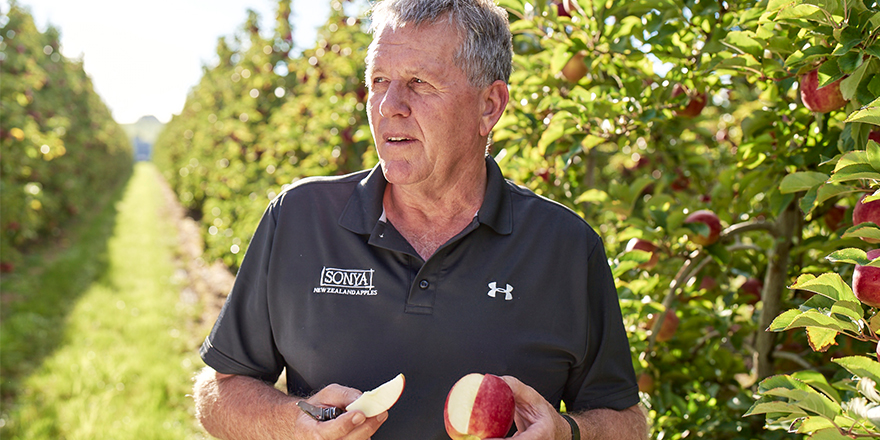
Dave Nuku on Kaitiakitanga and adopting a long term view.

In this podcast, Dave Nuku, 2024 Kellogg Scholar, talks to Bryan Gibson, Managing Editor at Farmers Weekly, on his work with Ngamanawa Incorporation and about how adopting a philosophy of Kaitiakitanga can be in alignment with a strong and profitable business.

Listen to the podcast here.

Bryan GibsonManaging Editor of Farmer’s Weekly.
You’ve joined Rural Leaders’ Ideas That Grow podcast. In this series, we’ll be drawing on insights from innovative rural leaders to help plant ideas that grow so our regions can flourish. Ideas that Grow is presented in association with Farmers Weekly.

Bryan Gibson, Managing Editor of Farmers Weekly.
You’re with Ideas That Grow, the Rural Leaders podcast. I’m Bryan Gibson, Managing Editor of Farmers Weekly. This week, I’m talking to Dave Nuku. How’s it going?

Dave Nuku, 2024 Kellogg Scholar, Ngamanawa Incorporation.
DN: Hi, good Bryan and you?

BG: Going good, thank you. You’re one of the very recent Kellogg scholars. I understand your report has only just come out.

DN: I’ve had a fantastic experience with Kellogg. Just finished my report, so glad to have had that completed. Yeah, it’s good to be here with you today.

BG: Just tell us a little bit about yourself. Where are you from?

Bringing a global perspective to New Zealand food and fibre.

DN: I’m from the Bay of Plenty, up here in Tauranga, and have some strong whakapapa connections back here. My family have been here for a long time. I’m currently working for Ngamanawa Incorporation, managing a block of Māori land of around 4,000 hectares in the lower Kaimai.

BG: Awesome. I was born in Tauranga, so I know the place pretty well. Has most of your career been in the food and fibre sector, or is that something relatively new to you?

DN: To be completely honest, it’s very new to me. I do not have a background in the food and fibre sector. I actually spent two decades overseas working through Southeast Asia, Hong Kong, Singapore, Philippines, Indonesia, Thailand, Malaysia. So I lived based in Malaysia, Hong Kong, and Singapore for several years in a completely different industry.

I was working for a multinational company over there running health clubs and resorts across Southeast Asia. So, it’s a big change from that perspective. I moved back home to Aotearoa a few years ago, just after COVID, and was fortunate enough to make a transition into the food and fibre sector with the Incorporation which our family have got long-standing connections with. It was a nice fit, but a very different industry – and all the differences that come with changing industries and countries.

BG: Yeah, that is quite a change, isn’t it? How did you find your time overseas? You’re obviously there a long time. environment.

DN: Absolutely loved being overseas, loved travel. My wife and I have got two kids as well, and so they were born overseas. So very much an international whanau. We did a lot of travel when the kids were young, and as they grew up. It was a constant part of our lives.

We were working in these different markets, so it was quite dynamic. Quite different to New Zealand. We were living in Malaysia and Singapore – so that’s closely connected to a lot of other countries, very easy to be mobile and get around. Businesses, languages, all of those things are very different, more nuanced, more complex than New Zealand in industries that we’re working at, but loved it. Absolutely loved it.

Having said all of that, it’s great to be home. I think Aotearoa, New Zealand is the best country on Earth and absolutely love living here, working here, and being home with my family.

BG: Tell me a little bit about the Incorporation you’re working for now.

Managing, leading, and stewardship.

DN: Yeah. So, Ngamanawa Incorporation has a large land block up in the lower Kaimai’s. Mainly the Incorporation has its roots in forestry. It’s around 2000 hectares of pine, radiata pine, and around 2000 hectares of native forest. In the native forest, we have a conservation team of five full-time Kaimahi or staff who are involved in our predator control efforts there.

We do everything from monitoring the waterways, the habitat for native species, whether it’s tuna/eels or kōkako, or kiwis. We have a lot of those really special native species up on the block. As well as forestry, we’re also involved in horticulture. We have a kiwifruit orchard with golden and green kiwi fruit in the Kaimai area, a little bit closer to Tauranga.

Then we also have some investments in other horticulture crops, strawberries on Matakana Island and some rocket apples in the Hawke’s Bay. So, quite a mix of different business interests across the Incorporation. It keeps you busy and it’s varied.

BG: Yeah, a lot of variation and diversity there. I guess there’s a lot of different farming techniques, business management, and you’ve got the native block as well, which is more of a conservation approach, I guess. A lot to keep on top of.

DN: I think it’s the variety and that diversity that makes it fascinating for me. I have a really strong international business background, but it’s nice to be doing something that is very, I suppose, organic and something working for an entity that we’ve got a long-standing connection to.

The block, the incorporation is made up of a number of different blocks of traditional Māori land, that has been in Māori ownership for hundreds of years. It’s nice to be taking that and really making sure that it’s productive in terms of our forestry, and then also in the indigenous forest space and the native bush, really looking at preserving the native species there.

We also have a lodge for our shareholders, so you can book the lodge and go up there and enjoy it with your family. It’s nice on a lake with lots of waterways in the middle of the bush.

It’s also about connecting people to land as well. Then the horticulture and the kiwifruit is really that’s a lot of the day-to-day operations. Long time between drinks in terms of the business model for forestry, but with Kiwifruit. They’ve got a more seasonal cash flow in business requirements and operations there.

BG: How are things tracking for you guys at the moment? Has it been a good year? Things looking pretty good?

DN: It’s been a fantastic year for kiwifruit in general across the Bay. It’s been something that the industry has really needed. We had a couple of rough years there with COVID, and there were a number of weather events.

Also, some of our growers down in the Hawke’s Bay area were really affected by cyclone Gabrielle. But overall, the industry has had a great season, a really strong crop. I think a record season, just under 200 million trays, which is around about a 25% increase on the previous highest year for Zespri overall, who sell our kiwifruit into market.

It’s been a record crop. Growers have really benefited from it. Last year’s growing conditions were excellent. Not only did we get good volume, but it also got really good fruit quality, which has held up well in the markets. We sell that through into Europe, China, and other places.

You’ve got to celebrate the wins, and we’ll take those because horticulture can be challenging. There’s always weather events, and you’re always on your toes, and no two seasons are the same. We’ll just take the win and then really focus on trying to do that again this season.

A background into how a Māori Land Incorporation works.

BG: Now, probably most of our listeners have a bit of an idea about how a Māori Incorporation functions and is structured. But could you just give us an overview of how that works?

DN: Absolutely. The Incorporation is governed by a committee of management. They function more or less like a board, I suppose, if you could think of it in that way, with some really small, subtle differences. But if you think of them as a board that are duly elected by the shareholders to represent the shareholder interests in the land block.

The Incorporation itself is an amalgamation of five different blocks in the lower Kaimai area that were all brought together just for the economies of scale that comes with a motivating all that land, which led to the 4,000 hectares that we currently have. Then what ends up happening is all of the owners in those individual land blocks more or less get shares in the Incorporation as opposed to a direct ownership in the land itself. That’s the governance structure and the ownership structure is more like a shareholding reporting into the committee of management.

The big difference between a Māori Land Incorporation versus a trust where the owners of the land still retained a slightly different ownership model. The Incorporation has been around for around 50 years and came together in the 1970s to amalgamate the land blocks to secure the land over the long term.

At that time, we were facing some challenges with the confiscation of land through the Public Works Act for the hydro scheme that’s currently up in the in the Kaimais. As I said, that was the origin story of the Incorporation. It’s come together as a result of that. We got into forestry and then have diversified over the years.

Kaitiakitanga – guardianship/stewardship. Adopting the long term view.

DN: So, generally speaking, Māori Land Incorporation, long term holders of assets in land, long term view, primary in nature, forestry, horticulture, looking to diversify. We have some other stocks and portfolio financial products. But everything we do isn’t really driven on a quarterly basis in terms of returns. It’s much more about where we want to be in 5, 10, 15, 20 years.

BG: That’s something that a lot of people are thinking about more and probably should think about more is having that longer term view of where you’re going. Because you’re right, that quarterly reporting makes you overegg the omelette in some ways.

You can drive production to meet targets and then have some issues to clean up afterwards. Whether a more measured approach with more long term targets seems to be a better way to take care of our land?

DN: I think so. That’s definitely our view on it. It’s more of the Kaitiakitanga view. Kaitiakitanga, meaning guardianship or stewardship. I’d describe it in that way – which was the subject of my report. What I wanted to do, having come back from extensive experience overseas in more international markets, where stewardship, guardianship, long term, intergenerational ownership, wasn’t really anything that I worked in overseas.

I worked for companies, many of whom were private equity owned. So, a different modus operandi, so to speak, a different timeframe, buying and selling companies, building them, selling them to the next person.

Coming back into this environment with a much more long term view, real care for land and nature, led me to study Kaitiakitanga, which is the subject of my Kellogg report. The concepts and all of the different influences, in fact, as they tie into Kaitiakitanga, I thought that would be a good way to educate myself and bring myself back up to speed so I can use that philosophy when managing the Incorporation assets and people.

Kellogg and Kaitiakitanga as a pathway to enduring prosperity.

BG: So, your report, as we said just out very recently, is called ‘Kaitiakitanga as a pathway to enduring prosperity’. I was interested that you kicked off by saying a lot of us have a simplistic view of what Kaitiakitanga is.

DN: Yeah, I think it’s most often thought about or used as a term in reference to guardianship or stewardship with regard to the natural environment. Whilst that is a part of Kaitiakitanga, that’s only a small component of Kaitiakitanga.

The broader application of Kaitiakitanga is the idea that one has a relationship not only with the environment, but also with your family members, also with everything within that environment. And with that, we call it Whanaungatanga or kinship. And with that kinship, our relationship, comes responsibilities. And the responsibilities that come from that, Whanaungatanga, or kinship, are responsibilities of care and Manaakitanga, looking after the environment, looking after others, looking after yourself, respecting the spiritual dimension that are imbued in all things.

We believe as Māori that things have a spirit, they have a Wairua, they have a Mana, they have a life force, or Mauri. Just acknowledging and respecting those things, particularly in the Taiao, but also one’s self. It’s a real all-encompassing philosophy in terms of how one can approach their life.

For me, in the way in which I think about it for the Incorporation. I see myself as a Kaitiaki of the assets that are within my responsibility, making sure that they’re not only produce good results, but they don’t do harm, whether it’s to the environment.

We look at things like forestry and our aspirations there to convert more of that into indigenous forests over time, perhaps retire parts of that. We also take the responsibility quite seriously and invest a lot into the conservation space, trapping possums, predators, to be able to restore some of the natural bird life on our block, to get the bird numbers up. To do that, you need to suppress the predators because they tend to kill all the chicks and the eggs and so on and so forth. That’s an example of Kaitiakitanga there.

Our team have rituals or practises that they use each day when they go out into the bush. They protect their Wairua or their Mauri. They’ll say special Karakia or incantations or prayers to protect themselves.

They’ll also ask for blessing and protection when they do the work in the bush. Then likewise, within the organisation itself, our philosophy is driven by Kaitiakitanga in terms of starting meetings with Karakia, with prayer, acknowledging people within the meeting or anyone who may have, for example, for us as Māori, in speaking back to that kinship and relationship connection.

We’ll also acknowledge those who may have passed on, their family connections and those within the region or the Mutu of Tauranga, the rohe of Tauranga will acknowledge them and do a Mihi to them and their family. So, all of these different practises that feed into Kaitiakitanga are all a part of the way you operate the way that you live and aspire to live.

Can you have alignment between Kaitiakitanga and propseprous business?

BG: As the title of your report suggests, Kaitiakitanga is not in opposition to having a prosperous and profitable business operation, is it? I mean, enduring prosperity, you can make a good living for all of your shareholders.

DN: Absolutely. That’s the aim. I suppose that was really what drew me to the subject  they’re not opposing forces. One can be a good steward of the land, good steward of themselves and a guardian, and still prosper and have good economic returns, whether it’s for your shareholder, whether it’s for your Whanau or your business or whatever it is. Those are not things that are opposing their nature. I think that comes back to the long term view.

Then also considering in a broader sense what the return on an investment might be. An example of that would be we most often measure return on investment in dollar terms. Whilst that’s an important metric, it’s not the only metric. For example, we have businesses we’ve invested in, and they have a really good social return for our people.

It’s about unlocking the potential of some of our Māori land, by our people, for our people and creating employment opportunities. Like growing high-value horticulture crops. The case in point is the blueberry investment we’ve made. We know that that investment is not just about a hard and fast financial return. That is also about investing in capability and building skills in high value horticulture.

We can accept that for that type of investment that may carry a higher risk, so to speak. But we think the returns are going to be social in nature as well as ultimately a sustainable, profitable business. We’re prepared to take on a bit more risk because we can see that we measure success differently, so to speak. You have the right size that for your Incorporation in your business.

We’re not going to put all your eggs in that type of investment, but we do take a number of smaller investments that allow us to be more adventurous. Then as those businesses grow and perform, then we can scale them up knowing that they have a good return for our people, for our land, and then also from a financial or Putea perspective for our shareholders.

BG: Obviously, your report looks at this quite in-depth. You’ve looked at the literature, of course, and case studies. You’ve made some recommendations about how to incorporate more of a Kaitiakitanga mindset into a food and fibre of sector business. What are some of those?

Three recommendations to include Kaitiakitana principles into business.

DN: What came out of the report that I did were a series of recommendations that I think I did expect would be the outcome. They are, first and foremost for Māori entities where there’s an opportunity to include Kaitiakitana principles. Those are things like in the culture of the organisation, having Tūkanga, what we call Tūkanga or Māori protocols around the Karakia, Mihi, acknowledgement of people, those who have passed special occasions, opening meetings with Karakia, finishing meetings with Karakia, welcoming new guests into your office with Mihi and Whakatau. That would be one example of something that the Incorporation does.

Also, there are some tools out there that one can use to exercise the Kaitiakitanga in regards to waterways. There’s a really cool tool called the Mauri compass, which allows you to measure the habitat of certain wildlife, wild species. For example, the native silverbelly tuna (or eels) that we have here. We do a lot of work in that space. So, water quality, habitat cover, abundance of life within the waterways, et cetera. Creating benchmarks using the Mauri compass across those different areas. Then setting some goals based on that.

One of the other recommendations that came out of the report was the importance of really capturing Kaitiakitanga and incorporating it into what we call our SAIPO, our strategic investment priorities and objectives document that outlines how we invest in different things and incorporating Kaitiakitanga as a guiding principle. So, that one, we’re investing in things that we’re proud of, that we want to be in, that are going to be good for the Taiao and the environment as opposed to things that aren’t.

That we are also making investments for a certain portion of our asset base. We’re looking at that as a good financial return, but also a good social return as well. And so, we have the lens of Kaitiakitanga, that’s our perspective, and we look at different investments.

Those were the three recommendations, what you can do on a daily basis in your Incorporation to make it part of what you do. Two is, tools that you can use in the natural environment. Three is, how you can weave it into your governance structures or your investment structures so that you’re getting involved with things where you can exercise your Kaitiakitanga.

BG: I talk to a lot of people and do a lot of reading in my job running Farmers Weekly. It seems to me that there’s a lot in the Incorporation’s view of how to run things that everyone could learn whether they’re a family farm in Canterbury, or wherever they are.

It gives a story to someone about the weighing up all of the externalities and the balance sheets of what you’re doing in terms of sustainability, social responsibility, social licence to operate, profitability, that sort of thing. Is that something you think?

Kaitiakitanga - universal principles for a long term view.

DN: I think the principles are universal. I really do think they’re universal. We’re talking about them in a Māori context here, but these are principles that you find in many indigenous populations across the world. I think you’ll find them in non-indigenous populations as well.

Part of the research that I looked into, you’d see new concepts emerging, for example, in the US, around steward ownership models that are really very similar to Kaitiakitanga, where entities that are in the environmental space, in the education space, or the charitable space in the US. They have come up with certain corporate structures that allow them to separate the stewardship values as a separate and enduring part of the governance structure that oversees those companies.

Irrespective of who the owners might be, they’re still held accountable to those principles of stewardship, and that’s really aimed at enshrining those principles of guardianship over these different assets, more common in the environmental space. I suppose my point is that that’s an example of the same concept halfway across the world being implemented and enshrined in legislative corporate law. Because I think it’s a lot of people are wanting to do that.

I think there are a lot of entities out there that are saying, Hey, look, these are really good principles of long term view, not just measuring the bottom line from a dollar perspective, but also from a social perspective. I think that a more holistic view and long term view is better. I mean, anything, even from an investment perspective, if you invest in it for longer, it’s generally better. I think there’s a lot of principles that could apply to any business.

BG: I was reading just the other day about something that applies to the other end of the supply chain, NZ Story, which is part of New Zealand Trade and Enterprise, did its most recent survey with Chinese consumers.

They found that after COVID, they were connecting more with their history and felt that New Zealanders, the fact that we embrace our indigenous culture and what we do more than some other colonised countries, was a point of difference for us. So, it’s an interesting thing to think about as well.

DN: I think we’ve got a great story. I think we’ve got the greatest country in the world. I really do. I think New Zealand is an incredible country. I think we do food and fibre really, really well. I hope there’s opportunities to lean into these indigenous narratives and concepts because they’re good for their environment, good for people.

That also sounds, as you’ve said, that they have a powerful resonance with other people abroad and other cultures. In typical New Zealand fashion, we’re probably too humble about it, quite modest. I think it’s okay to say, hey, look, these are things that we do really well. We do lean into it. That’s a part of our culture and our history, and we should be proud of.

The Kellogg Rural Leadership Programme.

BG:Now, how did you find the whole process of going through the Rural Leaders’ Kellogg Programme?

DN: I can absolutely say without any word of a lie or doubt that it was the best leadership programme that I’ve ever done. The most complete and thorough. The quality of the information from the presenters that you’re exposed to is really world-class.

We’ve got some of the best educators presenting content, a wide variety, too. People with military backgrounds, doctors, professors, politicians, farmers, horticulturalists, you name it. Te Ao Māori educators and specialists too. The broader array of leaders in all of these different fields and to be able to listen to them, to interact with them, to learn from them was just incredible.

It was a very, very special experience. Throughout that all, you’ve also got this report that you need to produce. You’re constantly taking in information from these presenters. You’re learning a lot from some of the best young minds, and probably I wouldn’t put myself in that, but more of a more mature vintage, shall we say myself. But they’re really, really great leaders in their own right who come in to do this course. You end up learning a lot from the people around you. That’s very motivating. Iron sharpens iron, so the whole experience has been exceptional.

If I was to say one thing to someone considering doing it, is to absolutely do it, go for it, but do not underestimate the amount of time it’s going to take you, and the focus and commitment that you’re going to need to get the most out of it. It’ll be worth it, but it’s a lot of great work.

You can read Dave’s Kellogg Report ‘Kaitiakitanga as a pathway to enduring prosperity’ here.

Thanks for listening to Ideas That Grow, a Rural Leaders podcast presented in association with Farmers Weekly.

For more information on Rural Leaders, the Nuffield New Zealand Farming Scholarships, the Kellogg Rural Leadership Programme, the Engage Programme, or the Value Chain Innovation Programme, please visit ruralleaders.co.nz
Reimagining Local Economies: How Small-scale Farming and Community-based Models can Build Climate Resilience.

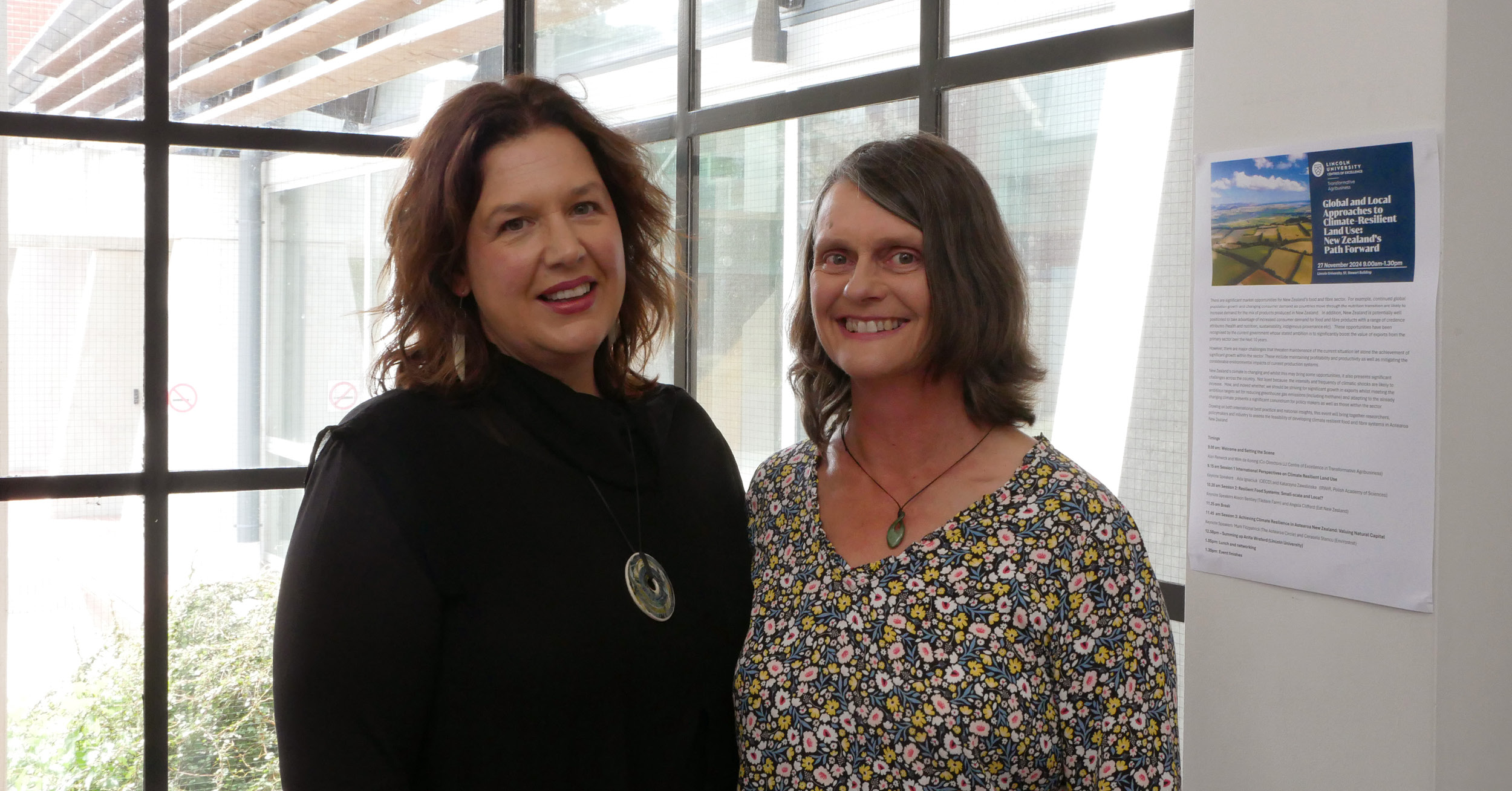
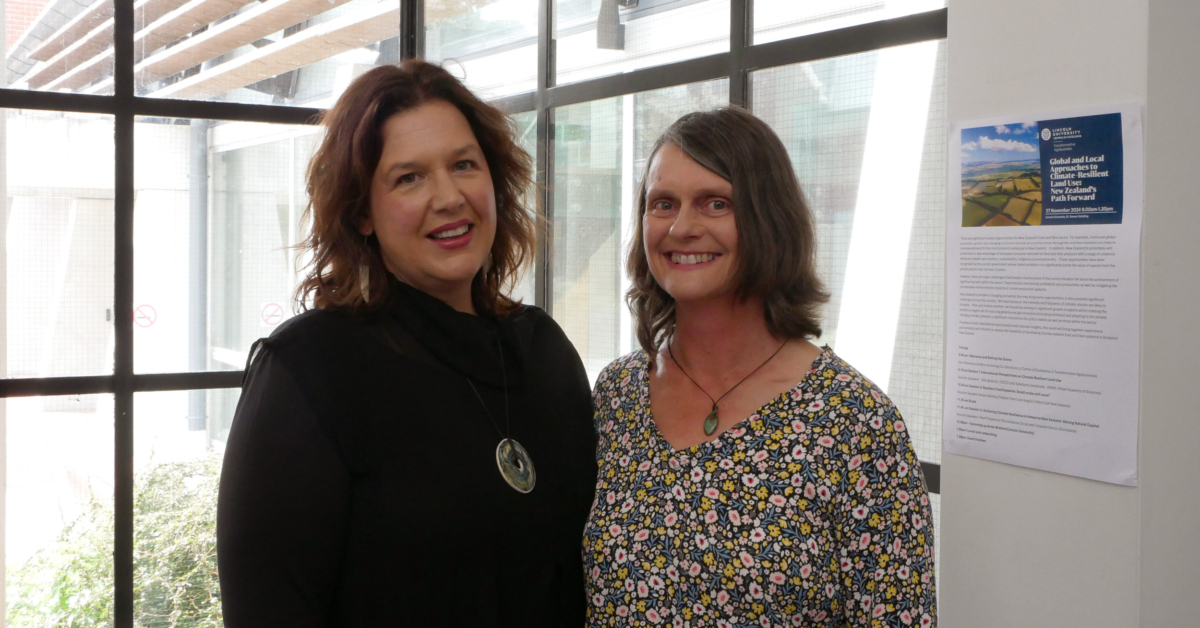
Alison Bentley (Tikitere Farm and 2023 Kellogg Scholar) spoke yesterday at the event ‘Global and Local Approaches to Climate-Resilient Land Use: NZ’s Path Forward,’ at Lincoln University. Alison joined Angela Clifford (CEO, Eat New Zealand), in Session 2: Resilient Food Systems: Small-scale and Local? 

As the effects of climate change and economic instability become harder to ignore, it’s clear that the current models of economics and land use are proving challenging. Enter Angela Clifford and Alison Bentley, two forward-thinkers who are shaking up how we think about local economies, food systems, and sustainable land use. 

Their ideas offer an alternative vision for a future where community-based economies and small-scale farming can not only help us better contend with climate crises but could also transform the way we live, eat, and work.

The Missing Link: Community-Based Economies.

Angela Clifford, CEO of Eat New Zealand, has been championing the power of local economies for years. In her view, traditional economic models are overly focused on macro-level concerns like national GDP, and micro-level issues, like business profits. But there’s a massive gap in between: the community economy. This often-overlooked space is where, Clifford argues, the real power lies, particularly when it comes to addressing environmental and social challenges.

For Clifford, redefining economic success isn’t just about how much a country makes or how many businesses thrive. It’s about creating systems that prioritise sustainability, local self-reliance, and social equity.

But Clifford’s vision goes beyond just localising industry; she sees a radical rethinking of food systems as central to building climate resilience. Despite the growing urgency around food security and sustainability, little has been done to strengthen local food systems, she argues.

Small Farms: Big Impact.

Alison Bentley, a small-scale farmer from Tikitere Farm near Rotorua, is proving that small farms can be a game-changer for climate resilience. Through her research with the Kellogg Rural Leadership Programme, Bentley has been exploring the role of small-scale farming, especially on plots of 10 hectares or less, in building a more sustainable food system. Unlike larger scale commercial agriculture, which can depend on chemical-intensive practices, Bentley argues, small-scale farming often works in harmony with natural ecosystems, fostering biodiversity and improving land use resilience.

“An increase in scale is more of the same to gain efficiency, whereas an increase in scope can give us diversity and resilience”, Says Bentley. In other words, rather than always pushing farms to become bigger and more industrialised, we should be looking for ways to diversify farming practices to build long-term resilience. By aligning farming methods with the natural capabilities of the land, small-scale farms could deliver more sustainable and climate-resilient outcomes.

One of the key issues Bentley identifies is the underuse of “lifestyle blocks”, small rural properties that often sit idle or are used for residential purposes rather than food production. In New Zealand alone, there are 870,000ha in such blocks on productive land, with 140,000ha on prime land. And just 10% of this land is run by landowners serious about producing a primary income from their blocks. The other 90%, if managed properly, could become a vital resource in strengthening local food systems and reducing reliance on large-scale agricultural exports.

Bridging Urban and Rural Food Systems.

But there’s a catch: connecting these small-scale producers to urban markets. As cities grow and sprawl outwards, rural land gets encroached upon, and small farmers face significant challenges in accessing urban consumers who increasingly want locally grown, chemical-free food. Bentley’s Kellogg research highlights a growing demand for this kind of food, but there are major obstacles to getting it to the people who want it, infrastructure, limited market access, and high transaction costs are just some.

Still, Bentley is optimistic. There’s a clear market for sustainably grown local food, and consumers are often willing to pay a premium for it. What’s needed is a rethinking of food systems that can help small-scale farmers tap into that market while overcoming the logistical barriers that can stand in the way.

A New Economic Framework.

Both Clifford and Bentley advocate for a new economic framework that goes beyond GDP and focuses on values like environmental sustainability, local self-reliance, and social equity. Clifford believes that, in the face of climate change, it’s more important than ever to build local systems that can withstand global disruptions. For Bentley, small-scale farming offers a practical way to increase food security, reduce carbon footprints, and create stronger communities.

While neither discount the importance of New Zealand’s food and fibre exports to our economy, they both argue that we do need to think differently about how we use land and produce food.

A Path Forward: Empowering Communities, Supporting Small Farms.

Together, Clifford and Bentley make a compelling case for reimagining the future of food and land use. Their vision isn’t just about protecting the environment or boosting local economies, it’s about creating a more resilient, equitable society where both people and the planet can thrive.

They conclude by stating that by empowering small-scale farmers, supporting community-based economies, and rethinking how we use our land, we could build a future where local food systems play a central role in creating more sustainable and just communities. Food for thought.

You can read more on the subject in Alison Bentley’s 2023 Kellogg Report here.

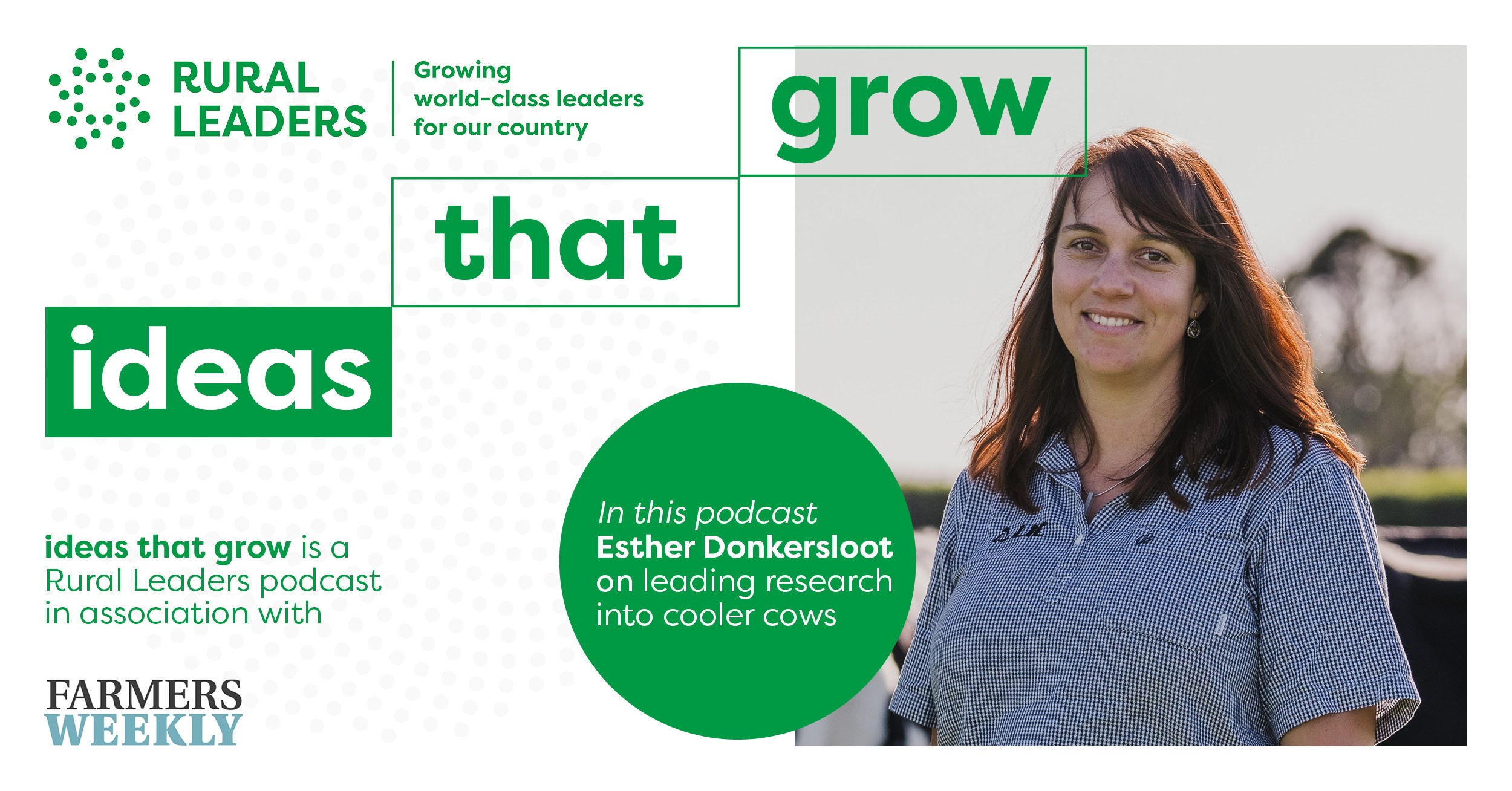
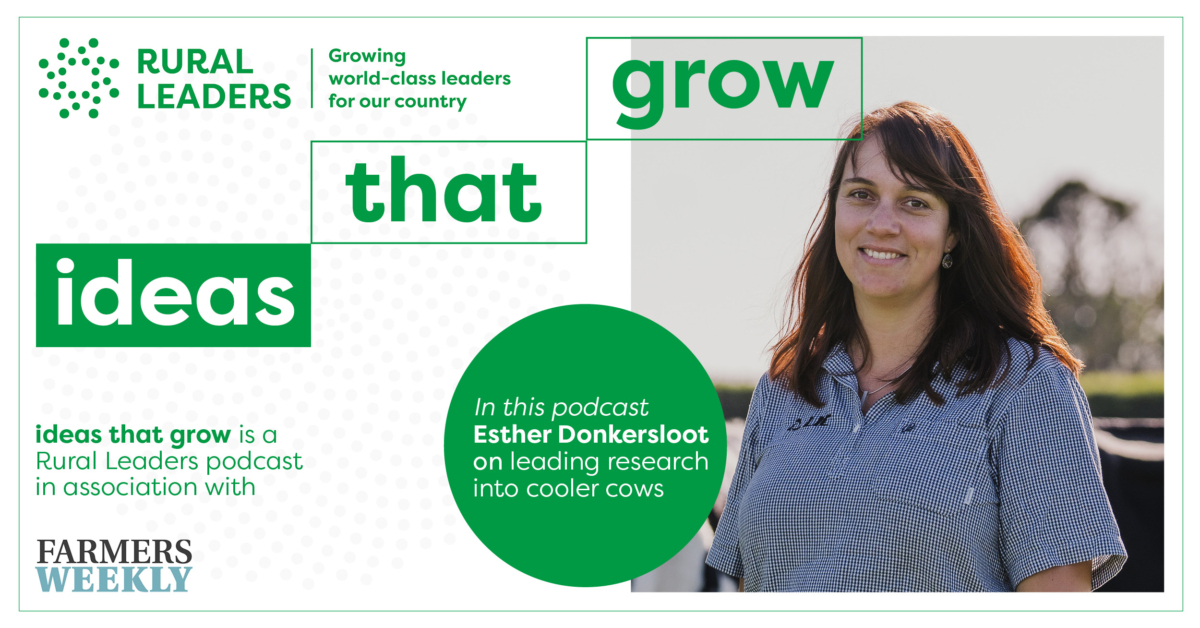
Esther Donkersloot on leading research into cooler cows.

In this podcast, Esther Donkersloot, 2024 Kellogg Scholar, talks to Bryan Gibson, Managing Editor at Farmers Weekly, about her research with LIC on breeding heat tolerant cows.

Esther came to New Zealand to do her Masters’ thesis and never left. Good thing too. Having studied at the prestigious Wageningen University, she has steadily built a career looking into better genetic outcomes for our dairy herd – especially as the planet gets warmer.

Along with her research at LIC, Esther discusses her Kellogg report insights on genetics’ social licence to operate.

Listen to the podcast here.

Bryan GibsonManaging Editor of Farmer’s Weekly.
You’ve joined Rural Leaders’ Ideas That Grow podcast. In this series, we’ll be drawing on insights from innovative rural leaders to help plant ideas that grow so our regions can flourish. Ideas that Grow is presented in association with Farmers Weekly.

Bryan Gibson, Managing Editor of Farmers Weekly.
You’re with Ideas That Grow, the Rural Leaders podcast. I am Farmers Weekly Managing Editor, Bryan Gibson. This week, our special guest is Esther Donkersloot, who is a recent Kellogg Scholar and works with LIC. G’day Esther, how’s it going?

Esther Donkersloot, 2024 Kellogg Scholar, Scientist LIC.
ED: Yeah, really good thank you.

BG: I usually start these conversations by just getting a bit of life history, I guess. Now, you’ve come a long way to your life in New Zealand and your role at LIC.

The Netherlands’ loss, New Zealand’s gain.

ED: Yeah, this was an overseas experience for six months that turned out to be a bit of a life move to the other side of the world. So, my background is Dutch. I grew up in rural Netherlands, and I was always very interested in doing my master’s thesis somewhere else. Just by chance, I ended up in New Zealand with LIC, and have been here for 10 years now. So yeah, it’s been great.

BG: I understand you went to Wageningen, if I say that correctly.

ED: Yeah, it’s a tricky one. Wageningen University research centre. It was very close to home for me, probably about 20ks away from where I grew up. I I studied animal sciences there. Wageningen University is our main agricultural university in the Netherlands. It’s a highly regarded university, and it’s all around food, sustainability, and environment studies.

BG: Yeah, I used to work at Massey University, and they had a lot of partnerships with that university, and I always wanted to go and visit because it just sounded like an amazing place, that food valley environment.

ED: It’s an interesting place because it’s actually a very small town that the University is based in. So the town is the University, and it’s the combined effort of the University side as well as a big arm for research, which is a great environment to learn in. Definitely look back at it very fondly.

BG: So you came over here to do your master’s?

ED: To do my master’s thesis yeah. In our master’s, we had the opportunity to either do two thesis or to do a thesis inside an internship. I did two thesis. So, it took away the opportunity to learn outside of the University. I was still keen to get my main thesis done in a company somewhere else. By chance, my professor did his PhD with our head of research at LIC, Richard Spellman.

So, I ended up with the chance to do my (main) thesis over here in New Zealand with LIC, on gestation length. And then from there, I just enjoyed it so much that I rolled into a temporary contract, then a fixed-term contract. Now I’m well and truly settled in.

LIC research into heat stress in cattle.

BG: I understand your role here now is related to heat stress in cattle.

ED: Yes. I started my career with LIC in animal evaluation, and then had a little time in our international team. I got the opportunity to travel around a bit and learn a lot more about dairy around the world. I then came back to the research and development team to lead the Slick Heat Tolerant Breeding Programme, which I’ve been doing for the last six and a half years, alongside my colleagues. Nothing in research is ever an individual piece. It’s always a team effort.

BG: Could you just tell us a little bit about the work you do and why it’s important? I mean, we know things are warming up, so I guess it’s finding ways to get genetic markers for animals that are more tolerant of the warming world.

ED: Exactly. We found the slick gene. The slick is a dominant gene that we found in the Senepol breed in 2014. It is originally a beef breed from the Caribbean. Then we started the breeding programme to incorporate that into our New Zealand dairy animals.

Back then in 2014, the focus was very much around the potential of this gene for international, knowing that a lot of our dairy still comes out of tropical environments, and this is a huge opportunity for growth.

Then when we started to focus a lot more on environment and climate change, we changed the breeding objective to focus on what this gene could do for New Zealand. Because especially here in New Zealand, where animals are outside 24/7, we don’t have the opportunity to shelter them so much from heat stress as they would be in barn-based systems. So the opportunity of having a genetic solution was just amazing.

So, we started incorporating it by just traditional breeding into our crossbred animals in LIC with the hope of launching this as a commercial product in 2029.

BG: Obviously, a lot of this stuff goes above my head, but I do know that when you’re looking at these genes for certain traits, the first thing you’ve got to look at is, does it cancel out other traits you’re after as well? Like, I guess, milk production and mastitis tolerance, that sort of thing.

ED: Yes, absolutely. I’ve been leading the breeding side, where we’ve been trying to dilute this beef breed that we got the gene originally from, into our dairy animals. We’re trying to get the genetic merit and the genetic gain up to be producing milk and getting all those traits that we require for our New Zealand dairy systems.

Then alongside, my colleague has been looking at the effects of this specific gene, not just on heat tolerance, because we know that it does create a benefit for heat tolerance, but also what could this mean to the cold sensitivity of these animals?

We’ve been doing some research ourselves as well as a project in collaboration with Lincoln University, to understand, especially in calves, when they’re born in winter here in New Zealand or very early spring, what this gene would mean to them. Because we know it did create a shorter hair coat.

We found there’s been no negative consequences to this gene, and we’re hoping to publish some of this data very early in 2025. It’s very important for us that we make sure that before we commercialise, especially knowing that we’re on a seasonal system here, once it’s out there, you can’t control what animals are being born. So, we need to totally understand everything we need to know about this gene and making sure there’s no negative consequences.

BG: Well, we look forward to reading some of your research findings and then seeing some of this technology hit the market.

ED: Yeah, it’s a super exciting project. Having being part of it now for this last six and a half years, we just see these animals produce more and more. It’s so exciting to follow them from the sideline and being able to do research on them in different locations in New Zealand.

Kellogg research into genetics’ social licence to operate.

BG: If that didn’t sound like a lot of work, you were part of the first cohort of Kellogg Scholars this year.

ED: Yeah. I was part of Cohort 51, and lucky enough to be there on an LIC Scholarship.

BG: Oh, nice. Tell us a little bit about what you focused your scholarship studies on.

ED: Yeah, that’s an interesting one. Being a scientist, doing social science in leadership is quite different to my normal day-to-day activities. But what I was interested in is this aspect of this term ‘social licence to operate’ and how that applied to my area of expertise, which is genetics.

I was keen to understand how people were, first of all, to learn from other technologies. Other examples of things out there that we can learn from how people discovered and built this social licence to operate. Then understanding how people felt about genetics and what that social licence looked like. That was the main focus of my Kellogg Individual Research Project.

BG: I’m a journalist, and that seems very newsworthy because in New Zealand we’re right in the middle of having a rethink of our gene editing laws. One of the big issues that we’re all grappling with is, even though you can do it, should you? That comes down to social licence. It comes down to the marketing of your food story and all that thing, doesn’t it?

ED: Yeah. Part of why I was really interested doing this is that I felt quite often that social licence or that public perspective always came in during the commercialisation stage, and not that much during the research stage. But especially when you’re in a cooperative like LIC, everything we do is returning value to our farmers. If it doesn’t tick that social licence box, we need to pivot.

For me, it was how do we bring that conversation all the way through our research phases, from brainstorming to commercialisation? And then how do we also keep a finger on the pulse? How do we understand that the market is reacting to when we have a product in market? Because as you know, things change.

We’re living in a world where everything is changing faster than ever. So we can’t just put a product out there and just assume everything is all right. So, how do we do that? And who do we involve? Who are our stakeholders? And how do we carry that as an industry? Big questions.

BG: Oh, big questions. Did you manage to come up with some insight about how the licence was going for genetic technology?

The Kellogg research insights.

ED: It was a big question. I only scraped the surface. But one of the things that, first of all, really captured me, all the stakeholders I talked to were very passionate about genetics. Everybody understands the value of it, and it’s something that’s a cumulative that we can create and maintain. But not everybody felt like they were part of the conversation. So there’s definitely work to do there.

Then it brought up a lot of conversations around New Zealand Inc. How can we collectively take responsibility of all the aspects of our dairy towards not just our direct community here in New Zealand, but also our consumers overseas? That was really fascinating. Also, one of the other things that came up was the term ‘trust’. How do we build trust? But also what level of transparency do we get down to?

As I said, I’m Dutch. I like to think I’m a very open and almost, oversharing person. For me, a big learning curve was that sometimes by creating almost too much transparency, you actually raise more questions, or you highlight probably the negatives a bit too much. How do you balance that?

By building that trust, having transparency, but not oversharing where you just create confusion. There was some really interesting learnings in there.

BG: I was going to ask that because you’re uniquely placed to give insight into things. The Netherlands is one of the big food tech, animal production powerhouses of the world. I guess the general population on the street probably has a pretty fair idea about what’s going on over there. I wondered how it differed from New Zealand.

ED: Probably not at all. I would think that there’s a closer connection here to our farming communities just because a lot more people live rural. There’s a real urban-rural divide in the Netherlands, where a lot of people probably wouldn’t really understand where their food is coming from.

Then for me as well, I was very interested in that stakeholder piece around consumer versus customer, versus your direct community. But because we’re an export country here in New Zealand, what does that look like and how do we do that? In the Netherlands, it’s similar. Here, people feel very connected to farmers. They see it on their way to school, they see it on their way to work. Probably not so much in the Netherlands.

Food security and farming systems – Netherlands vs New Zealand.

BG: That’s interesting. I guess another thing to think about is that because we export so much of our food, we kind of don’t have the same food security concerns that places like the Netherlands do, and who have relatively recent major issues in terms of keeping everyone fed.

ED: Absolutely. Animal health as well, and diseases, things like that. This is a very different ball game. That’s what makes it so fascinating to be here in New Zealand. Also just the seasonal pasture system, I think it’s absolutely fantastic what we’re doing here and how we convert our basics into profit.

But at the same time, it brings its own challenges. As I mentioned before, when we have a product like genetics going out and it’s being used in spring, next year, we get millions of calves, and it could be thousands of the same sire line, for example.

That brings very different complex systems with it than we have in Netherlands where you have barn-based systems and you get a calf every second or third day. It’s just absolutely fascinating to compare the systems and understand the strengths and weaknesses.

Connecting with the Kellogg network.

BG: How did you find the Kellogg programme on the whole? It’s quite a big deal. There’s a bit of work involved. Of course, you’ve got cohort of people doing it with you.

ED: You walk in that room the first day and you get really bad imposter syndrome. Being a scientist, I’m like, wow, there’s all these leaders here in the room, what am I doing here? But I think the beauty of Kellogg is not just the content and the amazing speakers you get, but it is that cohort.

Just being able to banter with others, understand what they do, what drives them, understand their farming systems or their organisations. Especially for somebody like me that didn’t grow up in this industry. It was really important to set those networks and understand a bit more about the drivers of other people on the course.

BG: You’re here in Aotearoa to stay, you reckon?

ED: Yeah, I am a permanent resident. I’m living just outside of Te Awamutu rurally, so absolutely here to stay.

BG: It’s been great chatting to you, Esther. All the best for the rest of your work there at LIC.

Thanks for listening to Ideas That Grow, a Rural Leaders podcast presented in association with Farmers Weekly.

For more information on Rural Leaders, the Nuffield New Zealand Farming Scholarships, the Kellogg Rural Leadership Programme, the Engage Programme, or the Value Chain Innovation Programme, please visit ruralleaders.co.nz