Rural Leaders News



Ben Hancock 2019 Nuffield Scholar – Global Insights: Farm societies have common issues

FARMING the world over as much as the context, production and scale vary, shows, as the saying goes, the more things change, the more they stay the same.
After nearly six months on the road of my Nuffield journey I was struck by the similarities across continents and farming systems.
So many of the issues we face in New Zealand can be translated to our counterparts around the world.
This highlights that we have allies in dealing with the challenges we face and that we’re not in this alone.
In many developed countries there are the same concerns of the widening gap between urban and rural communities and the challenge of attracting people into their agricultural sectors.
At an agri-tech symposium in the American mid-west, plenty of cutting-edge ideas, gadgets and technologies were proposed and introduced to solve a myriad of issues. After two days of the symposium a panel of mostly young and engaged farmers was asked what their main concerns were. They repeated a familiar concern: finding staff, especially good staff.
The dairy farmers in Kenya I visited were concerned about connecting with their consumers though the connection is a more literal one – the actual logistics of getting their product to consumers elsewhere in Kenya, regardless of whether they are small subsistence farmers or larger more commercial operations.
A reliable supply chain is of more concern than perceptions of production.
Even so, their perception in the community still helps when the almost inevitable threat of land theft approaches.
Frustration in having a political voice is a common theme in many countries and agricultural sectors.
Within a few minutes of meeting the owner of a packing house in California he asked what I thought of President Donald Trump but he didn’t want to hear what I thought. He wanted to tell me what he thought. So much of what he vented was born out of frustration of not being represented in state or federal politics or in the general public.
So how does New Zealand differ?
New Zealand does have a great reputation and it has been enabled by our government and regulators.
The trust in our production systems and goodwill in terms of how New Zealand is perceived and behaves on the international scene is an asset for our industry.
The five Nuffield scholars benefitted in our travels from New Zealand’s international reputation.
The Christchurch massacre occurred while we were in the United States. Often the perceptions of New Zealand’s reaction from locals was one of sympathy for what had happened but also an appreciation of the community’s response and Government decisiveness.
Our nation’s reputation is more important to New Zealand’s agriculture than elsewhere. Take the red meat sector. More than 90% of what we produce is exported. Our reputation matters.
After a long day riding in the back of a van across nearly the length of Romania our group of scholars reached Bulgaria. Rather worn out and hungry we found a nice enough place to eat. Lo and behold, there was New Zealand lamb on the menu.
Nothing else on the menu hinted as to where it came from. Somewhere on the border between Romania and Bulgaria our reputation still carried weight. Perhaps it was the only thing any locals would know of New Zealand.
It really hit home that our community is here, our customer is there. The appreciation for New Zealand’s image and all that it entails is valued by our customers. Yet a lot of the headwinds that are buffeting New Zealand’s agriculture sector and rural communities are generated locally.
I saw some perverse outcomes of government involvement in industries and, though I’m reluctant to admit, there might be some benefits.
For example, in Ireland, if society decides an action such as conservation or environmentalism is a priority that benefits wider society at a cost to the producer, wider society contributes in some form – whether through taxpayer-funded support or at the local checkout.
On returning to New Zealand it feels as though the support and validity gained through regulation has changed. The inundation of regulatory and societal pressure is wearing on rural communities. However, we’re not alone in this. There are seismic shifts happening globally.
The detachment between the community and consumer means the cost of demands on production are difficult to meet. Ultimately, though, the Garden of Eden can’t be demanded without someone needing to pay the full price for having that shiny apple.
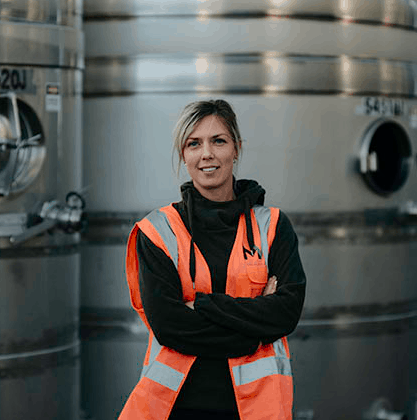
Hamish Marr 2019 Nuffield Scholar – Global Insights: Attacking the noblest profession

AFTER almost half of this year travelling the world there are a lot of thoughts in my head regarding agriculture and farming.
The biggest take-home for me is the universal problem of people wanting what they haven’t got simply through believing the grass is always greener over the fence and genuinely not understanding agriculture and what is involved in food production.
This fact was spelled out very clearly to me when two environmentally minded vegans in Germany told me the problem with German agriculture was that the cows were inside a lot of the time and farmers should put their cows outside all year like New Zealand farmers do.
Of course, that bought a smile from me because in NZ the green movement wants us to put our cows inside to be more like Europe.
So, who do we believe and who is right?
It is the same argument with synthetic meat, this seemingly new food on the block is going to save the planet and the people.
My question is how can a multi-ingredient, heavily processed, made-in-a-factory product even be compared to ruminant protein?
Nutritionists and health professionals all talk of whole, nutrient-dense foods consumed in moderation as part of a balanced diet.
Animal meat is the ultimate whole food, laden with nutrients and, best of all, it can be eaten without any process intervention.
In the 1980s and 1990s everyone was going to die prematurely from heart disease from eating too much butter and the alternative and golden ticket to eternal life was margarine. Now, in 2019, there is very little margarine sold as the apparent health benefits actually never came to be.
Genetically modified plants are almost enemy number one world over through misinformation about pesticide use and apparent food safety concerns.
The marketers and lobbyists will have you believe GM has led to huge increases in chemical use and it has been a campaign to sell agrichemicals by large, multi-national companies.
In truth GM was designed so farmers would apply less chemicals, both insecticides and herbicides, and the companies would make their money selling the patented seeds.
GM corn, for example, contains a naturally occurring fungus (Bacillus thuringiensis). BT, as it’s known, is registered as the safest organic insecticide in organic and biological farming when used on its own and yet because it has been bred to occur in corn it is labelled as hazardous by the very people calling for safe food.
At some point all western countries are going to face a wall of loud, anti-farming noise and governments will respond to the voters.
In the Netherlands, France and Germany we are seeing populations calling for more regulation to limit productivity.
Farmers, personally, will be the collateral damage in what will result and this will happen in NZ at some point.
What the people making the noise fail to grasp is the effect they have on people.
Recently, I was asked by a panel about my thoughts on morale in agriculture considering how good prices are.
My response was simple. Morale is extremely low and will remain so as farmers feel targeted.
They are made to feel responsible for a multi-generational production model that successive governments and regulators have promoted.
They feel targeted by a media seemingly interested in a story and they feel targeted by groups that understand only small parts of what are very complex systems.
I can tell you first hand when you criticise what a farmer does you criticise them, their home and their very reason for being.
It is not like criticising a company that can hide behind a name. The effects are real and they are very personal. Farming is a very emotional-laden occupation and farmers feel genuinely responsible for producing a good product for those who choose not to do it themselves.
The regulations facing agriculture will not go away and they they will almost certainly change in form and the way they are administered but regulation is probably here to stay if what is happening in other countries happens here.
It seems the life of any regulation begins as noise that gets louder regardless of the facts.
We have to remember our farms are outdoor factories and what we do can be openly seen by anyone who drives down the road.
By default that makes us targets unlike any indoor factory where trucks go in one side and out the other and something mysterious happens inside.
In general, people talk only about small components of our farming systems but talk as if they are experts and you have to think that just because I have teeth, it doesn’t make me a dentist.
The challenge for agriculture is to find a way through by understanding what the people want and in doing so try to explain why farming is so complex, diverse and at the same time the noblest occupation.


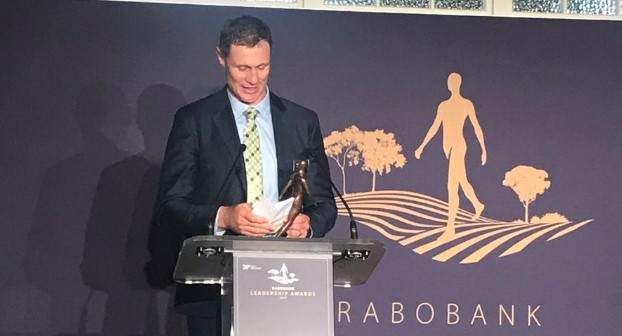
Mat Hocken – receives 2019 Rabobank Emerging Leader Award.
29th November 2019
Mat Hocken was announced as the 2019 Rabobank Emerging Leader at the Rabobank Leadership Awards on Thursday night (28th November). Our congratulations go out to Mat who is the first kiwi to receive this award!
The Rabobank Leadership Awards are held annually recognising the contribution of leaders from across New Zealand and Australia’s food and agribusiness sector. The 2019 event marked the 20th anniversary of the awards and the first occasion the awards dinner had been held in New Zealand. Find out more.
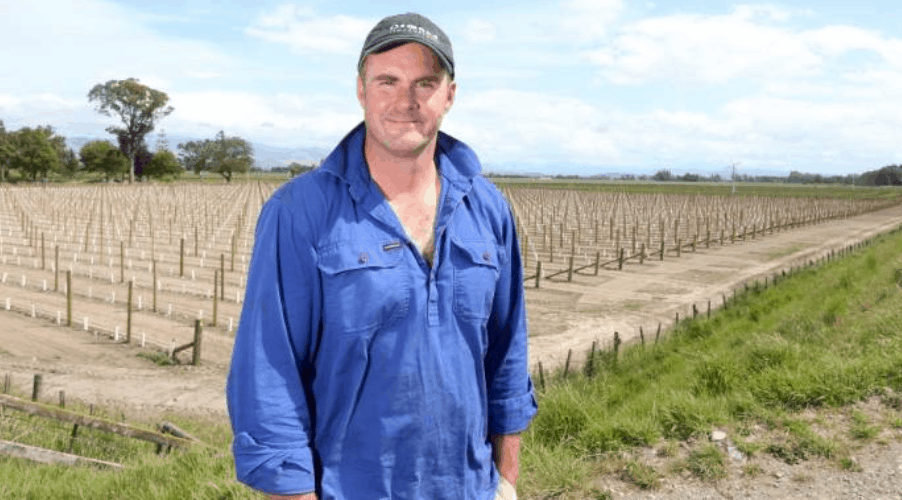
Nuffield Scholarship goes to Marlborough grapegrower – Ben McLauchlan
14th November 2019
Ben McLauchlan, from Marlborough has been awarded a Nuffield Scholarship and has plans to study how to help agriculture reduce its use of fossil fuels. Read more about Ben’s Scholarship research plans over the next 12 months .