2026 Nuffield NZ Farming Scholarship. Apply by 17 August 2025. Read More...

Apply for 2026 Nuffield NZ Farming Scholarship by 17 August 2025. More details...

Communicating with our growers.

Executive summary

This report was written with the aim of finding out how we can communicate more effectively with our suppliers. By ‘we’ I mean Trevelyan’s Pack and Cool Ltd, a kiwifruit and avocado post harvest company based in Te Puke, with approximately 330 suppliers. The research methods included
  1. a literature review
  2. an interview of four other primary industry based operations
  3. an online survey of our existing suppliers
  4. an interview of four existing suppliers
Key findings included
  • A need for our company to revamp our website offering to growers
  • A need to be concise with the information we provide
  • High performing companies have a focus on reporting and payment of quality of product supplied, not only quantity of product supplied.
This report was compiled with the help of many different people from throughout primary industries within New Zealand.

Daniel Birnie

Spray Use In The Kiwi Fruit Industry: How are we communicating with our community here in the bay of plenty

Executive summary

This report provides a review of how we are communicating with our communities (grower communities and wider public) within the context of the Bay of Plenty kiwifruit industry, as a way of starting to answer the question of whether we are adequately communicating, and if there are areas we need to focus on for improvement. 

Sources reviewed included material made available by the Bay of Plenty Regional Council, Zespri, New Zealand Kiwifruit Growers Incorporated, traditional news media, alternative news media, and social media. There were also conversations held with several orchardists. The goal was to find information that would come up when a member of the public searches, and this meant that not
all sources were the newest available.

The first sources that came up in most searches were from the regional council, followed by news media and social media. Material from the kiwifruit industry tended to be further down the list unless the search terms were modified with terms related to these (such as adding “Zespri” or “NZKGI” to the search). While most sources were quite balanced, alternative media had a tendency to publish more opinion pieces which were often negatively pointed towards spraying, and social media was all negative with one or two exceptions.

How should we communicate with our communities going forward?

  • Grower education – Make sure growers understand what their responsibilities are, and what their neighbours’; expectations are. Ensure that they know how to use their products correctly.
  • Community education – Help the community understand what their rights are, so that they understand there are laws to help protect them. Inform them as to what types of products we are using, why we’re using them, how those products compare to their alternatives, and what steps we have taken as an industry to reduce the impact we have on our neighbours through spraying.

The report finds that the kiwifruit industry is in the process of developing a strong communication programme regarding orchard spraying, but that the information we want to get in front of the public isn’t necessarily being shared with them right now. The industry has made great improvements to our spray practices in the last few years, and we need to make sure we promote this to the community prior to any major spray application periods via newspapers, mailbox drops, and community meetings, to counter the negativity before it becomes a major issue.

A time limitation while working on this report has led to detailed interviews with orchardists and the public not being conducted. Some additional work needed is suggested in the “Next Steps” section for anyone wanting to go into more depth on the issue of communication regarding spraying and agrichemicals.

Craig Ward

Technology use by sheep and beef farmers.

Executive Summary

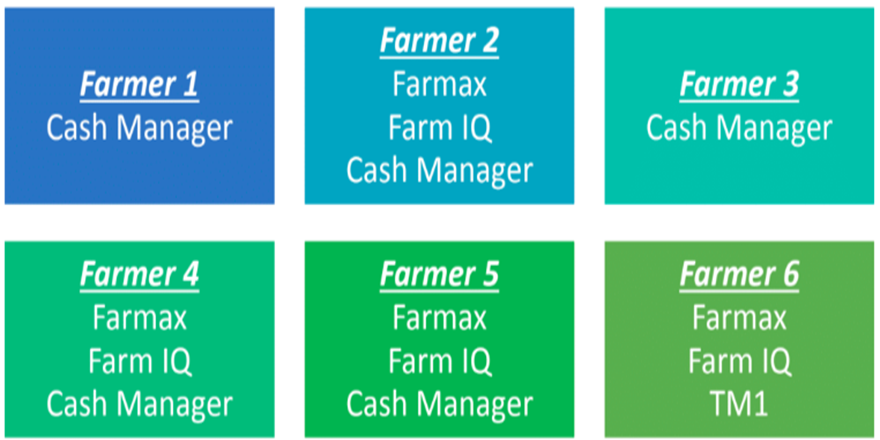
Farming is increasing in complexity. As such technology is becoming more important in businesses to understand impacts on both financial and physical performance. Top farmers typically lead effective technology adoption. However, this is not always the case. Five Wairarapa farmers along with one Central North Island Farmer were interviewed to determine how and why technology is used in farm businesses, to be a top farmer.

Past research in this area has been minimal, particularly in the sheep and beef sector. The majority of the research has been conducted with dairy industry funding. As such, little is really known about how and why top sheep and beef farmers use technology.

Budgeting technology was a key part of each farm business, and the only technology used by all six farmers. Farmax and Farm IQ were the two other technologies that were utilised in four of these farm businesses and were a key to their success.

Three important findings have emerged from this research. Firstly, top farmers are intrinsically successful. Technology just assists them in knowing their position to make informed decisions. Secondly, ground-truthing the results from technology with the farmers gut-feel and observations in the paddock is critical to effective decision making. Finally, technology provides some level of ‘insurance’ against events that may render the key decision maker unable to perform their duties for an extended period.

Technology use is unique to individuals, but some themes emerge time after time. Therefore, a greater understanding of these will lead to a more successful and resilient sheep and beef industry.

It is hoped this report will stimulate further discussion and investigation into technology-use on farms by farmers and industry professionals alike.

Industry crossroads.

Executive Summary

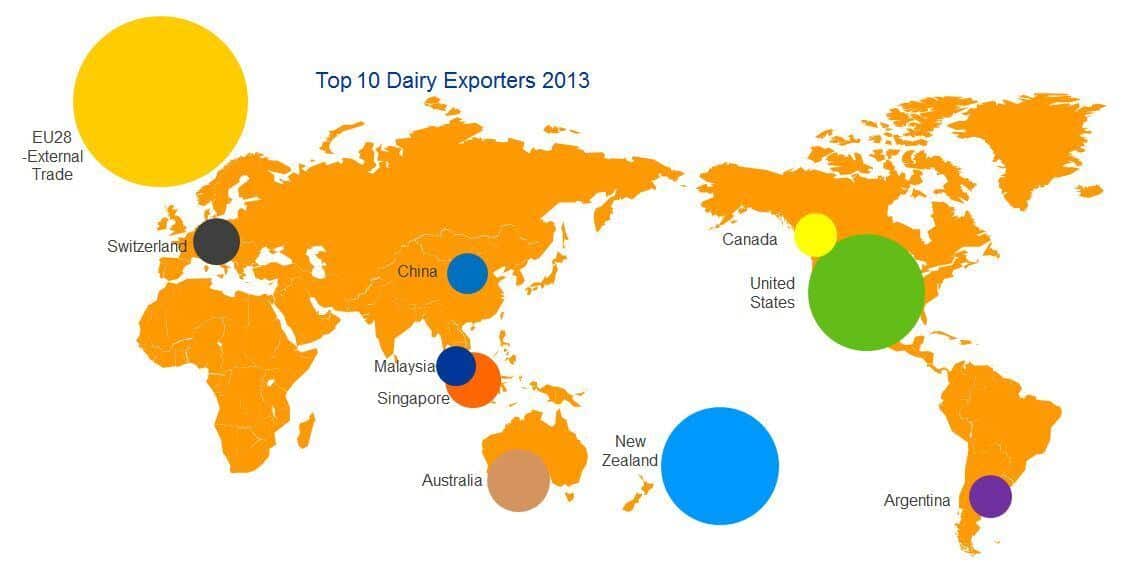
The dairy industry in New Zealand today is as important to the future of the dairy farmer as it is to the future of the New Zealand economy.

But as the industry stands, dairy is at a crossroads.

New Zealand was identified early in its colonisation as being blessed with the ideal climate and wide open spaces, ideal for pastoral farming and growing healthy livestock perfect for the production of milk. Chief Dairy Economist to the Government in 1884, William Bowron noted “The untold wealth of New Zealand lies upon the surface and the cow is the first factor in the way of securing it…..”.

In recent years, dairy in New Zealand has experienced unprecedented growth, driven by the availability of efficient irrigation to areas that traditionally saw other land use. This growth is based on the returns from other sectors not meeting the needs in many cases to make that irrigation viable. Market signals and the reputation of our milk in emerging markets, notably China has resulted in a change, not only the supply and demand paradigm but also in the interest international corporations and governments have in New Zealand Inc and more importantly New Zealand dairy. This is seen in the purchasing of land for conversion to dairy or established dairy farms, and the building of milk processing plants by these overseas players.

Multinational companies continue to set up in New Zealand thereby increasing competition, but further fragmenting the industry. The increase in optionality for farmers and the attraction of growth through release of share capital has proved to be too tempting for many. Fonterra is still the majority co-operative but it’s market share of the New Zealand milk pool has declined in recent times.

The Dairy Industry Restructuring Act (DIRA) introduced at the inception of Fonterra, has played a key role through the past 15 years in the sectors growth and development. It also encouraged greater competition within the industry. Although this act is being reviewed and changes are to go to the select committee, there is a further need for its relevance in the current climate. It needs to be reviewed as to whether parts, if not all of it is necessary at all.

In order to protect the future of the dairy industry, we have to look to the long term. With talk of competition coming at us from less traditional means in the form of synthetic milk we need to work collaboratively in order to ensure our future prosperity as an industry and a country.

Investigating the impact of social media on the primary industry in New Zealand.

Executive Summary

Social media offers primary sector corporations the opportunity to leverage network effects. Rather than one to one interactions, groups of customers and stakeholders have the opportunity to support each other. Primary industry corporations can use social media platforms to facilitate these interactions. This results in increased efficiency, better brand awareness and improved customer relationships.

The primary industry is constantly in the public eye and put under scrutiny. Therefore, it is important for companies within the industry to have a voice, social media has proven to provide a platform for companies to share their voice.

This report identifies how social media is used both positively and negatively. Firstly, an overview of what social media is, who uses it, and different types of social media.

A literature review researching how social media can be used effectively has been outlined in Chapter 2. This highlights how social media can benefit a business when done right. Social media can be used to build direct relationships with customers, collect feedback, and identify new business opportunities.

Nine interviews were conducted with representatives from companies that are active in social media to evaluate how they use social media, and what their aims are by doing so. Respondents were asked how risk is managed within a team, to ensure that the right information is given and that responses have a positive impact. It was found that companies using social media generally attempt to increase engagement, educate their customers, stakeholders, and the general public. It is important that a company has a risk management strategy, to help manage any negative interactions on their media platforms.

To complement the information gathered through the interviews, a case study was done about a business that has a very low presence on social media. The goal was to see benefits of using a different platform to engage with suppliers. From the learnings found in the interviews with the other companies, it was obvious that there is value in having a social media presence to educate the public. However more resource is needed to manage the social media platforms to make it more effective.

The report concludes with an overview, discussion, and recommendations on how companies can use social media to their advantage, and be an effective tool adding value to their business.

The urban rural divide: How can the New Zealand dairy industry better its social licence with New Zealand’s urban populations.

Executive Summary

Dairy farmer’s rights, like those of every member of society are bound by what that society is prepared to defend. This defence is called our social licence and it is the trust that has been built up over time between two parties.

The goal of this report is to identify ways in which dairy farmers can better their social licence and hopefully in doing so build enough trust with the public that allows farmers of the future a form of negotiated autonomy.

This need for a strong social licence has always been there but has come to the fore quickly over the last few years as the rise of digital media has meant people can now quickly share or find information on anything at the click of a button. Sometimes the facts of this media are not always accurate, sometimes they are but it may be taken out of context. Trust can be broken down a lot faster than it is made.

My investigation was done with a literature review on how other industries around the world have handled their situations with diminishing trust from communities and what ways they used to improve that standing. I have also conducted a survey of the community to see if any trends were obvious and used the feedback given to formulate some of my research and conclusions.

What I found from the surveys were a difference of opinions on the state of the environment from farmers to more urbanised people with farmers thinking the environment is better than those outside of farming. I also found that people are becoming more environmentally aware.

Results pointed to farmers not wanting to educate themselves at a field day as they thought they knew enough just working on the farm. I believe this is one of the key reasons we are getting a widening of the rural-urban divide and a weakening of the social licence farmers have with the NZ public.

In my opinion, the dairy industry needs to invest more into promoting its story. Farmers need to be implementing and displaying good on farm practices, principles and values. These actions need to be backed up by Dairy NZ with relatable facts to show what is being achieved on farm nationally and how it relates to the NZ public where possible.

More farmers need to play their part in educating the public. This can be done by hosting open field days, community groups and schools onto their farms to show case what happens on farms and connect the milk in the supermarket to the cow in the paddock.

A unified effort to wards improving farming practices in general needs to be done as a collaborative approach by the primary producer industry bodies. The siloed approached to public perception and social license is not effective and I believe this should be a united voice.

I think using on farm certification schemes is a significant way to encourage farmers to go over and above industry requirements. More promotion and adoption of these initiatives will also go a long way to building trust of the public sector. Examples of these programs are Synlait’s “Lead with Pride” and Miraka’s “Te ara Miraka.”

Although change may be painful and costly for some i  the short term, embracing the requirements of the social licence in a positive way may be the most effective way for farmers to receive continued support from the community.

Deer Farmers attitude towards benchmarking and data recording system requirements.

Executive Summary

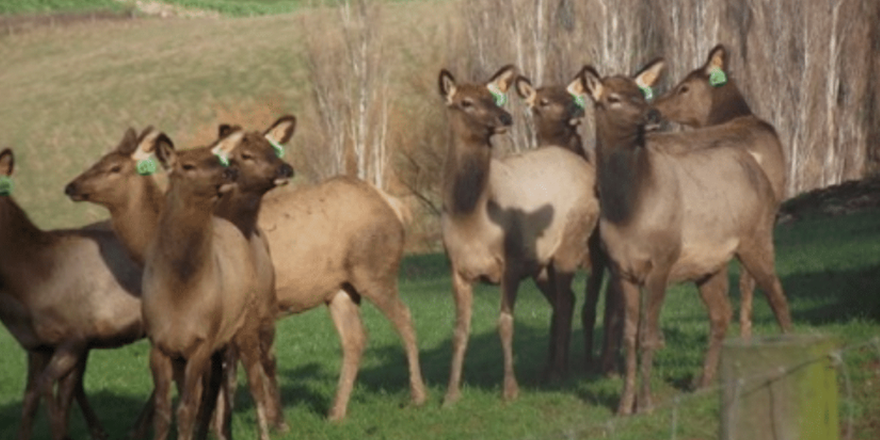
Deer Industry New Zealand is currently involved in a Primary Growth Partnership and levy payer funded project called Passion to Profit (P2P). The overall aims are to improve market returns and on-farm productivity for deer farms. One of the contributing projects to P2P is the definition and recording of Key Performance Indicators (KPIs) and industry benchmarks.

Data recording and benchmarking is important for business growth and a feature of higher performing farms. Benchmarking requires real-time management of data within an electronic database. Use of electronic data storage can be considered a “new technology” on farms which have traditionally kept pen and paper records. Adoption of new technologies follows a well described pattern amongst populations.

This study aimed to determine the attitudes of farmers towards data recording and benchmarking and the system requirements to encourage uptake of digital data recording technology.

The study design was an online survey of seventy eight farmers using SurveyMonkey. Of these seventy five responses provided useful data. Questions related to demographic information, current practices, attitudes towards data recording and benchmarking and requirements and impediments to the use of digital data recording systems.

Deer Farmers have a high level of interest in setting targets, recording production and benchmarking. They consider previous performance on their own properties and on farms similar to themselves as the most important factors for determining what their targets are.

Respondents considered that it is not adequate to solely focus on own performance and that comparison with other farms within the same year is also necessary to help them set realistic targets and identify potential areas for improvement.

The level of uptake of digital recording of production is low and manual records using paper and diaries are the most common method. Data are more likely to be formally recorded when there is a mandatory requirement to do so. For example financial accounts for tax return purposes.

There are a wide range of reasons for limited uptake of digital production data recording and benchmarking. These reasons vary between farmers. Relative satisfaction with current systems probably provides inertia for change along with the perception that current systems on offer will not provide a significant level of advantage, are too complicated to use or have other limitations.

The most important factors for achieving a high level of uptake are a simple system that is easy to use with good support. It needs to be reasonably priced, integrate well with other systems and give immediate feedback on the situation on the farm by comparing year on year and generating graphs and printable reports. The system should be accessible to all farmers and thus allow for offline use in situations of poor internet connectivity.

A wide range of privately managed digital recording and management options exist. These are not well integrated with each other, except perhaps for FarmIQ and data is not directly comparable or accessible between the systems. There is a relatively small number of deer farms in New Zealand so a high level of participation in a single platform will be required for adequate benchmarking. The deer industry should investigate whether a nationally managed collectively owned database is appropriate similar to those provided by Beef and Lamb NZ and Dairy NZ.

Understanding student awareness of primary sector career opportunities.

Executive Summary

According to the UN, food production must double by 2050 to meet the demand of the world’s growing population. Innovative strategies are needed to help combat hunger, which already affects more than one billion people in the world. (un.org 2009)

The world is changing and I believe the historical poor perceptions of the primary sector are no longer acceptable. There are students out there hungry for knowledge. My goal is to be proactive and help plant the seed of primary sector interest in their minds.

My rationale behind tackling this subject is the unacceptable, ill-informed opinions that our school leavers are still being exposed to.

My aim is to understand school leaver knowledge and awareness of primary sector career diversity.

My research was gathered via an 18 question questioner surveying 20 students, an interview with three ASB Future Leaders and an interview with two teachers.

Key findings;

  • Historical poor perceptions by parents, teachers and career advisors that are effecting knowledge of modern primary sector career options.
  • Our youth are very interested in knowing more regarding New Zealand’s primary sector, there is strong interest in finding careers that help New Zealand’s economy prosper.
  • Creating interest is only the first step, nurturing that interest right through to employment is lacking.
  • Tying together social media, technology and emotional marketing are the key to creating change.

Recommendations and action list;

  • The creation of a national curriculum tailored to New Zealand’s key economic drivers.
  • The use of cutting edge technology on a national scale to expose our students, parents and teachers to modern, world leading primary sector opportunities.
  • Create a concept that follows initial interest all the way through to employment.

Preventing pinkeye in young cattle.

Executive Summary

Infectious Bovine Keratoconjunctivitis (IBK) commonly known as Pinkeye in cattle is a long established animal health problem in New Zealand. Pinkeye is a painful and debilitating condition that can severely affect animal productivity. It is a bacterial infection of the eye that causes inflammation and in severe cases temporary or permanent blindness. Most cattle producers will be familiar with pinkeye but may not know how to best treat it and minimise its spread within the herd.

The economic impact of the disease is significant due to it being highly contagious. Pinkeye can affect up to 85% of a mob, the disease is painful because the eye becomes sensitive to UV light. Affected weaner calves losing up to 10% of their body weight. In rare cases when both eyes are affected cattle may die from starvation, thirst and accidents. The cost and time used treating infected cattle adds to the economic losses.

Managing an intensive large scale calf rearing farm in the Waikato, Pinkeye can be a challenge for the farm. Two of the three years the farm has vaccinated against the disease and one year we didn’t vaccinate at all. In the year we didn’t vaccinate against the disease there didn’t appear to be any more infected calves than previous years. I wanted to know why?

Piliguard is the only commercial vaccine available in New Zealand. It covers three strains of Moraxella bovis bacteria. This is where the science community is in debate over the number of Moraxella’s that exist. 38 strains of Moraxella have been identified by restriction endonuclease DNA analysis ‘BRENDA’ (R.B Marshall, P.J. Winter, B.S. Cooper, A.J. Robinson.1985) Other literature states there are only 7 strains that exist in New Zealand. What isn’t in debate is the only vaccine available does not provide full immunity. Most would conclude that at best it covers half of them.

The use of antibiotics to treat infected animals is common practice. With a worldwide shift to reduce antibiotic use in the food chain and antibiotic resistance increasing, trying to find an alternative to injecting antibiotics is important.

It is a widely held belief by Organic American dairy farmers that supplementing kelp into the diet of cattle reduces the susceptibility to pinkeye due to increased Iodine levels in the tears. It was very difficult to find scientific evidence to support this argument. One study that took place last year at the University of Minnesota stated nothing was known about the Iodine concentration in tears and the conclusion was that cattle fed kelp (Ascophyllum nodosum) for 30 days and no effect on Moraxella bovis (M.bovis) bacteria, the main agent that causes pinkeye.

Five key findings are:

  1. Vitamin A. I believe all farmers should supplement young animals with vitamin A from a young age. Very few currently do this. It appears calves not reared by cows are naturally deficient in vitamin A. It is thought that nutritional deficiencies specifically vitamin A, Selenium and Copper may contribute to Pinkeye. If any vitamin or mineral can be singled out and ranked, vitamin A is the most important. Vitamin A is important in the fight against disease it is extremely important in for vision and protection of the eyes. The immune function against viral, bacterial and parasitic infections. Virtually all immune cells are effected by vitamin A. This is sometimes referred to as the anti-infection vitamin. The younger the animal the sooner the vitamin deficiency with express itself. Young calves have lower body stores of vitamin A. Hot weather, disease, parasites and other stressors are believed to decrease the efficiency with which vitamin A is utilised.
  2. Stress and the environment; this is a major contributor to Pinkeye. Dusty yards, heat, flies, thistles, large mobs of animals, lack of shading are all examples of environmental factors that can increase the onset of pinkeye. A good preventative plan should be mindful of these factors. Any stress weakens the immune system. In times of stress animals use up valuable vitamin and mineral reserves which reduce the efficacy of the immune system.
  3. Kelp. The main question which drove this report was whether supplementation of kelp could improve the incidence of Pinkeye in calves. Although this is anecdotal I believe supplementing calves’ diet with kelp which has over 60 vitamins and minerals would assist greatly in helping to replace valuable vitamins and minerals lost in stressful periods. Because kelp is a plant, it is in a highly absorbable and available form for cattle.
  4. There is very little research on Pinkeye in New Zealand. Too little diagnostic testing is done in regards to Pinkeye. Gribbles Veterinary Laboratory who I spoke with said they would get less than ten eye swabs sent to them a year. There are nearly 10 million cattle in NZ, and veterinarians surveyed nationwide said about 10% of cattle develop the disease a year depending on the season. That means approximately that 1 million cattle contract the disease a year and veterinarians are sending in less than ten eye swabs a year. This simply isn’t good enough. Until now differentiating between types of Moraxella has never been possible. This is about to change with a new qPCR machine which will enable the science community to learn exactly what bacteria’s we are dealing with. And hopefully to develop a vaccine to cover all the strains.
  5. Antibiotics. These are the only real tool we have in treating the disease. If the current antibiotics we are using to treat Pinkeye have a reduction in efficacy we will be facing a severe animal health challenge, which could possibly be avoided by further widespread diagnostic testing going forward.

Food trends in the sheep and beef sector.

Executive Summary

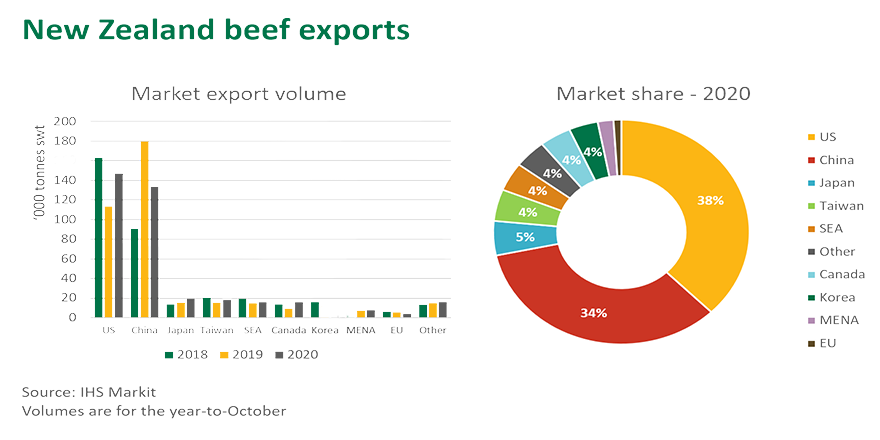
With a national sheep flock that has halved in size over the past 25 years, yet maintained output the Sheep and Beef sector is bursting with innovators and top producers, full of passion and enthusiasm to improve profitability. A cornerstone that drives the profitability beyond the farm gate is the consumer’s decisions on what, when, how they want to eat, and the quantity of consumers in these markets. The world population is growing, expected to be at 9.7 billion by 2050, how can we as an exporting nation capture this growth and turn it into revenue. Developing nations continue to grow their consumption, expected to increase 107mmt by 2020, whilst developed countries will grow by 19mmt in the same period. Population growth, urbanization, infrastructure development and shifting incomes could all lead to a genuine livestock revolution. This growth will not come without pressures and expectations on environmental and animal welfare fronts, with one hectare feeding 22 people with potatoes, contrastingly only 1 and 2 people for beef and lamb respectively.

Global sheep flocks have declined by 5.3% from 1990 to 20 13, a hybrid model of “ New Market Orientation ” , “ Shrink-To-Fit ” and “ The Knowledge Industry ” are needed to shape the future of the industry.

The opportunity is to be the farmers market of the world, the world artesian butchery, the corner retailer for the rest of the world. It’s how we pitch our image, our reputation and market it in savvy modern ways which will dictate the success of our future. The market changes and evolves, sheep farming was historically based on wool production, with no one thinking about synthetic carpets. Evolution of meat markets have seen the size of product decrease from a traditional leg roast, to a ready to eat or snackable meal. These measurable changes alongside emotive purchasing decisions, such as environmental sustainability and animal welfare which have had CAG of 72% and 42% respectively. We must pay special consideration to these attributes in our marketing package, but more importantly these have got to be driven from a farm level, and farmers must walk the talk and be proud of what they are improving, rather than see it as a compliance protocol.

We must be engaged in extracting the value of products we are selling through engaging with consumers. Ian Proudfoot quotes that industry exports worth $37 billion, are worth $.25 trillion at the consumer’s level. For every dollar collected here in New Zealand, there are six or seven dollars added by the time it reaches the consumer. The selling market will change, and be segregated by the big industrial players (e.g. JBS) and the niche high value operators, we can’t afford to be lost in the middle.

We must be prepared for a livestock revolution, have data and information on our stock to be able to use that data, to create a quantum shift in quality of products sold. We are on the verge of a quantum shift in livestock consumption and production. Our prerequisite is to embrace the opportunity to tell the story of our production cycle, where it’s from and what it is. We have a great story, we must be happy, upbeat and proud of what we are doing, sharing with New Zealand what we do, so a sales team of 4.5 million New Zealanders can sell to the world. The red meat sector needs to get savvy and upmarket, exit the dinosaurs currently employed and employ a fresh team of city born, innovative young millennials to drive this message. They are the face of what our future consumers, let them sell it to their peers. It’s imperative to learn from the past to prepare for the future, it’s a new way of doing business, don’t be frightened by change, but be excited by the challenge.