2026 Nuffield NZ Farming Scholarship. Apply by 17 August 2025. Read More...

Apply for 2026 Nuffield NZ Farming Scholarship by 17 August 2025. More details...

Understanding what drives youth perspective to make radical change in agriculture.

Executive Summary

The agriculture sector is one that is talked about and analysed from every angle by people all around the world every single day. Successful agriculture is essential to survival as people have to eat. 

As the world population is constantly increasing, so is the need to produce more food/fibre. Yet every day the agriculture sector is struck with the issue that we cannot gain enough attraction for passionate people to enter the sector; consequently nationally and internationally there is a cry for help from agricultural businesses trying to find and retain staff.

Agriculture in New Zealand is constantly in the limelight for questions being raised around impacts on the environment, on animal health and wellbeing. Due to this it is no wonder there is a struggle to attract good young people to the industry. 

There is also little government support to the industry, particularly to ensure the younger generations understand what agriculture is really about, let alone a clear pathway into the sector as agriculture is not a big part of the education curriculum. 

Through looking into past literature, statistics, and interviews we can clearly identify the current situation of agriculture and the direction it is heading in the future.

Key recommendations as a result of this research are;

  • Continue to share positive agricultural stories, by various methods such as media.
  • Target educating youth about agriculture as early as primary school through introducing an independent teaching platform as part of the primary school curriculum.
  • Teach children where their food comes from using backwards engineering; from plate to farm. This would need to be backed by company’s such as Talent Central and farming industry bodies to provide the information.
  • Build a clear pathway to support people with agricultural passion right from young children, through primary school, secondary school and beyond their tertiary education. We would do this by recognising those children with an agricultural interest and nurturing this. This would be implemented through introduced education programs and offering support to teachers, career advisors and parents. This could be done but those bodies collectively involved in primary, secondary and tertiary education.
  • Utilise technology and use it as a platform to educate the urban population. Selectively place interactive technology where people can read, listen and learn about agriculture in New Zealand.

Acknowledging there are already movements in place to change the common negative perspectives towards agriculture, creating a solution is a difficult task. Targeting children earlier is currently an area which will require further work. By helping children understand where their food comes from and establishing a ‘Just Cause’ around feeding the world, children are more likely grow up with a passionate agricultural mind set. 


How can rural professionals be more effective in this time of transformational change.

Executive Summary

Farmers are faced with many challenges. The external pressures of public perception, regulation and compliance have become stronger in recent years, and concerningly are likely to get more so. A farm is not just a business, it is a way of life for many people and supports many families.

Rural professionals help farmers achieve their aspirations and provide guidance on the operational boundaries of the farming business. Operational boundaries however shift under the influence of external pressures. Rural professionals have a role during this time of change and uncertainty to help farmers establish the best possible position on their farm, and within their community.

This project investigated the opportunities for rural professionals to be more effective to help farmers under pressure. Research was completed through a literature review and completion of twelve interviews. Those interviewed were from three representative groups – farmers, rural professionals, and extension programme managers. Research identified considerations for the rural professional as an individual and identified considerations for rural professional organisations. To be effective both the individual and the organisation must play their part. Common themes from the research were:

Rural professional individual:

  • Drivers of decision making must be understood
  • The first point of contact is critical
  • Technical competency remains important
  • Trust must be earned, and empathy demonstrated

Rural professional organisation:

  • Empower learning through coaching
  • Finding the right metrics to measure and report is critical
  • Value the time it takes to build enduring relationships
  • Technology is a double-edged sword
  • Avoid “one stop” and “cold calling” programmes
  • There is a need to increase capacity, and will be achieved with the right industry culture

Extension theory to achieve change remains sound, having identified the importance of relationships and influencing from a position of trust. Change is often a journey and multiple stages within a change process need to be captured and reported for one to gain a true appreciation of the extent of change occurring in the primary sector.


Having evaluated the research, the following recommendations have been made:

Rural professional individual – the “change enabler”:

  1. Follow the VALUE approach for first meetings
  2. Build your networks and understand everyone has a network you can influence
  3. Ensure your logic is grounded
  4. Develop your coaching skills to empower farmers to seek knowledge

 Rural professional organisation – the “change empowerer”:

  1. Follow the coach approach
  2. Continue with the sound extension model
  3. Take data seriously
  4. Develop aspirational programmes
  5. Operate at a community level with a global focus

Rural professionals are able to help farmers to meet the many challenges currently facing the primary sector. This will be achieved through enabling activity with programmes which empower farmers to lead their own change. Technical competency of rural professionals will remain valued by farmers, but their ability to elevate a farmers own thinking will be the difference between being constantly challenged or continually empowered. There are always areas of improvement, but what remains core to any role is the importance of maintaining enduring relationships built on trust and respect.


I hope this report will provide rural professionals and the organisations they work for comfort in the fundamental principles of being an effective change agent. Farmers currently face significant pressure. Rural professionals have a role to help farmers maintain a future focus. This role will be more effective when the recommendations of this report are embedded into everyday practice.


Boardroom to break-fence: pursuing a rural professional career while concurrently having a farming business interest.

Executive Summary

The New Zealand primary industry is facing significant change, in particular, pressures around environment, finance, biosecurity and changes to consumer behaviour. The leadership and skills of our rural professionals will be a key component to the success of our primary industry in this changing and challenging environment.

For agribusiness organisations to remain relevant and equipped to navigate the changes within the primary industry, it will be crucial for them to have the right people with the right skill sets. For many years rural professionals in New Zealand have been successfully providing a valuable service to the primary industry, however with the fast pace of change there is a need to have rural professionals who have a deeper connection to farming.

The model of having a rural professional career alongside a farming career is a potential solution to ensuring agribusiness organisations and the primary industry has the necessary skills and leadership in its people. This model helps to generate relevant rural professionals who have a depth of connection to farming that allows them to empathise with the challenges that producers and the wider industry face as they understand the what it takes to run a farming business. If agribusiness organisations and rural professionals lose this depth of connection to farming, we have a risk of becoming irrelevant.

Both the primary industry and agribusiness organisations need to develop their thinking on how we progress the model of having rural professionals pursuing an agribusiness career alongside a farming career, and similarly we need to encourage rural professionals to think about the opportunities and challenges this could create. From my research into the topic, it was clear that whilst there was no shortage of opinion, there was a lack of formal strategy around how this model could or should be working among agribusiness organisations, rural professionals and industry leaders.

This report addresses the question of ‘what would it take to pursue a rural professional career concurrently with a career in farming?’ It takes on the perspectives of a rural professional and agribusiness organisation. The research sets out to answer this question through a better understanding of the following key area’s;

  • Understanding rural professionals and what drives them
  • Understanding the need for a ‘balanced’ approach to this model
  • Understanding potential employment and farming structures
  • Understanding of the financial viability of the model
  • Understanding of the people capability and leadership benefits of the model

My aim for this report is that it will be used by rural professionals, agribusiness organisations and the primary industry to inspire further discussion and development on the topic for the purpose of looking at new ways to create opportunities for the benefit of all stakeholders.

The methodology used for this research report included an exploratory literature review followed by a qualitative approach using semi-structured interviews of key stakeholders.

The outcome of the research is made up of five key themes; values; balance; structures; financial viability; people capability and leadership. There are a large number of variables within such a model which at their heart are quite detailed and complex, some of which are discussed within the report, but many of which are unique to the individual situation and require more in-depth analysis.

From this research, my recommendations include:

  • Rural professionals and agribusiness organisations should take the time to understand their personal values, family values and organisational values. This will help them gain a deeper understanding about what really matters to them. They should communicate these and create some alignment between one another, ensuring they ‘tap’ into these on a regular basis.
  • Rural professionals should put in place well considered, realistic and measurable goals in all key areas to ensure they keep an overall balanced approach.
  • Rural professionals and agribusiness organisations should share stories and real-life examples of where this model has been implemented in the past or current including success and failures.
  • Rural professionals and agribusiness organisations should practice open and honest communication on a regular basis to ensure all stakeholders are clear on their responsibilities in the relationship.
  • Farm business structures and farm systems should be chosen carefully. The decision-making process should involve family a number of third parties including a bank manager, other farmers, farm consultants etc. Financial viability, family and workload management should be key considerations.
  • Agribusiness organisations should take the time to understand the issues that could arise if the depth of farming connection within its rural processionals is lost slowly over coming years
  • Agribusiness organisations should take next steps to develop a formal strategy to support the model. This should be a balanced approach involving all stakeholders in the organisation and management should be able to discuss the strategy with confidence.

As the primary industry faces a changing future, there is a need to build people capability and relevant industry leadership. This model offers a unique opportunity for innovative personal and professional development, relevant skill sets and wealth creation. Rural professionals, agribusiness organisations, and other key stakeholders have a responsibility in ensuring the primary industry can thrive in a changing and challenging environment and help future generations prosper.

Improving our on-farm Health and Safety Culture in Rural New Zealand.

Executive Summary

New Zealand as a country has a proud farming history with our farming culture having been built on a can do, ‘she’ll be right’ mindset. However, this same culture is killing our people. On a per capita basis New Zealand has some of the highest statistics in workplace fatalities with agriculture being the worst performing sector. This paper seeks to define culture in the health and safety context, and to understand where our current cultural level is on-farm in Rural New Zealand. It also seeks to understand where we should prioritise to improve this culture.

A review of the literature was completed, along with discussions with many of the key authors to develop a deeper understanding of their research. Additional research was also undertaken in the form of a survey completed by twenty New Zealand Young Farmers member’s nationwide.

This paper explores the definition of culture including work from Edgar Schein, George Stevenson and Jess Berentson-Shaw. This paper establishes that culture involves multiple people, is based on assumptions to solve problems, and is learned and shared. Through the literature review this paper found our culture is risk tolerant and as a nation we have negative perceptions towards health and safety largely because of the associated compliance. This was validated through this paper’s survey. However, it was found that compliance can have a positive impact on change. Recent work completed by Francois Barton and Gareth Chaplin suggest that culturally there are positive signals coming from the introduction of the Health and Safety at Work Act 2015. This was again validated in the survey as well as the fact that survey participants felt we are making progress. Al McCone suggested that health and safety was legislated because it’s important, and it’s not important just because it’s legislated.  

The following recommendations are made, based on the findings within the report: 

  • Change our ‘she’ll be right’ mentality to one of ‘do it right’
  • Provide education to individuals on farm to drive ownership and accountability within the health and safety space.
  • Promote the positive health and safety messages within the industry.
  • Offer appropriate incentives to help drive a positive culture change.

Key factors in developing a culture of high performance within a senior management team in large scale dairy organisations.

Executive Summary

The research in this report was based on four organisations with a structured interview designed to identify the key features of the culture of each organisation. The organisations were chosen as they represented different forms of ownership, state ownership, investment company, family owned business and corporate farming enterprise.

The key findings from the interviews were as follows

  • All organisations had a vision, strategy and values statements which is critical in defining the Why, What and How of the organisation.
  • Senior management team were structured in a way that each member had a distinct role in the business and responsibility. The goal was not to overload the operational team but to allow them to focus on coaching and mentoring the team.
  • A critical component of the senior team is their ability to use coaching and mentoring to build a relationship with their team and give and receive feedback from staff. It is important that the team members are engaged in the process and have clear exceptions and take ownership, responsibility and accountability for their roles. These are key components of above the line thinking and building a strong team culture.
  • Models such as Empowerment Model, Coach Approach, Clifton Strength Finder, Tuckman’s Model, Jim Collins Good to Great Model were used for coaching and feedback.
  • Excellence was recognised by all organisations with a focus on recognition and celebrating success.
  • Poor performance involved feedback focused on expectations and values of the organisation. The Performance Matrix is a tool which can be used in feedback process.
  • When building a team culture, relationships, trust, values are important and that individuals are accountable for their behaviour and aligned to organisational values.

Developing a culture of high performing management team is a deliberate process that requires a focus on continuous improvement and building strong team values.


Woodflows of the eastern southern North Island: 2019-2028

Executive Summary

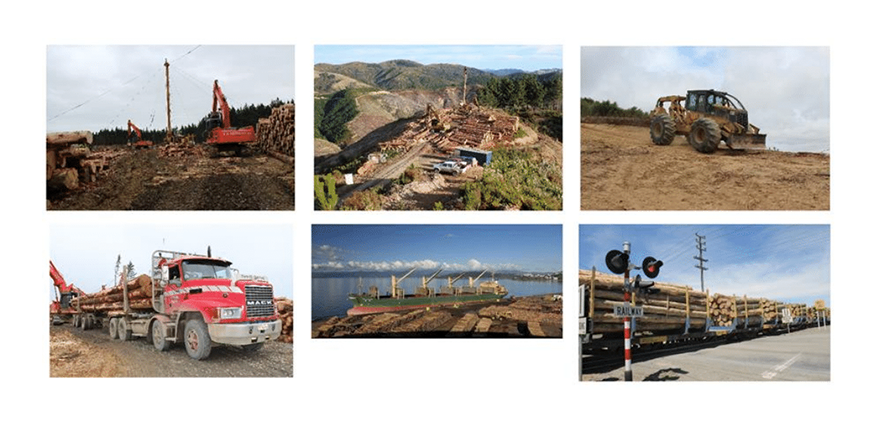
The catch phrase “Wall of Wood” is approaching reality with the substantial increase of afforestation in the mid-1990s coming to maturity and ready for harvest in the coming years. The Eastern Southern North Island (ESNI) was no exception in this new afforestation with the reported area of plantation forestry more than tripling from 20,500ha in 1993 to 66,500ha by 2003.

This report sets out to determine what the status is of the current forestry and woodproducts infrastructure of the ESNI. Then to ascertain whether this capacity is sufficient to meet the growing needs of the future radiata pine resource. 

A survey was compiled to obtain the harvesting capacity of the forestry companies within the ESNI region. They were asked to provide their current daily harvesting capacity and forecast their harvest volumes over the next 10-year period. 

The domestic mills and log cartage companies were also questioned regarding their capacities. 

The yield volume was calculated using the 2018 National Exotic Forest Description (NEFD) for the area of radiata pine plantations and overlaid with the MPI yield tables from 2015 for the ESNI. The minimum target age for harvest was set at 28.  A total yield volume was calculated for all radiata pine plantations that reach the age of 28 within the period of 2019-2028. The area of plantations that made up the yield volume was evenly spread over the 10 year period to make a non-declining yield based on the fixed average annual area of harvest. 

The forestry companies harvesting capacity sits at 1.97 million m3 and is forecast to increase to 2.25 million m3 in the next 3 years. The analysis concluded that these forecast volumes are the more accurate figures to use in forecasting the woodflow for the region. Though these volumes are less than the calculated yield the forestry companies can be confident that there is enough volume to meet their planned harvesting capacity. The forecast volumes can now be used by the log cartage companies and export traders to help forecast their capacity requirements.

The analysis concluded that there are insufficient markets for domestic pulp that give a positive return. The industry has to make the decision whether to remove this pulp from harvesting sites at a cost or find an alternative market for this product.

Further analysis is required to determine the absolute limit of the annual capacity at the Napier and Wellington ports. Both ports have noted record annual throughput of logs but how much further can they go?

The analysis has shown that there are potential errors in the total area documented in the NEFD. This is predominately around the modelling and recording of the small scale forest areas. Remote sensing has had proof of concept confirmed in identifying small scale forests. As technology improves this should be a vital tool to use for the NEFD data collection.

Lucy Griffiths – Appointed to IAP for Sustainable Food & Fibre Futures

2 December 2019

Well done to Lucy Griffiths who was recently appointed by Minister Damien O’Connor to the independent Investment Advisory Panel (IAP) for Sustainable Food and Fibre Futures (SFF Futures).

The advisory panel provides independent expert advice on both funding proposals and active programmes in NZ’s food and fibre industries. There is a $40 million fund available each year to support innovation in this sector, and the panel only advises on applications $5 million and over.  Find out more.

Find out more about Nuffield NZ Farming Scholarships


Mat Hocken – receives 2019 Rabobank Emerging Leader Award.

29th November 2019

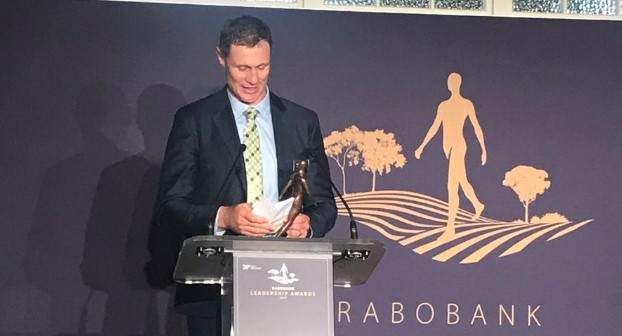
Mat Hocken was announced as the 2019 Rabobank Emerging Leader at the Rabobank Leadership Awards on Thursday night (28th November). Our congratulations go out to Mat who is the first kiwi to receive this award!

The Rabobank Leadership Awards are held annually recognising the contribution of leaders from across New Zealand and Australia’s food and agribusiness sector. The 2019 event marked the 20th anniversary of the awards and the first occasion the awards dinner had been held in New Zealand. Find out more.

Mat Hocken – 2019 Rabobank Emerging Leader Award Recipient

Find out more about Nuffield NZ Farming Scholarships

Rural leadership – taming the wicked problems

Rural Leadership – taming the wicked problems: Growing the toolbox to foster society’s trust through strategic solutions for all
By Ben Hancock

Ben Hancock – Scholar Presentation (June 2020)

Executive Summary

Societal and regulatory issues facing the agriculture have been escalating, and unrelenting – the demands on production and cost of food, society’s perceptions of agriculture, and the regulatory burden. These complex, contrary, large and evolving issues are truly wicked problems.

Agriculture needs to be involved in the issues and to be leading development of the solutions – not reacting – in part, to maintain and build public trust. Agriculture has the expertise but needs to be in the position to be masters of their own destiny. The overarching objective of this study was to position the agriculture industry as leaders in solving wicked problems that face the industry, effectively and efficiently.

This sets the scene that requires an understanding some of the potential drivers of the perceived rift between agriculture and wider society and regulators. Understanding the gap and agriculture’s position in the context of wider society creates a starting point and identifies an avenue to explore how to put farmers at the forefront of developing solutions.

The connectivity between rural and urban communities has widened. A shift to more urbanised populations has been occurring for generations and diminished direct relationships between the two communities. The weaker connection reduces the ability of the urban population to contextualise issues facing agriculture, and for the rural communities to relate them to the urban population.

In developing a durable relationship in which both parties have regard for the other’s interest – institutionalised trust – there are three elements that provide a foundation. Agriculture has a large influence on two – economic legitimacy and interactional trust. Agriculture has less control on the third – socio-political legitimacy – yet many wicked problems develop from this area. I sought out approaches that agriculture could incorporate to gain more control in building socio-political legitimacy.

The initial approach of seeking to “get ahead” by being first to pick up on any problems was unsuited for the agriculture sector. Four methods were explored; venture capital investment strategy, web analytics and data tools, scenario testing, and expert and stakeholder panels.

Applying these practices to identifying future issues was generally still reactionary and contained a relatively high element of risk. Any returns for success would be difficult to identify and reward from success difficult to gain or quantify – the position of agriculture is not markedly improved relative to other elements of society. There are uses from the practices explored and they are suitable for other objectives, but none clearly suited the objective of getting in front of the issues.

An alternative approach was to understand the values held by other parties affected or involved with agriculture to find alignment that addresses wicked problems, and identifies potential points of conflict. In a series of meetings, I was introduced to the field of bioethics. The three bioethics tools I presented were; the ethical matrix, the ethical Delphi, and reflective equilibrium.

While there are elements of overlap with these three tools, each had variations of objective, process, outcomes and use. At a high level:

  • The ethical matrix creates an inventory for the range of views and values held by affected parties in context of the issue through deliberation;
  • The ethical Delphi is more appropriate to arrive at a reasoned consensus amongst experts in a field by directed reiterations, and
  • Reflective equilibrium, which is another reiterative process, seeks to reach a moral judgement by taking an intuitive and experienced perspective on an issue, testing it against existing knowledge of the field, putting that in the context of relevant moral principles, and then relating it back to intuition and experience – repeating the process until a stable position is achieved.

These were an introduction to the field to highlight the bioethics tools use for agriculture to understand the range of views and perspectives on issues the relate to agriculture. Research, knowledge and experience of experts are incorporated in these processes but, importantly, it is framed in a manner relevant to wider society.

Wicked problems are difficult to define, without clear solutions and often driven by other issues. Bioethics tools provide an approach to understand the potential drivers and arrive at optimal outcomes for all affected parties.

Recognising where there is alignment in values and objectives amongst groups identifies opportunities for the agricultural industry to bring society along in solving issues facing the industry. Detecting divergence in values held by affected parties identifies the potential points of conflict. Understanding the values that are behind the range of views presents an opportunity to effectively communicate and resolve perceived discord.

Detecting issues before other affected parties was identified to not be the best approach to build trust towards agriculture. If success could be gained in identifying an issue, the response is still reactionary and there is still an element of being adversarial towards other parties – not leading.

Encouraging systems-thinking in stakeholders and interest groups affected or involved in the issues facing agriculture is key to developing effective solutions and create opportunity for synergies in policies and practices.

Adoption of bioethics tools aids the agriculture industry to recognise and construct alignment with other segments of society. Nurturing an affiliation with agriculture in wider society becomes more manageable if the values underlying the spectrum of views is understood – making issues and concerns of agriculture relevant to other segments of society.

Building relationships experts in the field of bioethics will be necessary to best use these tools in addressing the wicked problems. It is an immense field of diverse tools and rural leaders would be more effective with the guidance of specialists with an in-depth knowledge of tools and processes.

Read the full report:
Rural Leadership – taming the wicked problems: Growing the toolbox to foster society’s trust through strategic solutions for all. -Ben Hancock, 2019


Keywords for Search: Ben Hancock, Benjamin

Farming in a Pressure Cooker

Farming in a Pressure Cooker
By Corrigan Sowman

Corrigan Sowman – Scholar Presentation (May 2020)

Executive Summary

Across the world, pressure on our planet’s ecosystems is forcing society to “rethink” many of our everyday activities. Technology change is raising questions about where and how food can be produced, and the morality of food production.

Agriculture is at a crossroads; past practices are no longer seen as acceptable, often scrutinised by people with half the facts. The result of this situation is farmers are under pressure. They have more to respond to than there is time, money, or that current technology allows. For some, they are overwhelmed, and this is reflected in their mental wellbeing.

The purpose of this study has been to better understand how the pressure that farmers are experiencing impacts on their decisions making? These decisions underpin how the food is produced, and that is important to society, especially for countries such as New Zealand that rely on the prosperity earnt through exporting food.

This study used a four-part process called double diamond design (Banathy, 1996) to complete a broad international investigation into pressure and its effects on the farmer. The aim, to connect how farmers’ thinking is influenced by the pressure around them.

Pressure is described using five factors of uncertainty, high stakes, small margins, fast changes and judgement (Evans, 2019).

Historically farmers have managed pressure well through a multitude of management practices. This has provided them a degree of comfort despite their limited control of the biological systems they operate, systems heavily influenced by external factors such as trade. Growth through productivity has offset falling margins. But if growth is constrained through changing regulation and customer pressure, how do farmers adapt?

This study has explored the psychological factors surrounding thinking under pressure and proposed the use of a model to highlight the need for new skillsets that support accepting challenge over reaction to threat. Farmers are conditioned to recognise threat, often interlinked to their sense of purpose and identity.

How the brain responds to threat is important in understanding how best to facilitate practice change in agriculture. This report recommends a need to place the concept of pressure at the centre of future practice change in agriculture. It suggests new skills in thinking under pressure need to be fostered in farmers to underpin performance in a long-term pressure environment. It draws on the science of thinking under pressure and examples already available in New Zealand to highlight that branding food around origin in the future will rely on investing in the thinking skills of those producing it.

Read the full report here:

Farming in a Pressure Cooker: How pressure impacts farmer decision making.
– Corrigan Sowman, 2019

Keywords for Search: Corrigan Sowman, corigan soman