2026 Nuffield NZ Farming Scholarship. Apply by 17 August 2025. Read More...

Apply for 2026 Nuffield NZ Farming Scholarship by 17 August 2025. More details...

What are our 2014 Nuffield Scholars up to?

They are also planning to present as a team at the B+L NZ Ag Innovation conference in May being organised by 2014 scholar Mel Poulton.

Each person will highlight a couple of different trends or key global issues as they saw them, and how that relates to NZ Primary Industries and to our Farmers – what should farmers be aware of and plan for.


Lucy Griffiths (Cruikshank) got married in December and after that is back doing what she loves – marketing and sales strategy and coaching for NZ food companies.

She’s currently working with a manuka honey company on exports to Dubai, an organic blackcurrant company, a meat company selling direct through facebook and promoting the bourgeoning sheep dairy industry up and down the Country.

Her involvement in the Governance space is increasing and she was recently elected as Junior VP of the NZ Licensing Trust Association.

Paul Olsen has been busy back on the farm in full swing of potato harvest and despite dry conditions a good crop is promised. He has been active with articles around potato industry and is speaking at several conferences including the FAR conference in July.

Dan Shand is dealing with the drought in North Canterbury but has found time to judge the South Island Ballance Awards, including visits.
John Murphy has just handed in his report having an extension to allow him to complete his CSC.

He took the opportunity to complete the last of his research before locking himself away to write up. He is now fully into his garlic harvesting.

Mel Poulton is back fully into her role with Beef & Lamb NZ while working out how she engages with industry to take the findings of her research to the next stage and into government strategy.

Mel was our host for the GFP NZ group for 5 of the 6 days and was able to share her wealth of knowledge.

2014 Nuffield NZ Scholars announced

Nuffield New Zealand announced the new scholars for 2014 at a function in Parliament last Thursday night.

From North Canterbury sheep and beef farmer and entrepreneur Dan Shand.

From Marlborough Garlic general manager and vineyard owner John Murphy.

From Masterton sales and marketing entrepreneur Lucy Cruickshank.

Potato grower Paul Olsen from Opiki near Palmerston North.

Beef + Lamb NZ western North Island extension manager Mel Poulton from Woodville.

Their research topics are likely to cover issues such as mobile technology, the international distribution of New Zealand’s information and technology, turning good farming into big business, potato (cropping) production and the positioning of manuka and other honey off shore.

The five new scholars join more than 140 others who have been awarded Nuffield Scholarships in the past 60 years. A Nuffield Scholarship is one of New Zealand’s most valuable and prestigious awards with a limited number awarded each year, says Nuffield NZ chairman Julian Raine.

“To be awarded a Nuffield Scholarship is to be awarded a life changing experience. Nuffield New Zealand is investing in our future rural leaders.”

The Nuffield NZ Scholarship offers the opportunity for overseas travel, study of the latest developments in a number of leading agricultural countries, and provides an entrée to leaders and decision makers not accessible to the ordinary traveller.

Successful applicants have the opportunity to develop a better understanding of New Zealand and international relationships through at least four months travel.

Scholars participate in a Contemporary Scholars conference with 60 Nuffield Scholars from around the world and a six-week Global Focus Programme with an organised itinerary through several countries with other scholars.

Finally they have their own individual study programme with a research report due at the end of their travels.

New Zealand must embrace long term relationships with Asia

New Zealand agriculture must embrace long term relationships with our Asian customers, in particular China, says 2011 Nuffield Scholar David Campbell of Canterbury. “Too many New Zealanders misunderstand China and its potential. It troubles me that so many of us have such a narrow view on China given they are our number one market for the next century,” he says.

Mr Campbell has just completed his Nuffield Scholarship study report detailing two Asian markets, China and India, and outlining key market advantages, challenges and high level solutions to help create sustainable and profitable future markets for NZ agriculture.

In the last decade New Zealand agricultural exports to Asia have increased 71% to NZ$6 billion with China now the largest of these Asian markets. Growth is set to continue as the Asian economies continue to outpace those of the US or Europe.

“An increasing proportion of Asia’s large population will develop internationally competitive purchasing power and consumers will be more able to afford the safe, high quality and innovative foods that NZ agriculture is capable of producing,” he says.

Mr Campbell spent March through August 2011 overseas as part of his Nuffield Scholarship. He said being so far away from normal life and work (Synlait in Canterbury) was a great part of the challenge and the experience. First on the schedule was a global focus tour with a group of Australian Nuffield scholars.

“We basically went around the world – Brazil, Mexico, the US, Canada, Scotland – looking at all aspects of agriculture. We looked at farms and farm systems, visited processors, research institutions, wholesalers, retailers, trade officials and government departments – even the US Congress. An important part of the whole Nuffield experience is to give a well-rounded look at agriculture globally.”

David met up with his wife Sue in Italy before heading off on his own three month study tour of India, China and Japan to form the basis of his just-released report.

“China is described as New Zealand agriculture’s number one market for the next century due to its on-going economic strength, population dynamics and Government policy direction. The New Zealand/China Free Trade Agreement (FTA) and our reputation for high standards of food safety represent key market advantages for us.”

But he says New Zealand also faces challenges in understanding and engaging with Chinese customers, including language and cultural barriers, low purchasing power parity, New Zealand’s lack of capital and scale and Chinese Government processes.

The release of Mr Campbell’s report is timely given the recent interest and comment on the Chinese purchase of the Crafar farms. He doesn’t want to specifically enter the debate but says it illustrates some of the key findings of his study.

“It’s had a pretty thorough thrashing already. I personally believe the OIO made the right decision, and that it appears that Landcorp is doing a good job of engaging with the Chinese buyer for a win-win outcome.”

“My four key solutions for China are; get closer to the customer, build relationships, extend the value chain with a ‘One World’ approach, and get clear on strategy so we focus our attentions on what the customer wants and how we can add value for them. China is setting up long term strategic partnerships and supply chains around the globe. They’re demonstrating they want to engage with the world. NZ has natural advantages and a great reputation in agriculture so it makes sense for China to look for agricultural investments and relationships here,” he says.

He says one of New Zealand agriculture’s key advantages over its competitors at the moment is the country’s status as the first OECD nation to sign a free trade agreement with China.

“But we’re missing out on some of the benefits that the FTA has created because of an apparent fear of Chinese investment. We’re really short of capital, and China has lots to invest. So we have to marry the two together – take the capital and the pathway to market, concentrate on what we do really well or where we have unique advantages, and commit to mutually-beneficial relationships. If we’re too narrow-minded in our view on China, they will look elsewhere and we will miss out forever.”

“If people take the time to visit China they will see there’s a significant amount of pollution, large tracts of land in China are desert and there is huge pressure on natural resources to sustain their population. They just don’t have the agricultural production they need to feed themselves. And they often don’t trust the safety of the food that they do produce. This provides a great opportunity for New Zealand agriculture to capitalise on,” he says.

India represents a significant potential market for NZ agriculture worthy of development and investment; however it is currently a much smaller market than China. One of the advantages for New Zealand agriculture is an existing “brand NZ” presence through international cricket, while market challenges include significant agricultural tariffs, diverse culture and taste preferences, low beef consumption, lack of significant cold chain and modern retail infrastructure and bureaucracy.

For India, one of Mr Campbell’s four key solutions is to encourage the signing of a NZ/India bilateral FTA.

“I had never been to Asia before but that was part of the challenge for me – it was quite foreign – but I had a strong belief I needed to know more about it because it’s so important to the future of agriculture in New Zealand.”

He will be presenting his report to the Allflex Platinum Primary Producers Conference in March, as well as the Nuffield Conference in April and is happy to discuss his findings with others in the industry interested in greater engagement with Asia.

David’s Nuffield report can be downloaded here.

Capturing value.

Executive Summary

The world is seeking two things which are NZ’s strength areas: food production & agriculture expertise. NZ has a goal to increase the value of exports 50% by 2025 but is hitting production capacity. For decades NZ’s exports of expertise has been ad hoc & uncoordinated, leaving money on the table. An integrated framework for trade negotiations, market access & exports of expertise = value capture. Robust strategies & management plans to commercialise intellectual property need implementing. Utilising its strengths to capture value, exports of expertise enables NZ Agriculture to transcend borders. Developing nations will meet the production gap – they have the scope for growth. Farmers and the primary industry need to get feet on the ground and seats at the tables of influence.

 Capturing Value – Mel Poulton

The use of mobile technology in the red meat sector.

Executive Summary

The research in this report was gathered in order to determine how mobile technology can deliver improved on-farm and industry productivity gains now and in the future and also to understand technology adoption and how mobile could deliver positive outcomes. The scope was limited specifically to New Zealand sheep and beef farming and focused on opportunities that can give a genuine return on investment. The information was collected both in New Zealand and in a number of their largest trading partners around the world including China, Northern Ireland, the Republic of Ireland, England, Wales and the US.

The initial research found that low numbers of farmers record data on-farm using mobile technology for simple day to day decision making. This in turn means that the level of data that is then attached to the animals electronically as they move through the supply or value chain is also low. The only data that remains with the animals is related to animal health declarations. The main reason that farmers gave for not carrying out more data collection was due to the time available to collect the data in relation to the perceived cost: benefit ratio. Further to this, almost all farmers felt current available mobile data collection equipment was not suitable to use to a level that will have a significant lift to their individual farm performance, nor is it able to create industry change that will provide enough financial benefit to them directly.

A further significant observation was the performance of those who were measuring their key performance indicators compared to those who were not. It was noted that there are individuals with a natural farming ability who are able to perform extremely well with little or no technology, often with higher on-farm performance than the innovators or early adopters. These individuals are able to monitor grass levels, stock condition and market conditions with little technology. However, the fact that 80% of farmers believe that they are in the top 20% would indicate there are far more farmers thinking they are able to do this successfully than actually can. This leads to the question : “how much could farmers improve if they increased the monitoring they undertook on farm?”

Research has shown that the adoption of mobile technology has not only changed the buyer behaviour of consumers, but also their decision making process. The improvement in logistics systems for perishable goods is enabling smaller retailers to compete with larger retailers for premium markets by shortening the supply chain. This in turn provides opportunities for more niche markets to be opened up for high end products, the likes of which New Zealand creates.

The red meat sector in New Zealand continues to underperform due to the huge variation in on-farm performance and supply/value chain inefficiencies, rather than change in demand or the product’s ability to attract a price premium over other proteins. Some of these in adequacies are small and could be reconciled relatively easily, while others are far more “There is nothing amazing about collecting data. Collecting data is just the basics” Eric Reid, Ex production director Moy Park Mobile technology is the technology used for cellular or wireless complex and would require the cooperation of processors, industry good and government organisations, both here and abroad. Individually incremental changes would not reform the industry but collectively they would have the ability to increase the overall performance to a level that would have a satisfactory return and may enable new opportunities to open up.

Mobile Technology has the potential to change farming as we know it by providing a platform that enables a more transparent value chain. In conjunction with a behavioural change, mobile technology can provide an easy, affordable, convenient data collection and delivery platform at all points of the supply chain.

This may create disruption by by passing agents as businesses up and down the supply chain could communicate information directly relating to products made transparent to them. This matching of specific products or product attributes between the seller and buyer at all levels is a way of turning the red meat sector into a more transparent value chain and deriving premiums for all stakeholders.

Before adoption of technology can take place, industry extension must look at what can be done to engage with different types of farmers. Once identified it may be possible to develop strategies that target the individual groups and enable them to achieve their desired outcomes. Moving to this more structured holistic model would provide an ongoing cycle of improvement.

Conclusions

  • Although some farmers use mobile technology very few have it as an integrated part of their farm decision making system , but instead use the information in isolation.
  • Many of the mobile applications are emerging but not in a commercially viable form because they are unable to satisfy farmers’ seven principles of the adoption matrix.
  • Technology will be responsible for the next doubling of farm productivity throughout the world – red meat is no exception.
  • The red meat industry is underperforming which, if it continues, will cause declines in stock numbers, exacerbating the problem.
  • Reforming the industry must start at both ends of the value chain. On-Farm–Developing Premium Markets
  • There is more gain to be made in the industry by concentrating on moving the middle rather than moving the top.
  • Cellular coverage in New Zealand is poor compared with many third world countries. Our future relies on it improving.
  • Using ave rage as a measure of performance averages out potential value.
  • New farm data tools are required focusing on automation and user experience (UX)
  • Farmers who want to continue must collect key metrics otherwise they will eventually be swallowed up by those t hat have created their own certainty.
  • Transfer of information between industry stakeholders is currently poor. Good research is not being utilised and a lot of the extension is confusing and unsuitable for the farmers it is intended for. “We need a market where quality attributes are rewarded” – Tina Mackintosh White Rock Mains

Recommendations

  • Information systems that provide positive productivity outcomes and enable a transparent value chain should be developed and implemented.
  • Investment in increasing the broadband coverage in rural areas is crucial.
  • Marketing should be focussed on product attributes that are inimitable to New Zealand as much as possible.
  • Farmers must monitor key performance indicators to aid decision making.
  • Accurate, clear Return on Investment (ROI) models focused on farmers must be created by industry that simplify the decision making process of adopting technology.
  • New technology should focus on simple problems first instead of trying to fix all problems at once.
  • Extension should be accompanied by personal service that is focused on thought leadership and enables the individual farmer to identify and achieve their individual outcomes (enabling).
  • We must not focus on farm productivity in isolation of the consumer.
  • Industry good extension needs to be clear, concise, modernised and include ROI modelling.
  • Integrated Farming Systems should be used to enable farmers to exploit the interaction not the average.

 The use of mobile technology in the red meat sector – Daniel Shand

Business plan for the NZ sheep dairy industry.

Executive Summary

New Zealand pioneered the export of frozen sheep meat in 1882 and continues to be a world leader in many aspects of sheep breeding, meat and wool production and product development for both domestic and international markets. However we have never had a significant sheep milk industry and the question is why – or more importantly, why not?

Sheep milk has superior health properties, caters for the growing market premium around lactose intolerance, is arguably easier on the environment than other forms of dairy, and has a faster return on investment than cow milk.

Currently the world produces 10,122,522 Tonnes of fresh sheep milk, and parts of Europe and the Middle East have been milking for thousands of years. Some of the world’s most famous food ‘brands’ are products made from sheep milk including Rocquefort (France), Manchego (Spain) , Pecorino (Italy) and Feta (Greece).

This business plan for the NZ sheep dairy industry is one person’s observations and ideas after traveling for three months with a nuffield scholarship meeting and working with sheep milk farmers, small ruminant experts and retailers in Israel, France, United Kingdom, United States of America, Italy and New Zealand.

If NZ is to set up a strong sheep milk industry that has scale, high premiums and optimum volume we must think with the end in mind. Where do we want to position our products? And how are we going to get there? As a new industry we’re going to face many hurdles. We need to be able to adapt quickly, and learn from others around the world.

This report is a culmination of observations and ideas gleaned from countries with vastly different geographical environments, market opportunities, political and environmental constraints to NZ.

The target market for this report is business people who want to invest in NZ agriculture, farmers looking at alternative land use, and food and wellness product producers looking at utilising the superior health benefits of NZ sheep milk to meet growing market demand locally and Internationally.

 Business Plan for the NZ Sheep Dairy Industry – Lucy Griffiths

How does an agricultural business maintain its essence and become better at fulfilling its purpose.

Executive Summary

Sometimes the purpose of a business is very clear, however many times it is below the surface, as businesses simply get on and “just do it”, but are driven by something in them that is great. Some themes come up frequently in terms of purpose – whether the businesses are outwardly successful or struggling. These are a willingness to:

  • fulfill a personal drive and ambition to do something great or to be the best
  • provide a foundation for family well being
  • fulfill a way of life and a genuine love of farming
  • provide something different that is good for people and the world
  • enhance financial wellbeing
  • simply do it, because it’s what we do.

The operations I have observed had a variety of ways of driving performance, and many different ways at attempting to improve their practices to achieve better results. Focuses included:

  • building and working from a solid financial foundation
  • enhancing competitive advantage and responding to the market
  • being more expert in technical aspects of their operation than others
  • having a good knowledge of the regulatory environment and using this to advance business and gain competitive advantage
  • maintaining stable access and right-to-farm suitable land-investing in their business and enhancing innovation
  • pushing the operation beyond its natural performance trajectory
  • recognising the capability of people in the enterprise and enhancing this as required
  • effective collaboration throughout the supply chain
  • an integrated approach to the supply chain
  • having a good story and telling it well-maintaining a commercial edge
  • organising themselves well and disciplining their strategic decision-making
  • trusting their gut
  • taking the leap into the unknown when it felt right
  • working collaboratively to enhance the businesses advantages as above

It is important to note that whilst many of the operations I studied are operationally sound, run professionally, and inspirationally led, not all are overwhelmingly viable businesses from a profit and loss perspective, or necessarily successful farming operations. There are many reasons this might be the case, but common themes are vagaries of the market and fickle consumer behaviour affecting demand in market, distortion of markets due to government influence, bad luck playing a part in business, or a lack of focus on profit and loss due to other factors being the prime driver of an operation.

To summarise, in observing the above strategies to achieve the purpose of farm businesses, I have distilled some of the key aspects that agri-businesses should focus on to drive performance.

Many if not all of these drivers are needed in some form to run a good business – and indeed many of the seemingly positive behaviours can be a negative and hold a business back if applied in the wrong manner (e.g. hyper competitiveness leading to low pricing, driving market share up and profitability down).

In this paper I will further expand on what I believe to be the key drivers of the agricultural businesses I have studied.

Perhaps the key overarching factor is that these businesses affect what they can, take account of the factors beyond their control, and get on with the job and make things happen. They are results-orientated rather than problem-focused. They work hard AND smart to make their own luck.

 How does an agricultural business maintain its essence and become better at fulfilling its purpose? – John Murphy

Social Licence To Operate or Licence to Produce


By Kate Scott, 2018 Nuffield New Zealand Scholar

It’s not every day you walk into a room of 80 odd people and the entire room is abuzz with chatter, where people come together with a common and passionate link – agriculture and food. It’s also not every day that you get to attend the Contemporary Scholars Conference (CSC) as a Nuffield Scholar.
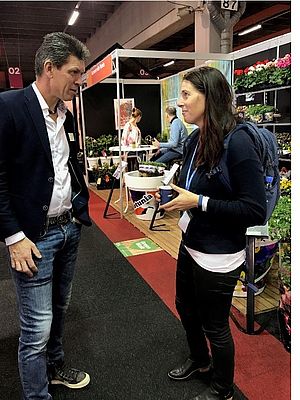

This year we were able to travel to the proverbial home of agriculture, the Netherlands for a week of immersion in all things Nuffield, including the opportunity to hear from some great speakers, to enter into some challenging debates, see some of the amazing opportunities that the Netherlands have to grow food, as well as to hear about the challenges that the Netherlands is facing in the agriculture space. It was however surprising that despite the Netherlands producing approximately 12 billion litres of milk per year that it was not overly easy to find fresh milk for your cuppa tea!


A couple of highlights included the opportunity to cycle to the farm of 2015 Scholar Gerjan Snippe where we were able to see the inner workings of Biobrass their organic cooperative farming business, and for me a highlight was also being able to attend the Royal Holland Flower Market, a modest 270ha area of land dedicated entirely to the selling and distribution of flowers and plants! (the inside tip for those of you interested in flowers, is that ‘pastel’ colours are on trend for the coming seasons).
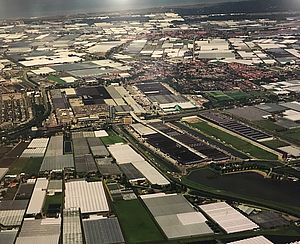
It was also a great opportunity to visit the recently opened World Horticulture Centre, which was a great example of collaborative use of space between industry, education and research to advance development in the Horticulture sector.  The Netherlands is truly world leading when it comes to horticulture and their ability to grow an abundance of food and produce, especially from a relatively small footprint.

I was also given the opportunity to participate in a panel discussion on the ‘future of agriculture 2030’ from a New Zealand perspective. This enabled me to reflect on where we are at the moment, and what the opportunities might be for New Zealand in the future.

One of the key things that came to mind for me was that there is a clear need for us to have an agriculture strategy, and that we need to focus on having the hard conversations so that there is a path forward for NZ to be the most environmentally friendly farming nation in the world. The opportunity is there for us as the leaders in the agriculture sector to seize, but we need to be brave enough to start the conversation.

Despite a jammed packed schedule at the CSC, there was also opportunity to observe some commonality amongst the various countries represented including the increasing disconnect between rural and urban communities, leading to a number of discussions around ‘social licence to operate’ or ‘licence to produce’. I was interested by the fact that many felt that NZ was perhaps the country feeling some of the most significant scrutiny, with a few people commenting on the fact that New Zealand’s farmers are now considered to be on the table of social standing at about the same level as the politicians.

There was also a lot of talk about the vegan movement, which I observed as creating a lot of angst for some amongst the room. However, where some see this as a threat to the agriculture sector, I see it as an opportunity. I don’t believe we are going to change the views of those who are so strongly engrained in their vegan view of the world, but I also don’t see that there will be a move to the majority of people choosing to be vegans (certainly not in the short to medium term).

The opportunity to focus on providing good quality, nutritious food which is known to be safe, exceeds animal welfare requirements and growing in an environmentally sustainable way is where we need to be spending our time. Those nations who can move quickly towards providing this certainty, traceability and confidence in their food, stand to prosper from the increasing knowledge that food consumers have. I believe New Zealand has the ability to lead this space.

After having spent the week in the Netherlands I am still firmly of the view that New Zealand is still at the leading edge in many aspects, and that if we can foster a collaborative approach to managing the effects of agriculture, that our future will continue to prosper as an agricultural leading nation.

Strengthen Our Adaptability by Developing Collaborative Models

By Andy Elliot, 2018 Nuffield New Zealand Scholar
It’s been a whirl wind week here in the Netherlands, I wasn’t too sure what to expect in terms of the whole experience and I honestly believe that it will take a while for it to all sink in.

The first challenge was the meeting and working together with another 75 other future leaders from around the world. It was incredible, stimulating, challenging and empowering. It really pushed me and forced me to look critically at myself and my perceptions.

Sitting here now reflecting on the week, I realise that there were a few themes emerge that have been interesting to dive deeper into, some issues have been specific to the Netherlands, but many relate to New Zealand.

One of these is the obvious pressures farmers are feeling to become more demand, rather than supply driven. It’s very difficult under a backdrop of subsidy, but we met a few of small operators who are achieving this transition successfully by moving to a direct to customer, or value add proposition within their business model. These farmers are the innovators, the first movers who will always find a gap and are prepared to tread a different path. In the Netherlands, these innovators are supplying a very concentrated local market with quality products. But what about the rest of the farmers?

We learnt that the Netherlands has approximately three small farmers leaving their land every day. They are walking off for several reasons; some of these include the income not being there, there are increasing legislative and regulatory layers and cost and the average farmer is becoming older without a younger generation succeeding them. For every farmer in Europe under twenty five there are seven over seventy five years. The average land price is close to €60000/H and these issues are not unfamiliar for us in NZ.


The Dutch cannot afford to continue to lower the cost of their production and rage battle over commodity prices, as like New Zealand, production costs are too high. Exports need a clear identity, a story, a differentiation from others, which will attract and appeal to the consumers purchasing choice. The other driver in loss of value would be volume, but that’s a bit more challenging to manage.

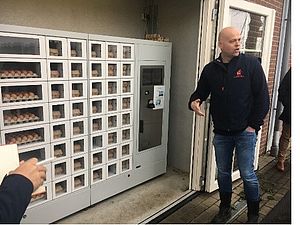
Photo: Egg vending machine – Tomesen Pluimveehouderij. A good example of a farmer transitioning from wholesale to direct to customer.

Can everyone innovate and become a supplier direct to consumer? Is everybody capable of becoming an entrepreneur? I’d suggest not, but we can all change what we do, and we can all prepare ourselves to be in a better position, when such disruption is being forced upon us.

I think, like the Dutch we need to improve our ability to collaborate and work together. There are many ways of diversifying or differentiating. It may be through supply chain or through the way we value and treat our environment or using technology within our business.

It could be through diversifying the products we produce or even through the capture and use of data within our farms. What we do not want to do is put our whole business at risk by hoping it will fix itself.
 
We can strengthen our adaptability by developing collaborative models or through the investment in doing things differently; research and development, transfer of technology and most importantly regular engagement with the customer and consumer to maintain awareness of their changing needs. This will all help decrease our risk, while enabling us to be more resilient to a changing export market.
Traditional farmers in the Netherlands are currently struggling to adapt to their new environment, even though the world may see the Netherlands as the innovators and technology creators.  The challenge is real and often daunting, but I believe NZ is already very well positioned to adapt faster.

Image: The kilometres of glasshouses around Rotterdam and the Royal Dutch Flower Market.

Global potato production: Helping feed the world.

Executive Summary

New Zealand potato growers produce on average 50tonne/hectare in the current farming system which on a global level within the potato industry is within the top spectrum. (www.fao.org)

For New Zealand to move up the ladder and raise the bar in terms of production, further investment into technology and advanced farming systems not commonly used in New Zealand to date is required.

One technology that could benefit the industry significantly moving forward is Genetic Modification (GM) of varieties. This could aid overcoming pest and disease pressures and allow growers to further maximise yields. The most important opportunity for farmers offered by GM is to drive some cost out of production and therefore increase the grower’s profit margin.

Research and development conducted to date in this area globally, GM has resulted in the development of varieties tolerant to the likes of blight, which does not only reduce chemical use (and the cost associated with this), but also makes the crop more environmentally friendly.

The identification of the Tomato and Potato Psyllid (TPP) in 2006 in New Zealand has resulted in a considerable increase of insecticide chemical use throughout the growing season to keep the crop clean and decrease processing defects. The use of  GM could help by developing varieties to overcome such issues and further decrease the chemical use.

GM is not used in New Zealand to date commercially, and it will require education by industry for the consumer, and further research to prove GM is not harmful. I believe embracing the potential of GM crops would be beneficial to the potato industry in New Zealand, and increase New Zealand Export Income as a result.

The other technologies that will help potato production dramatically will be the use of variable rate fertiliser, especially nitrogen. Intensification of other farming systems in New Zealand is putting pressures on the environment and impacting the clean-green image we as a nation are currently renowned for. By using variable rate input technology we can manage fertiliser inputs based on potential outputs of the crop resulting in better efficiencies and returns to the grower.

Variable rate irrigation in – conjunction with GPS and yield monitoring will be another technology that could play a major role in potato (and other edible crop) production in New Zealand in the future. Although some of this technology is already available and is being used currently, it is not used as standard practice in Primary Industries as yet in New Zealand.

With increased data collection and more precise use of inputs we are likely to see a direct outcome of better utilisation of crop inputs resulting in increased efficiencies and possibly yield increases. Importantly this data and efficiency will play a role in meeting customer demand for food production with high environmental awareness (especially if marketed effectively on an industry scale), and demonstrate best farm practice and decisions made as a result of increased knowledge.

With global regulation so stringent and only likely to get more challenging we need to be at the forefront of quality assurance programs, meeting regulatory requirements within current farm systems and leverage off our historical “pure” clean and green image to maintain our competitive advantage as a primary exporting nation.

Global Potato Production: Helping Feed The World – Paul Olsen 2014