
For over a century scientists have been observing cow grazing behavior to understand what cows do when grazing, what changes when dealing with differences in sward architecture (pasture density, length and quality) and how we can benefit from this knowledge. The research has evolved with technology and is shifted from empirical observations to predictive models, but not yet on a commercial scale.
At the moment there’s a gap in the integration of cow-wearable derived data, with real-time pasture mass and intake models, which could allow for dynamic grazing management decisions informed by continuous animal behavior data.
This study has been conceived from two premises:
- The understanding that cows increase bite rate when adapting to a shorter sward like a post-grazing residual and
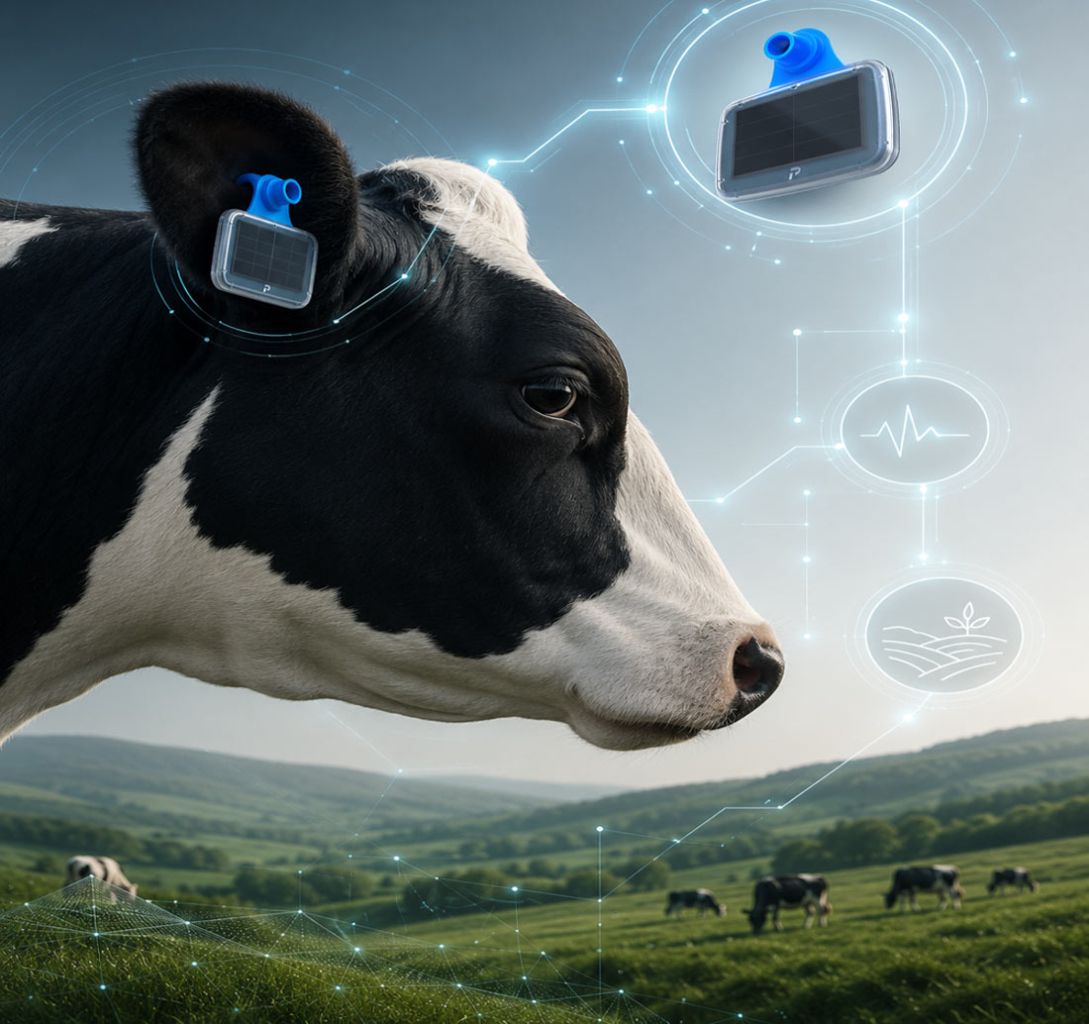
- The hypothesis that bite rate could be detected with a commercially available in-ear sensor (ProTag).
If the premises are confirmed, we would then be able to estimate post-grazing residuals in real-time from the derived sensor data.
Two research questions were proposed and proved or challenged by this study:
- Can we identify bite rate with existing cow-wearable technology?
Yes, Bite Rate can be estimated (±10%) from existing cow-wearable accelerometer data. The sensor signal yields three other independent behavioural channels related with bite strategy and sward characteristics - Can bite rate serve as a proxy for post grazing residual on rotationally grazed pastures?
Bite Rate is not a good predictor of post-grazing residuals, as satiety and rumen fill influences bite rate negatively, at least in late lactation.
This study despite its small dataset and lack of validation resources, proved a concept and brought forward several positive outcomes that highlight the importance of further research in this field.
Through the duration of this study, the attention shifted from bite rate to bite characteristics and how the cow engages with the sward, as the accelerometer data discriminated between bite rate, angle of approach, effort and lateral sway of cows tackling different patches of heterogeneous sward. This means the data could be used to predict sward characteristics.
There’s still a wealth of information encoded on the raw accelerometer data, ripe for its use. If we’re able to establish more behaviours from the existing data and combine this with data pools such as rumination, we will increase the reliability of predictive models.
Identification of nuances between animals associated with grazing behaviour could potentially be related to productivity gains and would aid the selection of more efficient animals.
Leo Pekar