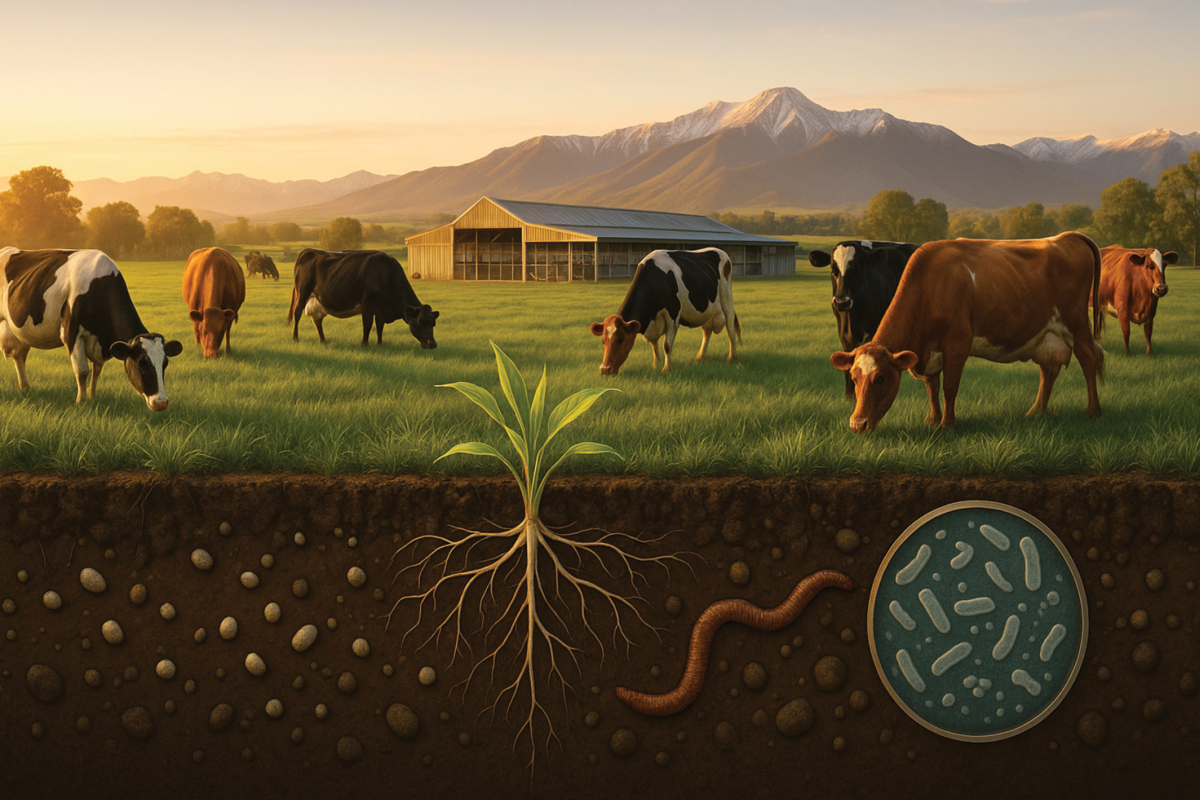

Soils lay the foundation of al farming productivity. Whether the farm is managed conventionaly or holisticaly; it al starts with soil.
How farmers manage their soil is influenced by multiple factors. Overarching al of them is our scientific space which affects farmers’ perceptions both culturally and technically.
Linear, cause and effect, output focused, studies suit fertiliser research and fit well with our commercialised scientific frameworks. This product based mentality has extended into our shift towards environmental research with productive environmental science providing solutions through this lens. Meanwhile studies on soil function have been limited, and studies on soil function relating to productivity are non-existent. With baseline biological data missing, soil biology studies related to fertiliser usage have used inconsistent rudimentary measures that have not been built on over time.
The major players within our commercialised scientific frameworks have been driven by market incentives in a way that flies by soil biology and function without stopping to investigate. Public funding is limited, private funding won’t receive a product from it and our scientists have entire careers within this framework that encourages short term thinking. So the long game of soil, unwinding its complexity and variation, falls by the wayside in spite of the possibilities it can bring.
Farmers, in an effort to do the best they can, take advice based on these scientific outputs. The science technically supports fertiliser and culturally supports linear thinking. There is no scientific basis for holistic management, because the studies have not been conducted.
Combined with political and media portrayals, an unnecessary cultural gap is created between conventional and holistic farmers. A gap that limits what conventional farmers see as viable options and leaves holistic farmers to do their own experimentation.
This paper does not make arguments for or against either strategy, but rather highlights how different farmers consider soils within their systems and the challenges they experience in managing them. Combined with the views of advisors and scientists, it tries to explain the drivers behind these challenges and perceptions.
Daniel Judd