
2026 Nuffield NZ Farming Scholarship. Apply by 17 August 2025. Read More...

Apply for 2026 Nuffield NZ Farming Scholarship by 17 August 2025. More details...

New Zealand must embrace long term relationships with Asia

New Zealand agriculture must embrace long term relationships with our Asian customers, in particular China, says 2011 Nuffield Scholar David Campbell of Canterbury. “Too many New Zealanders misunderstand China and its potential. It troubles me that so many of us have such a narrow view on China given they are our number one market for the next century,” he says.

Mr Campbell has just completed his Nuffield Scholarship study report detailing two Asian markets, China and India, and outlining key market advantages, challenges and high level solutions to help create sustainable and profitable future markets for NZ agriculture.

In the last decade New Zealand agricultural exports to Asia have increased 71% to NZ$6 billion with China now the largest of these Asian markets. Growth is set to continue as the Asian economies continue to outpace those of the US or Europe.

“An increasing proportion of Asia’s large population will develop internationally competitive purchasing power and consumers will be more able to afford the safe, high quality and innovative foods that NZ agriculture is capable of producing,” he says.

Mr Campbell spent March through August 2011 overseas as part of his Nuffield Scholarship. He said being so far away from normal life and work (Synlait in Canterbury) was a great part of the challenge and the experience. First on the schedule was a global focus tour with a group of Australian Nuffield scholars.

“We basically went around the world – Brazil, Mexico, the US, Canada, Scotland – looking at all aspects of agriculture. We looked at farms and farm systems, visited processors, research institutions, wholesalers, retailers, trade officials and government departments – even the US Congress. An important part of the whole Nuffield experience is to give a well-rounded look at agriculture globally.”

David met up with his wife Sue in Italy before heading off on his own three month study tour of India, China and Japan to form the basis of his just-released report.

“China is described as New Zealand agriculture’s number one market for the next century due to its on-going economic strength, population dynamics and Government policy direction. The New Zealand/China Free Trade Agreement (FTA) and our reputation for high standards of food safety represent key market advantages for us.”

But he says New Zealand also faces challenges in understanding and engaging with Chinese customers, including language and cultural barriers, low purchasing power parity, New Zealand’s lack of capital and scale and Chinese Government processes.

The release of Mr Campbell’s report is timely given the recent interest and comment on the Chinese purchase of the Crafar farms. He doesn’t want to specifically enter the debate but says it illustrates some of the key findings of his study.

“It’s had a pretty thorough thrashing already. I personally believe the OIO made the right decision, and that it appears that Landcorp is doing a good job of engaging with the Chinese buyer for a win-win outcome.”

“My four key solutions for China are; get closer to the customer, build relationships, extend the value chain with a ‘One World’ approach, and get clear on strategy so we focus our attentions on what the customer wants and how we can add value for them. China is setting up long term strategic partnerships and supply chains around the globe. They’re demonstrating they want to engage with the world. NZ has natural advantages and a great reputation in agriculture so it makes sense for China to look for agricultural investments and relationships here,” he says.

He says one of New Zealand agriculture’s key advantages over its competitors at the moment is the country’s status as the first OECD nation to sign a free trade agreement with China.

“But we’re missing out on some of the benefits that the FTA has created because of an apparent fear of Chinese investment. We’re really short of capital, and China has lots to invest. So we have to marry the two together – take the capital and the pathway to market, concentrate on what we do really well or where we have unique advantages, and commit to mutually-beneficial relationships. If we’re too narrow-minded in our view on China, they will look elsewhere and we will miss out forever.”

“If people take the time to visit China they will see there’s a significant amount of pollution, large tracts of land in China are desert and there is huge pressure on natural resources to sustain their population. They just don’t have the agricultural production they need to feed themselves. And they often don’t trust the safety of the food that they do produce. This provides a great opportunity for New Zealand agriculture to capitalise on,” he says.

India represents a significant potential market for NZ agriculture worthy of development and investment; however it is currently a much smaller market than China. One of the advantages for New Zealand agriculture is an existing “brand NZ” presence through international cricket, while market challenges include significant agricultural tariffs, diverse culture and taste preferences, low beef consumption, lack of significant cold chain and modern retail infrastructure and bureaucracy.

For India, one of Mr Campbell’s four key solutions is to encourage the signing of a NZ/India bilateral FTA.

“I had never been to Asia before but that was part of the challenge for me – it was quite foreign – but I had a strong belief I needed to know more about it because it’s so important to the future of agriculture in New Zealand.”

He will be presenting his report to the Allflex Platinum Primary Producers Conference in March, as well as the Nuffield Conference in April and is happy to discuss his findings with others in the industry interested in greater engagement with Asia.
David’s Nuffield report can be downloaded here.

Social Licence To Operate or Licence to Produce


By Kate Scott, 2018 Nuffield New Zealand Scholar

It’s not every day you walk into a room of 80 odd people and the entire room is abuzz with chatter, where people come together with a common and passionate link – agriculture and food. It’s also not every day that you get to attend the Contemporary Scholars Conference (CSC) as a Nuffield Scholar.
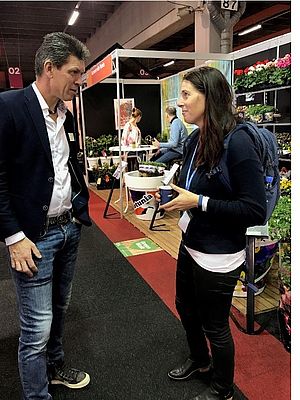

This year we were able to travel to the proverbial home of agriculture, the Netherlands for a week of immersion in all things Nuffield, including the opportunity to hear from some great speakers, to enter into some challenging debates, see some of the amazing opportunities that the Netherlands have to grow food, as well as to hear about the challenges that the Netherlands is facing in the agriculture space. It was however surprising that despite the Netherlands producing approximately 12 billion litres of milk per year that it was not overly easy to find fresh milk for your cuppa tea!


A couple of highlights included the opportunity to cycle to the farm of 2015 Scholar Gerjan Snippe where we were able to see the inner workings of Biobrass their organic cooperative farming business, and for me a highlight was also being able to attend the Royal Holland Flower Market, a modest 270ha area of land dedicated entirely to the selling and distribution of flowers and plants! (the inside tip for those of you interested in flowers, is that ‘pastel’ colours are on trend for the coming seasons).
It was also a great opportunity to visit the recently opened World Horticulture Centre, which was a great example of collaborative use of space between industry, education and research to advance development in the Horticulture sector.  The Netherlands is truly world leading when it comes to horticulture and their ability to grow an abundance of food and produce, especially from a relatively small footprint.

I was also given the opportunity to participate in a panel discussion on the ‘future of agriculture 2030’ from a New Zealand perspective. This enabled me to reflect on where we are at the moment, and what the opportunities might be for New Zealand in the future.

One of the key things that came to mind for me was that there is a clear need for us to have an agriculture strategy, and that we need to focus on having the hard conversations so that there is a path forward for NZ to be the most environmentally friendly farming nation in the world. The opportunity is there for us as the leaders in the agriculture sector to seize, but we need to be brave enough to start the conversation.

Despite a jammed packed schedule at the CSC, there was also opportunity to observe some commonality amongst the various countries represented including the increasing disconnect between rural and urban communities, leading to a number of discussions around ‘social licence to operate’ or ‘licence to produce’. I was interested by the fact that many felt that NZ was perhaps the country feeling some of the most significant scrutiny, with a few people commenting on the fact that New Zealand’s farmers are now considered to be on the table of social standing at about the same level as the politicians.

There was also a lot of talk about the vegan movement, which I observed as creating a lot of angst for some amongst the room. However, where some see this as a threat to the agriculture sector, I see it as an opportunity. I don’t believe we are going to change the views of those who are so strongly engrained in their vegan view of the world, but I also don’t see that there will be a move to the majority of people choosing to be vegans (certainly not in the short to medium term).

The opportunity to focus on providing good quality, nutritious food which is known to be safe, exceeds animal welfare requirements and growing in an environmentally sustainable way is where we need to be spending our time. Those nations who can move quickly towards providing this certainty, traceability and confidence in their food, stand to prosper from the increasing knowledge that food consumers have. I believe New Zealand has the ability to lead this space.

After having spent the week in the Netherlands I am still firmly of the view that New Zealand is still at the leading edge in many aspects, and that if we can foster a collaborative approach to managing the effects of agriculture, that our future will continue to prosper as an agricultural leading nation.

Strengthen Our Adaptability by Developing Collaborative Models

By Andy Elliot, 2018 Nuffield New Zealand Scholar
It’s been a whirl wind week here in the Netherlands, I wasn’t too sure what to expect in terms of the whole experience and I honestly believe that it will take a while for it to all sink in.

The first challenge was the meeting and working together with another 75 other future leaders from around the world. It was incredible, stimulating, challenging and empowering. It really pushed me and forced me to look critically at myself and my perceptions.

Sitting here now reflecting on the week, I realise that there were a few themes emerge that have been interesting to dive deeper into, some issues have been specific to the Netherlands, but many relate to New Zealand.

One of these is the obvious pressures farmers are feeling to become more demand, rather than supply driven. It’s very difficult under a backdrop of subsidy, but we met a few of small operators who are achieving this transition successfully by moving to a direct to customer, or value add proposition within their business model. These farmers are the innovators, the first movers who will always find a gap and are prepared to tread a different path. In the Netherlands, these innovators are supplying a very concentrated local market with quality products. But what about the rest of the farmers?

We learnt that the Netherlands has approximately three small farmers leaving their land every day. They are walking off for several reasons; some of these include the income not being there, there are increasing legislative and regulatory layers and cost and the average farmer is becoming older without a younger generation succeeding them. For every farmer in Europe under twenty five there are seven over seventy five years. The average land price is close to €60000/H and these issues are not unfamiliar for us in NZ.


The Dutch cannot afford to continue to lower the cost of their production and rage battle over commodity prices, as like New Zealand, production costs are too high. Exports need a clear identity, a story, a differentiation from others, which will attract and appeal to the consumers purchasing choice. The other driver in loss of value would be volume, but that’s a bit more challenging to manage.

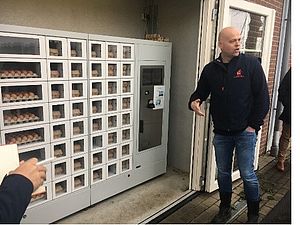
Photo: Egg vending machine – Tomesen Pluimveehouderij. A good example of a farmer transitioning from wholesale to direct to customer.

Can everyone innovate and become a supplier direct to consumer? Is everybody capable of becoming an entrepreneur? I’d suggest not, but we can all change what we do, and we can all prepare ourselves to be in a better position, when such disruption is being forced upon us.

I think, like the Dutch we need to improve our ability to collaborate and work together. There are many ways of diversifying or differentiating. It may be through supply chain or through the way we value and treat our environment or using technology within our business.

It could be through diversifying the products we produce or even through the capture and use of data within our farms. What we do not want to do is put our whole business at risk by hoping it will fix itself.
 
We can strengthen our adaptability by developing collaborative models or through the investment in doing things differently; research and development, transfer of technology and most importantly regular engagement with the customer and consumer to maintain awareness of their changing needs. This will all help decrease our risk, while enabling us to be more resilient to a changing export market.
Traditional farmers in the Netherlands are currently struggling to adapt to their new environment, even though the world may see the Netherlands as the innovators and technology creators.  The challenge is real and often daunting, but I believe NZ is already very well positioned to adapt faster.

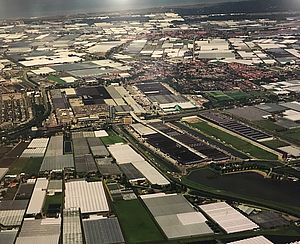
Image: The kilometres of glasshouses around Rotterdam and the Royal Dutch Flower Market.

2013 Nuffield New Zealand Scholars announced

They are spread from Northland to Southland.

Dairy NZ regional leader Tafadzwa Manjala from Whangarei, ANZ rural banker Sophie Stanley from Hamilton, rural entrepreneur Lisa Harper from Picton, Meridian Energy national agribusiness manager Natasha King from Christchurch and Northern Southland farmer and retailer Stephen Wilkins from Athol.

The research topics they are likely to cover are faster uptake and application of current and new management practices on farm, the use of social media to boost the New Zealand brand, encouraging innovation in rural businesses, using gas and electricity generation to solve effluent and water management issues and looking into synergies between arable and dairy from a nutrient and effluent perspective.

The Nuffield NZ Scholarship offers the opportunity for overseas travel, study of the latest developments in a number of leading agricultural countries, and provides an entrée to leaders and decision makers not accessible to the ordinary traveller.

Successful applicants have the opportunity to develop a better understanding of New Zealand and international relationships through at least four months travel. Scholars participate in a Contemporary Scholars conference with 60 Nuffield Scholars from around the world and a six-week Global Focus Programme with an organised itinerary through several countries with other scholars. Finally they have their own individual study programme with a research report due at the end of their travels.

Historically only two to three annual scholarships have been awarded, but Nuffield New Zealand Director Richard Green says it has been the organisation’s vision to grow the programme.

“We wanted to be able to award five scholarships without dropping our high quality standards and expectations on scholars. An increase in scholarship numbers has only been possible with the extra financial commitment from the partner sponsors, Dairy NZ, B+LNZ, FMG and AGMARDT as well as other supporting sponsors being FAR, Mackenzie Charitable Foundation and Landcorp,” he says.

“Nuffield and our sponsors have identified the opportunity and the need for more emerging leaders with the global vision and international connections that can be gained through a Nuffield Scholarship.”

The five 2013 Nuffield New Zealand Scholars are:

Hamilton’s Sophie Stanley, 26, has agricultural science and economics degrees from Massey University (2005-2008). She currently works for the ANZ Bank in Morrinsville managing a portfolio of 60 customers, mostly dairy. She completed the Kellogg’s Rural Leadership programme this year with the research project centred around the value of “Brand New Zealand” in our value added primary products in Asian markets.

She plans to take this a step further in her Nuffield studies to investigate how New Zealand’s agriculture industry can use social media and technology more effectively to both promote the NZ brand and promote innovation and knowledge transfer between farmers and industry, while at the same time attempting to reduce the rural/urban divide.

Christchurch’s Natasha King, 39, is national agribusiness manager for Meridian Energy and recently finished as chair of Canterbury Netball. She took the journey of share milking through to farm ownership and then stepped out of the gumboots and into the corporate world in the late 1990s.

One of her goals is to move into an equity farm partnership on a large irrigated dairy unit. Natasha is passionate about mentoring and progression within the dairy industry and has a close association with Dairy Industry Awards and AgITO.

Her likely research topic is whether generating gas and electricity can solve the effluent and water management issues for New Zealand agriculture. Natasha has two daughters, Victoria and Laura Shaw, who are 18 and 17 respectively, and partner Brett Hare.

Stephen Wilkins, 47, has been farming in a family farming business since 1982 and is based in Athol in Northern Southland.

The business includes sheep and beef breeding operations, a deer unit, dairy and dairy support. Stephen’s role focuses on an intensive arable system and the agronomy for the whole business. He has also been setting up a farm shop, run from an historic woolshed on the farm, selling farm grown and local produce and their own meat brand Athol Valley Meats.

Stephen’s potential research topic is to look at synergies between arable and dairy from a nutrient and effluent perspective. Stephen and his wife Heather have three daughters – Hannah, Ella and Molly.


Tafadzwa Manjala, 38, from Whangarei, is two thirds of the way through a Masters degree in Agriculture at Massey University, studying extramurally while working as a regional leader for Dairy NZ.

He has worked for Dairy NZ since 2004, organises the Green to Gold Group (business-focused discussion group) and until a few months ago was a councillor on the New Zealand Institute of Primary Industry Management. Tafadzwa also has a number of qualifications from his native Zimbabwe.

He would like to research how New Zealand can facilitate faster uptake and application of current and new management practices on farm. Tafadzwa and his wife Whitney have two children 10-year-old Rufaro and six-year-old Rosa.


Picton’s Lisa Harper, 37, was the 2011 winner of the Rural Women Enterprising Woman Award and a finalist in the 2009 Cuisine Artisan Food Awards.

She has a Masters in Business Management from Massey University (awaiting final results), a PhD in plant pathology from Lincoln University and a science degree from Victoria University. She was diverted from her academic career in 2003 when a family illness saw her return from working in Europe to take over the family farm in Marlborough where she grew up. The family started a business involved in cheese manufacturing and educational tourism – Lisa’s responsibilities include operations management, marketing, sales/customer service and quality control/hazard management.

Lisa already has a love of research and through her Nuffield scholarship might look at how to encourage greater levels of innovation in rural businesses and identify some of the road blocks that might be preventing businesses from taking their ideas further.


Nuffield Director appointed following review

The Trustees have over the last few months been working through a process to appoint a permanent Director of the New Zealand Nuffield Farming Scholarship Trust. Many of you may ask why this is necessary.

We have identified that to ensure the long term viability of the scholarship within New Zealand we needed to improve our performance with our existing sponsors and create an environment that actively encourages new investment by potential sponsors. To be able to enhance and develop new and existing funding relationships was the key skill set we were looking for in the appointment process for the position of Director.>

We were delighted with the response and quality of the applicants who applied. From this strong field we would like to announce that we have engaged Richard Green of Ashburton to fill this role. Richard is in his early 40’s, married to Vicky with three children. He has a strong background and experience in agriculture and business and a passion for rural leadership.  A brief outline of his working career is as follows:

  • BAg  Com Lincoln
  • Agricultural Business Consultant for Agriculture NZ
  • Director of Sales and Marketing of Agricom NZ Ltd (now part of PGG Wrightson)
  • International Seed Business Manager for PGG Wrightson
  • Director of a number of companies involved in agribusiness and other sectors

We are sure all scholars will join with us in welcoming Richard to the Nuffield fold. He attended the Wellington section of the Contemporary Scholars Conference to meet his international colleagues and contemporaries.

He is due to start in this part time contract position officially in early April. Please, if you should happen to meet him make yourself known.

This appointment is a major development for the NZ Nuffield Scholarship program and we are confident that Richard will bring his range of skills to enhance the way we operate. Barbie Barton will continue in her role with the secretariat work for New Zealand Nuffield allowing Richard to fully concentrate on the relationships needed to add real value to our sponsors.

For more information

Richard Green, New Zealand Nuffield Farming Scholarship Trust Director, 03 307 8159,0274 973 692

Stuart Wright, New Zealand Nuffield Farming Scholarship Trust Chairman, 021 329 763

2012 Nuffield Scholars

2012 Nuffield Scholarships to research strong wools, farmer capability development and arable farmingThree Nuffield Scholarships have been announced for 2012.  

Nuffield Scholarships assist individuals with vision and energy, who wish to make a difference to farming, food and rural communities. 

The 2012 New Zealand Nuffield Farming Scholars are:

Sandra Faulkner (Gisborne)

Sandra and her husband Robert, have a very mixed property comprising sheep and beef, 350 hectares of arable corps and a citrus orchard. Sandra is the Chair of Gisborne TB Free and has been a chairperson of Federated Farmers Gisborne/Wairoa Meat and Fibre.

Sandra’s research topic will be around the strong wool industry, with her looking to extend the Kelloggs project she is currently working on.

Richard Fitzgerald (Methven)

Richard is the Chief Executive Officer of New Zealand Young Farmers and with his wife Ruth, farms 253 hectares of intensive mixed cropping in Methven. 

He started working for New Zealand Young Farmers full time in 2002, initially as the Contest Manager for the National Bank Young Farmers Contest and has been its Chief Executive Officer since 2007.

Richard’s research topic will be on the capability development of farmers through farmer networks.

Michael Tayler (Temuka)

Michael farms 800 hectares over three properties in a family partnership with his brother, Nick Tayler. Their intensive arable business grows cereals, small seeds, carrots for juicing and potatoes. They also farm a sheep and beef and cattle unit.
Michael’s research topic will look at arable rotations and the sustainability of current practices.


New Zealand and Asia

February 2012 and published in Farmer’s Weekly’s Pulpit SectionNew Zealand agriculture must embrace long term relationships with Asian customers, in particular China, says 2011 Nuffield Scholar David Campbell. 

The Synlait employee has just completed his Nuffield Scholarship study report detailing two Asian markets, China and India, and outlining key market advantages, challenges for more profitable and sustainable markets.

It troubles me that so many of us have such a narrow view on China given they are our number one market for the next century.

In the last decade New Zealand agricultural exports to Asia have increased 71% to NZ$6 billion with China now the largest of these Asian markets. Growth is set to continue as the Asian economies continue to outpace those of the US or Europe.

An increasing proportion of Asia’s large population will develop internationally competitive purchasing power and consumers will be more able to afford the safe, high quality and innovative foods that NZ agriculture is capable of producing.

I spent March through August 2011 overseas as part of his Nuffield Scholarship. Being so far away from normal life and work for Synlait was a great part of the challenge and the experience.

First on the schedule was a global focus tour with a group of Australian Nuffield scholars. We basically went around the world – Brazil, Mexico, the US, Canada, Scotland – looking at all aspects of agriculture. We looked at farms and farm systems, visited processors, research institutions, wholesalers, retailers, trade officials and government departments – even the US Congress. An important part of the whole Nuffield experience is to give a well-rounded look at agriculture globally.”

I met up with my wife Sue in Italy before heading off on my own three month study tour of India, China and Japan to form the basis of the report.

China can be described as New Zealand agriculture’s number one market for the next century due to its on-going economic strength, population dynamics and Government policy direction. The New Zealand/China Free Trade Agreement (FTA) and our reputation for high standards of food safety represent key market advantages for us.

But New Zealand also faces challenges in understanding and engaging with Chinese customers, including language and cultural barriers, low purchasing power parity, New Zealand’s lack of capital and scale and Chinese Government processes.

The release of my report appears timely given the recent interest and comment on the Chinese purchase of the Crafar farms. While I don’t want to specifically enter the debate I believe the OIO made the right decision, and that it appears that Landcorp is doing a good job of engaging with the Chinese buyer for a win-win outcome.

My four key solutions for China are; get closer to the customer, build relationships, extend the value chain with a ‘One World’ approach, and get clear on strategy so we focus our attentions on what the customer wants and how we can add value for them. China is setting up long term strategic partnerships and supply chains around the globe. They’re demonstrating they want to engage with the world. NZ has natural advantages and a great reputation in agriculture so it makes sense for China to look for agricultural investments and relationships here.

One of New Zealand agriculture’s key advantages over its competitors at the moment is the country’s status as the first OECD nation to sign a free trade agreement with China. But we’re missing out on some of the benefits that the FTA has created because of an apparent fear of Chinese investment. We’re really short of capital, and China has lots to invest. So we have to marry the two together – take the capital and the pathway to market, concentrate on what we do really well or where we have unique advantages, and commit to mutually-beneficial relationships. If we’re too narrow-minded in our view on China, they will look elsewhere and we will miss out forever.

If people take the time to visit China they will see there’s a significant amount of pollution, large tracts of land in China are desert and there is huge pressure on natural resources to sustain their population. They just don’t have the agricultural production they need to feed themselves. And they often don’t trust the safety of the food that they do produce. This provides a great opportunity for New Zealand agriculture to capitalise on.

India represents a significant potential market for NZ agriculture worthy of development and investment; however it is currently a much smaller market than China.  One of the advantages for New Zealand agriculture is an existing “brand NZ” presence through international cricket, while market challenges include significant agricultural tariffs, diverse culture and taste preferences, low beef consumption, lack of significant cold chain and modern retail infrastructure and bureaucracy. For India, I believe, one solution would be to encourage the signing of a NZ/India bilateral FTA.

*David Campbell will be presenting his report to the Allflex Platinum Primary Producers Conference in March, as well as the Nuffield Conference in April and is happy to discuss his findings with others in the industry interested in greater engagement with Asia.

The report is available at here.