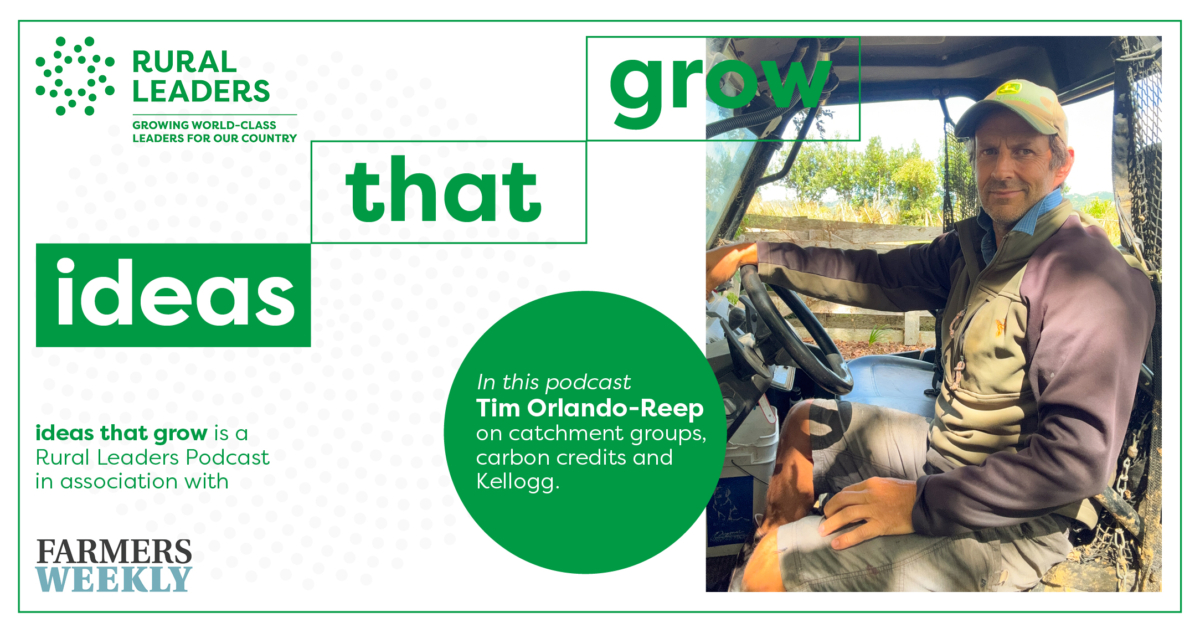
Listen to this episode of Ideas that Grow, or click on one of the platform icons below to listen on your favourite player:
In this Ideas That Grow Podcast, 2025 Kellogg Scholar Tim Orlando-Reep shares how his Waikato beef farm integrates carbon forestry, biodiversity ambitions and catchment collaboration.
While pine credits stack up financially, his research through the Kellogg Rural Leadership Programme explores how native plantings can balance profitability with environmental impacts.




Episode Transcript
You’ve joined the Ideas That Grow podcast, brought to you by Rural Leaders. In this series, we’ll be drawing on insights from innovative rural leaders to help plant ideas that grow so our regions can flourish. Ideas That Grow is presented in Association with Farmers Weekly.
BG: Bryan Gibson, Managing Editor of Farmers Weekly: You’ve joined the Ideas That Grow podcast, brought to you by Rural Leaders. In this series, we’ll be drawing on insights from innovative rural leaders to help plant Ideas That Grow so our regions can flourish. Ideas That Grow is presented in association with Farmers Weekly.
Welcome back to Ideas That Grow, a Rural Leaders podcast. I’m Bryan Gibson, Managing Editor of the Farmers Weekly, and our first guest for 2026, is recent Kellogg Programme graduate, Tim Orlando-Reep. Tim, how’s it going?
TO-R: Tim Orlando-Reep, Beef Farmer, 2025 Kellogg Scholar:
Hi, Bryan. How are you going? Thanks for having me.
BG: Now, you’re farming up in coastal Waikato, aren’t you?
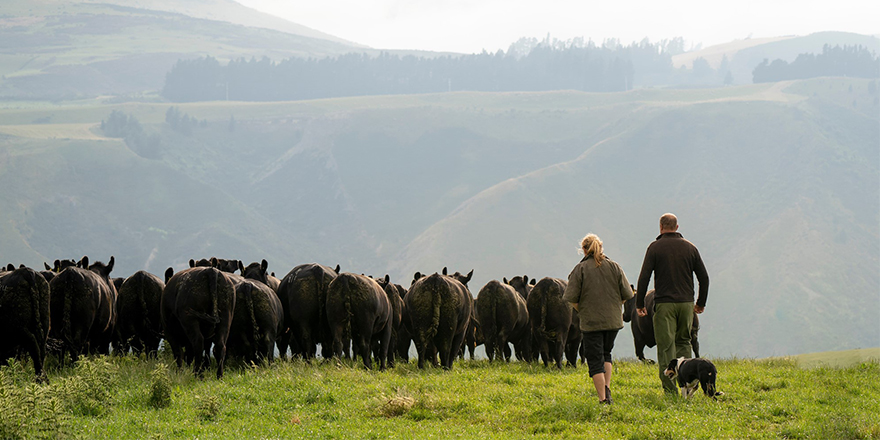
A diverse Waikato beef farm.
TO-R: Yeah, we’re based in the Northwest Waikato. About 10k’s as a crow flies, from the Coast. So, we get some nice westerlies here. Very nice area. Lived here pretty much my whole life. We fatten cattle up here, so buying in a lot of wieners and finishing them and sending to the works.
BG: Obviously, you’ve got a pretty diverse operation. You’ve got some carbon farming going on as well?
TO-R: We’ve got about 10 to 12 hectares of pine trees and second rotation carbon. My father was a bit of a pioneer when it came to grabbing onto the carbon market. He had a love of trees, and we’re taking that to the next level. We have been doing a lot of carbon farming through the pine trees, and we also do a lot of spaced willows and poplars throughout the farm. As well as the carbon advantage, I guess, we also have the advantage of shelter for stock, which is becoming more and more prevalent and much more important.
Also, if the worst does come to the worst, we can always do a bit of pruning in the summer there and feed some of the forage. It works really well. It’s a great way of beautifying at the farm as well and providing a bit of colour in the autumn.
BG: How does the carbon farming or the forestry side of things, how does that fit into your overall strategy of farming? Is it easily done? How did you go about it?
TO-R: We identified the steeper parts of the farm. We’re quite lucky up here. We have some really good soils, but there are some fragile steep parts. Probably the only thing we could have done with that really was put it into pine trees. I remember most of my school holidays planting pine trees, especially throughout the winter, through those steep areas where the cattle were making a bit of a mess.
Even now, we’re identifying places where it should have gone into trees, but we’re looking at now how we can diversify that a bit more. But look, it’s a project, it’s about 12 hectares, and we prune it all ourselves. We thin it all ourselves.
Tell you what, on a hot summer’s day, like it has been for the last week or something, there’s nothing better than escaping to the forestry and pruning some trees 12: 00 to 3: 00 for a bit of shade and check in on a podcast and get an idea of what’s going on in the world.
BG: You mentioned natives briefly. Of course, you recently went through the Kellogg Programme, and your scholar report was about developing a more robust biodiversity credit system.
Kellogg research into carbon credits.
TO-R: It was really interesting. We’re now identifying probably not the most fragile areas on the farm, but the next layer down, so the LUC 5 stuff. Instead of putting a pine tree on there, I’m just trying to work out, well, the idea was what we put on there that could compete with the pinus radiata. How could a native stack up, I guess, as far as income per hectare.
At the moment, it’s chalk and cheese as far as that comparison goes, compared to a fast-growing exotic like a pinus radiata. I really want to delve down and see what we can do as an industry or even as a nation as far as how can we encourage farmers and landowners to be planting native instead of pinus radiata.
It might not be one to one as far as income is concerned, but something that’s close to that has a little bit more longevity and a bit more permanence compared to every 25 years, basically destroying the hillside. At the moment, I’m pruning some trees at the back of the farm So it’s 10, 12 years old, and there’s some beautiful ferns and stuff coming through.
And I think, in 15 years’ time, this is all going to be decimated if we continue this whole cycle of harvesting pinus radiata. If I could back it up before they went in and I could put in a native tree and receive the same income than I can from carbon credit, then that’d be a win-win for everybody.
And that’s what I really wanted to delve into as far as (my Kellogg research) the project was concerned. Because what do we have to do to really excite people about putting in a native plant instead of an exotic. Where is the financial reward? Because at the end of the day, the feel good factor doesn’t pay the mortgage. We need to make sure it’s feasible from a financial viewpoint.
So, what’s holding farmers back from being excited about putting in a native tree? It was really exciting going through the process of the research and understanding through a survey, through quite a large number of people, through the Waikato. A lot of people are already putting native plants in place, and they’re doing it off their own, off their own back. They’re not doing it for a financial reward.
They’re doing it for ecological or freshwater reasons. But there’s no (financial) reward for that. I just feel as though if there’s some way of supporting farmers to even bring back some of financial input they put into that so they can establish a bit more, it’s got to be a lot better than what it is at the moment, where you’re just pouring money into something that looks great and is a great thing for the environment. There’s no financial incentive, I guess, to do that. It was exciting to see that farmers are just doing it anyway. I just feel as though there’s a real opportunity here for farmers to be able to monetise or financially receive something for that.
BG: It would seem to me it’s more of a holistic way of looking at things. I mean, carbon farming is a reward system for battling greenhouse gas emissions, and you get rewarded for that.
Planting natives also combats climate change, but as you say, in a slightly slower way. But the fresh water implications, the biodiversity implications from diverse native plantings, that’s also really beneficial to everyone. Why can’t we come up with a reward system for that?
TO-R: Exactly. Look, there’s been a lot of work done around this area, and internationally, there are some good established schemes. Domestically as well, we have Maungatautari Mountain with Ekos, and they’ve done some fantastic work over there.
The thing that I’ve realised is it’s a lot more complicated to measure than carbon credit. So, carbon credit is just the species of tree times the amount of hectares of that species of tree cover. And it’s a fairly standard equation. When we come into biodiversity, how do you measure that? And that’s one of the things I got from my semi-structured interviews, is that it is so complicated.
A lot of the costs of auditing that get sucked up by our subject matter experts, our auditors, and all that thing. And does that follow through effect go back to the people who are actually putting the plants on the ground?
So, it was an interesting process to understand that, and then also, how could we pick some of the low hanging fruit there and say, right, we understand what’s probably restricting our biodiversity support or advancement in these areas already.
How can we help steady the ship, I guess, for the lack of a better phrase, and move forward and increase some of that biodiversity in some of those areas already. It was interesting.
BG: Yeah. I mean, it’s really heartening to hear that a lot of the farmers up your way are already on board ideologically with this stuff and are just doing it because they feel like it’s a good thing to do for them.
I guess some of these plantings, as you say, you’re seeing more heat events up there, the volume of rainfall is rising. I guess that work will build a bit more resilience into the farming system.
TO-R: I think a lot of farmers have realised that already. Bill Garland is a classic example. We’ve had a few open days up there, and what he’s developed over the last 20, 30 years on that property, he still has the weather events, but he’s the person who now says, well, look, we can put in something here, and it’s not going to get destroyed because we put in some mitigation.
That’s just a byproduct of what they’ve done. They’ve decided that’s the best land use for that particular gully. The flow-on effects of what’s done downstream have just been fantastic.
You’re right, it’s just building up a bit of resilience. It’s going to save you money in the long term, isn’t it? I feel so sorry for the people who have had these weather events, especially on the East Coast. You’re putting in fences again that you’ve probably only put in a couple of years ago. That can be quite a soul-destroying, and it’s hard. Until you get to that stage where you can start thinking long term, it’s a hard road.
Catchment groups.
BG: You mentioned Bill there. I mean, you’re quite a fan, I understand, of catchment groups, the catchment, collective way of thinking of things, farmers working together for a common goal. Do you think that’s the model for the future of environmental progress in New Zealand farming?
TO-R: Yeah, Bryan, I think that’s a really good point. The catchment groups tend to be very farmer-orientated. I think farmers learn a lot more by going out and seeing something and learning from someone else who’s done something compared to a group that might come in and say, right, this is how it should be done.
The catchment group, that farmer-led initiative, has a lot more clout than we give it credit for. It’s easy to see what’s going on in our area, especially. We’ve got King Country River Care down the road. West Waikato catchment just to the west of us. Our catchment, Whangapē, leads into a freshwater lake that goes into the Waikato River.
We have our challenges here, and it’s great to see a key group of people getting together and bringing other people in and saying, hey, this is what we’ve done. What do you think? And we have some informal days where people just bring their own packed lunch in a thermos and we’re just going to have a look at what people have done. I think the value in that for other farmers is to say, oh, gee, it’s not actually that hard to go and maybe just identify an area.
Now I’ve met all these people who have done a bit of work like that. Maybe I can ask them instead of asking the council if they’re nervous about getting the council involved or whatever. It is farmer-orientated action approach. Some of the things that we’ve talked about in the last month or so, it’s like, how do we go around and help other people plant out or give them advice without any external influence at all?
I spent four days planting natives last winter, and it’d be great just to spend half a day doing that and having a group come over, and then I can go and spend half a day somewhere else. I think that collaborative approach is probably a lot more beneficial for a lot more than just putting plants in the ground. It’s having a yarn and having a chat and talking about all the challenges that everyone has had.
Reflecting on Kellogg.
BG: You’ve had a month or so or so to recover from the Kellogg experience. How are you feeling about the whole thing? What was the experience like?
TO-R: It’s funny. I almost put it out of my head before Christmas. Then last week I thought, it’s actually stimulated a whole lot more thinking about the process and the project, what I learned. I think that’s one thing that Kellogg does really well, by having these blocks, you get bombarded with information and all the cool stuff that goes on, then you get a chance to go away and think on it. And then also the project in the background as well.
It just really changed my way of thinking about things and really engaging in a different way of interpreting information, I guess, for lack of a better word. And even now, I’ve got my little blue book, and I sat back and read it just so I was doing a bit of prep for this over the last couple of days, and just picked up some little bits. I seem to be using it more often than not. Some leadership programmes, you go and you do it for a day, and then I think after the second or third day, you might retain 20 % of it.
The way the Kellogg Programme was designed was just so good at reinforcing some of those things you learned before. And the crew that you end up with in your cohort. We’ve got such a wide range of people from the top of the north to the bottom of the south, and not just beef farmers! Outside my comfort zone, we’ve got dairy, we’ve got horticulture, we’ve got the wine industry, we’ve got everything going on.
It’s just a great opportunity to be able to get someone else’s point of view. Really, over those four or five days you’re together (during phases), you can really drill down into what they’re thinking and what they see the world as and share some good ideas. Yeah, no, really fantastic. We haven’t even got into mentioning the people we get to meet as far as presenters. There’s some absolute gold that we pulled out of there.
BG: Just for our listeners, I must admit that I was part of Tim’s Kellogg cohort, but I promise that all of his thoughts are his own.
TO-R: I was going to mention gentleman as well, but I wasn’t too sure if we were sharing that information. That’s great. It was an absolute blast.
BG: Yeah, it was, wasn’t it? How’s the year ahead looking for you? You got any big plans, working on any projects or just focusing on the farm? A bit of both?
TO-R: As far as we’re really We’re trying to develop our catchment, so we’ve got a catchment coordinator on board. That’s been really interesting because it’s moved me away from the day-to-day running, and now I’m looking after that part. The farm is going fantastically.
We instigated Halter a couple of years ago, so we’re increasing our stocking rate. We’re trying to balance the environmental impact of that versus the economic impact. And just trying to bring the farm up to the next level. So it’s an exciting time, and I’m really enjoying it. Excellent.
BG: Thanks, Tim.
TO-R: Thanks, Bryan.
BG: Thanks for listening to Ideas That Grow, a Rural Leaders’ podcast presented in Association with Farmers Weekly. For more information on Rural Leaders, the Nuffield New Zealand Farming Scholarships, the Kellogg Rural Leadership Programme, the Horticulture NZ Leadership Programme, the Engage Programme and the Value Chain Innovation Programme, please visit ruralleaders.co.nz.