Listen to this episode of Ideas that Grow, or click on one of the platform icons below to listen on your favourite player:
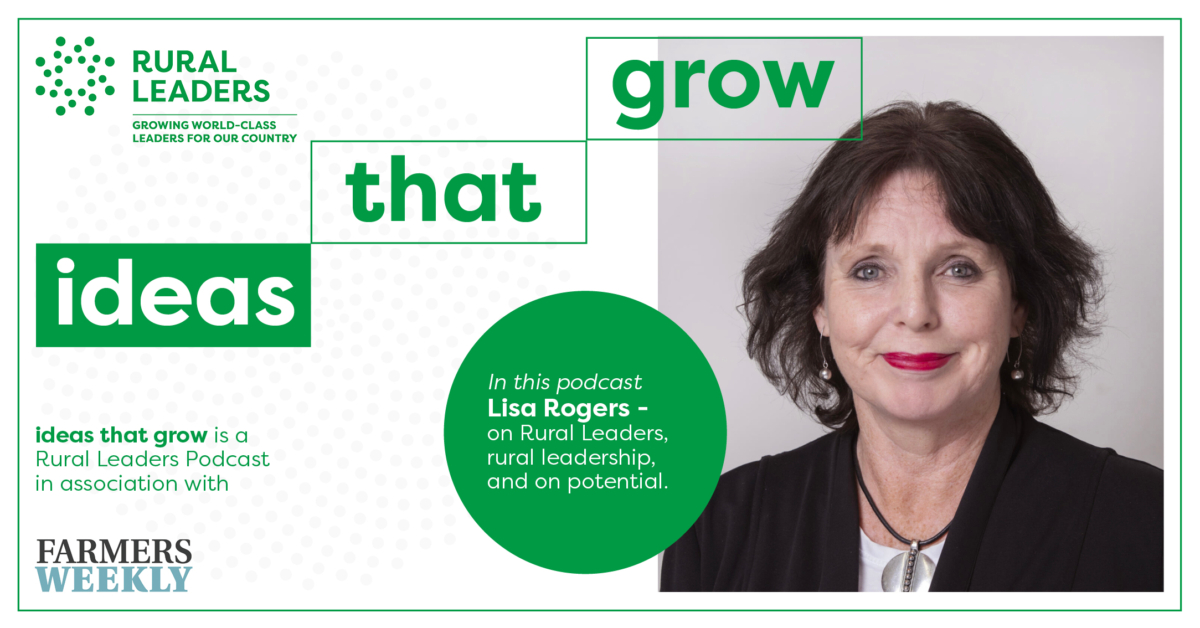
Lisa reflects on her nine-year tenure, the growth of Rural Leaders, and the lasting impact of programmes such as Kellogg and Nuffield.
She highlights leadership development, collaboration, alumni influence, and the organisation’s vital role in building confident, capable leaders for New Zealand’s food and fibre sector.




Episode Transcript
You’ve joined the Ideas That Grow podcast, brought to you by Rural Leaders. In this series, we’ll be drawing on insights from innovative rural leaders to help plant ideas that grow so our regions can flourish. Ideas That Grow is presented in Association with Farmers Weekly.
Bryan Gibson, Managing Editor of Farmers Weekly:
Welcome to Ideas That Grow, the Rural Leaders podcast. I’m Bryan Gibson, Managing Editor of the Farmers Weekly, and we have a very special guest this time to see out 2025. It is the outgoing, as we now know, Chief Executive of Rural Leaders, Lisa Rogers. Kia ora Lisa, how’re you going?
LR: Lisa Rogers, CEO Rural Leaders:
Kia ora, Bryan. I’m going really well, thank you, as we head into the final phase of what has been another really productive year for Rural Leaders.
BG: Now, you’ve been with the organisation more than a decade, and about two and a half of as the Chief Executive, how does it feel to be stepping away?
On Rural Leaders and Kellogg.
LR: It’s bittersweet in some ways because I’ve got a fantastic team and I’ve met so many amazing people throughout our sector over the nearly nine years that I’ve been with the organisation, and it’s been very hands-on all through that time.
But at the same time, really excited for moving into a new chapter for myself, but also know that the team is just in such a great spot in the organisation as well. I think that’s one of the best legacies that any leader can leave, is knowing that the organisation can just keep hurtling along in a way that’s actually going to make everyone proud of what we’re doing.
BG: My apologies there. I added a couple of years to your age.
LR: Oh, yeah, that’s all right. Sometimes it feels like it’s been decades. In a good way.
BG: Now, I’m a member of the alumni. I can tell that we do age people prematurely.
LR: You had an awesome time as a Kellogger. How have you found that experience afterwards? How did it change you, Bryan?
BG: It changed me massively, to be honest. You have a narrow view of yourself and what you’re good at, and you don’t know whether that can translate into bigger things, I guess. The course, the specific things you learn, but also just the talking to people and meeting people and that thing, it makes you realise that, yes, you can do big things, and actually that skill set that you have is really valuable. Yeah, no, it’s really cool.
On potential.
LR: Yeah, the amount of personal growth that we see in people is extraordinary. And that’s the biggest satisfaction that I take out of all of my time is watching these people who, in my opinion, like buds of a flower where they’re just all potential. And they actually realise that going through. But a lot of them, it’s happening so slowly that they don’t always realise until they get to the end. And then they reflect and they go, wow. And it’s that sense of being able to have self-confidence in that being self-aware is what we absolutely love in our programmes, and actually for the sector as well.
I think a lot of our people in Food and Fibre are a fairly low key about their own ability, and they may not have always been in environments where that’s actually been celebrated or highlighted. To be able to bring that out in people is just extraordinary and show them that they’ve got all this value and knowledge to contribute as well, which is cool. As an aside, we often do a survey on who’s doing what around the sector.
Alum from our programmes are just hugely represented in leadership positions throughout food and fibre sector, which is really important because otherwise, we will have the same people being, dare I say, worked to death slowly.
It’s massively important for these people to be coming through and have the confidence to start stepping up into roles where it could be governance, it could be politics, it could be leadership in an organisation, all sorts of things that they can contribute towards. So it’s wonderful.
On productive discussion and debate.
BG: One of the other key things, I think maybe I think about it more because of my job as a journalist, but the programmes create an environment where you can, for want of a better phrase, argue with compassion, if you know what I mean. You can thrash out these big challenges. Everyone’s coming from a different place, but everyone respects everyone else.
LR: Yeah, I think setting the ground rules nice and early around that in our programmes, but also the people that are selected to attend these programmes as well. They have a little bit more of that social understanding of how to actually do that. Having what are really productive conversations and debates, but everyone can go out and have a beer at the end of the day, is such a mature and enlightened way of being able to thrash out these ideas, because if we can’t do that, then everyone just sits in their own little corners, don’t they? And we get nothing done as a sector. I suppose underlying that is collaboration, really, isn’t it? But it’s without actually using collaboration as the word. It’s just inherent in everything that we actually do, which is so good.
BG: I guess related to that, most people are pretty familiar with the Kellogg and the Nuffield programmes. But of course, that discovering new perspectives on our world and our food production sector, that really fits into some of the other programmes you have, like the Value Chain Programme.
On Rural Leaders’ recent history.
LR: So when I reflect, as I am at the moment. I started nine years ago, Anne Hindson, who set up New Zealand Rural Leadership Trust as the first CE, did an amazing job of bringing together two of our most iconic programmes in the sector, so Nuffield Farming Scholarships and the Kellogg Rural Leadership Programme. Both of them had been going for a long time.
We’ve just celebrated 75 years of Nuffield Farming Scholarships in New Zealand. They needed a bit of a refresh in being able to bring in both programmes together gave them a new lease of life, as it were. I started working with Anne, and that was an amazing opportunity to start from the ground up with an organisation. And then as we’ve gone along, we had Chris Parsons join us in 2020, and he pushed the accelerator, on that and said, there’s more that you can do, and gave us the vision to actually see how that could be possible. That was awesome as well to start accelerating at quite a swift rate of knots. But since then, and under my tenure, we now run five different programmes in the calendar year.
Kellogg gets run twice, and then we do quite a few bespoke programmes as well. Those bespoke ones are usually a spin-off of what our Engage programme is. It is a joint venture with us in Lincoln University, and that is all around capability for people coming into the sector, but it’s also about continuous learning and improvement for different organisations throughout the sector as well.
We’re doing some really neat stuff around that that’s short and sweet, so different to our longer, traditional programmes. There’s a real need for that in the sector. We’ve got all the fantastic contacts and people who give us their time because they value what Rural Leaders does. I think that’s one of our biggest legacies that we’ve got, is that people understand the value of what we do.
On collaboration.
So as a result, we’ve got this amazing stable of programmes, and we love working with other organisations as well. So every now and again, we get the opportunity to partner up with some of our other friends in the sector or offer opportunities to attend our programme as ways of increasing that applying for newer people into the sector, for example, working with Young Farmers, Federated Farmers, and Dairy Women’s Network.
Having this big ecosystem or a whanau is It’s amazing for us to get to know all these different people. There’s room for all of us in the sector. Nearly 380,000 people in the sector. I think if you can’t find a space in a niche for everything, then there’s something really fundamentally wrong. We fully get that. Times are tough at times for our producers. The first thing that can often have a line put through it is training and development. We get that because sometimes it really does come down to those last few dollars.
I think most people understand the value of what we’re doing. To our credit in the sectors as well, and our investing partners with whom we literally couldn’t do this without them. We’ve seen through COVID, we’ve seen through tough times out there for return on farm, and people are still valuing that development and that leadership training and experience people are getting through our programmes.
BG: One amazing thing I’ve just clarified in my head, you do these big projects as part of the Kellogg or Nuffield Programme. As someone who’s done post-grad tertiary qualifications before, that’s all well and good, but with the Kellogg Project, especially, it seems like it’s just not for you because you’re contributing to a pool. It has ramifications for your small wedge of the pie, the bit of food production you work in, and for the sector as a whole. It’s more you’re doing it for something bigger than your own.
On alumni and their research.
LR: Too right, Bryan. We see our alumni and our reports as our two biggest treasures of troves, as it were. Actually, one of the team, Matt Hampton, did a bit of digging the other day and realised that we’re in the top five (holders) of rural research reports that are sitting with any one organisation in New Zealand.
They’re free for everyone to access. They’re sitting there on our websites, and a lot of them are incredibly topical years after being written. The way for us to keep pushing those and making sure that they’re available and through different tools that we’ve got available on our system is extraordinary.
There’s about 1,500 alumni in total for the Rural Leaders programmes, which when you think that Nuffield has had about 194/195 in total in 75 years, It just goes to show it’s a pretty special group of people. We don’t like to think of ourselves as being in any way exclusive or anything, but we are special. The value that our alumni get over the years when they reflect on that is something that we’re seeing through people approaching us for legacy payments and gifting as well, which you get that at a university level.
You don’t always see that in our programme that you’ve done with an organisation. We are incredibly thrilled to be able to be part of that. But in my nine years, I reflect, I’ve had direct contact or seen over 400 Kelloggers go through. I’ve had at least 40 Nuffielders do their programmes as well, and countless others for Value Chain and Engage and the HortNZ Leadership Programme. The touch points with our alumni are incredibly important and very special to me. It’s been quite a, not bittersweet, but satisfying to think that we’ve had a really positive impact on so many people around the country.
BG: I guess looking big picture, given some recent struggles in terms of big challenges in our sector, there has been a lot of naval gazing about how we develop leaders, how do you go about it? Do we set our future leaders up well to succeed or do the people who give them the mandate, understand what they’re doing, all these big things. Obviously, Rural Leaders is one of the big pipelines of leadership skills and strategies, that sort of thing. What’s your take on where we’re sitting at the moment?
LR: I think it’s always going to be something that needs focus continually. You can’t take your foot off the accelerator. To bring people through into those leadership roles is vital. I also believe strongly, but in a really positive way, that our Māori scholars are also in demand.
We need a lot more of our fantastic Māori Kellogg and Nuffield Scholars to step up into these roles and encourage that, but they will do that in their own way in their own time. We’re here to support, of course.
BG: I guess I speak for every person who’s done a Kellogg or a Nuffield to say thank you for your leadership of the programmes over time and wish you best in whatever you choose to do next.
LR: I’m laughing with some of my friends and saying I’m having a gap year at last. But no, certainly we’ll be looking to be back into it again by April, May. That’s when I’ve got something organised. But in the meantime, going to be enjoying a fabulous summer off. And those who know me all know that that probably involves a bit of golf and lots of time with family and friends. So couldn’t be happier. But also my team here know that if they ever need to know where something is or something that they were thinking about a while back, they can always ring me.
But yeah, I’ll definitely leave with a lovely smile on my face because I know that the organisation is in great heart and thriving. Yeah, so awesome.
BG: Excellent. Thanks, Lisa.
Thanks for listening to Ideas That Grow, a Rural Leaders’ podcast presented in Association with Farmers Weekly. For more information on Rural Leaders, the Nuffield New Zealand Farming Scholarship, the Kellogg Rural Leadership Programme, the Engage Programme and the Value Chain Innovation Programme, please visit ruralleaders.co.nz.