2026 Nuffield NZ Farming Scholarship. Apply by 17 August 2025. Read More...

Apply for 2026 Nuffield NZ Farming Scholarship by 17 August 2025. More details...

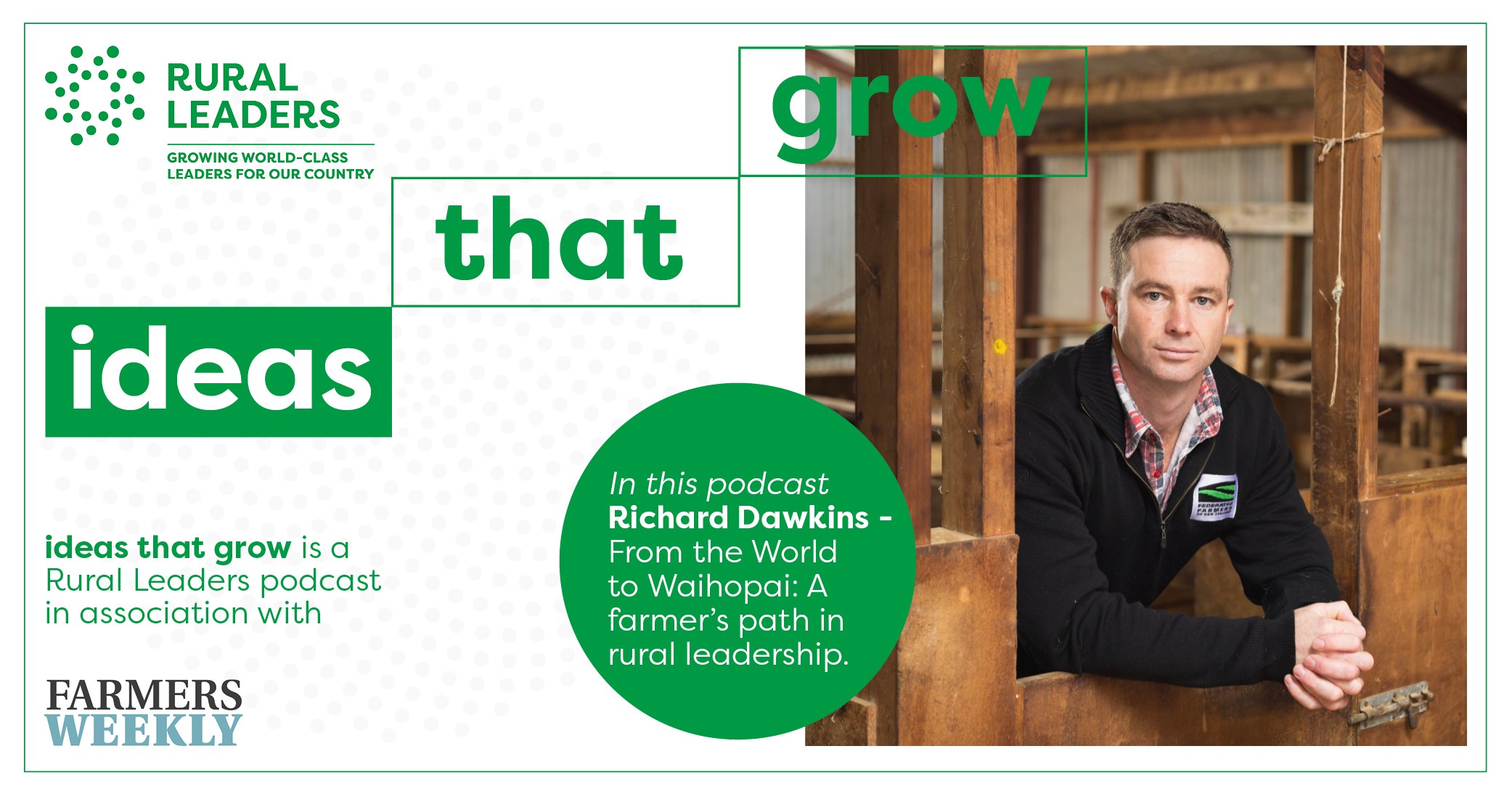
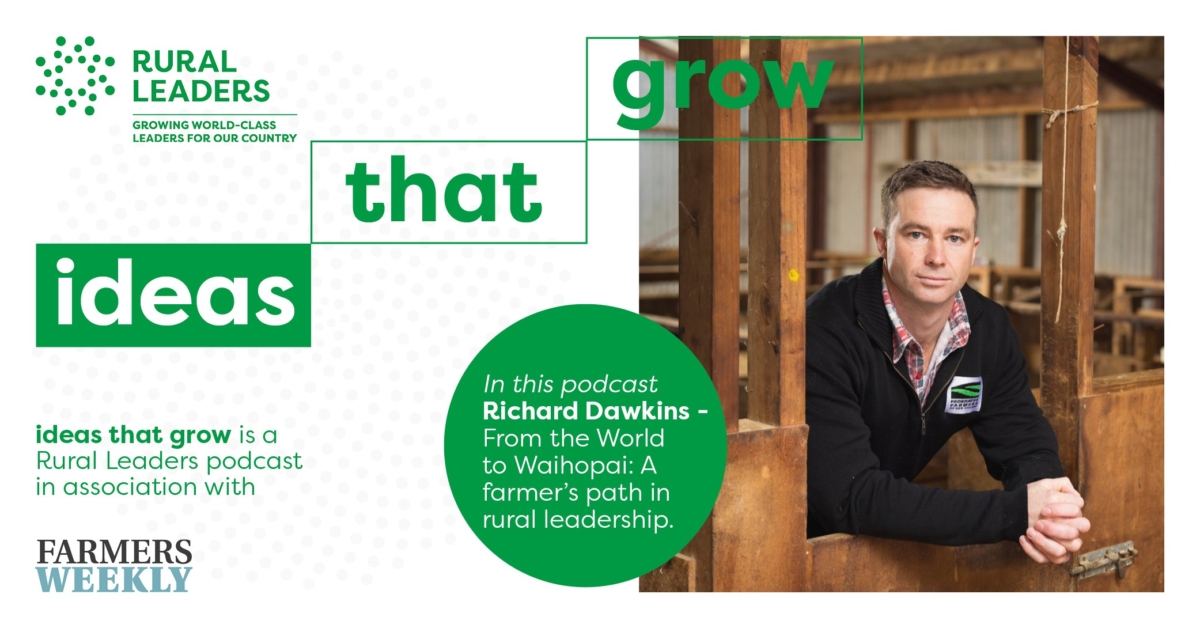
Richard Dawkins – from the World to Waihopai. A farmer’s path in rural leadership.

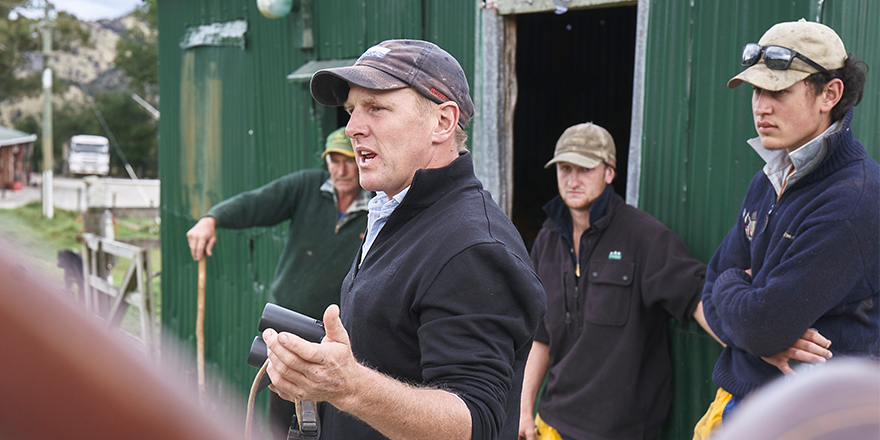
In this episode of Ideas That Grow, Bryan Gibson, Farmers Weekly Managing Editor, talks to Richard Dawkins, 2023 Kellogg Scholar and Marlborough sheep and beef farmer. Richard is also the new Meat and Wool Chair for Federated Farmers.

Richard discusses his family’s diverse 602-hectare farm operation, which includes sheep, cattle, forestry, and viticulture. He shares his experiences abroad and how returning home reignited his passion for farming.

Richard speaks about his Kellogg Rural Leadership Programme journey and research on lamb and ewe mortality, emphasising the need for better data and body condition scoring.

The discussion also covers leadership, collaboration, and the importance of timing when engaging in personal development.

Listen to this episode of Ideas that Grow, or click on one of the platform icons below to listen on your favourite player:


Episode Transcript

You’ve joined the Ideas That Grow podcast, brought to you by Rural Leaders. In this series, we’ll be drawing on insights from innovative rural leaders to help plant ideas that grow so our regions can flourish. Ideas That Grow is presented in Association with Farmers Weekly.

Bryan Gibson, Managing Editor of Farmers Weekly.
You’re with Ideas That Grow, the Rural Leaders podcast. I’m Bryan Gibson, the Managing Editor of Farmers Weekly. This week on the show, we have the new Meat and Wool Chair for Federated Farmers and Marlborough Sheep and Beef Farmer, Richard Dawkins. Richard, how are you?

Richard Dawkins, Farmer, 2023 Kellogg Scholar:
Yeah, good. Thanks, Bryan. The sun’s threatening to shine here, so we’ll take that as a win.

BG: Yeah, being pretty wet down your way, hasn’t it?

RD: Yeah, absolutely. We recorded 138mls in 24 hours, which was a record for us since 1954, but certainly, none of the damage compared to over the hill.

Farming to suit your environment.

BG: You farm up behind Blenheim, and you’re the latest in a long line of people in your family who have farmed there.

RD: Yeah. We’re 30 kilometres southwest of Blenheim, up the Waihopai Valley, or the Avon Valley, just off the Waihopai. I’m the third generation on the land, and my children will be the fourth. My wife, Jess, and I came home a decade ago and since have taken over and have three children.

BG: Excellent. Can you just Can you tell us a little bit about your farming business?

RD: We’re 602 hectares. The livestock side of the business is a composite ewe flock. We’re about 60% sheep and 40% cattle. We also do Jersey bulls, service bulls for the dairy industry, and some Friesians, which are just a straight fattening proposition for the works.

Our motto here has always been, you farm to suit your environment. You don’t modify the environment, you modify your farm systems to suit. We start lambing next week, late July, and main weaning is in November, and we sell all the lambs at weaning.

Last year was a record for us, actually. We sold 96% of the lambs straight off mum at 43. 5kg’s. Composite ewe flock, Jersey Bulls, a few Friesians, but we also have 20% of the property in farm forestry and 135 hectares of viticulture.

BG: Quite a diverse operation you’ve got going.

RD: Yeah, you have to be these days, don’t you? My father said in the late ’80s, 65% of his income was from wool. We’re now down under 1%, so yeah, just need to diversify those income streams a bit.

BG: Now, you mentioned you came back to the farm about a decade ago. You grew up there, I guess. What did you do after school?

Seeing the world before farming.

RD: Jess and I spent significant time in Western Australia. Funnily enough, we were in a different industry. We spent a fair amount of time working in the mines in WA near Kalgoorlie, and Jess was further north in Karata. But then we spent time in the United Kingdom as well, and it was really interesting to see their farm systems. I did a bit of labouring on farms. I worked on a dairy farm, more of an indoor system over there, and did a harvest up in Norwich, drove a lot of tractors.

So, yeah, that was a good experience. Good experience in Australia as well, but really glad to be home now and setting the foundation for the future, I suppose. We’re certainly not planning on going anywhere.

BG: Many, many, New Zealanders in their 20s head off to see the world. In a farming sense, do you think it’s good for people to go off and see, say, the likes of how you did a harvest a Norwich or a dairy farm in the UK?

RD: I think it is, Bryan, but there’s opportunity costs to everything isn’t there. Coming home in my mid-20s and seeing fellows in their teens who were a bit more advanced than me and had left school and gone straight into farming. It took a fair bit of catching up, which was a bit of a wake-up call.

You spend your childhood on the farm, but boy, there’s a big difference between helping dad shift some sheep and doing the tailing and things and helping in the sharing shed versus actually running a farm business. It took some catching up.

That’s what’s been fantastic about Federated Farmers is getting those farmer networks and rapidly expanding your knowledge. But at the same time, look, learning other industries, living in other countries, that was really valuable too.

Building knowledge and leadership skills.

I’ll tell you one positive was when we did come home, we were so full of enthusiasm. We hit the ground running and haven’t stopped, to be honest. Whereas some of my friends who did leave school and go straight into Ag, some of them are just thinking it’s a big wide world out there. Maybe I could go and try something else. I mean, it’s up to the individual, isn’t it? But there’s pros and cons with everything.

BG: Yeah, I often think that we see a lot of exporters and processors take farmer shareholders into export markets to give them an idea of actually what it’s like there and how people buy their food and how chefs cook it, or various other things. I think that global view and getting a first-hand understanding about how the fruit of their labour here in New Zealand is used, it can be really helpful in understanding why certain things have to happen.

RD: Yeah, for sure. I was fortunate enough to go on the Silver Fern Farms and Market Tour last year. We went through China and Korea, South Korea of course. Like you say, fantastic perspectives and quite mind-blowing, to be honest.

BG: Now, you’re a relatively recent Kellogg scholar. You went through the programme just a couple of years ago?

The Kellogg Rural Leadership Programme experience.

RD: So 2023, Phase One, part of K49. The timing for me was perfect, to be honest, in that I’d done a lot of industry stuff by that point. I had a few connections and a reasonable understanding of the bigger picture. But look, to go into Kellogg, it just really supercharged that foundation I had.

Getting those cross-sector connections, people from all walks of life, and hearing those different perspectives as well was hugely valuable and empowering. I guess since I’ve just carried on that journey, I would find very well-invested, I must say.

BG: That network that you build and the people you meet is really important. Of course, another thing they do is you find out quite a lot about yourself, which is good to what you’re good at, what you perhaps need to invest time into improving.

RD: Yeah, look, self-awareness is just absolutely essential. That was a big thing that I took out of it. It can be very confronting, but I think you go in as a bit of an unpolished diamond, and you have those courageous conversations and have that self-awareness.

You may be smooth off some of those rough edges. But some of those things you need to embrace, too. I’ve recognised that. Hey, I’m pretty extreme in this area, and maybe I need to tone it down sometimes. But look, maybe that makes me the man for the job with certain tasks. So, embrace those things as well.

Lamb and ewe mortality, leadership, and learning.

BG: Totally. Now, of course, a big part of the Kellogg Programme is the report you write. You looked at mortality in lambs and ewes?

RD: Yeah. I called it ‘Addressing Mortality in New Zealand Lambing Systems’ because I didn’t want to just purely focus on the lambs. Mortality in ewes is a huge issue as well. The findings were quite interesting. I guess the major takeaways were there’s not actually strong data sets out there.

The actual extent and understanding of the issue is not particularly good as an industry. Probably the lowest hanging fruit for progress is simply body condition scoring and feeding.

On the farm here, we take it to the enth degree, and we lamb our triplets indoors to give them extra care and attention. But look, as an industry, I think getting those body condition scores up and getting those pasture covers up prior and post-lambing is where we’d see the biggest gains.

BG: Now, you talk about data. I guess in a lot of cases, what happens on the farm stays on the farm in some ways in terms of the snow rolls in or whatever down in the high country and losses that no one quantifies in some ways.

RD: Yeah. It’s a real catch-22, isn’t it? In that our strategic advantage, our point of difference is those outdoor lambing systems. It’s free range for sure. How do you balance the welfare aspect versus that strategic advantage? I think the absolute majority of New Zealand farmers and farm systems are geared towards that low input, medium fecundity type breeding.

We do the indoor lambing here because we’re a highly fecund composite ewe flock, and it’s pretty simple at the end of the day, isn’t it? A ewe’s got two teats, and when she’s spitting out three or four lambs, I don’t think it’s controversial to say she needs a bit more TLC.

BG: Yeah, totally. In the drive for efficiency, which has been excellent over the years in the sheep and beef sector, that’s something everyone keeps in mind, I think.

RD: Look, and these composite ewes are amazing. Those ewes that leave the shed with three lambs, their average weaning weights, the combined weight of their three lambs was 110 kilos. That was at 105 days of age. So three lambs, straight off mum to the works, that’s about the most efficient ewe in the country. They’re big ewes, they’re 80 kilos at mating. But when you’re weaning 110 kilos of lambs, it’s worth putting the effort in. I mean, that’s just 1% of the flock, Bryan. Certainly not every ewe, but it is very rewarding when you get to weaning and all your effort pays off.

BG: Your project obviously completed, submitted, but it seems to have been read by some of the organisations that matter in our sector.

RD: I won’t take credit for that, I suppose. But it’s great, really cool to see Beef + Lamb  New Zealand pick up a lamb survival module now. I was involved behind the scenes, just having those discussions and organising a few things, bit of a working group. I’ve had a few podcasts and also going to have workshops around the country just focusing on lamb survival. That was one of my key recommendations. So full credit to them. It’s great to see.

Federated Farmers Meat and Wool Chair and further study.

BG: Now, obviously, the Kellogg Programme is based around growing rural leaders in our sector. You’ve come up through Federated Farmers, and you’re the new Meat and  Wool Chair. So it looks like you’re taking the ball by the horns in terms of leadership roles.

RD: Like I said earlier, it really did turbocharge things. I did learn a lot, learnt a lot through the process, but I think the biggest thing it gave me was confidence. Like, look, I can go through 500 hours or whatever I invested in. I was part of those deep conversations. I understood everything, had a really good cohort, and it just gave me that confidence to push to the next level.

It made me realise, hey, you are ready for those leadership positions. But it really was a foundation. One of the biggest takeaways for me was it’s fantastic work by the Rural Leaders team. I’ve actually connected the Kellogg Programme through Lincoln and Massey, and actually you can achieve a Postgraduate Certificate in Commerce.

That actually gains you entry to a master’s-level programme. After the Kellogg Programme, I went on to studying a Master of Business, and that’s taken all of that stuff I learned through Kellogg to a whole other level. That’s a fantastic opportunity for anyone. If they’re considering it, I’d be happy to talk people through that process.

BG: That’s excellent. I didn’t know about that. How are things going with Feds? How are you enjoying being on the National Exec?

RD: Look, it has been an absolutely flat out first fortnight. I probably look a bit tired at the moment. AGM and conference, followed by a lot of conversations. Obviously, a lot of media. We’ve had our oral submission to the select committee, and then on to the Silver Fern Farms Conference and all of the governance work that goes on in the background, the advocacy, the exciting stuff, the fun stuff.

But hey, this is a fantastic organisation. You have to govern as well. So, yeah, it’s been absolutely completely flat out. I think that may slow down a little bit, but with advocacy, the work never ends, and then we’ll be full steam ahead, trying to achieve what we want to achieve for not only the meat and wool council, but obviously every member too.

BG: It’s a big job and a big responsibility being the voice of our farming sector to not only the Beehive, but also the wider population of New Zealand, I guess, that you really are the window into that world.

Putting leadership development into practice.

RD: Yeah, you absolutely are. Look, it is a real privilege. When you come under a bit of pressure and you’re finally in this position, I guess your natural style comes out, shines. I’ve just realised that I’m more of a collaborator and a facilitator of these discussions. I don’t have a monopoly on good ideas. I have a fantastic council behind me, 24 men and women who volunteer their time and seven on the executive.

I think you need a bit of courage. Courage takes many forms. It’s putting a line in the sand and saying, this is not good enough, it needs to change. You probably saw that with the oral submission, the bill as it stands, isn’t fit for purpose. But courage is also saying, hey, I don’t know everything. Can I facilitate this discussion? Let’s get four or five people in a room and work out the pathway forward.

I mean, you’re never always going to agree, but at least have that talking to a friend or someone close to you and saying, This needs to change, that needs to change. We need to tidy up this area or that area. Actually, one thing I’m struggling with, which takes a bit of courage, is just learning to delegate. As a farmer, you see a problem, you want to go and fix it. But takes a bit of courage to say, Hey, I’ve got a bit much going on, or, You’re actually better at this than me, so could you please take care of it?

Again, we’ve got this council full of enthusiasm. So, yeah, quite often they’re willing to take up that mantle. And look, it’s just hugely appreciated these people volunteering their time, not for me, but for the whole sector.

BG: If someone’s out there thinking about developing their leadership skills to maybe looking at governance or just their own personal growth, the Kellogg Programme, something you’d recommend?

Get involved, be part of the bigger conversations.

RD: Look, it is, but I think it’s all about timing. I would really I encourage people to do a bit of that local provincial, maybe it’s volunteering any leadership position, and just do a bit of that.

Be part of those bigger conversations, those sector-wide conversations. Join your Federated Farmers and get involved. Join your Beef + Lamb New Zealand, various councils or working groups they have, or your rural advisory groups, things like that. Just get a bit of experience on that side of things, then go for Kellogg.

I think if you were just starting your leadership journey, you might not get as much out of Kellogg as you potentially could. But once you’ve done that foundation work, it’s absolutely fantastic.

BG: Thanks for listening to Ideas That Grow, a Rural Leaders podcast presented in Association with Farmers Weekly.

For more information on Rural Leaders, visit the pages for Nuffield New Zealand Farming Scholarships, the Kellogg Rural Leadership Programme, the HortNZ Leadership Programme, the Engage Programme, or the Value Chain Innovation Programme.
Commercialisation learnings for Agritech

Executive summary

There is a growing global demand for agritech to solve major global issues, such as climate change, water use and quality, and increased yields from food and fibre to feed the world’s population.

Whilst New Zealand has a proud history of primary sector innovation, there are only a handful of agritech companies of international significance. The 2020 Aotearoa Agritech Unleashed Report opined; “Compared to our international peers we are punching below our weight in our relative economic value and export earnings from agritech”.

What can New Zealand agritech companies do better to commercialise their innovations to grow the sector, but ultimately to help solve these global challenges and in the process advance New Zealand’s international competitiveness in primary production and grow our export earnings.

This report has undertaken to seek learnings and insights of what successful commercialisation of innovation looks like and apply this to a New Zealand agritech context to present key denominators for successful commercialisation of agritech.

The study completed literature reviews of academic, industry and business publications across innovation and agritech, together with semi-structured interviews with New Zealand agritech practitioners.

Thematic Analysis was applied to the body of research and interviews to capture the Key Findings and related Recommendations as follows:

1. Engage in Critical Self-Assessment:

Critically evaluating whether the agritech founder has a minimum viable product with initial customers to get to the start line. To be commercially successful at scale requires ongoing discipline for critical self-assessment of:

  • Total addressable market; develop a clear understanding at the outset of the addressable market, validating the innovation to that addressable market, what investment is required and the profit model.
  • Founders’ skills, traits and shortcomings; actively build a team with complementary skills and capabilities requiring the right industry and functional expertise (technical, operational, commercial and financial) with an ability to execute.

2. Value Proposition:

Develop and define a clear and (relatively) material value proposition for the adopters of the innovative solution. The Founders need to be focused on delivering a client solution (not an innovation).

3. Business Model:

Bring together the component parts to execute the commercialisation growth, including:

  • Product and market lifecycle; recognise and plan for the innovation to evolve from the initial core product and early adopter market to an augmented solution delivered and serviced for a mainstream market which requires active planning for channel to market, wrap-around solution, communication strategies and services model.
  • Resources; The resources required to execute, not just the team and governance, but broader relationships, suppliers, channel partners, components, facilities etc.
  • Profit Model & Capital structure; continually evaluate the commercial model and align with a fit for purpose capital structure. If external capital is required to support the company to break-even, then ensure that “smart” capital is pursued with the right industry experience and networks for execution.

The approach and recommendations have been brought together into a Framework of Key Denominators to Enhance Successful Commercialisation of Agritech (show in Figure 11 of the report).

The key themes, or denominators are all inter-related, they cannot be approached or applied in isolation. The framework is not a one-size-fits-all but a valuable roadmap to be evaluated and adapted for each unique agritech innovation and market opportunity.

Murray Dyer

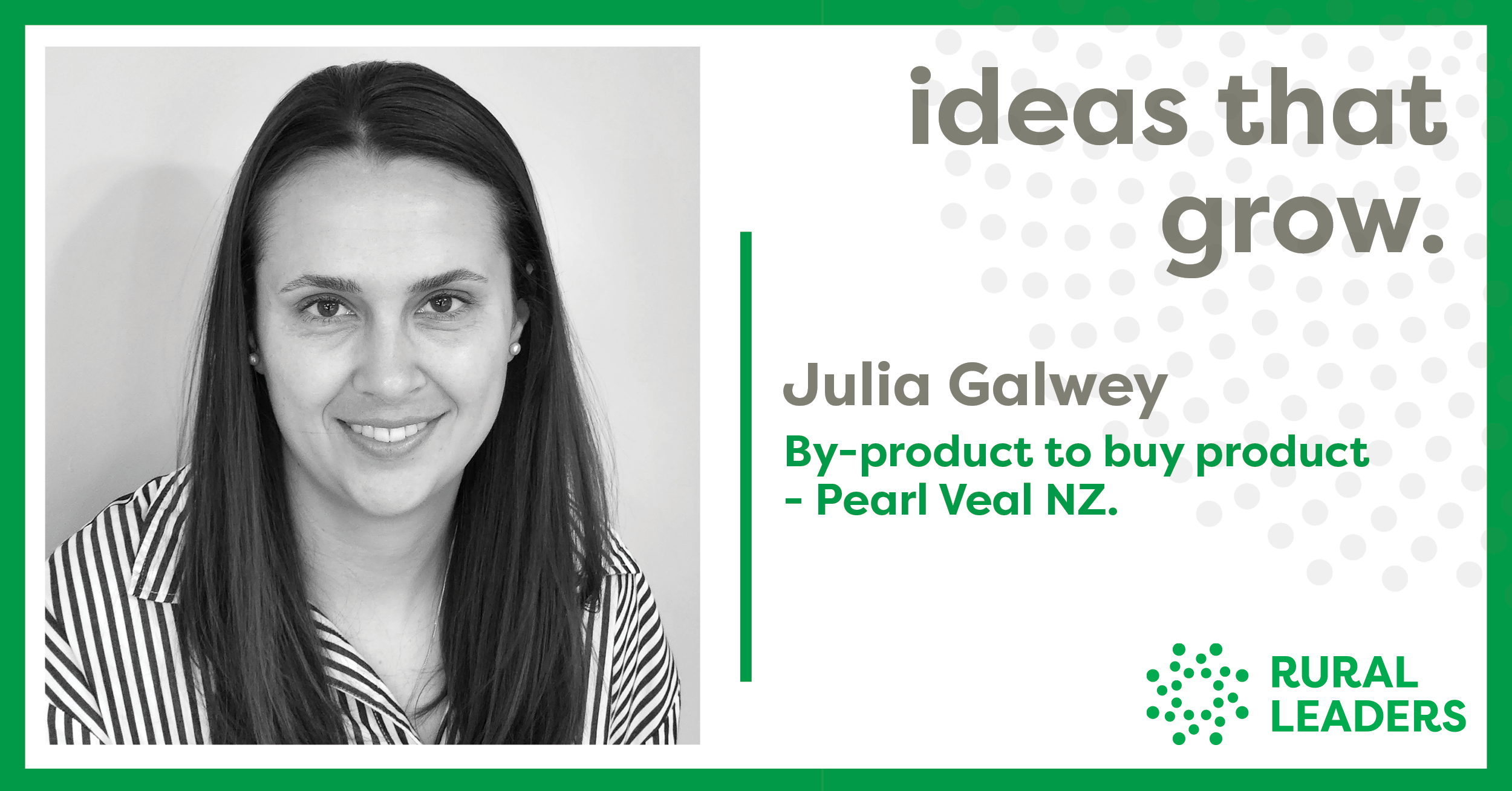
Julia Galwey. By-product to buy product – Pearl Veal NZ.

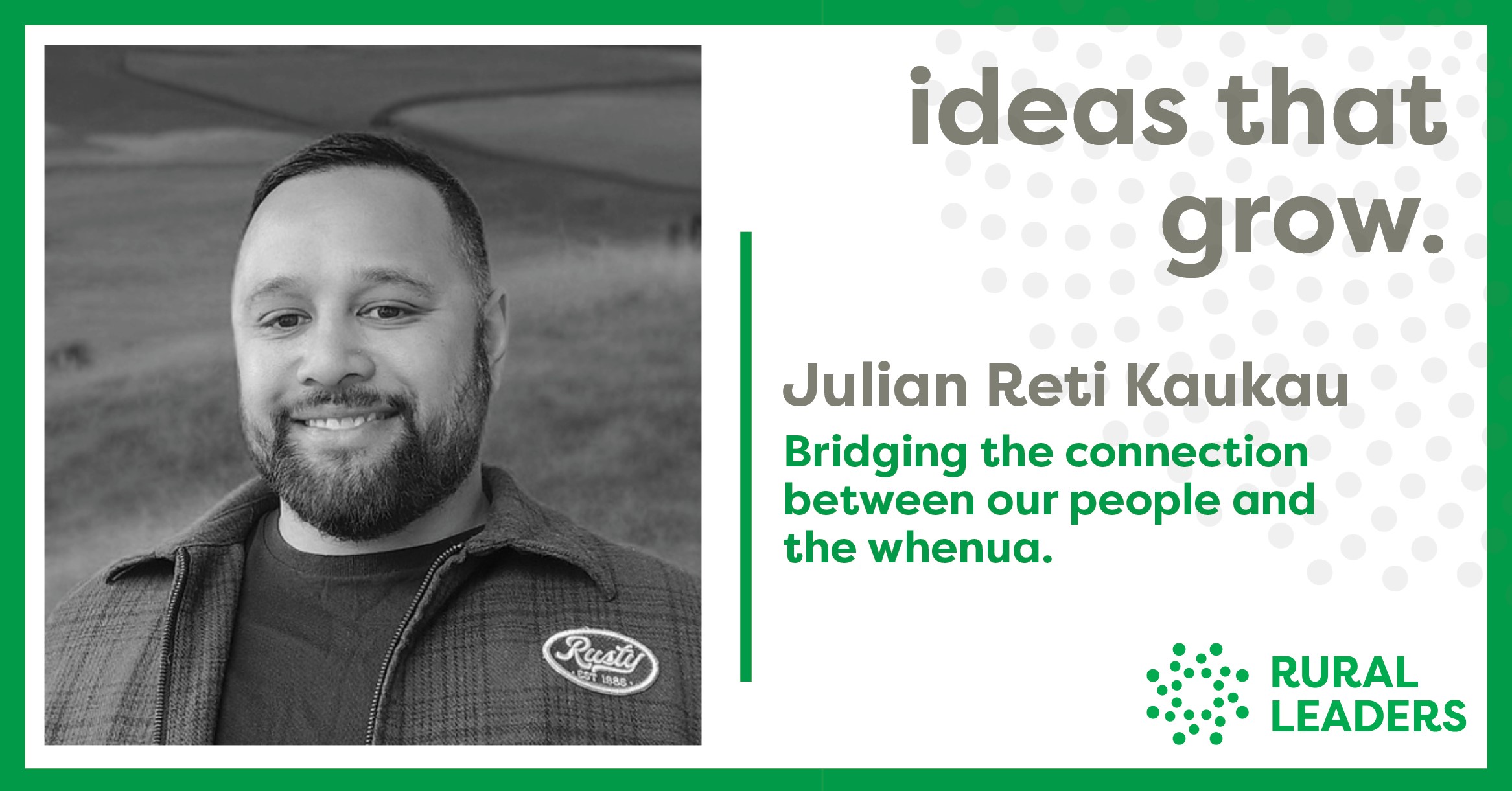
An innovation story that covers the journey from an idea to the challenges of development, and to implementation. Julia Galwey, 2020 Kellogg Scholar, talks about Pearl Veal NZ, a new sustainable utilisation of the bobby calf resource.

Pearl Veal NZ was the winner of the Silver Fern Farms Market Leader Award at the 2023 Beef+LambNZ Awards in mid October.

Listen to Julia’s podcast here or read the transcript below.

Bryan GibsonManaging Editor of Farmer’s Weekly.

Kia Ora, you’ve joined the Ideas That Grow podcast, brought to you by Rural Leaders. In this series, we’ll be drawing on insights from innovative rural leaders to help plant ideas that grow so our regions can flourish. Ideas that Grow is presented in association with Farmers Weekly.

My name is Bryan Gibson, Managing Editor of Farmers Weekly and this week I am talking to the recent winner of the Market Leader Award at the Beef and Lamb New Zealand Awards, Julia Galwey.

Bryan Gibson:
G’day Julia, how’s it going?

Julia Galwey, 2020 Kellogg Scholar and Co-Founder Pearl Veal:
Good, thank you Bryan. How are you?

BG: Pretty good, where are you calling from today?

JG: I am calling from my home office in Christchurch.

BG: Nice. Have you been getting all the wind we’ve been getting up here?

JG: Yeah, it’s been pretty mixed bag at the moment. Very much spring weather.

Winning at the Beef+LambNZ Awards.

BG: Yeah. Now, it was a pretty big time for you, the Beef and LambNZ Awards.

JG: Yeah, it was pretty neat for Pearl Veal to be recognised at such a wonderful event. Just have an evening of celebrating lots of positive things happening in the industry with the various finalists and category winners. A big thank you to Beef and LambNZ for hosting the event, and also to Silver Fern Farms for sponsoring the market leader category.

BG: Yeah. Now, can you just tell us a bit about your background in the food and fibre sector?

Background - Julia Galwey, 2020 Kellogg Scholar.

JG: Sure. I grew up on a sheep and beef and deer farm near Fairlie in South Canterbury. Then I headed off to Lincoln to do an Ag Science degree. Following that, I had six years in the agribusiness team for ANZCO Foods based in Ashburton, which was a neat team to be involved in, and a really varied role, that got me going in the meat industry.

Then in 2018, Alan McDermott and myself, we set up Agri-Food Strategy, which is our own agribusiness consultancy company. It focuses on working with farmers and agribusinesses to address strategic challenges and opportunities. I guess, again, it’s been pretty varied in terms of the work I’ve been involved with in that space.

BG: Now, you took on a Kellogg Scholarship in 2020, which, of course, was the year of the lockdown, if I remember correctly. You chose to do it on a value chain for veal. What made you think of that subject?

Kellogg research into the potential of the bobby calf resource.

JG: Good question. Yeah, I guess the idea to look at this for my report was just being around the meat industry and the bobby calf topic continues to come up in conversations. There just wasn’t really a lot of information that I could see here in New Zealand in terms of looking at older veal animals as an option for this resource, a by-product of the dairy industry. I didn’t really want to focus on the discussion or debate around the bobby calves themselves. I did for some context in my report, but I just wanted to focus on looking at one potential solution or opportunity for utilising some of that resource.

BG: Then, of course, it’s one thing to write a report about this stuff, but you carried that on and started a business. How did that get off the ground?

JG: I guess while I was doing my research report, there’s a few things that came up in terms of some learnings and drivers or motivators. One of them was probably around learning how much of a bigger risk the bobby calf thing was here in New Zealand. Especially compared to other countries in terms of the scale, with our couple of million versus Australia would be the next biggest, at around 400,000.

The report highlighted we were out there on our own in terms of how big of an issue it might be going forward. Some of that, was a bit of a driver. I learned a bit around the varying types of veal markets that there were internationally and saw some opportunity, but I really struggled to find any information on pasture-fed veal systems.

So, it became obvious that maybe there was an opportunity for New Zealand to diversify in terms of our offering in the veal space with what we’ve got here. Also, in terms of some of those credence attributes – pasture-fed, free-range, rather than copying some of the international veal systems.

From research to innovation.

As I was doing the report, Alan McDermott, who’s my business partner, was keen to have a go. We could test out what opportunity there really might be. I mean, it’s all very well, like you say, writing a report, but you just must have a go to see whether something might work or not. Halfway through my project, that’s what we started doing.

We had a quick brainstorm for a name so we could get a company set up. There are quite a few negative connotations around the name ‘veal’, which I learned a bit about while I was doing my report, in terms of some of the historic practices that used to happen in terms of how veal was raised internationally.

There was, I guess, some questions around whether we should even call it veal or not. But we talked to a few chefs, and they pointed out that we need to call it what it is. That’s what they know it is. A lot of them have trained internationally and used it before, so just stick with what it is, but make sure you build a story you can underpin your brand with. We sourced some under 12 months of age, a whole 12 of them, and found a processor that was happy to process them for us.

We set up cut specs and went along to the plant to see how it would go and then started sending some products to chefs to see what they thought. We had a development chef that we were introduced to through a contact, and he kindly took us around Wellington for a couple of days. He introduced us to a few chefs and helped us learn how that world works in terms of getting into restaurants and talking to chefs – and how to get on their menus.

Building scale.

The feedback on the product was great. We started working with the team at Synlait, including one of my fellow Kellogg cohort members, which was quite cool. They’ve been supportive in what we were trying to do and helped us connect with some of their dairy farm suppliers who were keen to give it a go and rear some calves. It’s been a nice fit for us to work with the Synlait team and some of their suppliers.

BG: How difficult is that process? You’ve got a prototype product and you’ve started with a small number of animals to begin with, then you’ve got to scale that up to something that’s a viable business. What’s the process there?

JG: It’s one of the trickier things to balance. It’s a bit of a chicken and egg in terms of you’re not quite sure in terms of what market you’ve got, but you need to get enough product that you’ve got enough to supply to a restaurant to put it on their menu. Yeah, it is a difficult balance, and some of that is just to take a risk. I guess for us, one of the things that we were quite focused on was building around the story and attributes we wanted to go around our brand. With some of that starting with animal welfare for us in producing the best calf possible.

The rearing regime and how it works.

There’s quite a lot of challenge in terms of veal as anything must be produced before the calf is 12-months old, so a lot of the challenge is around getting it to grow as fast as possible and to reach a heavy weight in that time. It needs a good start in life as a calf, to be able to do that. Some of our system was built around a particular rearing regime in terms of good colostrum.

Then we only use whole fresh milk rather than milk powder, which has had a lot of the good bits taken out of it. Milk is what’s designed for the calf, so let’s just give it that and obviously some pasture as well. But because of that rearing regime, we can’t just go out and get any calf on the market.

It starts right from the start in terms of what we’ve built to underpin our brand. That also is a little bit harder in terms of, like you say, we’re planning what we need over a year in advance, and you don’t necessarily know what your market is then. A bit of risk, I guess, and just a balance of starting smallish so that you learn the risks, learn the things you need to iron out as you go.

BG: Getting back to your rearing regime, that must mean you need to work pretty closely with the farmers who are actually doing this stuff?

Collaborating for success.

JG: Definitely. I think the other thing in that space is the Synlait farms that we’re working with are all certified ‘Lead with Pride’, which again, helps underpin animal welfare and the colostrum management. Obviously, our contracts have got the rearing regime outlined in them, and we talk them through what that looks like and why. We also don’t have meal as part of our rearing regime. Part of that is around wanting to remain grain-free, so 100% pasture-fed and antibiotic-free, so that we can look at going into the US market in time.

Again, it’s the whole fresh milk, no meal. It is a bit of a change to how calves are traditionally reared here. We’ve got to work closely with the farmers on what that looks like. We’re thankful for those first few farms that were willing to take a bit of a risk and rear and finish calves for us.

We were a couple of random people saying, here, we want to contract you to rear these calves in a particular way and finish them through to an age and weight that’s not traditional here. They had to trust a bit that we would take them when we said we would and have a processor to process them and pay them.

I guess that’s probably also part of what’s been quite helpful working within the Synlait team. That helped farmers have a go. There’s just some great farmers out there that are keen to try something different and learn with us, which has been nice.

BG: Yeah. Now, who are you selling to now? What are your export markets, or locally?

JG: Currently, we are pretty much mostly domestic market into high-end restaurants. We’ve just started doing a little bit into some smaller retailers here, and we’ve just started a little bit of export.

BG: Now, obviously, the bobby calf issue is one that New Zealand’s farming industry is grappling with. Do you see this type of initiative as part of a solution?

A new veal value chain.

JG: Yeah, I mean, the bobby calf issue is obviously a big social license to operate topic in the dairy industry, and it’s a pretty tricky thing to navigate with the views of community here and also our customers and consumers globally.

I guess we just have to keep asking ourselves if we’ve got practices that we’re comfortable and being transparent about, and if not, then what are our opportunities and solutions to do something differently? I guess that’s really what we’re trying to do with Pearl Veal is.

I don’t like to focus too much on the bobby calf aspect of it. But more the opportunity that exists to take some of that resource and add value to produce a really quality veal-based product with a story and a brand that’s underpinned by animal welfare standards and a pasture-based system that we believe in. We’re proud to share with chefs and customers and consumers here.

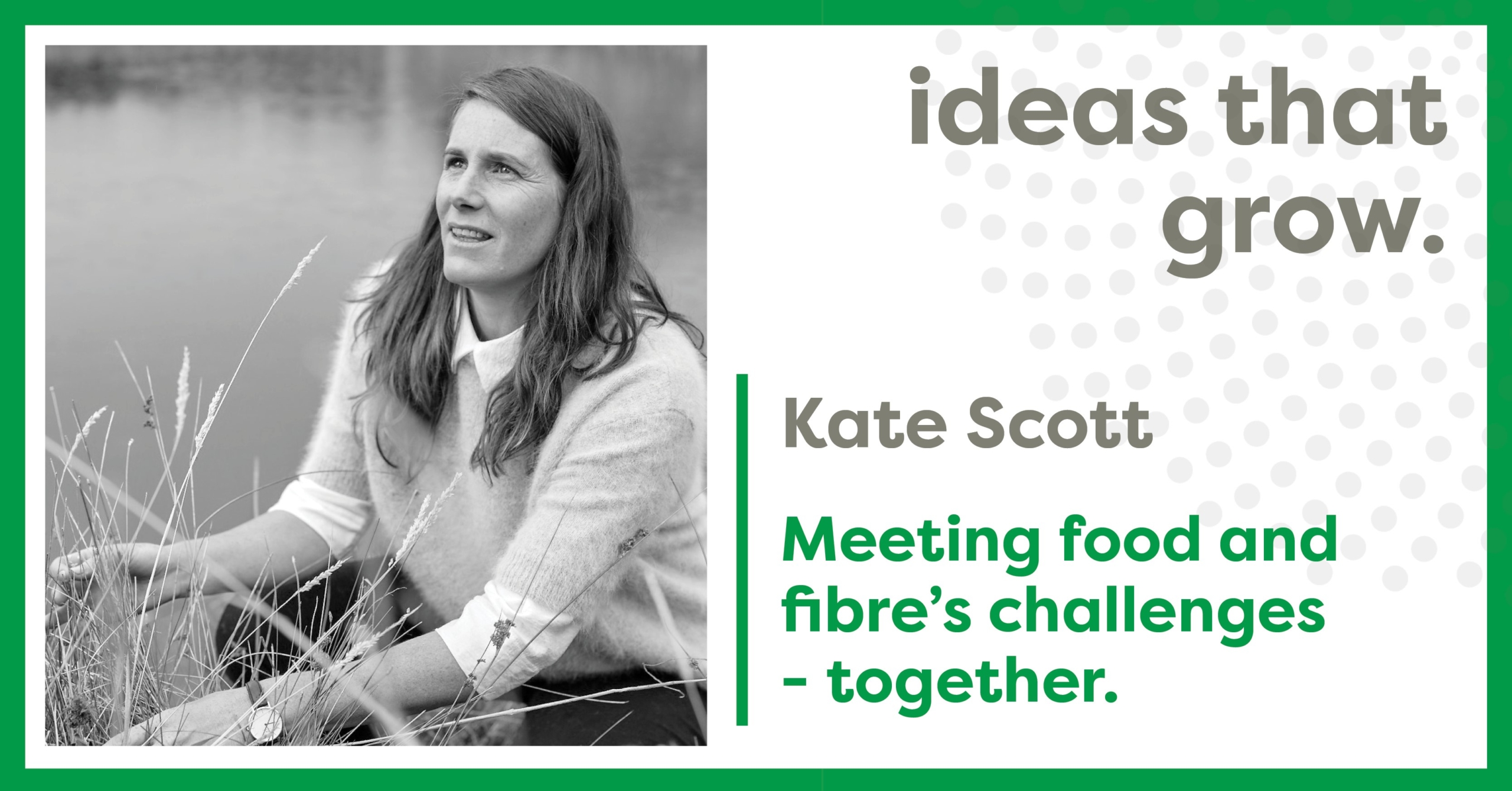
BG: Of course, back to where this all started, the Kellogg Programme –  how did you find it? Is it something you’d recommend to others who were thinking about doing it?

The Kellogg Rural Leadership Programme - where it started.

JG: Yeah, absolutely. It was such a good course and I guess a real opportunity to network too. We had such a great cohort of people. It was a good cross-sector group of people. You get to meet people that you wouldn’t normally be working with and the people and the speakers that come in are incredible. It really broadens your thinking and opens your networks and I would highly recommend it to anyone considering it.

That’s why I did it. It’s something that once people have done it, they’re always recommending to anyone that hasn’t. If you get that opportunity, jump at it. I think it’s one of those things that probably never feels like the right time when you’re in your working career because you’re always busy or home life as well. You just have to jump in and do it.

BG: Thanks for listening to Ideas that Grow, a Rural Leaders podcast in partnership with Massey and Lincoln Universities, AGMARDT and FoodHQ. This podcast was presented by Farmers Weekly.

For more information on Rural Leaders, the Nuffield New Zealand Farming Scholarships, the Kellogg Rural Leadership Programme, or the Value Chain Innovation Programme, please visit ruralleaders.co.nz

Addressing Mortality in New Zealand Lambing Systems.

Executive summary

The New Zealand sheep industry has become increasingly productive in recent decades. This has been achieved primarily through the fecundity and improved feeding of modern sheep breeds. While impressive, this world-leading production has created unintended consequences in the form of excess mortality rates. This is most notable in triplet-bearing ewes, mated hoggets, their offspring, and all lambs in adverse weather conditions.

New Zealand farm systems have a reputation for being free-range and pasture-based. Currently, consumers are unaware of, or accept a certain level of death as a natural outcome of this free-range system. However, the industry must consider whether the increasingly conscientious customers and consumers will accept high mortality levels in sheep flocks, particularly if they understand the inflated death rates following storm events and the regular wastage in higher-risk animals.

This project explores how New Zealand sheep farmers can improve livestock survival during the lambing season. Information was gathered through literature reviews, 10 expert interviews, 10 farmer surveys and three case studies. Key findings were:

  • Death rates in triplet-bearing ewes and their lambs are significantly higher than in other stock classes and the majority of these deaths occur during the lambing period
  • Industry experts and farmers unanimously agreed that lamb mortality is a problem and needs to be addressed, but few have management solutions for triplets, and a portion of farmers actively ignore the issue
  • There is a minority of top-performing farmers with management plans in place who achieve far below industry-average death rates
  • For improved welfare, mated hoggets require intensive management through the lambing period
  • There is a lack of collaboration between government and industry in funding applied science and performance-based studies to innovate further solutions
  • Farmers believe Beef + Lamb NZ should increase investment in research and development and extension work
  • While there are no market signals that current wastage is an issue, there was unanimous agreement that it could be a trade barrier. Comparisons should be made to bobby calves and future legislation being superseded by industry requirements
  • To drive behaviour change and improved outcomes, a culture shift amongst farmers is required where animal welfare is viewed as paramount through the lambing season and high wastage rates are frowned upon and considered unacceptable by peers.

These key findings were evaluated and recommendations were made to the industry. These are summarised below:

1. Conduct market research to assess perceptions of wastage in NZ lambing systems and the risk this could pose in accessing premium markets.

2. Investigate and understand the extent of wastage in New Zealand lambing systems and subsequently innovate solutions to reduce mortality. The sector should increase investment in research and development and explore opportunities for collaboration between MPI and the science community.

3. Identify innovators who are achieving industry-leading survival rates, and analyse their systems to gauge financial implications and the potential for broader uptake.

4. Improve extension services with an increased focus on wastage. Teach best practice management and distribute new innovations. The rapid development of extension modules and ready-to-present workshops specifically focusing on improving survival are required.

5. Empower industry experts and incentivise further interaction with farmers to promote discussion and make this issue front of mind for farmers.

12.0 Recommendations for Industry, Pg 48 explores these recommendations in more detail.

Richard Dawkins