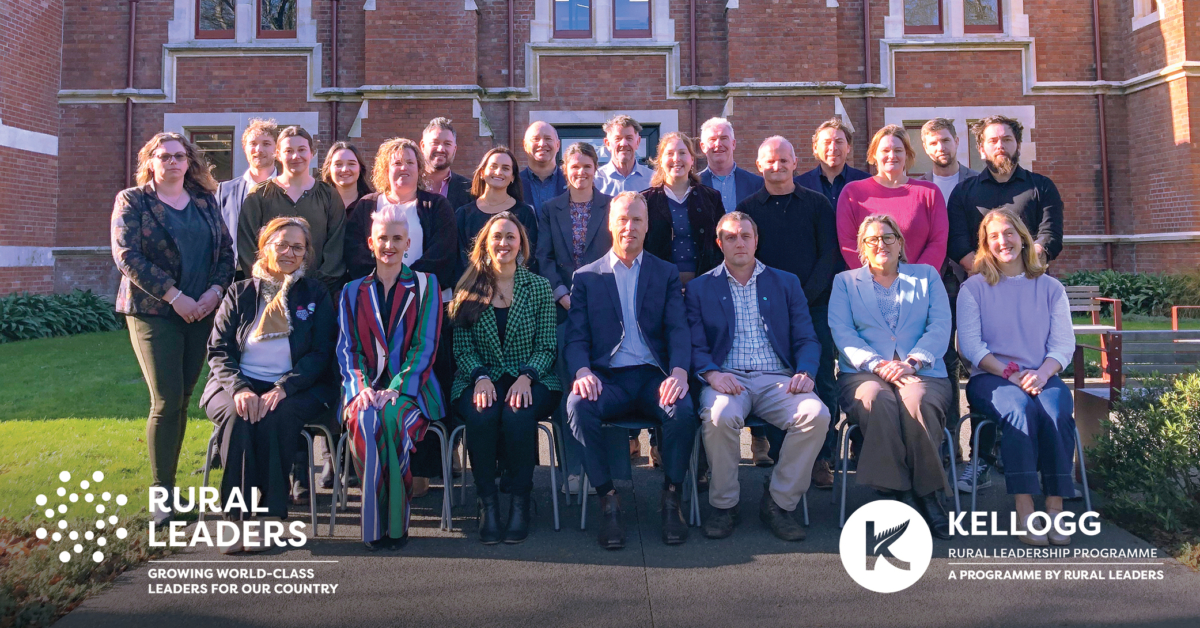
Each of The Kellogg Programme One K55 reports represent extraordinary effort from the scholars. Each explores a topical sector challenge or opportunity and in doing so makes a valuable contribution to the sector.
Collectively, they provide an even more compelling perspective on the opportunities, challenges and capabilities required to strengthen New Zealand’s food and fibre sector.
Across diverse topics including artificial intelligence, succession, governance, animal welfare, food security, Māori agribusiness, workforce diversity, technology adoption and sustainability, a consistent message emerges from this Kellogg cohort:
The future competitiveness of New Zealand agriculture will not be determined by technology alone. It will be determined by the capability of people, the strength of relationships, the quality of leadership and the resilience of the systems that support them.
Innovation features strongly throughout the research, but the reports consistently position technology as an enabler rather than an end goal. Artificial intelligence, digital learning, wearable technologies, genetics, automation and data analytics all offer significant opportunities. However, their value depends on the ability of people and organisations to interpret information, make informed decisions, adapt effectively and maintain trust.
The collective Kellogg research also identifies a fundamental shift in how success is defined. The sector is moving beyond a focus on production optimisation towards a broader model of stewardship, one that balances profitability with environmental responsibility, community wellbeing, cultural identity and intergenerational resilience.
Perhaps the strongest collective message is that trust remains New Zealand agriculture’s greatest strategic asset. Trust underpins export reputation, assurance systems, farmer-adviser relationships, workforce engagement, cooperative models and community confidence.
Protecting and strengthening trust must therefore remain central to future sector strategy.
Taken together, the K55 cohort research suggests that the next era of success will be created through:
Capable people + enabling leadership + trusted relationships + resilient systems + purposeful innovation.
New Zealand’s food and fibre sector is entering a new era where competitive advantage will come not from production alone, but from the ability to combine innovation with capable people, trusted relationships, adaptive leadership and resilient systems.
The future challenge is no longer simply how we produce more. It’s how we build a sector capable of creating enduring value for farmers, communities, markets, whenua, and future generations.
Take a look at the ten collective insights from this cohort’s Kellogg reports below.

1. People remain the sector’s greatest competitive advantage.
Across almost every report, the same conclusion emerges: technology will not replace the need for capable people, it will increase it. Future success requires people who can:
- Interpret information.
- Exercise judgement.
- Build relationships.
- Lead change.
- Collaborate effectively.
- Make complex decisions.
The sector’s future productivity gains will come as much from developing people as developing technology.
2. Technology creates value only when people are ready to use it.
AI, automation, digital learning, sensors and data systems appear throughout the research as significant opportunities. However, the reports consistently identify that adoption depends on:
- Capability.
- Confidence.
- Leadership.
- Practical implementation.
- Trust.
The challenge is not access to technology; it is ensuring the sector has the capability to turn technology into improved outcomes.
3. Leadership is shifting from expertise to enablement.
Traditional agricultural leadership has often been built around technical knowledge and experience. The reports highlight a leadership model based on:
- Developing others.
- Creating psychological safety.
- Facilitating collaboration.
- Navigating uncertainty.
- Supporting adaptation.
The future leader is not necessarily the person with all the answers, but the person who enables others to succeed.
4. Long-term stewardship is replacing short-term optimisation.
Across succession, Māori agribusiness, governance, food security and environmental research, the reports challenge short-term thinking. They highlight the importance of decisions that consider:
- Future generations.
- Resilience.
- Environmental outcomes.
- Community wellbeing.
- Business sustainability.
The strongest organisations will optimise not just for today, but for those who follow.
5. Trust is New Zealand’s most valuable rural asset.
Trust appears as a foundation across almost every report. It enables:
- International market confidence.
- Assurance credibility.
- Strong employment relationships.
- Effective governance.
- Cooperative success.
- Community engagement and participation.
New Zealand’s competitive advantage is not based on scale; it is based on confidence in the integrity of the system.
6. Strong systems outperform individual effort.
Many reports identify challenges caused by relying on exceptional individuals rather than building enduring systems. Future resilience requires:
- Better governance structures.
- Stronger career pathways.
- Improved succession planning.
- Integrated assurance systems.
- Coordinated industry approaches.
- Knowledge transfer.
Sustainable success requires systems that continue working beyond individual champions.
7. Financial capability underpins business resilience.
Several reports identify financial literacy as a critical but underdeveloped capability. This affects:
- Farm succession.
- Ownership transition.
- Investment decisions.
- Profitability.
- Debt management.
The sector needs to increasingly view farming as a business requiring financial capability, not simply an asset-building activity.
8. Diversity will strengthen future performance.
The sector is becoming more diverse:
- Culturally.
- Generationally.
- Professionally.
- Through different forms of leadership.
The reports demonstrate that diversity creates value when supported by:
- Cultural intelligence.
- Inclusive leadership.
- Recognition of different contributions.
- Flexible participation.
The future workforce will require broader definitions of leadership and contribution.
9. Productivity and sustainability are increasingly aligned.
The reports challenge the assumption that environmental outcomes and commercial outcomes compete. Examples include:
- Feed efficiency.
- Genetics.
- Better grazing management.
- Animal welfare improvements.
- Food system resilience.
- Improved resource use.
The strongest future systems will deliver both productivity and sustainability outcomes.
10. Capability development is the sector’s next competitive advantage.
The strongest recommendation across the entire cohort is investment in capability. Priority areas include:
- Leadership development.
- Digital capability.
- Financial literacy.
- Governance skills.
- Cultural intelligence.
- Mentoring.
- Lifelong learning.
The sector’s next breakthrough will come from stronger people making better decisions.
For a closer look at the research of each Kellogg Scholar, head to our cohort landing page here.