2026 Nuffield NZ Farming Scholarship. Apply by 17 August 2025. Read More...

Apply for 2026 Nuffield NZ Farming Scholarship by 17 August 2025. More details...

Once Upon a Time Down on the Farm…

Executive summary

Dairy farmers are being encouraged to tell their story by leaders in the New Zealand dairy industry. This study surveyed opinions from fifteen New Zealand dairy industry and media leaders and discovered a need to share good stories with other farmers to improve uptake of on farm practice, with the general public to improve the social licence to operate and with international markets to create value for dairy products. The science as to why storytelling as a communication tool is so effective in these circumstances points towards creating an emotional connection with the target audience that fuels a hormone induced bond and aids in persuading the audience towards a specific idea or outcome. 

Building a story to create that connection is an art. International experts talk of the story structure, plot, characters, conflict and resolution but the surveyed leaders indicate sharing small snapshots of the farmers’ story is adequate in building the larger New Zealand farming story. Leaders and experts agree storytelling requires the careful consideration of who the target audience is, the formation of a clear, simple message, selective use of emotive language and a creative form of delivery to have the desired effect. In the context of farmers telling their story, it is suggested that farmers use online multimedia through social networks to tell the story that they care about their farm, their families, their animals and their environment.

Cam Henderson, Cameron

Emotional intelligence: Seismic shifts in the primary industry compel whole brain leadership

Executive summary

Enthusiasm and passion for the Primary Industry, and it’s people, ignited an aspiration to understand how the Primary Sector is going to boost human capability to achieve it’s ambitions of doubling export earnings by 2025. Seismic market movements, international politics, technological advances and climate change all contribute to an unsettled and fickle business environment. Increasing complexity requires resilient leaders, and businesses, to be economically sustainable to withstand the challenges we face in the future. Involvement in the Dairy Sector fostered an awareness of the challenges business leaders are facing, particularly in terms of leading a team. Curious to learn more, the purpose of this report is to understand how Emotional Intelligence could influence leadership capability in the Primary Sector.

The capability to manage this level of disruption, presents a management challenge to those who operate in the Primary Sector. The same drivers that have delivered performance are no longer adequate to lead success in the future. Although leadership success starts with a vision, a leader’s performance is dependent on their ability to influence the behaviour of their team. It is about the ability to influence beyond positional power, influencing people to work towards a common goal with enthusiasm. Leaders are challenged to cultivate an environment to build capability, inspire the right behaviour and unlock potential; all characteristics underpinning high performing teams.

Parallels were significant between the literature review and the interview process, undoubtedly supporting my anecdotal views that emotional intelligence is a crucial precursor to exemplary leadership. Fifteen dairy business leaders were interviewed and results were analysed, identifying five key themes. Leaders demonstrating higher levels of self-awareness tended to be people focused, they knew themselves, their capabilities, and limitations. Energised to execute with integrity, they were motivated to build relationships and foster an environment for growing others. In times of disruption, they appeared to be adaptive, resilient, and embraced learning opportunities for themselves and their teams. The five themes identified were as follows:

  1. Prevalent left wired brain approaches are managing the journey with less awareness of the influence that EQ competencies are contributing to business performance.
  2. A disrupted intrinsic compass is inhibiting the growth of our sector. The New Zealand Primary Industry is characterised by industry uncertainty and a lack of emotional and adaptive resilience is influencing the ability to deal with disruption.
  3. Disruption is hindering leaders’ capability to energise and execute effectively. Farmers’ coping mechanism is to dig deep, working longer and harder, losing sight of the rituals that energise, tending to be reactive in their behaviour.
  4. Task focused leadership methods are skewing the ability to build high trust team relationships. Farmers acknowledged difficulty with understanding the diversity of our finger print on the world, the way you see the world is different to the way another person views the world.
  5. Leveraging positional power is impeding the capability to unleash potential and build high performing teams. Conversations with farmers indicated the ‘do as I say and not do as I do” leadership styles are prevalent.

Farmers are passionate about their stock and their pastures. Harvesting the best grass, requires cultivating the best soil for the grass to grow. Breeding the best young stock, cultivating the best pastures, seeking nutrient management advice, and purchasing a big green tractor. These investments all appear to be easily justified. Investment in people, appears to be less of a focus.

People management is indifferent; it is about nurturing the right environment to promote growth. This sets the beat of an organisation. Igniting this type of environment strengthens responsibility and accountability, the potential to increase both productivity and performance. Farmers are proud, and so they should be. It is however this pride and the ‘tall poppy syndrome’ that has been nurtured so well in New Zealand that is inhibiting our ability to lead effectively. Increasing complexity and the rise of the millennial generation will continue to challenge. The best leaders are learners, they are humble when they do not know something and are open to seeking new ideas and processes. Gone are the days where it was thought to be a weakness to acknowledge your shortcomings and seek help.

The pivotal element to drive this change is embracing a whole brain leadership strategy. Building emotional intelligence competencies will aid to engage this holistic attitude.

  1. Lead from the inside out by tuning into the intrinsic compass. To lead others, we must first lead ourselves, to lead ourselves, we must know ourselves.
  2. Energise to execute. Prioritise Personal Power. The ability to ignite enthusiasm, influence and motivate teams will be driven by leaders with significant personal energy, actively valuing themselves, to be the best person possible.
  3. Activate with Purpose. Know your why. A sense of purpose drives feet on the floor every single day. Attract your tribe through a shared value based mindset, igniting the power to shape behaviour.
  4. Pilot the focus. Shift to the blue head. Steering your focus is underpinned by the ability to anchor in disruptive environments, acting with edge to make the tough decisions. Focus is either diverted or on track.
  5. Flex the social filter to tune into the emotional and social atmosphere of your teams. Connect. One size fits all rules do not apply. A distinguishing factor between those who will thrive will be dependent on the ability to understand what makes your team tick, build relationships and care about people. This does not run through the left brain.
  6. Foster a learning climate to unleash potential. Create the right environment for the right behaviours to occur. Fuel the communication through rituals and beliefs that set the beat for the business, the team language shapes the values, values shape behaviour.

New Zealand has the best rugby team. Why? The All Blacks have the best coaches and the best culture. Why? Their actions are underpinned by the belief that leadership is an inside job, it starts with knowing yourself. The Primary Sector can learn from this attitude. The capability to meet the intricacies of an ever-changing business arena and the vision of the Primary Industry for 2025 hinges on fostering a world class learning environment. Learning environments should not only be challenging the intellectual capability but emotional parameters as well if it is to have the opportunity to build a great leader. The obvious barrier is the ability to build on this momentum. Building one’s emotional intelligence will not occur without commitment and effort. A how-to manual will not suffice, this is not for the faint hearted.

I hope this report will stimulate further discussion, both by individual farmers and industry bodies, on the importance of equipping our Primary Sector with the skills to lead from the inside out, adopting a whole brain leadership approach. A determining element is the courage and determination to change. They must want to change. Seismic disruption is an opportunity to lead from the front, high emotional and social intelligence will alter the game. Understanding the intrinsic compass, knowing oneself, is the jumping off point, the key determinant in achieving real change.

Change is unkind to those inflexible in mind. The first to develop a whole brain approach, will do well. The choice is yours.

Farm business strategic planning: A sheep and beef perspective

Executive summary

Farming livestock in New Zealand is becoming increasingly exposed to global and national economic, social, environmental and regulatory trends. Going forward there is increasing pressure from the public and consumers to preserve or ideally improve soil health, water quality and biodiversity, while ensuring that the food we produce is safe and nutritious, animals are treated ethically, and we are reducing their greenhouse gas emissions. Pressure is building towards significant change from the current situation. Sheep and beef farming is not immune to this pressure. 

What will sheep and beef farming look like in 2050; what are the challenges and opportunities farm businesses and communities will face between then and now?

As a farming business, we need to look at where our farming operation is now and make some decisions about where we would like it to be in the future. We need to lift our level of awareness and contemplate how our farm might operate – what it might produce – we need a whole farm business strategy.

There needs to be a definitive “picture” and agreement of how the business owners view success. We then need look at how we best optimise the resources – land, people, animals and infrastructure to achieve that success.

Having a clearly defined business strategy acts like a road map in times of challenge and is an important tool for any business to navigate their way.

This research sets out to define what is strategy, it looks at a snapshot of how strategy or long-term planning is performed in sheep and beef farming businesses today. It makes suggestions as to the key components of strategic planning and proposes a basic template for businesses considering their long-term future.

The motivation to undertake this research assumes that better awareness of the future, and planning for the future is a positive action that will better enable individuals, communities and the wider farming industry to respond to change proactively. It will allow us to seize opportunities that may otherwise have been missed and to sense and manage threats in a more timely fashion.

One of the benefits of strategic planning is a shift in mindset away from issue-specific discussions towards more holistic and long-term planning around the future of farming. With increased awareness and longer term thinking I believe that our industry can evolve and thrive under the care of future generations.

Anna Nelson

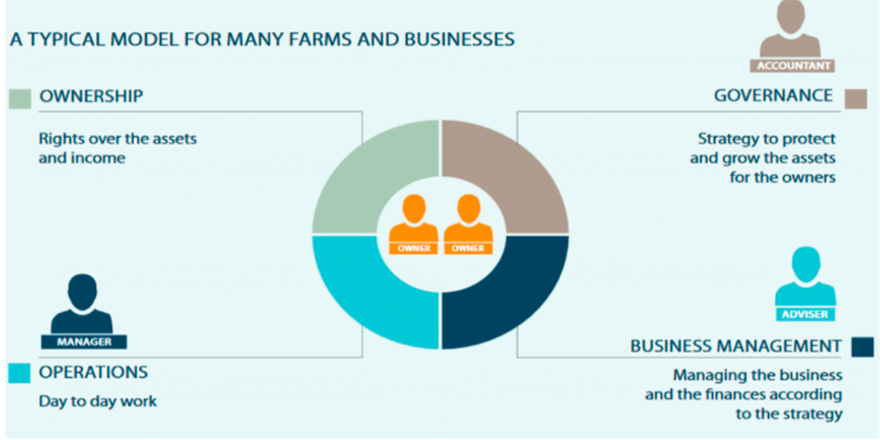
Stepping up to take a step back.

Executive summary

“It’s time I got out of the cowshed. What is the best way to do this?”
Questions similar to this have often come up in my conversations with farmers. The information available tends to be fragmented, focuses on processes and procedures, and more often refers to family succession. While this information is relevant, more targeted information specific to farm owners employing sharemilkers for the first time is harder to find. 

I undertook a literature review focusing on effective leadership in general then I refined my reading to specifically focus on leadership and governance in farming situations.

To gain an understanding of the topic from different perspectives, I carried out 9 semi- structured interviews, with three rural professionals, three dairy farm owners and three sharemilkers. I used the qualitative research method of thematic analysis to identify common themes that were identified as important for a successful change in a farming business structure.

As a result of reading relevant literature on leadership, and interviewing farmers and rural professionals who have experienced transitional farming situations, I believe there are four steps to consider before making such a change to your farming business.

The first step involves taking the time to consider why you want to take a step back and what life is going to look like once you have.

The second step is choosing the right people, who share in your vision, to become part of your farming business. It came through clearly in the interviews that attitude and compatibility are the very important.

Step three is about building a working relationship that is collaborative and long lasting. The ability to see things from the other person’s perspective and strong communication skills develops trust which then helps to facilitate the difficult task of delegating decision making.

The final step covers the advice, training, policies and procedures that are vital to ensuring clarity of roles and a smooth transition from day to day farm management to a governance role.

In my opinion to take a step back you need to step up. This involves becoming an effective leader and being surrounded by good people who share your vision.

Shirley Kissick

What does it take to be a Great Employer in 2016.

Executive summary

The motivation to research what it takes to be a great employer in 2016? stems from the author’s 10-year involvement in the kiwifruit post-harvest sector and an acknowledgment that a number of forces both globally and within the kiwifruit industry have reshaped the employment landscape during this time. The author’s opinion is that the kiwifruit post-harvest sector has experienced a human capability deficit in recent years which has put increasing pressures on current middle and senior managers. While at the same time there has been a shift in employee preferences at a global level. 

This report aims at validating the author’s anecdotal views through a globally focussed literature review and a set of semi-structured interviews of middle and senior managers in the kiwifruit post- harvest sector. Interviewees were asked to define what a great employer looks like, what motivates them and what the greatest challenges to employers within the sector are in becoming a ‘great employer.’

A key finding from the literature review was that technology and generational preferences are having a significant impact on the employer/employee relationship. The literature review was completed using a framework from the NZ Human Rights Commission ‘7 Key Elements of a Good Employer’ and adapted to being more ‘current’ based on findings. The literature review found that employees are increasingly looking to their employer to build their “personal brand”, develop a strong personal relationship with them, offer values and goals alignment, provide them with purpose and consider their wellbeing both physically and mentally through offering flexible conditions and encouraging work-life balance.

At the kiwifruit post-harvest sector level, rapid volume growth, increasing competition among post- harvest operators and increasing sophistication and complexity brought about by the industry’s strong customer focus have contributed to changing the landscape. Managers interviewed indicated that this has placed increased pressures on them. While seasonality has always been a challenge for the industry, the nature of seasonality appears to have changed. Historically, permanent staff were offered a “Work Hard, Play Hard” role where it was well accepted that long hours during a defined period over the harvest and packing season were counter-balanced by flexible work hours over the summer period of lower activity.

The outcome has been that there is a mismatch between findings of the literature review and trends within the post-harvest sector. Employees are looking for greater flexibility in their roles, improved work-life balance and enhanced wellbeing. However, longer work hours and greater stress have been a feature of work within the kiwifruit post-harvest sectors of recent years.

Managers interviewed highlighted the risk the sector faces if the industry is not able to attract talented individuals to the sector via a strong employment brand that is underpinned by more normal work hours and the other desirable features identified through this research as presented in Figure 10.
This report aims to identify what it takes to be a great employer in 2016? And identify what challenges the kiwifruit post-harvest sector faces in becoming a great employer.

Anthony Pangborn

What makes a strong rural community.

Executive summary

The aim of this research was to explore ways to strengthen rural communities in New Zealand. The research focuses on the three small rural communities of Kimbolton, Apiti and Rangiwahia, all located in the northern Manawatu. 

Six households were chosen from each community and invited to participate in the project. The participants were given a survey and interviewed in their homes. The survey questions covered the following things: participants’ understanding of a sense of community, rural change, community facilities and social groups, community involvement, understanding of community governance, and access to technology.

Alongside the interviews, a literature review has been done. This explores the importance of community, the concept of social capital and examines research done into communities facing change in relation to a changing rural environment.

In interviewing the participants, it was evident that community meant more than a physical or geographical location or connection. Everyone involved in the interviews talked about relationships and connections, and supporting community members, i.e. social capital.

Participants were asked to score their own community on a scale from 0 = no sense of community, to 5 = strong sense of community. The scores ranged from 1-4, with the majority sitting around 3. The desire for a strong sense of community was expressed and participants were keen to discuss what could be done to improve this.

It was evident in discussions on community governance, that all communities needed to have a more visible community vision and strategic direction. The foundation for this has been provided by work done on community planning with the Manawatu District Council. The drive now needs to come from within each community.

Participants were asked about rural change over the last ten years, and its effect on individuals and on the community. Relative newcomers to the communities talked about recent changes, while well-established members went back over 40 years to discuss the effects of dramatic change.

The importance of good infrastructure was evident. Good roads, access to fast, affordable internet and reliable cell phone coverage were all deemed essential to the communities’ wellbeing and development. For example, the recent sealing of a country road has made travel easier for residents and has also opened the area for tourist exploration.

All participants were heavily dependent on technology for social interaction, information and research, i.e. Google, business interactions and the ability to access technology for use on farms etc. Several participants talked about access to fast internet being vital in promoting the area to both a domestic and international audience. Several participants felt limited by expensive, and still unreliable, internet in the area.
Cell phone coverage remains a problem in places, particularly out on farms. Safety and ability to communicate for business needs were listed as high concerns.

The smallest community, Rangiwahia, appeared to have the highest social capital and community engagement. This is perhaps because counter-urbanisation is minimal and the community is still predominantly made up of farming families. There are very few lifestyle blocks and minimal urban influence. However, this is a community that is forward thinking, action based, and innovative with a high level of social capital.

The communities with the least cohesion had many transient farm staff and several people looking for very affordable housing and an alternative lifestyle.

The challenge here lies with successfully integrating non-rural community members into a traditional farming community. It is evident that larger communities face perhaps the most complex challenge with diverse individual and community needs.
The conclusion drawn from the research and literature review is that building strong social capital is necessary for a strong sense of community and sense of belonging.

This report concludes with four broad recommendations for actions that can be taken to support and strengthen New Zealand’s rural communities.

These are:

  1. Create Conscious Community – build social capital
  2. Build Quality Leadership – support, train and encourage
  3. Encourage Collaboration – with other local communities
  4. Community Development – social, economic and environmental

The challenge to our modern day rural communities is to embrace change and to continue to evolve. This is required to meet the needs of the 21st Century rural community. For this to be possible, communities need strong leadership, an inclusive and engaged community and the ability to think outside the box.

Katherine Gillespie

What is the most profitable way to harvest asparagus in New Zealand.

Executive summary

As a relatively new asparagus grower, in the Waikato region of New Zealand, I am interested in exploring opportunities within this industry. The harvesting costs in an asparagus business are a significant portion of the total expenditure, so any efficiency gains would provide a direct contribution to profitability. 

There are currently several different methods for harvesting asparagus, all of which involve manual picking of the spears. This project looked at which of the current methods was the most profitable for the New Zealand asparagus industry. Variations include paying staff a ‘per hour’ rate, a ‘per kg’ rate, or combinations of both. Picking methods vary from individuals walking along a row in their own time, harvesting into a bin or container carried on their person; to a team of pickers walking behind a tractor with a 20 metre boom, loaded with crates that they place the spears into as they pick.

The highly manual nature of the harvesting raised the question of what automation options have been considered or attempted in the past, as well as what the potential for this may be in the future.

The interviews held with existing asparagus growers provided a wealth of information regarding the picking process, as well as the potential for automation. The lowest cost system currently in use amongst the interviewees involves paying the pickers $0.87/kg through the entire season. The next lowest cost involved paying pickers a ‘per kg’ rate that varied from $0.85/kg at the start of the season, through to $1.20/kg at the end of the season when volumes were lower. The most costly system paid the pickers $18.00/hr, plus a $0.20/kg bonus for all ‘Class One’ graded asparagus. These costs were adjusted to reflect the wastage through the grading process, and therefore provide a more accurate actual cost per kilogram of saleable product. The results then saw the lowest net cost at $1.31/kg.

Although this assessment clearly showed the lowest cost, the determination of their relative profitability from a long term perspective was much more subjective. This was because each business had a number of unique considerations to incorporate into their decision making process around harvesting costs, for example the age and productivity of a block, access to labour and the typical profile of the labourers. The interviewee’s perspective on the potential for automation was explored and their opinions varied widely, from highly unlikely to occur, to highly likely to occur.

The potential for further study regarding innovative harvesting techniques, by incorporating automation, is significant. The challenge will be in balancing the needs of the growers for a cost effective and easy to use solution, with the research and development costs required to provide that as an appropriate solution.

Tim van de Molen

Starting the family succession conversations

Executive summary

Why is family succession planning an issue we should be concerned about? It comes back to the word family. Family succession planning within the agricultural landscape conquers within, an emotional connection to the land and a cultural identity within New Zealand. There have always been family businesses running farms and there appears to be a strong desire for this to continue long into the future within New Zealand Agriculture. Family succession also deals with the love and affection of those most dear to us and with significant wealth at stake it must be done well for family relationships to be enhanced through the process. 

However when it actually comes to family farm succession, no one size fits all and that is primarily why succession is still discussed, researched, and written about. It has never been an easy conversation to navigate through to the desired outcome with operating environments constantly changing and continuing to evolve. However there are processes that can enable the conversations to occur within the family business to focus them on a desired outcome they can achieve together.
In some cases the terminology of family farm succession is also beginning to change. Being referred to as an ‘intergenerational business model’ and ‘family business continuance’ where the sole concept of asset transfer has broadened to include the transfer of knowledge and experience between the generations (McLeod & Dooley, 2012). This in itself infers a shift in mind set to intergenerational or continuance indicating a natural progression through the generations as opposed to simply succeeding in the family business or a sale of an asset.

Those spoken with and throughout the literature identified numerous triggers for a family succession process to begin ranging from a death in the family, an accident or injury, marriage or divorce, son or daughter wanting to ‘come home’, age and stage, someone asking the family the question of succession, through to business opportunities being identified which require a succession conversation. The trigger point will vary depending on the family situation. Once identified by the family as a priority the process can begin and conversations initiated to determine the way forward. Key attributes contributing to the success or otherwise of the process is a commitment and good will to see an agreed outcome achieved. This will often require patience and perseverance along with mutual respect for all involved.

Communication was identified time and time again underpinning the succession conversations because this is where and how the process has to begin. Addressing the ‘icebergs’ within the family business is about clearly articulating a number of often unspoken expectations, aspirations, assumptions, concepts such as fairness and equality and ultimately what the vision of the family business actually is. The part of communication which is often forgotten is the ability to listen and respect each person’s contribution and opinion to the conversations as the process unfolds. As George Bernard Shaw stated “The single biggest problem with communication is the illusion that it has taken place”.

Starting early often yields the best outcome for the family as time allows identified issues or concerns to be raised and addressed before it is too late. Dr James Lockhart points to the Dutch as an example of how to begin the conversations around family business governance. He indicates this should start from an early age discussing family business matters around the kitchen table. As the family grows and develops keeping the family involved in planning meetings and discussing the future helps to shape business principles and future conversations about their place in the business or what the future may hold. The family is exposed to the process of sharing ideas, listening and discussing plans for the current business and its future. By discussing the family business from a young age, siblings are exposed to business processes and skills which are required when it comes to more formal discussions around family succession planning.

What became clear from interviews with professionals and farmers is that strategic business planning is an area of running a family business that is not given enough priority. Rather time is spent working in the business but not on the business. The planning process involves disciplined time set aside to think about and plan for the future needs of the current business. Thinking through where are we now and where do we want to be with a plan of how to achieve that. Prioritising business planning enables a step towards succession conversations as this should come up within these planning sessions as the future is discussed. Encouraging business planning and governance principles within a family business is an important enabler for a strong platform for succession conversations to begin from.

Ultimately the outcomes of a family succession conversation will be determined by the family, for the family, as success will look different to every business. Following a structured process to succession planning which is led by a strong chair or independent facilitator to navigate a series of conversations, interviews and family meetings can enable this to occur and an outcome achieved rather than being put off or put in the too hard basket.

It is for the family to decide together what they want to see happen in the next phase of the family business cycle, how they determine that to occur, when the transfer will take place and why they want that to be their future.

Nathan Nelson

Improving Maori capability to make decisions for the development of Maori land.

Natasha Clarke-Nathan Kellogg report image

Executive Summary

This report outlines research conducted to identify how Maori decision making capability can be improved to increase the development of Maori land and to recommend ways to support that capability.

The research identifies how historical Maori decision making frameworks enabled Maori to develop their land collectively as a tribal people. It describes the key differences of historical frameworks to the current legislative Maori Land Trust frameworks provided in the Te Ture Whenua Maori Land Act 1997 and the constraints to progressing Maori land development.

The research highlights that historically Maori worked collectively as inter-dependents and how legislative frameworks that today promote individualism, have disbanded this collective ability. Individualism is established with the appointment of trustees who to some degree act independently on behalf of their land owners. The research identifies this as a key deferent to the development of land. The handing over of authority and decision making from the owners to trustees presents a risk or threat to the owners. This has contributed in the loss of Maori land development.

The results of the data analysed and tests of additional processes and thinking techniques present opportunities to reinstate the collectivised approach to developing land as Maori practiced historically – pre European contact.

The report finds that the application of additional processes can improve land owner participation and the application of thinking techniques can mobilize the development of Maori land and encourage new styles of thinking for Maori.

The recommendations of the report are for further testing and refinement of the process and for the process to be tested in other sectors (outside Primary Industries).

The dream that made us.

Executive summary

When looking at people and culture, it is difficult to use traditional academic processes to understand how we see the world, and how we think and feel. This is because the influences on humans tend to be more around emotions, rather than logic. Traditional academic process has been around logic or critical thinking, and this has served us well but I have strayed away from this discipline to explain the emotion behind our culture. 

I have chosen to deliver this paper in way that can explain the perception or the emotion of our culture – The Culture of Dairy Farming. I have also written this paper so a dairy farmer that reads this paper can easily follow the information. I have used the story telling approach to allow the reader to relate to different perspectives. The hope is to allow for a solution to develop by having a better understanding of different people’s perspectives. 

I have relied on comments and perceptions from interviewees to explain an agricultural perspective. I have also conducted a survey of dairy farmers to understand how they see or think about their work and life.

Stuart Taylor