By Anna Seccombe for AWDT.
When we sat down with Professor Hamish Gow, one thing became clear almost immediately: New Zealand’s food and fibre sector holds far more value and opportunity than we may realise.
For more than 35 years, Hamish has worked across the world helping producers, processors, and agribusiness leaders understand how value is truly created and captured. Yet the patterns he saw 30 years ago are still showing up today. As he told us, “Most people talk about value-add, but they don’t actually understand how value is created in the final marketplace.”
And if we don’t understand how value is created, how can we position ourselves to benefit from it?
So, what is a value chain, really?
Before we can rethink value, we need to be clear about what the definition of a value chain is.
A value chain is the full pathway your product travels; from farm to consumer, and the way every step along that pathway adds (or erodes) value. It includes the people, decisions, systems, and relationships that transform what you grow or produce into something a customer ultimately chooses to buy.
Importantly, a value chain is not just a supply chain.
A supply chain moves product.
A value chain creates value and determines who captures it.
As Hamish puts it, every farm business is part of a value chain whether we acknowledge it or not. Our challenge as leaders is to understand the discipline of the chain we’re selling into, and whether it aligns with where we want to take our business.
Three ways value is created
Hamish frames value creation through three core models, providing a clear and accessible framework for agribusinesses:
- Operational Excellence
Built on scale, efficiency, and consistency. The classic commodity model: the truck arrives, product leaves, and price is set by the market. - Product Leadership
Where superior genetics, IP, or technical performance set a business apart. Zespri is an example everyone knows: a world-leading product that customers actively seek out, leaving retailers with no choice but to stock it. - Customer Intimacy
Where value lies in solving a very specific problem for a very specific customer. Rocket Apples didn’t just sell fruit, they sold a healthy, safe, portable snack into places where good fresh food was hard to find.
Each model is valid. Each can be successful. But each requires its own discipline, investment, and alignment. The problem, as Hamish sees it, is when farmers, processors, marketers, and policymakers all assume they’re playing the same game, when they’re not.
Seeing the whole chain, not just our own parts
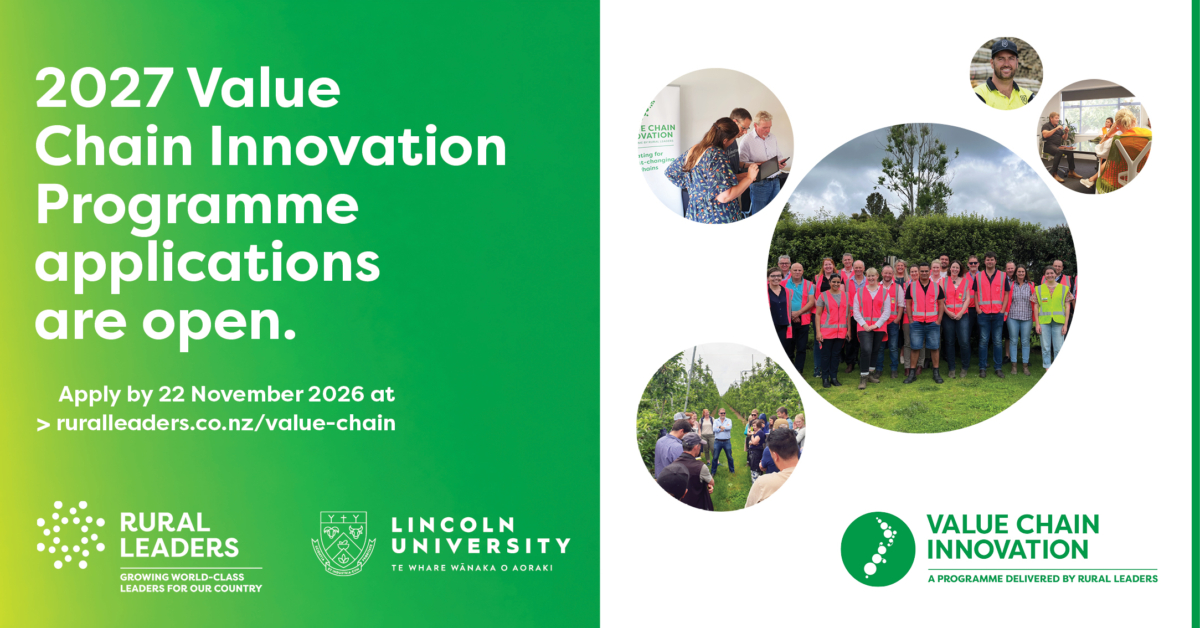
As we talked with Hamish, he spoke passionately about the programme he and the New Zealand Rural Leadership Trust have developed: the Value Chain Innovation Programme.
It’s a week-long, immersive experience designed to help producers, processors, sector leaders and emerging leaders truly understand how different value chains create, capture, and return value.
Participants don’t just hear about value chains, they walk them. They visit dairy, red meat, horticulture and niche customer-focused models, seeing firsthand how decisions flow and where value is created along the way.
But the real learning doesn’t happen in the factory or the packhouse.
It happens on the bus.
On the bus, people test assumptions, and debate. They connect the dots between industries. They wrestle with discomfort as they let go of long-held beliefs. And as Hamish told us, some even consider walking off on day one, only to have breakthrough moments on subsequent days.
Because when you finally see how another sector creates value, you cannot unsee it in your own.
And that’s why this programme is so powerful.
Leadership is alignment
At AWDT, we often talk about leadership as clarity and self-awareness; knowing what matters, what you stand for, and where you want to go. Hamish’s work reinforces this at a sector level.
Understanding your value chain is ultimately about alignment:
- Aligning your business with how your value chain creates and captures value.
- Aligning your investments (time, money, energy) with the model that fits your goals.
- Aligning your relationships with business partners whose disciplines reflect your own values.
- And, for leaders, aligning your organisation around a shared understanding of “the game we are playing.”
A challenge for every producer and leader
Whether you’re farming, processing, advising, or shaping policy, you’re part of a value chain. And you deserve to understand the forces shaping your place in it.
So, we leave you with the most important question to ask, and one Hamish poses on every programme:
Do you know how your value chain creates value, captures value, and returns it to you?
If the answer is “not fully,” you’re not alone. Most people discover how much they don’t know only once they start asking.
But that’s also where the opportunity lives.
Because once you see the whole chain – not just your part in it – you gain the clarity, confidence, and strategic insight to lead with purpose in a sector that desperately needs it.