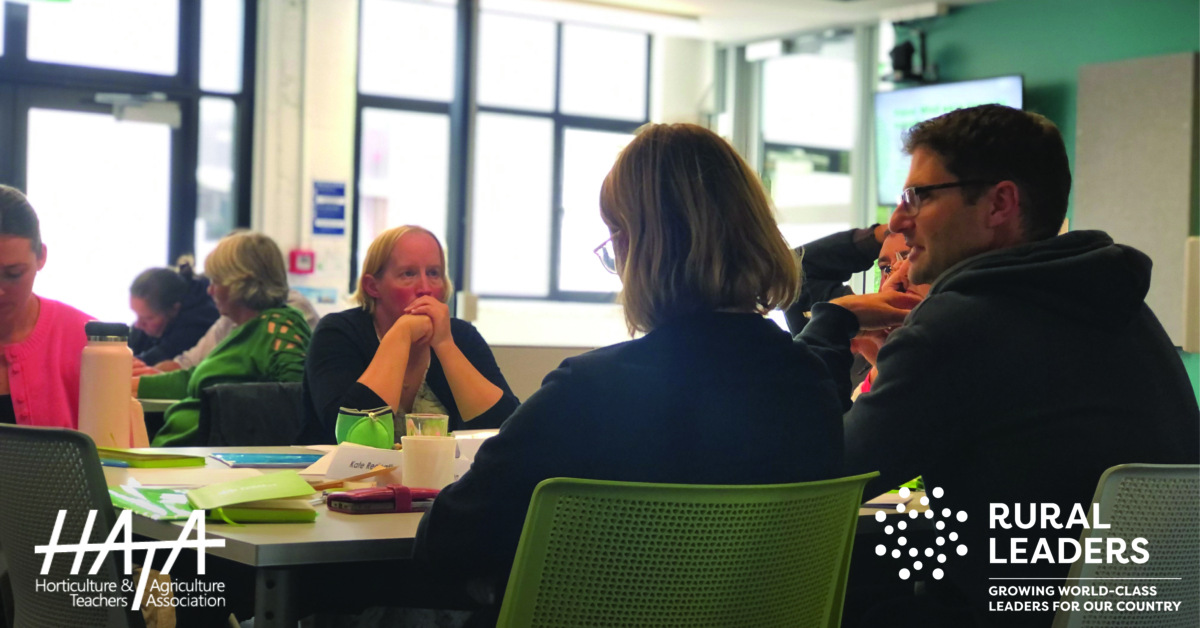
Over two inspiring days, the Agri Educators Leadership Programme brought together 18 passionate teachers from across Aotearoa.
New Zealand’s agricultural and horticultural industries have long depended on a strong pipeline of young people entering the workforce. Increasingly, that pipeline begins not on farm, but in the classroom. And right now, the teachers responsible for sparking that interest are being asked to do far more than teach.
Across the country, Agricultural Science and Horticulture teachers are navigating curriculum uncertainty, rising student demand, and a shortage of specialist colleagues. At the same time, they are working to shift outdated perceptions of the sector and keep pace with rapid change in sustainability, environmental management, climate change, and agri-technology. It is a complex brief, one that now requires leadership as much as teaching skill.
From a curriculum perspective, uncertainty continues to shape delivery. Ongoing debate about whether agricultural and horticultural science sits best as an academic discipline, vocational pathway, or hybrid model has created instability in programme design and long-term planning.
Despite strong industry demand for skilled graduates, only a small proportion of secondary students nationally currently take agricultural subjects, with access particularly limited in urban schools.
Workforce constraints add further pressure. A shortage of qualified specialist teachers means programmes often rely on a small group of experienced educators, while non-specialists are increasingly asked to step into unfamiliar content areas. This creates uneven delivery and places additional strain on those leading programmes.
In response, the Horticulture and Agriculture Teachers Association (HATA) has launched the Agriculture Educators Leadership Programme, designed and facilitated by Lynsey Stratford (Primary People and 2021 Nuffield Scholar) and delivered by the New Zealand Rural Leadership Trust (Rural Leaders).

The programme brought together 18 teachers from across New Zealand, each identified as having the potential to strengthen not only their own programmes, but the wider direction of agri-education.
For rural producers and agribusiness leaders, this matters. These educators strongly influence how the next generation perceives the primary sector, its relevance, its science base, and its career opportunities.
The programme focused on building practical leadership capability. Participants developed a personal leadership plan, explored behavioural preferences, and learned how to improve communication, influence, and decision-making. A strong emphasis was placed on self-awareness and how leadership style impacts others in real-world settings.
Kate Redpath, Agriculture Science Teacher at Stratford High School in Taranaki, highlighted the practical value of tools for both workload and communication:
“The Eisenhower Matrix around time management and identifying which task needs to be completed in the moment and which can be done later in order to reduce pressure. DISC profiles and understanding the ways that different communication styles can have an impact on the way that you like or dislike different communication styles, being open to these and considering how you can adjust yours to meet the needs of other people.”
In school environments, where teachers move constantly between curriculum leadership, student engagement, and external partnerships, this adaptability is critical.
Redpath also pointed to a broader leadership insight:
“I really enjoyed the talk from Hamish Marr, the previous Special Agricultural Trade Envoy, around how a lot of things around the world are done in similar ways, it is the scale and location that differs. I think this can be applied to education and agriculture in the sense that we all have different resources, challenges and environments, but we can achieve the same outcomes, we just need to do it in slightly different ways.”
For many participants, the most powerful outcome has been connection. Isaac Lovatt, Biology, Science and AgHort Teacher at Bay of Islands College, described the impact of working alongside peers nationwide:
“The value of collective engagement and connections with other passionate Ag Educators … sharing and getting inspiration and ideas from different regions from right across the country. This gives energy and motivation to keep doing what we are doing.”
He was equally clear on the value of the programme itself, and would encourage others in the profession:
“Definitely go for it! The value of learning more about yourself and your own leadership tendencies is super valuable for growth and team development. But more importantly, doing it with like-minded Ag teachers from different locationsand contexts is inspiring.”
That sense of professional connection is echoed by Kirsten McIntyre, Agriculture Science and Agribusiness Teacher at Blue Mountain College in Otago:
“The Disc Personality test showed my strengths and weakness as a person and how best to use the knowledge of personality to get the best out of your team.”
For McIntyre, the biggest takeaway was the strength of the national network:
“There are some amazing agriculture teachers around New Zealand and it was cool to connect with them and learn from what they are doing.”
For HATA, the intent is clear. Building leadership capability among educators is essential if teachers are to lead curriculum development, support non-specialist colleagues, form strong industry partnerships, and advocate effectively within schools.
In turn, this helps lift programme quality, reduce isolation, and strengthen student pathways into the primary sector.
At a time when agriculture is facing workforce shortages, increasing complexity, and rapid change, the Agriculture Educators Leadership Programme represents a targeted investment in one of the sector’s most influential leverage points, the educators shaping perception long before students ever reach the farm gate.
Because ultimately, the future of New Zealand agriculture is not only grown in paddocks and orchards, but in the classroom, where it begins.