
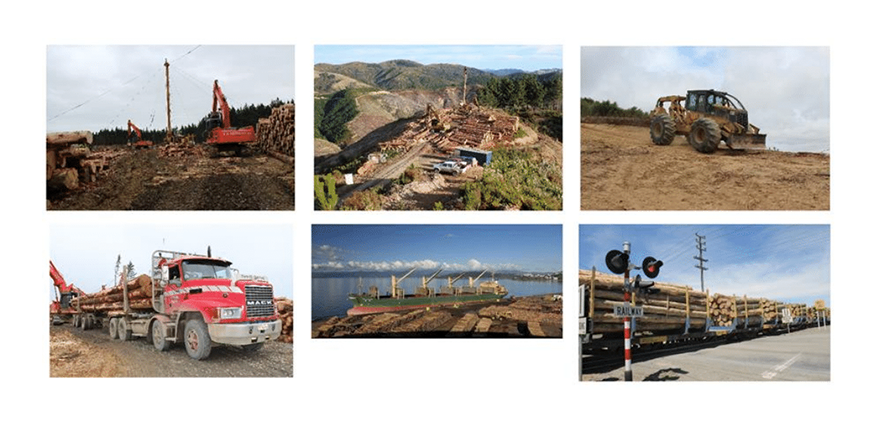
The catch phrase “Wall of Wood” is approaching reality with the substantial increase of afforestation in the mid-1990s coming to maturity and ready for harvest in the coming years. The Eastern Southern North Island (ESNI) was no exception in this new afforestation with the reported area of plantation forestry more than tripling from 20,500ha in 1993 to 66,500ha by 2003.
This report sets out to determine what the status is of the current forestry and woodproducts infrastructure of the ESNI. Then to ascertain whether this capacity is sufficient to meet the growing needs of the future radiata pine resource.
A survey was compiled to obtain the harvesting capacity of the forestry companies within the ESNI region. They were asked to provide their current daily harvesting capacity and forecast their harvest volumes over the next 10-year period.
The domestic mills and log cartage companies were also questioned regarding their capacities.
The yield volume was calculated using the 2018 National Exotic Forest Description (NEFD) for the area of radiata pine plantations and overlaid with the MPI yield tables from 2015 for the ESNI. The minimum target age for harvest was set at 28. A total yield volume was calculated for all radiata pine plantations that reach the age of 28 within the period of 2019-2028. The area of plantations that made up the yield volume was evenly spread over the 10 year period to make a non-declining yield based on the fixed average annual area of harvest.
The forestry companies harvesting capacity sits at 1.97 million m3 and is forecast to increase to 2.25 million m3 in the next 3 years. The analysis concluded that these forecast volumes are the more accurate figures to use in forecasting the woodflow for the region. Though these volumes are less than the calculated yield the forestry companies can be confident that there is enough volume to meet their planned harvesting capacity. The forecast volumes can now be used by the log cartage companies and export traders to help forecast their capacity requirements.
The analysis concluded that there are insufficient markets for domestic pulp that give a positive return. The industry has to make the decision whether to remove this pulp from harvesting sites at a cost or find an alternative market for this product.
Further analysis is required to determine the absolute limit of the annual capacity at the Napier and Wellington ports. Both ports have noted record annual throughput of logs but how much further can they go?
The analysis has shown that there are potential errors in the total area documented in the NEFD. This is predominately around the modelling and recording of the small scale forest areas. Remote sensing has had proof of concept confirmed in identifying small scale forests. As technology improves this should be a vital tool to use for the NEFD data collection.
Scott Andrew