Following the New Zealand Government’s announcement to include agriculture into the ETS by 2025, He Waka Eke Noa has proposed two primary initiatives to measure and manage carbon emissions in the agriculture sector at the processor and/or farm level. For farmers to measure and manage their carbon footprints there must be a robust system in place to calculate not only their carbon dioxide emissions, but also their carbon dioxide sequestration potential.
This research report will focus on answering the question of; what is the carbon sequestration potential of indigenous woody vegetation on New Zealand farmland and how can it be used to more accurately model on-farm carbon footprints?
Key findings
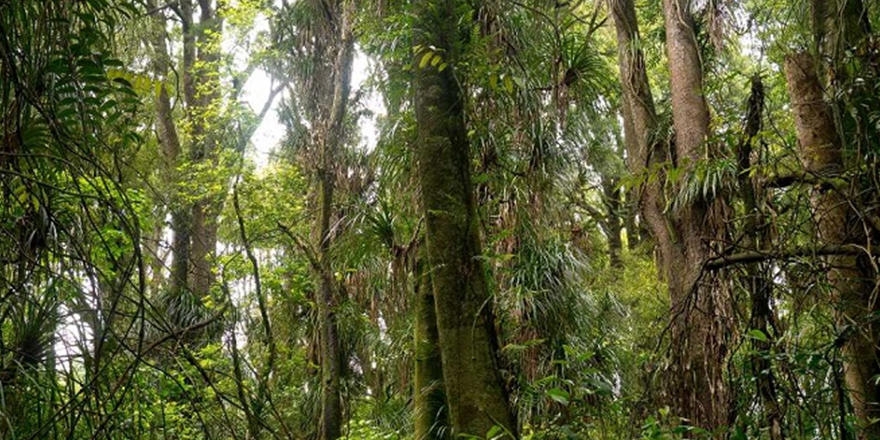
- The opportunity for indigenous carbon sequestration on New Zealand farmland is significant, with approximately 2,000,000 hectares of indigenous forest and shrubland existing.
- The carbon sequestration potential of indigenous woody vegetation is largely understudied. This was particularly evident in the lack of research completed on the carbon sequestration potential of indigenous forest and shrubland that is typical of New Zealand farmland; naturally regenerating, and restorative, mixed species compositions.
- Current ETS policy does not provide measures for landowners to accurately model the carbon sequestration of indigenous woody vegetation typically found on farm. This is specifically for landowners wanting to enter forest land less than 100ha which under policy they must use the MPI carbon look-up tables to calculate.
- Current ETS policy limits the actual on-farm carbon sequestration occurring within indigenous woody vegetation with its ‘forest land definition’. It has been noted that feasibly, the only factor in the ‘forest land definition’ that could be changed would be the requirement to have trees that are 5m or more in height.
Recommendations
- Agriculture industry to prioritise extensive, nationwide research on understanding the carbon sequestration rates of indigenous woody vegetation, particularly of mixed species composition indigenous regeneration and restoration forest and shrubland on farmland.
- Agriculture industry to use this research to develop a robust model of indigenous carbon look-up tables that captures the common categories of woody vegetation on farmland. It may be that this is species specific for the large, more studied conifers, but it should also accommodate mixed species forest and shrubland scenarios typical of indigenous regenerating and restoration on farmland. This should also include a category for key indigenous scenarios growing below 5m in height, such as matagouri, Coprosma, Hebe, and riparian plantings. The current MPI look-up tables should be kept and used for calculating the sequestration of manuka and kanuka only.
- MPI’s ETS policy of ‘forest land definition’ should be changed to allow indigenous forest and shrubland species less than 5m in height to be included. This may be that it is provided as a special case to the agriculture industry.
- Once robust carbon look-up tables have been developed, MPI’s ETS policy which states that forests equal to or over 100ha should have its threshold area increased (e.g. to 500ha) before Field Measurement Assessment (FMA) is required, or one step further, have FMA as optional.
Sam Mander