Listen to this episode of Ideas that Grow, or click on one of the platform icons below to listen on your favourite player:




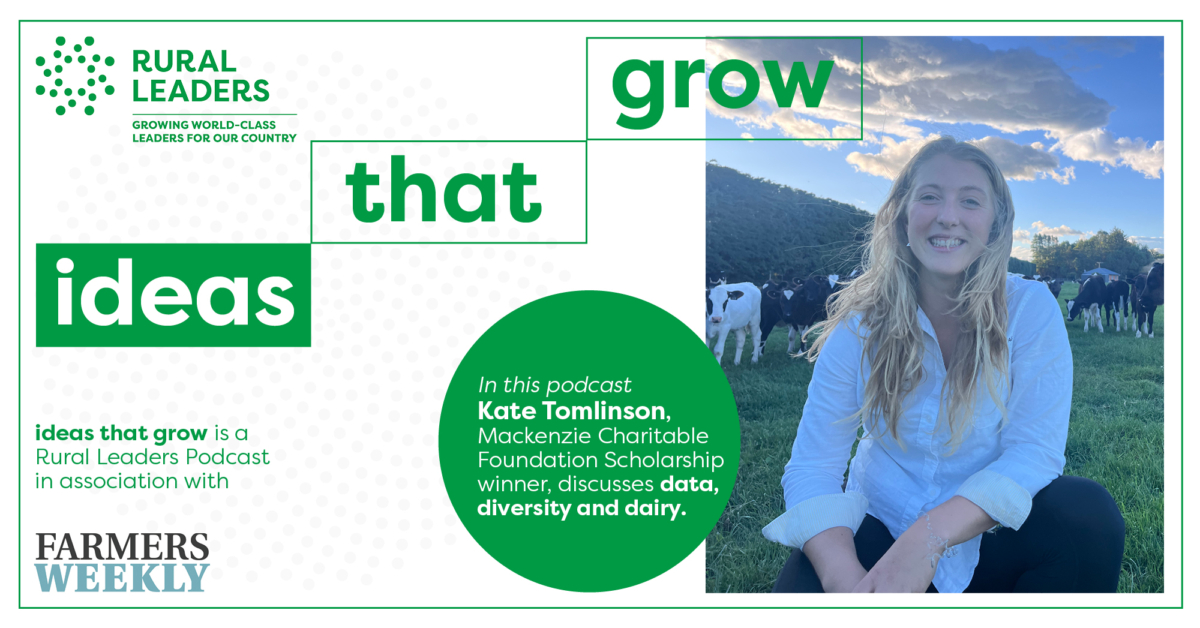
2026 In this Ideas that Grow Podcast, Kate Tomlinson, 2026 Mackenzie Charitable Foundation Scholarship winner, talks to Bryan Gibson Managing Editor at Farmers Weekly, and shares her journey from a UK farm to New Zealand, where Kate now blends practical farming with sustainability and data insights in her role with Map of Ag.
As a current Kellogg Programme scholar, Kate is set to research cultural diversity in Canterbury’s dairy workforce. This podcast highlights curiosity, a global perspective, and the value of structured leadership development in shaping future rural leaders.
Episode Transcript
Bryan Gibson, Managing Editor Farmers Weekly, 2025 Kellogg Scholar.
You’ve joined the Ideas That Grow podcast, brought to you by Rural Leaders. In this series, we’ll be drawing on insights from innovative rural leaders to help plant ideas that grow so our regions can flourish.
Ideas That Grow is presented in Association with Farmers Weekly. Welcome to Ideas That Grow, the Rural Leaders podcast. I’m your host, Bryan Gibson, Managing Editor of the Farmers Weekly.
This week, our guest is Kate Tomlinson, who is a current member of the Kellogg Programme. Kia ora, Kate, how are you?
Kate Tomlinson, Current Kellogg Scholar (2026 Prog. One), Agricultural Sustainability Analyst Consultant at Map of Ag.
Hello, I’m really good. How are you?
BG: Yeah, really good. So it’s not often on the podcast we get to talk to someone who’s right in the middle of it. You’re in the 55th cohort, I think. Is that right?
KT: Yes.
BG: You’ve been through phase 1 of the programme. For those who don’t know, there are 3 quite in-depth contact courses involved in Kellogg, and the first one is the longest and it’s quite intense. Tell us a little bit about yourself. Where’d you grow up? Has farming always been part of your life?
KT: Yeah, so as you can probably tell from my accent, I’m not from Methven originally. I live in Methven, Mid Canterbury now, but originally I’m from a beef and sheep farm in County Durham in England, but moved to New Zealand a couple of years ago.
I was on a sabbatical and like the trap that New Zealand is, ended up wanting to stay longer and I’m now on path to residency. So really exciting. And yeah, farming, it’s always been part of my life, always been, I’d say, in my blood.
It’s my family, it’s my friends, it’s my work, it’s what I do on my weekends off when I just need to get outside. And you know, sometimes … it’s nice to get back and just do something I know how to do. So it’s everywhere, everywhere. It’s kind of, who I am, I’d say.
BG: You currently work for Map of Ag, so you’ve kind of gone from the simplicity of farming to the technology of farming. You’ve run the full spectrum.
Current work at Map of Ag.
KT: Yeah, it’s really interesting and it’s a brilliant place to work. It did take me a while to settle in and to understand. It’s very dynamic. Our HQ is in the UK. We have a base in New Zealand and Australia, and we cover so many different areas of work.
At the core of it, it’s all about data integrity and insights, but it’s almost like a spectrum, and the things that we can be looking at within that. Animal health, animal welfare, antibiotic use, sustainability, greenhouse gas, biodiversity. It’s very varied.
So, I joined about a year ago, and it’s been really cool to spend some time with the UK team. I’m part of the global sustainability team, so I get to cheque in and see what’s happening on that side of the world. And more often than not, it’s bringing it back to this side of the world and saying, these guys are doing this. It’s a cool place to work.
BG: What sort of path did you travel to get, you know, from growing up on a farm to being immersed in farm data?
KT: Yeah, it’s not your usual pathway, but what is, really? I went to an agricultural university in the UK called Harper Adams University. I was studying to be a rural chartered surveyor. Do you know Cheerful Charlie? Cheerful Charlie from Clarkson’s Farm?
BG: I don’t, but I suspect many of their listeners do.
KT: Yeah. Okay. So if you bring Charlie to mind, he is Jeremy Clarkson’s advisor. So when Jeremy Clarkson’s like, “I’m going to buy a pub”, and old mate is stood next to him like, “hmm, Jeremy, we need to consider this bit of legislation. What is the cost associated with this?” Blah, blah. So that’s what I was training to do in the UK. A farmer has their accountant, their solicitor, and a rural chartered surveyor, their land agent.
I went to uni for 4 years to study, and then following that, spent 3 years getting qualified as a rural chartered surveyor, providing all sorts of advice. A lot of it is looking at legislation, identifying threats, looking at opportunities, covering not just agriculture, but the business itself and the land that it’s sat on.
Often there’s a farm with residential properties, and commercial opportunities. So that’s where I began. But the desire to come to New Zealand, particularly to farm, was very strong. And after 7 years of battling it out to get qualified, I was very keen to spend some time actually farming. And so I came to New Zealand and I did a bit of dairy farming, as many people do from the UK, on their working holiday visa.
I quickly decided I wanted to do something that was similar to what I was doing before, and I’ve just hopped, skipped, and jumped between farming and a bit of research work at Lincoln Uni or working in an agribusiness type environment, which has eventually led me to this role. Which is having a farmer’s brain, the sustainability knowledge from the UK.
A global perspective on data.
BG: You’ve got a unique perspective, I guess, on the differences and similarities between how farmers here and in the UK use data and how important it is. Is it similar?
KT: Yes and no. I guess from this context, when you look at the UK versus Australia and New Zealand, often you’d see in the UK that providing data to your bank or whoever it is who’s requesting your data, particularly when we’re working with supermarkets or suppliers, it might be a requirement of being part of that supply chain.
Here, I’d say it’s less so, and sometimes it’s what is the value to providing that data? So that’s definitely one of the bigger differences. But on both sides of the world, it is like, how do you make that data the most useful it could be for the farmer? Especially as we’re entering an era where there’s so much of it.
Kellogg research – cultural diversity in Canterbury’s dairy workforce.
KT: Not data, which was my original project, but actually I’m looking at something I noticed straight away when I landed and was working on farm. That was the cultural diversity of Canterbury’s dairy workforce. I’ve never worked on a farm with an all Kiwi team. I’ve worked on farms with Nepali, Sri Lankan, Filipino, Indian, South American, British, Irish.
It’s such a diverse place and I found it such a fun environment to work in. You know, one of the guys would be bringing one of the bobbies to the shed, and then next thing you know, we’re talking about his banana farm at home, or you’re learning something else.
I visited Nepal a couple of years ago, so I was speaking to my Nepali neighbour, and I just wanted to explore it further. I wanted to know what’s been happening in the last 10 years, what kind of trends are we seeing? What does that mean going forward?
But particularly how are teams thriving and what challenges might arise from that diversity of team? And does it actually matter at all, or is it personality? That’s what I’m investigating.
BG: Yeah, that’s really cool because the research will tell us that diversity of thought leads to better outcomes as long as the structure they’re in is for purpose. But of course, there are real challenges on even as basic as language, social beliefs, that sort of thing, you know, expectations around family, just like getting stuff done every day can be more of a challenge with people who don’t go about their day in the same way.
KT: Yeah, yeah. And I have a bit of a story that resonated very strongly with me, which hopefully I’ll share, and you tell me if it makes any sense to you, because if not, I’m going to scrap it for the use of my presentation at the end of Kellogg.
There’s a story of a big fish, and the big fish is swimming along, having a great time, and the big fish sees two little fish and says, hey, little fish, how’s the water? And the two little fish are like, what the hell’s water? For me, me moving to New Zealand, you know, we are like cousins basically. And some of the things you guys do, I’m like, we are so different.
I’ve been here a couple years now, and you get to see the water, the water being the world that you live in, the social expectations that are normal, the transparency of people in New Zealand, the fact that there is no hierarchy. Those are things that when you’re living in it the whole time, you might not see. But if your staff have come from completely different ponds with their own invisible things, I could imagine it can be quite jarring.
From some of the (research) interviews, that’s been something that I found as well. Effing and swearing for example. It might just be an expression, but to some people who’ve come here, swearing is against religion and it means so much more, as in, you know, the only time someone swears was when they might try and attack you.
If you’ve just moved to New Zealand and your boss is, ah, “just effing good, put that (whatever) over there”. So, it’s things like that which I’d be quite interested to see about as well.
BG: I’m a fan of that story. It’s used in David Foster Wallace’s famous inauguration address, I think.
KT: Yeah, thank you for quoting him.
BG: And so the Kellogg Programme as a whole, I mean, why did you want to sign up?
Why do the Kellogg Rural Leadership Programme?
KT: A few different reasons. I think as a person, I’m very curious about the world, about myself. I’d be quite an introspective kind of person, and in the UK we have Nuffield Scholarships, which there are quite a few more widely available. And as soon as I came to New Zealand, I could see that Kellogg was something that I could access sooner rather than later.
I really wanted to get on it from that kind of self-journey thing, but also to understand and see New Zealand through a different, more structured lens. Especially obviously agriculture, rather than me just being like, how can I build my knowledge of this country in the agricultural industry and go and work here, go to this talk and try and build it myself.
This is a structured programme that has given me access to things and people that I would never ever have had access to, especially coming up and heading to Wellington. I might sound very naive, but politics doesn’t cross my mind very often and it should. So I’m at a point in my life where I’m like, come on Kate, come on, and I think this is going to be the stepping stone I need.
It’s an environment that I thrive in, which is having people who are interested, and then you can build the energy and you can talk about it, and then it clicks, rather than just constantly by yourself trying to piece it all together.
The Kellogg cohort connection
BG: Alongside the learning programme, it’s the cohort of people you’re in who are all on the same journey, which is a big part of the experience, isn’t it?
KT: Yeah, I love them all. Shout out to them all. And we’ve only spent 10 days together.
BG: You know, everything else is, um, going well in terms of the programme? You’re, positive about the whole thing, I can hear.
KT: Yeah, I mean, at what point should I be worried? I mean, a little bit I am worried about the deadline creeping up for getting our projects in. I actually have never experienced time moving this fast in my life, but yeah, really positive.
It’s been great to keep up the connections with the people in the cohort from Phase 1. I recently went to go visit one of the girls who came down south, and it’s just interesting that we’re doing the same thing and we’re so open to ideas and helping each other. Yes, this is still positive. Ask me that in another month. It’ll be fine.
BG: You know, that’s all I can say. It’ll be fine. You know, good luck for the rest of the programme and no doubt as a Kellogg alumni, we’ll be hearing from you again in the wider world of farming again.
KT: Oh yeah, thank you very much.
BG: Thanks for listening to Ideas That Grow, a Rural Leaders’ podcast presented in Association with Farmers Weekly. For more information on Rural Leaders, the Nuffield New Zealand Farming Scholarship, the Kellogg Rural Leadership Programme, the Engage Programme, the HortNZ Leadership Programme and the Value Chain Innovation Programme, please visit ruralleaders.co.nz