Listen to this episode of Ideas that Grow, or click on one of the platform icons below to listen on your favourite player:
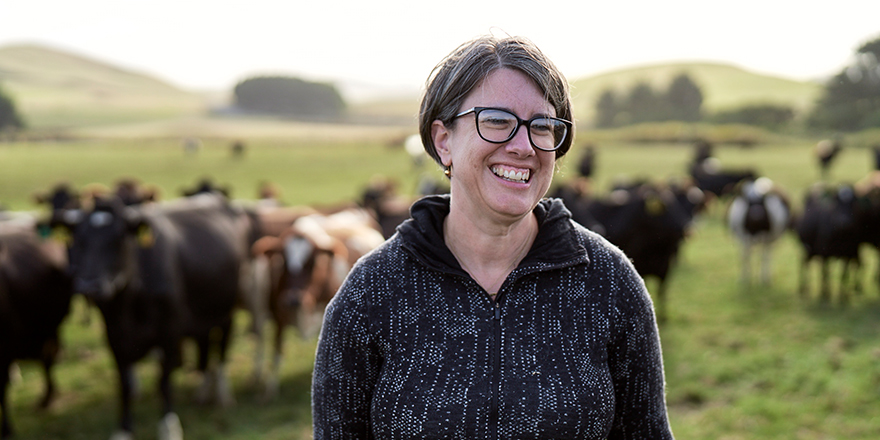
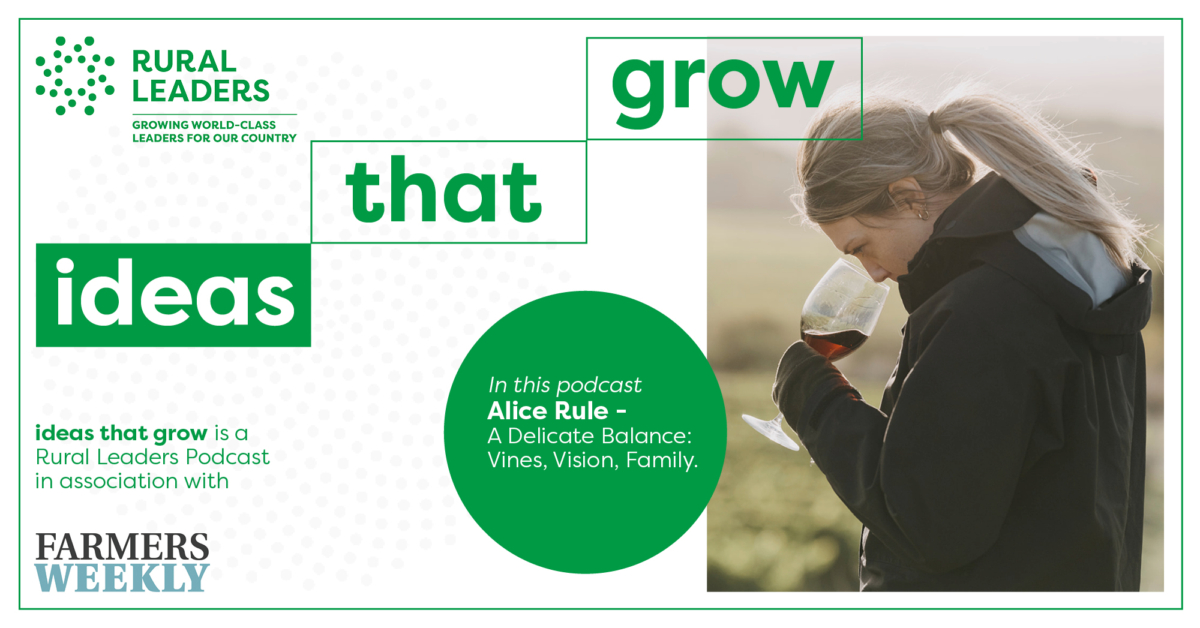
In this Ideas That Grow Podcast, Alice Rule, Hawke’s Bay winemaker and 2019 Kellogg Scholar, talks to Bryan Gibson about her journey from a Bay of Islands farm to the wine industry.
Alice discusses her circular glass economy research, leadership lessons from Kellogg, and balancing entrepreneurship, rural advisory work, and family amid uncertain wine markets.




Episode Transcript
BG: Bryan Gibson, Managing Editor of Farmers Weekly:
You’ve joined the Ideas That Grow podcast, brought to you by Rural Leaders. In this series, we’ll be drawing on insights from innovative rural leaders to help plant ideas that grow so our regions can flourish.
Ideas That Grow is presented in Association with Farmers Weekly. Welcome to Ideas That Grow, the Rural Leaders podcast. I’m your host, Bryan Gibson, Managing Editor of the Farmers Weekly.
This week, we are talking to a Kellogg scholar, Alice Rule. Kia ora Alice, how are you?
AR: Alice Rule – Winemaker/Owner, Rural Advisor and 2019 Kellogg Scholar:
Kia ora. Thank you for having me. I’m good.
BG: You were part of Kellogg Cohort 40 in 2019?
Background and the journey to winemaking.
AR: Yeah, that was me. I was actually pretty lucky to get on there that early. They normally have huge waiting lists.
BG: And you’re in the Hawke’s Bay. Is that where you grew up?
AR: No, I grew up on a dairy sheep and beef farm in the Bay of Islands. A wee while away, but I moved to the Hawke’s Bay in my teens to get into the wine industry. I’ve always based myself here, even though I’ve done several vintages elsewhere. We just bought our forever home here. Yeah, this is base.
BG: Growing up on a farm, what caught your eye about viticulture?
AR: Grape growing really appealed to me because you don’t have to get out of bed so early in the morning. Poohed on by cows, that’s pretty relentless. As much as I love that farm life, I thought grapes would be easier, but on the flip side, potentially, in many respects, much, much more difficult.
The wine industry, I think from an outsider, looks very glamorous. It looks sexy. You see all these beautiful photographic images and videos of these swooping vineyards. But actually, behind the scenes, there was a lot of hard work that goes in day in, day out, and those vintages, they’re pretty gruelling.
BG: What part of the winemaking process did you want to be involved in, specifically?
The wine industry context.
AR: I took quite an unconventional approach in that I didn’t actually really specialise in either viticulture or winemaking. Initially, when I first started out, I did a lot of lab work in the wineries, did a lot of cellar work, and then I got into the vineyards because I understood there was this real big disconnect between the understanding on what’s happening in the winery and what was happening in the vineyards.
If anyone in the wine industry will know that there’s often tensions between the two, especially over harvest. I thought I’ll get into the vineyards, and I acted as a technical viticulturist for many years. But balanced that with my first year of winemaking vintages too. A lot of people would choose a discipline, either winemaking or viticulture or marketing in business, and just stay doing that. But that was never mine. Mine was actually far more broad.
BG: You’ve moved away from, specifically, the wine making business into a broader rural advisor role?
AR: Everyone will know that the wine industry is quite a challenging place to be. It has been for quite some time, really. I started exporting in COVID and was lucky enough to get into four international markets. At that time, the business was doing really well. Those four markets were keeping the business going. I was making really good money, but it wasn’t a full-time job for me.
I got into Rural Advisory and worked with a lot of farms on the East Coast. This was post-cyclone Gabrielle, and helped with them. The business has always kept on ticking in the background. I haven’t lost my love for it.
It’s just a plus because at the moment, it’s quite a frightening place to be, really. Producing with markets as uncertain as they are. I’ve been there, and I’ve recently had twin babies, they’re now toddlers. My risk appetite just isn’t there anymore. I’ve got to choose some security, so that’s why having a job as well as this is what I’m doing at the moment.
On Kellogg.
BG: It’s been a few years since you did the Kellogg Programme. What attracted you to it?
AR: I was actually quite young, and I’ve listened to quite a few of these podcasts, and there was quite a few people suggesting and recommending doing it later on. Get life experience and business experience.
I had a mentor, and he linked me up with Lawrence Yule, actually. Lawrence said, Listen, Alice, if there’s one thing that you need to do right now, it is get on to the Kellogg Rural Leadership Programme. I didn’t at the time, know a lot about it. I followed his advice, and they let me onto the programme much sooner than what I anticipated, and all the stars aligned.
Reflecting back, that was the best thing that I could have done. For me in my career and where my business was at the time, the best thing that I could have done. Timing was perfect, and I would have been maybe in my late 20s.
BG: Every Kellogg Scholar needs to plough their way through a research report. You did yours on the circular economy of glass?
Kellogg research into glass sustainability.
AR: Yeah, I did. At the time, I couldn’t afford to do Kellogg, so I got a sponsorship through the Glass Packaging Forum and AGMARDT. Thanks to those guys for enabling this opportunity, big shout out.
It was a good opportunity to get behind the hood of what happens with glass in New Zealand once we’ve finished with it, the importance of recycling, what happens in councils where they co-mingle and they have dirty glass is an example, and the huge carbon benefits of actually recycling colour to a basically smashed up glass.
BG: A lot of people, I guess, they enjoy a bottle of wine. They chuck it in the green bin or whatever you’ve got it in your region. Truck takes it away, and you don’t really think about it anymore, do you?
AR: No, you don’t. It’s actually quite a complex system in that there’s only one, or at the time that I did the research, there was only one place that would actually harvest all of this glass. It was all deposited in one place.
We only had one major glass manufacturer, OI. They just recycle and re-melt this down, and that reduces emissions quite significantly because you can re-melt at much lower temperatures than virgin material materials.
It was quite cool. I got to go through the plant and see how it was all collected and the challenges and the waste and the dirtiness of systems where glass isn’t recycled properly. Got to look at the councils that were doing an amazing job, and Tauranga Council was being one of the leaders in that space. Hugely complicated supply system for just glass, but cool thing to research. Very grateful.
BG: The cool thing about doing these research projects is, as you say, you get out there and see stuff happening which is what your work is relevant to, but you also meet a lot of people and ask a lot of questions.
AR: Loads, like New Zealand Wine got involved, our advocacy team. They peer reviewed my report. They pushed it through the sustainable wine growing, and that opened up doors and got me onto the technical advisory group for SWNZ (Sustainable Winegrowing New Zealand).
Back then, it was amazing. But again, this is all Kellogg, really. The connections, the learnings, the interactions. It’s not a research project that sits in a drawer.
BG: What about all the other bits of the Kellogg Programme? You have those three and a half weeks in intensive contact with your cohort being bombarded with information, really. When you’re doing it, it does seem a bit overwhelming. How did you find it?
Kellogg leadership skills and being anchored in your values.
AR: It was actually so good. We were really lucky to have such a strong cohort. Like any of my cohort that will be listening to this will agree with me. We are in regular contact. We have got such a strong, and I’m so grateful for that, so many different walks of life. But again, a huge bow of people to become Sounding boards.
I guess another really amazing thing is the people that we managed to meet along the way. They’ve become firm friends. Julia Jones is another example. She’s become the most amazing mentor for me over the years. It just opened so many opportunities.
BG: We’ve talked about the research opportunities that the Kellogg Programme gives you, and of course, the cohort and the connections you make there. But of course, it is a leadership programme. Could you tell me some of the key leadership tools you took out of it?
AR: That’s a cool question. Something that really stood out for me is the amount of confidence that I got out of the programme. It just equips you with so many tools. For me, I was a business owner at the time, and I’ve now moved into a rural advisory capacity. I look at leadership as being more than just a job title.
I’m looking at leadership as being grounded and who you are, owning your values, something I will not compromise on. That comes with this confidence. You get that confidence when you are surrounded by such amazing people and you have been given these opportunities by high performance coaches. That would be a key principle.
I think, it is just being anchored in your values.
I walked away from my MBA at the very last minute because I was anchored in those values. They wouldn’t let me do my dissertation or my research in sustainable business. I had that confidence to say, I’m not here for letters after my name. Catch you later. I’m going to do my dissertation on sustainable land use. I’m just going to do that.
Equally in the workplace, just having the courage to walk away from ongoing disrespect, I think that is leadership. To be trusted and respected and be that voice that people want to pick up the phone and call you, that to me is leadership. It takes time, and Kellogg plays a big part in that.
BG: That’s great to hear. It sounds like you really took a lot out of the programme.
AR: I did. Thank you.
Thanks for listening to Ideas That Grow, a Rural Leaders’ podcast presented in Association with Farmers Weekly. For more information on Rural Leaders, the Nuffield New Zealand Farming Scholarships, the Kellogg Rural Leadership Programme, the Horticulture NZ Leadership Programme, the Engage Programme and the Value Chain Innovation Programme, please visit ruralleaders.co.nz.